REVIEW 3 major objections 5 minor 5 cited by
The ubiquity of variable radio emission and spin-down rates in pulsars
T0 review · 3 major / 5 minor · reviewed 2026-08-10 · deepseek-v4-flash
Pith's one-line read Most isolated pulsars do not spin down steadily: 238 of 259 show significant spin-down variability, and the fluctuation amplitude grows with spin-down rate.
desk verdict Large, carefully built catalogue whose headline 92% variability rate rests on an uncalibrated GP threshold; the scaling relation is plausible but inherits the risk. read the letter →
The pith
A machine-rendered reading of the paper's core claim, the machinery that carries it, and where it could break.
The reading
What carries the argument
The load-bearing object is the K-metric, $$K = \frac{|\dot{\nu}_{\rm min}| - |\dot{\nu}_{\rm max}|}{2\sigma_{\dot{\nu},\,{\rm mean}}},$$ computed from Gaussian process fits to timing residuals; K > 1 marks a pulsar as variable. Gaussian process regression with squared-exponential kernels (and Matérn kernels for profile variability maps) produces continuous spin-down and profile models from unevenly sampled observations, while Bayesian information criterion model selection decides between one or two kernels and a fixed one-year sinusoidal kernel used to absorb positional offsets. This machinery lets the authors measure fluctuation amplitudes, search for correlations between profile changes and spin-down, and test scaling relations against spin, spin-down rate, characteristic age, and magnetic field.
What would settle it
Run the same Gaussian-process and K-metric pipeline on simulated timing residuals that contain only white noise and the same observation times as the 259 pulsars, and count how many simulated objects cross K > 1; a non-negligible false-positive rate would mean the 92% variable fraction is inflated by the method rather than by the pulsars.
Extended reading notes
Core claim
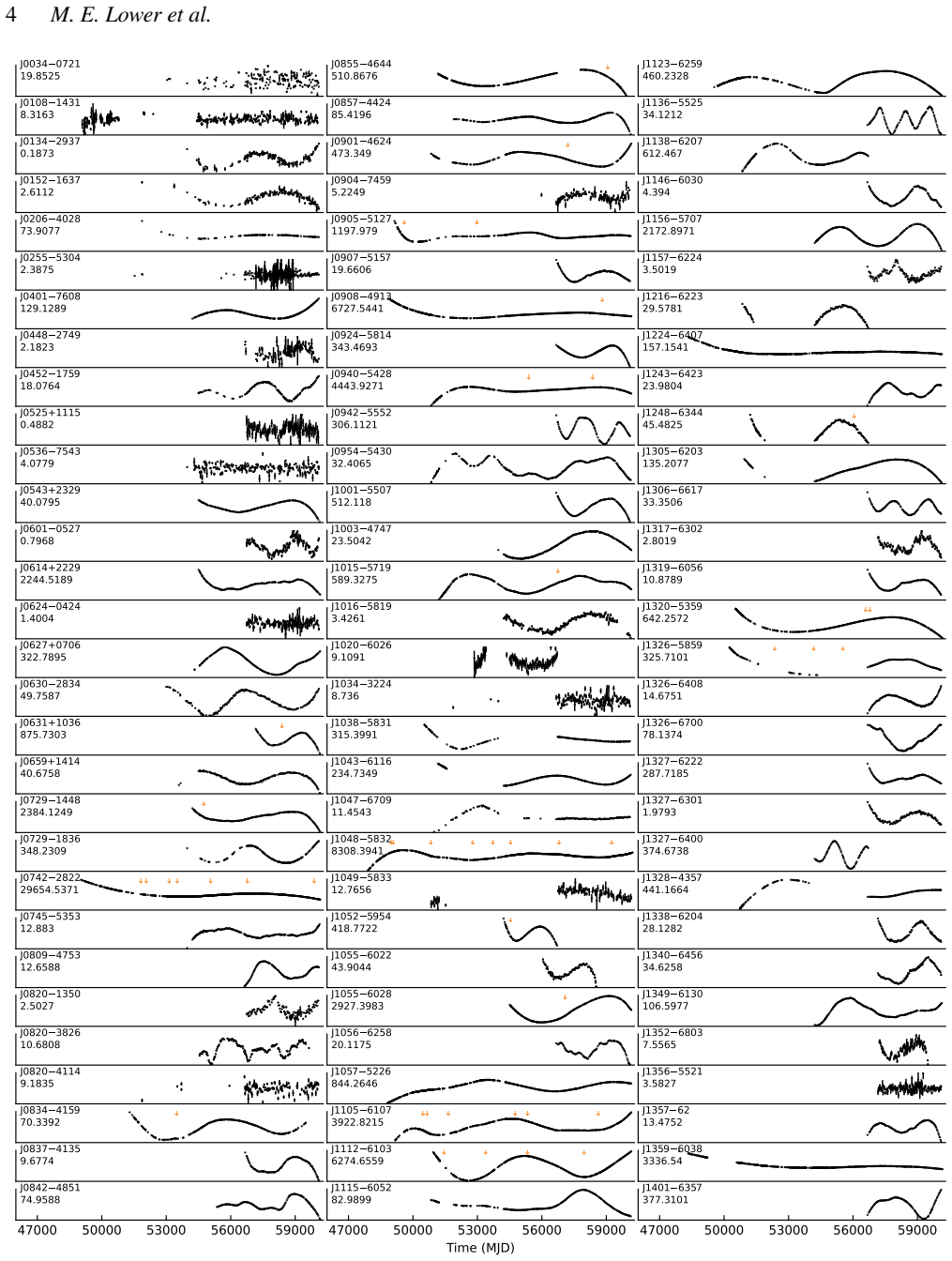
On its own terms, the paper claims that 238 of 259 isolated, non-recycled pulsars display significant spin-down variability as measured by the K-metric (K > 1), and 52 of those also show substantial changes in pulse profile shape. The fluctuation amplitude follows the relation $\delta\dot{\nu} = 10^{-4.5 \pm 0.5}\,|\dot{\nu}_{\rm weak}|^{0.85 \pm 0.04}$, with only a marginal dependence on spin frequency ($\nu^{-0.18 \pm 0.17}$). This is the largest catalogue of variable pulsars to date, and the authors interpret it as evidence that these behaviours are ubiquitous among the broader pulsar population. They also find that quasi-periodic spin-down modulations in 45 pulsars do not follow the scaling expected from free precession, and that 68 transient spin-down events in 26 pulsars imply frequent interactions with small bodies if interpreted as asteroid impacts.
Load-bearing premise
The classification of 238 pulsars as variable assumes that the K-metric, with its K > 1 threshold and no injected-noise false-positive test, separates genuine spin-down variability from artefacts caused by imperfect glitch recovery, annual positional sinusoids, and receiver changes.
Editorial extensions
If this is right
- Spin-down variability is common enough that the steady-clock assumption for isolated pulsars needs revision in population studies.
- The amplitude scaling $\delta\dot{\nu} \propto |\dot{\nu}_{\rm weak}|^{0.85}$ predicts detectable spin-down fluctuations in millisecond pulsars, where timing-array noise models currently use red power laws.
- The same Gaussian-process pipeline can be applied to other long-term timing data sets to enlarge the variable-pulsar catalogue.
- Quasi-periodic modulation periods scattered across $P$, $\tau_c$, and $\dot{E}$ fail the free-precession scaling relations, strengthening magnetospheric state-switching as the driver.
- Transient spin-down events, if caused by asteroid impacts, imply that debris discs and asteroid belts around pulsars should be common.
Reading between the lines
- If the scaling relation extends to millisecond pulsars, timing-array analyses should include an explicit spin-down fluctuation term; standard red-noise models will absorb part of it and can bias the inferred gravitational-wave background amplitude.
- The 52/238 profile-change fraction is likely sensitivity-limited by per-epoch signal-to-noise and pulse jitter, so longer integrations should reveal more shape-changing pulsars even if the spin-down result is unchanged.
- Because K > 1 was set without injection-based false-positive calibration, re-running the pipeline on synthetic noise-only data would directly test the 92% detection rate; until then, the ubiquity claim rests on the assumption that glitch-recovery and positional artefacts are negligible.
- A natural next test is to monitor the 45 quasi-periodic pulsars for phase drift or state changes; stable periods over decades would keep a geometric clock such as precession viable, while drift and switching would favour magnetospheric reconfiguration.
Signed reviews
Editorial analysis
A structured set of objections, weighed in public.
Referee Report
Summary. The manuscript applies Gaussian-process regression and Bayesian inference to roughly 30 years of Parkes (Murriyang) timing data for 259 isolated, non-recycled pulsars, and claims that 238 of them show significant spin-down rate variability under a K>1 criterion, with 52 also showing profile shape changes. It derives an empirical scaling relation δν̇ = 10^(-4.5±0.5) |ν̇_weak|^(0.85±0.04) with only marginal spin-frequency dependence, and discusses implications for pulsar timing array searches, quasi-periodic variability, and planetesimal interaction scenarios.
Significance. The paper is potentially important because it assembles the largest catalogue of variable pulsars to date and, if the central claims hold, establishes that spin-down instability is common across the isolated pulsar population rather than confined to a few notable objects. The long-baseline Parkes data, the use of public data products, and the explicit Bayesian framework for the scaling fit are strengths. However, the headline detection rate rests entirely on an uncalibrated K-metric threshold; without a false-positive quantification, the ubiquity claim and the fitted power law are not yet established. The paper is therefore promising but requires a validation step before the central claims can be accepted.
major comments (3)
- [3.3, Eq. (4)] The K>1 criterion is not calibrated against a null hypothesis. The paper states 'We used a threshold of K > 1' but does not report the false-positive rate of this threshold for noise-only data, for data with imperfectly removed glitch recoveries, or for data with annual positional offsets, both of which are acknowledged as sources of spurious ν̇ variability in Sections 3.1 and 3.3. Because K is computed from the extrema of the Gaussian-process second derivative divided by the GP predictive uncertainty, smooth excursions can appear in pure noise while model-selection and hyperparameter uncertainties are not included in σ_ν̇,mean. An injection study that reports the fraction of K>1 pulsars expected by chance, for white noise and for simulated glitch-recovery and annual-position signals, is required to support the 238/259 claim and the scaling relation in Eq. (7), which is fit only to the selected pulsars.
- [3.3, model selection] The kernel selection procedure combines BIC with unspecified visual inspection. The text says 'on occasion we had to make by-eye judgement calls when one model visually matched the data better than another in spite of the reported BIC.' This subjective step is not quantified: the number of pulsars affected, the criteria used, and the reproducibility of the decisions are not reported. Since the choice of one-kernel, two-kernel, and annual-sinusoid models directly shapes the ν̇ timeseries and hence K, this selection uncertainty should be propagated or at least enumerated.
- [5.1, Eqs. (5)–(9)] The scaling relation is fitted only to the 238 K>1 pulsars and treats δν̇ as known data. However, δν̇ = |ν̇_min| − |ν̇_max| and |ν̇_weak| are both outputs of the same Gaussian-process fit, so their uncertainties are correlated and model-dependent; the likelihood in Eq. (6) adds a single scatter σ_Q but does not propagate the GP posterior covariance. Given the selection-threshold issue in Eq. (4), the reported index 0.85±0.04 and spin-frequency exponent −0.18±0.17 in Eqs. (7) and (9) should be presented as conditional on the detection method, with an additional sensitivity analysis excluding marginal K values.
minor comments (5)
- [5.4, Eq. (13)] The rate calculation uses 27/260 pulsars, but the sample is 259 and Section 4 reports 238/259; please reconcile the denominator.
- [Tables A1 and A2] The tables contain inconsistent notation (e.g., missing minus signs in several exponents and 'e' notation such as '7.1𝑒+ 01'), which makes verification difficult.
- [4.2 and Conclusions] Section 4.2 mentions 'another 28 pulsars' while the Conclusions state '29 pulsars for which we describe the links ... for the first time'; the counting should be clarified.
- [3.3] The equations for the GP predictive variance from Brook et al. (2016) are not reproduced; since the K-metric denominator is central, a brief summary of those equations would help the reader assess the significance metric.
- [Figure 3] The labels give δν̇/|ν̇| without error bars; adding typical uncertainties or a note on how σ_ν̇,mean varies would make the K>1 selection easier to evaluate.
Circularity Check
No significant circularity: the scaling relation is an empirical fit, but the K>1 significance definition is internally calibrated and the uncertainty denominator is self-cited.
-
self definitional
[Section 3.3, Eq. (4)]
"This ‘K-metric‘ is given by K = (|ν̇min|−|ν̇max|)/(2σν̇, mean) ... where ν̇min and ν̇max refer to the minimum and maximum inferred absolute spin-down rates derived from the Gaussian process regression, and σν̇, mean is the mean spin-down uncertainty computed via equations 9 and 10 of Brook et al. (2016). We used a threshold of K > 1 for defining when a pulsar displayed substantial spin-down variability."
The paper defines 'substantial spin-down variability' as K>1, so the abstract's statement that '238 pulsars display significant variability' is by construction the number of pulsars with K>1; no injected-noise or false-positive test is provided to show this threshold separates physical variability from artifacts such as imperfect glitch recovery or annual positional offsets. Additionally, the uncertainty denominator comes from self-cited equations 9 and 10 of Brook et al. (2016), a prior paper with overlapping authors, rather than from an independent calibration. This is a definitional and validation coupling rather than a circular derivation of the main fitted result, so it is minor.
full rationale
The central quantitative claim, δν̇ = 10^(−4.5±0.5)|ν̇_weak|^(0.85±0.04), is obtained by fitting the Gaussian-process-inferred fluctuation amplitude against the Gaussian-process-inferred weak spin-down rate; this is an empirical fit, not a circular derivation, because neither quantity is defined as the other, even though both arise from the same GP model. The profile-variability and spin-down correlation analyses are likewise data-driven. The main circularity-adjacent issue is the K-metric threshold: 'significant' is defined as K>1 with the uncertainty from self-cited Brook et al. (2016) equations, and the paper explicitly acknowledges that glitch-recovery residuals and annual positional offsets can create spurious ν̇ variations. These are validation gaps (no false-positive-rate calibration) rather than examples of a fitted parameter being renamed as a prediction. I therefore assign a score of 2 for a minor self-citation and definitional coupling, not for a circular derivation.
Assumptions & free parameters
free parameters (5)
- K-metric significance threshold =
1
- Power-law scaling parameters of delta_nu_dot versus |nu_dot_weak| =
xi = -4.5 +/- 0.5, b = 0.85 +/- 0.04 (Eq. 7)
- Spin-frequency exponent a =
-0.18 +/- 0.17 (Eq. 9)
- Additional scatter sigma_Q =
not tabulated
- Per-pulsar Gaussian process kernel hyperparameters =
Table A1 (sigma_1, lambda_1, sigma_2, lambda_2, sigma_N)
assumptions (6)
- domain assumption The second derivative of the Gaussian process timing residual model is a faithful estimator of intrinsic spin-down variability.
- domain assumption The K > 1 threshold reliably separates variable from stable pulsars without false-positive calibration.
- domain assumption The P574 sample is representative enough to support population-wide ubiquity despite a bias toward high-spin-down-energy and Fermi-target pulsars.
- domain assumption Glitch recovery and annual positional sinusoids are sufficiently corrected so that residual artifacts do not dominate the detected spin-down variability.
- domain assumption Canonical neutron star parameters and the dipole spin-down formula apply for asteroid mass inference.
- domain assumption C-type asteroid density of 1.57 g cm^-3 applies to the inferred planetesimal radii.
Cite this review
Pith. "Pith review of The ubiquity of variable radio emission and spin-down rates in pulsars." pith.science (2026). https://pith.science/paper/L4TEY5CR
@misc{pith2026250103500,
  author       = {Pith},
  title        = {Pith review of: The ubiquity of variable radio emission and spin-down rates in pulsars},
  year         = {2026},
  howpublished = {\url{https://pith.science/paper/L4TEY5CR}},
  note         = {Machine review of arXiv:2501.03500}
}
read the original abstract
Pulsars are often lauded for their (relative) rotational and radio emission stability over long time scales. However, long-term observing programmes are identifying an increasing number of pulsars that deviate from this preconceived notion. Using Gaussian process regression and Bayesian inference techniques, we investigated the emission and rotational stability of 259 isolated radio pulsars that have been monitored using Murriyang, the Parkes 64 m radio telescope, over the past three decades. We found that 238 pulsars display significant variability in their spin-down rates, 52 of which also exhibit changes in profile shape. Including 23 known state-switching pulsars, this represents the largest catalogue of variable pulsars identified to date and indicates that these behaviours are ubiquitous among the wider population. The intensity of spin-down fluctuations positively scales with increasing pulsar spin-down rate, with only a marginal dependence on spin-frequency. This may have substantial implications for ongoing searches for gravitational waves in the ensemble timing of millisecond pulsars. We also discuss challenges in explaining the physical origins of quasi-periodic and transient profile/spin-down variations detected among a subset of our pulsars.
Figures


Figures from the paper (8 more)


Forward citations
Cited by 5 Pith papers
-
Gamma-ray Pulsar Emission is Mostly Stable on Timescales from Minutes to Years
A matched-filter search of 115 gamma-ray pulsars finds no confirmed flux state changes from minutes to years and limits most flux variations to under 10%.
-
Observation of discontinuities in the periodic modulation of PSR B1828-11
Bayesian comparison of spin-down models finds three discontinuities in PSR B1828-11's ~500-day modulation, all occurring before the glitch, with a natural-log Bayes factor of 1486.
-
Understanding the Neutron Star Population with the SKAO Telescopes
SKAO AA* and AA4 surveys are projected to discover thousands of ordinary pulsars and ~800–1000 MSPs, enabling population synthesis, mass measurements and tests of gravity and emission physics.
-
The SKAO Pulsar Timing Array
An SKAO PTA with ~174 millisecond pulsars can dominate nanohertz GW sensitivity within four years and enable continuous-wave detections plus anisotropy maps of the gravitational-wave background.
-
Probing Neutron Star Interiors and the Properties of Cold Ultra-dense Matter with the SKAO
SKAO's sensitivity, surveys and sub-arraying will deliver tighter NS mass, MoI, spin, glitch and precession constraints that, with X-ray and GW data, probe cold ultra-dense matter.
Reference graph
Works this paper leans on
-
[2]
Agazie G., et al., 2023b, @doi [ ] 10.3847/2041-8213/acdac6 , https://ui.adsabs.harvard.edu/abs/2023ApJ...951L...8A 951, L8
-
[3]
Akbal O., G \"u gercino g lu E., S a s maz Mu s S., Alpar M. A., 2015, @doi [ ] 10.1093/mnras/stv322 , https://ui.adsabs.harvard.edu/abs/2015MNRAS.449..933A 449, 933
-
[4]
Ambikasaran S., Foreman-Mackey D., Greengard L., Hogg D. W., O'Neil M., 2015, @doi [IEEE Transactions on Pattern Analysis and Machine Intelligence] 10.1109/TPAMI.2015.2448083 , https://ui.adsabs.harvard.edu/abs/2015ITPAM..38..252A 38, 252
arXiv 2015
-
[5]
Ashton G., et al., 2019, @doi [ ] 10.3847/1538-4365/ab06fc , https://ui.adsabs.harvard.edu/abs/2019ApJS..241...27A 241, 27
-
[6]
C., 1970a, @doi [ ] 10.1038/228042a0 , https://ui.adsabs.harvard.edu/abs/1970Natur.228...42B 228, 42
Backer D. C., 1970a, @doi [ ] 10.1038/228042a0 , https://ui.adsabs.harvard.edu/abs/1970Natur.228...42B 228, 42
-
[7]
Backer D. C., 1970b, @doi [ ] 10.1038/228752a0 , https://ui.adsabs.harvard.edu/abs/1970Natur.228..752B 228, 752
-
[8]
Backer D. C., 1970c, @doi [ ] 10.1038/2281297a0 , https://ui.adsabs.harvard.edu/abs/1970Natur.228.1297B 228, 1297
-
[9]
Basu A., et al., 2022, @doi [ ] 10.1093/mnras/stab3336 , https://ui.adsabs.harvard.edu/abs/2022MNRAS.510.4049B 510, 4049
Show all 134 references
-
[10]
Basu A., et al., 2024, @doi [ ] 10.1093/mnras/stae483 , https://ui.adsabs.harvard.edu/abs/2024MNRAS.528.7458B 528, 7458
2024 doi
-
[11]
A., et al., 2020, @doi [ ] 10.3847/2041-8213/ab8121 , https://ui.adsabs.harvard.edu/abs/2020ApJ...893L...8B 893, L8
Behrens E. A., et al., 2020, @doi [ ] 10.3847/2041-8213/ab8121 , https://ui.adsabs.harvard.edu/abs/2020ApJ...893L...8B 893, L8
2020 doi
-
[12]
D., 1986, PhD thesis, The University of Sydney, Australia
Biggs J. D., 1986, PhD thesis, The University of Sydney, Australia
1986
-
[13]
D., 1990, , https://ui.adsabs.harvard.edu/abs/1990MNRAS.246..341B 246, 341
Biggs J. D., 1990, , https://ui.adsabs.harvard.edu/abs/1990MNRAS.246..341B 246, 341
1990
-
[14]
D., 1992, @doi [ ] 10.1086/171608 , https://ui.adsabs.harvard.edu/abs/1992ApJ...394..574B 394, 574
Biggs J. D., 1992, @doi [ ] 10.1086/171608 , https://ui.adsabs.harvard.edu/abs/1992ApJ...394..574B 394, 574
1992 doi
-
[15]
D., Ravi V., Belov K
Bochenek C. D., Ravi V., Belov K. V., Hallinan G., Kocz J., Kulkarni S. R., McKenna D. L., 2020, @doi [ ] 10.1038/s41586-020-2872-x , https://ui.adsabs.harvard.edu/abs/2020Natur.587...59B 587, 59
2020 doi
-
[16]
M., Levin Y., 2020, @doi [ ] 10.3847/1538-4357/ab93b7 , https://ui.adsabs.harvard.edu/abs/2020ApJ...897..173B 897, 173
Bransgrove A., Beloborodov A. M., Levin Y., 2020, @doi [ ] 10.3847/1538-4357/ab93b7 , https://ui.adsabs.harvard.edu/abs/2020ApJ...897..173B 897, 173
2020 doi
-
[17]
M., 2025, @doi [ ] 10.3847/1538-4357/ad90a3 , https://ui.adsabs.harvard.edu/abs/2025ApJ...979..144B 979, 144
Bransgrove A., Levin Y., Beloborodov A. M., 2025, @doi [ ] 10.3847/1538-4357/ad90a3 , https://ui.adsabs.harvard.edu/abs/2025ApJ...979..144B 979, 144
2025 doi
-
[18]
R., Karastergiou A., Buchner S., Roberts S
Brook P. R., Karastergiou A., Buchner S., Roberts S. J., Keith M. J., Johnston S., Shannon R. M., 2014, @doi [ ] 10.1088/2041-8205/780/2/L31 , https://ui.adsabs.harvard.edu/abs/2014ApJ...780L..31B 780, L31
2014 doi
-
[19]
R., Karastergiou A., Johnston S., Kerr M., Shannon R
Brook P. R., Karastergiou A., Johnston S., Kerr M., Shannon R. M., Roberts S. J., 2016, @doi [ ] 10.1093/mnras/stv2715 , https://ui.adsabs.harvard.edu/abs/2016MNRAS.456.1374B 456, 1374
2016 doi
-
[20]
R., et al., 2018, @doi [ ] 10.3847/1538-4357/aae9e3 , https://ui.adsabs.harvard.edu/abs/2018ApJ...868..122B 868, 122
Brook P. R., et al., 2018, @doi [ ] 10.3847/1538-4357/aae9e3 , https://ui.adsabs.harvard.edu/abs/2018ApJ...868..122B 868, 122
2018 doi
-
[21]
Carry B., 2012, @doi [ ] 10.1016/j.pss.2012.03.009 , https://ui.adsabs.harvard.edu/abs/2012P&SS...73...98C 73, 98
2012 doi
-
[22]
L., et al., 2023, @doi [ ] 10.1093/mnras/stac3654 , https://ui.adsabs.harvard.edu/abs/2023MNRAS.519.2709C 519, 2709
Chen J. L., et al., 2023, @doi [ ] 10.1093/mnras/stac3654 , https://ui.adsabs.harvard.edu/abs/2023MNRAS.519.2709C 519, 2709
2023 doi
-
[23]
E., Buchner S., 2012, @doi [ ] 10.1088/0004-637X/745/1/40 , https://ui.adsabs.harvard.edu/abs/2012ApJ...745...40C 745, 40
Chukwude A. E., Buchner S., 2012, @doi [ ] 10.1088/0004-637X/745/1/40 , https://ui.adsabs.harvard.edu/abs/2012ApJ...745...40C 745, 40
2012 doi
-
[24]
E., Ubachukwu A
Chukwude A. E., Ubachukwu A. A., Okeke P. N., 2003, @doi [ ] 10.1051/0004-6361:20021651 , https://ui.adsabs.harvard.edu/abs/2003A&A...399..231C 399, 231
2003 doi
-
[25]
M., Downs G
Cordes J. M., Downs G. S., 1985, @doi [ ] 10.1086/191076 , https://ui.adsabs.harvard.edu/abs/1985ApJS...59..343C 59, 343
1985 doi
-
[26]
M., Greenstein G., 1981, @doi [ ] 10.1086/158883 , https://ui.adsabs.harvard.edu/abs/1981ApJ...245.1060C 245, 1060
Cordes J. M., Greenstein G., 1981, @doi [ ] 10.1086/158883 , https://ui.adsabs.harvard.edu/abs/1981ApJ...245.1060C 245, 1060
1981 doi
-
[27]
G., Wang J
Dai Z. G., Wang J. S., Wu X. F., Huang Y. F., 2016, @doi [ ] 10.3847/0004-637X/829/1/27 , https://ui.adsabs.harvard.edu/abs/2016ApJ...829...27D 829, 27
2016 doi
-
[28]
Desvignes G., et al., 2024, @doi [Nature Astronomy] 10.1038/s41550-024-02226-7 , https://ui.adsabs.harvard.edu/abs/2024NatAs...8..617D 8, 617
2024 doi
-
[29]
Detweiler S., 1979, @doi [ ] 10.1086/157593 , https://ui.adsabs.harvard.edu/abs/1979ApJ...234.1100D 234, 1100
1979 doi
-
[30]
J., Cordes J
Dewey R. J., Cordes J. M., 1989, in \"O gelman H., van den Heuvel E. P. J., eds, NATO Advanced Study Institute (ASI) Series C Vol. 262, Timing Neutron Stars. p. 119, @doi 10.1007/978-94-009-2273-0_7
1989 doi
-
[31]
G., Kropotina J., Levenfish K., 2013, @doi [ ] 10.1088/0004-637X/763/2/72 , https://ui.adsabs.harvard.edu/abs/2013ApJ...763...72D 763, 72
Durant M., Kargaltsev O., Pavlov G. G., Kropotina J., Levenfish K., 2013, @doi [ ] 10.1088/0004-637X/763/2/72 , https://ui.adsabs.harvard.edu/abs/2013ApJ...763...72D 763, 72
2013 doi
-
[32]
D., Greenberg R., Jedicke R., 1998, @doi [ ] 10.1006/icar.1998.5960 , https://ui.adsabs.harvard.edu/abs/1998Icar..135..431D 135, 431
Durda D. D., Greenberg R., Jedicke R., 1998, @doi [ ] 10.1006/icar.1998.5960 , https://ui.adsabs.harvard.edu/abs/1998Icar..135..431D 135, 431
1998
-
[33]
EPTA Collaboration et al., 2023a, @doi [ ] 10.1051/0004-6361/202346841 , https://ui.adsabs.harvard.edu/abs/2023A&A...678A..48E 678, A48
-
[34]
EPTA Collaboration et al., 2023b, @doi [ ] 10.1051/0004-6361/202346844 , https://ui.adsabs.harvard.edu/abs/2023A&A...678A..50E 678, A50
-
[35]
M., Lyne A
Espinoza C. M., Lyne A. G., Kramer M., Manchester R. N., Kaspi V. M., 2011, @doi [ ] 10.1088/2041-8205/741/1/L13 , https://ui.adsabs.harvard.edu/abs/2011ApJ...741L..13E 741, L13
2011 doi
- [36]
-
[37]
A., Wright G
Fowler L. A., Wright G. A. E., 1982, , https://ui.adsabs.harvard.edu/abs/1982A&A...109..279F 109, 279
1982
-
[38]
A., Wright G
Fowler L. A., Wright G. A. E., Morris D., 1981, , https://ui.adsabs.harvard.edu/abs/1981A&A....93...54F 93, 54
1981
-
[39]
Freire P. C. C., Wex N., 2024, @doi [Living Reviews in Relativity] 10.1007/s41114-024-00051-y , https://ui.adsabs.harvard.edu/abs/2024LRR....27....5F 27, 5
2024 doi
-
[40]
S., 2003, in Bailes M., Nice D
Frescura F., Flanagan C. S., 2003, in Bailes M., Nice D. J., Thorsett S. E., eds, Astronomical Society of the Pacific Conference Series Vol. 302, Radio Pulsars. p. 237
2003
-
[41]
M., Arons J., Kaspi V
Gaensler B. M., Arons J., Kaspi V. M., Pivovaroff M. J., Kawai N., Tamura K., 2002, @doi [ ] 10.1086/339354 , https://ui.adsabs.harvard.edu/abs/2002ApJ...569..878G 569, 878
2002 doi
-
[42]
J., Huang Y
Geng J. J., Huang Y. F., 2015, @doi [ ] 10.1088/0004-637X/809/1/24 , https://ui.adsabs.harvard.edu/abs/2015ApJ...809...24G 809, 24
2015 doi
-
[43]
Goncharov B., et al., 2021, @doi [ ] 10.1093/mnras/staa3411 , https://ui.adsabs.harvard.edu/abs/2021MNRAS.502..478G 502, 478
2021 doi
-
[44]
2001 Digest
Granet C., et al., 2001, in IEEE Antennas and Propagation Society International Symposium. 2001 Digest. Held in conjunction with: USNC/URSI National Radio Science Meeting (Cat. No.01CH37229). pp 296--299, @doi 10.1109/APS.2001.959722
2001
-
[45]
M., Kot J
Granet C., Bowen M., Reynolds J., Davis I. M., Kot J. S., Pope G., 2011, in Proceedings of the 5th European Conference on Antennas and Propagation (EUCAP). pp 918--920
2011
-
[46]
R., et al., 2020, @doi [Nature] 10.1038/s41586-020-2649-2 , 585, 357
Harris C. R., et al., 2020, @doi [Nature] 10.1038/s41586-020-2649-2 , 585, 357
2020 doi
-
[47]
Hermsen W., et al., 2013, @doi [Science] 10.1126/science.1230960 , https://ui.adsabs.harvard.edu/abs/2013Sci...339..436H 339, 436
2013 doi
-
[48]
Hermsen W., et al., 2017, @doi [ ] 10.1093/mnras/stw3135 , https://ui.adsabs.harvard.edu/abs/2017MNRAS.466.1688H 466, 1688
2017 doi
-
[49]
Hermsen W., et al., 2018, @doi [ ] 10.1093/mnras/sty2075 , https://ui.adsabs.harvard.edu/abs/2018MNRAS.480.3655H 480, 3655
2018 doi
-
[50]
Hirai R., Podsiadlowski P., 2022, @doi [ ] 10.1093/mnras/stac3007 , https://ui.adsabs.harvard.edu/abs/2022MNRAS.517.4544H 517, 4544
2022 doi
-
[51]
Hobbs G., et al., 2002, @doi [ ] 10.1046/j.1365-8711.2002.05600.x , https://ui.adsabs.harvard.edu/abs/2002MNRAS.333L...7H 333, L7
2002
-
[52]
R., Lyne A
Hobbs G., Lorimer D. R., Lyne A. G., Kramer M., 2005, @doi [ ] 10.1111/j.1365-2966.2005.09087.x , https://ui.adsabs.harvard.edu/abs/2005MNRAS.360..974H 360, 974
2005
-
[53]
B., Edwards R
Hobbs G. B., Edwards R. T., Manchester R. N., 2006, @doi [ ] 10.1111/j.1365-2966.2006.10302.x , https://ui.adsabs.harvard.edu/abs/2006MNRAS.369..655H 369, 655
2006
-
[54]
G., Kramer M., 2010, @doi [ ] 10.1111/j.1365-2966.2009.15938.x , https://ui.adsabs.harvard.edu/abs/2010MNRAS.402.1027H 402, 1027
Hobbs G., Lyne A. G., Kramer M., 2010, @doi [ ] 10.1111/j.1365-2966.2009.15938.x , https://ui.adsabs.harvard.edu/abs/2010MNRAS.402.1027H 402, 1027
2010
-
[55]
Hobbs G., et al., 2011, @doi [ ] 10.1071/AS11016 , https://ui.adsabs.harvard.edu/abs/2011PASA...28..202H 28, 202
2011 doi
-
[56]
Hobbs G., et al., 2020, @doi [ ] 10.1017/pasa.2020.2 , https://ui.adsabs.harvard.edu/abs/2020PASA...37...12H 37, e012
2020 doi
-
[57]
W., van Straten W., Manchester R
Hotan A. W., van Straten W., Manchester R. N., 2004, @doi [ ] 10.1071/AS04022 , https://ui.adsabs.harvard.edu/abs/2004PASA...21..302H 21, 302
2004 doi
-
[58]
D., 2007, @doi [Computing in Science & Engineering] 10.1109/MCSE.2007.55 , 9, 90
Hunter J. D., 2007, @doi [Computing in Science & Engineering] 10.1109/MCSE.2007.55 , 9, 90
2007 doi
-
[59]
J., Cordes J
Jennings R. J., Cordes J. M., Chatterjee S., 2020a, @doi [ ] 10.3847/1538-4357/ab64df , https://ui.adsabs.harvard.edu/abs/2020ApJ...889..145J 889, 145
-
[60]
J., Cordes J
Jennings R. J., Cordes J. M., Chatterjee S., 2020b, @doi [ ] 10.3847/1538-4357/abc178 , https://ui.adsabs.harvard.edu/abs/2020ApJ...904..191J 904, 191
-
[61]
J., et al., 2024, @doi [ ] 10.3847/1538-4357/ad2930 , https://ui.adsabs.harvard.edu/abs/2024ApJ...964..179J 964, 179
Jennings R. J., et al., 2024, @doi [ ] 10.3847/1538-4357/ad2930 , https://ui.adsabs.harvard.edu/abs/2024ApJ...964..179J 964, 179
2024 doi
-
[62]
E., 2021, @doi [ ] 10.1093/mnrasl/slab092 , https://ui.adsabs.harvard.edu/abs/2021MNRAS.507L..41J 507, L41
Johnston S., Lower M. E., 2021, @doi [ ] 10.1093/mnrasl/slab092 , https://ui.adsabs.harvard.edu/abs/2021MNRAS.507L..41J 507, L41
2021 doi
-
[63]
Johnston S., van Straten W., Kramer M., Bailes M., 2001, @doi [ ] 10.1086/319154 , https://ui.adsabs.harvard.edu/abs/2001ApJ...549L.101J 549, L101
2001 doi
-
[64]
Johnston S., et al., 2021, @doi [ ] 10.1093/mnras/stab095 , https://ui.adsabs.harvard.edu/abs/2021MNRAS.502.1253J 502, 1253
2021 doi
-
[65]
J., Oswald L
Johnston S., Kramer M., Karastergiou A., Keith M. J., Oswald L. S., Parthasarathy A., Weltevrede P., 2023, @doi [ ] 10.1093/mnras/stac3636 , https://ui.adsabs.harvard.edu/abs/2023MNRAS.520.4801J 520, 4801
2023 doi
-
[67]
I., Andersson N., 2001, @doi [ ] 10.1046/j.1365-8711.2001.04251.x , https://ui.adsabs.harvard.edu/abs/2001MNRAS.324..811J 324, 811
Jones D. I., Andersson N., 2001, @doi [ ] 10.1046/j.1365-8711.2001.04251.x , https://ui.adsabs.harvard.edu/abs/2001MNRAS.324..811J 324, 811
2001
-
[68]
I., Ashton G., Prix R., 2017, @doi [ ] 10.1103/PhysRevLett.118.261101 , https://ui.adsabs.harvard.edu/abs/2017PhRvL.118z1101J 118, 261101
Jones D. I., Ashton G., Prix R., 2017, @doi [ ] 10.1103/PhysRevLett.118.261101 , https://ui.adsabs.harvard.edu/abs/2017PhRvL.118z1101J 118, 261101
2017 doi
-
[69]
J., Johnston S., Lee H., Weltevrede P., Kramer M., 2011, @doi [ ] 10.1111/j.1365-2966.2011.18697.x , https://ui.adsabs.harvard.edu/abs/2011MNRAS.415..251K 415, 251
Karastergiou A., Roberts S. J., Johnston S., Lee H., Weltevrede P., Kramer M., 2011, @doi [ ] 10.1111/j.1365-2966.2011.18697.x , https://ui.adsabs.harvard.edu/abs/2011MNRAS.415..251K 415, 251
2011
-
[70]
J., Ni t u I
Keith M. J., Ni t u I. C., 2023, @doi [ ] 10.1093/mnras/stad1713 , https://ui.adsabs.harvard.edu/abs/2023MNRAS.523.4603K 523, 4603
2023 doi
-
[71]
J., Shannon R
Keith M. J., Shannon R. M., Johnston S., 2013, @doi [ ] 10.1093/mnras/stt660 , https://ui.adsabs.harvard.edu/abs/2013MNRAS.432.3080K 432, 3080
2013 doi
-
[72]
M., Kiczynski M., Hollow R., Johnston S., 2014, @doi [ ] 10.1093/mnras/stu1716 , https://ui.adsabs.harvard.edu/abs/2014MNRAS.445..320K 445, 320
Kerr M., Hobbs G., Shannon R. M., Kiczynski M., Hollow R., Johnston S., 2014, @doi [ ] 10.1093/mnras/stu1716 , https://ui.adsabs.harvard.edu/abs/2014MNRAS.445..320K 445, 320
2014 doi
-
[73]
M., 2015, @doi [ ] 10.1088/2041-8205/809/1/L11 , https://ui.adsabs.harvard.edu/abs/2015ApJ...809L..11K 809, L11
Kerr M., Johnston S., Hobbs G., Shannon R. M., 2015, @doi [ ] 10.1088/2041-8205/809/1/L11 , https://ui.adsabs.harvard.edu/abs/2015ApJ...809L..11K 809, L11
2015 doi
-
[74]
M., 2016, @doi [ ] 10.1093/mnras/stv245710.48550/arXiv.1510.06078 , https://ui.adsabs.harvard.edu/abs/2016MNRAS.455.1845K 455, 1845
Kerr M., Hobbs G., Johnston S., Shannon R. M., 2016, @doi [ ] 10.1093/mnras/stv245710.48550/arXiv.1510.06078 , https://ui.adsabs.harvard.edu/abs/2016MNRAS.455.1845K 455, 1845
2016
-
[75]
J., 2013, @doi [Classical and Quantum Gravity] 10.1088/0264-9381/30/22/224009 , https://ui.adsabs.harvard.edu/abs/2013CQGra..30v4009K 30, 224009
Kramer M., Champion D. J., 2013, @doi [Classical and Quantum Gravity] 10.1088/0264-9381/30/22/224009 , https://ui.adsabs.harvard.edu/abs/2013CQGra..30v4009K 30, 224009
2013 doi
-
[76]
G., O'Brien J
Kramer M., Lyne A. G., O'Brien J. T., Jordan C. A., Lorimer D. R., 2006, @doi [Science] 10.1126/science.112406010.48550/arXiv.astro-ph/0604605 , https://ui.adsabs.harvard.edu/abs/2006Sci...312..549K 312, 549
2006
-
[77]
T., et al., 2018, @doi [ ] 10.3847/1538-4357/aac770 , https://ui.adsabs.harvard.edu/abs/2018ApJ...861..132L 861, 132
Lam M. T., et al., 2018, @doi [ ] 10.3847/1538-4357/aac770 , https://ui.adsabs.harvard.edu/abs/2018ApJ...861..132L 861, 132
2018 doi
-
[78]
P., Feroz F., van Haasteren R., Lee K
Lentati L., Alexander P., Hobson M. P., Feroz F., van Haasteren R., Lee K. J., Shannon R. M., 2014, @doi [ ] 10.1093/mnras/stt2122 , https://ui.adsabs.harvard.edu/abs/2014MNRAS.437.3004L 437, 3004
2014 doi
-
[79]
Li X.-D., 2006, @doi [ ] 10.1086/506962 , https://ui.adsabs.harvard.edu/abs/2006ApJ...646L.139L 646, L139
2006 doi
-
[80]
I., 2001, @doi [ ] 10.1086/321581 , https://ui.adsabs.harvard.edu/abs/2001ApJ...556..392L 556, 392
Link B., Epstein R. I., 2001, @doi [ ] 10.1086/321581 , https://ui.adsabs.harvard.edu/abs/2001ApJ...556..392L 556, 392
2001 doi
-
[81]
Liu P., et al., 2024, @doi [ ] 10.1093/mnras/stae1973 , https://ui.adsabs.harvard.edu/abs/2024MNRAS.533.4274L 533, 4274
2024 doi
-
[82]
A., Kaspi V
Livingstone M. A., Kaspi V. M., 2011, @doi [ ] 10.1088/0004-637X/742/1/31 , https://ui.adsabs.harvard.edu/abs/2011ApJ...742...31L 742, 31
2011 doi
-
[83]
E., et al., 2020, @doi [ ] 10.1093/mnras/staa615 , https://ui.adsabs.harvard.edu/abs/2020MNRAS.494..228L 494, 228
Lower M. E., et al., 2020, @doi [ ] 10.1093/mnras/staa615 , https://ui.adsabs.harvard.edu/abs/2020MNRAS.494..228L 494, 228
2020 doi
-
[84]
E., et al., 2021, @doi [ ] 10.1093/mnras/stab2678 , https://ui.adsabs.harvard.edu/abs/2021MNRAS.508.3251L 508, 3251
Lower M. E., et al., 2021, @doi [ ] 10.1093/mnras/stab2678 , https://ui.adsabs.harvard.edu/abs/2021MNRAS.508.3251L 508, 3251
2021 doi
-
[85]
E., et al., 2023, @doi [ ] 10.1093/mnras/stad2243 , https://ui.adsabs.harvard.edu/abs/2023MNRAS.524.5904L 524, 5904
Lower M. E., et al., 2023, @doi [ ] 10.1093/mnras/stad2243 , https://ui.adsabs.harvard.edu/abs/2023MNRAS.524.5904L 524, 5904
2023 doi
-
[86]
G., 1971, @doi [ ] 10.1093/mnras/153.1.27P , https://ui.adsabs.harvard.edu/abs/1971MNRAS.153P..27L 153, 27P
Lyne A. G., 1971, @doi [ ] 10.1093/mnras/153.1.27P , https://ui.adsabs.harvard.edu/abs/1971MNRAS.153P..27L 153, 27P
1971 doi
-
[87]
Lyne A., Hobbs G., Kramer M., Stairs I., Stappers B., 2010, @doi [Science] 10.1126/science.118668310.48550/arXiv.1006.5184 , https://ui.adsabs.harvard.edu/abs/2010Sci...329..408L 329, 408
2010
-
[88]
H., Main R., Pen U.-L., 2018, @doi [ ] 10.3847/2041-8213/aae713 , https://ui.adsabs.harvard.edu/abs/2018ApJ...867L...2M 867, L2
Mahajan N., van Kerkwijk M. H., Main R., Pen U.-L., 2018, @doi [ ] 10.3847/2041-8213/aae713 , https://ui.adsabs.harvard.edu/abs/2018ApJ...867L...2M 867, L2
2018 doi
-
[89]
N., IPTA 2013, @doi [Classical and Quantum Gravity] 10.1088/0264-9381/30/22/224010 , https://ui.adsabs.harvard.edu/abs/2013CQGra..30v4010M 30, 224010
Manchester R. N., IPTA 2013, @doi [Classical and Quantum Gravity] 10.1088/0264-9381/30/22/224010 , https://ui.adsabs.harvard.edu/abs/2013CQGra..30v4010M 30, 224010
2013 doi
-
[90]
N., Hobbs G
Manchester R. N., Hobbs G. B., Teoh A., Hobbs M., 2005, @doi [ ] 10.1086/428488 , https://ui.adsabs.harvard.edu/abs/2005AJ....129.1993M 129, 1993
2005 doi
-
[91]
N., et al., 2013, @doi [ ] 10.1017/pasa.2012.017 , https://ui.adsabs.harvard.edu/abs/2013PASA...30...17M 30, e017
Manchester R. N., et al., 2013, @doi [ ] 10.1017/pasa.2012.017 , https://ui.adsabs.harvard.edu/abs/2013PASA...30...17M 30, e017
2013 doi
-
[92]
J., Sarah B., Lewandowska N., 2015, in 3rd Annual Conference on High Energy Astrophysics in Southern Africa (HEASA2015)
Maritz J., Meintjes P. J., Sarah B., Lewandowska N., 2015, in 3rd Annual Conference on High Energy Astrophysics in Southern Africa (HEASA2015). p. 30, @doi 10.22323/1.241.0030
2015 doi
-
[93]
A., 2013, @doi [Classical and Quantum Gravity] 10.1088/0264-9381/30/22/224008 , https://ui.adsabs.harvard.edu/abs/2013CQGra..30v4008M 30, 224008
McLaughlin M. A., 2013, @doi [Classical and Quantum Gravity] 10.1088/0264-9381/30/22/224008 , https://ui.adsabs.harvard.edu/abs/2013CQGra..30v4008M 30, 224008
2013 doi
-
[94]
Menou K., Perna R., Hernquist L., 2001, @doi [ ] 10.1086/322418 , https://ui.adsabs.harvard.edu/abs/2001ApJ...559.1032M 559, 1032
2001 doi
-
[95]
C., 1988, @doi [ ] 10.1038/333644a0 , https://ui.adsabs.harvard.edu/abs/1988Natur.333..644M 333, 644
Michel F. C., 1988, @doi [ ] 10.1038/333644a0 , https://ui.adsabs.harvard.edu/abs/1988Natur.333..644M 333, 644
1988 doi
-
[96]
T., Shannon R
Miles M. T., Shannon R. M., Bailes M., Reardon D. J., Buchner S., Middleton H., Spiewak R., 2022, @doi [ ] 10.1093/mnras/stab3549 , https://ui.adsabs.harvard.edu/abs/2022MNRAS.510.5908M 510, 5908
2022 doi
-
[97]
T., et al., 2025a, @doi [ ] 10.1093/mnras/stae2572 , https://ui.adsabs.harvard.edu/abs/2025MNRAS.536.1467M 536, 1467
Miles M. T., et al., 2025a, @doi [ ] 10.1093/mnras/stae2572 , https://ui.adsabs.harvard.edu/abs/2025MNRAS.536.1467M 536, 1467
-
[98]
T., et al., 2025b, @doi [ ] 10.1093/mnras/stae2571 , https://ui.adsabs.harvard.edu/abs/2025MNRAS.536.1489M 536, 1489
Miles M. T., et al., 2025b, @doi [ ] 10.1093/mnras/stae2571 , https://ui.adsabs.harvard.edu/abs/2025MNRAS.536.1489M 536, 1489
-
[99]
Namkham N., Jaroenjittichai P., Johnston S., 2019, @doi [ ] 10.1093/mnras/stz1671 , https://ui.adsabs.harvard.edu/abs/2019MNRAS.487.5854N 487, 5854
2019 doi
-
[100]
S., Miles M
Nathan R. S., Miles M. T., Ashton G., Lasky P. D., Thrane E., Reardon D. J., Shannon R. M., Cameron A. D., 2023, @doi [ ] 10.1093/mnras/stad1660 , https://ui.adsabs.harvard.edu/abs/2023MNRAS.523.4405N 523, 4405
2023 doi
-
[101]
J., Cox A
Newman M. J., Cox A. N., 1980, @doi [ ] 10.1086/158465 , https://ui.adsabs.harvard.edu/abs/1980ApJ...242..319N 242, 319
1980 doi
-
[102]
C., Keith M
Ni t u I. C., Keith M. J., Stappers B. W., Lyne A. G., Mickaliger M. B., 2022, @doi [ ] 10.1093/mnras/stac593 , https://ui.adsabs.harvard.edu/abs/2022MNRAS.512.2446N 512, 2446
2022 doi
-
[103]
C., et al., 2024, @doi [ ] 10.1093/mnras/stae2162 , https://ui.adsabs.harvard.edu/abs/2024MNRAS.534.1753N 534, 1753
Ni t u I. C., et al., 2024, @doi [ ] 10.1093/mnras/stae2162 , https://ui.adsabs.harvard.edu/abs/2024MNRAS.534.1753N 534, 1753
2024 doi
-
[104]
M., Hotan A., Ellingsen S., van Straten W., 2018, @doi [ ] 10.1038/s41586-018-0001-x , https://ui.adsabs.harvard.edu/abs/2018Natur.556..219P 556, 219
Palfreyman J., Dickey J. M., Hotan A., Ellingsen S., van Straten W., 2018, @doi [ ] 10.1038/s41586-018-0001-x , https://ui.adsabs.harvard.edu/abs/2018Natur.556..219P 556, 219
2018 doi
-
[105]
Parthasarathy A., et al., 2019, @doi [ ] 10.1093/mnras/stz2383 , https://ui.adsabs.harvard.edu/abs/2019MNRAS.489.3810P 489, 3810
2019 doi
-
[106]
Parthasarathy A., et al., 2020, @doi [ ] 10.1093/mnras/staa882 , https://ui.adsabs.harvard.edu/abs/2020MNRAS.494.2012P 494, 2012
2020 doi
-
[107]
Pedregosa F., et al., 2011, Journal of Machine Learning Research, 12, 2825
2011
-
[108]
J., Johnston S., van Straten W., Shannon R
Petroff E., Keith M. J., Johnston S., van Straten W., Shannon R. M., 2013, @doi [ ] 10.1093/mnras/stt1401 , https://ui.adsabs.harvard.edu/abs/2013MNRAS.435.1610P 435, 1610
2013 doi
- [109]
-
[110]
J., et al., 2023, @doi [ ] 10.3847/2041-8213/acdd02 , https://ui.adsabs.harvard.edu/abs/2023ApJ...951L...6R 951, L6
Reardon D. J., et al., 2023, @doi [ ] 10.3847/2041-8213/acdd02 , https://ui.adsabs.harvard.edu/abs/2023ApJ...951L...6R 951, L6
2023 doi
-
[111]
A., Thompson S
Rosen R., McLaughlin M. A., Thompson S. E., 2011, @doi [ ] 10.1088/2041-8205/728/1/L19 , https://ui.adsabs.harvard.edu/abs/2011ApJ...728L..19R 728, L19
2011 doi
-
[112]
V., 1978, , https://ui.adsabs.harvard.edu/abs/1978SvA....22...36S 22, 36
Sazhin M. V., 1978, , https://ui.adsabs.harvard.edu/abs/1978SvA....22...36S 22, 36
1978
-
[113]
V., 2005, @doi [ ] 10.1111/j.1365-2966.2004.08580.x , https://ui.adsabs.harvard.edu/abs/2005MNRAS.356.1435S 356, 1435
Shabanova T. V., 2005, @doi [ ] 10.1111/j.1365-2966.2004.08580.x , https://ui.adsabs.harvard.edu/abs/2005MNRAS.356.1435S 356, 1435
2005
-
[114]
V., 2009, @doi [ ] 10.1088/0004-637X/700/2/1009 , https://ui.adsabs.harvard.edu/abs/2009ApJ...700.1009S 700, 1009
Shabanova T. V., 2009, @doi [ ] 10.1088/0004-637X/700/2/1009 , https://ui.adsabs.harvard.edu/abs/2009ApJ...700.1009S 700, 1009
2009 doi
-
[115]
V., Lyne A
Shabanova T. V., Lyne A. G., Urama J. O., 2001, @doi [ ] 10.1086/320438 , https://ui.adsabs.harvard.edu/abs/2001ApJ...552..321S 552, 321
2001 doi
-
[116]
M., Cordes J
Shannon R. M., Cordes J. M., 2010, @doi [ ] 10.1088/0004-637X/725/2/1607 , https://ui.adsabs.harvard.edu/abs/2010ApJ...725.1607S 725, 1607
2010 doi
-
[117]
M., et al., 2013, @doi [ ] 10.1088/0004-637X/766/1/5 , https://ui.adsabs.harvard.edu/abs/2013ApJ...766....5S 766, 5
Shannon R. M., et al., 2013, @doi [ ] 10.1088/0004-637X/766/1/5 , https://ui.adsabs.harvard.edu/abs/2013ApJ...766....5S 766, 5
2013 doi
-
[118]
M., et al., 2016, @doi [ ] 10.3847/2041-8205/828/1/L1 , https://ui.adsabs.harvard.edu/abs/2016ApJ...828L...1S 828, L1
Shannon R. M., et al., 2016, @doi [ ] 10.3847/2041-8205/828/1/L1 , https://ui.adsabs.harvard.edu/abs/2016ApJ...828L...1S 828, L1
2016 doi
-
[119]
Shaw B., et al., 2022, @doi [ ] 10.1093/mnras/stac1156 , https://ui.adsabs.harvard.edu/abs/2022MNRAS.513.5861S 513, 5861
2022 doi
-
[120]
A., et al., 2023, @doi [ ] 10.3847/1538-4357/acee67 , https://ui.adsabs.harvard.edu/abs/2023ApJ...958..191S 958, 191
Smith D. A., et al., 2023, @doi [ ] 10.3847/1538-4357/acee67 , https://ui.adsabs.harvard.edu/abs/2023ApJ...958..191S 958, 191
2023 doi
-
[121]
S., 2020, @doi [ ] 10.1093/mnras/staa278 , https://ui.adsabs.harvard.edu/abs/2020MNRAS.493.3132S 493, 3132
Speagle J. S., 2020, @doi [ ] 10.1093/mnras/staa278 , https://ui.adsabs.harvard.edu/abs/2020MNRAS.493.3132S 493, 3132
2020 doi
-
[122]
H., Lyne A
Stairs I. H., Lyne A. G., Shemar S. L., 2000, @doi [ ] 10.1038/35020010 , https://ui.adsabs.harvard.edu/abs/2000Natur.406..484S 406, 484
2000 doi
-
[123]
H., et al., 2019, @doi [ ] 10.1093/mnras/stz647 , https://ui.adsabs.harvard.edu/abs/2019MNRAS.485.3230S 485, 3230
Stairs I. H., et al., 2019, @doi [ ] 10.1093/mnras/stz647 , https://ui.adsabs.harvard.edu/abs/2019MNRAS.485.3230S 485, 3230
2019 doi
-
[124]
Staveley-Smith L., et al., 1996, , https://ui.adsabs.harvard.edu/abs/1996PASA...13..243S 13, 243
1996
-
[125]
Virtanen P., et al., 2020, @doi [Nature Methods] 10.1038/s41592-019-0686-2 , https://rdcu.be/b08Wh 17, 261
2020 doi
-
[126]
Weltevrede P., Wright G. A. E., Stappers B. W., 2007, @doi [ ] 10.1051/0004-6361:20066957 , https://ui.adsabs.harvard.edu/abs/2007A&A...467.1163W 467, 1163
2007 doi
-
[127]
Weltevrede P., et al., 2010, @doi [ ] 10.1071/AS09054 , https://ui.adsabs.harvard.edu/abs/2010PASA...27...64W 27, 64
2010 doi
-
[128]
M., 2011, @doi [ ] 10.1111/j.1365-2966.2010.17821.x10.48550/arXiv.1010.0857 , https://ui.adsabs.harvard.edu/abs/2011MNRAS.411.1917W 411, 1917
Weltevrede P., Johnston S., Espinoza C. M., 2011, @doi [ ] 10.1111/j.1365-2966.2010.17821.x10.48550/arXiv.1010.0857 , https://ui.adsabs.harvard.edu/abs/2011MNRAS.411.1917W 411, 1917
2011
-
[129]
Weltevrede P., Wright G., Johnston S., 2012, @doi [ ] 10.1111/j.1365-2966.2012.21207.x , https://ui.adsabs.harvard.edu/abs/2012MNRAS.424..843W 424, 843
2012
-
[130]
G., et al., 2020, @doi [ ] 10.3847/1538-4357/abbfa3 , https://ui.adsabs.harvard.edu/abs/2020ApJ...904...72W 904, 72
Wen Z. G., et al., 2020, @doi [ ] 10.3847/1538-4357/abbfa3 , https://ui.adsabs.harvard.edu/abs/2020ApJ...904...72W 904, 72
2020 doi
-
[131]
Xu H., et al., 2023, @doi [Research in Astronomy and Astrophysics] 10.1088/1674-4527/acdfa5 , https://ui.adsabs.harvard.edu/abs/2023RAA....23g5024X 23, 075024
2023 doi
-
[132]
M., Manchester R
Yan W. M., Manchester R. N., Wang N., Wen Z. G., Yuan J. P., Lee K. J., Chen J. L., 2020, @doi [ ] 10.1093/mnras/stz3399 , https://ui.adsabs.harvard.edu/abs/2020MNRAS.491.4634Y 491, 4634
2020 doi
-
[133]
Yuan Y., Levin Y., Bransgrove A., Philippov A., 2021, @doi [ ] 10.3847/1538-4357/abd405 , https://ui.adsabs.harvard.edu/abs/2021ApJ...908..176Y 908, 176
2021 doi
-
[134]
R., Wang H
Zhang Y. R., Wang H. G., Huang X. J., Chen J. L., 2020, @doi [ ] 10.3847/1538-4357/ab65f3 , https://ui.adsabs.harvard.edu/abs/2020ApJ...890...31Z 890, 31
2020 doi
-
[135]
Zic A., et al., 2023, @doi [ ] 10.1017/pasa.2023.36 , https://ui.adsabs.harvard.edu/abs/2023PASA...40...49Z 40, e049
2023 doi
- [136]
Reviewed August 10, 2026 · model on record in the stance chip above.
Discussion (0). Continue with ORCID to comment.