REVIEW 2 major objections 1 minor 1 cited by
Entity Resolution via Batched Oracle Queries
T0 review · 2 major / 1 minor · reviewed 2026-06-25 · grok-4.3
Pith's one-line read Batched entity resolution casts oracle query selection as an NP-hard problem with an optimal solution when entity sizes satisfy a natural condition.
desk verdict Batched oracle model for ER adds NP-hardness proof and conditional optimal algorithm, but the load-bearing size condition stays underspecified. read the letter →
The pith
A machine-rendered reading of the paper's core claim, the machinery that carries it, and where it could break.
The reading
What carries the argument
The batched entity resolution formulation together with the polynomial-time optimal batch selector that applies when entity sizes meet the regularity condition.
What would settle it
A dataset whose entity-size distribution violates the stated condition, on which the proposed selector fails to match or exceed the recall of a simple greedy baseline at the same number of oracle calls.
Extended reading notes
Core claim
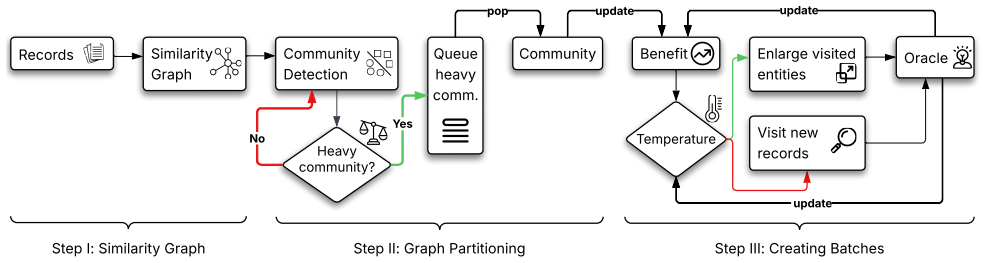
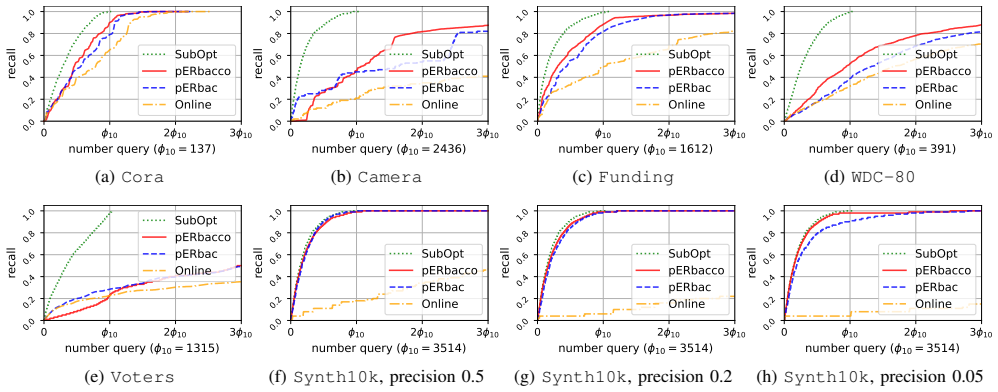
We formally cast this problem as batched entity resolution, prove that selecting optimal batches is NP-hard, and provide an optimal solution under a natural condition on entity sizes. Finally, we evaluate our approach on six datasets and show its superiority over state-of-the-art baselines.
Load-bearing premise
The claimed optimal batch selector works only when the dataset obeys a stated natural condition on the sizes of its entities.
Editorial extensions
If this is right
- Users obtain explicit, incremental control over the total number of oracle consultations while recall improves at each step.
- The pay-as-you-go property lets practitioners stop querying once a target recall is reached rather than committing to a fixed budget in advance.
- Under the size condition the method is guaranteed to be optimal, removing the need for heuristic search over batch choices.
- The same modeling framework applies to any oracle that returns clusters within a supplied batch rather than pairwise decisions.
Reading between the lines
- If the size condition holds for most real-world entity-resolution collections, the NP-hardness result mainly serves as a warning against brute-force search rather than a barrier to practice.
- The pay-as-you-go framing could extend to other oracle-limited tasks such as deduplication in streams or active learning loops that request labels in batches.
- Relaxing the size condition while retaining near-optimality would require approximation algorithms whose guarantees the paper leaves open.
Editorial analysis
A structured set of objections, weighed in public.
Referee Report
Summary. The paper formalizes the problem of batched entity resolution, where an oracle clusters records from limited-size batches that may not contain all mentions of any entity. It proves that selecting optimal batches is NP-hard and claims an optimal solution exists under a natural condition on entity sizes. It then evaluates the approach on six datasets, reporting superiority over state-of-the-art baselines in a pay-as-you-go setting that controls oracle consult costs while maximizing recall.
Significance. If the hardness result and conditional optimality hold with the condition explicitly stated and verified, the work would provide a useful theoretical framing for entity resolution under batch-oracle constraints, along with a practical algorithm and empirical evidence of improvement. The new formalization and complexity analysis are the primary contributions; the six-dataset evaluation strengthens the case for applicability if the modeling assumptions are met.
major comments (2)
- [Abstract] Abstract: The optimality claim rests entirely on an unspecified 'natural condition on entity sizes.' Without an explicit definition of this condition (e.g., bounded maximum entity size or a distributional requirement) and a verification that the six evaluation datasets satisfy it, the route from the NP-hardness result to a practical optimal algorithm cannot be assessed, undermining the central practical claim.
- [Abstract] Abstract (and implied § on algorithm): The paper states it provides 'an optimal solution under a natural condition,' yet the abstract gives no derivation outline or section reference for how the condition enables polynomial-time optimality. This is load-bearing because the NP-hardness result alone does not yield a usable algorithm without the condition.
minor comments (1)
- [Abstract] The abstract mentions 'six datasets' but provides no names, sizes, or entity-size statistics; adding these details would allow readers to check the condition themselves.
Simulated Author's Rebuttal
We thank the referee for the careful review and constructive feedback. We address the major comments point by point below.
read point-by-point responses
-
Referee: [Abstract] Abstract: The optimality claim rests entirely on an unspecified 'natural condition on entity sizes.' Without an explicit definition of this condition (e.g., bounded maximum entity size or a distributional requirement) and a verification that the six evaluation datasets satisfy it, the route from the NP-hardness result to a practical optimal algorithm cannot be assessed, undermining the central practical claim.
Authors: We agree that the abstract would benefit from an explicit definition of the condition to make the optimality claim self-contained. The condition is defined in the body of the manuscript; we will revise the abstract to include a concise statement of the condition along with confirmation that the six datasets satisfy it based on their entity-size distributions. revision: yes
-
Referee: [Abstract] Abstract (and implied § on algorithm): The paper states it provides 'an optimal solution under a natural condition,' yet the abstract gives no derivation outline or section reference for how the condition enables polynomial-time optimality. This is load-bearing because the NP-hardness result alone does not yield a usable algorithm without the condition.
Authors: We will revise the abstract to add a reference to the section containing the derivation of the conditional polynomial-time optimality result. This will clarify the logical connection between the NP-hardness proof and the practical algorithm. revision: yes
Circularity Check
No significant circularity
full rationale
The paper introduces a formalization of batched entity resolution as a new problem, proves NP-hardness of optimal batch selection, states an optimal solution under an explicitly declared condition on entity sizes, and validates via evaluation on six external datasets. No equations, definitions, or claims reduce the central results to self-definitional inputs, fitted parameters renamed as predictions, or load-bearing self-citations. The derivation chain is self-contained with independent theoretical content and falsifiable external benchmarks.
Assumptions & free parameters
assumptions (1)
- domain assumption The oracle returns correct clusters for records that refer to the same entity within any given batch.
Cite this review
Pith. "Pith review of Entity Resolution via Batched Oracle Queries." pith.science (2026). https://pith.science/paper/L533QI6Q
@misc{pith2026260624407,
  author       = {Pith},
  title        = {Pith review of: Entity Resolution via Batched Oracle Queries},
  year         = {2026},
  howpublished = {\url{https://pith.science/paper/L533QI6Q}},
  note         = {Machine review of arXiv:2606.24407}
}
read the original abstract
We consider an oracle that processes a limited batch of records at a time and clusters those that refer to the same real-world entity. We study how to interrogate such an oracle to resolve entities in a dataset whose size is far larger than a single batch, and where no batch is guaranteed to contain all records of any given entity. We aim at a pay-as-you-go approach, to have full control over the costs (the number of oracle consults), while achieving the highest possible recall at every step. We formally cast this problem as batched entity resolution, prove that selecting optimal batches is NP-hard, and provide an optimal solution under a natural condition on entity sizes. Finally, we evaluate our approach on six datasets and show its superiority over state-of-the-art baselines.
Figures


Figures from the paper (2 more)

Forward citations
Cited by 1 Pith paper
-
Beyond Scale and Generation: Understanding Language Model-based Entity Matching
Disentangling architecture, pretraining variant, and size shows embedding init is decisive for bi-encoders, joint encoding beats independent encoding, and generative matchers mainly help under distribution shift—not u...
Reference graph
Works this paper leans on
-
[1]
An overview of end-to-end entity resolution for big data,
V . Christophides, V . Efthymiou, T. Palpanas, G. Papadakis, and K. Ste- fanidis, “An overview of end-to-end entity resolution for big data,”ACM Comput. Surv., vol. 53, no. 6, pp. 127:1–127:42, 2021
2021
-
[2]
Effective entity matching with transformers,
Y . Li, J. Li, Y . Suhara, A. Doan, and W. Tan, “Effective entity matching with transformers,”VLDB J., vol. 32, no. 6, pp. 1215–1235, 2023
2023
-
[3]
Progres- sive entity matching: A design space exploration,
J. Maciejewski, K. Nikoletos, G. Papadakis, and Y . Velegrakis, “Progres- sive entity matching: A design space exploration,”PACMMOD, vol. 3, no. 1, Feb. 2025
2025
-
[4]
Three-dimensional entity resolution with jedai,
G. Papadakis, G. M. Mandilaras, L. Gagliardelli, G. Simonini, E. Thanos, G. Giannakopoulos, S. Bergamaschi, T. Palpanas, and M. Koubarakis, “Three-dimensional entity resolution with jedai,”Inf. Syst., vol. 93, p. 101565, 2020
2020
-
[5]
Magellan: toward building ecosystems of entity matching solutions,
A. Doan, P. Konda, P. S. G. C., Y . Govind, D. Paulsen, K. Chandrasekhar, P. Martinkus, and M. Christie, “Magellan: toward building ecosystems of entity matching solutions,”Commun. ACM, vol. 63, no. 8, pp. 83–91, 2020
2020
-
[6]
Deepblock: A novel blocking approach for entity resolution using deep learning,
D. Javdani, H. Rahmani, M. Allahgholi, and F. Karimkhani, “Deepblock: A novel blocking approach for entity resolution using deep learning,” inICWR, 2019, pp. 41–44
2019
-
[7]
Pay-as-you-go entity resolution,
S. E. Whang, D. Marmaros, and H. Garcia-Molina, “Pay-as-you-go entity resolution,”IEEE TKDE, vol. 25, no. 5, pp. 1111–1124, 2013
2013
-
[8]
Aspdup: Ast-sequence- based progressive duplicate code detection tool for onsite programming code,
Y . Yu, Z. Huang, Y . Zhou, W. Li, and Y . Shao, “Aspdup: Ast-sequence- based progressive duplicate code detection tool for onsite programming code,” inInternetware, 2020, pp. 260–264
2020
Show all 52 references
-
[9]
Schema- agnostic progressive entity resolution,
G. Simonini, G. Papadakis, T. Palpanas, and S. Bergamaschi, “Schema- agnostic progressive entity resolution,”IEEE TKDE, vol. 31, no. 6, pp. 1208–1221, 2019
2019
-
[10]
Online entity resolution using an oracle,
D. Firmani, B. Saha, and D. Srivastava, “Online entity resolution using an oracle,”PVLDB, vol. 9, no. 5, pp. 384–395, 2016
2016
-
[11]
A theory for record linkage,
I. P. Fellegi and A. B. Sunter, “A theory for record linkage,”J. Am. Stat. Assoc., vol. 64, no. 328, pp. 1183–1210, 1969
1969
-
[12]
Set transformer: A framework for attention-based permutation-invariant neural networks,
J. Lee, Y . Lee, J. Kim, A. R. Kosiorek, S. Choi, and Y . W. Teh, “Set transformer: A framework for attention-based permutation-invariant neural networks,” inICML, 2019, pp. 3744–3753
2019
-
[13]
Match, compare, or select? an investigation of large language models for entity matching,
T. Wang, X. Chen, H. Lin, X. Chen, X. Han, L. Sun, H. Wang, and Z. Zeng, “Match, compare, or select? an investigation of large language models for entity matching,” inCOLING, 2025, pp. 96–109
2025
-
[14]
Crowder: Crowdsourc- ing entity resolution,
J. Wang, T. Kraska, M. J. Franklin, and J. Feng, “Crowder: Crowdsourc- ing entity resolution,”PVLDB, vol. 5, no. 11, pp. 1483–1494, 2012
2012
-
[15]
Facenet: A unified embed- ding for face recognition and clustering,
F. Schroff, D. Kalenichenko, and J. Philbin, “Facenet: A unified embed- ding for face recognition and clustering,” inCVPR, 2015, pp. 815–823
2015
-
[16]
Waldo: An adaptive human interface for crowd entity resolution,
V . Verroios, H. Garcia-Molina, and Y . Papakonstantinou, “Waldo: An adaptive human interface for crowd entity resolution,” inSIGMOD, 2017, pp. 1133–1148
2017
-
[17]
Training language models to follow instructions with human feedback,
L. Ouyang, J. Wu, X. Jiang, D. Almeida, C. L. Wainwright, P. Mishkin, C. Zhang, S. Agarwal, K. Slama, A. Ray, J. Schulman, J. Hilton, F. Kelton, L. Miller, M. Simens, A. Askell, P. Welinder, P. F. Christiano, J. Leike, and R. Lowe, “Training language models to follow instructi...
2022 arXiv
-
[18]
A demonstration of PERC: probabilistic entity resolution with crowd errors,
X. Ke, M. Teo, A. Khan, and V . K. Yalavarthi, “A demonstration of PERC: probabilistic entity resolution with crowd errors,”PVLDB, vol. 11, no. 12, pp. 1922–1925, 2018
1922
-
[19]
Robust entity resolution using a crowdoracle,
D. Firmani, S. Galhotra, B. Saha, and D. Srivastava, “Robust entity resolution using a crowdoracle,”IEEE Data Eng. Bull., vol. 41, no. 2, pp. 91–103, 2018
2018
-
[20]
Crowd-based deduplication: An adaptive approach,
S. Wang, X. Xiao, and C. Lee, “Crowd-based deduplication: An adaptive approach,” inSIGMOD, T. K. Sellis, S. B. Davidson, and Z. G. Ives, Eds., 2015, pp. 1263–1277
2015
-
[21]
Select your questions wisely: For entity resolution with crowd errors,
V . K. Yalavarthi, X. Ke, and A. Khan, “Select your questions wisely: For entity resolution with crowd errors,” inCIKM, 2017, pp. 317–326
2017
-
[22]
A linear programming approach to the cutting-stock problem,
P. C. Gilmore and R. E. Gomory, “A linear programming approach to the cutting-stock problem,”Oper. Res., vol. 9, no. 6, pp. 849–859, 1961
1961
-
[23]
Multi-way number partitioning
R. E. Korf, “Multi-way number partitioning.” inIJCAI, vol. 9, 2009, pp. 538–543
2009
-
[24]
The densek-subgraph problem,
U. Feige, D. Peleg, and G. Kortsarz, “The densek-subgraph problem,” Algorithmica, vol. 29, no. 3, pp. 410–421, Mar. 2001
2001
-
[25]
Christen,Data Matching - Concepts and Techniques for Record Linkage, Entity Resolution, and Duplicate Detection, ser
P. Christen,Data Matching - Concepts and Techniques for Record Linkage, Entity Resolution, and Duplicate Detection, ser. Data-Centric Systems and Applications. Springer, 2012
2012
-
[26]
Sparkly: A simple yet surprisingly strong TF/IDF blocker for entity matching,
D. Paulsen, Y . Govind, and A. Doan, “Sparkly: A simple yet surprisingly strong TF/IDF blocker for entity matching,”PVLDB, vol. 16, no. 6, pp. 1507–1519, 2023
2023
-
[27]
Deep entity matching with pre-trained language models,
Y . Li, J. Li, Y . Suhara, A. Doan, and W.-C. Tan, “Deep entity matching with pre-trained language models,”arXiv preprint arXiv:2004.00584, 2020
2004
-
[28]
Using chatgpt for entity matching,
R. Peeters and C. Bizer, “Using chatgpt for entity matching,” inADBIS, 2023, pp. 221–230
2023
-
[29]
Sudowoodo: Contrastive self-supervised learning for multi-purpose data integration and preparation,
R. Wang, Y . Li, and J. Wang, “Sudowoodo: Contrastive self-supervised learning for multi-purpose data integration and preparation,” inICDE, 2023, pp. 1502–1515
2023
-
[30]
A survey of indexing techniques for scalable record linkage and deduplication,
P. Christen, “A survey of indexing techniques for scalable record linkage and deduplication,”IEEE TKDE, vol. 24, no. 9, pp. 1537–1555, 2012
2012
-
[31]
Scaling entity resolution to large, heterogeneous data with enhanced meta-blocking
G. Papadakis, G. Papastefanatos, T. Palpanas, and M. Koubarakis, “Scaling entity resolution to large, heterogeneous data with enhanced meta-blocking.” inEDBT, 2016, pp. 221–232
2016
-
[32]
GSM: A generalized approach to supervised meta-blocking for scalable entity resolution,
L. Gagliardelli, G. Papadakis, G. Simonini, S. Bergamaschi, and T. Pal- panas, “GSM: A generalized approach to supervised meta-blocking for scalable entity resolution,”Inf. Syst., vol. 120, p. 102307, 2024
2024
-
[33]
Deep learning for blocking in entity matching: a design space exploration,
S. Thirumuruganathan, H. Li, N. Tang, M. Ouzzani, Y . Govind, D. Paulsen, G. Fung, and A. Doan, “Deep learning for blocking in entity matching: a design space exploration,”PVLDB, vol. 14, no. 11, pp. 2459–2472, 2021
2021
-
[34]
Alaska: A flexible benchmark for data integration tasks,
V . Crescenzi, A. De Angelis, D. Firmani, M. Mazzei, P. Merialdo, F. Piai, and D. Srivastava, “Alaska: A flexible benchmark for data integration tasks,”arXiv preprint arXiv:2101.11259, 2021
2021
-
[35]
Wdc products: A multi-dimensional entity matching benchmark,
R. Peeters, R. C. Der, and C. Bizer, “Wdc products: A multi-dimensional entity matching benchmark,”arXiv preprint arXiv:2301.09521, 2023
2023
-
[36]
Mdedup: duplicate detection with matching dependencies,
l. Koumarelas, T. Papenbrock, and F. Naumann, “Mdedup: duplicate detection with matching dependencies,”PVLDB, vol. 13, no. 5, pp. 712– 725, Jan. 2020
2020
-
[37]
Fast unfolding of communities in large networks,
V . D. Blondel, J.-L. Guillaume, R. Lambiotte, and E. Lefebvre, “Fast unfolding of communities in large networks,”J. Stat. Mech., vol. 2008, no. 10, p. P10008, 2008
2008
-
[38]
From louvain to leiden: guaranteeing well-connected communities,
V . A. Traag, L. Waltman, and N. J. Van Eck, “From louvain to leiden: guaranteeing well-connected communities,”Sci. Rep., vol. 9, no. 1, pp. 1–12, 2019
2019
-
[39]
Near linear time algorithm to detect community structures in large-scale networks,
U. N. Raghavan, R. Albert, and S. Kumara, “Near linear time algorithm to detect community structures in large-scale networks,”Phys. Rev. E, vol. 76, no. 3, p. 036106, 2007
2007
-
[40]
The map equation,
M. Rosvall, D. Axelsson, and C. T. Bergstrom, “The map equation,” Eur. Phys. J. Spec. Top., vol. 178, no. 1, pp. 13–23, 2009
2009
-
[41]
Network community detection: A review and visual survey,
B. S. Khan and M. A. Niazi, “Network community detection: A review and visual survey,”arXiv preprint arXiv:1708.00977, 2017
2017 arXiv
-
[42]
Cost-effective in-context learning for entity resolution: A design space exploration,
M. Fan, X. Han, J. Fan, C. Chai, N. Tang, G. Li, and X. Du, “Cost-effective in-context learning for entity resolution: A design space exploration,” in2024 IEEE 40th International Conference on Data Engineering (ICDE), 2024, pp. 3696–3709
2024
-
[43]
Avenger: Ensembling and fine-tuning llms for select prompts in entity resolution,
A. Zeakis, G. Papadakis, D. Skoutas, and M. Koubarakis, “Avenger: Ensembling and fine-tuning llms for select prompts in entity resolution,” inThe Semantic Web. Cham: Springer Nature Switzerland, 2025, pp. 301–320
2025
-
[44]
Cost-efficient prompt engineering for unsupervised entity resolution in the product matching domain,
N. Nananukul, K. Sisaengsuwanchai, and M. Kejriwal, “Cost-efficient prompt engineering for unsupervised entity resolution in the product matching domain,”Discover Artificial Intelligence, vol. 4, no. 1, p. 56, 2024. 13
2024
-
[45]
Web-scale data integration: You can afford to pay as you go,
J. Madhavan, S. Cohen, X. L. Dong, A. Y . Halevy, S. R. Jeffery, D. Ko, and C. Yu, “Web-scale data integration: You can afford to pay as you go,” inCIDR, 2007, pp. 342–350
2007
-
[46]
Progressive duplicate detection,
T. Papenbrock, A. Heise, and F. Naumann, “Progressive duplicate detection,”IEEE TKDE, vol. 27, no. 5, pp. 1316–1329, 2015
2015
-
[47]
Entity resolution on-demand,
G. Simonini, L. Zecchini, S. Bergamaschi, and F. Naumann, “Entity resolution on-demand,”PVLDB, vol. 15, no. 7, pp. 1506–1518, 2022
2022
-
[48]
Interactive deduplication using active learning,
S. Sarawagi and A. Bhamidipaty, “Interactive deduplication using active learning,” inProceedings of the Eighth ACM SIGKDD International Conference on Knowledge Discovery and Data Mining, July 23-26, 2002, Edmonton, Alberta, Canada. ACM, 2002, pp. 269–278
2002
-
[49]
The battleship approach to the low resource entity matching problem,
B. Genossar, A. Gal, and R. Shraga, “The battleship approach to the low resource entity matching problem,”Proc. ACM Manag. Data, vol. 1, no. 4, pp. 224:1–224:25, 2023
2023
-
[50]
Can foundation models wrangle your data?
A. Narayan, I. Chami, L. J. Orr, and C. R ´e, “Can foundation models wrangle your data?”PVLDB, vol. 16, no. 4, pp. 738–746, 2022
2022
-
[51]
Entity matching using large language models,
R. Peeters, A. Steiner, and C. Bizer, “Entity matching using large language models,” inEDBT, 2025, pp. 529–541
2025
-
[52]
In-context clustering-based entity resolution with large language models: A design space exploration,
J. Fu, H. Tang, A. Khan, S. Mehrotra, X. Ke, and Y . Gao, “In-context clustering-based entity resolution with large language models: A design space exploration,”PACMMOD, vol. 3, no. 4, Sep. 2025. 14
2025
Reviewed June 25, 2026 · model on record in the stance chip above.
Discussion (0). Continue with ORCID to comment.