Remarks on the relative isoperimetric profile of polygonal domains in mathbb{R}²
Pith reviewed 2026-05-25 03:34 UTC · model grok-4.3
The pith
The relative isoperimetric problem is solved for a square with a square corner removed.
A machine-rendered reading of the paper's core claim, the machinery that carries it, and where it could break.
Core claim
We develop techniques for solving the relative isoperimetric problem on polygonal domains in R^2, with special attention paid to corners. As an application, we solve the relative isoperimetric problem for a square with a square corner removed.
What carries the argument
Techniques for handling corners when solving the relative isoperimetric problem on polygonal domains.
Load-bearing premise
The techniques developed for handling corners in polygonal domains are sufficient to produce a complete and rigorous solution without additional regularity assumptions that might fail at vertices.
What would settle it
An explicit curve inside the square with corner removed that encloses a given area using strictly less relative perimeter than the profile claimed in the solution.
Figures



read the original abstract
We develop techniques for solving the relative isoperimetric problem on polygonal domains in $\mathbb{R}^2$, with special attention paid to corners. As an application, we solve the relative isoperimetric problem for a square with a square corner removed.
Editorial analysis
A structured set of objections, weighed in public.
Referee Report
Summary. The manuscript develops techniques for the relative isoperimetric problem on polygonal domains in R^2, paying special attention to corners, and applies these techniques to solve the problem explicitly for the domain consisting of a square with one square corner removed.
Significance. If the corner techniques are fully rigorous, the work supplies an explicit solution to a concrete relative isoperimetric problem on a non-convex polygonal domain. This is a modest but useful contribution to the literature on isoperimetric problems in domains with corners, where explicit profiles are rarely available.
major comments (1)
- [Application section (the square-with-corner-removed case)] The central claim that the developed corner techniques produce a complete, rigorous solution for the square-with-corner-removed domain rests on the assertion that all first-variation and regularity conditions hold at every vertex (including the newly created ones). Without an explicit verification that the constructed candidate satisfies the necessary angle or curvature conditions at 90-degree corners without hidden interior-regularity assumptions, the solution remains formally incomplete.
Simulated Author's Rebuttal
We thank the referee for the careful reading and the constructive comment on the application section. We address it below.
read point-by-point responses
-
Referee: [Application section (the square-with-corner-removed case)] The central claim that the developed corner techniques produce a complete, rigorous solution for the square-with-corner-removed domain rests on the assertion that all first-variation and regularity conditions hold at every vertex (including the newly created ones). Without an explicit verification that the constructed candidate satisfies the necessary angle or curvature conditions at 90-degree corners without hidden interior-regularity assumptions, the solution remains formally incomplete.
Authors: We agree that an explicit verification of the first-variation and regularity conditions at all vertices (including the 90-degree corners and newly created ones) would strengthen the rigor of the application. In the revised manuscript we will add a short dedicated paragraph (or subsection) that directly checks these conditions for the constructed candidate, confirming that the angle conditions hold without hidden interior assumptions. This addresses the concern and renders the solution formally complete. revision: yes
Circularity Check
No circularity: derivation relies on variational techniques without reduction to inputs
full rationale
The paper develops techniques for the relative isoperimetric problem on polygonal domains with attention to corners and applies them to solve the problem for a square with one corner removed. No load-bearing steps reduce by construction to fitted parameters, self-definitions, or self-citation chains; the central claims rest on standard first-variation and regularity analysis that is presented as independent of the target result. The derivation chain is self-contained against external benchmarks in geometric measure theory.
Axiom & Free-Parameter Ledger
axioms (1)
- standard math Standard properties of rectifiable curves and perimeter functionals in R^2 hold at polygonal corners.
Lean theorems connected to this paper
-
IndisputableMonolith/Foundation/AlexanderDuality.leanalexander_duality_circle_linking unclear?
unclearRelation between the paper passage and the cited Recognition theorem.
Theorem 1.1: If K convex then ∂S does not contain K; if non-convex then at most one smooth component contains K and makes no acute angle.
-
IndisputableMonolith/Cost/FunctionalEquation.leanwashburn_uniqueness_aczel unclear?
unclearRelation between the paper passage and the cited Recognition theorem.
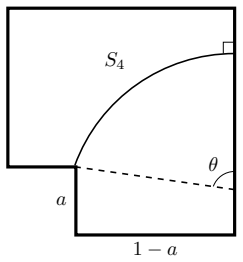
Explicit f_a via quarter-circles, line segments, and S4 circular arcs meeting non-convex corner (eq. 4.2, Lemma 4.1).
What do these tags mean?
- matches
- The paper's claim is directly supported by a theorem in the formal canon.
- supports
- The theorem supports part of the paper's argument, but the paper may add assumptions or extra steps.
- extends
- The paper goes beyond the formal theorem; the theorem is a base layer rather than the whole result.
- uses
- The paper appears to rely on the theorem as machinery.
- contradicts
- The paper's claim conflicts with a theorem or certificate in the canon.
- unclear
- Pith found a possible connection, but the passage is too broad, indirect, or ambiguous to say the theorem truly supports the claim.
Reference graph
Works this paper leans on
-
[1]
H. Brezis and A. Bruckstein. A sharp relative isoperimetric inequality for the square.C. R. Math. Acad. Sci. Paris, 359(9):1191–1199, 2021
work page 2021
-
[2]
J. Choe, M. Ghomi, and M. Ritor´ e. The relative isoperimetric inequality outside a convex domain inR n.Calc. Var. PDE, 29(4):421–429, 2007
work page 2007
-
[3]
E. Gonzalez, U. Massari, and I. Tamanini. On the regularity of boundaries of sets minimizing perimeter with a volume constraint.Indiana University Mathematics Journal, 32(1):25–37, 1983
work page 1983
- [4]
-
[5]
E. M¨ ader-Baumdicker, R. Neumayer, J. Park, and M. Rupflin. Quantitative estimates for the relative isoperimetric problem and its gradient flow outside convex bodies in the plane.arXiv2508.21198, 2025
-
[6]
E. Stredulinsky and W.P. Ziemer. Area minimizing sets subject to a volume constraint in a convex set.J. Geom. Anal., 7:653–677, 1997. 24
work page 1997
discussion (0)
Sign in with ORCID, Apple, or X to comment. Anyone can read and Pith papers without signing in.