Grid-Forming Characterization in DC Microgrids
Pith reviewed 2026-05-10 14:54 UTC · model grok-4.3
The pith
Three impedance-based indices quantify voltage-forming and current-forming behavior in DC microgrids to improve voltage regulation.
A machine-rendered reading of the paper's core claim, the machinery that carries it, and where it could break.
Core claim
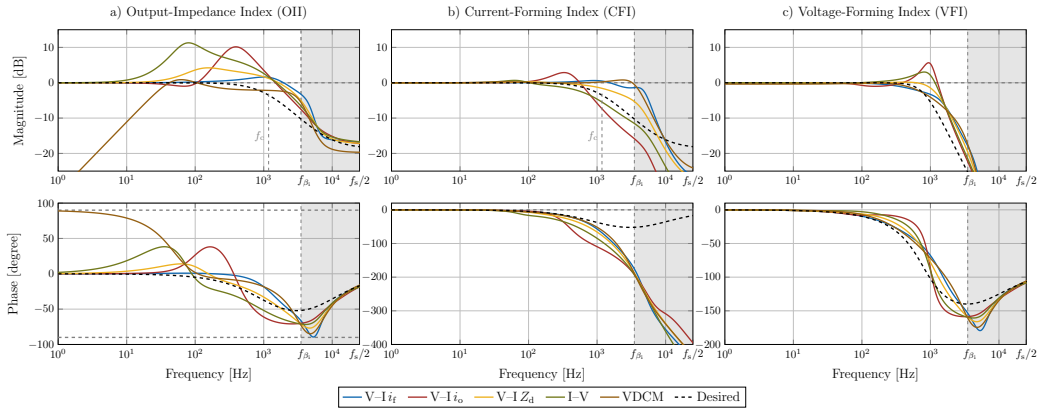
This paper introduces three novel impedance-based indices that quantify the voltage-forming and current-forming behavior of a converter. The indices provide a basis for defining the desired converter behavior that yields superior DC-bus voltage regulation performance.
What carries the argument
Three novel impedance-based indices for quantifying voltage-forming and current-forming behavior of a converter.
If this is right
- These indices enable classification and comparison of different converter control algorithms.
- They support defining target converter behavior for improved DC-bus voltage regulation.
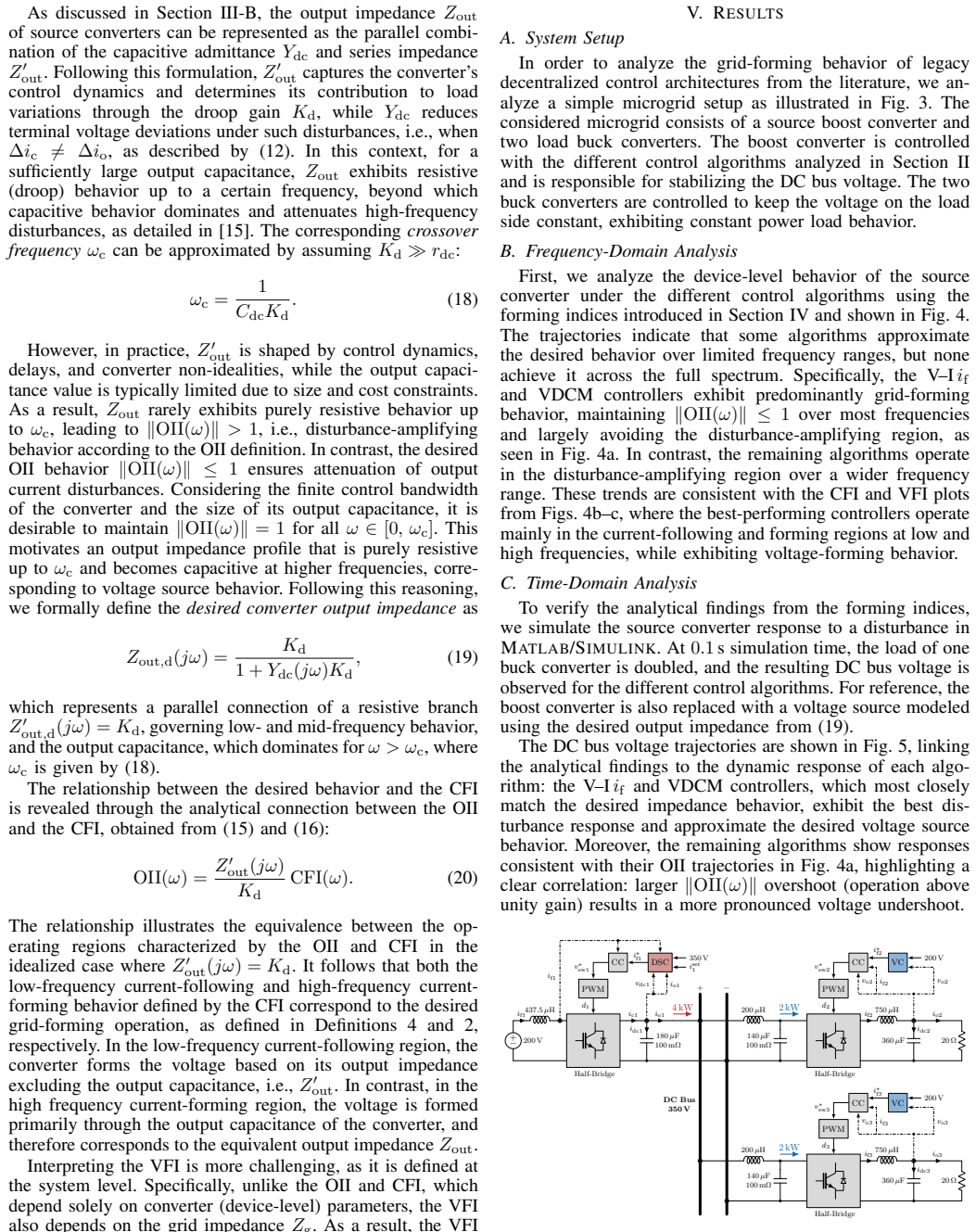
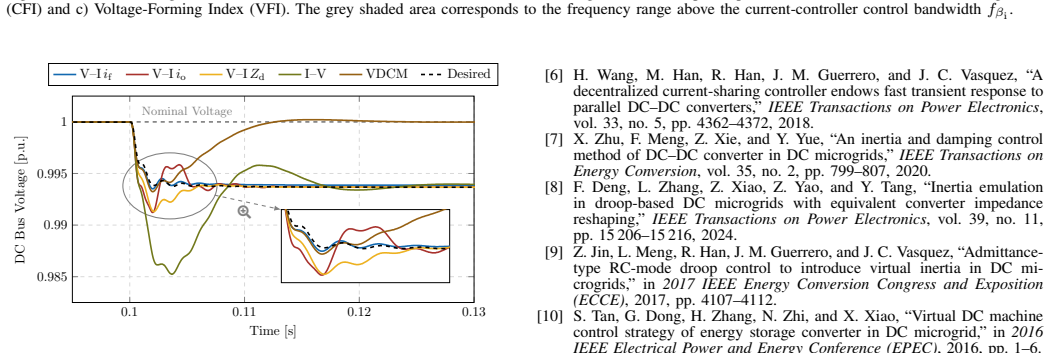
- Simulations of representative controls illustrate the framework and reveal strengths and limitations of each strategy.
Where Pith is reading between the lines
- The indices could be used to develop standardized guidelines for converter selection in DC microgrid design.
- They might extend to assessing interactions in multi-converter systems for overall stability.
- Experimental validation on physical hardware would test if the indices predict real-world performance accurately.
Load-bearing premise
The impedance-based indices accurately reflect the physical behavior of the converters and directly lead to superior voltage regulation performance when applied to define desired behavior.
What would settle it
An experiment showing that converters tuned according to the proposed indices do not achieve better DC-bus voltage regulation than those using traditional methods under varying load conditions.
Figures


read the original abstract
DC microgrids are converter-based electrical networks that are increasingly being used in various applications, including data centers and industrial distribution systems. A central challenge in their operation is maintaining the DC-bus voltage within predefined limits while ensuring overall system stability. Although a wide variety of converter control algorithms has been proposed to achieve these objectives, the literature lacks a clear and physically interpretable framework for evaluating their effectiveness and for classifying and comparing them. Moreover, the grid-forming versus grid-following distinction that exists in AC systems has largely been unexplored in DC microgrids. To address this gap, this paper introduces three novel impedance-based indices that can be used to quantify the voltage-forming and current-forming behavior of a converter. The indices also provide a basis for defining the desired converter behavior that yields superior DC-bus voltage regulation performance. Simulation results illustrate the application of the framework to several representative control strategies and highlight the strengths and limitations of these control algorithms.
Editorial analysis
A structured set of objections, weighed in public.
Referee Report
Summary. The paper introduces three novel impedance-based indices to quantify the voltage-forming and current-forming behavior of converters in DC microgrids. These indices provide a framework for classifying controls and defining desired behaviors that yield superior DC-bus voltage regulation performance, with simulations demonstrating application to representative control strategies.
Significance. If the indices are shown to be physically grounded and predictive, the work supplies a standardized, interpretable tool for evaluating and designing converter controls in DC microgrids, extending AC grid-forming concepts to DC systems. This addresses a clear literature gap and could improve voltage regulation in practical applications such as data centers. The reliance on standard impedance modeling and simulation-based validation are strengths.
minor comments (2)
- The abstract states that simulations illustrate the framework, but the manuscript should explicitly link each index value to observed voltage regulation metrics in the results section to strengthen the performance claim.
- Ensure all simulation parameters (e.g., line impedances, load steps) are tabulated for reproducibility.
Simulated Author's Rebuttal
We thank the referee for the positive assessment of our manuscript and the recommendation for minor revision. We appreciate the recognition that the proposed impedance-based indices address a clear literature gap and offer a standardized, interpretable tool for evaluating converter controls in DC microgrids.
Circularity Check
No significant circularity in derivation chain
full rationale
The paper introduces three novel impedance-based indices derived from standard small-signal impedance models to quantify voltage-forming versus current-forming converter behavior in DC microgrids. These indices are defined directly from physical impedance characteristics and used to specify desired behavior for voltage regulation, without reducing to fitted parameters, self-referential definitions, or load-bearing self-citations. The abstract and claim structure show an independent modeling framework applied to representative controls via simulation, with no enumerated circular patterns (self-definitional, fitted-input-as-prediction, or ansatz smuggling) present in the stated derivation. The chain is self-contained against external benchmarks of impedance analysis.
Axiom & Free-Parameter Ledger
Forward citations
Cited by 1 Pith paper
-
Exploring Converter Control Duality in Microgrids: AC Grid-Forming vs DC Droop Control
AC grid-forming and DC droop controls are duals in small-signal models, current control structure, power-sharing mechanisms, and disturbance responses.
discussion (0)
Sign in with ORCID, Apple, or X to comment. Anyone can read and Pith papers without signing in.