REVIEW 4 major objections 5 minor 12 references
Large Language Models Can Follow Instructions, But Not Many at Once: Phase Transitions in Compositional Constraint Satisfaction
T0 review · 4 major / 5 minor · reviewed 2026-08-16 · deepseek-v4-flash
Pith's one-line read The paper claims that LLM instruction-following collapses because constraint failures multiply: each added constraint trims per-constraint pass rate by a fixed factor, so the chance of satisfying all k constraints falls steeply even when…
desk verdict Useful benchmark and per-k measurements, but the central 'near-independence' mechanism is contradicted by the paper's own numbers; the main explanation doesn't hold. read the letter →
The pith
A machine-rendered reading of the paper's core claim, the machinery that carries it, and where it could break.
The reading
What carries the argument
The central object is Constraint Saturation Evaluation (CSE), a procedurally generated benchmark that varies the number of simultaneous constraints (k) from 1 to 12 across 36 deterministically verifiable constraint types. Two metrics carry the argument: sCSR (strict constraint satisfaction rate), the fraction of probes where all k constraints pass, and mCSR (marginal CSR), the average per-constraint pass rate. The divergence between these metrics, with mCSR decaying gently while sCSR collapses, is what the paper calls the phase transition. The load-bearing identity is the multiplicative model P(k) = a·r^(k−1), fitted on k=1–8 and validated on k=9–12. The key quantitative measure for the independence claim is the pairwise phi coefficient among constraint failures, which the paper reports as small on average.
What would settle it
Recompute sCSR at k=8 from the reported per-constraint rates: if per-constraint pass rates average 40.7% and successes were independent, the all-eight success rate would be roughly (0.407)^8 = 0.00117, or 0.12%, not the reported 5.7%. A direct check of whether the marginals at k=8 are approximately equal across constraints, and whether their geometric mean is near 40.7% or much higher, would settle whether the independence assumption holds or whether a small set of high-pass-rate constraints is carrying the joint success rate.
Extended reading notes
Core claim
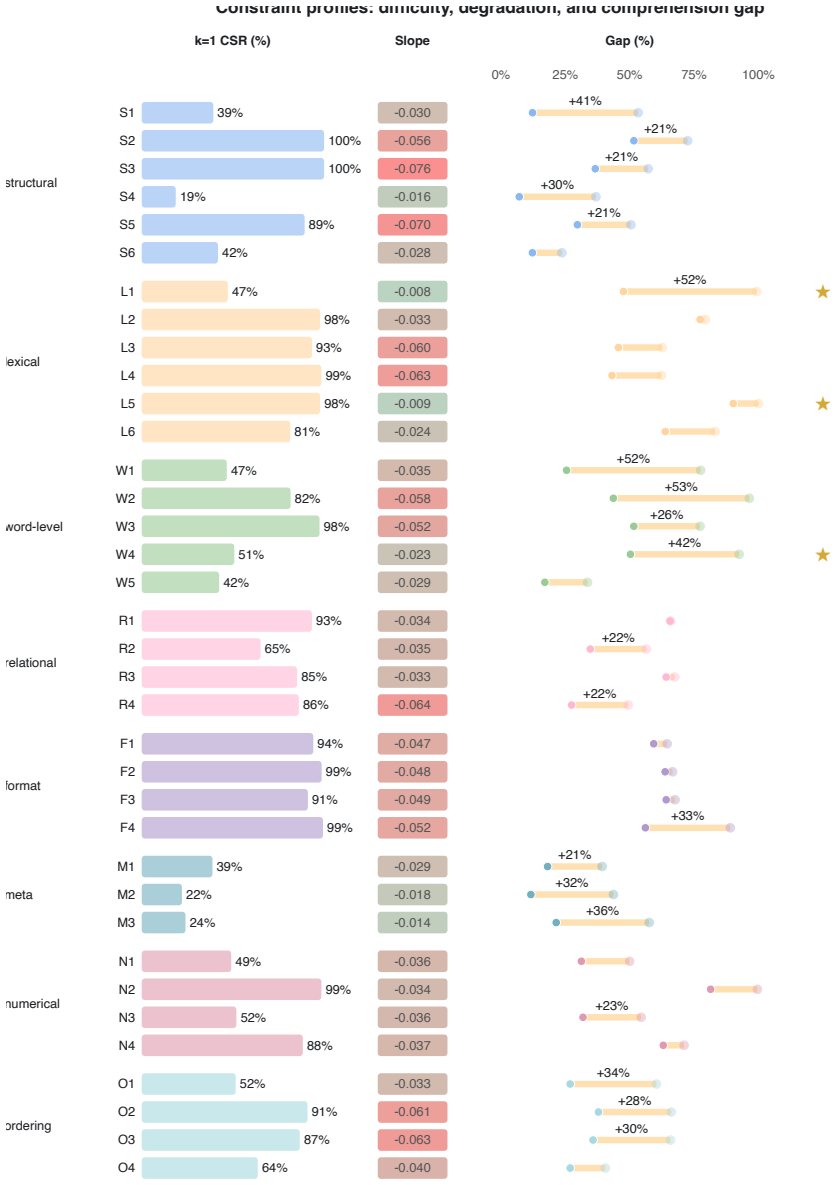
The central discovery is that the steep decline in compositional instruction following is mostly a consequence of near-multiplicative accumulation of per-constraint failures, not pairwise constraint interference. The paper measures that at k=8 the average per-constraint pass rate is 40.7%, but the rate of simultaneously satisfying all eight constraints is only 5.7%. It fits the per-constraint decay as mCSR(k)=72.0% x 0.922^(k−1) with 0.2pp held-out MAE, and the probe-level success collapses below 2% by k=11. The paper reports that pairwise co-failure correlations are weak (mean phi = +0.067; 54% of pairs within |phi| <= 0.05), with only one negative pair, implying that selecting or rearranging constraints cannot mitigate the collapse. It also finds a constraint hierarchy: structural constraints lose 2.0x more baseline capability per added constraint than lexical ones, and this is predicted by the comprehension-maintenance gap, the difference between a model's continuous compliance score and its strict binary pass rate. Constraints that require sustained tracking, like word counting, degrade fastest, while binary constraints like including a mandatory word are compositionally immune.
Load-bearing premise
The whole prediction rests on the assumption that when a model fails one constraint it does not make failing the others much more likely; if that assumption is off, the steep predictable collapse could actually be driven by a few constraints that fail together, not by many independent small failures.
Editorial extensions
If this is right
- Production systems that assume gradual degradation will overshoot: a system that is reliable with 3 constraints can fail most probes with 5–6 constraints, even though each individual constraint is still satisfied at moderate rates.
- The compositional half-life k* gives a one-number estimate of how many simultaneous constraints a model can handle, ranging from 1 to 7 across the 15 models tested, and the paper's decay factors allow estimating the maximum k for any target compliance rate.
- Inference-time mitigations have bounded effect: planning scaffolds do not shift the threshold, while post-hoc self-correction and best-of-5 retries recover only one to two constraints, because a given probe's failure is largely deterministic across resamples.
- Improving per-constraint reliability is the only identified lever that moves the collapse threshold, since constraint pairing and rearrangement cannot mitigate a near-multiplicative failure accumulation.
- Continuous compliance scores can overestimate true satisfaction by up to 50pp near the transition (e.g., W1 at 78.6% score vs 28.4% strict), so strict binary verification is necessary for measuring real instruction-following quality.
Reading between the lines
- If the near-multiplicative failure model holds, it implies a strong testable prediction for any new constraint type: its contribution to the joint failure rate is determined by its standalone pass rate and its coupling to shared output features, so the collapse curve for a model can be assembled from single-constraint measurements plus a small number of pairwise output-feature couplings.
- The paper's own synergy results at low k suggest that its near-independence claim may be best understood as a high-k phenomenon only: at k=1–4, actual sCSR exceeds the product-of-marginals prediction by up to 26pp, which cannot be an arithmetic artifact in the same way as the high-k floor.
- The finding that best-of-N retries deliver only two-fifths of the lift predicted by independent resampling suggests a second, within-probe correlation layer: failures are near-independent across constraints but largely deterministic across resamples, which could be probed directly by measuring resample correlation separately from across-constraint correlation.
- The structural-vs-lexical degradation gap, if it reflects sustained tracking demand rather than chance, predicts that scaffolding that externalises tracking (for example, structured generation that checks counts during decoding) should flatten the hierarchy rather than uniformly improve all constraints.
Signed reviews
Editorial analysis
A structured set of objections, weighed in public.
Referee Report
Summary. The paper introduces Constraint Saturation Evaluation (CSE), a procedurally generated benchmark for multi-constraint instruction following with 36 deterministic constraint types, k=1–12, 15 models, and 369,753 constraint checks. It reports three main findings: per-constraint pass rate decays multiplicatively (mCSR ≈ 72.0% × 0.922^{k−1}); structural constraints degrade faster than lexical ones, with a comprehension-maintenance gap predicting degradation; and constraint failures are 'nearly independent,' so joint sCSR is approximately the product of k marginal rates. The paper also reports three interventions (pre-generation planning, post-hoc self-correction, and best-of-5 retries) and concludes that only per-constraint reliability, not constraint pairing or prompt structuring, can move the compositional threshold.
Significance. If the empirical trajectory and ranking results were reliable, CSE would be a useful diagnostic resource: deterministic verification avoids the LLM-as-judge circularity, the k-trajectory across 15 models is well matched to deployment concerns, and the promised release of probes, verifiers, outputs, and code would support reproducibility. The mCSR-versus-sCSR divergence and the per-constraint degradation hierarchy are genuinely interesting observations. However, the central mechanistic claim that failures are nearly independent and that sCSR is the product of marginal rates is not established, and the paper's own synergy analysis appears to contradict it. Because the headline conclusions about the 'only lever' and the impossibility of constraint-selection mitigation depend on this mechanism, the contribution as currently framed cannot be accepted.
major comments (4)
- [Sections 3.1 and 4, Eqs. (1)–(2)] The paper asserts that sCSR 'collapses because it is the product of k marginal rates,' but this is a theorem under independence, not an empirical consequence of the reported measurements. The correct independence baseline is the average over probes of the product of per-probe constraint pass rates; the aggregate mCSR is not a valid substitute when per-constraint rates are heterogeneous. The paper never reports this baseline. At k=8, mCSR is 40.7% and sCSR is 5.7%; if marginal rates were homogeneous, independence would predict about 0.075%, and while heterogeneous probes can move the product upward, no calculation in the paper shows how 5.7% arises. The near-multiplicative claim is therefore unsupported as stated.
- [Section O and Figure 2] The synergy analysis directly contradicts the near-independence claim. Section O reports that actual sCSR exceeds the independence prediction by +26.4pp at k=1 and by positive amounts at every k from 1 to 11. But by the definitions in Eqs. (1)–(2), sCSR equals mCSR at k=1, so any baseline computed from the same per-constraint rates must give zero synergy at k=1. The reported +26pp at k=1 implies either that the 'independence prediction' is not the product-of-marginal-rates rule stated in Section 3.1 or that the synergy computation is internally inconsistent. Moreover, positive synergy is positive correlation in success outcomes, which is not the same as 'failures are nearly independent.'
- [Section 4, 'Two-regime decay model'] The two fitted decay models are not shown to be consistent with each other. The paper fits mCSR(k)=72.0%×0.922^{k−1} and separately fits sCSR(k)=1.000·e^{−0.376k}+0.003, corresponding to a per-constraint factor of about e^{−0.376}≈0.686. If sCSR really were the product of the k marginal rates, the sCSR fit would have to be derived from the mCSR fit; no such derivation is presented, and the per-constraint factors differ by a factor of roughly 0.686/0.922≈0.74. The paper either needs to derive the probe-level curve from the marginal curve or explain why near-independence permits a separate exponential fit with a different rate.
- [Section 5, 'Two senses of independence'] The distinction between 'independence across constraints within a response' and 'dependence across resamples of the same probe' is asserted but not tested. The best-of-5 result—about two-fifths of the independent-resampling lift—is direct evidence of strong probe-level correlation across draws. A probe-level random effect (topic difficulty, parameter difficulty, or a deterministic failure mode) would produce correlated draws while also inflating the sCSR tail relative to a product-of-marginals baseline. A mixed model or per-probe conditional analysis is needed before one can conclude that 'only per-constraint reliability helps'; the pairwise φ≈+0.067 analysis does not rule out such an effect.
minor comments (5)
- [Limitations and Appendix Q] The text refers to '30 constraint types,' 'all 30 constraint verifiers,' and 'Ten of 30 constraints,' while the benchmark is defined as 36 constraint types (Section 3.1, Table 2). These counts should be reconciled.
- [Section 3.1] Section 3.1 mentions 'Composability profiles for all 38 candidates,' but Section K describes 36 final constraints plus at least two rejected candidates. The relation between the 38 candidates and the 36-constraint pool should be stated explicitly.
- [Figure 2 and Section O] The numbers for easy- and hard-tercile synergy are not aligned: Section 4 text reports '+33pp' and '+18pp,' while Section O reports '+32.6pp' and '+17.7pp.' Such inconsistencies make the synergy analysis difficult to audit.
- [Title and Section 4] The term 'phase transition' is used for what appears to be a smooth exponential decay with no discontinuity. Either an operational definition of 'phase transition' should be given, or a less loaded term should be used.
- [Table 3] The intervention results in Table 3 are reported without confidence intervals or significance tests, despite k* changes of one constraint and small model counts; the planning result in particular is consistent with no effect under reasonable noise.
Circularity Check
The paper's central explanation of the sCSR collapse as the 'product of k marginal rates' is asserted rather than derived: the sCSR decay curve is fit separately from the measured marginal decay, and the paper's own k=8 numbers contradict the product-of-marginals identity.
-
self definitional
[Section 3.1 (Equations 1-2); Section 1; Abstract]
"Atk=1, sCSR and mCSR are identical. Their divergence at higherk is the phase transition: mCSR decays gradually (each constraint fails somewhat more often under load), but sCSR collapses because it is the productof k marginal rates. ... We measure the co-failure structure directly and find failures nearly independent, which makes joint success approximately the product of k per-constraint rates: a mild per-constraint decay compounds into a steep collapse."
Equation (1) defines sCSR as the average over probes of the product of the k per-probe binary outcomes, not as the product of the k marginal (average) rates. Equality between the two holds only under the independence assumption that the paper claims to establish. The paper never computes this product-of-marginals baseline from the per-probe data; had it done so with its own k=8 figures, 0.407^8 is about 0.075%, not the reported 5.7%. The exposition moves from the definition of the metric to the conclusion, skipping the independence condition that is itself the load-bearing claim under investigation.
-
fitted input called prediction
[Section 4, 'Two-regime decay model']
"If constraint failures are largely uncorrelated (Section 4), the aggregate sCSR should followP(k) =a·r k−1. We test this by fitting on k=1−8 and evaluating on held-out k=9−12 (Figure 1). At the probe level (sCSR), the decay is steep: P(k) = 1.000·e −0.376k + 0.003"
The exponential model is fit directly to the sCSR curve, so the held-out MAE validates the fit, not the independence mechanism. Under the paper's own marginal model mCSR(k)=72.0%×0.922^{k−1}, independence would predict sCSR(k) = (0.72×0.922^{k−1})^k = 0.72^k×0.922^{k(k−1)}, which is not a single exponential a·r^{k−1}. The fitted per-constraint factor r≈0.686 is a free parameter estimated from the sCSR data, not the product of the measured marginal rates, and it is then relabeled as 'near-multiplicative structure.' The prediction is therefore the fitted curve renamed as the consequence of independence.
full rationale
The benchmark itself is self-contained and externally anchored: 15 models, deterministic verifiers, 369,753 checks, and out-of-sample validation of the fitted decay curves are genuine empirical contributions, and no load-bearing self-citation chain is present. The circularity is concentrated in the paper's central mechanistic claim. The sCSR and mCSR decay curves are fit separately, yet the paper states that sCSR 'collapses because it is the product of k marginal rates'; this identity is not evaluated against the measured marginals, and the paper's own k=8 numbers (mCSR 40.7%, sCSR 5.7%) contradict the aggregate product 0.407^8≈0.075%. The positive synergy reported in Section O (up to +26pp above an independence baseline at low k) further undercuts the 'weakly correlated / near-multiplicative' summary. These are not merely correctness concerns: the headline 'prediction' (collapse as product of marginal rates) is effectively the separately fitted sCSR exponential presented as though it were derived from the per-constraint rates and the near-independence measurement. That is a partial circularity of the fitted-input-called-prediction form, justifying a score of 5 rather than 0. The empirical phase transition itself is not in question; only the claimed derivation of its functional form is.
Assumptions & free parameters
free parameters (4)
- aggregate mCSR decay intercept and factor =
72.0%, 0.922
- sCSR decay model parameters =
a=1.000, beta=0.376, c=0.003
- per-model decay factors r =
0.721-0.977 per model (e.g., DeepSeek 0.721, Claude 4.7 0.977)
- constraint parameter calibration ranges =
word count 40-60, letter frequency rank 5-15, etc.
assumptions (4)
- domain assumption Pairwise φ coefficients conditioned on k and aggregated per-model capture the full dependence structure among constraint failures.
- domain assumption The high incompatibility rejection rate at k≥8 (up to 98%) does not bias the measured degradation trend.
- domain assumption The 36 deterministically verifiable constraint types are representative of real-world multi-constraint instructions.
- domain assumption The continuous score s_i and binary pass/fail measure the same underlying capability, so the comprehension-maintenance gap Δ=s_i-mCSR is a meaningful psychological construct.
Cite this review
Pith. "Pith review of Large Language Models Can Follow Instructions, But Not Many at Once: Phase Transitions in Compositional Constraint Satisfaction." pith.science (2026). https://pith.science/paper/LAU5KK2U
@misc{pith2026260812426,
  author       = {Pith},
  title        = {Pith review of: Large Language Models Can Follow Instructions, But Not Many at Once: Phase Transitions in Compositional Constraint Satisfaction},
  year         = {2026},
  howpublished = {\url{https://pith.science/paper/LAU5KK2U}},
  note         = {Machine review of arXiv:2608.12426}
}
read the original abstract
Large language models are increasingly deployed in settings that require simultaneous adherence to multiple explicit constraints - reasoning structure, safety boundaries, output schemas. Individual constraints are handled proficiently, but the compositional regime, where many must hold jointly, remains poorly characterized: how rapidly does performance degrade, what governs the degradation, and can the collapse be mitigated? We introduce Constraint Saturation Evaluation (CSE), a procedurally generated benchmark that systematically varies the number of simultaneous constraints (k), with every constraint scored by a deterministic, rule-based verifier and zero LLM-judge involvement: 15 models, 36 constraint types, 369,753 checks at k=1-12. Three findings emerge. First, per-constraint pass rate decays gradually and predictably, while the chance of satisfying all k constraints collapses - a model passing individual constraints at ~41% at k=8 succeeds on all eight just 5.7% of the time. Second, constraints do not degrade equally: structural constraints lose 2x more baseline capability per added constraint than lexical ones, ordered by a comprehension-maintenance gap that separates constraints requiring sustained tracking from binary decisions immune to composition. Third, failures are nearly independent, which is what makes the accumulation multiplicative; the residual coupling that does exist tracks shared output features rather than pairwise interference - a wrong sentence count fails every constraint that reads it. Reliable instruction following breaks down beyond 5-6 simultaneous constraints: probe-level success falls below 50% at 7 constraints for the strongest model, and at 3 or fewer for 12 of 15.
Figures


Figures from the paper (3 more)

Reference graph
Works this paper leans on
-
[1]
Concrete inclusion > abstract avoidance. L2 (mandatory words) survives at 73–100%; 30 Table 12: Per-constraint survival rate on 444 impossible probes. CID Pass ScorenCID Pass Scoren L5 92.7 100.0 2038 O3 18.5 52.0 714 N2 69.5 99.4 924 N3 17.5 43.0 1363 L6 61.1 83.5 1620 O2 15.2 49.6 2632 L2 60.6 63.0 1827 M3 13.8 52.6 1547 R1 53.3 53.6 1136 N1 13.5 33.5 1...
-
[2]
Models find it easier to omit than to include
Prohibition > requirement.N2 (no digits) survives at 84–91%; N1 and N3 are sacrificed at 0%, N4 at 4%. Models find it easier to omit than to include
-
[3]
InAdvances in Neural Information Processing Systems, volume 36
Faith and fate: Limits of transformers on com- positionality. InAdvances in Neural Information Processing Systems, volume 36. Alessandro Favero, Antonio Sclocchi, Francesco Cagnetta, Pascal Frossard, and Matthieu Wyart. 2025. How compositional generalization and creativity im- prove as diffusion models are trained. InForty- second International Conference...
work page 2025
-
[4]
ConceptMix++: Leveling the playing field in text-to-image benchmarking via iterative prompt optimization.arXiv preprint arXiv:2507.03275. Zhengkang Guo, Wenhao Liu, Mingchen Xie, Jing- wen Xu, Zisu Huang, Muzhao Tian, Jianhan Xu, Yuanzhe Shen, Qi Qian, Muling Wu, Xiaohua Wang, Changze Lv, HeDa Wang, Hu Yao, Xiaoqing Zheng, and Xuanjing Huang. 2025. RECAST...
work page Pith review arXiv 2025
-
[6]
established the paradigm of verifiable in- struction following with 25 constraint types and deterministic programmatic checks, but probes typ- ically contain k≤3 constraints—insufficient to observe compositional degradation. A model scor- ing 80%+ on IFEval could in principle collapse atk=5−8 on CSE, exposing degradation invisible to proficiency-oriented ...
work page 2022
-
[7]
evaluates whether LLMs can generate sen- tences with concepts in a specified order across 36 models, finding that even the best model follows the specified order only 75% of the time on a single or- dering constraint. CSE’s ordering constraints show similarly low k=1 rates (O1 monotonic length: 28.9%, O2 alphabetical: 43.7%), and these per- constraint imp...
work page 2025
-
[8]
genuine” failures are constraint self-narration (“Constraint L1 requires no letter ‘k’
documents degradation across attribute bind- ing, spatial relationships, and generative numer- acy. T2V-CompBench (Sun et al., 2024b) shows temporal composition failures in video generation. GenAI-Bench (Li et al., 2024) evaluates compo- sitional text-to-visual generation, reporting degra- dation with compositional complexity in image, video, and 3D gener...
work page 2025
-
[9]
A four-way probe (forbidden letter ‘e’ + manda- tory words + unique words + exact word count) tests whether the strongest sacrifice priority erodes under multi-constraint tension. R.2 Results Across 55,645 constraint checks, 28.2% of individ- ual constraints were satisfied on impossible probes. Zero probe×model pairs passed all constraints on any impossib...
Show all 12 references
-
[12]
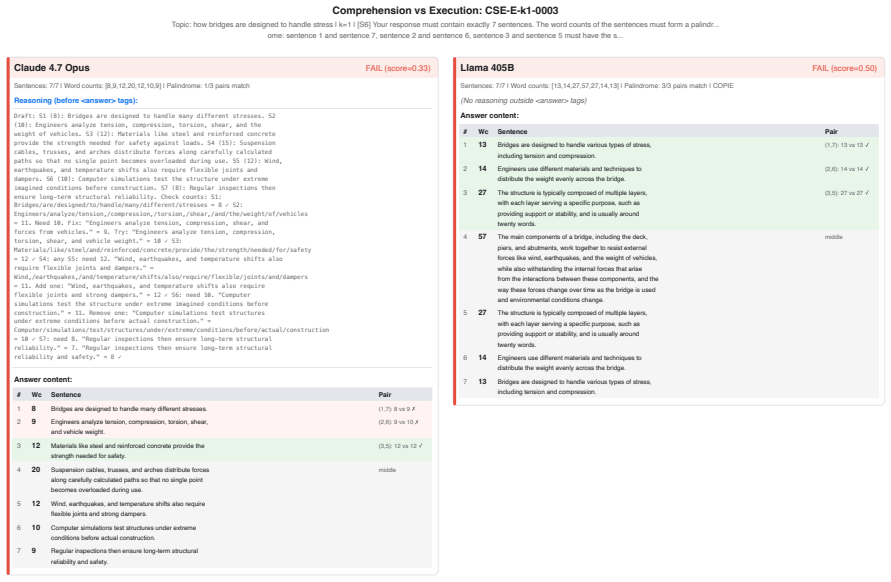
S2: 11. Need 10. Fix
Natural structure > imposed structure. O3 (alternating) survives at 56%; O1 (mono- tonic) at 7% and O4 (growth) at 0%. Alternat- ing sentence lengths approximate natural prose more closely than strict monotonic or Fibonacci growth. Hierarchy inversion under binary choice. When...
-
[2006]
Marc Mézard and Andrea Montanari
Threshold values of random K-SAT from the cavity method.Random Structures & Algorithms, 28(3):340–373. Marc Mézard and Andrea Montanari. 2009.Informa- tion, Physics, and Computation. Oxford University Press. George A. Miller. 1956. The magical number seven, plus or minus two: ...
2009 arXiv
-
[2023]
Alice":{
Prompting is programming: A query language for large language models. InProceedings of the 44th ACM SIGPLAN International Conference on Programming Language Design and Implementation (PLDI). Howard Chen, Huihan Li, Danqi Chen, and Karthik Narasimhan. 2022. Controllable text ge...
2022 arXiv
-
[2025]
InThe Thirteenth International Conference on Learning Representations
Self-play with execution feedback: Improving instruction-following capabilities of large language models. InThe Thirteenth International Conference on Learning Representations. Nouha Dziri, Ximing Lu, Melanie Sclar, Xiang Lor- raine Li, Liwei Jiang Jiang, Bill Yuchen Lin, Pete...
Reviewed August 16, 2026 · model on record in the stance chip above.
Discussion (0). Continue with ORCID to comment.