An Efficient Laguerre Minimum Action Method for Computing Quasi-Potentials
Pith reviewed 2026-06-26 13:55 UTC · model grok-4.3
The pith
A Laguerre spectral method computes quasi-potentials by discretizing semi-infinite time intervals without truncation.
A machine-rendered reading of the paper's core claim, the machinery that carries it, and where it could break.
Core claim
The LMAM computes minimum action paths by formulating the problem on a semi-infinite time interval and discretizing the temporal direction using Laguerre functions, with an appropriate time rescaling strategy proposed to enhance accuracy and convergence of the Laguerre spectral approximation. Precise numerical analysis for the linear problem and a local result for the nonlinear case are developed, supported by an improved quadrature procedure that enables stable double-precision computations.
What carries the argument
Laguerre spectral discretization on semi-infinite intervals with time rescaling and improved Gauss-Radau quadrature for the minimum action problem.
If this is right
- The formulation avoids artificial truncation of the time horizon that affects conventional minimum action methods.
- Stable computations become possible with large numbers of Laguerre modes for both ODEs and PDEs.
- Precise error analysis is available for linear cases and local guarantees for nonlinear cases.
- The method applies directly to systems such as the Allen-Cahn equation and Navier-Stokes equations.
Where Pith is reading between the lines
- The reduced parameter sensitivity may allow the method to be used in automated pipelines for exploring rare transitions across families of dynamical systems.
- Time rescaling ideas could transfer to other spectral bases when solving variational problems on unbounded domains.
- The approach may lower the barrier to computing quasi-potentials in higher-dimensional or stochastic partial differential equation settings.
Load-bearing premise
The time rescaling strategy combined with the improved Laguerre-Gauss-Radau quadrature enables stable double-precision computations and accurate results for both linear and nonlinear problems without significant post-hoc parameter tuning.
What would settle it
A computation on a nonlinear test problem that shows instability or accuracy loss in double precision when the number of Laguerre modes is increased beyond a modest threshold would falsify the central efficiency claim.
Figures


read the original abstract
Minimum action methods provide a powerful framework for analyzing rare transitions in small-noise-driven dynamical systems, but their practical performance is often limited by time truncation and parameter sensitivity in infinite-horizon problems. In this paper, we develop an efficient Laguerre spectral minimum action method (LMAM) for computing quasi-potentials associated with fixed points of dynamical systems. Based on the large deviation framework, the method computes minimum action paths by formulating the problem on a semi-infinite time interval and discretize the temporal direction using Laguerre functions. An appropriate time rescaling strategy is proposed to enhance accuracy and convergence of the Laguerre spectral approximation. To efficiently handle nonlinear terms, we employ an improved procedure for evaluating Laguerre--Gauss--Radau quadrature, which enables stable and accurate double-precision computations with a large number of Laguerre modes. Precise numerical analysis for the linear problem and a local result for the nonlinear case are developed. Numerical experiments including both ordinary and partial differential equations (Allen-Cahn and Navier-Stokes) are presented to illustrate the accuracy and efficiency of the proposed method.
Editorial analysis
A structured set of objections, weighed in public.
Referee Report
Summary. The paper proposes the Laguerre Minimum Action Method (LMAM) for computing quasi-potentials of fixed points in dynamical systems. It formulates the minimum action problem on a semi-infinite time interval, discretizes the temporal direction with Laguerre functions, introduces a time rescaling strategy to improve accuracy and convergence, and uses an improved Laguerre-Gauss-Radau quadrature procedure for nonlinear terms to enable stable double-precision computations with many modes. Precise numerical analysis is developed for the linear problem and a local result for the nonlinear case, with numerical experiments on ODEs and PDEs (Allen-Cahn, Navier-Stokes) to demonstrate accuracy and efficiency.
Significance. If the efficiency and accuracy claims hold, the method would advance computation of minimum action paths for rare events by addressing time truncation and parameter sensitivity in infinite-horizon problems via spectral discretization. The provision of analysis for the linear case and local nonlinear result, combined with experiments on both ODEs and PDEs, would strengthen its utility in large deviation theory applications. The time rescaling and quadrature improvements are presented as key enablers of stable high-mode computations without heavy tuning.
major comments (2)
- [Abstract] Abstract: The central efficiency/accuracy claims for nonlinear problems rest on experiments with nonlinear ODEs and PDEs (Allen-Cahn, Navier-Stokes), yet the paper develops only a local result for the nonlinear case (with precise analysis reserved for the linear problem). If the locality assumption does not cover the global regimes or the specific time-rescaled Laguerre discretization used in those experiments, then observed convergence and double-precision stability rely on empirical quadrature improvements rather than analysis, weakening the claim that the rescaling strategy reliably enables accurate results.
- [Abstract] The time rescaling strategy is introduced to enhance accuracy of the Laguerre spectral approximation, but no derivation or bound is provided showing that the rescaling parameter remains non-tuning (i.e., does not require problem-specific adjustment that affects the central claims of parameter robustness). This is load-bearing because the abstract and experiments present the overall method as efficient and stable without significant post-hoc tuning.
Simulated Author's Rebuttal
We thank the referee for the careful review and constructive comments on our manuscript. We address each major comment below, providing clarifications on the scope of our analysis and the practical aspects of the time rescaling strategy.
read point-by-point responses
-
Referee: [Abstract] Abstract: The central efficiency/accuracy claims for nonlinear problems rest on experiments with nonlinear ODEs and PDEs (Allen-Cahn, Navier-Stokes), yet the paper develops only a local result for the nonlinear case (with precise analysis reserved for the linear problem). If the locality assumption does not cover the global regimes or the specific time-rescaled Laguerre discretization used in those experiments, then observed convergence and double-precision stability rely on empirical quadrature improvements rather than analysis, weakening the claim that the rescaling strategy reliably enables accurate results.
Authors: The abstract already states that 'precise numerical analysis for the linear problem and a local result for the nonlinear case are developed,' making the scope of the theoretical results explicit. The efficiency and accuracy claims for nonlinear problems are supported by the numerical experiments, which demonstrate practical performance on the tested systems (ODEs, Allen-Cahn, Navier-Stokes). The local nonlinear result provides a foundation, while the experiments validate behavior beyond the local regime for the specific discretizations employed. We will revise the abstract to more clearly distinguish the theoretical guarantees from the empirical validation supporting the method's utility in nonlinear settings. revision: partial
-
Referee: [Abstract] The time rescaling strategy is introduced to enhance accuracy of the Laguerre spectral approximation, but no derivation or bound is provided showing that the rescaling parameter remains non-tuning (i.e., does not require problem-specific adjustment that affects the central claims of parameter robustness). This is load-bearing because the abstract and experiments present the overall method as efficient and stable without significant post-hoc tuning.
Authors: The rescaling parameter is chosen according to the characteristic time scale obtained from the linearization at the fixed point, which is a standard and readily computable quantity for the systems considered. While a rigorous a priori bound guaranteeing zero problem-specific adjustment is not derived, the numerical experiments across multiple ODE and PDE examples show that this choice yields stable, accurate results with minimal adjustment. We will add a dedicated remark in the manuscript explaining the selection procedure and its observed robustness to address concerns about tuning. revision: yes
Circularity Check
No circularity: new spectral discretization with independent analysis
full rationale
The paper introduces a Laguerre spectral discretization for minimum-action paths on a semi-infinite interval, proposes a time-rescaling strategy, and supplies an improved Laguerre-Gauss-Radau quadrature procedure. It states precise numerical analysis for the linear problem plus a local result for the nonlinear case, then validates via experiments on ODEs and PDEs. No step reduces by the paper's own equations to a fitted parameter renamed as prediction, a self-citation chain, or a definition that presupposes the claimed output; the central construction is therefore self-contained against external benchmarks.
Axiom & Free-Parameter Ledger
free parameters (2)
- time rescaling parameter
- number of Laguerre modes
axioms (2)
- domain assumption Large deviation principle holds for the dynamical systems considered
- standard math Laguerre functions form a suitable orthogonal basis for functions on the semi-infinite interval
Reference graph
Works this paper leans on
-
[1]
A microscopic theory for antiphase boundary motion and its application to antiphase domain coarsening
Allen, S.M., Cahn, J.W., 1979. A microscopic theory for antiphase boundary motion and its application to antiphase domain coarsening. Acta Metallurgica 27, 1085–1095
1979
-
[2]
A Laguerre–Legendre spectral method for the Stokes problem in a semi-infinite channel
Azaiez, M., Shen, J., Xu, C., Zhuang, Q., 2009. A Laguerre–Legendre spectral method for the Stokes problem in a semi-infinite channel. SIAM Journal on Numerical Analysis 47, 271–292. doi:10.1137/070698269
-
[3]
Afourth-ordertime-splittingLaguerre–HermitepseudospectralmethodforBose–Einsteincondensates
Bao,W.,Shen,J.,2005. Afourth-ordertime-splittingLaguerre–HermitepseudospectralmethodforBose–Einsteincondensates. SIAM Journal on Scientific Computing 26, 2011–2028. doi:10.1137/030601211
-
[4]
Transitionpathsampling:Throwingropesoverroughmountainpasses, in the dark
Bolhuis,P.,Chandler,D.,Dellago,C.,Geissler,P.,2002. Transitionpathsampling:Throwingropesoverroughmountainpasses, in the dark. Annual Review of Physical Chemistry 53, 291–318. doi:10.1146/annurev.physchem.53.082301.113146
work page doi:10.1146/annurev.physchem.53.082301.113146 2002
-
[5]
Boyd,J.P.,Rangan,C.,Bucksbaum,P.,2003. Pseudospectralmethodsonasemi-infiniteintervalwithapplicationtothehydrogen atom: A comparison of the mapped Fourier-sine method with Laguerre series and rational Chebyshev expansions. Journal of Computational Physics 188, 56–74. doi:10.1016/S0021-9991(03)00127-X
-
[6]
Chen, F., Shen, J., Yu, H., 2012. A new spectral element method for pricing european options under the Black–Scholes and Merton jump diffusion models. J. Sci. Comput. 52, 499–518. doi:10.1007/s10915-011-9556-5
-
[7]
AsymptoticProblemsRelatedtoSmoluchowski-KramersApproximation
Chen,Z.,2006. AsymptoticProblemsRelatedtoSmoluchowski-KramersApproximation. Ph.D.thesis.UniversityofMaryland
2006
-
[8]
Nucleationoforderedphasesinblockcopolymers
Cheng,X.,Lin,L.,E,W.,Zhang,P.,Shi,A.C.,2010. Nucleationoforderedphasesinblockcopolymers. PhysicalReviewLetters 104, 148301. doi:10.1103/PhysRevLett.104.148301
-
[9]
Laguerrespectralapproximationofellipticproblemsinexteriordomains
Coulaud,O.,Funaro,D.,Kavian,O.,1990. Laguerrespectralapproximationofellipticproblemsinexteriordomains. Computer Methods in Applied Mechanics and Engineering 80, 451–458. doi:10.1016/0045-7825(90)90050-V
-
[10]
Transition path sampling and the calculation of rate constants
Dellago, C., Bolhuis, P.G., Csajka, F.S., Chandler, D., 1998. Transition path sampling and the calculation of rate constants. Journal of Chemical Physics 108, 1964–1977. doi:10.1063/1.475562
-
[11]
A constrained string method and its numerical analysis
Du, Q., Zhang, L., 2009. A constrained string method and its numerical analysis. Communications in Mathematical Sciences 7, 1039–1051. doi:201308301701
2009
-
[12]
String method for the study of rare events
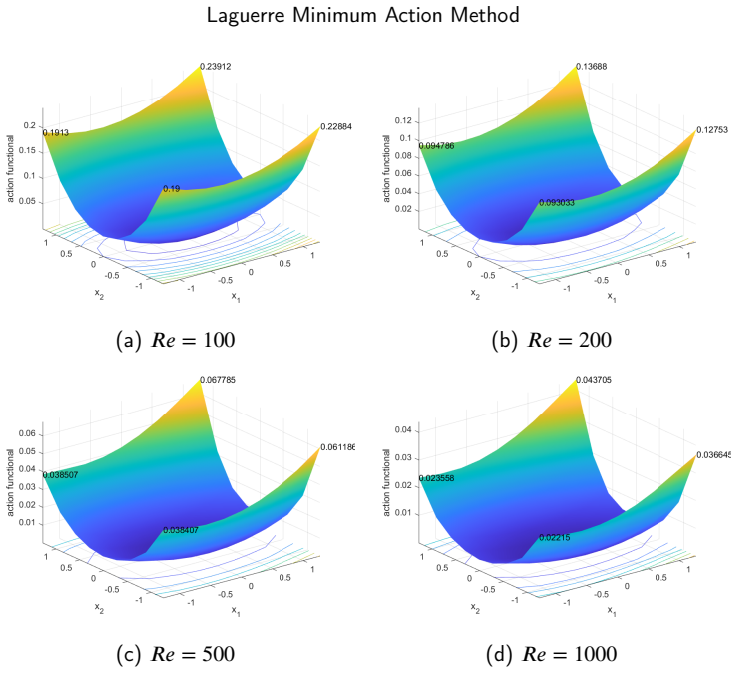
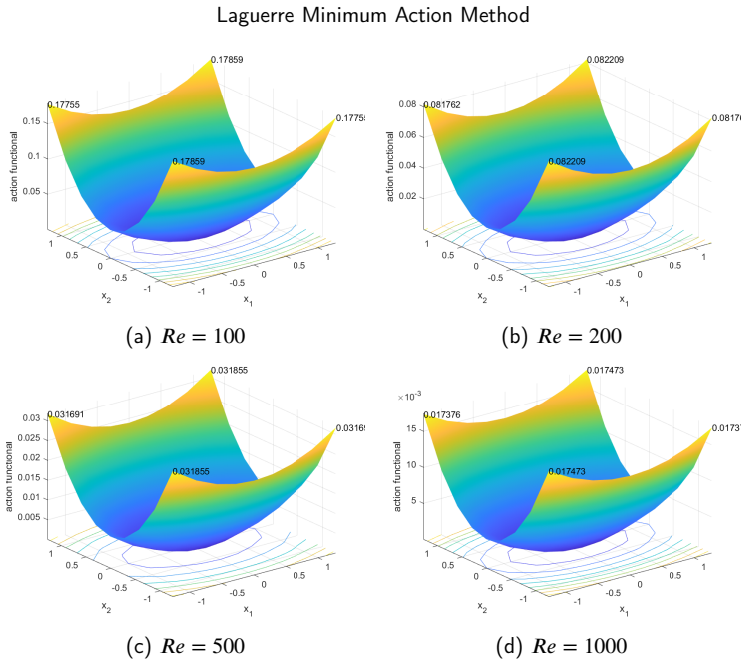
E, W., Ren, W., Vanden-Eijnden, E., 2002. String method for the study of rare events. Physical Review B 66, 52301. doi:10.1103/PhysRevB.66.052301. S. Huang, Y. Yue and H. Yu:Preprint submitted to ElsevierPage 23 of 26 Laguerre Minimum Action Method (a)𝑅𝑒= 100 (b)𝑅𝑒= 200 (c)𝑅𝑒= 500 (d)𝑅𝑒= 1000 Figure 8:Visualization of the quasi-potential for the linearize...
-
[13]
Minimum action method for the study of rare events
E, W., Ren, W., Vanden-Eijnden, E., 2004. Minimum action method for the study of rare events. Communications on Pure and Applied Mathematics 57, 637–656. doi:10.1002/cpa.20005
-
[14]
Transitionpathwaysincomplexsystems:Reactioncoordinates,isocommittorsurfaces, and transition tubes
E,W.,Ren,W.,Vanden-Eijnden,E.,2005. Transitionpathwaysincomplexsystems:Reactioncoordinates,isocommittorsurfaces, and transition tubes. Chemical Physics Letters 413, 242–247
2005
-
[15]
E, W., Ren, W., Vanden-Eijnden, E., 2007. Simplified and improved string method for computing the minimum energy paths in barrier-crossing events. Journal of Chemical Physics 126, 164103. doi:10.1063/1.2720838
-
[16]
E,W.,Vanden-Eijnden,E.,2010. Transition-paththeoryandpath-findingalgorithmsforthestudyofrareevents. AnnualReview of Physical Chemistry 61, 391–420. doi:10.1146/annurev.physchem.040808.090412
-
[17]
E, W., Zhou, X., 2011. The gentlest ascent dynamics. Nonlinearity 24, 1831–1842. doi:10.1088/0951-7715/24/6/008
-
[18]
Partial Differential Equations
Evans, L.C., 2022. Partial Differential Equations. volume 19. American Mathematical Society
2022
-
[19]
Random Perturbations of Dynamical Systems
Freidlin, M.I., Wentzell, A.D., 2012. Random Perturbations of Dynamical Systems. volume 260 ofGrundlehren Der Mathematischen Wissenschaften. Springer Berlin Heidelberg, Berlin, Heidelberg
2012
-
[20]
An iterative minimization formulation for saddle point search
Gao, W., Leng, J., Zhou, X., 2015. An iterative minimization formulation for saddle point search. SIAM Journal on Numerical Analysis 53, 1786–1805. doi:10.1137/130930339
-
[21]
Iterative minimization algorithm for efficient calculations of transition states
Gao, W., Leng, J., Zhou, X., 2016. Iterative minimization algorithm for efficient calculations of transition states. Journal of Computational Physics 309, 69–87. doi:10.1016/j.jcp.2015.12.056
-
[22]
Grafke, T., Schäfer, T., Vanden-Eijnden, E., 2017. Long term effects of small random perturbations on dynamical systems: Theoretical and computational tools, in: Recent Progress and Modern Challenges in Applied Mathematics, Modeling and Computational Science. Springer, pp. 17–55
2017
-
[23]
Grafke, T., Schäfer, T., Vanden-Eijnden, E., 2024. Sharp asymptotic estimates for expectations, probabilities, and mean first passage times in stochastic systems with small noise. Communications on Pure and Applied Mathematics 77, 2268–2330. doi:10.1002/cpa.22177
-
[24]
Gu,S.,Zhou,X.,2018.Simplifiedgentlestascentdynamicsforsaddlepointsinnon-gradientsystems.Chaos:anInterdisciplinary Journal of Nonlinear Science 28, 123106. doi:10.1063/1.5046819
-
[25]
Laguerre-Galerkin method for nonlinear partial differential equations on a semi-infinite interval:
Guo, B.Y., Shen, J., 2000. Laguerre-Galerkin method for nonlinear partial differential equations on a semi-infinite interval:. Numerische Mathematik 86, 635–654. doi:10.1007/PL00005413
-
[26]
Numerical integration based on Laguerre–Gauss interpolation
Guo, B.Y., Wang, Z.Q., 2007. Numerical integration based on Laguerre–Gauss interpolation. Computer Methods in Applied Mechanics and Engineering 196, 3726–3741. doi:10.1016/j.cma.2006.10.035
-
[27]
IntegrationprocessesofordinarydifferentialequationsbasedonLaguerre– Radau interpolations
Guo,B.Y.,Wang,Z.Q.,Tian,H.J.,Wang,L.L.,2008. IntegrationprocessesofordinarydifferentialequationsbasedonLaguerre– Radau interpolations. Mathematics of Computation 77, 181–199. doi:10.1090/S0025-5718-07-02035-2. S. Huang, Y. Yue and H. Yu:Preprint submitted to ElsevierPage 24 of 26 Laguerre Minimum Action Method
-
[28]
Henkelman, G., Jónsson, H., 1999. A dimer method for finding saddle points on high dimensional potential surfaces using only first derivatives. Journal of Chemical Physics 111, 7011–7022. doi:10.1063/1.480097
-
[29]
Henkelman, G., Jónsson, H., 2000. Improved tangent estimate in the nudged elastic band method for finding minimum energy paths and saddle points. Journal of Chemical Physics 113, 9978–9985. doi:10.1063/1.1323224
-
[30]
Thegeometricminimumactionmethod:Aleastactionprincipleonthespaceofcurves
Heymann,M.,Vanden-Eijnden,E.,2008. Thegeometricminimumactionmethod:Aleastactionprincipleonthespaceofcurves. Communications on Pure and Applied Mathematics 61, 1052–1117. doi:10.1002/cpa.20238
-
[31]
Convergence analysis for minimum action methods coupled with a finite difference method
Hong, J., Jin, D., Sheng, D., 2025. Convergence analysis for minimum action methods coupled with a finite difference method. IMA Journal of Numerical Analysis 45, 1501–1536
2025
-
[32]
Scaling optimized Hermite approximation methods
Hu, H., Yu, H., 2026a. Scaling optimized Hermite approximation methods. SIAM Journal on Numerical Analysis 64, 125–147. doi:10.1137/25M1737146
-
[33]
Scalingoptimizedspectralapproximationsonunboundeddomains:thegeneralizedHermiteandLaguerre methods
Hu,H.,Yu,H.,2026b. Scalingoptimizedspectralapproximationsonunboundeddomains:thegeneralizedHermiteandLaguerre methods. arXiv:2602.03083 doi:10.48550/arXiv.2602.03083
-
[34]
ImprovedLaguerrespectralmethodswithlessround-offerrorsandbetterstability
Huang,S.,Yu,H.,2024. ImprovedLaguerrespectralmethodswithlessround-offerrorsandbetterstability. JournalofScientific Computing 101, 72. doi:10.1007/s10915-024-02725-9
-
[35]
Jónsson, H., Mills, G., Jacobsen, K.W., 1998. Nudged elastic band method for finding minimum energy paths of transitions, in: Proceedings of the International School of Physics, World Scientific. pp. 385–404. doi:10.1142/9789812839664_0016
-
[36]
Li, C., Lu, J., Yang, W., 2015. Gentlest ascent dynamics for calculating first excited state and exploring energy landscape of Kohn-Sham density functionals. Journal of Chemical Physics 143, 224110. doi:10.1063/1.4936411
-
[37]
Quasi-potential calculation and minimum action method for limit cycle
Lin, L., Yu, H., Zhou, X., 2019. Quasi-potential calculation and minimum action method for limit cycle. Journal of Nonlinear Science 29, 961–991. doi:10.1007/s00332-018-9509-3
-
[38]
Laguerrepolynomialsforinfinite-domainspectralelements
Mavriplis,C.,1989. Laguerrepolynomialsforinfinite-domainspectralelements. JournalofComputationalPhysics80,481–488. doi:10.1016/0021-9991(89)90112-5
-
[39]
doi:10.1016/S0893-9659(99)00043-9
Mikhailenko,B.,1999.SpectralLaguerremethodfortheapproximatesolutionoftimedependentproblems.AppliedMathematics Letters 12, 105–110. doi:10.1016/S0893-9659(99)00043-9
-
[40]
A spectral numerical method for the Navier-Stokes equations with applications to Taylor-Couette flow
Moser, R., Moin, P., Leonard, A., 1983. A spectral numerical method for the Navier-Stokes equations with applications to Taylor-Couette flow. Journal of Computational Physics 52, 524–544
1983
-
[41]
Aclimbingstringmethodforsaddlepointsearch
Ren,W.,Vanden-Eijnden,E.,2013. Aclimbingstringmethodforsaddlepointsearch. JournalofChemicalPhysics138,134105. doi:10.1063/1.4798344
-
[42]
Iterative Methods for Sparse Linear Systems
Saad, Y., 2003. Iterative Methods for Sparse Linear Systems. SIAM
2003
-
[43]
Efficient spectral-Galerkin method I
Shen, J., 1994. Efficient spectral-Galerkin method I. Direct solvers of second- and fourth-order equations using Legendre polynomials. SIAM Journal on Scientific Computing 15, 1489–1505. doi:10.1137/0915089
-
[44]
Stable and efficient spectral methods in unbounded domains using Laguerre functions
Shen, J., 2000. Stable and efficient spectral methods in unbounded domains using Laguerre functions. SIAM Journal on Numerical Analysis 38, 1113–1133. doi:10.1137/S0036142999362936
-
[45]
Spectral Methods: Algorithms, Analysis and Applications
Shen, J., Tang, T., Wang, L.L., 2011. Spectral Methods: Algorithms, Analysis and Applications. Number 41 in Springer Series in Computational Mathematics, Springer, Heidelberg; New York
2011
-
[46]
Fourierization of the Legendre–Galerkin method and a new space–time spectral method
Shen, J., Wang, L.L., 2007. Fourierization of the Legendre–Galerkin method and a new space–time spectral method. Applied Numerical Mathematics 57, 710–720. doi:https://doi.org/10.1016/j.apnum.2006.07.012
-
[47]
Shen, J., Wang, Y., Yu, H., 2016. Efficient spectral-element methods for the electronic Schrödinger equation, in: Garcke, J., Pflüger, D. (Eds.), Sparse Grids and Applications - Stuttgart 2014, Springer International Publishing : Imprint: Springer, Cham. doi:10.1007/978-3-319-28262-6
-
[48]
Numerical approximations of Allen–Cahn and Cahn–Hilliard equations
Shen, J., Yang, X., 2010. Numerical approximations of Allen–Cahn and Cahn–Hilliard equations. Discrete and Continuous Dynamical Systems - Series A 28, 1669–1691. doi:10.3934/dcds.2010.28.1669
-
[49]
Computing non-equilibrium trajectories by a deep learning approach
Simonnet, E., 2023. Computing non-equilibrium trajectories by a deep learning approach. Journal of Computational Physics 491, 112349
2023
-
[50]
Improved high-index saddle dynamics for finding saddle points and solution landscape
Su, H., Wang, H., Zhang, L., Zhao, J., Zheng, X., 2025. Improved high-index saddle dynamics for finding saddle points and solution landscape. SIAM Journal on Numerical Analysis 63, 1757–1775. doi:10.1137/25M173212X
-
[51]
TheHermitespectralmethodforGaussian-typefunctions
Tang,T.,1993. TheHermitespectralmethodforGaussian-typefunctions. SIAMJournalonScientificComputing14,594–594. doi:10.1137/0914038
-
[52]
Navier–Stokes Equations: Theory and Numerical Analysis
Temam, R., 2024. Navier–Stokes Equations: Theory and Numerical Analysis. volume 343. American Mathematical Society
2024
-
[53]
Thegeometricminimumactionmethodforcomputingminimumenergypaths
Vanden-Eijnden,E.,Heymann,M.,2008. Thegeometricminimumactionmethodforcomputingminimumenergypaths. Journal of Chemical Physics 128, 61103. doi:10.1063/1.2833040
-
[54]
System identification using Laguerre models
Wahlberg, B., 1991. System identification using Laguerre models. IEEE Transactions on Automatic Control 36, 551–562. doi:10.1109/9.76361
-
[55]
A minimum action method with optimal linear time scaling
Wan, X., 2015. A minimum action method with optimal linear time scaling. Communications in Computational Physics 18, 1352–1379. doi:10.4208/cicp.030614.180315a
-
[56]
Adynamic-solver-consistentminimumactionmethod:Withanapplicationto2dNavier-Stokesequations
Wan,X.,Yu,H.,2017. Adynamic-solver-consistentminimumactionmethod:Withanapplicationto2dNavier-Stokesequations. Journal of Computational Physics 331, 209–226. doi:10.1016/j.jcp.2016.11.019
-
[57]
Convergence analysis of a finite element approximation of minimum action methods
Wan, X., Yu, H., Zhai, J., 2018a. Convergence analysis of a finite element approximation of minimum action methods. SIAM Journal on Numerical Analysis 56, 1597–1620. doi:10.1137/17M1141679
-
[58]
Anℎ𝑝-adaptive minimum action method based on a posteriori error estimate
Wan, X., Zheng, B., Lin, G., 2018b. Anℎ𝑝-adaptive minimum action method based on a posteriori error estimate. Commun. Comput. Phys. 23, 408–439
-
[59]
Wang, L., Yu, H., 2018. On efficient second order stabilized semi-implicit schemes for the Cahn–Hilliard phase-field equation. J. Sci. Comput. 77, 1185–1209. doi:10.1007/s10915-018-0746-2
-
[60]
Energy-stable second-order linear schemes for the Allen–Cahn phase-field equation
Wang, L., Yu, H., 2019. Energy-stable second-order linear schemes for the Allen–Cahn phase-field equation. Communications in Mathematical Sciences 17, 609–635. doi:10.4310/CMS.2019.v17.n3.a2
-
[61]
Efficient scaling and moving techniques for spectral methods in unbounded domains
Xia, M., Shao, S., Chou, T., 2021. Efficient scaling and moving techniques for spectral methods in unbounded domains. SIAM Journal on Scientific Computing 43, A3244–A3268. doi:10.1137/20M1347711
-
[62]
Transitionpathwaysconnectingcrystalsandquasicrystals
Yin,J.,Jiang,K.,Shi,A.C.,Zhang,P.,Zhang,L.,2021. Transitionpathwaysconnectingcrystalsandquasicrystals. Proceedings of the National Academy of Sciences 118, e2106230118. doi:10.1073/pnas.2106230118. S. Huang, Y. Yue and H. Yu:Preprint submitted to ElsevierPage 25 of 26 Laguerre Minimum Action Method
-
[63]
Construction of a pathway map on a complicated energy landscape
Yin, J., Wang, Y., Chen, J.Z.Y., Zhang, P., Zhang, L., 2020. Construction of a pathway map on a complicated energy landscape. Physical Review Letters 124, 90601. doi:10.1103/PhysRevLett.124.090601
-
[64]
Shrinking dimer dynamics and its applications to saddle point search
Zhang, J., Du, Q., 2012. Shrinking dimer dynamics and its applications to saddle point search. SIAM Journal on Numerical Analysis 50, 1899–1921. doi:10.1137/110843149
-
[65]
Adaptiveminimumactionmethodforthestudyofrareevents
Zhou,X.,Ren,W.,E,W.,2008. Adaptiveminimumactionmethodforthestudyofrareevents. TheJournalofChemicalPhysics 128. S. Huang, Y. Yue and H. Yu:Preprint submitted to ElsevierPage 26 of 26
2008
discussion (0)
Sign in with ORCID, Apple, or X to comment. Anyone can read and Pith papers without signing in.