Beyond Self-Similarity: Reconciling X-Ray Scaling Relations in Galaxy Clusters and Groups
Pith reviewed 2026-06-28 12:49 UTC · model grok-4.3
The pith
Two power-law corrections for gas fraction and temperature variation reconcile most X-ray scaling relations in clusters and groups.
A machine-rendered reading of the paper's core claim, the machinery that carries it, and where it could break.
Core claim
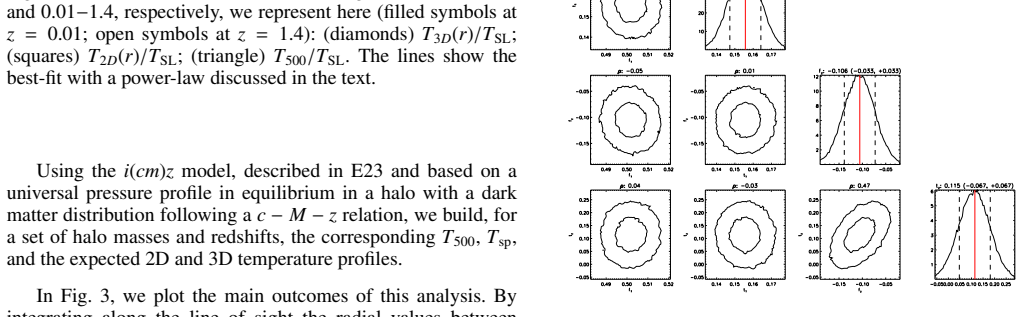
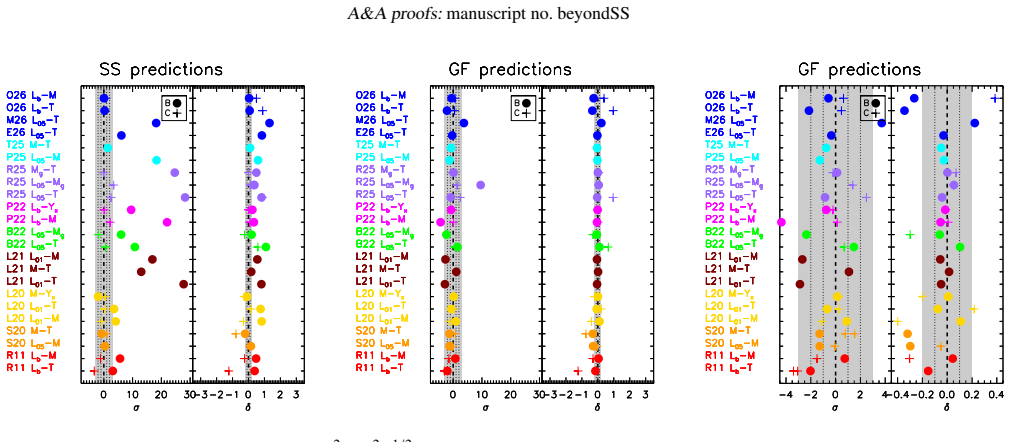
Departures from self-similar predictions are efficiently described by fg ~ T^{f1} E_z^{fz} and fT ~ T^{t1} E_z^{tz}; MCMC calibration on published relations gives f1 = 0.50 ± 0.01, fz = -0.11 ± 0.03 and mild positive exponents for fT, reducing relations in >3 sigma (>5 sigma) tension from 49 (36) percent to 11 (3) percent and enabling direct predictions for slopes and redshift evolution of multiple scaling laws, including the new Y_LGT0 proxy that traces mass with no fg, fT or redshift dependence.
What carries the argument
The two meta-parameters fg and fT, each expressed as a power law in temperature and E_z, that multiply the self-similar scaling relations to absorb non-gravitational effects.
If this is right
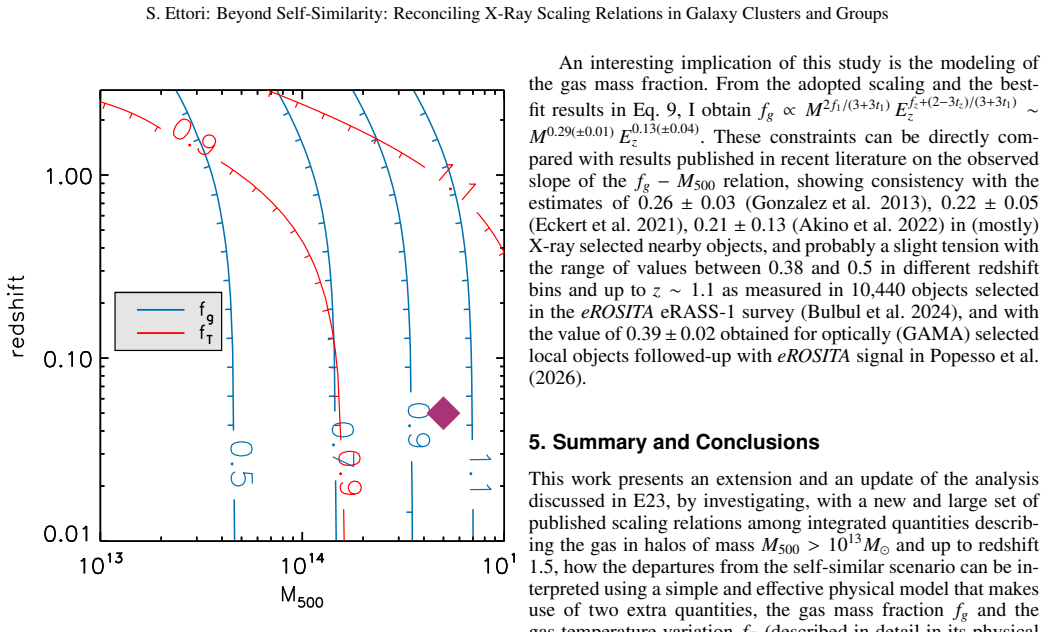
- The gas mass fraction decreases significantly with decreasing halo mass but shows negligible redshift evolution.
- The temperature variation factor increases mildly with both mass and redshift.
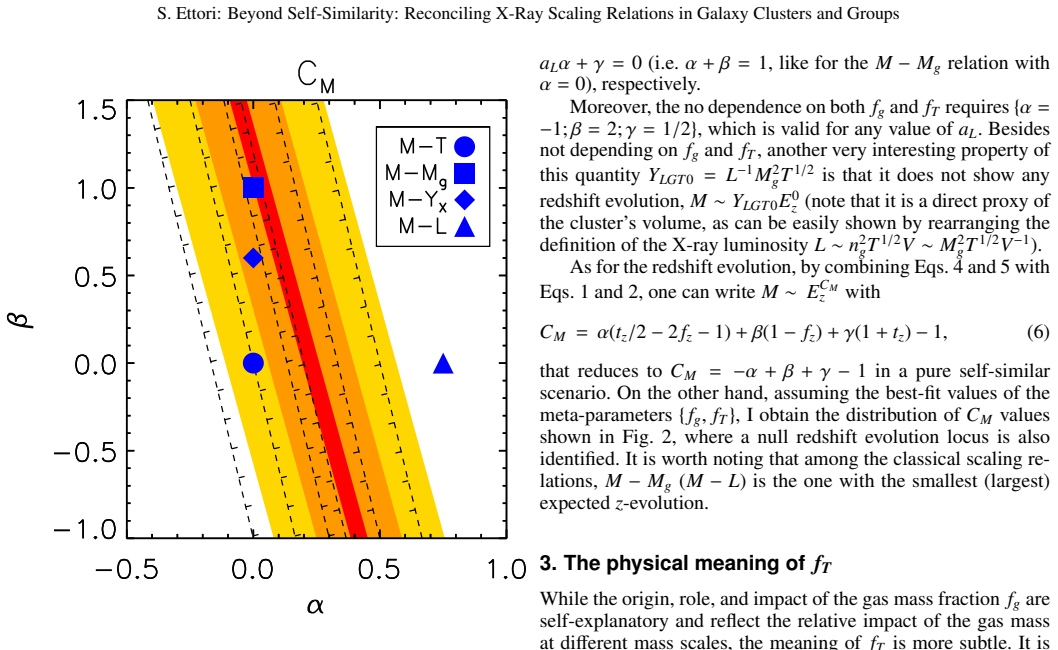
- The quantity Y_LGT0 = L^{-1} M_g^2 T^{1/2} relates directly to total mass with no redshift evolution and no dependence on fg or fT.
- Only four of the 39 relations remain in >3 sigma tension and can be flagged as peculiar.
Where Pith is reading between the lines
- The same parametrization could be inserted into numerical simulations to test whether the recovered exponents match the baryonic physics that is actually implemented.
- Extending the power-law form to higher-redshift or lower-mass systems would provide a direct test of whether additional terms become necessary.
- Because Y_LGT0 is constructed to be independent of fg and fT, any observed deviation from the predicted mass scaling would point to a breakdown in the underlying assumptions rather than in the correction factors.
Load-bearing premise
The temperature and redshift dependencies of fg and fT modeled as power laws capture all physical departures from self-similarity across the observed mass and redshift range without systematic bias from the choice of the 39 relations.
What would settle it
A new compilation of scaling relations, independent of the original 39, that still shows more than 11 percent in >3 sigma tension after the fg and fT corrections are applied would falsify the model.
Figures

read the original abstract
Scaling relations hold among observed quantities that describe the thermodynamic properties of the gas in galaxy clusters and groups. However, observed data show systematic departures from the self-similar model's baseline predictions, particularly in lower-mass systems. I show that the observed departures from self-similar predictions can be efficiently described by two physical quantities modeled with power laws: the gas mass fraction ($f_g \sim T^{f_1} E_z^{f_z}$) and the temperature variation ($f_T \sim T^{t_1} E_z^{t_z}$). Using a large variety of published X-ray scaling relations, this study proceeds with an MCMC-based meta-analysis to constrain the temperature- and redshift-dependence of the meta-parameters $f_g$ and $f_T$ to calibrate the model. These calibrations indicate that, while the gas mass fraction ($f_g$) does not show significant evolution with cosmic time ($f_z = -0.11 \pm 0.03$), it decreases significantly with decreasing halo mass ($f_1 = 0.50 \pm 0.01$). On the other hand, the temperature variation shows a mild positive increase with both mass and redshift. Overall, modeling the departures from the self-similar model with $\{f_g, f_T\}$ drastically improves predictive accuracy, reducing the number of scaling relations in $>3\sigma$ ($>5 \sigma$) tension from 49 (36) percent under the self-similar scenario to just 11 (3) percent (four and one out of 39, respectively) that might be identified for their peculiarity. Moreover, the modelization through the generalized form allows me to present an extended discussion of the expected slopes and redshift evolution for several X-ray scaling laws, including the new quantity $Y_{LGT0} = L^{-1} M_g^2 T^{1/2}$, a proxy for the cluster's volume which does not depend on $f_g$ and $f_T$ by construction, and is predicted to relate directly to the mass without any redshift evolution: $M \sim Y_{LGT0} f_g^0 f_T^0 E_z^0$.
Editorial analysis
A structured set of objections, weighed in public.
Referee Report
Summary. The manuscript presents a meta-analysis of 39 published X-ray scaling relations for galaxy clusters and groups. It introduces two meta-parameters, fg (gas mass fraction, modeled as ~T^{f1} E_z^{fz}) and fT (temperature variation, ~T^{t1} E_z^{tz}), constrained via MCMC from the observed slopes and normalizations. The central claim is that this four-parameter model accounts for departures from self-similarity, reducing the fraction of relations in >3σ (>5σ) tension from 49% (36%) to 11% (3%), while also predicting a new mass proxy Y_LGT0 = L^{-1} M_g^2 T^{1/2} that is independent of fg and fT by construction and shows no redshift evolution.
Significance. If independently validated, the parameterization offers a compact, physically motivated way to capture non-self-similar behavior across mass and redshift, and the derived Y_LGT0 provides a falsifiable prediction for a volume proxy. The approach could streamline comparisons between observations and simulations, but its current evidential weight rests on the in-sample fit rather than out-of-sample tests.
major comments (3)
- [Abstract / MCMC meta-analysis] Abstract and MCMC meta-analysis section: the four meta-parameters (f1, fz, t1, tz) are constrained directly from the measured slopes/normalizations of the same 39 relations whose tension statistics are then recomputed. No cross-validation, hold-out set, or dof-adjusted metric is described, so the drop from 49% to 11% in >3σ tension is an in-sample result whose improvement is expected from the added degrees of freedom.
- [Abstract] Abstract: the claim that power-law forms in T and E_z are sufficient to capture all physical departures is presented without a quantitative test against raw cluster data, hydrodynamical simulations, or an explicit check for residual trends after the fit.
- [Abstract] Abstract: selection of the 39 published relations is not shown to be free of systematic bias (e.g., publication bias toward relations that deviate from self-similarity), which could inflate the apparent improvement when the same sample is used for both calibration and tension evaluation.
minor comments (2)
- [Abstract / Methods] Notation for fg and fT is introduced in the abstract but the explicit functional forms (including the four free parameters) should be stated once in a dedicated equation early in the methods.
- [Abstract] The new quantity Y_LGT0 is defined in the abstract; a short derivation showing why it is independent of fg and fT would improve clarity.
Simulated Author's Rebuttal
We thank the referee for the constructive and detailed comments. We address each major comment below, acknowledging limitations where they exist and outlining planned revisions to improve the manuscript.
read point-by-point responses
-
Referee: Abstract and MCMC meta-analysis section: the four meta-parameters (f1, fz, t1, tz) are constrained directly from the measured slopes/normalizations of the same 39 relations whose tension statistics are then recomputed. No cross-validation, hold-out set, or dof-adjusted metric is described, so the drop from 49% to 11% in >3σ tension is an in-sample result whose improvement is expected from the added degrees of freedom.
Authors: We agree that the analysis is performed in-sample on the same ensemble of relations. The MCMC procedure derives a single set of physically motivated meta-parameters that are then used to evaluate consistency across the relations. While the improvement is partly expected from the added flexibility, the fact that four parameters reconcile the majority of diverse relations supports the model's utility. In revision we will add an explicit discussion of effective degrees of freedom and include a leave-one-out cross-validation exercise to quantify robustness. revision: partial
-
Referee: Abstract: the claim that power-law forms in T and E_z are sufficient to capture all physical departures is presented without a quantitative test against raw cluster data, hydrodynamical simulations, or an explicit check for residual trends after the fit.
Authors: The manuscript is a meta-analysis of published scaling relations rather than a direct fit to raw cluster catalogs or simulation outputs. The power-law parameterization is adopted as the minimal functional form capable of capturing the dominant observed trends in fg and fT. We will add a dedicated paragraph in the discussion section comparing the derived meta-parameters to trends reported in hydrodynamical simulations and note that residual-trend checks on individual cluster samples lie outside the present scope. revision: partial
-
Referee: Abstract: selection of the 39 published relations is not shown to be free of systematic bias (e.g., publication bias toward relations that deviate from self-similarity), which could inflate the apparent improvement when the same sample is used for both calibration and tension evaluation.
Authors: The 39 relations were assembled from the literature on X-ray scaling relations for clusters and groups that report both slope and normalization. We will expand the methods section to document the exact selection criteria and add a limitations paragraph discussing possible publication bias. Because the improvement is observed across relations spanning different mass and redshift ranges, we believe the result is not driven solely by selection effects, but we acknowledge this cannot be fully excluded without a new, bias-controlled compilation. revision: yes
Circularity Check
MCMC meta-fit of 4 parameters (f1,fz,t1,tz) to the 39 relations, then tension recomputed on the identical set, turning the drop from 49% to 11% >3σ outliers into an in-sample result
specific steps
-
fitted input called prediction
[Abstract]
"Using a large variety of published X-ray scaling relations, this study proceeds with an MCMC-based meta-analysis to constrain the temperature- and redshift-dependence of the meta-parameters fg and fT to calibrate the model. ... modeling the departures from the self-similar model with {fg, fT} drastically improves predictive accuracy, reducing the number of scaling relations in >3σ (>5 σ) tension from 49 (36) percent under the self-similar scenario to just 11 (3) percent (four and one out of 39, respectively)"
The four meta-parameters are obtained by MCMC fit to the slopes and normalizations of the identical 39 relations; the tension statistics are then recomputed with those best-fit values on the same relations, so the reported improvement is produced by construction rather than by an independent test.
full rationale
The central claim rests on fitting fg(T,Ez) and fT(T,Ez) power-law parameters directly to the measured slopes/normalizations of the same 39 published scaling relations whose tensions are later reported as reduced. Because the model has four free parameters while self-similar has zero, any reduction in outliers is expected from the extra degrees of freedom; no hold-out, cross-validation or dof-adjusted metric separates calibration from validation. The Y_LGT0 construction is explicitly independent by design and does not participate in the circular step.
Axiom & Free-Parameter Ledger
free parameters (4)
- f1 =
0.50
- fz =
-0.11
- t1
- tz
axioms (2)
- domain assumption The self-similar model supplies the correct baseline slopes and redshift scalings for X-ray relations in the absence of non-gravitational effects.
- domain assumption The collection of published X-ray scaling relations forms an unbiased sample suitable for joint meta-analysis.
Reference graph
Works this paper leans on
-
[1]
i(cm)z, a semi-analytic model for the thermodynamic properties in galaxy clusters: Calibrations with mass and redshift, and implications for the hydrostatic bias. , keywords =. doi:10.1051/0004-6361/202245002 , archivePrefix =. 2211.03082 , primaryClass =
-
[2]
On the Self-Similar Appearance of Galaxy Clusters in X-rays
Modelling self-similar appearance of galaxy clusters in X-rays. , keywords =. doi:10.1051/0004-6361/201118000 , archivePrefix =. 1112.5035 , primaryClass =
work page internal anchor Pith review Pith/arXiv arXiv doi:10.1051/0004-6361/201118000
-
[3]
Galaxy Groups as the Ultimate Probe of AGN Feedback. Galaxies , keywords =. doi:10.3390/galaxies12030024 , archivePrefix =. 2403.17145 , primaryClass =
-
[4]
The hot gas mass fraction in halos: From Milky Way-like groups to massive clusters. , keywords =. doi:10.1051/0004-6361/202453256 , archivePrefix =. 2411.16555 , primaryClass =
-
[5]
The first catalog of galaxy clusters and groups in the Western Galactic Hemisphere
The SRG/eROSITA All-Sky Survey. The first catalog of galaxy clusters and groups in the Western Galactic Hemisphere. , keywords =. doi:10.1051/0004-6361/202348264 , archivePrefix =. 2402.08452 , primaryClass =
-
[6]
XMM-Newton observations of ten high-redshift CAMIRA clusters of galaxies. , keywords =. doi:10.1093/pasj/psag029 , archivePrefix =. 2601.16386 , primaryClass =
-
[7]
Feedback from Active Galactic Nuclei in Galaxy Groups. Universe , keywords =. doi:10.3390/universe7050142 , archivePrefix =. 2106.13259 , primaryClass =
-
[8]
HSC-XXL: Baryon budget of the 136 XXL groups and clusters. , keywords =. doi:10.1093/pasj/psab115 , archivePrefix =. 2111.10080 , primaryClass =
-
[9]
Scaling relations between X-ray properties and weak lensing mass
XXL Survey groups and clusters in the Hyper Suprime-Cam Survey. Scaling relations between X-ray properties and weak lensing mass. , keywords =. doi:10.1093/mnras/stz3425 , archivePrefix =. 1912.02827 , primaryClass =
-
[10]
Predicting Single-Temperature Fit to Multi-Component Thermal Plasma Spectra
Predicting a Single-Temperature Fit to Multicomponent Thermal Plasma Spectra. , keywords =. doi:10.1086/500121 , archivePrefix =. astro-ph/0504098 , primaryClass =
work page internal anchor Pith review Pith/arXiv arXiv doi:10.1086/500121
-
[11]
Observational constraints on the redshift evolution of X-ray scaling relations of galaxy clusters out to z -0.5ex 1.5. , keywords =. doi:10.1051/0004-6361/201116861 , archivePrefix =. 1109.3708 , primaryClass =
work page internal anchor Pith review Pith/arXiv arXiv doi:10.1051/0004-6361/201116861
-
[12]
Scaling Properties of Galaxy Groups. Universe , keywords =. doi:10.3390/universe7050139 , archivePrefix =. 2106.13256 , primaryClass =
-
[13]
The cosmological analysis of X-ray cluster surveys. V. The potential of cluster counts in the 1 < z < 2 range. , keywords =. doi:10.1051/0004-6361/202347699 , archivePrefix =. 2312.04253 , primaryClass =
-
[14]
The SRG/eROSITA all-sky survey: X-ray scaling relations of galaxy groups and clusters in the western Galactic hemisphere. arXiv e-prints , keywords =. doi:10.48550/arXiv.2511.14356 , archivePrefix =. 2511.14356 , primaryClass =
-
[15]
Average X-ray properties of galaxy groups: From Milky Way-like halos to massive clusters. , keywords =. doi:10.1051/0004-6361/202453255 , archivePrefix =. 2411.17120 , primaryClass =
-
[16]
The eROSITA view on the halo mass─temperature relation: From low-mass groups to massive clusters. , keywords =. doi:10.1051/0004-6361/202554352 , archivePrefix =. 2505.01502 , primaryClass =
-
[17]
The impact of strong feedback on galaxy group scaling relations
The impact of strong feedback on galaxy group scaling relations. , keywords =. doi:10.1051/0004-6361/202558334 , archivePrefix =. 2512.04203 , primaryClass =
work page internal anchor Pith review Pith/arXiv arXiv doi:10.1051/0004-6361/202558334
-
[18]
Identification of low redshift groups and clusters of galaxies in the X-CLASS survey and the X-ray luminosity-temperature relation. arXiv e-prints , keywords =. doi:10.48550/arXiv.2603.23195 , archivePrefix =. 2603.23195 , primaryClass =
work page internal anchor Pith review Pith/arXiv arXiv doi:10.48550/arxiv.2603.23195
-
[19]
The gravitational field of X-COP galaxy clusters. , keywords =. doi:10.1051/0004-6361/202142507 , archivePrefix =. 2205.01110 , primaryClass =
-
[20]
Measuring the dynamical state of Planck SZ-selected clusters: X-ray peak - BCG offset
Measuring the dynamical state of Planck SZ-selected clusters: X-ray peak - BCG offset. , keywords =. doi:10.1093/mnras/stw265 , archivePrefix =. 1512.00410 , primaryClass =
work page internal anchor Pith review Pith/arXiv arXiv doi:10.1093/mnras/stw265
-
[21]
The fraction of cool-core clusters in X-ray vs. SZ samples using Chandra observations
The Fraction of Cool-core Clusters in X-Ray versus SZ Samples Using Chandra Observations. , keywords =. doi:10.3847/1538-4357/aa7461 , archivePrefix =. 1703.08690 , primaryClass =
work page internal anchor Pith review Pith/arXiv arXiv doi:10.3847/1538-4357/aa7461
-
[22]
Testing for X-ray-SZ Differences and Redshift Evolution in the X-ray Morphology of Galaxy Clusters
Testing for X-Ray-SZ Differences and Redshift Evolution in the X-Ray Morphology of Galaxy Clusters. , keywords =. doi:10.3847/1538-4357/aa6db4 , archivePrefix =. 1609.00375 , primaryClass =
work page internal anchor Pith review Pith/arXiv arXiv doi:10.3847/1538-4357/aa6db4
-
[23]
Characterization of morphological properties of galaxy groups and clusters
The eROSITA Final Equatorial-Depth Survey (eFEDS). Characterization of morphological properties of galaxy groups and clusters. , keywords =. doi:10.1051/0004-6361/202141639 , archivePrefix =. 2106.15086 , primaryClass =
-
[24]
The Cluster HEritage project with XMM-Newton: Mass Assembly and Thermodynamics at the Endpoint of structure formation. I. Programme overview. , keywords =. doi:10.1051/0004-6361/202039632 , archivePrefix =. 2010.11972 , primaryClass =
-
[25]
CHEX-MATE: Morphological analysis of the sample. , keywords =. doi:10.1051/0004-6361/202243470 , archivePrefix =. 2205.11326 , primaryClass =
-
[26]
Hydrostatic Chandra X-ray analysis of SPT-selected galaxy clusters - I. Evolution of profiles and core properties. , keywords =. doi:10.1093/mnras/stx2796 , archivePrefix =. 1705.09299 , primaryClass =
work page internal anchor Pith review Pith/arXiv arXiv doi:10.1093/mnras/stx2796
-
[27]
Mapping `out-of-the-box' the properties of the baryons in massive halos. , keywords =. doi:10.1051/0004-6361/202244068 , archivePrefix =. 2206.08382 , primaryClass =
-
[28]
Linking a universal gas density profile to the core-excised X-ray luminosity in galaxy clusters up to z 1.1. , keywords =. doi:10.1051/0004-6361/202243074 , archivePrefix =. 2206.06656 , primaryClass =
-
[29]
arXiv e-prints , keywords =
The Evolution and Mass Dependence of Galaxy Cluster Pressure Profiles at 0.05 z 0.60 and 4 10^ 14 M _ M _ 500 30 10^ 14 M _. arXiv e-prints , keywords =
-
[30]
The physics inside the scaling relations for X-ray galaxy clusters: gas clumpiness, gas mass fraction and slope of the pressure profile. , keywords =. doi:10.1093/mnras/stu2292 , archivePrefix =. 1410.8522 , primaryClass =
work page internal anchor Pith review Pith/arXiv arXiv doi:10.1093/mnras/stu2292
-
[31]
From universal profiles to universal scaling laws in X-ray galaxy clusters. , keywords =. doi:10.1051/0004-6361/202038586 , archivePrefix =. 2010.04192 , primaryClass =
-
[32]
A Millimetre/Submillimetre Probe of the Warm and Hot Universe
Astrophysics with the Spatially and Spectrally Resolved Sunyaev-Zeldovich Effects. A Millimetre/Submillimetre Probe of the Warm and Hot Universe. , keywords =. doi:10.1007/s11214-019-0581-2 , archivePrefix =. 1811.02310 , primaryClass =
-
[33]
The effects of baryonic cooling on the concentration-mass relation. , keywords =. doi:10.1111/j.1365-2966.2012.21302.x , archivePrefix =. 1111.5780 , primaryClass =
-
[34]
Weak-lensing Analysis of X-Ray-selected XXL Galaxy Groups and Clusters with Subaru HSC Data. , keywords =. doi:10.3847/1538-4357/ab6bca , archivePrefix =. 1909.10524 , primaryClass =
-
[35]
doi:10.1093/mnras/222.2.323 , keywords =
Evolution and clustering of rich clusters. , keywords =. doi:10.1093/mnras/222.2.323 , adsurl =
-
[36]
The galaxy cluster mass scale and its impact on cosmological constraints from the cluster population
The Galaxy Cluster Mass Scale and Its Impact on Cosmological Constraints from the Cluster Population. , keywords =. doi:10.1007/s11214-019-0591-0 , archivePrefix =. 1902.10837 , primaryClass =
work page internal anchor Pith review Pith/arXiv arXiv doi:10.1007/s11214-019-0591-0 1902
-
[37]
Pointing to the minimum scatter: the generalized scaling relations for galaxy clusters. , keywords =. doi:10.1111/j.1365-2966.2011.20318.x , archivePrefix =. 1111.1693 , primaryClass =
-
[38]
The generalized scaling relations for X-ray galaxy clusters: the most powerful mass proxy
The generalized scaling relations for X-ray galaxy clusters: the most powerful mass proxy. , keywords =. doi:10.1093/mnras/stt1368 , archivePrefix =. 1307.7157 , primaryClass =
work page internal anchor Pith review Pith/arXiv arXiv doi:10.1093/mnras/stt1368
-
[39]
Simulating Groups and the IntraGroup Medium: The Surprisingly Complex and Rich Middle Ground between Clusters and Galaxies. Universe , keywords =. doi:10.3390/universe7070209 , archivePrefix =. 2106.13257 , primaryClass =
-
[40]
Scaling Properties of a Complete X-ray Selected Galaxy Group Sample
Scaling properties of a complete X-ray selected galaxy group sample. , keywords =. doi:10.1051/0004-6361/201423954 , archivePrefix =. 1409.3845 , primaryClass =
work page internal anchor Pith review Pith/arXiv arXiv doi:10.1051/0004-6361/201423954
-
[41]
X-Ray morphological analysis of the Planck ESZ clusters
X-Ray Morphological Analysis of the Planck ESZ Clusters. , keywords =. doi:10.3847/1538-4357/aa855f , archivePrefix =. 1708.02590 , primaryClass =
work page internal anchor Pith review Pith/arXiv arXiv doi:10.3847/1538-4357/aa855f
-
[42]
X-Ray Scaling Relations for a Representative Sample of Planck-selected Clusters Observed with XMM-Newton. , keywords =. doi:10.3847/1538-4357/ab7997 , archivePrefix =. 2002.11740 , primaryClass =
-
[43]
Planck early results. XI. Calibration of the local galaxy cluster Sunyaev-Zeldovich scaling relations. , keywords =. doi:10.1051/0004-6361/201116458 , archivePrefix =. 1101.2026 , primaryClass =
work page internal anchor Pith review Pith/arXiv arXiv doi:10.1051/0004-6361/201116458 2026
-
[44]
Planck intermediate results. V. Pressure profiles of galaxy clusters from the Sunyaev-Zeldovich effect. , keywords =. 2013. doi:10.1051/0004-6361/201220040 , archivePrefix =. 1207.4061 , primaryClass =
work page internal anchor Pith review Pith/arXiv arXiv doi:10.1051/0004-6361/201220040 2013
-
[45]
Additional planets and stellar models
Measuring the escape velocity and mass profiles of galaxy clusters beyond their virial radius. , archivePrefix = "arXiv", eprint =. doi:10.1111/j.1365-2966.2010.17946.x , adsurl =
-
[46]
, archivePrefix = "arXiv", eprint =
A Systematic Analysis of Caustic Methods for Galaxy Cluster Masses. , archivePrefix = "arXiv", eprint =. doi:10.1088/0004-637X/773/2/116 , adsurl =
-
[47]
, archivePrefix = "arXiv", eprint =
Stacking Caustic Masses from Galaxy Clusters. , archivePrefix = "arXiv", eprint =. doi:10.3847/1538-4357/834/2/204 , adsurl =
-
[48]
The Heated Core of the Radio-quiet Galaxy Cluster A644. , eprint =. doi:10.1086/432045 , adsurl =
-
[49]
, archivePrefix = "arXiv", eprint =
Radio spectral study of the cluster of galaxies Abell 2255. , archivePrefix = "arXiv", eprint =. doi:10.1051/0004-6361/200912465 , adsurl =
-
[50]
Evidence for an On-going Cluster/Group Merger in Abell 2255. , keywords =. doi:10.1086/175817 , adsurl =
-
[51]
XMM-Newton observations of Abell 2255: a test case of a merger after `core crossing'. , eprint =. doi:10.1111/j.1365-2966.2006.10080.x , adsurl =
-
[52]
ArXiv e-prints , archivePrefix = "arXiv", eprint =
The Massively Accreting Cluster A2029. ArXiv e-prints , archivePrefix = "arXiv", eprint =
-
[53]
, archivePrefix = "arXiv", eprint =
What Do the Hitomi Observations Tell Us About the Turbulent Velocities in the Perseus Cluster? Probing the Velocity Field with Mock Observations. , archivePrefix = "arXiv", eprint =. doi:10.3847/1538-4357/aaa4b3 , adsurl =
-
[54]
, archivePrefix = "arXiv", eprint =
The quiescent intracluster medium in the core of the Perseus cluster. , archivePrefix = "arXiv", eprint =. doi:10.1038/nature18627 , adsurl =
-
[55]
, archivePrefix = "arXiv", eprint =
Atmospheric gas dynamics in the Perseus cluster observed with Hitomi. , archivePrefix = "arXiv", eprint =. doi:10.1093/pasj/psx138 , adsurl =
-
[56]
The Chemical Composition of the Sun. , keywords =. doi:10.1146/annurev.astro.46.060407.145222 , archivePrefix =. 0909.0948 , primaryClass =
-
[57]
Abundances of the elements - Meteoritic and solar. , keywords =. doi:10.1016/0016-7037(89)90286-X , adsurl =
-
[58]
, archivePrefix = "arXiv", eprint =
Constraining hydrostatic mass bias of galaxy clusters with high-resolution X-ray spectroscopy. , archivePrefix = "arXiv", eprint =. doi:10.1093/pasj/psy040 , adsurl =
-
[59]
, archivePrefix = "arXiv", eprint =
Shaken Snow Globes: Kinematic Tracers of the Multiphase Condensation Cascade in Massive Galaxies, Groups, and Clusters. , archivePrefix = "arXiv", eprint =. doi:10.3847/1538-4357/aaaa1b , adsurl =
-
[60]
MULTINEST: an efficient and robust Bayesian inference tool for cosmology and particle physics. , archivePrefix = "arXiv", eprint =. doi:10.1111/j.1365-2966.2009.14548.x , adsurl =
-
[61]
ArXiv e-prints , archivePrefix = "arXiv", eprint =
Three problems about multi-scale modelling in cosmology. ArXiv e-prints , archivePrefix = "arXiv", eprint =
-
[62]
, archivePrefix = "arXiv", eprint =
A textbook example of ram-pressure stripping in the Hydra A/A780 cluster. , archivePrefix = "arXiv", eprint =. doi:10.1051/0004-6361/201526641 , adsurl =
-
[63]
, archivePrefix = "arXiv", eprint =
Thermal SZ fluctuations in the ICM: probing turbulence and thermodynamics in Coma cluster with Planck. , archivePrefix = "arXiv", eprint =. doi:10.1093/mnras/stw2027 , adsurl =
-
[64]
, archivePrefix = "arXiv", eprint =
Identification of Members in the Central and Outer Regions of Galaxy Clusters. , archivePrefix = "arXiv", eprint =. doi:10.1088/0004-637X/768/2/116 , adsurl =
-
[65]
Are group- and cluster-scale dark matter haloes overconcentrated?. , keywords =. doi:10.1093/mnras/stt1585 , adsurl =
-
[66]
, archivePrefix = "arXiv", eprint =
The MUSIC of CLASH: Predictions on the Concentration-Mass Relation. , archivePrefix = "arXiv", eprint =. doi:10.1088/0004-637X/797/1/34 , adsurl =
-
[67]
, archivePrefix = "arXiv", eprint =
The mass-concentration relation in massive galaxy clusters at redshift 1. , archivePrefix = "arXiv", eprint =. doi:10.1093/mnras/stt1086 , adsurl =
-
[68]
, archivePrefix = "arXiv", eprint =
Effects of Center Offset and Noise on Weak-Lensing Derived Concentration-Mass Relation of Dark Matter Halos. , archivePrefix = "arXiv", eprint =. doi:10.1088/0004-637X/785/1/57 , adsurl =
-
[69]
Dark matter halo concentrations in the Wilkinson Microwave Anisotropy Probe year 5 cosmology. , archivePrefix = "arXiv", eprint =. doi:10.1111/j.1745-3933.2008.00537.x , adsurl =
-
[70]
, archivePrefix = "arXiv", eprint =
Some Aspects of Measurement Error in Linear Regression of Astronomical Data. , archivePrefix = "arXiv", eprint =. doi:10.1086/519947 , adsurl =
-
[71]
, archivePrefix = "arXiv", eprint =
The mass-concentration-redshift relation of cold and warm dark matter haloes. , archivePrefix = "arXiv", eprint =. doi:10.1093/mnras/stw1046 , adsurl =
-
[72]
, archivePrefix = "arXiv", eprint =
CLASH: The Concentration-Mass Relation of Galaxy Clusters. , archivePrefix = "arXiv", eprint =. doi:10.1088/0004-637X/806/1/4 , adsurl =
-
[73]
, archivePrefix = "arXiv", eprint =
A Bayesian approach to linear regression in astronomy. , archivePrefix = "arXiv", eprint =. doi:10.1093/mnras/stv2374 , adsurl =
-
[74]
Bias and scatter in weak lensing and X-ray mass estimates of clusters
Comparing masses in literature (CoMaLit) - I. Bias and scatter in weak lensing and X-ray mass estimates of clusters. , archivePrefix = "arXiv", eprint =. doi:10.1093/mnras/stv810 , adsurl =
-
[75]
Evolution and self-similarity of scaling relations with the galaxy cluster mass
CoMaLit - IV. Evolution and self-similarity of scaling relations with the galaxy cluster mass. , keywords =. doi:10.1093/mnras/stv814 , adsurl =
-
[76]
Weak lensing analysis of the Planck clusters in the CFHTLenS and in the RCSLenS
PSZ2LenS. Weak lensing analysis of the Planck clusters in the CFHTLenS and in the RCSLenS. , archivePrefix = "arXiv", eprint =. doi:10.1093/mnras/stx2085 , adsurl =
-
[77]
, archivePrefix = "arXiv", eprint =
The mass-concentration relation in lensing clusters: the role of statistical biases and selection effects. , archivePrefix = "arXiv", eprint =. doi:10.1093/mnras/stv416 , adsurl =
-
[78]
, archivePrefix = "arXiv", eprint =
CLASH: Weak-lensing Shear-and-magnification Analysis of 20 Galaxy Clusters. , archivePrefix = "arXiv", eprint =. doi:10.1088/0004-637X/795/2/163 , adsurl =
-
[79]
, archivePrefix = "arXiv", eprint =
On the Discrepancy between Theoretical and X-Ray Concentration-Mass Relations for Galaxy Clusters. , archivePrefix = "arXiv", eprint =. doi:10.1088/0004-637X/776/1/39 , adsurl =
-
[80]
New Journal of Physics , archivePrefix = "arXiv", eprint =
Lensing and x-ray mass estimates of clusters (simulations). New Journal of Physics , archivePrefix = "arXiv", eprint =. doi:10.1088/1367-2630/14/5/055018 , adsurl =
discussion (0)
Sign in with ORCID, Apple, or X to comment. Anyone can read and Pith papers without signing in.