Neutron Star Equation of State via Physics Informed Neural Network
Pith reviewed 2026-06-28 21:39 UTC · model grok-4.3
The pith
Two neural networks trained jointly on neutron star observations and the TOV equations yield an equation of state with maximum mass 2.06 solar masses and speed-of-sound softening at 2-4 nuclear densities.
A machine-rendered reading of the paper's core claim, the machinery that carries it, and where it could break.
Core claim
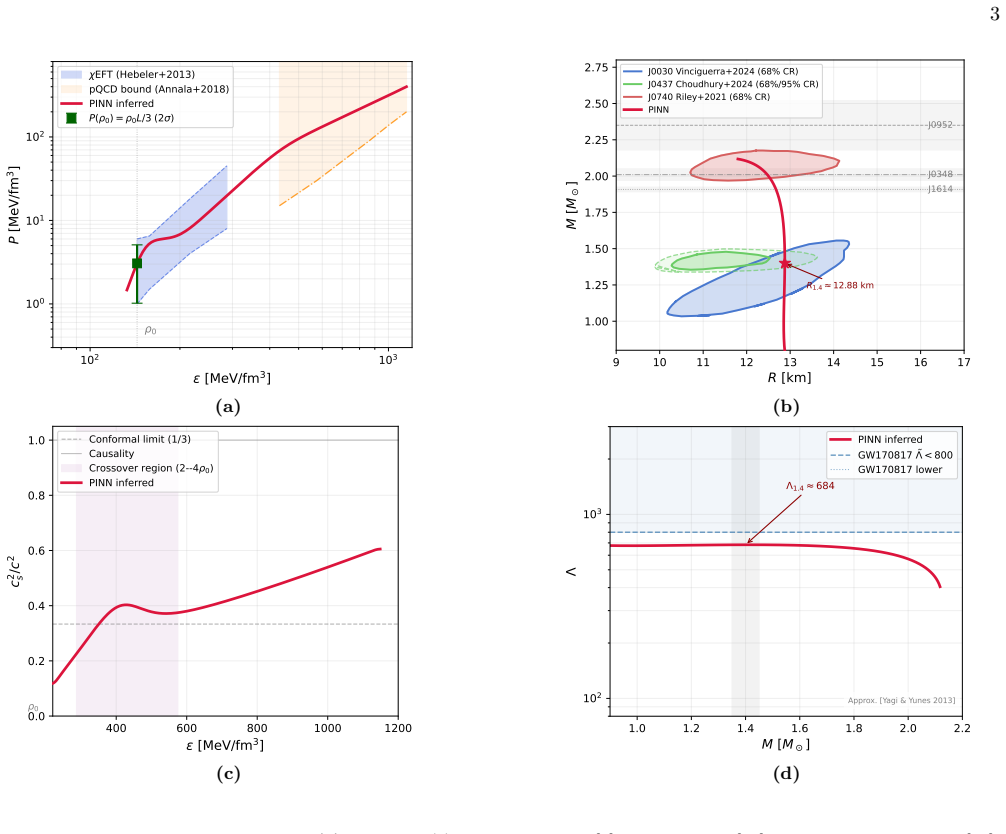
We present the first application of Physics-Informed Neural Networks to the neutron star equation-of-state inverse problem. Two interacting networks—one representing the EOS P(ε) as a continuous, non-parametric function, the other solving the Tolman-Oppenheimer-Volkoff equations—are trained jointly on NICER X-ray timing posteriors and pulsar mass measurements. The TOV equations enter as a mean-square ODE residual enforced via automatic differentiation at every training step. The inferred EOS satisfies nuclear saturation properties, causality, and perturbative QCD bounds simultaneously; χEFT consistency at 1–2ρz emerges without explicit enforcement. Across N=15 independent training runs, M_ma
What carries the argument
Joint training of an EOS-representing network and a TOV-solving network, with the Tolman-Oppenheimer-Volkoff equations imposed as a mean-square residual loss via automatic differentiation.
If this is right
- The inferred equation of state remains causal and satisfies perturbative QCD constraints at high densities by construction.
- Consistency with chiral effective field theory at 1–2 times nuclear saturation density appears automatically as an internal check.
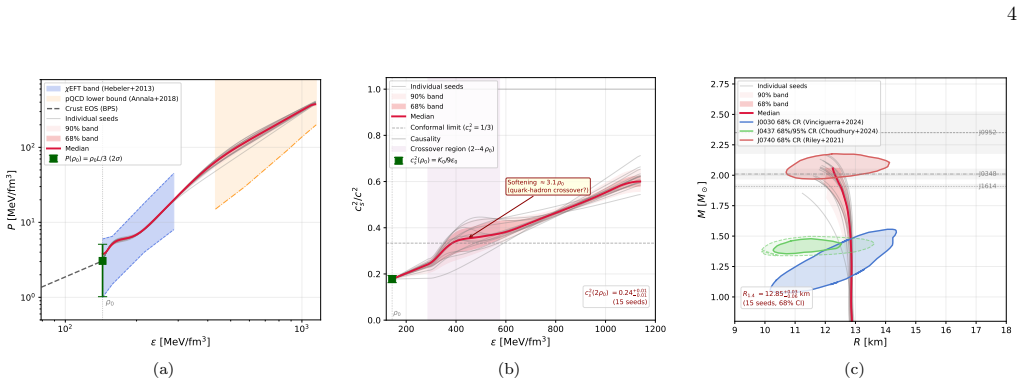
- The speed of sound softens reproducibly between 2 and 4 times nuclear saturation density, indicating a possible quark-hadron crossover.
- Maximum mass, radius, and tidal deformability values agree with recent Bayesian analyses while arising from a non-parametric representation.
Where Pith is reading between the lines
- If the sound-speed softening is robust, it would favor hybrid-star models containing quark matter at densities already present inside observed neutron stars.
- The same joint-training architecture could incorporate gravitational-wave tidal measurements from binary mergers to further restrict the equation of state at intermediate densities.
- Training the networks on mock data generated from known equations of state would quantify how faithfully the method recovers input features.
Load-bearing premise
The joint training on the supplied NICER posteriors and mass measurements produces an unbiased representation of the true high-density equation of state without missing physics outside the enforced bounds and TOV equations.
What would settle it
A confirmed neutron star mass above roughly 2.2 solar masses or a 1.4-solar-mass radius measured outside the narrow 12.7–13.0 km window would place the inferred equation of state in tension with observation.
Figures


read the original abstract
We present the first application, to the best of our knowledge, of Physics-Informed Neural Networks (PINNs) to the neutron star equation-of-state (EOS) inverse problem. Two interacting networks -- one representing the EOS $P(\varepsilon)$ as a continuous, non-parametric function, the other solving the Tolman-Oppenheimer-Volkoff (TOV) equations -- are trained jointly on NICER X-ray timing posteriors and pulsar mass measurements. The TOV equations enter as a mean-square ODE residual enforced via automatic differentiation at every training step, rooted in the Neural Differential Equation framework. The inferred EOS satisfies nuclear saturation properties, causality, and perturbative QCD bounds simultaneously; $\chi$EFT consistency at $1$--$2\rhoz$ emerges without explicit enforcement, providing a non-trivial self-consistency check. Across $N=15$ independent training runs, we find a neutron star maximum mass $M_\mathrm{max}=2.06^{+0.07}_{-0.09}$ and radius and tidal deformability of a 1.4 $M_\odot$ star $R_{1.4}=12.85^{+0.03}_{-0.06}$~km and $\Lambda_{1.4}=684$, respectively, with 68\% CI, in agreement with recent Bayesian analyses. Most interestingly, the speed of sound exhibits a reproducible softening at $2$--$4\,\rhoz$, consistent with a quark-hadron crossover.
Editorial analysis
A structured set of objections, weighed in public.
Referee Report
Summary. The paper presents the first application of Physics-Informed Neural Networks (PINNs) to the neutron star equation-of-state inverse problem. Two interacting networks—one representing the EOS P(ε) as a continuous function and the other solving the TOV equations—are trained jointly on NICER X-ray timing posteriors and pulsar mass measurements. The TOV equations enter as a mean-square ODE residual enforced via automatic differentiation. The inferred EOS satisfies nuclear saturation, causality, and pQCD bounds; χEFT consistency at 1–2ρ_z emerges without explicit enforcement. Across N=15 independent runs, the results are M_max=2.06^{+0.07}_{-0.09} M_⊙, R_{1.4}=12.85^{+0.03}_{-0.06} km, and Λ_{1.4}=684 (68% CI), with a reproducible sound-speed softening at 2–4ρ_z.
Significance. If the central numerical results hold, the work demonstrates a novel PINN-based framework for EOS inference that directly incorporates the TOV ODE residual and multiple physical constraints during training. The agreement with existing Bayesian analyses, the non-trivial emergence of χEFT consistency, and the reproducibility across independent runs are strengths. The method could complement traditional sampling approaches if training stability and residual convergence are demonstrated.
major comments (2)
- [Abstract/training procedure] Abstract and training-procedure paragraph: the claim that the joint optimization produces an unbiased representation of the high-density EOS rests on the assumption that the network parameterization and loss weighting do not introduce extraneous bias; the manuscript should report the final mean-square TOV residual magnitude and its variation across the N=15 runs to confirm the ODE is satisfied to machine precision.
- [Results] Results paragraph: the reported 68% CI intervals on M_max, R_{1.4}, and Λ_{1.4} are obtained from 15 independent trainings; the manuscript must specify how the ensemble is constructed (e.g., whether each run uses the full NICER posterior or a single draw) because this choice directly affects whether the quoted uncertainties capture both statistical and optimization variability.
minor comments (2)
- The abstract states 'first application, to the best of our knowledge'; a brief literature note on any prior PINN or Neural ODE work in compact-object astrophysics would strengthen the novelty claim.
- The value of Λ_{1.4} is given without uncertainty; adding the 68% CI would make the quoted results consistent with the other quantities.
Simulated Author's Rebuttal
We thank the referee for their constructive comments and positive assessment of our manuscript. We address each major comment below.
read point-by-point responses
-
Referee: [Abstract/training procedure] Abstract and training-procedure paragraph: the claim that the joint optimization produces an unbiased representation of the high-density EOS rests on the assumption that the network parameterization and loss weighting do not introduce extraneous bias; the manuscript should report the final mean-square TOV residual magnitude and its variation across the N=15 runs to confirm the ODE is satisfied to machine precision.
Authors: We agree that explicit reporting of the TOV residual is necessary to substantiate convergence. In the revised manuscript we will add the final mean-square TOV residual values (mean and standard deviation across the 15 runs) in the training-procedure section. revision: yes
-
Referee: [Results] Results paragraph: the reported 68% CI intervals on M_max, R_{1.4}, and Λ_{1.4} are obtained from 15 independent trainings; the manuscript must specify how the ensemble is constructed (e.g., whether each run uses the full NICER posterior or a single draw) because this choice directly affects whether the quoted uncertainties capture both statistical and optimization variability.
Authors: We appreciate the request for clarification. Each of the 15 runs employs the full NICER posterior in the likelihood term, with differences arising only from random weight initialization. We will state this explicitly in the methods section of the revised manuscript. revision: yes
Circularity Check
No significant circularity identified
full rationale
The derivation infers the EOS via joint optimization of two networks against external NICER posteriors and pulsar mass data, with the TOV residual enforced as an independent ODE constraint via automatic differentiation; nuclear saturation, causality, and pQCD bounds are imposed as separate hard constraints rather than fitted outputs. Emergent chiEFT consistency at low density and the sound-speed softening are presented as non-enforced checks that survive across independent runs, and the reported M_max, R_1.4, and Lambda_1.4 values are stated to lie within existing Bayesian ranges. No load-bearing step reduces by construction to a self-citation, a renamed fit, or an ansatz smuggled from prior author work; the central claim remains falsifiable against the supplied external likelihoods and independent physical bounds.
Axiom & Free-Parameter Ledger
free parameters (1)
- Neural network weights and biases
axioms (2)
- standard math Tolman-Oppenheimer-Volkoff equations describe hydrostatic equilibrium in neutron stars
- domain assumption Inferred EOS must satisfy nuclear saturation properties, causality, and perturbative QCD bounds
Reference graph
Works this paper leans on
-
[1]
Raaijmakerset al., Constraints on the dense mat- ter equation of state and neutron star properties from NICER spectral-timing measurements, Astrophys
G. Raaijmakerset al., Constraints on the dense mat- ter equation of state and neutron star properties from NICER spectral-timing measurements, Astrophys. J. Lett.918, L29 (2021)
2021
-
[2]
Milleret al., The radius of PSR J0740+6620 from NICER and XMM-Newton data, Astrophys
M. Milleret al., The radius of PSR J0740+6620 from NICER and XMM-Newton data, Astrophys. J. Lett.918, L28 (2021)
2021
-
[3]
Panget al., Nuclear-physics multimessenger astro- physics constraints on the neutron-star equation of state, Astrophys
P. Panget al., Nuclear-physics multimessenger astro- physics constraints on the neutron-star equation of state, Astrophys. J.922, 14 (2021)
2021
-
[4]
Legred, K
I. Legred, K. Chatziioannou, R. Essick, S. Han, and P. Landry, Impact of the PSR J0740+6620 radius con- straint on the properties of high-density matter, Phys. Rev. D104, 063003 (2021)
2021
-
[5]
Annala, T
E. Annala, T. Gorda, J. Hirvonen, A. Kurkela, J. Parkki- nen, and A. Vuorinen, Strongly interacting matter ex- hibits deconfined behavior in massive neutron stars, Nat. Commun.14, 8451 (2023)
2023
-
[6]
Vinciguerraet al., An updated mass-radius analysis of the 2017-2018 NICER data set of PSR J0030+0451, Astrophys
S. Vinciguerraet al., An updated mass-radius analysis of the 2017-2018 NICER data set of PSR J0030+0451, Astrophys. J.961, 62 (2024)
2017
-
[7]
Fonsecaet al., Refined mass and geometric measure- ments of the high-mass PSR J0740+6620, Astrophys
E. Fonsecaet al., Refined mass and geometric measure- ments of the high-mass PSR J0740+6620, Astrophys. J. Lett.915, L12 (2021)
2021
-
[8]
Antoniadiset al., A massive pulsar in a compact rela- tivistic binary, Science340, 448 (2013)
J. Antoniadiset al., A massive pulsar in a compact rela- tivistic binary, Science340, 448 (2013)
2013
-
[9]
Hebeler, J
K. Hebeler, J. Lattimer, C. Pethick, and A. Schwenk, Equation of state and neutron star properties constrained by nuclear physics and observation, Astrophys. J.773, 11 (2013)
2013
-
[10]
Lindblom, Spectral representations of neutron-star equations of state, Phys
L. Lindblom, Spectral representations of neutron-star equations of state, Phys. Rev. D82, 103011 (2010)
2010
-
[11]
Landry and R
P. Landry and R. Essick, Nonparametric inference of the neutron star equation of state from gravitational wave observations, Phys. Rev. D99, 084049 (2019)
2019
-
[12]
Raissi, P
M. Raissi, P. Perdikaris, and G. Karniadakis, Physics- informed neural networks: A deep learning framework for solving forward and inverse problems involving nonlinear partial differential equations, J. Comput. Phys.378, 686 (2019)
2019
-
[13]
R. T. Chen, Y. Rubanova, J. Bettencourt, and D. Duve- naud, Neural ordinary differential equations, inAdvances in Neural Information Processing Systems, Vol. 31 (2018) arXiv:1806.07366
work page internal anchor Pith review Pith/arXiv arXiv 2018
-
[14]
Rileyet al., A NICER view of the massive pulsar PSR J0740+6620 informed by radio timing and XMM-Newton spectroscopy, Astrophys
T. Rileyet al., A NICER view of the massive pulsar PSR J0740+6620 informed by radio timing and XMM-Newton spectroscopy, Astrophys. J. Lett.918, L27 (2021)
2021
-
[15]
Choudhuryet al., A NICER view of the nearest and brightest millisecond pulsar: PSR J0437-4715, Astro- phys
D. Choudhuryet al., A NICER view of the nearest and brightest millisecond pulsar: PSR J0437-4715, Astro- phys. J. Lett.971, L20 (2024)
2024
-
[16]
LIGO Scientific Collaboration and Virgo Collaboration, GW170817: Measurements of neutron star radii and equation of state, Phys. Rev. Lett.121, 161101 (2018)
2018
-
[17]
Romaniet al., PSR J0952-0607: The fastest and heav- iest known galactic neutron star, Astrophys
R. Romaniet al., PSR J0952-0607: The fastest and heav- iest known galactic neutron star, Astrophys. J. Lett.934, L17 (2022)
2022
-
[18]
Tolman, Static solutions of Einstein’s field equations for spheres of fluid, Phys
R. Tolman, Static solutions of Einstein’s field equations for spheres of fluid, Phys. Rev.55, 364 (1939)
1939
-
[19]
Oppenheimer and G
J. Oppenheimer and G. Volkoff, On massive neutron cores, Phys. Rev.55, 374 (1939)
1939
-
[20]
Stone, N
J. Stone, N. Stone, and S. Moszkowski, Incompressibility in finite nuclei and nuclear matter, Phys. Rev. C89, 044316 (2014)
2014
-
[21]
Oertel, M
M. Oertel, M. Hempel, T. Kl¨ ahn, and S. Typel, Equa- tions of state for supernovae and compact stars, Rev. Mod. Phys.89, 015007 (2017)
2017
-
[22]
Lattimer and M
J. Lattimer and M. Prakash, The equation of state of hot, dense matter and neutron stars, Phys. Rep.621, 127 (2016)
2016
-
[23]
Annala, T
E. Annala, T. Gorda, A. Kurkela, J. N¨ attil¨ a, and A. Vuorinen, Evidence for quark-matter cores in massive neutron stars, Nat. Phys.16, 907 (2020)
2020
-
[24]
Annala, T
E. Annala, T. Gorda, A. Kurkela, and A. Vuori- nen, Gravitational-wave constraints on the neutron-star- matter equation of state, Phys. Rev. Lett.120, 172703 (2018)
2018
-
[25]
Yagi and N
K. Yagi and N. Yunes, I-love-Q: Unexpected universal relations for neutron stars and quark stars, Science341, 365 (2013)
2013
-
[26]
Dempster, N
A. Dempster, N. Laird, and D. Rubin, Maximum likeli- hood from incomplete data via the EM algorithm, J. R. Stat. Soc. Ser. B39, 1 (1977)
1977
-
[27]
Adam: A Method for Stochastic Optimization
D. Kingma and J. Ba, Adam: A method for stochas- tic optimization, Int. Conf. Learn. Represent. (2015), arXiv:1412.6980
work page internal anchor Pith review Pith/arXiv arXiv 2015
-
[28]
Drischleret al., How well do we know the neutron- matter equation of state and the radius of a medium-mass neutron star?, Phys
C. Drischleret al., How well do we know the neutron- matter equation of state and the radius of a medium-mass neutron star?, Phys. Rev. Lett.125, 202702 (2020)
2020
-
[29]
D. Mroczek, M. Miller, J. Noronha-Hostler, and N. Yunes, Nontrivial features in the speed of sound in- side neutron stars, Phys. Rev. D110, 123009 (2024), arXiv:2309.02345
-
[30]
Ecker and L
C. Ecker and L. Rezzolla, Impact of large-mass con- straints on the properties of neutron stars, Astrophys. J. Lett.939, L35 (2022)
2022
-
[31]
Hinderer, Tidal love numbers of neutron stars, Astro- phys
T. Hinderer, Tidal love numbers of neutron stars, Astro- phys. J.677, 1216 (2008)
2008
discussion (0)
Sign in with ORCID, Apple, or X to comment. Anyone can read and Pith papers without signing in.