The first hours and days of the 2021 explosion of the recurrent symbiotic nova RS Ophiuchii
Pith reviewed 2026-06-27 05:53 UTC · model grok-4.3
The pith
Bipolar ejecta in RS Oph form from white dwarf rotation and power shocks that reprocess into the pseudophotosphere.
A machine-rendered reading of the paper's core claim, the machinery that carries it, and where it could break.
Core claim
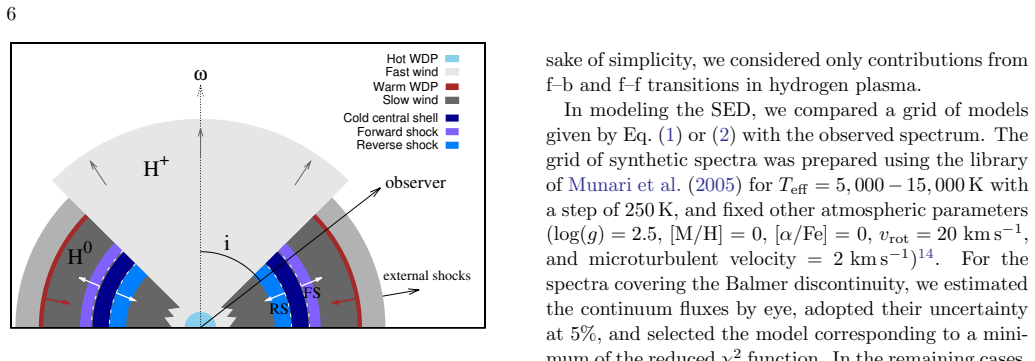
Our SED models revealed an early stage of development of the ejecta bipolar structure, consisting of a flared, density-enhanced equatorial disk and low-density regions in bipolar directions. The comparability of the internal shocks' luminosity in the equatorial outflow, inferred from our model parameters, with the luminosity of the warm WD pseudophotosphere during its presence in the spectrum (until ∼day 42) confirmed that a significant part of its radiation originates from reprocessed shock emission. We explain the formation and evolution of the bipolar ejecta structure during RS Oph explosions by the rotation of the accreting WD. Such an ejecta structure provides a natural framework for th
What carries the argument
The bipolar ejecta structure with a flared density-enhanced equatorial disk and low-density bipolar regions, whose formation is attributed to rotation of the accreting white dwarf.
If this is right
- Rotation of the accreting white dwarf sets the bipolar geometry of the ejecta in RS Oph explosions.
- Internal shocks in the equatorial outflow reprocess energy that supplies a significant fraction of the pseudophotosphere luminosity until day 42.
- The resulting structure generates strong internal shocks capable of producing gamma-ray emission inside the ejecta.
- The same ejecta geometry and shock reprocessing operated in the 2006 and 1985 outbursts of RS Oph.
Where Pith is reading between the lines
- If white dwarf spin controls the ejecta opening angle, future high-resolution observations could constrain the rotation period directly from the bipolar structure.
- Gamma-ray monitoring campaigns timed to the first weeks after outburst could test the predicted internal-shock luminosities.
- The reprocessing channel may operate in other recurrent novae and could reduce the need to invoke separate energy sources to match observed light curves.
Load-bearing premise
The observed spectrum can be decomposed into a flared equatorial disk plus low-density bipolar regions such that the calculated internal-shock luminosity directly accounts for the pseudophotosphere output without other major contributions.
What would settle it
High-resolution imaging or spectroscopy that shows no equatorial density enhancement matching the modeled parameters, or gamma-ray observations that yield fluxes inconsistent with the inferred shock luminosities during the first 42 days.
Figures





read the original abstract
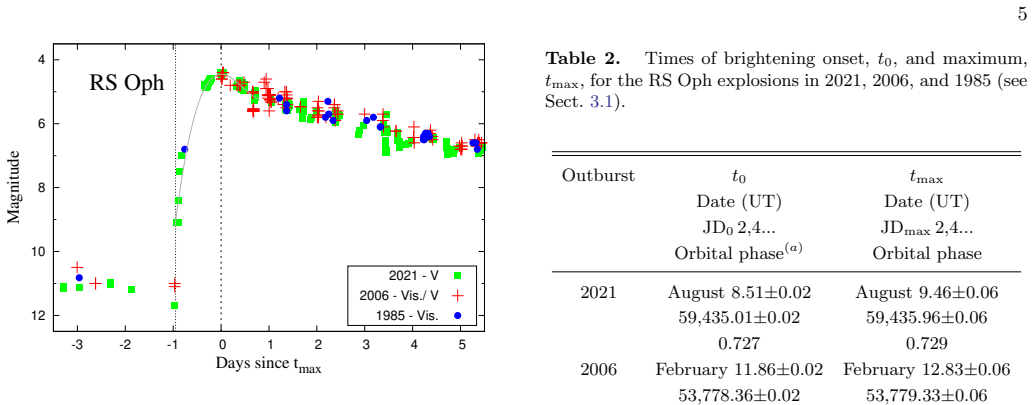
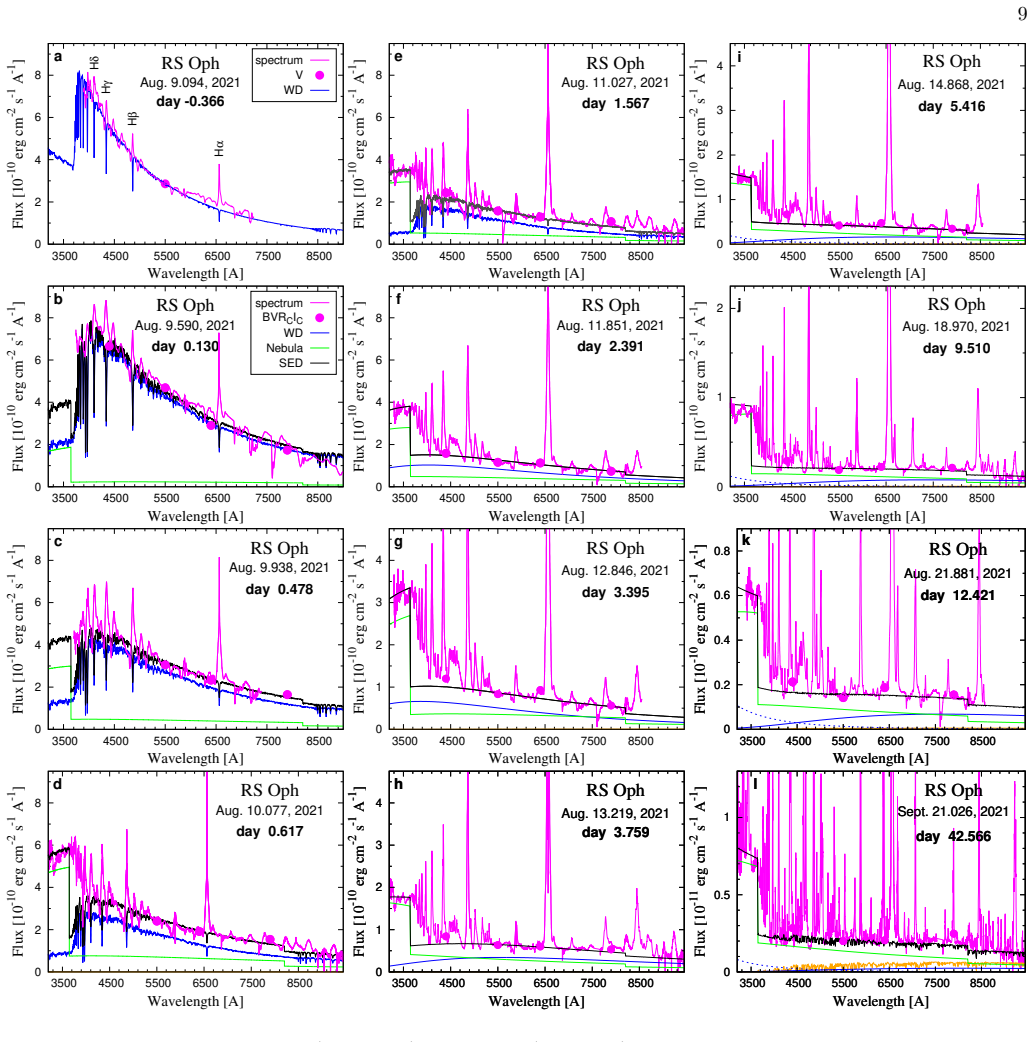
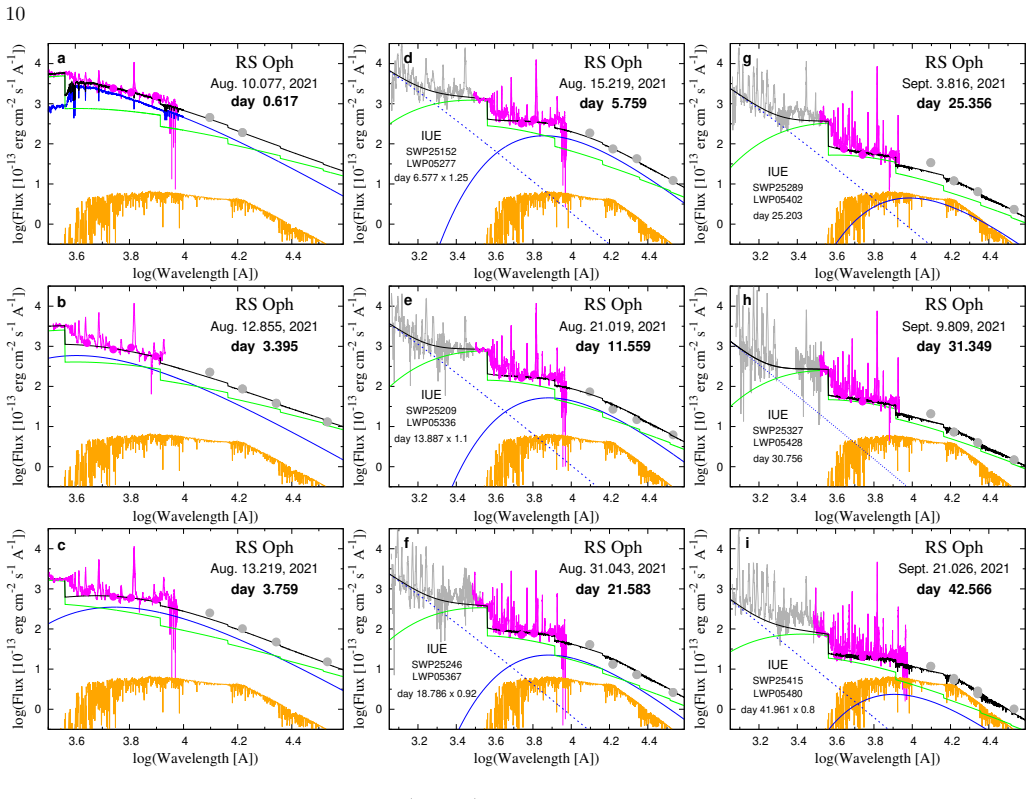
The accretion of matter on a massive white dwarf (WD) can lead to repeated nuclear explosions on its surface over a timescale of years to decades. The seventh explosion of the recurrent symbiotic nova RS Ophiuchi (RS Oph) was recorded on August 8, 2021. In this paper, we examine its early evolution, from 9 hours before its optical maximum until day 42. We achieved our goal by modeling the spectral energy distribution (SED) using optical spectroscopy and simultaneous $BVR_{\rm C}I_{\rm C}$ photometry, supplemented by $JHKL$ photometry and ultraviolet spectroscopy from previous explosions in 2006 and 1985. Our SED models revealed an early stage of development of the ejecta bipolar structure, consisting of a flared, density-enhanced equatorial disk and low-density regions in bipolar directions. The comparability of the internal shocks' luminosity in the equatorial outflow, inferred from our model parameters, with the luminosity of the warm WD pseudophotosphere during its presence in the spectrum (until $\sim$day 42) confirmed that a significant part of its radiation originates from reprocessed shock emission. We explain the formation and evolution of the bipolar ejecta structure during RS Oph explosions by the rotation of the accreting WD. Such an ejecta structure provides a natural framework for the generation of strong internal shocks and thus $\gamma$-ray emission inside the ejecta.
Editorial analysis
A structured set of objections, weighed in public.
Referee Report
Summary. The paper models the spectral energy distribution (SED) of the 2021 RS Ophiuchi explosion from 9 hours before optical maximum to day 42, using optical spectroscopy, BVRcIc photometry, and supplementary JHKL/UV data from the 2006 and 1985 events. The models indicate an early bipolar ejecta structure consisting of a flared, density-enhanced equatorial disk and low-density bipolar regions. The authors infer that the luminosity of internal shocks in the equatorial outflow is comparable to the warm WD pseudophotosphere luminosity (present until ~day 42), confirming that a significant fraction of the pseudophotosphere radiation is reprocessed shock emission. They attribute the bipolar structure to rotation of the accreting WD and note that this geometry naturally generates internal shocks capable of producing gamma-ray emission.
Significance. If the SED decomposition and luminosity comparison hold, the work provides a physically motivated framework for the early geometry and energy budget of recurrent symbiotic novae, linking ejecta morphology directly to WD rotation and internal shocks. This could inform models of gamma-ray production in such systems and the role of reprocessing in the observed pseudophotosphere.
major comments (2)
- [Abstract] Abstract: The abstract states modeling results and conclusions but supplies no information on the functional form of the SED components, fitting procedure, error treatment, or validation against the data, so the support for the central claims cannot be assessed from available text.
- [Abstract] Abstract: The central claim that comparability of inferred internal shock luminosity (from equatorial outflow model parameters) to warm WD pseudophotosphere luminosity confirms reprocessing origin depends on the SED model correctly decomposing the flared density-enhanced equatorial disk plus low-density bipolar regions, and on the shock luminosity being computed such that it can be directly compared without unaccounted geometric factors, reprocessing efficiency <1, or contributions from the WD itself or other components. The model also incorporates JHKL and UV data from the 2006/1985 events, which may not match 2021 conditions exactly.
Simulated Author's Rebuttal
We thank the referee for their thorough and constructive review. We address the two major comments below. We agree that the abstract can be strengthened to better outline the modeling methodology and will revise it accordingly while preserving its concise nature.
read point-by-point responses
-
Referee: [Abstract] Abstract: The abstract states modeling results and conclusions but supplies no information on the functional form of the SED components, fitting procedure, error treatment, or validation against the data, so the support for the central claims cannot be assessed from available text.
Authors: The abstract is intentionally brief to highlight the primary results and conclusions. Full details on the SED components (flared equatorial disk with enhanced density, low-density bipolar regions, and separate blackbody for the WD pseudophotosphere), the fitting procedure (chi-squared minimization to combined spectroscopy and BVRcIc photometry), error treatment (incorporating observational uncertainties and parameter covariances), and validation (via reproduction of spectral line profiles and photometric evolution) are provided in Sections 2, 3, and 4 of the manuscript. To address the concern, we will revise the abstract to include a concise statement on the modeling approach and data sources. revision: yes
-
Referee: [Abstract] Abstract: The central claim that comparability of inferred internal shock luminosity (from equatorial outflow model parameters) to warm WD pseudophotosphere luminosity confirms reprocessing origin depends on the SED model correctly decomposing the flared density-enhanced equatorial disk plus low-density bipolar regions, and on the shock luminosity being computed such that it can be directly compared without unaccounted geometric factors, reprocessing efficiency <1, or contributions from the WD itself or other components. The model also incorporates JHKL and UV data from the 2006/1985 events, which may not match 2021 conditions exactly.
Authors: The decomposition is validated by the quality of the fits across all epochs and wavelengths, with the equatorial disk component required to match the IR excess and the bipolar components required for the UV/optical. Shock luminosity is computed from the dissipation of kinetic energy in the equatorial outflow using the fitted densities, velocities, and covering factors; geometric dilution and reprocessing are incorporated via the model solid angles, with efficiency near unity as the shocks directly heat the emitting gas. The WD pseudophotosphere is modeled as an independent component. Supplementary JHKL/UV data from prior outbursts are used only to supplement limited 2021 coverage in the earliest phases, with the paper noting the similarity of early evolution; we will add explicit discussion of these assumptions and any potential differences in the revised manuscript. revision: yes
Circularity Check
No circularity: claims rest on independent SED modeling of 2021 data
full rationale
The paper models the 2021 SED with optical spectroscopy and photometry, supplemented by prior-event data, to infer ejecta structure and shock luminosities. The comparability statement is an inference drawn from those fitted parameters rather than a quantity forced by construction or reduced to a self-citation. No step matches the enumerated circularity patterns; the central confirmation is presented as a consistency check against external observations, not an internal redefinition or fitted-input prediction. The derivation chain remains self-contained.
Axiom & Free-Parameter Ledger
Reference graph
Works this paper leans on
-
[1]
2025, A&A, 695, A152, doi: 10.1051/0004-6361/202452447 18 Sokolovsky et al
Detection of RS Oph with LST-1 and modelling of its HE/VHE gamma-ray emission. , keywords =. doi:10.1051/0004-6361/202452447 , archivePrefix =. 2503.13283 , primaryClass =
-
[2]
Proton acceleration in thermonuclear nova explosions revealed by gamma rays. Nature Astronomy , keywords =. doi:10.1038/s41550-022-01640-z , archivePrefix =. 2202.07681 , primaryClass =
-
[3]
On the unidentified bands 6830-7088 in symbiotic stars. , keywords =. doi:10.1093/mnras/190.1.75 , adsurl =
-
[4]
, year = 1974, month = jun, volume = 167, pages =
Photometry of the eclipsing system AR Pavonis. , year = 1974, month = jun, volume = 167, pages =. doi:10.1093/mnras/167.3.635 , adsurl =
-
[5]
, year = 1979, month = apr, volume =
Novalike Object in Vulpecula (Nova Vulpeculae 1979?). , year = 1979, month = apr, volume =
1979
-
[6]
Direct evidence for shock-powered optical emission in a nova. Nature Astronomy , keywords =. doi:10.1038/s41550-020-1070-y , archivePrefix =. 2004.05562 , primaryClass =
-
[7]
Multi-wavelength spectroscopic study of shock-driven phenomena in explosive outbursts in symbiotic-like recurrent novae with an emphasis on RS Ophiuchi. , keywords =. doi:10.1051/0004-6361/202245185 , archivePrefix =. 2303.07805 , primaryClass =
-
[8]
Near-infrared H- and K-band studies of the 2006 outburst of the recurrent nova RSOphiuchi. , keywords =. doi:10.1111/j.1365-2966.2009.15279.x , archivePrefix =. 0903.3794 , primaryClass =
-
[9]
Milliarcsecond N-Band Observations of the Nova RS Ophiuchi: First Science with the Keck Interferometer Nuller. , keywords =. doi:10.1086/529422 , archivePrefix =. 0801.4165 , primaryClass =
work page internal anchor Pith review Pith/arXiv arXiv doi:10.1086/529422
-
[10]
A catalogue of symbiotic stars. , eprint =. doi:10.1051/aas:2000280 , adsurl =
-
[11]
On the absence of symbiotic stars in globular clusters. , keywords =. doi:10.1093/mnras/staa1714 , archivePrefix =. 2004.05453 , primaryClass =
-
[12]
Information Bulletin on Variable Stars , year = 1976, month = aug, volume =
Observations of the Symbiotic Star CI Cyg in 1975. Information Bulletin on Variable Stars , year = 1976, month = aug, volume =
1975
-
[13]
, year = 1991, month = apr, volume =
Brightness Variation of the Cool Component of the Symbiotic Eclipsing Variable Ci-Cygni. , year = 1991, month = apr, volume =
1991
-
[14]
Izvestiya Ordena Trudovogo Krasnogo Znameni Krymskoj Astrofizicheskoj Observatorii , year = 1992, month = jan, volume =
The photometric observations of the symbiotic variables Z And, AG Peg and V443 HER in the eighties. Izvestiya Ordena Trudovogo Krasnogo Znameni Krymskoj Astrofizicheskoj Observatorii , year = 1992, month = jan, volume =
1992
-
[15]
AGB winds in interacting binary stars. , keywords =. doi:10.1093/mnras/staa403 , archivePrefix =. 2002.02570 , primaryClass =
-
[16]
UBVRI photometry II: the Cousins VRI system, its temperature and absolute flux calibration, and relevance for two-dimensional photometry. , keywords =. doi:10.1086/130542 , adsurl =
-
[17]
Equatorial Disk Formation around Rotating Stars Due to Ram Pressure Confinement by the Stellar Wind. , keywords =. doi:10.1086/172676 , adsurl =
-
[18]
An incisive look at the symbiotic star SS Leporis -- Milli-arcsecond imaging with PIONIER/VLTI
An incisive look at the symbiotic star <ASTROBJ>SS Leporis</ASTROBJ>. Milli-arcsecond imaging with PIONIER/VLTI. , keywords =. doi:10.1051/0004-6361/201118036 , archivePrefix =. 1112.1514 , primaryClass =
work page internal anchor Pith review Pith/arXiv arXiv doi:10.1051/0004-6361/201118036
-
[19]
Hubble Space Telescope Imaging of the Expanding Nebular Remnant of the 2006 Outburst of the Recurrent Nova RS Ophiuchi. , keywords =. doi:10.1086/520929 , archivePrefix =. 0706.2745 , primaryClass =
work page internal anchor Pith review Pith/arXiv arXiv doi:10.1086/520929 2006
-
[20]
, year = 1947, month = jan, volume =
The Electron Velocity Distribution in Gaseous Nebulae and Stellar Envelopes. , year = 1947, month = jan, volume =. doi:10.1086/144890 , adsurl =
-
[21]
, year = 1944, month = jan, volume =
On the mechanism of accretion by stars. , year = 1944, month = jan, volume =. doi:10.1093/mnras/104.5.273 , adsurl =
-
[22]
Modelling the circumstellar medium in RS Ophiuchi and its link to Type Ia supernovae
Modelling the circumstellar medium in RS Ophiuchi and its link to Type Ia supernovae. , keywords =. doi:10.1093/mnras/stw001 , archivePrefix =. 1601.02635 , primaryClass =
work page internal anchor Pith review Pith/arXiv arXiv doi:10.1093/mnras/stw001
-
[23]
, year = 1966, month = oct, volume =
The Continuous Spectrum of AG Pegasi. , year = 1966, month = oct, volume =
1966
-
[24]
The spectroscopic orbits and other parameters of the symbiotic binary FN Sgr. , keywords =. doi:10.1051/0004-6361:20042552 , adsurl =
-
[25]
Spectroscopic orbits and variations of RS Oph
Spectroscopic orbits and variations of RS Ophiuchi. , keywords =. doi:10.1051/0004-6361/200811417 , archivePrefix =. 0902.2177 , primaryClass =
work page internal anchor Pith review Pith/arXiv arXiv doi:10.1051/0004-6361/200811417
-
[26]
, keywords =
The variable light curve of the eclipsing symbiotic star AR Pavonis. , keywords =
-
[27]
Contributions of the Astronomical Observatory Skalnate Pleso , keywords =
A description of the shellspec code. Contributions of the Astronomical Observatory Skalnate Pleso , keywords =
-
[28]
The Relationship between Infrared, Optical, and Ultraviolet Extinction. , keywords =. doi:10.1086/167900 , adsurl =
-
[29]
, archivePrefix = "arXiv", eprint =
Ionization structure of hot components in symbiotic binaries during active phases. , archivePrefix = "arXiv", eprint =. doi:10.1051/0004-6361/201219221 , adsurl =
-
[30]
VLTI/AMBER interferometric observations of the recurrent Nova RS Oph 5.5 days after outburst
AMBER/VLTI interferometric observations of the recurrent Nova RS Ophiuchii 5.5 days after outburst. , keywords =. doi:10.1051/0004-6361:20066609 , archivePrefix =. astro-ph/0611602 , primaryClass =
work page internal anchor Pith review Pith/arXiv arXiv doi:10.1051/0004-6361:20066609
-
[31]
Fermi LAT Gamma-ray Detection of the Recurrent Nova RS Ophiuchi during its 2021 Outburst. , keywords =. doi:10.3847/1538-4357/ac7eb7 , archivePrefix =. 2207.02921 , primaryClass =
-
[32]
Binary orbits as the driver of gamma-ray emission and mass ejection in classical novae
Binary orbits as the driver of -ray emission and mass ejection in classical novae. , keywords =. doi:10.1038/nature13773 , archivePrefix =. 1410.3473 , primaryClass =
work page internal anchor Pith review Pith/arXiv arXiv doi:10.1038/nature13773
-
[33]
New Insights into Classical Novae. , keywords =. doi:10.1146/annurev-astro-112420-114502 , archivePrefix =. 2011.08751 , primaryClass =
-
[34]
Information Bulletin on Variable Stars , keywords =
Pulsating AGB star in the symbiotic nova PU Vulpeculae. Information Bulletin on Variable Stars , keywords =
-
[35]
13th Cambridge Workshop on Cool Stars, Stellar Systems and the Sun , year = 2005, editor =
A Wind analysis of an evolved Giant - FUSE and HST/STIS observations of an eclipsing Symbiotic Binary. 13th Cambridge Workshop on Cool Stars, Stellar Systems and the Sun , year = 2005, editor =
2005
-
[36]
An illumination effect and an eccentric orbit for the symbiotic binary PU Vul revealed by 32 yr of optical spectroscopy. , keywords =. doi:10.1093/mnras/sty1686 , archivePrefix =. 1802.10565 , primaryClass =
work page internal anchor Pith review Pith/arXiv arXiv doi:10.1093/mnras/sty1686
-
[37]
Low-frequency radio observations of recurrent nova RS Ophiuchi with MeerKAT and LOFAR. , keywords =. doi:10.1093/mnras/stad1418 , archivePrefix =. 2301.10552 , primaryClass =
-
[38]
Optical and IR Telescope Instrumentation and Detectors , year = 2000, editor =
Design, construction, and performance of UVES, the echelle spectrograph for the UT2 Kueyen Telescope at the ESO Paranal Observatory. Optical and IR Telescope Instrumentation and Detectors , year = 2000, editor =. doi:10.1117/12.395512 , adsurl =
-
[39]
Evidence for Multiple Shocks from the -Ray Emission of RS Ophiuchi. , keywords =. doi:10.3847/1538-4357/acc105 , archivePrefix =. 2211.02059 , primaryClass =
-
[40]
An IUE Survey of Interstellar H i Lyman-Alpha Absorption. II. Interpretations. , keywords =. doi:10.1086/174139 , adsurl =
-
[41]
Astronomy Letters , year = 2000, month = aug, volume =
UBVRI Photometry of the Eclipsing Symbiotic System CI Cygni in 1996-1999. Astronomy Letters , year = 2000, month = aug, volume =. doi:10.1134/1.1306988 , adsurl =
-
[42]
Collimation and asymmetry of the hot blast wave from the recurrent nova V745 Scorpii
Collimation and Asymmetry of the Hot Blast Wave from the Recurrent Nova V745 Sco. , keywords =. doi:10.3847/0004-637X/825/2/95 , archivePrefix =. 1604.04537 , primaryClass =
work page internal anchor Pith review Pith/arXiv arXiv doi:10.3847/0004-637x/825/2/95
-
[43]
, year = 1998, month = apr, volume =
Stellar radii of M giants. , year = 1998, month = apr, volume =. doi:10.1016/S1384-1076(98)00003-7 , adsurl =
-
[44]
, keywords =
Circumstellar matter around M-giants in symbiotic binaries: SY MUSCAE and RW Hydrae. , keywords =
-
[45]
A Review of Bondi--Hoyle--Lyttleton Accretion
A review of Bondi-Hoyle-Lyttleton accretion. , keywords =. doi:10.1016/j.newar.2004.06.001 , archivePrefix =. astro-ph/0406166 , primaryClass =
work page internal anchor Pith review Pith/arXiv arXiv doi:10.1016/j.newar.2004.06.001 2004
-
[46]
The case of slowly accelerating oxygen-rich outflows
Wind morphology around cool evolved stars in binaries. The case of slowly accelerating oxygen-rich outflows. , keywords =. doi:10.1051/0004-6361/202037492 , archivePrefix =. 2001.04482 , primaryClass =
-
[47]
Astronomy Letters , year = 2000, month = mar, volume =
Evolution of the Symbiotic Star AS338 after Its Strong Outburst in 1983. Astronomy Letters , year = 2000, month = mar, volume =. doi:10.1134/1.20379 , adsurl =
-
[48]
Infrared observations of the 1985 outburst of RS Ophiuchi. , keywords =. doi:10.1093/mnras/234.3.755 , adsurl =
-
[49]
Infrared Spectroscopy of Symbiotic Stars. III. First Orbits for Three S-Type Systems. , keywords =. doi:10.1086/319966 , adsurl =
-
[50]
The active phase of the hot component of Z Andromedae. , keywords =. doi:10.1086/175446 , adsurl =
-
[51]
I - Their progress and the expansion of the envelope
A theory of hydrogen shell flashes on accreting white dwarfs. I - Their progress and the expansion of the envelope. II - The stable shell burning and the recurrence period of shell flashes. , keywords =. doi:10.1086/160029 , adsurl =
-
[52]
, year = 1982, month = jun, volume =
A Theory of Hydrogen Shell Flashes on Accreting White Dwarfs - Part Two - the Stable Shell Burning and the Recurrence Period of Shell Flashes. , year = 1982, month = jun, volume =. doi:10.1086/160030 , adsurl =
-
[53]
AG Draconis observed with XMM-Newton. , keywords =. doi:10.1051/0004-6361:20078593 , adsurl =
-
[54]
S and D'-Type Systems
Light Curves of Symbiotic Stars in Massive Photometric Surveys II. S and D'-Type Systems. , keywords =
-
[55]
The Physics and Dynamics of Planetary Nebulae
-
[56]
A Prediction Formula of Supersoft X-ray Phase of Classical Novae
A Prediction Formula of Supersoft X-ray Phase of Classical Novae. , keywords =. doi:10.1088/0004-637X/709/2/680 , archivePrefix =. 0912.1136 , primaryClass =
work page internal anchor Pith review Pith/arXiv arXiv doi:10.1088/0004-637x/709/2/680
-
[57]
Discovery of a nova super-remnant cavity surrounding RS Ophiuchi. , keywords =. doi:10.1093/mnrasl/slae016 , archivePrefix =. 2402.05855 , primaryClass =
-
[58]
Astronomical photometry
-
[59]
Time-resolved hadronic particle acceleration in the recurrent nova RS Ophiuchi. Science , keywords =. doi:10.1126/science.abn0567 , archivePrefix =. 2202.08201 , primaryClass =
-
[60]
Growing White Dwarfs to the Chandrasekhar Limit: The Parameter Space of the Single Degenerate SNIa Channel. , keywords =. doi:10.3847/0004-637X/819/2/168 , archivePrefix =. 1508.03141 , primaryClass =
work page internal anchor Pith review Pith/arXiv arXiv doi:10.3847/0004-637x/819/2/168
-
[61]
Simulations of multiple nova eruptions induced by wind accretion in symbiotic systems. , keywords =. doi:10.1093/mnras/staa3600 , archivePrefix =. 2010.05869 , primaryClass =
-
[62]
Infrared Spectroscopy of Symbiotic Stars. VII. Binary Orbit and Long Secondary Period Variability of CH Cygni. , keywords =. doi:10.1088/0004-637X/692/2/1360 , archivePrefix =. 0811.0631 , primaryClass =
work page internal anchor Pith review Pith/arXiv arXiv doi:10.1088/0004-637x/692/2/1360
-
[63]
Infrared Spectroscopy of Symbiotic Stars. IX. D-type Symbiotic Novae. , keywords =. doi:10.1088/0004-637X/770/1/28 , adsurl =
-
[64]
Radio Observations of the 1985 Outburst of RS Ophiuchi. , keywords =. doi:10.1086/184687 , adsurl =
-
[65]
HST Eclipse Mapping of Dwarf Nova OY Carinae in Quiescence: an ``Fe II Curtain'' with Mach 6 Velocity Dispersion Veils the White Dwarf. , keywords =. doi:10.1086/174064 , adsurl =
-
[66]
Case B calculations for H I and He II
Recombination-line intensities for hydrogenic ions - I. Case B calculations for H I and He II. , keywords =. doi:10.1093/mnras/224.3.801 , adsurl =
-
[67]
Spectrum of the Yellow Symbiotic Star LT Delphini before, during, and after the 2017 Outburst
Spectrum of the Yellow Symbiotic Star LT Delphini before, during, and after the 2017 Outburst. Astronomy Letters , keywords =. doi:10.1134/S1063773719040042 , archivePrefix =. 1904.11855 , primaryClass =
work page internal anchor Pith review Pith/arXiv arXiv doi:10.1134/s1063773719040042 2017
-
[68]
X-Rays from RS Ophiuchi's 2021 Eruption: Shocks In and Out of Ionization Equilibrium. , keywords =. doi:10.3847/1538-4357/ad1041 , archivePrefix =. 2311.17156 , primaryClass =
-
[69]
, keywords =
Eclipse cross-sections of cool components in double star systems. , keywords =
-
[70]
Orbital Elements of the Symbiotic Star Z Andromedae from Optical Linear Polarization During the Quiescent Phase. , keywords =. doi:10.1088/0004-6256/140/1/235 , adsurl =
-
[71]
Harvard College Observatory Bulletin , year = 1941, month = jun, volume = 915, pages =
Notes on Variable Stars. Harvard College Observatory Bulletin , year = 1941, month = jun, volume = 915, pages =
1941
-
[72]
Contributions of the Astronomical Observatory Skalnate Pleso , keywords =
Insights from mid-infrared interferometric observations of the symbiotic nova RS Ophiuchi. Contributions of the Astronomical Observatory Skalnate Pleso , keywords =. doi:10.31577/caosp.2025.55.3.98 , adsurl =
-
[73]
1994, ApJ, 437, 802, doi: 10.1086/175041 —
Optically Thick Winds in Nova Outbursts. Astrophys. J. , keywords =. doi:10.1086/175041 , adsurl =
-
[74]
Evolution of the Symbiotic Nova PU Vul Outbursting White Dwarf, Nebulae, and Pulsating Red Giant Companion. , keywords =. doi:10.1088/0004-637X/750/1/5 , archivePrefix =. 1202.6171 , primaryClass =
work page internal anchor Pith review Pith/arXiv arXiv doi:10.1088/0004-637x/750/1/5
-
[75]
X-Ray Flashes in Recurrent Novae: M31N 2008-12a and the Implications of the Swift Non-detection
X-ray Flashes in Recurrent Novae: M31N 2008-12a and the Implications of the Swift Nondetection. , keywords =. doi:10.3847/0004-637X/830/1/40 , archivePrefix =. 1607.07985 , primaryClass =
work page internal anchor Pith review Pith/arXiv arXiv doi:10.3847/0004-637x/830/1/40 2008
-
[76]
A Self-consistent Model for a Full Cycle of Recurrent Novae Wind Mass-Loss Rate and X-Ray Luminosity. , keywords =. doi:10.3847/1538-4357/838/2/153 , archivePrefix =. 1701.01825 , primaryClass =
work page internal anchor Pith review Pith/arXiv arXiv doi:10.3847/1538-4357/838/2/153
-
[77]
Physics of nova outbursts: A theoretical model of classical nova outbursts with self-consistent wind mass loss. , keywords =. doi:10.1093/pasj/psac051 , archivePrefix =. 2206.03136 , primaryClass =
-
[78]
A Light-curve Analysis of the X-Ray Flash First Observed in Classical Novae. , keywords =. doi:10.3847/2041-8213/ac85c1 , archivePrefix =. 2208.01249 , primaryClass =
-
[79]
The orbital period of the symbiotic star AX Per. , keywords =. doi:10.1086/130957 , adsurl =
-
[80]
Cambridge and New York, Cambridge University Press, 1986, 295 p
The symbiotic stars. Cambridge and New York, Cambridge University Press, 1986, 295 p. , year = 1986, adsurl =
1986
discussion (0)
Sign in with ORCID, Apple, or X to comment. Anyone can read and Pith papers without signing in.