REVIEW 3 major objections 4 minor 51 references
Back Home: A Computer Vision Solution to Seashell Identification for Ecological Restoration
T0 review · 3 major / 4 minor · reviewed 2026-08-10 · deepseek-v4-flash
Pith's one-line read A photograph of a confiscated seashell can identify its Pacific or Caribbean origin with 86.3% balanced accuracy, and an anomaly filter keeps the pipeline usable on real uploads.
desk verdict A genuinely useful new shell-provenance dataset and a real deployed system, but the headline 86.3% accuracy rests on a split that likely leaks species between training and test, so the generalization claim is not yet established. read the letter →
The pith
A machine-rendered reading of the paper's core claim, the machinery that carries it, and where it could break.
The reading
What carries the argument
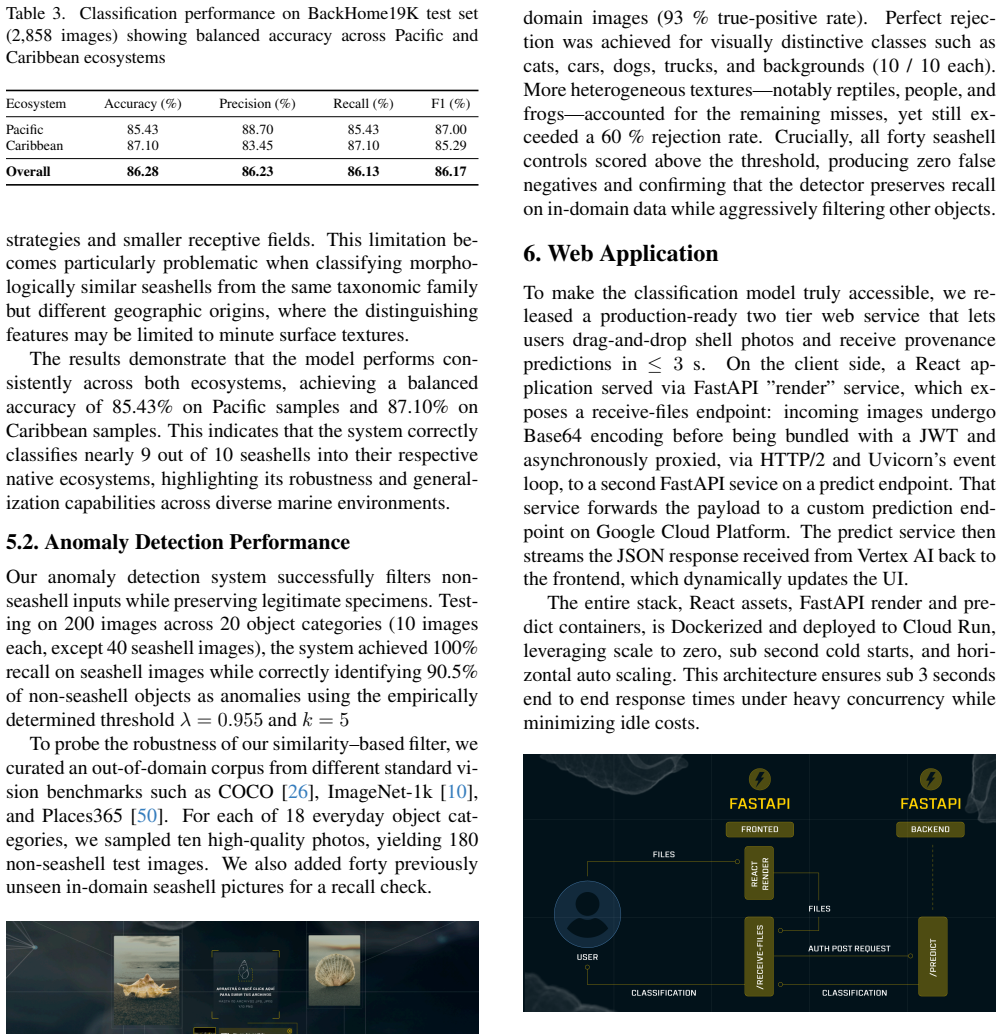
The pipeline has two stages. First, an anomaly detector runs each image through SqueezeNet and takes the global-average-pooled activations of the final convolutional layer as a 1000-dimensional embedding; a query is accepted only if its mean cosine similarity to its $k=5$ nearest neighbors is at least $\lambda = 0.955$. Accepted images then go to a ConvNeXt-Tiny classifier initialized with ImageNet-1K weights, with the stem and first three stages frozen and only the last block unfrozen. The embedding-similarity filter is what makes the deployed system resilient to user-generated noise; the frozen-feature re-learning scheme is what lets a 28-million-parameter network capture fine-grained shell cues without overfitting.
What would settle it
Run a species-disjoint split on BackHome19K: hold out every image of a random subset of species for testing and train on the rest; if accuracy on those unseen species falls well below 86.3%, the central generalization claim fails. The paper's own tables make this check possible by listing all 516 species.
Extended reading notes
Core claim
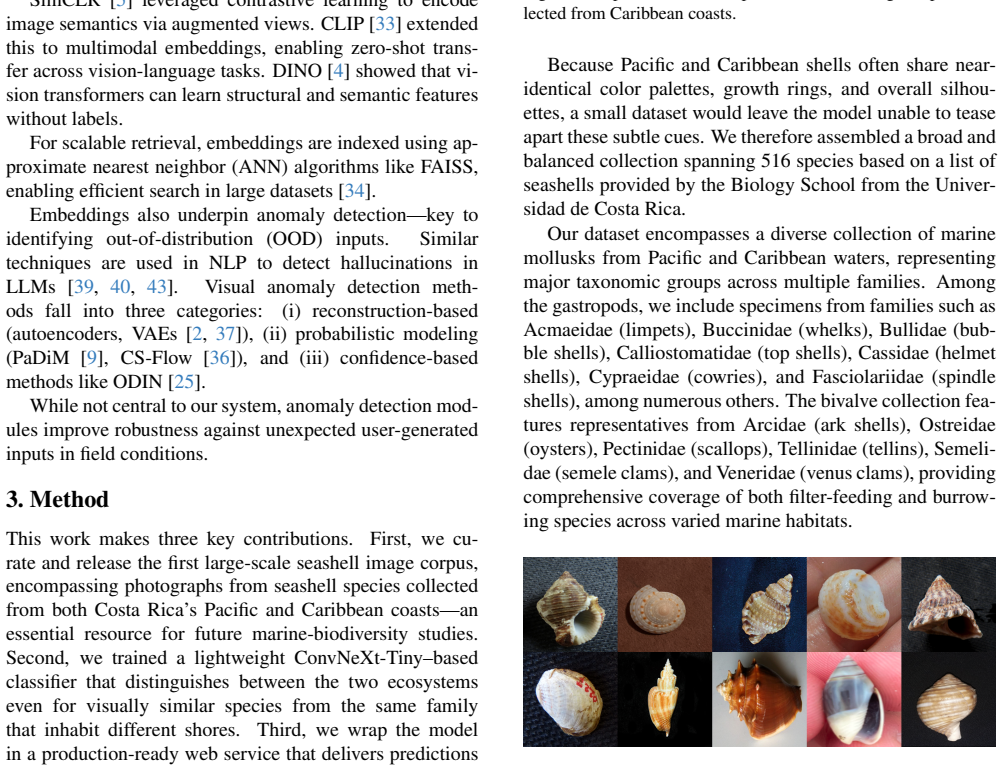
The central claim is that a photograph of a seashell carries enough subtle morphological information—texture, hue, growth rings, micro-geometry—for a compact convolutional network to distinguish Pacific from Caribbean origin at 86.3% balanced accuracy, even when species from the two coasts look nearly identical. The paper further claims that a PaDiM-inspired embedding filter can screen out non-shell uploads with 93% rejection on 180 out-of-domain images and zero false negatives on 40 shell controls, making the system safe to deploy in a public web tool. Together these results are presented as evidence that automated provenance determination is feasible enough to support real repatriation decisions.
Load-bearing premise
The evaluation assumes that a photo-level 70/15/15 split, balanced by family, measures performance on confiscated shells the model has never seen; if images of the same species occur in both training and test, the reported 86.3% balanced accuracy can overstate real-world results.
Editorial extensions
If this is right
- Wildlife officers can process a confiscated shell in under three seconds per image, turning a storage backlog into a fast triage queue.
- Most confiscated shells can be returned to their native coast, reducing the risk of introducing parasites or disrupting local gene pools.
- The public release of BackHome19K gives other researchers a coast-labeled benchmark for ecosystem-level, not just species-level, shell classification.
- The filter-plus-classifier design shows that anomaly detection can protect a fine-grained classifier from noisy user uploads in a deployed conservation tool.
- An 86.3% accuracy rate still leaves roughly one in seven shells misrouted, so the pipeline's output needs human review before repatriation.
Reading between the lines
- This inference goes beyond the paper: a species-disjoint holdout would turn the reported accuracy into a true unseen-species estimate; the released species lists make this test easy to run.
- This inference goes beyond the paper: the same two-stage design could be retrained for other coast-pair classification tasks in other countries with distinct shorelines, where habitat-matching decisions face the same data bottleneck.
- This inference goes beyond the paper: the reported failure mode of marine debris such as coral and rocks passing the filter suggests that a targeted negative-class dataset could improve the anomaly threshold without sacrificing recall.
Editorial analysis
A structured set of objections, weighed in public.
Referee Report
Summary. The paper introduces BackHome19K, a dataset of 19,058 photographs of 516 seashell species labeled by Costa Rican coast (Pacific vs. Caribbean), and a two-stage pipeline: a SqueezeNet-based k-nearest-neighbor similarity filter (PaDiM-inspired) that rejects out-of-domain inputs, followed by a ConvNeXt-Tiny binary classifier. The authors report 86.28% balanced test accuracy (mean over ten runs), a 93% rejection rate on 180 out-of-domain images, zero false negatives on 40 seashell controls, and a deployed web application with sub-3-second end-to-end latency. Ablations examine the number of unfrozen layers and training schedules. The dataset is publicly released on HuggingFace.
Significance. If the generalization numbers hold, this is a useful applied contribution: it provides the first coast-level seashell image corpus for a conservation task, demonstrates a lightweight deployable architecture, and includes practical deployment measurements. The public dataset release and the reporting of mean±std over ten runs are commendable. However, the central claim of generalization to never-before-seen shells currently rests on an image-level, family-balanced split rather than a species-disjoint split, and the anomaly-filter threshold is tuned on in-domain data and then evaluated on in-domain controls. Both issues are fixable within the manuscript's scope, but they are load-bearing for the abstract's quantitative claims and for the conclusion that the system enables safe repatriation.
major comments (3)
- [§4.1, §5.1, Table 3] The split protocol is a family-balanced image-level split, not a species-disjoint split. The paper states only that the split 'ensured a balanced representation of families across all subsets', with no statement that images of the same species were confined to one subset. With 516 species and roughly 19,000 images (about 35 images per species on average), a family-stratified image-level split will almost certainly place multiple images of the same species in both training and test. The reported 86.28% balanced accuracy therefore measures recognition of previously seen species, not performance on 'completely new seashells' as claimed in §4.1 and as required by the confiscation scenario. This is the load-bearing empirical claim of the paper, so the evaluation must be repeated with a species-disjoint split (or, at minimum, accuracy reported separately for species whose images were entirely held out), with the degree of species overlap quantified. The split must use per-image species metadata rather than coast labels alone, because the supplementary species lists contain species such as Bulla punctulata, Semele purpurascens, and Strigilla dichotoma on both coasts.
- [§3.3, §5.2, Table 5] The anomaly-detection evaluation is partly circular and inconsistent. The threshold λ=0.955 and neighborhood size k=5 are determined 'empirically by analyzing the distribution of similarity scores between known seashell images' (§3.3), and the 'zero false negatives' result is then reported on 40 in-domain seashell controls drawn from the same population used to set the threshold. This makes the recall claim circular, and n=40 gives a one-sided 95% upper bound of roughly 7.5% on the false-negative rate even with zero observed failures. Please set λ and k on a held-out tuning set or via cross-validation, and report recall with an uncertainty estimate. In addition, the OOD evaluation numbers are inconsistent: §5.2 first reports '200 images across 20 object categories (10 images each, except 40 seashell images)' and '90.5% of non-seashell objects', then reports 180 images across 18 categories with 93% rejection, while Table 5 lists 19 non-shell categories whose 'below threshold' counts sum to 168. These counts must be reconciled.
- [Abstract, §6, §9] The abstract claims the system 'has already processed 70,000 shells for wildlife officers', but Section 6 reports a three-day public launch with about 200 unique users and roughly 36,000 classifications, with no described deployment involving wildlife officers. The 70,000 figure appears unsupported by the manuscript's own deployment section. Relatedly, the conclusion that the system enables 'safe repatriation' is stronger than the evidence: at 86.28% balanced accuracy, about 14% of shells receive the wrong coast label, and no analysis is provided of the ecological risk of releasing a shell on the wrong coast. Please align the abstract with the deployment data actually reported, or provide the missing operational details, and temper the safety claim to match the demonstrated error rate.
minor comments (4)
- [§3.1, Table 1] The dataset size is reported inconsistently: the abstract says 19,058 photographs, Section 3.1 says 19,051 images, and Table 1 sums to 19,058. Please harmonize these numbers.
- [Table 4] The ablation table is difficult to interpret: the header 'Unfrozen Epochs Scheduling Accuracy' and the row values (e.g., '0 50 25 83.24') do not make the column semantics clear, and the first two rows (both '0 50 25') report different accuracies (83.24 and 84.11) without explanation. Please reformat the table with explicit column headings and clarify the duplicate configuration.
- [§5.2] The phrase '93 % true-positive rate' for out-of-domain rejection is confusing because the classifier's 'true positives' are defined differently in the classification task; consider using 'anomaly detection recall' or 'rejection rate' consistently throughout.
- [Figure 5 caption] The caption contains a typo ('mean feature vectors for each specie') and should read 'species'; it would also help to specify whether the t-SNE/DBSCAN visualization was computed on the training split or the full dataset.
Circularity Check
No significant circularity: the classifier and anomaly-filter claims are evaluated on held-out data, not derived from their own inputs.
full rationale
The paper reports a ConvNeXt-Tiny classifier trained on a 70/15/15 split and evaluated on a held-out test set; no equation-level derivation is present, so there is no chain in which a result is equivalent to its own input by construction. The anomaly-detection threshold lambda is described as determined empirically from known seashell similarity scores, but the zero-false-negative result is then checked on forty previously unseen in-domain shells, which is threshold calibration followed by held-out evaluation rather than a fitted parameter renamed as a prediction. The family-balanced image-level split may share species between training and test, which is a legitimate generalization-validity concern for the deployment claim, but it is a data-protocol weakness, not circularity. There are no load-bearing self-citations, imported uniqueness theorems, or ansatz-smuggling citations; the architecture and PaDiM-inspired filter are standard external methods cited for their original contributions. Therefore no specific circular step can be exhibited, and the honest finding is no significant circularity.
Assumptions & free parameters
free parameters (4)
- anomaly threshold lambda =
0.955
- number of nearest neighbors k =
5
- unfrozen ConvNeXt-Tiny layer count =
30
- learning rate =
0.001
assumptions (3)
- domain assumption Coastal provenance is visually decodable from shell photographs at 224x224 resolution
- domain assumption The UCR species list and coast labels are accurate and complete
- ad hoc to paper An image-level train/test split is sufficient for measuring generalization to unseen shells
Cite this review
Pith. "Pith review of Back Home: A Computer Vision Solution to Seashell Identification for Ecological Restoration." pith.science (2026). https://pith.science/paper/LQCAJ2PW
@misc{pith2026250104873,
  author       = {Pith},
  title        = {Pith review of: Back Home: A Computer Vision Solution to Seashell Identification for Ecological Restoration},
  year         = {2026},
  howpublished = {\url{https://pith.science/paper/LQCAJ2PW}},
  note         = {Machine review of arXiv:2501.04873}
}
read the original abstract
Illegal souvenir collection strips an estimated five tonnes of seashells from Costa Rica's beaches each year. Yet, once these specimens are seized, their coastal origin -- Pacific or Caribbean -- cannot be verified easily due to the lack of information, preventing their return when confiscated by local authorities. To solve this issue, we introduce BackHome19K, the first large-scale image corpus (19,058 photographs, 516 species) annotated with coast-level labels, and propose a lightweight pipeline that infers provenance in real time on a mobile-grade CPU. A trained anomaly filter pre-screens uploads, increasing robustness to user-generated noise. On a held-out test set, the classifier attains 86.3% balanced accuracy, while the filter rejects 93% of 180 out-of-domain objects with zero false negatives. Deployed as a web application, the system has already processed 70,000 shells for wildlife officers in under three seconds per image, enabling confiscated specimens to be safely repatriated to their native ecosystems. The dataset is available at https://huggingface.co/datasets/FIFCO/BackHome19K
Figures


Figures from the paper (6 more)



Reference graph
Works this paper leans on
-
[1]
A.M. Costa Rica. Four tons of seashells seized from tourists in costa rica. A.M. Costa Rica, 2023. Online news article. 1
work page 2023
-
[2]
Variational autoencoder based anomaly detection using reconstruction probability
Jinwon An and Sungzoon Cho. Variational autoencoder based anomaly detection using reconstruction probability. Technical report, SNU Data Mining Center, 2015. Technical Report. 3
work page 2015
-
[3]
George Ashline, Joanna Ellis-Monaghan, Zsuzsanna Kadas, and Declan Mccabe. Modeling seashell morphology. UMAP/ILAP Modules, 2009. 1
work page 2009
-
[4]
Emerging properties in self-supervised vision transformers
Mathilde Caron, Hugo Touvron, Ishan Misra, Herv´e J´egou, Julien Mairal, Piotr Bojanowski, and Armand Joulin. Emerging properties in self-supervised vision transformers. In Proceedings of the IEEE/CVF international conference on computer vision , pages 9650– 9660, 2021. 3
work page 2021
-
[5]
A simple framework for contrastive learning of visual representations
Ting Chen, Simon Kornblith, Mohammad Norouzi, and Geoffrey Hinton. A simple framework for contrastive learning of visual representations. In International conference on machine learning, pages 1597–1607. PMLR, 2020. 3
work page 2020
-
[6]
Overview of structure, function and integrated utilization of marine shell
Meiqi Cheng, Man Liu, Lirong Chang, Qing Liu, Chunxiao Wang, Le Hu, Ziyue Zhang, Wanying Ding, Li Chen, Sihan Guo, Zhi Qi, Panpan Pan, and Jingdi Chen. Overview of structure, function and integrated utilization of marine shell. Science of The Total Environment, 870:161950, 2023. 1
work page 2023
- [7]
-
[8]
Modelling seashells shapes and pigmentation patterns: Experiments with 3d printing
Francesco De Comit ´e. Modelling seashells shapes and pigmentation patterns: Experiments with 3d printing. 2017. 1
work page 2017
Show all 51 references
-
[9]
PaDiM: a patch distribution modeling framework for anomaly detection and localization
Thomas Defard, Alex Setkov, Angeline Loesch, and Romaric Audigier. PaDiM: a patch distribution modeling framework for anomaly detection and localization. In International Conference on Pattern Recognition (ICPR), 2021. 3, 4
2021
-
[10]
Imagenet: A large-scale hierarchical image database
Jia Deng, Wei Dong, Richard Socher, Li-Jia Li, Kai Li, and Li Fei-Fei. Imagenet: A large-scale hierarchical image database. In 2009 IEEE conference on computer vision and pattern recognition, pages 248–255. Ieee, 2009. 7
2009
-
[11]
An image is worth 16x16 words: Transformers for image recognition at scale
Alexey Dosovitskiy, Lucas Beyer, Alexander Kolesnikov, Dirk Weissenborn, Xiaohua Zhai, Thomas Unterthiner, Mostafa Dehghani, Matthias Minderer, Georg Heigold, Sylvain Gelly, Jakob Uszkoreit, and Neil Houlsby. An image is worth 16x16 words: Transformers for image recognition at...
2010 arXiv
-
[12]
Swinfishnet: A swin transformer-based approach for automatic fish species classification using transfer learning
Ebru Erg ¨un. Swinfishnet: A swin transformer-based approach for automatic fish species classification using transfer learning. PLOS ONE, 20(5):1–27, 2025. 2
2025
-
[13]
A density-based algorithm for discovering clusters in large spatial databases with noise
Martin Ester, Hans-Peter Kriegel, J ¨org Sander, and Xiaowei Xu. A density-based algorithm for discovering clusters in large spatial databases with noise. In Proceedings of the Second International Conference on Knowledge Discovery and Data Mining , page 226–231. AAAI Press, 1996. 5
1996
-
[14]
Shell color polymorphism in marine gastropods
Juan Gefaell, Juan Galindo, and Emilio Rol ´an-Alvarez. Shell color polymorphism in marine gastropods. Evolutionary Applications, 16(2):202–222, 2022. 1
2022
-
[15]
Deep residual learning for image recognition
Kaiming He, Xiangyu Zhang, Shaoqing Ren, and Jian Sun. Deep residual learning for image recognition. In Proceedings of the IEEE Conference on Computer Vision and Pattern Recognition, pages 770–778, 2016. 2, 6
2016
-
[16]
Densely connected convolutional networks
Gao Huang, Zhuang Liu, Laurens Van Der Maaten, and Kilian Q Weinberger. Densely connected convolutional networks. In Proceedings of the IEEE Conference on Computer Vision and Pattern Recognition, pages 4700–4708, 2017. 2
2017
-
[17]
Morphometric analysis of two shell color strains of the bay scallop argopecten irradians
Xianpeng Huang, Zhenlin Hao, Junxia Mao, Luo Wang, Xubo Wang, and Ying Tian. Morphometric analysis of two shell color strains of the bay scallop argopecten irradians. Fishes, 9(7), 2024. 1
2024
-
[18]
Iandola, Song Han, Matthew W
Forrest N. Iandola, Song Han, Matthew W. Moskewicz, Khalid Ashraf, William J. Dally, and Kurt Keutzer. Squeezenet: Alexnet-level accuracy with 50x fewer parameters and ¡0.5mb model size, 2016. 4
2016
-
[19]
inaturalist: Connect with nature, n.d
iNaturalist. inaturalist: Connect with nature, n.d. Accessed: 2024-12-26. 3
2024
-
[20]
Welcome to conchology, inc., n.d
Conchology Inc. Welcome to conchology, inc., n.d. Accessed: 2024-12-26. 3
2024
-
[21]
Adam: A method for stochastic optimization
Diederik P Kingma and Jimmy Ba. Adam: A method for stochastic optimization. arXiv preprint arXiv:1412.6980, 2015. 6
2015 arXiv
-
[22]
Kocot, Felipe Aguilera, Carmel McDougall, Daniel J
Kevin M. Kocot, Felipe Aguilera, Carmel McDougall, Daniel J. Jackson, and Bernard M. Degnan. Sea shell diversity and rapidly evolving secretomes: insights into the evolution of biomineralization. Frontiers in Zoology, 13:23, 2016. 1
2016
-
[23]
Imagenet classification with deep convolutional neural networks
Alex Krizhevsky, Ilya Sutskever, and Geoffrey E Hinton. Imagenet classification with deep convolutional neural networks. In Advances in Neural Information Processing Systems. Curran Associates, Inc., 2012. 2
2012
-
[24]
Adaptation of shell morphology to different tidal zones—insights into phenotypic plasticity of littorina brevicula
Siqi Lai, Ling Shi, Yida Han, Ying Tian, and Zhenlin Hao. Adaptation of shell morphology to different tidal zones—insights into phenotypic plasticity of littorina brevicula. Frontiers in Ecology and Evolution, V olume 12 - 2024, 2025. 1
2024
-
[25]
Shiyu Liang, Yixuan Li, and R. Srikant. Enhancing the reliability of out-of-distribution image detection in neural networks, 2020. 3
2020
-
[26]
Lawrence Zitnick, and Piotr Doll´ar
Tsung-Yi Lin, Michael Maire, Serge Belongie, Lubomir Bourdev, Ross Girshick, James Hays, Pietro Perona, Deva Ramanan, C. Lawrence Zitnick, and Piotr Doll´ar. Microsoft coco: Common objects in context, 2015. 7
2015
-
[27]
Swin transformer: Hierarchical vision transformer using shifted windows
Ze Liu, Yutong Lin, Yue Cao, Han Hu, Yixuan Wei, Zheng Zhang, Stephen Lin, and Baining Guo. Swin transformer: Hierarchical vision transformer using shifted windows. arXiv preprint arXiv:2103.14030, 2021. 2
2021 arXiv
-
[28]
Z. Liu, H. Mao, C.-Y . Wu, C. Feichtenhofer, T. Darrell, and S. Xie. A convnet for the 2020s. In Proceedings of the IEEE/CVF Conference on Computer Vision and Pattern Recognition (CVPR), pages 11976–11986, 2022. 2, 4
2022
-
[29]
Decoupled weight decay regularization
Ilya Loshchilov and Frank Hutter. Decoupled weight decay regularization. arXiv preprint arXiv:1711.05101, 2019. 6 14
2019 arXiv
-
[30]
Tuset, and Joana Vasconcelos
Olivia Mart ´ınez-Ruiz, Rodrigo Riera, V´ıctor M. Tuset, and Joana Vasconcelos. Coastal exposure and artificialization: Drivers of shell shape variation in intertidal limpets. Estuarine, Coastal and Shelf Science, 322:109344, 2025. 1
2025
-
[31]
South florida atlantic sea shell types, n.d
Matthewacs. South florida atlantic sea shell types, n.d. Accessed: 2024-12-26. 3
2024
-
[32]
Marine & environmental systems: Mollusk shell collection, n.d
Florida Institute of Technology. Marine & environmental systems: Mollusk shell collection, n.d. Accessed: 2024-12-26. 3
2024
-
[33]
Learning transferable visual models from natural language supervision
Alec Radford, Jong Wook Kim, Chris Hallacy, Aditya Ramesh, Gabriel Goh, Sandhini Agarwal, Girish Sastry, Amanda Askell, Pamela Mishkin, Jack Clark, et al. Learning transferable visual models from natural language supervision. InInternational conference on machine learning, pag...
2021
-
[34]
Efficient medical image retrieval using densenet and faiss for birads classification, 2024
MD Shaikh Rahman, Feiroz Humayara, Syed Maudud E Rabbi, and Muhammad Mahbubur Rashid. Efficient medical image retrieval using densenet and faiss for birads classification, 2024. 3
2024
-
[35]
A stochastic approximation method
Herbert Robbins and Sutton Monro. A stochastic approximation method. The Annals of Mathematical Statistics , 22(3):400–407,
-
[36]
Fully convolutional cross-scale-flow for image-based anomaly detection and localization
Lukas Rudolph, Bastian Wandt, and Bodo Rosenhahn. Fully convolutional cross-scale-flow for image-based anomaly detection and localization. In IEEE/CVF Winter Conference on Applications of Computer Vision (WACV), 2022. 3
2022
-
[37]
Anomaly detection using autoencoders with nonlinear dimensionality reduction
Mayu Sakurada and Takashi Yairi. Anomaly detection using autoencoders with nonlinear dimensionality reduction. In Proceed- ings of the 2nd Workshop on Machine Learning for Sensory Data Analysis (MLSDA), in conjunction with the 20th ACM SIGKDD International Conference on Knowle...
2014
-
[38]
Mobilenetv2: Inverted residuals and linear bottlenecks
Mark Sandler, Andrew Howard, Menglong Zhu, Andrey Zhmoginov, and Liang-Chieh Chen. Mobilenetv2: Inverted residuals and linear bottlenecks. In Proceedings of the IEEE Conference on Computer Vision and Pattern Recognition, pages 4510–4520, 2018. 2, 6
2018
-
[39]
Mitigating entity-level hallucination in large language models
Weihang Su, Yichen Tang, Qingyao Ai, Changyue Wang, Zhijing Wu, and Yiqun Liu. Mitigating entity-level hallucination in large language models. arXiv preprint arXiv:2407.09417, 2024. 3
2024 arXiv
-
[40]
Unsupervised real-time hallucination detection based on the internal states of large language models
Weihang Su, Changyue Wang, Qingyao Ai, Yiran Hu, Zhijing Wu, Yujia Zhou, and Yiqun Liu. Unsupervised real-time hallucination detection based on the internal states of large language models. arXiv preprint arXiv:2403.06448, 2024. 3
2024 arXiv
-
[41]
Leave the shells, take memories: The hidden cost of your costa rican souvenir
The Costa Rican Times. Leave the shells, take memories: The hidden cost of your costa rican souvenir. The Costa Rican Times ,
-
[42]
Shells must remain on costa rican beaches
The Tico Times. Shells must remain on costa rican beaches. The Tico Times, 2023. Online news article. 1
2023
-
[43]
S. M. Towhidul Islam Tonmoy, S. M. Mehedi Zaman, Vinija Jain, Anku Rani, Vipula Rawte, Aman Chadha, and Amitava Das. A comprehensive survey of hallucination mitigation techniques in large language models. arXiv preprint arXiv:2401.01313, 2024. 3
2024 arXiv
-
[44]
Training data-efficient image transformers & distillation through attention
Hugo Touvron, Matthieu Cord, Matthijs Douze, Francisco Massa, Alexandre Sablayrolles, and Herv ´e J´egou. Training data-efficient image transformers & distillation through attention. arXiv preprint arXiv:2012.12877, 2021. 2
2012 arXiv
-
[45]
Visualizing data using t-sne
Laurens van der Maaten and Geoffrey Hinton. Visualizing data using t-sne. Journal of Machine Learning Research, 9:2579–2605,
-
[46]
Deep-sea debris identification using deep convolutional neural networks
Bing Xue, Baoxiang Huang, Ge Chen, Haitao Li, and Weibo Wei. Deep-sea debris identification using deep convolutional neural networks. IEEE Journal of Selected Topics in Applied Earth Observations and Remote Sensing, 14:8909–8915, 2021. 2
2021
-
[47]
H. Xue, Y . Li, and X. Wang. Deep-sea debris identification with shuffle-xception. In Proc. OCEANS, 2021. 2
2021
-
[48]
J. Yue, P. Luo, and S. Liu. Flnet: Filter pruning and repair for imbalanced shellfish recognition. Pattern Recognition, 142:109–119,
-
[49]
A shell dataset for shell features extraction and recognition
Qi Zhang, Jianhang Zhou, Jing He, Xiaodong Cun, Shaoning Zeng, and Bob Zhang. A shell dataset for shell features extraction and recognition. Scientific Data, 6(226), 2019. 2, 3
2019
-
[50]
Places: A 10 million image database for scene recognition
Bolei Zhou, Agata Lapedriza, Aditya Khosla, Aude Oliva, and Antonio Torralba. Places: A 10 million image database for scene recognition. IEEE Transactions on Pattern Analysis and Machine Intelligence, 2017. 7 15
2017
-
[2023]
Online news article. 1
Reviewed August 10, 2026 · model on record in the stance chip above.
Discussion (0). Continue with ORCID to comment.