Towards an FMI Layered Standard for DAE: Applications for Simulation and Optimization
Pith reviewed 2026-06-26 09:38 UTC · model grok-4.3
The pith
A proposed FMI layered standard for DAEs enables optimization convergence on an industrial model where the ODE version fails.
A machine-rendered reading of the paper's core claim, the machinery that carries it, and where it could break.
Core claim
Exposing algebraic equations and their variables directly in an FMI FMU as a semi-explicit index-1 DAE removes the need for hidden internal Newton iterations, improves numerical behavior, and allows downstream optimization routines to succeed on problems that fail under the equivalent ODE formulation.
What carries the argument
The fmi-ls-dae layered standard, an extension to the FMI XML schema that declares algebraic variables and equations alongside differential states in semi-explicit index-1 form.
If this is right
- Dynamic optimization tools gain direct access to algebraic structure instead of relying on internal solver states.
- Models generated from Modelica can avoid accuracy loss from hidden Newton iterations during export.
- Simulation and optimization workflows become more robust for systems that contain significant algebraic constraints.
- The same FMU can be used for both simulation and optimization without reformulation.
Where Pith is reading between the lines
- Higher-index DAE support, consistent initialization, and event handling would extend the same benefit to a wider class of models.
- Existing FMI importers would need targeted updates to read the new XML sections and treat algebraic residuals explicitly.
- The approach could reduce the need for manual index reduction or reformulation steps before model export.
Load-bearing premise
Importers can accept the newly exposed algebraic variables and equations without creating fresh numerical problems or needing large changes to current FMI tools.
What would settle it
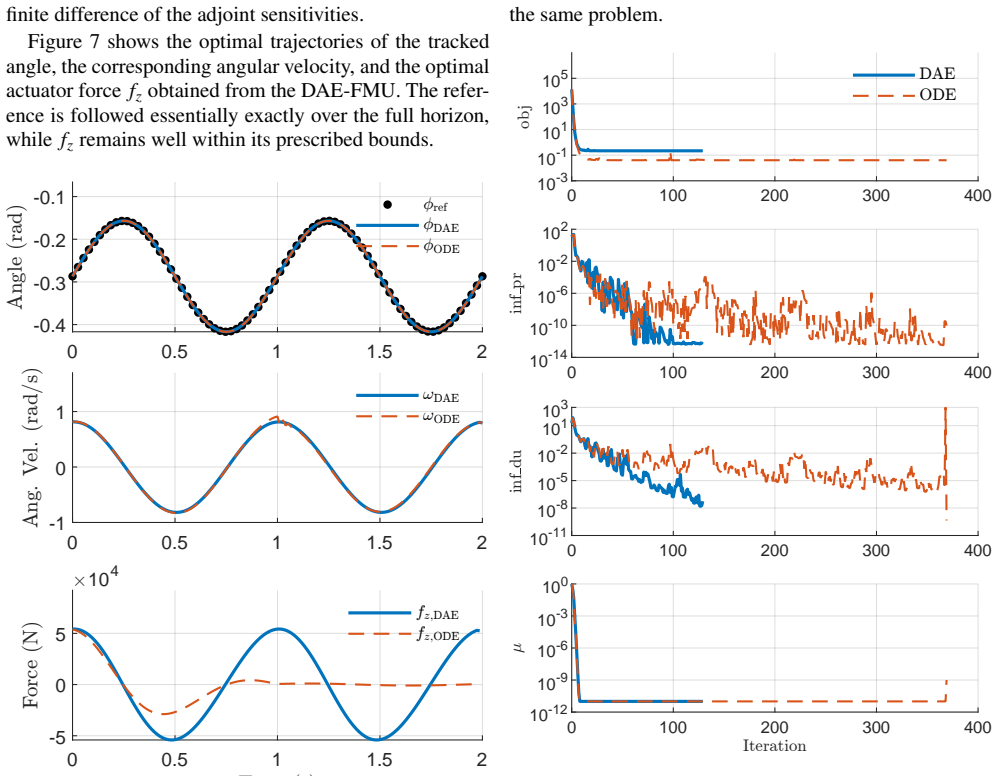
Run the same optimal control problem on the multilink suspension corner model once with the DAE-FMU and once with the ODE-FMU; convergence occurs only with the DAE version.
Figures



read the original abstract
The Functional Mock-up Interface (FMI) 3.0 standard for Model Exchange is restricted to hybrid ordinary differential equations, requiring any internal algebraic equations to be solved inside the Functional Mock-up Unit (FMU) before derivatives are returned to the importer. For models originating from, e.g. Modelica, this means that nonlinear algebraic equations must be solved through internal Newton iterations, which can reduce accuracy, increase computational cost, introduce hidden solver states, and cause robustness issues in downstream simulation and optimization workflows. In this article, we present a proposal for a layered standard, fmi-ls-dae, that exposes algebraic equations and their associated algebraic variables as part of a semi-explicit index-1 differential-algebraic equation. We describe the proposed extensions to the FMI XML schema and demonstrate the approach through prototype implementations: Dymola and CasADi generate FMUs that expose this semi-explicit index-1 formulation, while CasADi, FMIOPT, Simcenter Twin Activate, and MOO (the dynamic optimization tool of OpenModelica) import them for simulation and dynamic optimization. On an industrially relevant multilink suspension corner model, the proposed DAE-FMU formulation enables the optimization routine to converge on an optimal control problem on which the equivalent ODE-FMU fails to converge. We outline ongoing work towards supporting higher-index DAEs, consistent initialization, and event handling,
Editorial analysis
A structured set of objections, weighed in public.
Referee Report
Summary. The paper proposes a layered standard fmi-ls-dae extending FMI 3.0 Model Exchange to expose semi-explicit index-1 DAEs (algebraic equations and variables) rather than requiring internal solution inside the FMU. It describes XML schema extensions and presents prototype generators (Dymola, CasADi) and importers (CasADi, FMIOPT, Simcenter Twin Activate, MOO) for simulation and dynamic optimization. The central empirical claim is that, on an industrially relevant multilink suspension corner model, the DAE-FMU formulation enables convergence of an optimal control problem on which the equivalent ODE-FMU fails to converge. Ongoing work on higher-index DAEs, initialization, and events is outlined.
Significance. If the approach can be shown to work with standard FMI importers, exposing algebraic structure could improve numerical robustness and accuracy for Modelica-derived models in simulation and optimization pipelines. The concrete industrial example and multiple prototype implementations constitute a useful existence proof and are strengths of the work.
major comments (2)
- [Abstract] Abstract: the claim that the DAE-FMU formulation enables convergence on the multilink suspension OCP where the ODE-FMU fails is demonstrated exclusively inside custom-extended importers (CasADi/FMIOPT/MOO) that were modified to consume the new algebraic variables and residuals; no evidence is supplied that a stock FMI 3.0 importer (or even a minimally modified one) can ingest the exposed algebraic equations without introducing its own Newton iterations, step-size restrictions, or accuracy loss.
- [Abstract] Abstract: the manuscript provides neither error analysis, tabulated convergence metrics, nor verification that the observed improvement is due to DAE exposure rather than other differences between the prototype importers.
minor comments (1)
- The distinction between the proposed layered standard and the specific prototype modifications should be stated more explicitly when discussing applicability to existing FMI infrastructure.
Simulated Author's Rebuttal
We thank the referee for the constructive comments and for recognizing the industrial relevance of the multilink suspension example along with the multiple prototype implementations. We address each major comment below.
read point-by-point responses
-
Referee: [Abstract] Abstract: the claim that the DAE-FMU formulation enables convergence on the multilink suspension OCP where the ODE-FMU fails is demonstrated exclusively inside custom-extended importers (CasADi/FMIOPT/MOO) that were modified to consume the new algebraic variables and residuals; no evidence is supplied that a stock FMI 3.0 importer (or even a minimally modified one) can ingest the exposed algebraic equations without introducing its own Newton iterations, step-size restrictions, or accuracy loss.
Authors: We agree that the reported convergence result is obtained with prototype importers that were extended to directly consume the exposed algebraic variables and residuals. The manuscript does not provide evidence that unmodified stock FMI 3.0 importers would automatically benefit without their own internal algebraic handling. The core contribution is the definition of the layered standard that makes such direct access possible; the prototypes serve as an existence proof of the benefit when importers exploit the exposed structure. We will revise the abstract to state explicitly that the convergence improvement is observed in the extended prototype importers. revision: partial
-
Referee: [Abstract] Abstract: the manuscript provides neither error analysis, tabulated convergence metrics, nor verification that the observed improvement is due to DAE exposure rather than other differences between the prototype importers.
Authors: The empirical claim is presented as a binary outcome (convergence versus failure) on an otherwise comparable optimal-control formulation. We acknowledge that tabulated metrics (e.g., iteration counts, residual histories) and a more explicit isolation of the DAE-exposure effect would strengthen the evidence. We will add a table of key optimization metrics and a short discussion of the controlled differences between the ODE-FMU and DAE-FMU setups in the revised manuscript. revision: yes
Circularity Check
Proposal paper with prototype demonstration; no derivation chain reduces to inputs by construction
full rationale
The manuscript is a standards proposal for exposing semi-explicit index-1 DAEs via FMI layered extensions, accompanied by prototype generators and importers. No mathematical derivation, uniqueness theorem, fitted parameter, or prediction is presented whose result is equivalent to its inputs by definition or self-citation. The empirical convergence result on the multilink suspension model is produced inside the described prototypes; this is an implementation demonstration rather than a self-referential reduction of any claimed first-principles result. No instances of the six enumerated circularity patterns appear in the provided text.
Axiom & Free-Parameter Ledger
axioms (1)
- domain assumption Physical models from tools like Modelica can be represented as semi-explicit index-1 DAEs without loss of fidelity.
invented entities (1)
-
fmi-ls-dae layered standard
no independent evidence
Reference graph
Works this paper leans on
-
[1]
2023 , url =
Modelica -- A Unified Object-Oriented Language for Systems Modeling , author =. 2023 , url =
2023
-
[2]
2026 , url =
Layered Standard for Differential Algebraic Equations (unreleased) , institution =. 2026 , url =
2026
-
[3]
Christian Bertsch and others , BOOKTITLE =
-
[4]
Mathematical Programming Computation , volume =
Joel A E Andersson and Joris Gillis and Greg Horn and James B Rawlings and Moritz Diehl , title =. Mathematical Programming Computation , volume =. 2019 , publisher =
2019
-
[5]
Joel A. E. Andersson , BOOKTITLE =
-
[6]
Proceedings of the 13th International Modelica Conference , address =
Erik Henningsson and Hans Olsson and Luigi Vanfretti , title =. Proceedings of the 13th International Modelica Conference , address =. 2019 , pages =. doi:10.3384/ecp19157491 , url =
-
[7]
Continuous System Simulation , publisher =
Cellier, Fran. Continuous System Simulation , publisher =
-
[8]
Proceedings of the 12th International Modelica Conference , year =
Braun, Willi and Casella, Francesco and Bachmann, Bernhard , title =. Proceedings of the 12th International Modelica Conference , year =. doi:10.3384/ecp17132557 , publisher =
-
[9]
OpenModelica User's Guide , year =
-
[10]
2025 , url =
Andreas Pfeiffer and Christoph Winter and Fabian Jarmolowitz and Christian Bertsch , booktitle =. 2025 , url =
2025
-
[11]
Ernst Hairer, Gerhard Wanner , title =
-
[12]
K. E. Brenan, S. L. Campbell, Linda R. Petzold , title =
-
[13]
W\"achter and L.T
A. W\"achter and L.T. Biegler , Journal =. 2006 , Number =
2006
-
[14]
SIAM Journal on Matrix Analysis and Applications , volume =
A Fully Asynchronous Multifrontal Solver Using Distributed Dynamic Scheduling , author =. SIAM Journal on Matrix Analysis and Applications , volume =. 2001 , pages =
2001
discussion (0)
Sign in with ORCID, Apple, or X to comment. Anyone can read and Pith papers without signing in.