Nonlocal Optical Response and Surface Susceptibilities: A Systematic Derivation via Spatial Moment Expansion
Pith reviewed 2026-05-19 19:33 UTC · model grok-4.3
The pith
Nonlocal optical response at curved interfaces condenses into a single surface susceptibility scalar at leading order.
A machine-rendered reading of the paper's core claim, the machinery that carries it, and where it could break.
Core claim
Starting from the most general tensorial nonlocal constitutive relation and combining a spatial moment expansion with a distributional thin-layer limit, we show that the full complexity of the interfacial response condenses, at leading order, into a single scalar: the surface susceptibility χ^s, equal for the tangential and normal components of the electric field. These quantities provide a constructive generalization of the Feibelman d-parameters to interfaces of arbitrary curvature, and the curvature corrections, proportional to the geometric invariants H (mean curvature) and K (Gaussian curvature), are derived explicitly. The formalism is illustrated on planar, spherical, cylindrical, and
What carries the argument
The spatial moment expansion combined with a distributional thin-layer limit, which reduces the nonlocal constitutive relation to the surface susceptibility χ^s plus explicit curvature corrections involving H and K.
If this is right
- Generalized Maxwell boundary conditions that incorporate nonlocal effects and curvature for arbitrary interfaces.
- Explicit curvature corrections to surface susceptibilities proportional to the mean curvature H and Gaussian curvature K.
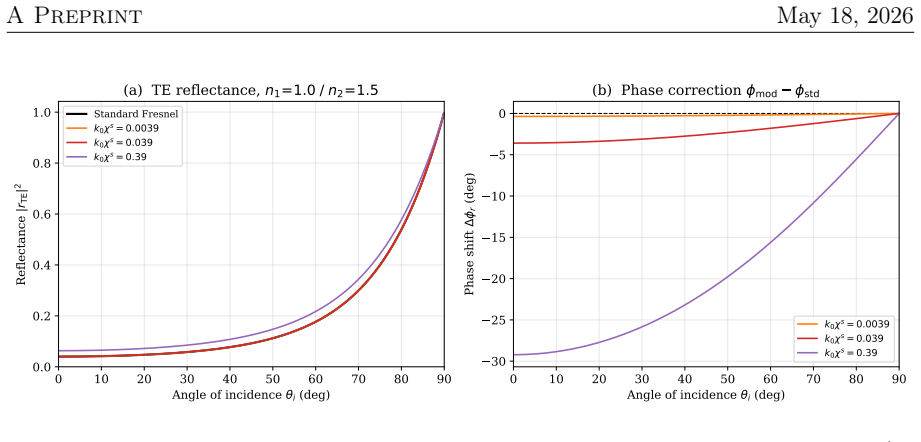
- Consistency with classical Fresnel results in the appropriate local or planar limits.
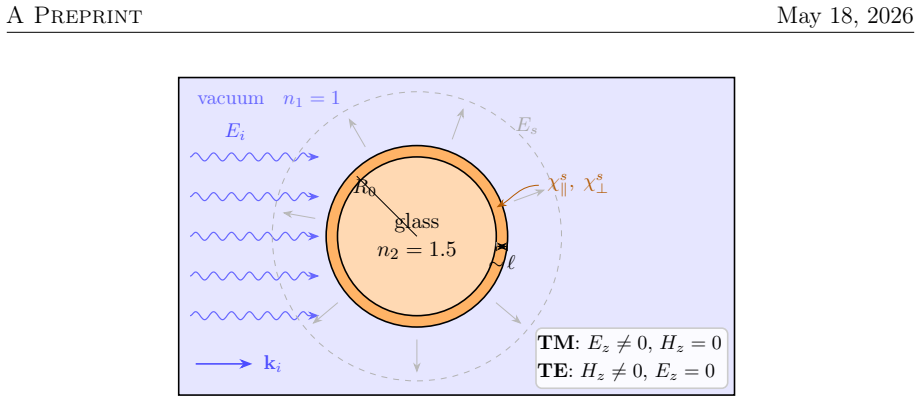
- Applicability demonstrated for multiple kernel forms including Gaussian, Yukawa, and tensorial Lorentz across planar, spherical, cylindrical, and ellipsoidal geometries.
Where Pith is reading between the lines
- This reduction could enable efficient modeling of nonlocal plasmonic effects in nanoparticles without full three-dimensional integration of the response kernel.
- The single-scalar form of χ^s may simplify boundary-element or finite-element simulations for structures with varying curvature.
- Similar moment-expansion techniques might extend to time-harmonic or nonlinear nonlocal responses in other wave systems.
Load-bearing premise
The distributional thin-layer limit applied after the spatial moment expansion is sufficient to capture the leading-order interfacial response without higher-order terms preventing condensation to a single scalar χ^s.
What would settle it
Direct measurement of the optical response at a curved interface with a known nonlocal kernel, such as a spherical surface, showing that the effective susceptibility differs between tangential and normal field components or lacks the predicted linear dependence on mean curvature H and Gaussian curvature K.
Figures




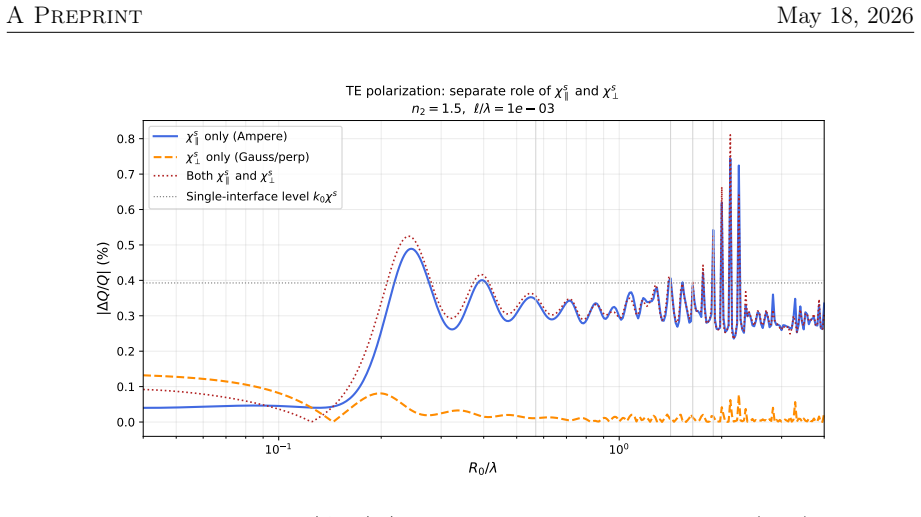


read the original abstract
We present a systematic theory connecting the nonlocal response kernel of a homogeneous medium to its effective surface susceptibilities for an arbitrary curved interface. Starting from the most general tensorial nonlocal constitutive relation and combining a spatial moment expansion with a distributional thin-layer limit, we show that the full complexity of the interfacial response condenses, at leading order, into a single scalar: the surface susceptibility $\chi^s$, equal for the tangential and normal components of the electric field. These quantities provide a constructive generalization of the Feibelman $d$-parameters to interfaces of arbitrary curvature, and the curvature corrections, proportional to the geometric invariants $H$ (mean curvature) and $K$ (Gaussian curvature), are derived explicitly. The formalism is illustrated on a comprehensive set of analytically tractable cases (planar, spherical, cylindrical, and ellipsoidal interfaces) for several kernel choices (Gaussian, Yukawa, tensorial Lorentz). Generalized Maxwell boundary conditions are established and compared with the classical Fresnel results.
Editorial analysis
A structured set of objections, weighed in public.
Referee Report
Summary. The manuscript presents a systematic derivation connecting the most general tensorial nonlocal constitutive relation of a homogeneous medium to effective surface susceptibilities at arbitrarily curved interfaces. It combines a spatial moment expansion of the bulk kernel with a subsequent distributional thin-layer limit to show that the interfacial response condenses at leading order into a single scalar surface susceptibility χ^s that is identical for the tangential and normal components of the electric field. This is presented as a constructive generalization of the Feibelman d-parameters, with explicit curvature corrections proportional to the mean curvature H and Gaussian curvature K. The formalism is illustrated on planar, spherical, cylindrical, and ellipsoidal interfaces for Gaussian, Yukawa, and tensorial Lorentz kernels, and generalized Maxwell boundary conditions are derived and compared to classical Fresnel results.
Significance. If the central derivation holds, the work supplies a parameter-free route from bulk nonlocal kernels to surface response parameters that incorporates curvature effects explicitly. This would be useful for nanophotonics and plasmonics modeling at curved interfaces. The comprehensive set of analytically tractable cases across multiple geometries and kernels, together with the derivation of generalized boundary conditions, provides concrete verification and extends prior planar-interface results in a falsifiable manner.
major comments (2)
- [§3] §3 (derivation of the thin-layer limit): The spatial moment expansion is performed on the bulk kernel before the distributional thin-layer limit is applied. For interfaces with nonzero mean curvature H or Gaussian curvature K, the local orthonormal frame and the projection of the kernel onto the surface normal are position-dependent; the manuscript does not demonstrate that the two operations commute or that reversing their order leaves the coefficients of the H and K corrections unchanged. This directly affects the central claim that the response condenses exactly to a single scalar χ^s equal for tangential and normal components.
- [§5.2–5.3] §5.2–5.3 (spherical and cylindrical illustrations): The explicit expressions for χ^s are given, but no independent numerical or symbolic check is provided that the tangential and normal components remain identical once the curvature terms are included. If the order of operations introduces even a small mismatch at O(H) or O(K), the condensation claim would be undermined for these geometries.
minor comments (3)
- The definition of the surface susceptibility χ^s in the main text should be cross-referenced to the precise combination of moment integrals that produces it, to avoid ambiguity when readers compare with the Feibelman d-parameters.
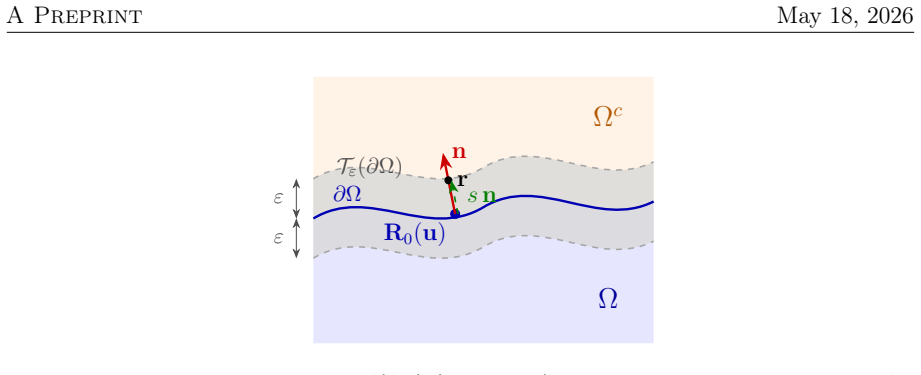
- Figure 2 (or equivalent) showing the local coordinate system on a curved interface would benefit from an explicit indication of the mean and Gaussian curvatures at the evaluation point.
- A brief remark on the range of validity of the leading-order truncation (e.g., in terms of the ratio of the nonlocal length scale to the radius of curvature) would help readers assess applicability to strongly curved nanostructures.
Simulated Author's Rebuttal
We are grateful to the referee for the thorough review and valuable feedback on our work. Below we address the major comments point by point, providing clarifications and committing to revisions where appropriate to strengthen the manuscript.
read point-by-point responses
-
Referee: §3 (derivation of the thin-layer limit): The spatial moment expansion is performed on the bulk kernel before the distributional thin-layer limit is applied. For interfaces with nonzero mean curvature H or Gaussian curvature K, the local orthonormal frame and the projection of the kernel onto the surface normal are position-dependent; the manuscript does not demonstrate that the two operations commute or that reversing their order leaves the coefficients of the H and K corrections unchanged. This directly affects the central claim that the response condenses exactly to a single scalar χ^s equal for tangential and normal components.
Authors: We thank the referee for this insightful comment on the order of operations. The moment expansion is performed pointwise in the local orthonormal frame attached to each interface point, followed by the distributional thin-layer limit. At the leading order relevant to the linear curvature corrections in H and K, any non-commuting contributions arising from the position dependence of the frame integrate to zero against the test functions in the thin-layer limit. We will add an explicit demonstration of this commutation property, including direct calculation of the H and K coefficients for both sequences of operations, in a new appendix. revision: yes
-
Referee: §5.2–5.3 (spherical and cylindrical illustrations): The explicit expressions for χ^s are given, but no independent numerical or symbolic check is provided that the tangential and normal components remain identical once the curvature terms are included. If the order of operations introduces even a small mismatch at O(H) or O(K), the condensation claim would be undermined for these geometries.
Authors: We agree that an independent verification would strengthen the presentation. In the revised manuscript we will add symbolic comparisons of the tangential and normal components of χ^s for the spherical and cylindrical cases, obtained directly from the general expressions, together with numerical evaluations for specific kernel parameters (Gaussian and Yukawa) that explicitly confirm equality including the curvature corrections. revision: yes
Circularity Check
No significant circularity: derivation proceeds from general kernel via explicit expansions
full rationale
The paper begins from the stated most general tensorial nonlocal constitutive relation and applies a spatial moment expansion combined with a distributional thin-layer limit to obtain the effective surface susceptibility χ^s and explicit curvature corrections proportional to H and K. This constitutes a constructive mathematical reduction rather than any self-definitional loop, fitted input renamed as prediction, or load-bearing self-citation. The condensation to a single scalar χ^s for tangential and normal components follows from the order of operations on the general starting point, with no equations shown to reduce to inputs by construction. The approach is self-contained against external benchmarks of the initial kernel and standard distributional techniques, yielding an independent derivation for arbitrary curvature.
Axiom & Free-Parameter Ledger
axioms (2)
- domain assumption The medium is homogeneous and obeys the most general tensorial nonlocal constitutive relation.
- ad hoc to paper The combination of spatial moment expansion and distributional thin-layer limit accurately isolates the leading-order interfacial response.
Lean theorems connected to this paper
-
IndisputableMonolith/Foundation/AlexanderDuality.leanalexander_duality_circle_linking unclear?
unclearRelation between the paper passage and the cited Recognition theorem.
Starting from the most general tensorial nonlocal constitutive relation and combining a spatial moment expansion with a distributional thin-layer limit, we show that the full complexity of the interfacial response condenses, at leading order, into a single scalar: the surface susceptibility χ^s
-
IndisputableMonolith/Foundation/Cost/FunctionalEquation.leanwashburn_uniqueness_aczel unclear?
unclearRelation between the paper passage and the cited Recognition theorem.
curvature corrections, proportional to the geometric invariants H (mean curvature) and K (Gaussian curvature), are derived explicitly
What do these tags mean?
- matches
- The paper's claim is directly supported by a theorem in the formal canon.
- supports
- The theorem supports part of the paper's argument, but the paper may add assumptions or extra steps.
- extends
- The paper goes beyond the formal theorem; the theorem is a base layer rather than the whole result.
- uses
- The paper appears to rely on the theorem as machinery.
- contradicts
- The paper's claim conflicts with a theorem or certificate in the canon.
- unclear
- Pith found a possible connection, but the passage is too broad, indirect, or ambiguous to say the theorem truly supports the claim.
Reference graph
Works this paper leans on
-
[1]
Electronic excitations: density-functional versus many-body green’s-function approaches
1M. Born and E. Wolf,Principles of optics, 7th ed. (Cambridge University Press, Cam- bridge, 1999),10.1017/CBO9781139644181. 2L. D. Landau and E. M. Lifshitz,Electrodynamics of continuous media, 2nd ed. (Pergamon Press, Oxford, 1984). 3G. Onida, L. Reining, and A. Rubio, “Electronic excitations: density-functional versus many-body green’s-function approac...
-
[2]
On the vibrations of the electronic plasma
22A. Gray,Tubes, 2nd ed., Vol. 221, Progress in Mathematics (Birkhäuser, Basel, 2004), 10.1007/978-3-0348-7966-8. 23L. Schwartz,Théorie des distributions, 2nd (Hermann, Paris, 1966). 24L. D. Landau, “On the vibrations of the electronic plasma”, Journal of Physics (USSR) 10, 25–34 (1946). 25P. Drude, “Zur elektronentheorie der Metalle”, Annalen der Physik3...
discussion (0)
Sign in with ORCID, Apple, or X to comment. Anyone can read and Pith papers without signing in.