LensKit-Auto
Pith reviewed 2026-06-26 19:30 UTC · model grok-4.3
The pith
LensKit-Auto now runs on current LensKit and adds Tree Parzen Estimator for automatic recommender tuning.
A machine-rendered reading of the paper's core claim, the machinery that carries it, and where it could break.
Core claim
LensKit-Auto is extended to function with the new LensKit version, incorporates the Tree Parzen Estimator alongside prior optimizers, supports reuse of the selected algorithm, supplies process visualizations, updates its documentation, and adapts an existing meta-learning framework to produce suitable meta-datasets, thereby restoring compatibility and increasing accessibility for non-expert users.
What carries the argument
LensKit-Auto black-box interface that ingests a dataset and outputs an algorithm-hyperparameter pair, now extended with version compatibility and Tree Parzen Estimator search.
If this is right
- Users can run the tool on current LensKit installations without version conflicts.
- Non-experts obtain algorithm recommendations through the same black-box call as before.
- Tree Parzen Estimator supplies an alternative search strategy that may converge differently on some datasets.
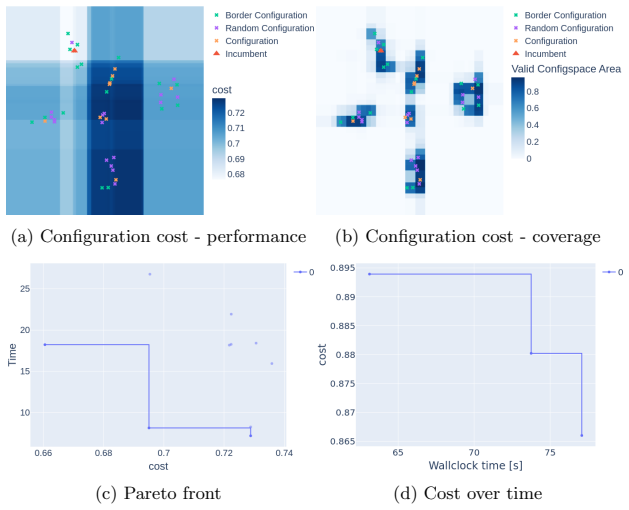
- Visualization output lets users inspect how the optimizer explored the space.
- The meta-dataset preparation step readies the framework for future meta-learning additions.
Where Pith is reading between the lines
- Wider adoption of automated tuning could reduce manual trial-and-error in production recommender deployments.
- Meta-learning integration might shorten search time on new datasets by transferring knowledge from prior runs.
- The reuse feature enables direct deployment of the discovered model without extra steps.
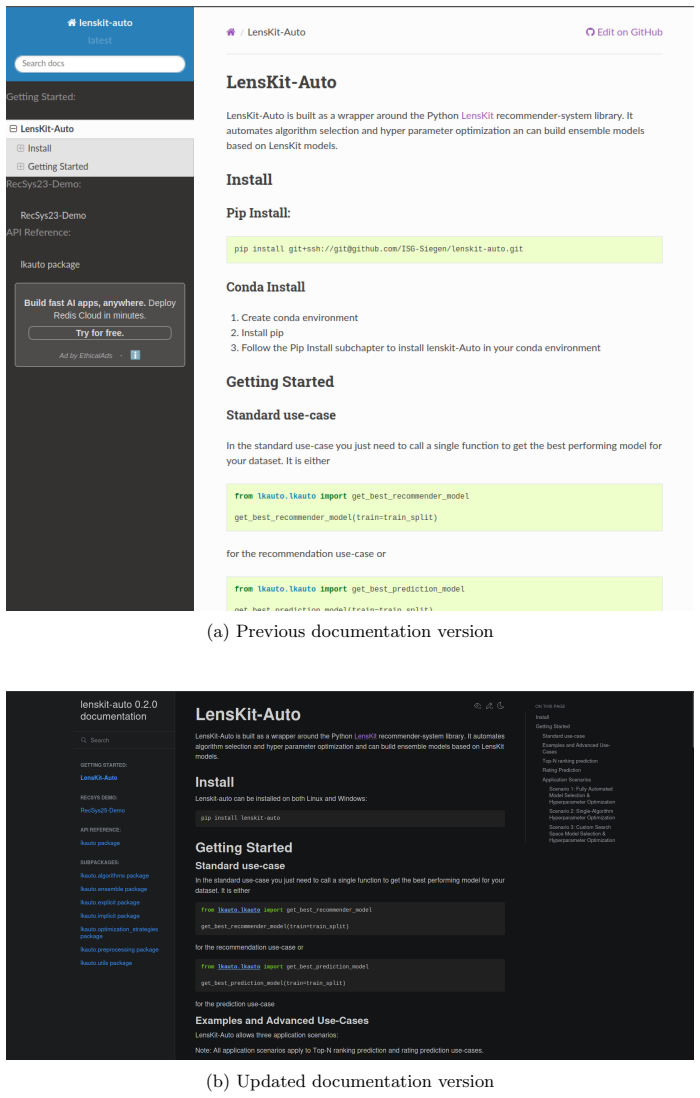
- Updated documentation lowers the barrier for researchers adding new algorithms to the search space.
Load-bearing premise
The code changes for LensKit compatibility and the Tree Parzen Estimator integrate cleanly and produce usable results on real recommender datasets.
What would settle it
Install the updated LensKit-Auto, run it on the MovieLens dataset, and verify that it completes the search without errors and returns a model whose performance can be measured on held-out data.
Figures

read the original abstract
Recommender systems have a wide area of application, e.g. in fields like video streaming, social media, or digital marketplaces. But, for a recommender-system, finding the right algorithm with the right hyperparameters is a reoccurring challenge. There is no one-fits-all solution, since the performance of one algorithm can vary immensely on different data sets. Due to the challenges of finding the right algorithm and the broad use of recommender-systems, it is of interest to create an Automated Recommender System (AutoRecSys) that takes on the task of finding the right algorithm-hyperparameter-combination for a given data set. In this work, we present the enhancement of LensKit-Auto, a framework introduced by Vente et al., that solves exactly this task of finding a fitting algorithm-hyperparameter-combination. LensKit-Auto's biggest strength lies in its ease of use, where it operates as a black-box, into which the user can feed their data set and receive the information of which algorithm and hyperparameters work best on this data set. In this work, we bring LensKit-Auto up to date, so that it works with the new version of its underlying framework, LensKit. We also implement further functionalities, such as the Tree Parzen Estimator as an additional optimization method, the ability to reuse the found algorithm, updated documentation, and the ability to visualize the optimization process. We also adapt an existing meta-learning framework to generate a suitable meta-dataset for LensKit-Auto, which could enable the integration of meta-learning into LensKit-Auto in the future. The presented changes bring LensKit-Auto up to date and enhance its usability, so that even non-experts in the field can find the right algorithm for their use case.
Editorial analysis
A structured set of objections, weighed in public.
Referee Report
Summary. The manuscript describes updates to LensKit-Auto, an automated recommender system (AutoRecSys) framework originally introduced by Vente et al. The updates include compatibility with the new LensKit version, addition of the Tree Parzen Estimator as an optimization method, functionality to reuse the selected algorithm, visualization of the optimization process, updated documentation, and adaptation of an existing meta-learning framework to generate a meta-dataset for potential future integration. The central claim is that these changes bring the tool up to date and enhance its usability as a black-box system, enabling even non-experts to identify suitable algorithms and hyperparameters for a given dataset.
Significance. If the described updates function correctly and are validated, the work could provide a practical contribution to the AutoRecSys literature by improving accessibility of an existing framework in the recommender systems community. The addition of TPE and visualization features addresses common usability gaps in hyperparameter optimization tools. However, the absence of any empirical validation means the significance remains potential rather than demonstrated; the manuscript does not establish that the changes preserve or improve performance on real data.
major comments (1)
- [Abstract] Abstract and manuscript body: The central usability claim for non-experts requires that the compatibility updates, TPE integration, reuse functionality, and visualization all operate without errors and produce usable results. However, the text provides no execution traces, error rates, runtime measurements, output quality checks, or any evaluation on datasets to support this. This is load-bearing because the claim rests entirely on the implementation description without evidence.
Simulated Author's Rebuttal
We thank the referee for their review and constructive feedback on our manuscript describing updates to LensKit-Auto. We provide a point-by-point response to the major comment below.
read point-by-point responses
-
Referee: [Abstract] Abstract and manuscript body: The central usability claim for non-experts requires that the compatibility updates, TPE integration, reuse functionality, and visualization all operate without errors and produce usable results. However, the text provides no execution traces, error rates, runtime measurements, output quality checks, or any evaluation on datasets to support this. This is load-bearing because the claim rests entirely on the implementation description without evidence.
Authors: The manuscript is intended as a description of software updates to an existing framework, building upon the original LensKit-Auto work which included empirical evaluations. Our contributions focus on compatibility, new optimization methods (TPE is a standard approach), reuse functionality, visualization, and documentation improvements. These are standard software engineering practices, and the open-source nature of the project allows users to inspect and test the implementation directly. We do not claim new performance results but rather enhanced accessibility. Therefore, we believe the implementation description is sufficient to support the usability claims without additional empirical sections in this update paper. revision: no
Circularity Check
No derivations or predictions present; software update paper is self-contained
full rationale
The manuscript is a description of software enhancements to LensKit-Auto (compatibility with updated LensKit, addition of Tree Parzen Estimator, reuse functionality, visualization, and meta-dataset adaptation). No equations, predictions, fitted parameters, or derivation chains appear anywhere in the text. The single citation to Vente et al. is historical context for the original framework and does not serve as a load-bearing premise for any result. All claims reduce to statements of what was implemented, with no reduction to self-citation or input data by construction. This is the expected non-finding for an engineering update paper.
Axiom & Free-Parameter Ledger
Reference graph
Works this paper leans on
-
[1]
Accessed: 31.03.2026
Amazon2014 datasets.https://grouplens.org/datasets/movielens/. Accessed: 31.03.2026
2026
-
[2]
Autogluon documentation.https://auto.gluon.ai/stable/index. html. Accessed: 31.03.2026
2026
-
[3]
Accessed: 31.03.2026
Homepage of the omni cluster of the university of siegen.https:// cluster.uni-siegen.de/. Accessed: 31.03.2026
2026
-
[4]
Accessed: 30.03.2026
Deepcave documentation.https://automl.github.io/DeepCAVE/main/ index.html. Accessed: 30.03.2026
2026
-
[5]
Ac- cessed: 31.03.2026
Lenskit documentation.https://lenskit.org/stable/index.html. Ac- cessed: 31.03.2026
2026
-
[6]
Accessed: 31.03.2026
Meta-learning framework git repository.https://github.com/ ISG-Siegen/RecSys-Algorithm-Selection-Ranking-Implicit-LBR, . Accessed: 31.03.2026
2026
-
[7]
Accessed: 31.03.2026
Git repository of the adapted meta-learning framework.https://github.com/LucaQuade/ RecSys-Algorithm-Selection-Ranking-Implicit-LBR, . Accessed: 31.03.2026
2026
-
[8]
Accessed: 31.03.2026
Movielens datasets.https://cseweb.ucsd.edu/ ~jmcauley/datasets/ amazon/links.html. Accessed: 31.03.2026
2026
-
[9]
Accessed: 31.03.2026
Recbole documentation.https://recbole.io/docs/, . Accessed: 31.03.2026
2026
-
[10]
Accessed: 31.03.2026
Recpack documentation.https://recpack.froomle.ai/, . Accessed: 31.03.2026
2026
-
[11]
Ac- cessed: 31.03.2026
Slurm documentation.https://slurm.schedmd.com/overview.html. Ac- cessed: 31.03.2026
2026
-
[12]
Adomavicius and A
G. Adomavicius and A. Tuzhilin. Toward the next generation of recom- mender systems: a survey of the state-of-the-art and possible extensions. IEEE Transactions on Knowledge and Data Engineering, 17(6):734–749,
-
[13]
doi: 10.1109/TKDE.2005.99
-
[14]
Aggarwal.Recommender Systems: The Textbook
Charu C. Aggarwal.Recommender Systems: The Textbook. Springer, 2016. doi: 10.1007/978-3-319-29659-3
-
[15]
Xavier Amatriain and Justin Basilico.Recommender Systems in Industry: A Netflix Case Study, pages 385–419. 01 2015. ISBN 978-1-4899-7636-9. doi: 10.1007/978-1-4899-7637-6 11. 38
-
[16]
Rohan Anand and Joeran Beel. Auto-surprise: An automated recommender-system (autorecsys) library with tree of parzens estimator (tpe) optimization. InProceedings of the 14th ACM Conference on Rec- ommender Systems, RecSys ’20, page 585–587, New York, NY, USA, 2020. Association for Computing Machinery. ISBN 9781450375832. doi: 10.1145/ 3383313.3411467. URL...
-
[17]
Auto-surprise: An automated recommender-system (autorecsys) library with tree of parzens estimator (tpe) optimization
Rohan Anand and Joeran Beel. Auto-surprise: An automated recommender-system (autorecsys) library with tree of parzens estimator (tpe) optimization. InProceedings of the 14th ACM Conference on Recom- mender Systems, pages 585–587, 2020
2020
-
[18]
Green recommender systems: Optimizing dataset size for energy-efficient algorithm perfor- mance
Ardalan Arabzadeh, Tobias Vente, and Joeran Beel. Green recommender systems: Optimizing dataset size for energy-efficient algorithm perfor- mance. InInternational Workshop on Recommender Systems for Sustain- ability and Social Good, pages 73–82. Springer, 2024
2024
-
[19]
4.3 best-practices for offline evaluations of recommender systems.Evaluation Perspectives of Recommender Systems: Driving Re- search and Education, 55(8):110, 2022
Joeran Beel, Dietmar Jannach, Alan Said, Guy Shani, Tobias Vente, and Lukas Wegmeth. 4.3 best-practices for offline evaluations of recommender systems.Evaluation Perspectives of Recommender Systems: Driving Re- search and Education, 55(8):110, 2022
2022
-
[20]
Random search for hyper-parameter optimization.Journal of Machine Learning Research, 13(10):281–305, 2012
James Bergstra and Yoshua Bengio. Random search for hyper-parameter optimization.Journal of Machine Learning Research, 13(10):281–305, 2012. URLhttp://jmlr.org/papers/v13/bergstra12a.html
2012
-
[21]
Random search for hyper-parameter optimization.Journal of machine learning research, 13(2), 2012
James Bergstra and Yoshua Bengio. Random search for hyper-parameter optimization.Journal of machine learning research, 13(2), 2012
2012
-
[22]
Algo- rithms for hyper-parameter optimization
James Bergstra, R´ emi Bardenet, Yoshua Bengio, and Bal´ azs K´ egl. Algo- rithms for hyper-parameter optimization. InProceedings of the 25th Inter- national Conference on Neural Information Processing Systems, NIPS’11, page 2546–2554, Red Hook, NY, USA, 2011. Curran Associates Inc. ISBN 9781618395993
2011
-
[23]
Progress in recommender sys- tems research: Crisis? what crisis?AI Magazine, 42(3):43–54,
Paolo Cremonesi and Dietmar Jannach. Progress in recommender sys- tems research: Crisis? what crisis?AI Magazine, 42(3):43–54,
-
[24]
URLhttps:// onlinelibrary.wiley.com/doi/abs/10.1609/aimag.v42i3.18145
doi: https://doi.org/10.1609/aimag.v42i3.18145. URLhttps:// onlinelibrary.wiley.com/doi/abs/10.1609/aimag.v42i3.18145
-
[25]
Tiago Cunha, Carlos Soares, and Andr´ e C.P.L.F. de Carvalho. Met- alearning and recommender systems: A literature review and empirical study on the algorithm selection problem for collaborative filtering.In- formation Sciences, 423:128–144, 2018. ISSN 0020-0255. doi: https: //doi.org/10.1016/j.ins.2017.09.050. URLhttps://www.sciencedirect. com/science/ar...
-
[26]
Item-based top-n recommenda- tion algorithms.ACM Transactions on Information Systems (TOIS), 22 (1):143–177, 2004
Mukund Deshpande and George Karypis. Item-based top-n recommenda- tion algorithms.ACM Transactions on Information Systems (TOIS), 22 (1):143–177, 2004. 39
2004
-
[27]
Lenskit for python: Next-generation software for recommender systems experiments
Michael D Ekstrand. Lenskit for python: Next-generation software for recommender systems experiments. InProceedings of the 29th ACM inter- national conference on information & knowledge management, pages 2999– 3006, 2020
2020
-
[28]
Michael D. Ekstrand, John T. Riedl, and Joseph A. Konstan. Collaborative filtering recommender systems.Found. Trends Hum.-Comput. Interact., 4 (2):81–173, February 2011. ISSN 1551-3955. doi: 10.1561/1100000009. URLhttps://doi.org/10.1561/1100000009
-
[29]
Mueller, Alexander Shirkov, Hang Zhang, Pedro Larroy, Mu Li, and Alex Smola
Nick Erickson, Jonas W. Mueller, Alexander Shirkov, Hang Zhang, Pedro Larroy, Mu Li, and Alex Smola. Autogluon-tabular: Robust and accurate automl for structured data.ArXiv, abs/2003.06505, 2020. URLhttps: //api.semanticscholar.org/CorpusID:212725762
Pith/arXiv arXiv 2003
-
[30]
Efficient and robust au- tomated machine learning
Matthias Feurer, Aaron Klein, Katharina Eggensperger, Jost Sprin- genberg, Manuel Blum, and Frank Hutter. Efficient and robust au- tomated machine learning. In C. Cortes, N. Lawrence, D. Lee, M. Sugiyama, and R. Garnett, editors,Advances in Neural In- formation Processing Systems, volume 28. Curran Associates, Inc.,
-
[31]
URLhttps://proceedings.neurips.cc/paper_files/paper/ 2015/file/11d0e6287202fced83f79975ec59a3a6-Paper.pdf
2015
-
[32]
A survey of accuracy evaluation met- rics of recommendation tasks.Journal of Machine Learning Research, 10 (12), 2009
Asela Gunawardana and Guy Shani. A survey of accuracy evaluation met- rics of recommendation tasks.Journal of Machine Learning Research, 10 (12), 2009
2009
-
[33]
Evaluating recom- mender systems
Asela Gunawardana, Guy Shani, and Sivan Yogev. Evaluating recom- mender systems. InRecommender systems handbook, pages 547–601. Springer, 2012
2012
-
[34]
Evaluating collaborative filtering recommender systems.ACM Transactions on Information Systems (TOIS), 22(1):5–53, 2004
Jonathan L Herlocker, Joseph A Konstan, Loren G Terveen, and John T Riedl. Evaluating collaborative filtering recommender systems.ACM Transactions on Information Systems (TOIS), 22(1):5–53, 2004
2004
-
[36]
Collaborative filtering for implicit feedback datasets
Yifan Hu, Yehuda Koren, and Chris Volinsky. Collaborative filtering for implicit feedback datasets. InProceedings of the 2008 Eighth IEEE Inter- national Conference on Data Mining, ICDM ’08, page 263–272, USA, 2008. IEEE Computer Society. ISBN 9780769535029. doi: 10.1109/ICDM.2008
-
[37]
URLhttps://doi.org/10.1109/ICDM.2008.22
-
[38]
Collaborative filtering for implicit feedback datasets
Yifan Hu, Yehuda Koren, and Chris Volinsky. Collaborative filtering for implicit feedback datasets. In2008 Eighth IEEE international conference on data mining, pages 263–272. Ieee, 2008. 40
2008
-
[39]
Frank Hutter, Holger H. Hoos, and Kevin Leyton-Brown. Sequential model- based optimization for general algorithm configuration. InProceedings of the 5th International Conference on Learning and Intelligent Optimization, LION’05, page 507–523, Berlin, Heidelberg, 2011. Springer-Verlag. ISBN 9783642255656. doi: 10.1007/978-3-642-25566-3 40. URLhttps://doi. ...
-
[40]
Springer, 2019
Frank Hutter, Lars Kotthoff, and Joaquin Vanschoren.Automated Machine Learning: Methods, Systems, Challenges. Springer, 2019. doi: 10.1007/ 978-3-030-05318-5
2019
-
[41]
Frank Hutter, Lars Kotthoff, and Joaquin Vanschoren.Automated Machine Learning - Methods, Systems, Challenges. 01 2019. ISBN 978-3-030-05317-
2019
-
[42]
doi: 10.1007/978-3-030-05318-5
-
[43]
Springer, 2019
Frank Hutter, Lars Kotthoff, and Joaquin Vanschoren.Automated machine learning: methods, systems, challenges. Springer, 2019
2019
-
[44]
Cumulated gain-based evaluation of ir techniques.ACM Transactions on Information Systems (TOIS), 20 (4):422–446, 2002
Kalervo J¨ arvelin and Jaana Kek¨ al¨ ainen. Cumulated gain-based evaluation of ir techniques.ACM Transactions on Information Systems (TOIS), 20 (4):422–446, 2002
2002
-
[46]
Matrix factorization tech- niques for recommender systems.Computer, 42(8):30–37, 2009
Yehuda Koren, Robert Bell, and Chris Volinsky. Matrix factorization tech- niques for recommender systems.Computer, 42(8):30–37, 2009
2009
-
[47]
Matrix Factorization Techniques for Recommender Systems.Computer, 42(8):30–37, August 2009
Yehuda Koren, Robert Bell, and Chris Volinsky. Matrix factorization tech- niques for recommender systems.Computer, 42(8):30–37, August 2009. ISSN 0018-9162. doi: 10.1109/MC.2009.263. URLhttps://doi.org/10. 1109/MC.2009.263
-
[48]
Recpack: An(other) experimentation toolkit for top-n recommendation using implicit feedback data
Lien Michiels, Robin Verachtert, and Bart Goethals. Recpack: An(other) experimentation toolkit for top-n recommendation using implicit feedback data. InProceedings of the 16th ACM Conference on Recommender Sys- tems, RecSys ’22, page 648–651, New York, NY, USA, 2022. Association for Computing Machinery. ISBN 9781450392785. doi: 10.1145/3523227. 3551472. U...
-
[49]
Emanuel Parzen. On estimation of a probability density function and mode.The Annals of Mathematical Statistics, 33(3):1065–1076, 1962. ISSN 00034851. URLhttp://www.jstor.org/stable/2237880
arXiv 1962
-
[50]
Open- ing the black box: Automated software analysis for algorithm selection
Damir Pulatov, Marie Anastacio, Lars Kotthoff, and Holger Hoos. Open- ing the black box: Automated software analysis for algorithm selection. In Isabelle Guyon, Marius Lindauer, Mihaela van der Schaar, Frank Hut- ter, and Roman Garnett, editors,Proceedings of the First International 41 Conference on Automated Machine Learning, volume 188 ofProceedings of ...
2022
-
[51]
Bpr: Bayesian personalized ranking from implicit feedback
Steffen Rendle, Christoph Freudenthaler, Zeno Gantner, and Lars Schmidt- Thieme. Bpr: Bayesian personalized ranking from implicit feedback. In Proceedings of the Twenty-Fifth Conference on Uncertainty in Artificial Intelligence, UAI ’09, page 452–461, Arlington, Virginia, USA, 2009. AUAI Press. ISBN 9780974903958
2009
-
[52]
Kantor, ed- itors.Recommender Systems Handbook
Francesco Ricci, Lior Rokach, Bracha Shapira, and Paul B. Kantor, ed- itors.Recommender Systems Handbook. Springer, 2011. doi: 10.1007/ 978-0-387-85820-3
2011
-
[53]
Badrul Sarwar, George Karypis, Joseph Konstan, and John Riedl. Item- based collaborative filtering recommendation algorithms. InProceedings of the 10th International Conference on World Wide Web, WWW ’01, page 285–295, New York, NY, USA, 2001. Association for Computing Machinery. ISBN 1581133480. doi: 10.1145/371920.372071. URLhttps://doi.org/ 10.1145/371...
-
[54]
Deepcave: An interactive analysis tool for automated machine learning, 2022
Ren´ e Sass, Eddie Bergman, Andr´ e Biedenkapp, Frank Hutter, and Marius Lindauer. Deepcave: An interactive analysis tool for automated machine learning, 2022. URLhttps://arxiv.org/abs/2206.03493
arXiv 2022
-
[55]
Bobak Shahriari, Kevin Swersky, Ziyu Wang,{Ryan P.}Adams, and Nando {De Freitas}. Taking the human out of the loop: A review of bayesian optimization.Proceedings of the IEEE, 104(1):148–175, January 2016. ISSN 0018-9219. doi: 10.1109/JPROC.2015.2494218. Publisher Copyright:© 1963-2012 IEEE
-
[56]
Everyone’s a winner! on hyper- parameter tuning of recommendation models
Faisal Shehzad and Dietmar Jannach. Everyone’s a winner! on hyper- parameter tuning of recommendation models. InProceedings of the 17th ACM Conference on Recommender Systems, RecSys ’23, page 652–657, New York, NY, USA, 2023. Association for Computing Machinery. ISBN 9798400702419. doi: 10.1145/3604915.3609488. URLhttps://doi.org/ 10.1145/3604915.3609488
-
[57]
Jasper Snoek, Hugo Larochelle, and Ryan P. Adams. Practical bayesian optimization of machine learning algorithms, 2012. URLhttps://arxiv. org/abs/1206.2944
Pith/arXiv arXiv 2012
-
[58]
Practical bayesian op- timization of machine learning algorithms.Advances in neural information processing systems, 25, 2012
Jasper Snoek, Hugo Larochelle, and Ryan P Adams. Practical bayesian op- timization of machine learning algorithms.Advances in neural information processing systems, 25, 2012
2012
-
[59]
librec-auto: A tool for 42 recommender systems experimentation
Nasim Sonboli, Masoud Mansoury, Ziyue Guo, Shreyas Kadekodi, Weiwen Liu, Zijun Liu, Andrew Schwartz, and Robin Burke. librec-auto: A tool for 42 recommender systems experimentation. InProceedings of the 30th ACM In- ternational Conference on Information & Knowledge Management, CIKM ’21, page 4584–4593, New York, NY, USA, 2021. Association for Comput- ing ...
-
[60]
Xiaoyuan Su and Taghi M. Khoshgoftaar. A survey of collaborative filtering techniques.Advances in Artificial Intelligence, 2009(1):421425. doi: https: //doi.org/10.1155/2009/421425. URLhttps://onlinelibrary.wiley. com/doi/abs/10.1155/2009/421425
-
[61]
Auto-weka: Combined selection and hyperparameter optimization of classi- fication algorithms
Chris Thornton, Frank Hutter, Holger H Hoos, and Kevin Leyton-Brown. Auto-weka: Combined selection and hyperparameter optimization of classi- fication algorithms. InProceedings of the 19th ACM SIGKDD international conference on Knowledge discovery and data mining, pages 847–855, 2013
2013
-
[62]
Evaluating group recommender systems
Christoph Trattner, Alan Said, Ludovico Boratto, and Alexander Felfernig. Evaluating group recommender systems. InGroup recommender systems: an introduction, pages 63–75. Springer, 2023
2023
-
[63]
Meta-learning
Joaquin Vanschoren. Meta-learning. pages 39–68
-
[64]
Advancing automation of design decisions in recommender system pipelines
Tobias Vente. Advancing automation of design decisions in recommender system pipelines. InProceedings of the 17th ACM Conference on Recom- mender Systems, pages 1355–1360, 2023
2023
-
[65]
Introducing lenskit-auto, an experimental automated recommender system (autorecsys) toolkit
Tobias Vente, Michael Ekstrand, and Joeran Beel. Introducing lenskit-auto, an experimental automated recommender system (autorecsys) toolkit. In Proceedings of the 17th ACM Conference on Recommender Systems, pages 1212–1216, 2023
2023
-
[66]
Greedy ensemble selection for top-n recommendations
Tobias Vente, Zainil Mehta, Lukas Wegmeth, and Joeran Beel. Greedy ensemble selection for top-n recommendations. InRobustRecSys@ RecSys, pages 12–16, 2024
2024
-
[67]
From clicks to carbon: the environmental toll of recommender systems
Tobias Vente, Lukas Wegmeth, Alan Said, and Joeran Beel. From clicks to carbon: the environmental toll of recommender systems. InProceedings of the 18th ACM Conference on Recommender Systems, pages 580–590, 2024
2024
-
[68]
Aps explorer: Navigating algorithm performance spaces for informed dataset selection
Tobias Vente, Michael Heep, Abdullah Abbas, Theodor Sperle, Joeran Beel, and Bart Goethals. Aps explorer: Navigating algorithm performance spaces for informed dataset selection. InProceedings of the Nineteenth ACM Con- ference on Recommender Systems, pages 1322–1324, 2025
2025
-
[69]
The potential of automl for recommender systems
Tobias Vente, Lukas Wegmeth, and Joeran Beel. The potential of automl for recommender systems. InAdjunct Proceedings of the 33rd ACM Con- ference on User Modeling, Adaptation and Personalization, pages 371–378, 2025. 43
2025
-
[70]
What to compare? towards un- derstanding user sessions on price comparison platforms
Ahmadou Wagne and Julia Neidhardt. What to compare? towards un- derstanding user sessions on price comparison platforms. InProceedings of the 18th ACM Conference on Recommender Systems, RecSys ’24, page 1158–1162, New York, NY, USA, 2024. Association for Computing Ma- chinery. ISBN 9798400705052. doi: 10.1145/3640457.3691717. URL https://doi.org/10.1145/3...
-
[71]
What to compare? towards un- derstanding user sessions on price comparison platforms
Lukas Wegmeth, Tobias Vente, and Joeran Beel. Recommender systems algorithm selection for ranking prediction on implicit feedback datasets. In Proceedings of the 18th ACM Conference on Recommender Systems, RecSys ’24, page 1163–1167, New York, NY, USA, 2024. Association for Computing Machinery. ISBN 9798400705052. doi: 10.1145/3640457.3691718. URL https:/...
-
[72]
Recommender systems algorithm selection for ranking prediction on implicit feedback datasets
Lukas Wegmeth, Tobias Vente, and Joeran Beel. Recommender systems algorithm selection for ranking prediction on implicit feedback datasets. In Proceedings of the 18th ACM Conference on Recommender Systems, pages 1163–1167, 2024
2024
-
[73]
Green recom- mender systems: Understanding and minimizing the carbon footprint of ai-powered personalization.ACM Transactions on Recommender Systems, 2025
Lukas Wegmeth, Tobias Vente, Alan Said, and Joeran Beel. Green recom- mender systems: Understanding and minimizing the carbon footprint of ai-powered personalization.ACM Transactions on Recommender Systems, 2025
2025
-
[74]
Recbole: Towards a unified, compre- hensive and efficient framework for recommendation algorithms
Wayne Xin Zhao, Shanlei Mu, Yupeng Hou, Zihan Lin, Yushuo Chen, Xingyu Pan, Kaiyuan Li, Yujie Lu, Hui Wang, Changxin Tian, Yingqian Min, Zhichao Feng, Xinyan Fan, Xu Chen, Pengfei Wang, Wendi Ji, Yaliang Li, Xiaoling Wang, and Ji-Rong Wen. Recbole: Towards a unified, compre- hensive and efficient framework for recommendation algorithms. InProceed- ings of...
-
[75]
Automl for deep recommender systems: A survey.ACM Transactions on Information Systems, 41(4):1–38, 2023
Ruiqi Zheng, Liang Qu, Bin Cui, Yuhui Shi, and Hongzhi Yin. Automl for deep recommender systems: A survey.ACM Transactions on Information Systems, 41(4):1–38, 2023. 44
2023
discussion (0)
Sign in with ORCID, Apple, or X to comment. Anyone can read and Pith papers without signing in.