Predicting Malicious Insider Threat Scenarios Using Organizational Data and a Heterogeneous Stack-Classifier
Pith reviewed 2026-05-24 17:09 UTC · model grok-4.3
The pith
A meta-classifier aggregates multiple models to predict a specific insider threat scenario with 96.2 percent accuracy.
A machine-rendered reading of the paper's core claim, the machinery that carries it, and where it could break.
Core claim
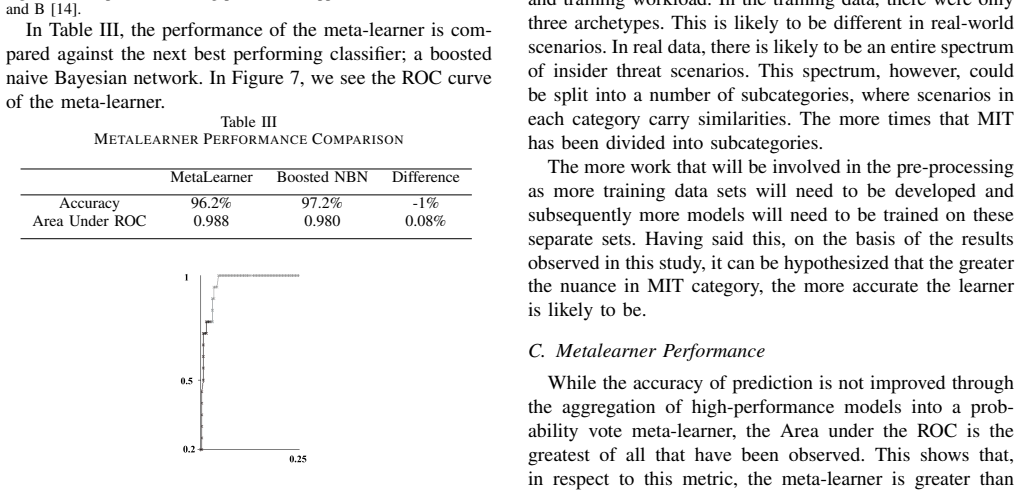
By converting CERT r4.2 logs into daily user summaries and training multiple classifiers that are aggregated into a heterogeneous stack-classifier with boosting, the approach detects the malicious insider threat of leaking data to WikiLeaks prior to leaving with 96.2% accuracy and 0.988 AUC.
What carries the argument
The heterogeneous stack-classifier, formed by aggregating the best performing individual classifiers trained on daily user summaries derived from organizational logs.
If this is right
- Daily user summaries from log data provide sufficient features for distinguishing the target threat from normal behavior.
- Boosting optimizes the accuracy of the base classifiers before aggregation.
- The meta-classifier demonstrates stronger predictive performance than any of its constituent models.
- Analysis of confusion matrices and ROC curves validates the high accuracy and AUC values.
- This methodology can be used to train classifiers for the specified threat scenario.
Where Pith is reading between the lines
- The method could be tested on real organizational data to check if performance holds outside the synthetic CERT dataset.
- Similar preprocessing and stacking could apply to other insider threat scenarios like unauthorized access or sabotage.
- Real-time implementation of daily summary generation might allow for proactive alerts in security systems.
- Combining this with additional data sources beyond logs could further improve detection.
Load-bearing premise
That the daily user summaries from the synthetic CERT r4.2 logs contain signals that distinguish the threat scenario in a way that generalizes to real organizations.
What would settle it
Applying the trained meta-classifier to a different dataset of real insider threat incidents and checking if accuracy remains near 96%.
Figures


read the original abstract
Insider threats continue to present a major challenge for the information security community. Despite constant research taking place in this area; a substantial gap still exists between the requirements of this community and the solutions that are currently available. This paper uses the CERT dataset r4.2 along with a series of machine learning classifiers to predict the occurrence of a particular malicious insider threat scenario - the uploading sensitive information to wiki leaks before leaving the organization. These algorithms are aggregated into a meta-classifier which has a stronger predictive performance than its constituent models. It also defines a methodology for performing pre-processing on organizational log data into daily user summaries for classification, and is used to train multiple classifiers. Boosting is also applied to optimise classifier accuracy. Overall the models are evaluated through analysis of their associated confusion matrix and Receiver Operating Characteristic (ROC) curve, and the best performing classifiers are aggregated into an ensemble classifier. This meta-classifier has an accuracy of \textbf{96.2\%} with an area under the ROC curve of \textbf{0.988}.
Editorial analysis
A structured set of objections, weighed in public.
Referee Report
Summary. The manuscript claims to predict a specific malicious insider threat scenario (uploading sensitive information to Wikileaks before departure) on the synthetic CERT r4.2 dataset. It describes a preprocessing pipeline that converts organizational logs into daily user summaries, trains multiple base classifiers with boosting, and aggregates the strongest models into a meta-classifier that achieves 96.2% accuracy and 0.988 AUC, with evaluation via confusion matrices and ROC curves.
Significance. If the performance numbers survive rigorous validation, the preprocessing methodology for daily summaries and the ensemble construction could provide a reusable template for log-based insider-threat detection. The work also demonstrates the practical aggregation of heterogeneous classifiers, which is a modest but concrete engineering contribution.
major comments (3)
- [Evaluation] Evaluation section (and abstract): the reported 96.2% accuracy and 0.988 AUC are presented without any description of the train/test partitioning, cross-validation procedure, or stratification for the extreme class imbalance present in CERT r4.2. Because the central claim rests on these performance figures, the absence of these details makes it impossible to determine whether the numbers reflect genuine out-of-sample prediction or in-sample fitting.
- [Methodology] Data-preprocessing section: the daily user summaries are constructed from the full CERT r4.2 logs with no stated safeguards against temporal leakage (e.g., feature statistics computed on the entire timeline rather than strictly within training windows). Given that the malicious traces are rule-based synthetic injections, any feature that encodes log volume, timing, or file-type patterns tied to those rules can produce high accuracy without capturing generalizable behavioral signals.
- [Experiments] Experimental design: all results are obtained on a single synthetic corpus (CERT r4.2) with no external hold-out dataset, cross-organization test, or real-world logs. The meta-classifier therefore cannot be shown to generalize beyond the specific injection rules used to generate the target scenario.
minor comments (1)
- [Abstract] Abstract: 'wiki leaks' should be written as the single word 'Wikileaks'.
Simulated Author's Rebuttal
We thank the referee for their constructive and detailed comments. We address each major point below and indicate the changes planned for the revised manuscript.
read point-by-point responses
-
Referee: [Evaluation] Evaluation section (and abstract): the reported 96.2% accuracy and 0.988 AUC are presented without any description of the train/test partitioning, cross-validation procedure, or stratification for the extreme class imbalance present in CERT r4.2. Because the central claim rests on these performance figures, the absence of these details makes it impossible to determine whether the numbers reflect genuine out-of-sample prediction or in-sample fitting.
Authors: We agree that the Evaluation section does not provide sufficient detail on the experimental protocol. We will revise both the Evaluation section and the abstract to include a complete description of the train/test partitioning, cross-validation procedure, and stratification approach used to handle class imbalance, allowing readers to verify that the reported metrics reflect out-of-sample performance. revision: yes
-
Referee: [Methodology] Data-preprocessing section: the daily user summaries are constructed from the full CERT r4.2 logs with no stated safeguards against temporal leakage (e.g., feature statistics computed on the entire timeline rather than strictly within training windows). Given that the malicious traces are rule-based synthetic injections, any feature that encodes log volume, timing, or file-type patterns tied to those rules can produce high accuracy without capturing generalizable behavioral signals.
Authors: We acknowledge that the Data-preprocessing section does not explicitly document safeguards against temporal leakage. We will revise this section to describe how daily summaries were constructed while respecting temporal order and ensuring that all feature computations were performed strictly within training windows, thereby clarifying that no future information influenced the models. revision: yes
-
Referee: [Experiments] Experimental design: all results are obtained on a single synthetic corpus (CERT r4.2) with no external hold-out dataset, cross-organization test, or real-world logs. The meta-classifier therefore cannot be shown to generalize beyond the specific injection rules used to generate the target scenario.
Authors: We recognize that limiting evaluation to a single synthetic dataset restricts claims of broad generalizability. Our contribution centers on the daily-summary preprocessing pipeline and the heterogeneous stacking methodology rather than on cross-dataset validation. We will add an explicit discussion of this limitation in the revised manuscript and outline directions for future work on additional datasets. revision: partial
Circularity Check
No significant circularity; empirical ML evaluation on provided dataset.
full rationale
The paper describes an empirical machine-learning pipeline that derives daily user summary features from the CERT r4.2 logs, trains a heterogeneous stack of classifiers, applies boosting, and aggregates them into a meta-classifier whose performance is measured by accuracy and AUC on that same corpus. No mathematical derivation chain, first-principles equations, or uniqueness theorem is presented whose output is definitionally identical to its inputs. The reported 96.2 % accuracy and 0.988 AUC are standard supervised-learning evaluation metrics rather than a 'prediction' that has been forced by construction. No self-citation load-bearing step, ansatz smuggling, or renaming of a known result occurs. The work is therefore self-contained as an applied ML study; any concerns about synthetic-data artifacts or lack of external hold-out belong to correctness or generalization risk, not circularity.
Axiom & Free-Parameter Ledger
free parameters (2)
- daily summary feature definitions and thresholds
- classifier hyperparameters and boosting rounds
axioms (1)
- domain assumption CERT r4.2 synthetic labels accurately reflect real-world malicious insider behavior for the WikiLeaks scenario.
Reference graph
Works this paper leans on
-
[1]
The Greater The Power , The More Dangerous The Abuse : Facing Malicious Insiders in The Cloud,
N. Pitropakis, C. Lyvas, and C. Lambrinoudakis, “The Greater The Power , The More Dangerous The Abuse : Facing Malicious Insiders in The Cloud,” no. c, pp. 156–161, 2017
work page 2017
-
[2]
Sans Intitute, “Interested in learning SANS Institute InfoSec Reading Room Defending Against the Wrong Enemy : 2017 SANS Defending Against the Wrong Enemy : 2017 SANS Insider Threat Survey,” 2017
work page 2017
-
[3]
2017 Cost of Data Breach Study, Global Overview,
I. Ponemon, “2017 Cost of Data Breach Study, Global Overview,” IBM Security , no. March, pp. 1–34, 2017. [Online]. Available: https://www-01.ibm.com/common/ssi/ cgi-bin/ssialias?htmlfid=SEL03130WWEN{&}
work page 2017
-
[4]
C. Associates, “Insider Threat 2018 Report,” p. 41, 2018. [Online]. Available: https://www.cybersecurity-insiders.com/ wp-content/uploads/2016/09/Insider-Threat-Report-2018.pdf
work page 2018
-
[5]
I. A. Gheyas and A. E. Abdallah, “Detection and prediction of insider threats to cyber security: a systematic literature review and meta-analysis,” Big Data Analytics , vol. 1, no. 1, p. 6, 2016. [Online]. Available: http://bdataanalytics. biomedcentral.com/articles/10.1186/s41044-016-0006-0
-
[6]
Insider Threat Detection Using Graph-Based Approaches,
W. Eberle and L. Holder, “Insider Threat Detection Using Graph-Based Approaches,” 2009 Cybersecurity Applications & Technology Conference for Homeland Security , pp. 237–241, 2009. [Online]. Available: http://ieeexplore.ieee. org/document/4804450/
-
[7]
Anomaly instruction detec- tion of masqueraders and threat evaluation using fuzzy logic,
Y . Yingbing and J. H. Graham, “Anomaly instruction detec- tion of masqueraders and threat evaluation using fuzzy logic,” Conference Proceedings - IEEE International Conference on Systems, Man and Cybernetics , vol. 3, pp. 2309–2314, 2007
work page 2007
-
[8]
Deep learning based attribute classification insider threat detection for data secu- rity,
F. Meng, F. Lou, Y . Fu, and Z. Tian, “Deep learning based attribute classification insider threat detection for data secu- rity,” in 2018 IEEE Third International Conference on Data Science in Cyberspace (DSC) , June 2018, pp. 576–581
work page 2018
-
[9]
Deep Learning for Unsupervised Insider Threat Detection in Structured Cybersecurity Data Streams
A. Tuor, S. Kaplan, B. Hutchinson, N. Nichols, and S. Robinson, “Deep Learning for Unsupervised Insider Threat Detection in Structured Cybersecurity Data Streams,” no. 2012, 2017. [Online]. Available: http://arxiv.org/abs/ 1710.00811
work page internal anchor Pith review Pith/arXiv arXiv 2012
-
[10]
Y . Hashem, H. Takabi, M. Ghasemigol, and R. Dantu, “Inside the Mind of the Insider: Towards Insider Threat Detection Using Psychophysiological Signals *,” Journal of Internet Services and Information Security , vol. 6, no. 1, pp. 20 – 36, 2016. [Online]. Available: http: //isyou.info/jisis/vol6/no1/jisis-2016-vol6-no1-02.pdf
work page 2016
-
[11]
G. Gavai, K. Sricharan, D. Gunning, J. Hanley, M. Singhal, and R. Rolleston, “Supervised and unsupervised methods to detect insider threat from enterprise social and online activity data,” Journal of Wireless Mobile Networks, Ubiquitous Computing, and Dependable Applications (JoWUA) , vol. 6, no. 4, pp. 47–63, 2015. [Online]. Available: http://isyou.info/...
work page 2015
-
[12]
Weka 3 - data mining with open source machine learning software in java,
“Weka 3 - data mining with open source machine learning software in java,” https://www.cs.waikato.ac.nz/ml/weka/, ac- cessed: 2018-10-05
work page 2018
-
[13]
J. P. A. C. M. Wooldridge, “Agent-Based Modeling for Complex Financial Systems have concluded that the dynamics of networked market,” IEEE Intelligent Systems , vol. 33, no. 2, pp. 74–82, 2018
work page 2018
-
[14]
I. H. Witten, E. Frank, and M. a. Hall, Data Mining: Practical Machine Learning Tools and Techniques (Google eBook), 2013. [Online]. Available: http://books.google.com/ books?id=bDtLM8CODsQC{&}pgis=1
work page 2013
discussion (0)
Sign in with ORCID, Apple, or X to comment. Anyone can read and Pith papers without signing in.