PickleFuzzer: A Case Study in Fuzzing for Discrepancies Between Python Pickle Implementations
Pith reviewed 2026-06-30 20:08 UTC · model grok-4.3
The pith
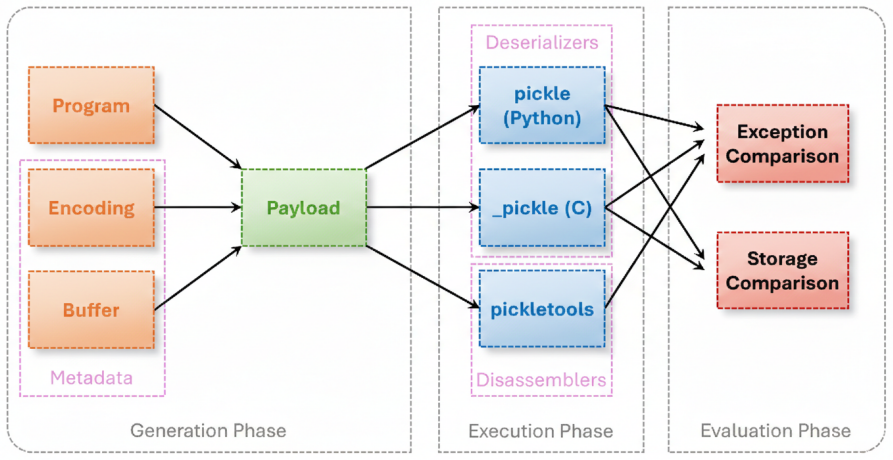
A grammar-based fuzzer using differential testing detects 14 discrepancies between Python pickle implementations, four of which bypass security scanners.
A machine-rendered reading of the paper's core claim, the machinery that carries it, and where it could break.
Core claim
PickleFuzzer generates pickle objects using a grammar developed to account for the missing pickle specification. It determines discrepancies by comparing the execution behaviors of each test implementation, rather than requiring a specification-derived oracle. PickleFuzzer detected 14 new discrepancies between the pickle implementations. Four discrepancies are critical and can be used to bypass security-critical scanning tools.
What carries the argument
PickleFuzzer, a generation-based fuzzer that applies differential testing to inputs produced by a custom grammar covering pickle opcodes.
If this is right
- Inconsistent exception behavior or state changes across implementations can produce incorrect classification of malicious payloads.
- Security tools that scan pickle data may fail to detect attacks that succeed on one implementation but not another.
- Differential testing without a full specification is sufficient to surface security-relevant inconsistencies in pickle.
- The same method can support more directed fuzzing aimed at deeper bugs in the pickle virtual machine.
Where Pith is reading between the lines
- The same grammar-driven differential approach could be applied to other serialization protocols that lack complete public specifications.
- A formal, public specification of the pickle opcode set would reduce the need for post-hoc grammar engineering to catch implementation drift.
- Extending the fuzzer to additional third-party or language-specific pickle variants would test whether the observed discrepancies are Python-specific.
- Serialization choices in machine-learning pipelines may warrant systematic differential testing as part of their security review.
Load-bearing premise
The custom grammar developed to account for the missing pickle specification is sufficiently complete to generate inputs that expose security-relevant discrepancies rather than only superficial differences.
What would settle it
An independent check showing that none of the four reported critical discrepancies actually allow a malicious payload to bypass the security scanners in practice.
Figures
read the original abstract
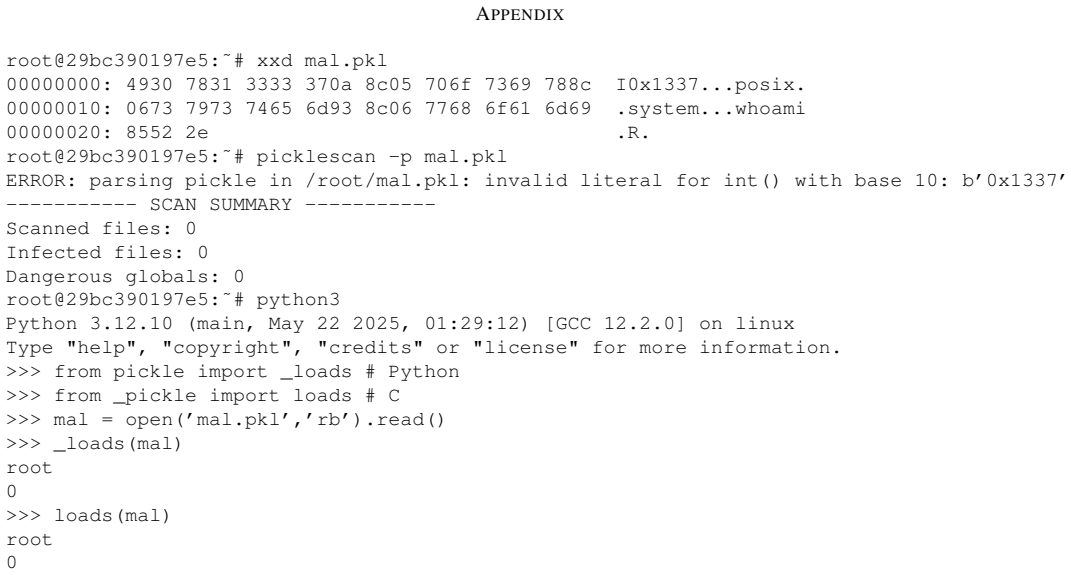
Python's native serialization protocol, pickle, is a powerful but insecure format for transferring untrusted data. It is frequently used, especially for saving machine learning models, despite known security challenges. While developers sometimes mitigate this risk by restricting imports during unpickling or using static and dynamic analysis tools, these approaches are error-prone and depend heavily on accurate interpretations of the Pickle Virtual Machine (PVM) opcodes. Discrepancies across Python's three native PVM modules can lead to incorrect detection of malicious payloads and undermine existing defenses. To efficiently and scalably identify discrepancies, we present PickleFuzzer, a custom generation-based fuzzer that identifies inconsistencies across pickle implementations. PickleFuzzer generates pickle objects, passes them to each implementation, and detects differences in thrown exceptions or changes to key internal states. It generates pickle objects using a grammar, which we developed to account for the missing pickle specification. It determines discrepancies by comparing the execution behaviors of each test implementation, rather than requiring a specification-derived oracle. PickleFuzzer detected 14 new discrepancies between the pickle implementations. Four discrepancies are critical and can be used to bypass security-critical scanning tools like those deployed on the popular model hosting platform, Hugging Face. We disclosed all findings to the Python Software Foundation for remediation, and additionally disclosed the security issues to a bug bounty platform and were awarded a $750 bounty. We demonstrate that differential testing is a viable approach for identifying security-relevant discrepancies in important pickle implementations, and our work can lead to promising future directions for finding deeper pickle bugs with more directed fuzzing.
Editorial analysis
A structured set of objections, weighed in public.
Referee Report
Summary. The paper introduces PickleFuzzer, a generation-based fuzzer that uses a hand-crafted grammar (developed in the absence of a formal pickle specification) to generate inputs and detect behavioral discrepancies across Python's pickle implementations by comparing thrown exceptions and internal PVM state changes. It reports 14 new discrepancies, four of which are characterized as critical because they enable bypass of security scanners including those deployed on Hugging Face; the findings were disclosed to the PSF and yielded a $750 bounty.
Significance. If the discrepancies are reproducible and the bypass claims hold, the work provides concrete evidence that differential testing can surface security-relevant inconsistencies in a widely used but underspecified serialization format, with direct implications for ML model hosting and import-restriction defenses. The external bounty award supplies independent corroboration that at least some reported issues are actionable.
major comments (2)
- [§3] §3 (Grammar Construction): the central claim that four discrepancies enable scanner bypass rests on the grammar producing inputs that reach security-critical PVM opcode sequences and state transitions; however, the manuscript supplies no coverage metrics, no enumeration of exercised opcodes against the full set, and no comparison of generated inputs to the opcode patterns present in known malicious pickles.
- [§5.2] §5.2 (Critical Discrepancies): the assertion that the four discrepancies bypass Hugging Face-style scanners is load-bearing for the security contribution, yet the evaluation provides only high-level descriptions of the differing behaviors without concrete reproduction steps, the exact opcode/state combinations involved, or evidence that the fuzzer inputs are dense in the relevant subspace rather than only triggering superficial exception differences.
minor comments (2)
- [Table 2] Table 2: the column headers for the three PVM implementations are not repeated on continuation pages, reducing readability.
- [Abstract and §5] The abstract states '14 new discrepancies' while the body occasionally refers to 'previously unreported' without clarifying overlap with prior public reports; a short clarification sentence would help.
Simulated Author's Rebuttal
We thank the referee for their positive assessment of the significance of our work and the independent validation provided by the bounty award. We address each of the major comments below.
read point-by-point responses
-
Referee: [§3] §3 (Grammar Construction): the central claim that four discrepancies enable scanner bypass rests on the grammar producing inputs that reach security-critical PVM opcode sequences and state transitions; however, the manuscript supplies no coverage metrics, no enumeration of exercised opcodes against the full set, and no comparison of generated inputs to the opcode patterns present in known malicious pickles.
Authors: We agree that the manuscript would benefit from more explicit details on the grammar's coverage. Although no formal pickle specification exists, making traditional coverage metrics challenging to define, we will add an enumeration of the opcodes and key state transitions exercised by the grammar to the revised §3. We will also include a comparison of our generated inputs against opcode patterns from publicly known malicious pickles to demonstrate that the grammar reaches security-critical sequences. This addresses the concern directly. revision: yes
-
Referee: [§5.2] §5.2 (Critical Discrepancies): the assertion that the four discrepancies bypass Hugging Face-style scanners is load-bearing for the security contribution, yet the evaluation provides only high-level descriptions of the differing behaviors without concrete reproduction steps, the exact opcode/state combinations involved, or evidence that the fuzzer inputs are dense in the relevant subspace rather than only triggering superficial exception differences.
Authors: We acknowledge that the current presentation in §5.2 is high-level. In the revision, we will provide concrete reproduction steps for the four critical discrepancies, including the exact opcode sequences and state changes that lead to the scanner bypasses. Regarding the density of fuzzer inputs in the relevant subspace, our differential testing approach prioritizes finding any discrepancies, and the fact that four were deemed critical enough for a bounty suggests they are not superficial. We can add further analysis or examples from our test cases to show the inputs target the relevant behaviors. revision: yes
Circularity Check
No significant circularity; purely empirical differential testing
full rationale
The paper describes a generation-based fuzzer that uses a hand-crafted grammar (developed because no authoritative pickle specification exists) to produce inputs, then compares runtime behaviors across three Python pickle implementations to surface discrepancies. No equations, fitted parameters, predictions, or derivations appear in the provided text. The central claims rest on observed differences in exceptions and internal state rather than any self-referential reduction, self-citation chain, or renaming of known results. The grammar completeness is an explicit modeling assumption whose adequacy is evaluated by the discrepancies found, not by construction from the outputs themselves.
Axiom & Free-Parameter Ledger
Reference graph
Works this paper leans on
-
[1]
SensePost|Playing with python pickle #1,
M. Slaviero, “SensePost|Playing with python pickle #1,” Oct. 2010, https://sensepost.com/blog/2010/playing-with-python-pickle-%231/. [Online]. Available: https://sensepost.com/blog/2010/playing-with-pyt hon-pickle-%231/
2010
-
[2]
Shellcoding in Python’s serialisation format,
——, “Shellcoding in Python’s serialisation format,”Black Hat, 2011. [Online]. Available: https://media.blackhat.com/bh-us-11/Slaviero/BH US 11 Slaviero Sour Pickles WP.pdf
2011
-
[3]
moreati/pickle-fuzz,
A. Willmer, “moreati/pickle-fuzz,” https://github.com/moreati/pickle-f uzz. [Online]. Available: https://github.com/moreati/pickle-fuzz
-
[4]
PEP 307 – Extensions to the pickle protocol |peps.python.org,
G. van Rossum, “PEP 307 – Extensions to the pickle protocol |peps.python.org,” Feb. 2003, https://peps.python.org/pep-0307/. [Online]. Available: https://peps.python.org/pep-0307/
2003
-
[5]
Django’s cache framework|Django documentation,
“Django’s cache framework|Django documentation,” https:// docs.djangoproject.com/en/5.1/topics/cache/. [Online]. Available: https://docs.djangoproject.com/en/5.1/topics/cache/
-
[6]
Never a dill moment: Exploiting machine learning pickle files,
E. Sultanik, “Never a dill moment: Exploiting machine learning pickle files,” Mar. 2021, https://blog.trailofbits.com/2021/03/15/never-a-dill-m oment-exploiting-machine-learning-pickle-files/. [Online]. Available: https://blog.trailofbits.com/2021/03/15/never-a-dill-moment-exploitin g-machine-learning-pickle-files/
2021
-
[7]
Pickleball: Secure deserialization of pickle-based machine learning models,
A. D. Kellas, N. Christou, W. Jiang, P. Li, L. Simon, Y . David, V . P. Kemerlis, J. C. Davis, and J. Yang, “Pickleball: Secure deserialization of pickle-based machine learning models,” inProceedings of the 2025 ACM SIGSAC Conference on Computer and Communications Security, ser. CCS ’25. New York, NY , USA: Association for Computing Machinery, 2025, p. 33...
-
[8]
Paws in the Pickle Jar: Risk & Vulnerability in the Model-sharing Ecosystem,
“Paws in the Pickle Jar: Risk & Vulnerability in the Model-sharing Ecosystem,” https://www.splunk.com/en us/blog/security/paws-in-the -pickle-jar-risk-vulnerability-in-the-model-sharing-ecosystem.html. [Online]. Available: https://www.splunk.com/en us/blog/security/paws -in-the-pickle-jar-risk-vulnerability-in-the-model-sharing-ecosystem.h tml
-
[9]
protectai/modelscan,
“protectai/modelscan,” Apr. 2025, https://github.com/protectai/modelsc an. [Online]. Available: https://github.com/protectai/modelscan
2025
-
[10]
mmaitre314/picklescan,
M. Maitre, “mmaitre314/picklescan,” Apr. 2025, https://github.com/m maitre314/picklescan. [Online]. Available: https://github.com/mmaitre 314/picklescan
2025
-
[11]
trailofbits/fickling,
“trailofbits/fickling,” Feb. 2026, https://github.com/trailofbits/fickling. [Online]. Available: https://github.com/trailofbits/fickling
2026
-
[12]
Hugging face teams up with protect ai: Enhancing model security for the ml community,
“Hugging face teams up with protect ai: Enhancing model security for the ml community,” https://huggingface.co/blog/protectai. [Online]. Available: https://huggingface.co/blog/protectai
-
[13]
Third-party scanner: Protect ai,
“Third-party scanner: Protect ai,” https://huggingface.co/blog/protectai. [Online]. Available: https://huggingface.co/blog/protectai
-
[14]
Pickle Scanning,
“Pickle Scanning,” https://huggingface.co/docs/hub/en/security-pickle. [Online]. Available: https://huggingface.co/docs/hub/en/security-pickle
-
[15]
pickle — Python object serialization,
“pickle — Python object serialization,” https://docs.python.org/3/librar y/pickle.html. [Online]. Available: https://docs.python.org/3/library/pick le.html
-
[16]
Malicious ml models discovered on hugging face platform,
K. Zanki, “Malicious ml models discovered on hugging face platform,” Feb 2025. [Online]. Available: https://www.reversinglabs.com/blog/rl-i dentifies-malware-ml-model-hosted-on-hugging-face
2025
-
[17]
The Art of Hide and Seek: Making Pickle-Based Model Supply Chain Poisoning Stealthy Again,
T. Liu, G. Meng, P. Zhou, Z. Deng, S. Yao, and K. Chen, “The Art of Hide and Seek: Making Pickle-Based Model Supply Chain Poisoning Stealthy Again,” 2025. [Online]. Available: https: //arxiv.org/abs/2508.19774
-
[18]
Hugging Face – The AI community building the future
“Hugging Face – The AI community building the future.” May 2025, https://huggingface.co/. [Online]. Available: https://huggingface.co/
2025
-
[19]
cpython/Lib/pickle.py at 16c8eccfcf85811d1d9368aacb94b47ae8195719 · python/cpython,
“cpython/Lib/pickle.py at 16c8eccfcf85811d1d9368aacb94b47ae8195719 · python/cpython,” https://github.com/python/cpython/blob/16c8eccfc f85811d1d9368aacb94b47ae8195719/Lib/pickle.py#L658. [Online]. Available: https://github.com/python/cpython/blob/16c8eccfcf85811d1 d9368aacb94b47ae8195719/Lib/pickle.py#L658
-
[20]
Pain Pickle: Bypassing Python Restricted Unpickler for Automatic Exploit Generation,
N.-J. Huang, C.-J. Huang, and S.-K. Huang, “Pain Pickle: Bypassing Python Restricted Unpickler for Automatic Exploit Generation,” in2022 IEEE 22nd International Conference on Software Quality, Reliability and Security (QRS), Dec. 2022, pp. 1079–1090, iSSN: 2693-9177. [Online]. Available: https://ieeexplore.ieee.org/abstract/document/1006 2403
2022
-
[21]
Weights-only unpickler,
PyTorch, “Weights-only unpickler,” https://github.com/pytorch/pytorch /blob/main/torch/ weights only unpickler.py, 2024
2024
-
[22]
cpython/Lib/pickle.py at main · python/cpython,
“cpython/Lib/pickle.py at main · python/cpython,” https://github.c om/python/cpython/blob/main/Lib/pickle.py. [Online]. Available: https://github.com/python/cpython/blob/main/Lib/pickle.py
-
[23]
cpython/Modules/ pickle.c at main · python/cpython,
“cpython/Modules/ pickle.c at main · python/cpython,” https://github.c om/python/cpython/blob/main/Modules/ pickle.c. [Online]. Available: https://github.com/python/cpython/blob/main/Modules/ pickle.c
-
[24]
cpython/Lib/pickletools.py at main · python/cpython,
“cpython/Lib/pickletools.py at main · python/cpython,” https://github.c om/python/cpython/blob/main/Lib/pickletools.py. [Online]. Available: https://github.com/python/cpython/blob/main/Lib/pickletools.py
-
[25]
Differential testing for software,
W. M. McKeeman, “Differential testing for software,”Digit. Tech. J., vol. 10, pp. 100–107, 1998. [Online]. Available: https://api.semanticsc holar.org/CorpusID:14018070
1998
-
[26]
Asfuzzer: Differential testing of assemblers with error-driven grammar inference,
H. Kim, S. Kim, J. Lee, and S. K. Cha, “Asfuzzer: Differential testing of assemblers with error-driven grammar inference,” inProceedings of the 33rd ACM SIGSOFT International Symposium on Software Testing and Analysis, ser. ISSTA 2024. New York, NY , USA: Association for Computing Machinery, 2024, p. 1099–1111. [Online]. Available: https://doi.org/10.1145...
-
[27]
dippy gram: Grammar-aware, coverage- guided differential fuzzing of url parsers,
B. Kallus and S. W. Smith, “dippy gram: Grammar-aware, coverage- guided differential fuzzing of url parsers,” 2023. [Online]. Available: https://langsec.org/spw23/papers/Kallus LangSec23.pdf
2023
-
[28]
Email Smuggling with Differential Fuzzing of MIME Parsers ,
S. B. Andarzian, M. Meyers, and E. Poll, “ Email Smuggling with Differential Fuzzing of MIME Parsers ,” in2025 IEEE Security and Privacy Workshops (SPW). Los Alamitos, CA, USA: IEEE Computer Society, May 2025, pp. 26–37. [Online]. Available: https://doi.ieeecomputersociety.org/10.1109/SPW67851.2025.00007
-
[29]
Equivocal URLs: Understanding the Fragmented Space of URL Parser Implementations,
J. Reynolds, A. Bates, and M. Bailey, “Equivocal URLs: Understanding the Fragmented Space of URL Parser Implementations,” inComputer Security – ESORICS 2022: 27th European Symposium on Research in Computer Security, Copenhagen, Denmark, September 26–30, 2022, Proceedings, Part III. Berlin, Heidelberg: Springer-Verlag, 2022, p. 166–185. [Online]. Available...
-
[30]
pickledoc/Opcodes.md at main · Legoclones/pickledoc,
“pickledoc/Opcodes.md at main · Legoclones/pickledoc,” https://github .com/Legoclones/pickledoc/blob/main/Opcodes.md. [Online]. Available: https://github.com/Legoclones/pickledoc/blob/main/Opcodes.md
-
[31]
cPickle doesn’t raise error, pickle does (recursiondepth) · Issue #38614 · python/cpython,
“cPickle doesn’t raise error, pickle does (recursiondepth) · Issue #38614 · python/cpython,” https://github.com/python/cpython/issues/38614. [Online]. Available: https://github.com/python/cpython/issues/38614
-
[32]
Demystify the fuzzing methods: A comprehensive survey,
S. Mallissery and Y .-S. Wu, “Demystify the fuzzing methods: A comprehensive survey,”ACM Comput. Surv., vol. 56, no. 3, Oct. 2023. [Online]. Available: https://doi.org/10.1145/3623375
-
[33]
Token-Level fuzzing,
C. Salls, C. Jindal, J. Corina, C. Kruegel, and G. Vigna, “Token-Level fuzzing,” in30th USENIX Security Symposium (USENIX Security 21). USENIX Association, Aug. 2021, pp. 2795–2809. [Online]. Available: https://www.usenix.org/conference/usenixsecurity21/presentation/salls
2021
-
[34]
Chapter 5: Input and Output — Definitive Guide to Jython latest documentation,
“Chapter 5: Input and Output — Definitive Guide to Jython latest documentation,” https://jython.readthedocs.io/en/latest/InputOutput/. [Online]. Available: https://jython.readthedocs.io/en/latest/InputOutput/
-
[35]
What is Jython,
“What is Jython,” https://www.jython.org/. [Online]. Available: https://www.jython.org/
-
[36]
Sunsetting Python 2,
“Sunsetting Python 2,” https://www.python.org/doc/sunset-python-2/. [Online]. Available: https://www.python.org/doc/sunset-python-2/
-
[37]
IronLanguages/ironpython3,
“IronLanguages/ironpython3,” Feb. 2026, https://github.com/IronLangu ages/ironpython3. [Online]. Available: https://github.com/IronLanguag es/ironpython3
2026
-
[38]
pypy/pypy,
“pypy/pypy,” Feb. 2026, https://github.com/pypy/pypy. [Online]. Available: https://github.com/pypy/pypy APPENDIX root@29bc390197e5:˜# xxd mal.pkl 00000000: 4930 7831 3333 370a 8c05 706f 7369 788c I0x1337...posix. 00000010: 0673 7973 7465 6d93 8c06 7768 6f61 6d69 .system...whoami 00000020: 8552 2e .R. root@29bc390197e5:˜# picklescan -p mal.pkl ERROR: parsi...
2026
discussion (0)
Sign in with ORCID, Apple, or X to comment. Anyone can read and Pith papers without signing in.