REVIEW 3 major objections 6 minor 99 references
Unveiling the Origins and Dynamics of the Hierarchical Triple Star System CN Lyn
T0 review · 3 major / 6 minor · reviewed 2026-08-11 · deepseek-v4-flash
Pith's one-line read CN Lyn is a hierarchical triple whose outermost star was captured from the galactic halo, not formed with the inner binary, as its much older age and much lower metal content show.
desk verdict Solid close-binary analysis, but the halo-capture claim leans on an unvalidated disentangling step and inconsistent abundance errors. read the letter →
The pith
A machine-rendered reading of the paper's core claim, the machinery that carries it, and where it could break.
The reading
What carries the argument
The argument is carried by spectral disentangling plus the outer orbit. The authors resample the higher-resolution ELODIE spectra to the lower Asiago dispersion (about $R \sim 17\,000$), merge the two archives, and run the Fourier disentangling code KOREL — a code that separates blended spectra of multiple stars — to extract three individual component spectra from the composite. The SP Ace code then derives each star's $T_{\mathrm{eff}}$, $\log g$, and abundances of up to 20 elements from those separated spectra. In parallel, an O–C light-time effect fit using Irwin's LITE formula to 55 eclipse timings, joined to a spectroscopic orbit of the wide AB system, fixes the outer period (3130 days) and eccentricity (0.55) that anchor the third body's mass and location. The mechanism that carries the capture conclusion is the contrast: a $\Delta[\mathrm{Fe/H}] \approx +1.28$ dex gap between the inner pair and B, and an age gap of roughly 8.6 Gyr, both measured on disentangled spectra rather than on blended composite light.
What would settle it
Obtain phase-resolved, high-resolution spectra across the 8.6-year outer orbit and measure B's line profiles and radial velocities; if B's iron abundance varies with phase, its lines broaden or split, or the radial-velocity curve fails to close the predicted 3.1 and 8.5 km/s amplitudes, the single-halo-star capture scenario fails.
Extended reading notes
Core claim
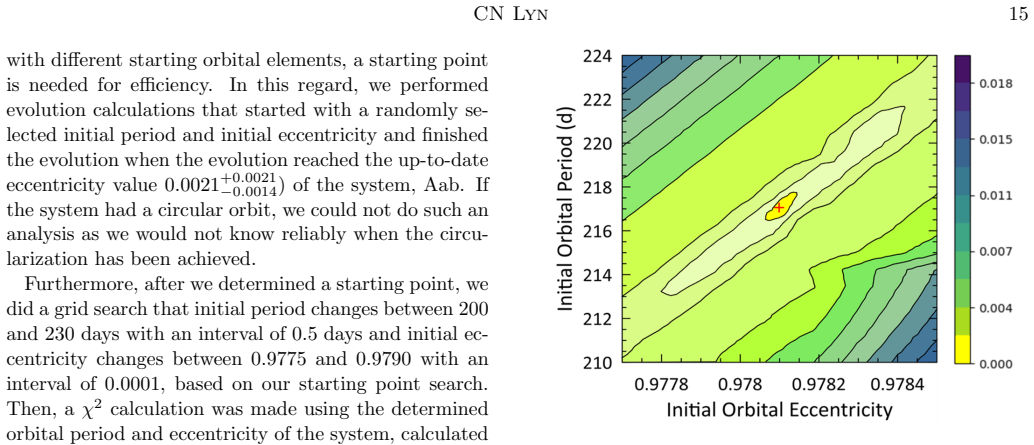
The paper claims that CN Lyn is a dynamically stable hierarchical triple system whose inner pair Aab — masses $1.166^{+0.013}_{-0.012}\,M_\odot$ and $1.143^{+0.013}_{-0.012}\,M_\odot$, radii $1.786$ and $1.651\,R_\odot$, metallicities $-0.78$ and $-0.55$ dex — formed together about 3.89 Gyr ago at the metal-poor edge of the Galactic disk, near a birth radius of about $14.6$ kpc, on a highly eccentric orbit (initial period $\sim 217$ days, initial eccentricity $\sim 0.978$) that has since circularized to the present 1.955-day period. The third component B, with mass $0.85 \pm 0.23\,M_\odot$, $[\mathrm{Fe/H}] = -1.83$ dex, and age $12.5 \pm 2.5$ Gyr, is chemically and chronologically consistent with the halo population. Since the two inner stars cannot have formed together with a star so much older and so much poorer in metals, the authors conclude that B was captured by the Aab binary in a region with weak gravitational interactions far beyond the Galactic disc, and that the observed configuration satisfies the Eggleton–Kiseleva stability criterion for hierarchical triples.
Load-bearing premise
Component B is a single main-sequence star whose disentangled spectrum yields a trustworthy $T_{\mathrm{eff}}$, $\log g$, and $[\mathrm{Fe/H}]$; if B's spectrum is blended or B is itself a binary, the 12.5 Gyr halo age and the capture conclusion no longer follow.
Editorial extensions
If this is right
- The inner binary was born on a highly eccentric roughly 217-day orbit and tidally circularized to the current 1.955-day period within about 3.9 Gyr.
- The wide configuration is dynamically stable by a large margin in the Eggleton–Kiseleva criterion, so the captured third star remains bound over long timescales.
- Birth-radius tracing places the binary's origin at $R_{\mathrm{birth}} = 14.59 \pm 0.86$ kpc, at the metal-poor edge of the old thin disk, matching its mean $[\mathrm{Fe/H}] \approx -0.65$ dex.
- Mass transfer in the inner pair is predicted to begin in about 460 Myr, giving a concrete evolutionary timetable for the system.
Reading between the lines
- If capture-built triples like CN Lyn are common, the fraction of field triples with halo-like tertiaries could serve as a probe of early-Galaxy dynamical encounter rates.
- The same trick of degrading high-resolution archive spectra to a common low resolution before disentangling could be applied to other candidate multiples in comparable archival data sets, producing chemically homogeneous multi-component catalogs.
- A testable check on the planet-ingestion explanation for the inner iron difference would be lithium abundances in Aa and Ab, since engulfment tends to deplete lithium in the engulfing star.
- A longer baseline of eclipse timings and radial velocities covering another full 8.6-year outer cycle should confirm or refute the LITE and spectroscopic orbits; a phase mismatch would mean the third-body solution is not yet unique.
Editorial analysis
A structured set of objections, weighed in public.
Referee Report
Summary. CN Lyn is presented as a hierarchical triple system. The paper combines literature spectra (Asiago/Marrese and ELODIE), TESS and Hipparcos photometry, eclipse-timing minima, and Gaia astrometry. It performs a LITE fit and a spectroscopic orbit for the outer AB system, a PHOEBE light-curve and radial-velocity model of the inner eclipsing binary Aab, KOREL spectral disentangling followed by SP_Ace abundance analysis, MESA evolutionary models for Aab and B, and galpy orbital integrations. The central claims are that Aa and Ab have masses 1.166 and 1.143 solar masses, radii 1.786 and 1.651 solar radii, [Fe/H] -0.78 and -0.55 dex, and a common age of 3.89 Gyr; that B has mass 0.85 solar masses, [Fe/H] -1.83 dex, and age 12.5 Gyr; and that B was captured by Aab in a weak-interaction region beyond the Galactic disk. The paper also reports a birth radius of 14.59 kpc for Aab and states that the triple satisfies the hierarchical stability criterion.
Significance. If correct, CN Lyn would be a rare, well-characterized hierarchical triple whose component abundances and ages bear on triple-star formation, chemical tagging, and Galactic archaeology. The close-binary analysis is built on standard methods and external anchors: PHOEBE with TESS photometry and radial velocities gives masses and radii at roughly percent precision, and the photometric distance of 241+-10 pc agrees with the Gaia parallax distance of 230.9+-3.4 pc. The paper also provides abundant tabulated material, including eclipse timings, abundance measurements, MESA grid results, and a stability check. The novel astrophysical conclusion, however, is the halo-capture scenario for B, and that conclusion rests entirely on the disentangled spectrum of a component contributing only about 23% of the TESS light; this step is not yet adequately validated and is the weakest link in the chain.
major comments (3)
- [Sections 3.3-3.4, Table 7, Section 4.2] The stellar parameters of component B are obtained by resampling the R~42,000 ELODIE spectra to the R~17,000 Asiago scale, merging the two datasets, and running KOREL, but no injection/recovery test, no comparison with a known triple, and no independent spectrum of B are presented. Because B contributes only 22.8% of the TESS light, residual contamination by the two much stronger A components is a real concern. The Teff=6238 K, log g, [Fe/H]=-1.83, and the resulting 12.5+-2.5 Gyr age and halo classification in Section 4.2 are built directly on this unvalidated disentangling. This is load-bearing for the capture claim, so the authors should either provide a validation test or substantially soften the conclusion.
- [Section 3.5 versus Tables 7 and 8] Section 3.5 states that abundance uncertainties cannot be better than 0.15 dex and that this was adopted as the error floor, yet Table 7 and Table 8 quote [Fe/H] uncertainties of 0.02-0.11 dex for all three components, and Table 7 quotes Teff errors of 40-94 K. The abstract repeats the small abundance uncertainties. If the 0.15 dex floor is real, the reported errors are internally inconsistent and the 0.23 dex Aa-Ab difference and the 1.28 dex A-B difference are not as significant as claimed; if the floor is not real, it should be removed. This must be resolved because the metallicity differences are central to the capture scenario.
- [Section 3.1, Tables 3 and 8] The derivation of the third-body mass and inclination is not presented explicitly. Table 3 gives m_B sin^3 i = 0.080+-0.040 solar masses and q=0.37, while Table 8 gives M_B=0.85+-0.23 solar masses and i_AB=26.7+-2.1 degrees. The text in Section 6 says the mass ratio was used to obtain the inclination, but a mass ratio alone does not set the inclination. If M_B is taken from the single-star evolutionary track in Section 4.2, then the subsequent agreement with m_B sin^3 i is not independent validation; if instead M_A from the PHOEBE solution is used, that should be stated. The roughly 1.5-sigma difference between the LITE a_A sin i of 1.03+-0.14 AU and the spectroscopic a_A sin i of 0.76+-0.18 AU is also not folded transparently into the quoted M_B and i_AB uncertainties.
minor comments (6)
- [Section 6, stability criterion] The stability calculation uses a_outer=4.53 AU, but Table 8 lists the AB separation as 1327 R_sun, about 6.17 AU, and the text even writes the ratio as 2.86/0.041, which is inconsistent with 4.53. The correct relative a_outer is approximately 6.2 AU, which still satisfies the criterion, but the arithmetic should be fixed.
- [Section 2.2] The phrase "quality flag of 'hard'" is unclear; please specify the TESS quality-bitmask value or the Lightkurve flag setting actually used.
- [Table 2] The parameter Q is listed as 0.0 but is never defined; please define the quadratic term in the LITE ephemeris or remove it if it is not used.
- [Table 4] The tertiary radial velocities are described as measured from the H-beta line only; please state how these measurements were made and why other lines were not used.
- [Section 6] The phrase "far beyond the Galactic centre" appears to be a wording error; the abstract and the surrounding context say "beyond the Galactic disc."
- [Section 3.5] The claim that detailed spectroscopic studies set a floor of about 0.1 dex for abundance uncertainties would benefit from an explicit citation.
Circularity Check
No significant circularity: close-binary parameters are measured against external TESS/Gaia/literature data, and the third-body mass/inclination chain is a standard combination of independent observables rather than a fit renamed as a prediction.
full rationale
Reviewing the derivation chain, I find no step in which a predicted quantity is equal by construction to a fitted input. The close-binary masses and radii come from PHOEBE fits to TESS photometry and RV orbits (Tables 5-6), with SP Ace temperatures from disentangled spectra; these are independent of the paper's interpretive conclusions. The third-body mass is obtained from the spectroscopic mass ratio q = K_A/K_B = 0.37 and the total A mass (2.309 Msun), not from the evolutionary track: Section 6 states the mass ratio was obtained 'via obtaining the spectroscopic orbit, leading to the estimation of orbital inclination of the B-component as 26.7 deg'; the inclination then follows from m_B sin^3 i = 0.080 Msun with M_B = 0.85 Msun. This is a standard combination of independent observables, not a circular reduction. The 12.5 Gyr age of B is then read off MESA tracks at the dynamically-based mass and the SP Ace metallicity; the mass is not itself inferred from that age. The stability criterion is a consistency check (110.5 >> 8.7) and is robust to the stated B-mass uncertainty. Self-citations (Eker et al. series, Yucel & Bakis 2022, Yucel et al. 2024) are methodological examples, not load-bearing; the paper is benchmarked against external TESS, Gaia, and independent literature RVs. Two non-circular caveats deserve flagging: the KOREL disentangling of B is not validated by injection/recovery tests or an independent spectrum, and the adopted 0.15 dex abundance uncertainty floor (Sec. 3.5) is not propagated into the quoted Table 7/Table 8 errors, which are smaller. These affect the reliability of the halo/capture conclusion but are not circularity.
Assumptions & free parameters
free parameters (5)
- Initial period of Aab in MESA grid search =
217.0 days
- Initial eccentricity of Aab in MESA grid search =
0.9781
- Primary temperature fixed in PHOEBE =
6500 K
- Mass transfer efficiencies in MESA =
alpha=0.4, beta=0.1, gamma=0.1
- B component mass =
0.85 +/- 0.23 M_sun
assumptions (5)
- domain assumption Aab is detached and has not undergone mass transfer since the ZAMS
- domain assumption B is a single main-sequence star whose disentangled spectrum is reliable
- ad hoc to paper Resampling ELODIE spectra to Asiago resolution does not bias abundance results
- domain assumption MWPotential2014 is an adequate static model for 3.9 Gyr backward orbit integration
- domain assumption SP Ace/ATLAS9/SPECTRUM abundance scale has a systematic floor of about 0.1 to 0.15 dex
Cite this review
Pith. "Pith review of Unveiling the Origins and Dynamics of the Hierarchical Triple Star System CN Lyn." pith.science (2026). https://pith.science/paper/MDRAO4JB
@misc{pith2026241204540,
  author       = {Pith},
  title        = {Pith review of: Unveiling the Origins and Dynamics of the Hierarchical Triple Star System CN Lyn},
  year         = {2026},
  howpublished = {\url{https://pith.science/paper/MDRAO4JB}},
  note         = {Machine review of arXiv:2412.04540}
}
abstract
In this study we present a detailed analysis of CN Lyn, an overlooked triple star system, by combining spectroscopic data from the literature, photometric \textit{TESS} data, and kinematic techniques. We updated the fundamental parameters of the known eclipsing components in the system with high precision. The chemical composition of both eclipsing components (Aab) and the third component (B) in the system were calculated with great accuracy. According to our analysis the mass, radius, and metallicity of the eclipsing components are $1.166_{-0.012}^{+0.013}\,M_\odot$, $1.786_{-0.014}^{+0.013}\,R_\odot$, and $-0.78_{-0.02}^{+0.02}$ dex for Aa and $1.143_{-0.012}^{+0.013}\,M_\odot$, $1.651_{-0.013}^{+0.014}\,R_\odot$, and $-0.55_{-0.02}^{+0.03}$ dex for Ab. The pair's age is $3.89_{-0.10}^{+0.10}$ Gyr. The mass, radius, metallicity, and age for B are $0.85_{-0.23}^{+0.23}\,M_\odot$, $1.436_{-0.023}^{+0.026}\,R_\odot$, $-1.83_{-0.11}^{+0.09}$ dex, and $12.5_{-2.5}^{+2.5}$ Gyr, respectively. It is also found that the triple system (AabB) satisfies the stability criteria for the hierarchical triple system. Kinematic and Galactic orbital parameters of CN Lyn were obtained from the astrometric and spectroscopic data of the system. Dynamical orbital analyses, taking into account the ages of the component stars in the central binary system (A) show that the CN Lyn originated at the metal-poor edge of the Galactic disk. The third component of the system was found to be a member of the halo population in terms of age, $\alpha$ elements and metal abundance. Given the different chemical abundances and age of B compared to A, this suggests that the third component was captured by the central system in a region with weak gravitational interactions far beyond the Galactic disc.
Figures


Figures from the paper (10 more)




Reference graph
Works this paper leans on
-
[1]
Radial Metallicity Gradients for the Chemically Selected Galactic Thin Disc Main-Sequence Stars
Akbaba, F., Ak, T., Bilir, S., et al. 2024, arXiv e-prints, arXiv:2411.13660, doi: 10.48550/arXiv.2411.13660
work page Pith review arXiv doi:10.48550/arxiv.2411.13660 2024
-
[2]
2024, NewA, 107, 102135, doi: 10.1016/j.newast.2023.102135 Ali¸ cavu¸ s, F
Alan, N. 2024, NewA, 107, 102135, doi: 10.1016/j.newast.2023.102135 Ali¸ cavu¸ s, F. 2022, NewA, 96, 101860, doi: 10.1016/j.newast.2022.101860
arXiv 2024
-
[3]
Antonini, F., & Perets, H. B. 2012, ApJ, 757, 27, doi: 10.1088/0004-637X/757/1/27 Astropy Collaboration, Robitaille, T. P., Tollerud, E. J., et al. 2013, A&A, 558, A33, doi: 10.1051/0004-6361/201322068 Astropy Collaboration, Price-Whelan, A. M., Sip˝ ocz, B. M., et al. 2018, AJ, 156, 123, doi: 10.3847/1538-3881/aabc4f Astropy Collaboration, Price-Whelan, ...
-
[4]
Baranne, A., Mayor, M., & Poncet, J. L. 1979, Vistas in Astronomy, 23, 279, doi: 10.1016/0083-6656(79)90016-3
-
[5]
2023, MNRAS, 518, 5465, doi: 10.1093/mnras/stac3435
Behmard, A., Sevilla, J., & Fuller, J. 2023, MNRAS, 518, 5465, doi: 10.1093/mnras/stac3435
-
[6]
2003, A&A, 410, 527, doi: 10.1051/0004-6361:20031213
Bensby, T., Feltzing, S., & Lundstr¨ om, I. 2003, A&A, 410, 527, doi: 10.1051/0004-6361:20031213
-
[7]
Bensby, T., Feltzing, S., & Oey, M. S. 2014, A&A, 562, A71, doi: 10.1051/0004-6361/201322631
-
[8]
Boeche, C., & Grebel, E. K. 2016, A&A, 587, A2, doi: 10.1051/0004-6361/201526758
Show all 99 references
-
[9]
2021, A&A, 645, A35, doi: 10.1051/0004-6361/202038973
Boeche, C., Vallenari, A., & Lucatello, S. 2021, A&A, 645, A35, doi: 10.1051/0004-6361/202038973
2021 doi
-
[10]
2016, MNRAS, 455, 4136, doi: 10.1093/mnras/stv2530
Borkovits, T., Hajdu, T., Sztakovics, J., et al. 2016, MNRAS, 455, 4136, doi: 10.1093/mnras/stv2530
2016 doi
-
[11]
2015, ApJS, 216, 29, doi: 10.1088/0067-0049/216/2/29 Br´ at, L.,ˇSmelcer, L., Ku` e´ akov´ a, H., et al
Bovy, J. 2015, ApJS, 216, 29, doi: 10.1088/0067-0049/216/2/29 Br´ at, L.,ˇSmelcer, L., Ku` e´ akov´ a, H., et al. 2008, Open European Journal on Variable Stars, 0094, 1
2015 doi
-
[12]
M., Heyer, M
Brunt, C. M., Heyer, M. H., & Mac Low, M. M. 2009, A&A, 504, 883, doi: 10.1051/0004-6361/200911797
2009 doi
-
[13]
Castelli, F., & Kurucz, R. L. 2003, in Modelling of Stellar Atmospheres, ed. N. Piskunov, W. W. Weiss, & D. F
2003
- [14]
-
[15]
Castelli, F., & Kurucz, R. L. 2004, A&A, 419, 725, doi: 10.1051/0004-6361:20040079
2004 doi
-
[16]
E., Prˇ sa, A., Stassun, K
Conroy, K. E., Prˇ sa, A., Stassun, K. G., et al. 2014, AJ, 147, 45, doi: 10.1088/0004-6256/147/2/45
2014 doi
-
[17]
E., Kochoska, A., Hey, D., et al
Conroy, K. E., Kochoska, A., Hey, D., et al. 2020, ApJS, 250, 34, doi: 10.3847/1538-4365/abb4e2 Co¸ skunoˇ glu, B., Ak, S., Bilir, S., et al. 2011, MNRAS, 412, 1237, doi: 10.1111/j.1365-2966.2010.17983.x
2020
-
[18]
2017, ApJ, 840, 99, doi: 10.3847/1538-4357/aa6d10
Dotter, A., Conroy, C., Cargile, P., & Asplund, M. 2017, ApJ, 840, 99, doi: 10.3847/1538-4357/aa6d10
2017 doi
-
[19]
C., Ta¸ sdemir, S., Ko¸ c, S., & Iyer, S
Dursun, D. C., Ta¸ sdemir, S., Ko¸ c, S., & Iyer, S. 2024, Physics and Astronomy Reports, 2, 1, doi: 10.26650/PAR.2024.00002
2024
-
[20]
Eggleton, P. P. 1983, ApJ, 268, 368, doi: 10.1086/160960
1983 doi
-
[21]
P., & Kiseleva, L
Eggleton, P. P., & Kiseleva, L. G. 1995, ApJ, 455, 640, doi: 10.1086/176610
1995 doi
-
[22]
P., & Kiseleva-Eggleton, L
Eggleton, P. P., & Kiseleva-Eggleton, L. 2001, ApJ, 562, 1012, doi: 10.1086/323843
2001 doi
-
[23]
2023, MNRAS, 523, 2440, doi: 10.1093/mnras/stad1563
Eker, Z., & Bakı¸ s, V. 2023, MNRAS, 523, 2440, doi: 10.1093/mnras/stad1563
2023 doi
-
[24]
2021, MNRAS, 503, 4231, doi: 10.1093/mnras/stab684
Eker, Z., Bakı¸ s, V., Soydugan, F., & Bilir, S. 2021, MNRAS, 503, 4231, doi: 10.1093/mnras/stab684
2021 doi
-
[25]
2014, PASA, 31, e024, doi: 10.1017/pasa.2014.17
Eker, Z., Bilir, S., Soydugan, F., et al. 2014, PASA, 31, e024, doi: 10.1017/pasa.2014.17
2014 doi
-
[26]
2022, AJ, 164, 189, doi: 10.3847/1538-3881/ac9123
Eker, Z., Soydugan, F., Bakı¸ s, V., Bilir, S., & Steer, I. 2022, AJ, 164, 189, doi: 10.3847/1538-3881/ac9123
2022 doi
-
[27]
2024, Physics and Astronomy Reports, 2, 41, doi: 10.26650/PAR.2024.00001
Eker, Z., Soydugan, F., & Bilir, S. 2024, Physics and Astronomy Reports, 2, 41, doi: 10.26650/PAR.2024.00001
2024
-
[28]
2015, AJ, 149, 131, doi: 10.1088/0004-6256/149/4/131
Eker, Z., Soydugan, F., Soydugan, E., et al. 2015, AJ, 149, 131, doi: 10.1088/0004-6256/149/4/131
2015 doi
-
[29]
2018, MNRAS, 479, 5491, doi: 10.1093/mnras/sty1834
Eker, Z., Bakı¸ s, V., Bilir, S., et al. 2018, MNRAS, 479, 5491, doi: 10.1093/mnras/sty1834
2018 doi
-
[30]
2020, MNRAS, 496, 3887, doi: 10.1093/mnras/staa1659 European Space Agency
Eker, Z., Soydugan, F., Bilir, S., et al. 2020, MNRAS, 496, 3887, doi: 10.1093/mnras/staa1659 European Space Agency. 1997, ESA Special Publication, Vol. 1200, The HIPPARCOS and TYCHO catalogues. Astrometric and photometric star catalogues derived from the ESA HIPPARCOS Space A...
2020 doi
-
[31]
2016, The Journal of Open Source Software, 1, 24, doi: 10.21105/joss.00024
Foreman-Mackey, D. 2016, The Journal of Open Source Software, 1, 24, doi: 10.21105/joss.00024
2016 doi
-
[32]
W., Lang, D., & Goodman, J
Foreman-Mackey, D., Hogg, D. W., Lang, D., & Goodman, J. 2013, PASP, 125, 306, doi: 10.1086/670067 Gaia Collaboration, Vallenari, A., Brown, A. G. A., et al. 2023a, A&A, 674, A1, doi: 10.1051/0004-6361/202243940 Gaia Collaboration, Recio-Blanco, A., Kordopatis, G., et al. 2023...
2013 doi
-
[33]
2023, AJ, 166, 263, doi: 10.3847/1538-3881/ad08b0
Gokmen, S., Eker, Z., Yontan, T., et al. 2023, AJ, 166, 263, doi: 10.3847/1538-3881/ad08b0
2023 doi
- [34]
- [35]
-
[36]
O., Rolland, L., et al
Grenier, S., Baylac, M. O., Rolland, L., et al. 1999, A&AS, 137, 451, doi: 10.1051/aas:1999489 CN Lyn 23
1999 doi
-
[37]
R., Millman, K
Harris, C. R., Millman, K. J., van der Walt, S. J., et al. 2020, Nature, 585, 357, doi: 10.1038/s41586-020-2649-2
2020 doi
-
[38]
E., Pablo, H., et al
Horvat, M., Conroy, K. E., Pablo, H., et al. 2018, ApJS, 237, 26, doi: 10.3847/1538-4365/aacd0f Hoˇ nkov´ a, K., Juryˇ sek, J., Lehk´ y, M., et al. 2013, Open European Journal on Variable Stars, 160, 1 —. 2014, Open European Journal on Variable Stars, 165, 1
2018 doi
-
[39]
2014, Information Bulletin on Variable Stars, 6118, 1 —
Hubscher, J. 2014, Information Bulletin on Variable Stars, 6118, 1 —. 2015, Information Bulletin on Variable Stars, 6152, 1 —. 2017, Information Bulletin on Variable Stars, 6196, 1, doi: 10.22444/IBVS.6196
2014 doi
-
[40]
Hubscher, J., & Lehmann, P. B. 2015, Information Bulletin on Variable Stars, 6149, 1
2015
-
[41]
Hunter, J. D. 2007, Computing in Science and Engineering, 9, 90, doi: 10.1109/MCSE.2007.55
2007 doi
-
[42]
R., Tout, C
Hurley, J. R., Tout, C. A., & Pols, O. R. 2002, MNRAS, 329, 897, doi: 10.1046/j.1365-8711.2002.05038.x
2002
-
[43]
Irwin, J. B. 1952, ApJ, 116, 211, doi: 10.1086/145604 —. 1959, AJ, 64, 149, doi: 10.1086/107913
1952 doi
-
[44]
R., Pilachowski, C
Jacobson, H. R., Pilachowski, C. A., & Friel, E. D. 2011, AJ, 142, 59, doi: 10.1088/0004-6256/142/2/59
2011 doi
-
[45]
S., Bauer, E
Jermyn, A. S., Bauer, E. B., Schwab, J., et al. 2023, ApJS, 265, 15, doi: 10.3847/1538-4365/acae8d Jofr´ e, P., Heiter, U., & Soubiran, C. 2019, ARA&A, 57, 571, doi: 10.1146/annurev-astro-091918-104509
2023 doi
-
[46]
Johnson, D. R. H., & Soderblom, D. R. 1987, AJ, 93, 864, doi: 10.1086/114370
1987 doi
-
[47]
E., Horvat, M., et al
Jones, D., Conroy, K. E., Horvat, M., et al. 2020, ApJS, 247, 63, doi: 10.3847/1538-4365/ab7927
2020 doi
-
[48]
2021, A&A, 655, A111, doi: 10.1051/0004-6361/202140453
Matteo, P. 2021, A&A, 655, A111, doi: 10.1051/0004-6361/202140453
2021 doi
-
[49]
R., Parker, R
King, R. R., Parker, R. J., Patience, J., & Goodwin, S. P. 2012, MNRAS, 421, 2025, doi: 10.1111/j.1365-2966.2012.20437.x
2012
-
[50]
1990, A&A, 236, 385
Kolb, U., & Ritter, H. 1990, A&A, 236, 385
1990
-
[51]
Kreiner, J. M. 2004, AcA, 54, 207
2004
-
[52]
2021, MNRAS, 508, 6111, doi: 10.1093/mnras/stab2871 Lightkurve Collaboration, Cardoso, J
Liao, W., Qian, S., & Li, L. 2021, MNRAS, 508, 6111, doi: 10.1093/mnras/stab2871 Lightkurve Collaboration, Cardoso, J. V. d. M., Hedges, C., et al. 2018, Lightkurve: Kepler and TESS time series analysis in Python, Astrophysics Source Code Library. http://ascl.net/1812.013
2021 doi
-
[53]
2021, MNRAS, 508, 1227, doi: 10.1093/mnras/stab2471
Liu, F., Bitsch, B., Asplund, M., et al. 2021, MNRAS, 508, 1227, doi: 10.1093/mnras/stab2471
2021 doi
-
[54]
2024, Nature, 627, 501, doi: 10.1038/s41586-024-07091-y
Liu, F., Ting, Y.-S., Yong, D., et al. 2024, Nature, 627, 501, doi: 10.1038/s41586-024-07091-y
2024 doi
-
[55]
2014, Automated Wide-field Survey for Transient Objects with a Small Telescope, Tech
Maehara, H. 2014, Automated Wide-field Survey for Transient Objects with a Small Telescope, Tech. rep., Journal of Space Science Informatics Japan. https://jaxa.repo.nii.ac.jp/records/1963
2014
-
[56]
R., Schiavon, R
Majewski, S. R., Schiavon, R. P., Frinchaboy, P. M., et al. 2017, AJ, 154, 94, doi: 10.3847/1538-3881/aa784d
2017 doi
-
[57]
2017, ApJ, 848, 25, doi: 10.3847/1538-4357/aa8b6e
Maoz, D., & Graur, O. 2017, ApJ, 848, 25, doi: 10.3847/1538-4357/aa8b6e
2017 doi
-
[58]
M., Munari, U., Siviero, A., et al
Marrese, P. M., Munari, U., Siviero, A., et al. 2004, A&A, 413, 635, doi: 10.1051/0004-6361:20031544
2004 doi
-
[59]
2021, A&A Rv, 29, 5, doi: 10.1007/s00159-021-00133-8
Matteucci, F. 2021, A&A Rv, 29, 5, doi: 10.1007/s00159-021-00133-8
2021 doi
-
[60]
2009, A&A, 501, 531, doi: 10.1051/0004-6361/200911869
Matteucci, F., Spitoni, E., Recchi, S., & Valiante, R. 2009, A&A, 501, 531, doi: 10.1051/0004-6361/200911869
2009 doi
-
[61]
1981, Galactic astronomy
Mihalas, D., & Binney, J. 1981, Galactic astronomy. Structure and kinematics (W.H. Freeman & Co.)
1981
-
[62]
2017, ApJS, 230, 15, doi: 10.3847/1538-4365/aa6fb6
Moe, M., & Di Stefano, R. 2017, ApJS, 230, 15, doi: 10.3847/1538-4365/aa6fb6
2017 doi
-
[63]
2022, A&A, 666, A43, doi: 10.1051/0004-6361/202243210
Moedas, N., Deal, M., Bossini, D., & Campilho, B. 2022, A&A, 666, A43, doi: 10.1051/0004-6361/202243210
2022 doi
-
[64]
A., Prugniel, P., & Soubiran, C
Moultaka, J., Ilovaisky, S. A., Prugniel, P., & Soubiran, C. 2004, PASP, 116, 693, doi: 10.1086/422177
2004 doi
-
[65]
2001, A&A, 378, 477, doi: 10.1051/0004-6361:20011230
Munari, U., Tomov, T., Zwitter, T., et al. 2001, A&A, 378, 477, doi: 10.1051/0004-6361:20011230
2001 doi
-
[66]
A., & Mead, R
Nelder, J. A., & Mead, R. 1965, The Computer Journal, 7, 308, doi: 10.1093/comjnl/7.4.308
1965 doi
-
[67]
M., Brewer, J
Oh, S., Price-Whelan, A. M., Brewer, J. M., et al. 2018, ApJ, 854, 138, doi: 10.3847/1538-4357/aaab4d
2018 doi
-
[68]
G., Collins, K
Paegert, M., Stassun, K. G., Collins, K. A., et al. 2022, VizieR Online Data Catalog: TESS Input Catalog version 8.2 (TIC v8.2) (Paegert+, 2021), VizieR On-line Data Catalog: IV/39. Originally published in: 2021arXiv210804778P
2022
-
[69]
2018, Information Bulletin on Variable Stars, 6244, 1, doi: 10.22444/IBVS.6244
Pagel, L. 2018, Information Bulletin on Variable Stars, 6244, 1, doi: 10.22444/IBVS.6244
2018 doi
-
[70]
2011, ApJS, 192, 3, doi: 10.1088/0067-0049/192/1/3
Paxton, B., Bildsten, L., Dotter, A., et al. 2011, ApJS, 192, 3, doi: 10.1088/0067-0049/192/1/3
2011 doi
-
[71]
2013, ApJS, 208, 4, doi: 10.1088/0067-0049/208/1/4
Paxton, B., Cantiello, M., Arras, P., et al. 2013, ApJS, 208, 4, doi: 10.1088/0067-0049/208/1/4
2013 doi
-
[72]
2015, ApJS, 220, 15, doi: 10.1088/0067-0049/220/1/15
Paxton, B., Marchant, P., Schwab, J., et al. 2015, ApJS, 220, 15, doi: 10.1088/0067-0049/220/1/15
2015 doi
-
[73]
B., et al
Paxton, B., Schwab, J., Bauer, E. B., et al. 2018, ApJS, 234, 34, doi: 10.3847/1538-4365/aaa5a8
2018 doi
-
[74]
2019, ApJS, 243, 10, doi: 10.3847/1538-4365/ab2241
Paxton, B., Smolec, R., Schwab, J., et al. 2019, ApJS, 243, 10, doi: 10.3847/1538-4365/ab2241
2019 doi
-
[75]
Perryman, M. A. C., Lindegren, L., Kovalevsky, J., et al. 1997, A&A, 323, L49
1997
-
[76]
L., Skillen, I., Collier Cameron, A., et al
Pollacco, D. L., Skillen, I., Collier Cameron, A., et al. 2006, PASP, 118, 1407, doi: 10.1086/508556 24 Y¨ucel et al
2006 doi
-
[77]
Flannery, B. P. 2007, Numerical Recipes: The Art of Scientific Computing, 3rd edn. (Cambridge University Press) Prˇ sa, A., & Zwitter, T. 2005, ApJ, 628, 426, doi: 10.1086/430591 Prˇ sa, A., Conroy, K. E., Horvat, M., et al. 2016, ApJS, 227, 29, doi: 10.3847/1538-4365/227/2/29...
2007 doi
-
[78]
A., Henry, T
Raghavan, D., McAlister, H. A., Henry, T. J., et al. 2010, ApJS, 190, 1, doi: 10.1088/0067-0049/190/1/1
2010 doi
-
[79]
Rappaport, S., Verbunt, F., & Joss, P. C. 1983, ApJ, 275, 713, doi: 10.1086/161569
1983 doi
-
[80]
M., Connelley, M
Reipurth, B., Guimar˜ aes, M. M., Connelley, M. S., & Bally, J. 2007, AJ, 134, 2272, doi: 10.1086/523596
2007 doi
-
[81]
R., Winn, J
Ricker, G. R., Winn, J. N., Vanderspek, R., et al. 2015, Journal of Astronomical Telescopes, Instruments, and Systems, 1, 014003, doi: 10.1117/1.JATIS.1.1.014003
2015 doi
-
[82]
Senhadji, A. A. 2019, MNRAS, 483, 862, doi: 10.1093/mnras/sty3117 Ruci´ nski, S. M. 1969, AcA, 19, 245
2019 doi
-
[83]
2024, A&A, 682, L23, doi: 10.1051/0004-6361/202449263
Saffe, C., Miquelarena, P., Alacoria, J., et al. 2024, A&A, 682, L23, doi: 10.1051/0004-6361/202449263
2024 doi
-
[84]
1993, ApJ, 414, 580, doi: 10.1086/173105
Salaris, M., Chieffi, A., & Straniero, O. 1993, ApJ, 414, 580, doi: 10.1086/173105
1993 doi
-
[85]
B., Lacour, S., et al
Sana, H., Le Bouquin, J. B., Lacour, S., et al. 2014, ApJS, 215, 15, doi: 10.1088/0067-0049/215/1/15
2014 doi
-
[86]
2013, A&A, 557, A119, doi: 10.1051/0004-6361/201322195
Southworth, J. 2013, A&A, 557, A119, doi: 10.1051/0004-6361/201322195
2013 doi
-
[87]
2021, Universe, 7, doi: 10.3390/universe7100369
Southworth, J. 2021, Universe, 7, doi: 10.3390/universe7100369
2021 doi
-
[88]
2020, Research in Astronomy and Astrophysics, 20, 052, doi: 10.1088/1674-4527/20/4/52 Ta¸ sdemir, S., & Yontan, T
Soydugan, F., Soydugan, E., & Ali¸ cavu¸ s, F. 2020, Research in Astronomy and Astrophysics, 20, 052, doi: 10.1088/1674-4527/20/4/52 Ta¸ sdemir, S., & Yontan, T. 2023, Physics and Astronomy Reports, 1, 1, doi: 10.26650/PAR.2023.00001
2020
-
[90]
2006, A&A, 450, 681, doi: 10.1051/0004-6361:20054427
Tokovinin, A., Thomas, S., Sterzik, M., & Udry, S. 2006, A&A, 450, 681, doi: 10.1051/0004-6361:20054427
2006 doi
-
[91]
2020, A&A, 640, A16, doi: 10.1051/0004-6361/201936835 Tun¸ cel G¨ u¸ ctekin, S., Bilir, S., Karaali, S., Plevne, O., &
Bandopadhyay, D. 2020, A&A, 640, A16, doi: 10.1051/0004-6361/201936835 Tun¸ cel G¨ u¸ ctekin, S., Bilir, S., Karaali, S., Plevne, O., &
2020 doi
-
[92]
2019, Advances in Space Research, 63, 1360, doi: 10.1016/j.asr.2018.10.041 van Leeuwen, F., Evans, D
Ak, S. 2019, Advances in Space Research, 63, 1360, doi: 10.1016/j.asr.2018.10.041 van Leeuwen, F., Evans, D. W., Grenon, M., et al. 1997, A&A, 323, L61
2019 doi
-
[93]
E., et al
Virtanen, P., Gommers, R., Oliphant, T. E., et al. 2020, Nature Methods, 17, 261, doi: 10.1038/s41592-019-0686-2
2020 doi
- [94]
-
[95]
2000, A&AS, 143, 9, doi: 10.1051/aas:2000332
Wenger, M., Ochsenbein, F., Egret, D., et al. 2000, A&AS, 143, 9, doi: 10.1051/aas:2000332
2000 doi
-
[96]
Wyse, R. F. G., & Gilmore, G. 1992, AJ, 104, 144, doi: 10.1086/116226 Yıldız, M. 2008, MNRAS, 388, 1143, doi: 10.1111/j.1365-2966.2008.13352.x
1992
-
[97]
2009, Information Bulletin on Variable Stars, 5887, 1
Yilmaz, M., Basturk, O., Alan, N., et al. 2009, Information Bulletin on Variable Stars, 5887, 1
2009
-
[98]
2023, Physics and Astronomy Reports, 1, 65, doi: 10.26650/PAR.2023.00008
Yontan, T., & Canbay, R. 2023, Physics and Astronomy Reports, 1, 65, doi: 10.26650/PAR.2023.00008
2023
-
[99]
2022, RMxAA, 58, 333, doi: 10.22201/ia.01851101p.2022.58.02.14 Y¨ ucel, G., & Bakı¸ s, V
Yontan, T., C ¸ akmak, T., Bilir, S., et al. 2022, RMxAA, 58, 333, doi: 10.22201/ia.01851101p.2022.58.02.14 Y¨ ucel, G., & Bakı¸ s, V. 2022, MNRAS, 516, 2486, doi: 10.1093/mnras/stac2293 Y¨ ucel, G., Canbay, R., & Bakı¸ s, V. 2024, Physics and Astronomy Reports, 2, 18, doi: 10...
2022
-
[100]
M., et al
Zwitter, T., Munari, U., Marrese, P. M., et al. 2003, A&A, 404, 333, doi: 10.1051/0004-6361:20030446 CN Lyn 25 APPENDIX 26 Y¨ucel et al. CN Lyn 27 28 Y¨ucel et al. Figure A1. Models fits for R V measurements
2003 doi
Reviewed August 11, 2026 · model on record in the stance chip above.
Discussion (0). Continue with ORCID to comment.