SARIF: Segment Anything for Robust Image Forensics
Pith reviewed 2026-06-26 14:50 UTC · model grok-4.3
The pith
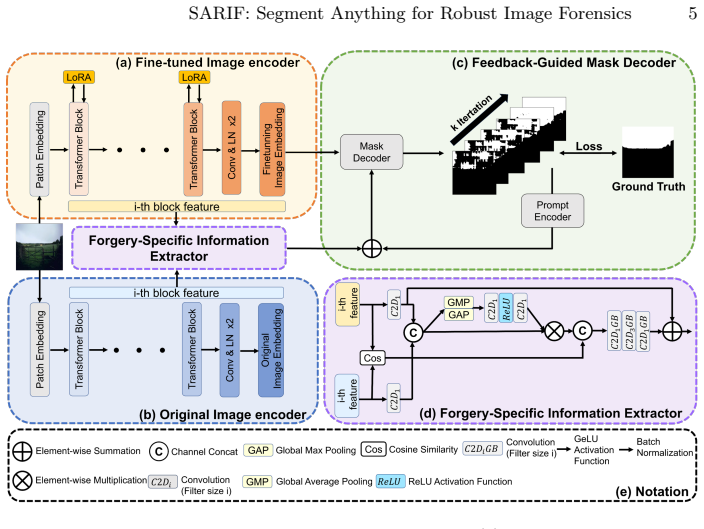
SARIF adapts SAM with dual encoders and feedback refinement to localize forgeries automatically across datasets and corruptions.
A machine-rendered reading of the paper's core claim, the machinery that carries it, and where it could break.
Core claim
SARIF introduces a feedback-guided mask decoder and dual-encoder design that extracts forgery-specific information from residual features between an adapted encoder and its frozen counterpart. These residuals are fused with previous mask prompts via block-wise prompting to drive a feedback-based refinement process, enabling automatic forgery segmentation that leverages SAM's promptable architecture and generalization ability.
What carries the argument
Block-wise prompting mechanism that derives forgery-specific cues from residual features between an adapted encoder and its frozen counterpart, fused with previous mask prompts to drive feedback-based mask refinement.
If this is right
- Automatic forgery segmentation becomes possible without manual prompt input.
- Strong average performance holds across multiple standard forgery-localization benchmarks.
- Robustness is observed under common image corruptions such as noise and compression.
- The approach preserves SAM's broad generalization while adding domain-specific forensic traces.
Where Pith is reading between the lines
- The residual-feature prompting pattern could be tested on other foundation models to adapt them for specialized detection tasks.
- Iterative feedback refinement may reduce reliance on manual prompts in segmentation problems beyond forensics.
- Observed corruption robustness suggests the method could be evaluated on real-world image streams that contain mixed degradations.
Load-bearing premise
Residual features between the adapted encoder and its frozen counterpart reliably supply forgery-specific cues that the feedback decoder can use for accurate automatic segmentations.
What would settle it
Evaluation on a previously unseen forgery dataset containing manipulation types absent from the training distribution, measuring whether cross-dataset average performance remains high relative to prior methods.
Figures



read the original abstract
Image forgery localization remains challenging due to diverse manipulation techniques and distribution shifts. Existing forgery localization models achieve high accuracy on benchmarks but often struggle with cross-domain generalization and robustness. In this paper, we propose SARIF (Segment Anything for Robust Image Forensics), a framework that leverages the Segment Anything Model (SAM), which has a promptable architecture and strong generalization ability. SARIF introduces a feedback-guided mask decoder and a dual-encoder design that extracts forgery-specific information to capture forensic traces while exploiting the SAM architecture. To localize manipulated regions, we design a block-wise prompting mechanism that derives forgery-specific cues from residual features between an adapted encoder and its frozen counterpart. These features are fused with the previous mask prompt to drive a feedback-based mask refinement process, enabling automatic forgery segmentation without manual input. Extensive experiments on standard forgery-localization benchmarks show that SARIF achieves strong average cross-dataset performance and robustness to common image corruptions.
Editorial analysis
A structured set of objections, weighed in public.
Referee Report
Summary. The paper proposes SARIF, a framework adapting the Segment Anything Model (SAM) for image forgery localization. It introduces a dual-encoder design that computes residual features between an adapted encoder and its frozen counterpart, fuses these with previous mask prompts via a block-wise prompting mechanism, and feeds them into a feedback-guided mask decoder for automatic (prompt-free) segmentation of manipulated regions. The central claim is that this yields strong average cross-dataset performance on standard forgery-localization benchmarks together with robustness to common image corruptions.
Significance. If the performance claims hold, the work would demonstrate a practical way to transfer SAM’s generalization properties to the forensics domain via residual cues and feedback refinement, potentially improving cross-domain robustness over existing specialized models. The architecture itself is a plausible, parameter-light adaptation of SAM; however, the manuscript supplies no quantitative results, datasets, baselines, or ablations, so the significance cannot be assessed from the given text.
major comments (2)
- [Abstract] Abstract: the claim of 'strong average cross-dataset performance and robustness to common image corruptions' is presented without any numerical results, error bars, dataset names, or baseline comparisons, rendering the central empirical claim unverifiable from the manuscript.
- [Abstract] Abstract / method description: the key assumption that residual features between the adapted and frozen encoders 'reliably supply forgery-specific cues' is stated but never supported by any derivation, ablation, or visualization; without this link the feedback decoder’s claimed advantage over standard SAM prompting remains ungrounded.
Simulated Author's Rebuttal
Thank you for the referee's comments on our manuscript. We address each major comment below and commit to revisions that directly respond to the concerns raised.
read point-by-point responses
-
Referee: [Abstract] Abstract: the claim of 'strong average cross-dataset performance and robustness to common image corruptions' is presented without any numerical results, error bars, dataset names, or baseline comparisons, rendering the central empirical claim unverifiable from the manuscript.
Authors: We agree that the abstract's performance claims would be more verifiable with concrete numbers. In the revised manuscript we will insert key quantitative results (average cross-dataset metrics, dataset names, and baseline comparisons) into the abstract while retaining conciseness. revision: yes
-
Referee: [Abstract] Abstract / method description: the key assumption that residual features between the adapted and frozen encoders 'reliably supply forgery-specific cues' is stated but never supported by any derivation, ablation, or visualization; without this link the feedback decoder’s claimed advantage over standard SAM prompting remains ungrounded.
Authors: We acknowledge that the current text does not supply supporting evidence for the residual-feature assumption. We will add ablations, visualizations of the residual maps, and a short derivation or justification in the revised method and experimental sections, with a brief reference in the abstract, to establish the link to forgery-specific cues. revision: yes
Circularity Check
No significant circularity
full rationale
The paper proposes an architectural adaptation of SAM with a dual-encoder residual mechanism and feedback decoder for forgery localization. No equations, derivations, or first-principles predictions appear in the provided text. Claims rest on empirical cross-dataset performance rather than any reduction of outputs to inputs by construction, fitted parameters renamed as predictions, or load-bearing self-citations. The design choices are presented as engineering decisions, not derived results.
Axiom & Free-Parameter Ledger
Reference graph
Works this paper leans on
-
[1]
Heliyon9(10) (2023)
Ahmed, S., Chua, H.W.: Perception and deception: Exploring individual responses to deepfakes across different modalities. Heliyon9(10) (2023)
2023
-
[2]
Pattern Recog- nition159, 111136 (2025)
Bai, N., Wang, X., Han, R., Hou, J., Wang, Y., Pang, S.: Pim-net: Progressive inconsistency mining network for image manipulation localization. Pattern Recog- nition159, 111136 (2025)
2025
-
[3]
ACM Trans
Barnes, C., Shechtman, E., Finkelstein, A., Goldman, D.B.: Patchmatch: A ran- domized correspondence algorithm for structural image editing. ACM Trans. Graph.28(3), 24 (2009)
2009
-
[4]
In: Proceedings of the IEEE/CVF Conference on Computer Vision and Pattern Recognition Workshops (2019)
Bi, X., Wei, Y., Xiao, B., Li, W.: Rru-net: The ringed residual u-net for image splic- ing forgery detection. In: Proceedings of the IEEE/CVF Conference on Computer Vision and Pattern Recognition Workshops (2019)
2019
-
[5]
Caruso,R.D.,Postel,G.C.:Imageeditingwithadobephotoshop6.0.Radiographics 22(4), 993–1002 (2002)
2002
-
[6]
IEEE Transactions on Circuits and Systems for Video Technology (2024)
Chen, H., Wei, P., Guo, G., Gao, S.: Sam-cod+: Sam-guided unified framework for weakly-supervised camouflaged object detection. IEEE Transactions on Circuits and Systems for Video Technology (2024)
2024
-
[7]
In: Proceedings of the IEEE/CVF international con- ference on computer vision
Chen, X., Dong, C., Ji, J., Cao, J., Li, X.: Image manipulation detection by multi- view multi-scale supervision. In: Proceedings of the IEEE/CVF international con- ference on computer vision. pp. 14185–14193 (2021)
2021
-
[8]
IEEE Transactions on Information Forensics and Security9(4), 554–567 (2014)
Chierchia, G., Poggi, G., Sansone, C., Verdoliva, L.: A bayesian-mrf approach for prnu-based image forgery detection. IEEE Transactions on Information Forensics and Security9(4), 554–567 (2014)
2014
-
[9]
In: Proceedings of the IEEE/CVF winter conference on applications of computer vision
Dai, Y., Gieseke, F., Oehmcke, S., Wu, Y., Barnard, K.: Attentional feature fusion. In: Proceedings of the IEEE/CVF winter conference on applications of computer vision. pp. 3560–3569 (2021)
2021
-
[10]
IEEE Trans- actions on Information Forensics and Security8(7), 1182–1194 (2013)
De Carvalho, T.J., Riess, C., Angelopoulou, E., Pedrini, H., de Rezende Rocha, A.: Exposing digital image forgeries by illumination color classification. IEEE Trans- actions on Information Forensics and Security8(7), 1182–1194 (2013)
2013
-
[11]
Philosophy & Technology34(4), 1311–1332 (2021)
De Ruiter, A.: The distinct wrong of deepfakes. Philosophy & Technology34(4), 1311–1332 (2021)
2021
-
[12]
In: 2009 16th IEEE International Conference on Image Processing (ICIP)
Dirik, A.E., Memon, N.: Image tamper detection based on demosaicing artifacts. In: 2009 16th IEEE International Conference on Image Processing (ICIP). pp. 1497–1500. IEEE (2009)
2009
-
[13]
IEEE Transactions on Pattern Analysis and Machine Intelligence45(3), 3539–3553 (2022)
Dong, C., Chen, X., Hu, R., Cao, J., Li, X.: Mvss-net: Multi-view multi-scale super- vised networks for image manipulation detection. IEEE Transactions on Pattern Analysis and Machine Intelligence45(3), 3539–3553 (2022)
2022
-
[14]
IEEE (Jul 2013).https://doi.org/10.1109/chinasip
Dong, J., Wang, W., Tan, T.: CASIA image tampering detection evaluation database.In:2013IEEEChinaSummitandInternationalConferenceonSignaland Information Processing. IEEE (Jul 2013).https://doi.org/10.1109/chinasip. 2013.6625374,https://doi.org/10.1109/chinasip.2013.6625374 16 D.-H. Moon, J.-H. Nam, and S.-C. Lee
-
[15]
In: In- ternational Conference on Learning Representations (2021),https://openreview
Dosovitskiy, A., Beyer, L., Kolesnikov, A., Weissenborn, D., Zhai, X., Unterthiner, T., Dehghani, M., Minderer, M., Heigold, G., Gelly, S., Uszkoreit, J., Houlsby, N.: An image is worth 16x16 words: Transformers for image recognition at scale. In: In- ternational Conference on Learning Representations (2021),https://openreview. net/forum?id=YicbFdNTTy
2021
-
[16]
IEEE Transactions on Information Forensics and Security7(5), 1566–1577 (2012)
Ferrara, P., Bianchi, T., De Rosa, A., Piva, A.: Image forgery localization via fine- grained analysis of cfa artifacts. IEEE Transactions on Information Forensics and Security7(5), 1566–1577 (2012)
2012
-
[17]
Pattern Recognition p
Gao, D., Zhou, Y., Yan, H., Chen, C., Hu, X.: Cod-sam: Camouflage object detec- tion using sam. Pattern Recognition p. 111826 (2025)
2025
-
[18]
IEEE access10, 62751–62762 (2022)
Gu, A.R., Nam, J.H., Lee, S.C.: Fbi-net: Frequency-based image forgery local- ization via multitask learning with self-attention. IEEE access10, 62751–62762 (2022)
2022
-
[19]
In: Pro- ceedings of the IEEE/CVF Conference on Computer Vision and Pattern Recogni- tion (CVPR)
Guillaro, F., Cozzolino, D., Sud, A., Dufour, N., Verdoliva, L.: Trufor: Leveraging all-round clues for trustworthy image forgery detection and localization. In: Pro- ceedings of the IEEE/CVF Conference on Computer Vision and Pattern Recogni- tion (CVPR). pp. 20606–20615 (June 2023)
2023
-
[20]
In: ICASSP 2024-2024 IEEE International Conference on Acoustics, Speech and Signal Processing (ICASSP)
Guo, K., Zhu, H., Cao, G.: Effective image tampering localization via enhanced transformer and co-attention fusion. In: ICASSP 2024-2024 IEEE International Conference on Acoustics, Speech and Signal Processing (ICASSP). pp. 4895–4899. IEEE (2024)
2024
-
[21]
Advances in neural information processing systems35, 1140–1156 (2022)
Guo, M.H., Lu, C.Z., Hou, Q., Liu, Z., Cheng, M.M., Hu, S.M.: Segnext: Rethink- ing convolutional attention design for semantic segmentation. Advances in neural information processing systems35, 1140–1156 (2022)
2022
-
[22]
IEEE Transactions on Pattern Analysis and Machine Intelligence (2024)
Han, R., Wang, X., Bai, N., Wang, Y., Hou, J., Xue, J.: Hdf-net: Capturing ho- mogeny difference features to localize the tampered image. IEEE Transactions on Pattern Analysis and Machine Intelligence (2024)
2024
-
[23]
In: Proceedings of the IEEE/CVF International Conference on Computer Vision
Hao, J., Zhang, Z., Yang, S., Xie, D., Pu, S.: Transforensics: image forgery local- ization with dense self-attention. In: Proceedings of the IEEE/CVF International Conference on Computer Vision. pp. 15055–15064 (2021)
2021
-
[24]
He,K.,Zhang,X.,Ren,S.,Sun,J.:Deepresiduallearningforimagerecognition.In: Proceedings of the IEEE conference on computer vision and pattern recognition. pp. 770–778 (2016)
2016
-
[25]
Hsu, Y.F., Chang, S.F.: Detecting image splicing using geometry invariants and cameracharacteristicsconsistency.In: International Conferenceon Multimediaand Expo (2006)
2006
-
[26]
ICLR1(2), 3 (2022)
Hu, E.J., Shen, Y., Wallis, P., Allen-Zhu, Z., Li, Y., Wang, S., Wang, L., Chen, W., et al.: Lora: Low-rank adaptation of large language models. ICLR1(2), 3 (2022)
2022
-
[27]
In: Proceedings of the IEEE conference on computer vision and pattern recognition
Hu, J., Shen, L., Sun, G.: Squeeze-and-excitation networks. In: Proceedings of the IEEE conference on computer vision and pattern recognition. pp. 7132–7141 (2018)
2018
-
[28]
In: Computer Vision–ECCV2020:16thEuropeanConference,Glasgow,UK,August23–28,2020, Proceedings, Part XXI 16
Hu, X., Zhang, Z., Jiang, Z., Chaudhuri, S., Yang, Z., Nevatia, R.: Span: Spa- tial pyramid attention network for image manipulation localization. In: Computer Vision–ECCV2020:16thEuropeanConference,Glasgow,UK,August23–28,2020, Proceedings, Part XXI 16. pp. 312–328. Springer (2020)
2020
-
[29]
IEEE Transactions on Pattern Analysis and Machine Intelligence (2025)
Huang, Y., Huang, J., Liu, Y., Yan, M., Lv, J., Liu, J., Xiong, W., Zhang, H., Cao, L., Chen, S.: Diffusion model-based image editing: A survey. IEEE Transactions on Pattern Analysis and Machine Intelligence (2025)
2025
-
[30]
In: Proceedings of the European conference on computer vision (ECCV)
Huh, M., Liu, A., Owens, A., Efros, A.A.: Fighting fake news: Image splice detec- tion via learned self-consistency. In: Proceedings of the European conference on computer vision (ECCV). pp. 101–117 (2018) SARIF: Segment Anything for Robust Image Forensics 17
2018
-
[31]
Nature394(6695), 784–787 (1998)
Hupé,J.,James,A.,Payne,B.,Lomber,S.,Girard,P.,Bullier,J.:Corticalfeedback improves discrimination between figure and background by v1, v2 and v3 neurons. Nature394(6695), 784–787 (1998)
1998
-
[32]
Psycho- logical review64(6p1), 384 (1957)
Hurvich, L.M., Jameson, D.: An opponent-process theory of color vision. Psycho- logical review64(6p1), 384 (1957)
1957
-
[33]
Advances in Neural Information Processing Systems36, 69625–69637 (2023)
Jain, Y., Behl, H., Kira, Z., Vineet, V.: Damex: Dataset-aware mixture-of-experts for visual understanding of mixture-of-datasets. Advances in Neural Information Processing Systems36, 69625–69637 (2023)
2023
-
[34]
In: Proceedings of the 7th workshop on Multimedia and security
Johnson, M.K., Farid, H.: Exposing digital forgeries by detecting inconsistencies in lighting. In: Proceedings of the 7th workshop on Multimedia and security. pp. 1–10 (2005)
2005
-
[35]
Data6(10), 102 (2021)
Kadam, K.D., Ahirrao, S., Kotecha, K.: Multiple image splicing dataset (misd): a dataset for multiple splicing. Data6(10), 102 (2021)
2021
-
[36]
In: Proceedings of the IEEE/CVF Conference on Computer Vision and Pattern Recognition
Kawar, B., Zada, S., Lang, O., Tov, O., Chang, H., Dekel, T., Mosseri, I., Irani, M.: Imagic: Text-based real image editing with diffusion models. In: Proceedings of the IEEE/CVF Conference on Computer Vision and Pattern Recognition. pp. 6007–6017 (2023)
2023
-
[37]
Advances in Neural Information Processing Systems36, 29914–29934 (2023)
Ke, L., Ye, M., Danelljan, M., Tai, Y.W., Tang, C.K., Yu, F., et al.: Segment anything in high quality. Advances in Neural Information Processing Systems36, 29914–29934 (2023)
2023
-
[38]
ACM Transactions on Graphics33(5), 1–21 (2014)
Kee, E., O’brien, J.F., Farid, H.: Exposing photo manipulation from shading and shadows. ACM Transactions on Graphics33(5), 1–21 (2014)
2014
-
[39]
Adam: A Method for Stochastic Optimization
Kingma, D.P., Ba, J.: Adam: A method for stochastic optimization. arXiv preprint arXiv:1412.6980 (2014)
work page internal anchor Pith review Pith/arXiv arXiv 2014
-
[40]
Science advances7(27), eabe1833 (2021)
Kirchberger, L., Mukherjee, S., Schnabel, U.H., van Beest, E.H., Barsegyan, A., Levelt, C.N., Heimel, J.A., Lorteije, J.A., van der Togt, C., Self, M.W., et al.: The essential role of recurrent processing for figure-ground perception in mice. Science advances7(27), eabe1833 (2021)
2021
-
[41]
In: Proceedings of the IEEE/CVF international conference on computer vision
Kirillov, A., Mintun, E., Ravi, N., Mao, H., Rolland, C., Gustafson, L., Xiao, T., Whitehead, S., Berg, A.C., Lo, W.Y., et al.: Segment anything. In: Proceedings of the IEEE/CVF international conference on computer vision. pp. 4015–4026 (2023)
2023
-
[42]
IEEE Transactions on Information Forensics and Security12(4), 809–824 (2016)
Korus, P., Huang, J.: Multi-scale analysis strategies in prnu-based tampering local- ization. IEEE Transactions on Information Forensics and Security12(4), 809–824 (2016)
2016
-
[43]
Journal of neurophysiology16(1), 37–68 (1953)
Kuffler,S.W.:Dischargepatternsandfunctionalorganizationofmammalianretina. Journal of neurophysiology16(1), 37–68 (1953)
1953
-
[44]
In: Proceedings of the AAAI Conference on Artificial Intelligence
Kwon, M.J., Lee, W., Nam, S.H., Son, M., Kim, C.: Safire: Segment any forged image region. In: Proceedings of the AAAI Conference on Artificial Intelligence. vol. 39, pp. 4437–4445 (2025)
2025
-
[45]
Trends in neurosciences23(11), 571–579 (2000)
Lamme, V.A., Roelfsema, P.R.: The distinct modes of vision offered by feedforward and recurrent processing. Trends in neurosciences23(11), 571–579 (2000)
2000
-
[46]
arXiv preprint arXiv:2412.15798 (2024)
Lee, H., Kang, M., Han, B.: Diffusion-based conditional image editing through optimized inference with guidance. arXiv preprint arXiv:2412.15798 (2024)
-
[47]
In: Proceedings of the IEEE/CVF Conference on Computer Vision and Pattern Recognition
Liu, C., Li, X., Ding, H.: Referring image editing: Object-level image editing via referring expressions. In: Proceedings of the IEEE/CVF Conference on Computer Vision and Pattern Recognition. pp. 13128–13138 (2024)
2024
-
[48]
IEEE Transactions on Circuits and Systems for Video Technology32(11), 7505–7517 (2022)
Liu, X., Liu, Y., Chen, J., Liu, X.: Pscc-net: Progressive spatio-channel correlation network for image manipulation detection and localization. IEEE Transactions on Circuits and Systems for Video Technology32(11), 7505–7517 (2022)
2022
-
[49]
SGDR: Stochastic Gradient Descent with Warm Restarts
Loshchilov, I., Hutter, F.: Sgdr: Stochastic gradient descent with warm restarts. arXiv preprint arXiv:1608.03983 (2016) 18 D.-H. Moon, J.-H. Nam, and S.-C. Lee
work page internal anchor Pith review Pith/arXiv arXiv 2016
-
[50]
In: Security, steganography, and watermarking of multimedia contents VIII
Lukáš, J., Fridrich, J., Goljan, M.: Detecting digital image forgeries using sen- sor pattern noise. In: Security, steganography, and watermarking of multimedia contents VIII. vol. 6072, pp. 362–372. SPIE (2006)
2006
-
[51]
Nature Communications15(1), 654 (2024)
Ma, J., He, Y., Li, F., Han, L., You, C., Wang, B.: Segment anything in medical images. Nature Communications15(1), 654 (2024)
2024
- [52]
-
[53]
Journal of Neuroscience24(15), 3736–3745 (2004)
McMahon, M.J., Packer, O.S., Dacey, D.M.: The classical receptive field surround of primate parasol ganglion cells is mediated primarily by a non-gabaergic pathway. Journal of Neuroscience24(15), 3736–3745 (2004)
2004
-
[54]
SDEdit: Guided Image Synthesis and Editing with Stochastic Differential Equations
Meng, C., He, Y., Song, Y., Song, J., Wu, J., Zhu, J.Y., Ermon, S.: Sdedit: Guided image synthesis and editing with stochastic differential equations. arXiv preprint arXiv:2108.01073 (2021)
work page internal anchor Pith review Pith/arXiv arXiv 2021
-
[55]
In: 2016 fourth international confer- ence on 3D vision (3DV)
Milletari, F., Navab, N., Ahmadi, S.A.: V-net: Fully convolutional neural networks for volumetric medical image segmentation. In: 2016 fourth international confer- ence on 3D vision (3DV). pp. 565–571. Ieee (2016)
2016
-
[56]
Ieee Access11, 144497–144529 (2023)
Mubarak, R., Alsboui, T., Alshaikh, O., Inuwa-Dutse, I., Khan, S., Parkinson, S.: A survey on the detection and impacts of deepfakes in visual, audio, and textual formats. Ieee Access11, 144497–144529 (2023)
2023
-
[57]
Neuro- computing p
Nam, J.H., Kang, D.H., Lee, S.C.: M3fpolypsegnet++: Adaptive gaussian fre- quency decomposition with multi-task learning for polyp segmentation. Neuro- computing p. 131134 (2025)
2025
-
[58]
Computer Vision and Image Understanding232, 103684 (2023)
Nam, J.H., Lee, S.C.: Random image frequency aggregation dropout in image classification for deep convolutional neural networks. Computer Vision and Image Understanding232, 103684 (2023)
2023
-
[59]
Pattern Recognition150, 110332 (2024)
Nam, J.H., Lee, S.C.: Fsda: Frequency re-scaling in data augmentation for corruption-robust image classification. Pattern Recognition150, 110332 (2024)
2024
-
[60]
Artificial Intelli- gence in Medicine p
Nam, J.H., Lee, S.C.: Frequency-based boundary-guided attention network for do- main generalizable polyp segmentation from colonoscopy images. Artificial Intelli- gence in Medicine p. 103288 (2025)
2025
-
[61]
arXiv preprint arXiv:2506.20922 (2025)
Nam, J.H., Moon, D.H., Lee, S.C.: M2sformer: Multi-spectral and multi-scale at- tention with edge-aware difficulty guidance for image forgery localization. arXiv preprint arXiv:2506.20922 (2025)
-
[62]
In: Proceedings of the IEEE/CVF conference on computer vision and pattern recognition
Nam, J.H., Syazwany, N.S., Kim, S.J., Lee, S.C.: Modality-agnostic domain gen- eralizable medical image segmentation by multi-frequency in multi-scale atten- tion. In: Proceedings of the IEEE/CVF conference on computer vision and pattern recognition. pp. 11480–11491 (2024)
2024
-
[63]
In: 2020 IEEE Winter Applications of Computer Vision Workshops (WACVW)
Novozamsky, A., Mahdian, B., Saic, S.: Imd2020: A large-scale annotated dataset tailored for detecting manipulated images. In: 2020 IEEE Winter Applications of Computer Vision Workshops (WACVW). pp. 71–80 (March 2020)
2020
-
[64]
In: ACM SIGGRAPH 2023 conference proceedings
Pan, X., Tewari, A., Leimkühler, T., Liu, L., Meka, A., Theobalt, C.: Drag your gan: Interactive point-based manipulation on the generative image manifold. In: ACM SIGGRAPH 2023 conference proceedings. pp. 1–11 (2023)
2023
-
[65]
Symmetry11(1), 83 (2019)
Pham, N.T., Lee, J.W., Kwon, G.R., Park, C.S.: Hybrid image-retrieval method for image-splicing validation. Symmetry11(1), 83 (2019)
2019
-
[66]
In: International workshop on information hiding
Popescu, A.C., Farid, H.: Statistical tools for digital forensics. In: International workshop on information hiding. pp. 128–147. Springer (2004)
2004
-
[67]
IEEE Transactions on Signal Processing53(10), 3948–3959 (2005) SARIF: Segment Anything for Robust Image Forensics 19
Popescu, A.C., Farid, H.: Exposing digital forgeries in color filter array interpolated images. IEEE Transactions on Signal Processing53(10), 3948–3959 (2005) SARIF: Segment Anything for Robust Image Forensics 19
2005
-
[68]
SAM 2: Segment Anything in Images and Videos
Ravi, N., Gabeur, V., Hu, Y.T., Hu, R., Ryali, C., Ma, T., Khedr, H., Rädle, R., Rolland, C., Gustafson, L., et al.: Sam 2: Segment anything in images and videos. arXiv preprint arXiv:2408.00714 (2024)
work page internal anchor Pith review Pith/arXiv arXiv 2024
-
[69]
In: Medical image computing and computer-assisted intervention–MICCAI 2015: 18th international conference, Munich, Germany, Oc- tober 5-9, 2015, proceedings, part III 18
Ronneberger, O., Fischer, P., Brox, T.: U-net: Convolutional networks for biomed- ical image segmentation. In: Medical image computing and computer-assisted intervention–MICCAI 2015: 18th international conference, Munich, Germany, Oc- tober 5-9, 2015, proceedings, part III 18. pp. 234–241. Springer (2015)
2015
-
[70]
Autosam: Adapting sam to medical images by overloading the prompt encoder,
Shaharabany, T., Dahan, A., Giryes, R., Wolf, L.: Autosam: Adapting sam to med- ical images by overloading the prompt encoder. arXiv preprint arXiv:2306.06370 (2023)
-
[71]
Tahir, E., Bal, M.: Deep image composition meets image forgery (2024)
2024
-
[72]
In: Proceedings ELMAR-2013
Tralic, D., Zupancic, I., Grgic, S., Grgic, M.: Comofod—new database for copy- move forgery detection. In: Proceedings ELMAR-2013. pp. 49–54. IEEE (2013)
2013
-
[73]
Social media+ society6(1), 2056305120903408 (2020)
Vaccari, C., Chadwick, A.: Deepfakes and disinformation: Exploring the impact of synthetic political video on deception, uncertainty, and trust in news. Social media+ society6(1), 2056305120903408 (2020)
2020
-
[74]
In: Proceedings of the IEEE/CVF conference on computer vision and pattern recognition
Wang, J., Wu, Z., Chen, J., Han, X., Shrivastava, A., Lim, S.N., Jiang, Y.G.: Objectformer for image manipulation detection and localization. In: Proceedings of the IEEE/CVF conference on computer vision and pattern recognition. pp. 2364–2373 (2022)
2022
-
[75]
Knowledge-Based Systems 314, 113159 (2025).https://doi.org/10.1016/j.knosys.2025.113159
Wang, Y., Li, H., Hou, S., Dong, Z., Gao, R.: Distortion information and edge fea- tures guided network for real-world image restoration. Knowledge-Based Systems 314, 113159 (2025).https://doi.org/10.1016/j.knosys.2025.113159
-
[76]
In: Proceedings of the European conference on computer vision (ECCV)
Woo, S., Park, J., Lee, J.Y., Kweon, I.S.: Cbam: Convolutional block attention module. In: Proceedings of the European conference on computer vision (ECCV). pp. 3–19 (2018)
2018
-
[77]
Wu, J., Ji, W., Liu, Y., Fu, H., Xu, M., Xu, Y., Jin, Y.: Medical sam adapter: Adapting segment anything model for medical image segmentation (2023)
2023
-
[78]
In: Proceedings of the IEEE/CVF conference on computer vision and pattern recog- nition
Wu, Y., AbdAlmageed, W., Natarajan, P.: Mantra-net: Manipulation tracing net- work for detection and localization of image forgeries with anomalous features. In: Proceedings of the IEEE/CVF conference on computer vision and pattern recog- nition. pp. 9543–9552 (2019)
2019
-
[79]
IEEE Transactions on Artificial Intelligence (2024)
Xu, X., Chen, J., Lv, W., Wang, W., Zhang, Y.: Image tampering detection with frequency-aware attention and multi-view fusion. IEEE Transactions on Artificial Intelligence (2024)
2024
-
[80]
In: Proceedings of the IEEE/CVF Conference on Computer Vision and Pattern Recognition
Yang, B., Gu, S., Zhang, B., Zhang, T., Chen, X., Sun, X., Chen, D., Wen, F.: Paint by example: Exemplar-based image editing with diffusion models. In: Proceedings of the IEEE/CVF Conference on Computer Vision and Pattern Recognition. pp. 18381–18391 (2023)
2023
discussion (0)
Sign in with ORCID, Apple, or X to comment. Anyone can read and Pith papers without signing in.