REVIEW 3 major objections 3 minor 6 cited by
Magnetic tidal fields from a supermassive black hole trigger new orbital resonances in a companion compact binary, boosting eccentricity and altering its gravitational-wave signal.
Reviewed by Pith at T0; open to challenge. T0 means a machine referee read the full paper against a public rubric. the ladder, T0–T4 →
T0 review · deepseek-v4-flash
2026-08-04 07:37 UTC pith:MI2QMM3O
load-bearing objection Honest, internally consistent extension of the group's electric-tide resonance work to the 0.5PN magnetic term; the new resonances are real, but Eq. (5.13) has a printed error and App. A's CoM decoupling is asserted, not proved. the 3 major comments →
Observable signature of magnetic tidal coupling in hierarchical triple systems
The pith
A machine-rendered reading of the paper's core claim, the machinery that carries it, and where it could break.
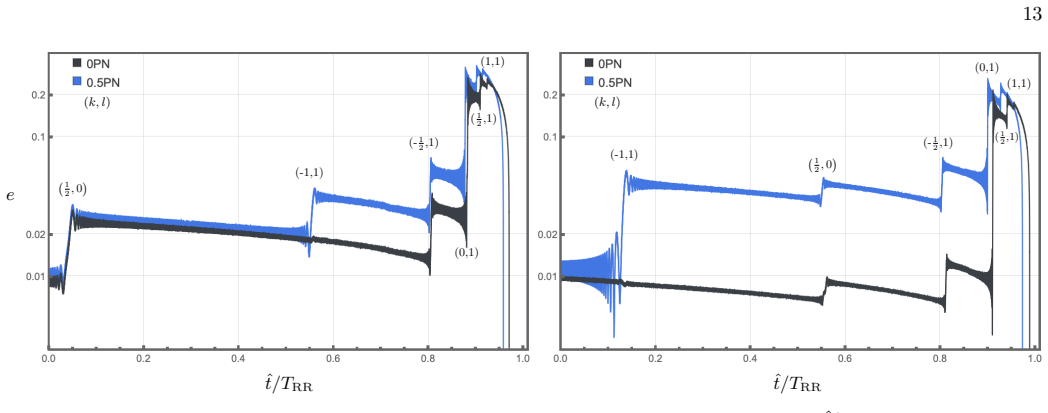
They show that this magnetic coupling creates new resonances: when the inner binary's periastron precession frequency matches certain combinations of the outer orbit's radial and frame-precession frequencies, the inner orbit's eccentricity jumps. These jumps appear in addition to the previously known electric-tide resonances. The authors integrate the Lagrange Planetary Equations numerically and reproduce the predicted jumps, confirming the analytical resonance conditions. They find the effect is strongest for inclined or aligned orbits and grows with the outer orbit's eccentricity.
The authors argue that these eccentricity jumps would leave phase shifts in the gravitational waves emitted by the inner binary, within LISA's frequency band, and that the extra eccentricity slightly accelerates the merger. However, the analytic resonance model is derived for nearly circular outer orbits, and the LISA detectability is asserted qualitatively rather than through a signal-to-noise calculation.
Core claim
The paper's core assertion is that 'magnetic tides introduce new resonances absent at lower order, leading to additional eccentricity excitations and significantly modifying the binary's long-term evolution' (Abstract). Concretely, the 0.5PN magnetic tidal coupling yields precession resonances at ˙γ = −Ω_r + Ω_Ψ, Ω_Ψ, and Ω_r + Ω_Ψ (Eq. 5.12), which are not present for the 0PN electric tides alone, and which produce eccentricity jumps visible in the numerical LPE solutions.
Load-bearing premise
The decoupling of the inner binary's center-of-mass from its relative motion at 0.5PN order. The paper asserts, without solving the system (A.9), that the accelerated-frame corrections to Marck's tetrad are of quadrupolar order and therefore negligible (App. A, Eq. A.4–A.9, text after Eq. A.9). If those corrections contributed at the same order as the magnetic tidal coupling, the Hamiltonian (2.18) would omit 0.5PN terms that could shift or suppress the predicted resonances.
Editorial analysis
A structured set of objections, weighed in public.
Referee Report
Summary. The paper studies hierarchical triples consisting of a compact binary orbiting a supermassive black hole, and extends earlier work on precession resonances from 0PN electric tidal fields to 0.5PN magnetic tidal fields. The main claim is that the magnetic quadrupole tidal coupling, which is linear in the outer orbital angular momentum and has odd parity, produces precession resonances with q=1 in the condition \dot\gamma = k\Omega_{\hat r}+l\Omega_{\hat\Psi}. At leading order in the outer eccentricity, three resonances are predicted: \dot\gamma = -\Omega_{\hat r}+\Omega_{\hat\Psi}, \Omega_{\hat\Psi}, and \Omega_{\hat r}+\Omega_{\hat\Psi}. The authors derive the orbit-averaged 0.5PN magnetic Hamiltonian, compute the relevant Fourier coefficients, and verify the resonance crossings numerically through Lagrange Planetary Equations supplemented by Peters-type radiation reaction. They argue that these resonances produce additional eccentricity jumps, accelerate merger, and leave signatures in the LISA band.
Significance. If the derivation is sound, this is a genuinely new strong-gravity effect: it identifies a concrete observable consequence of purely relativistic magnetic tidal fields in a hierarchical triple, with no Newtonian analogue. The core mechanism is elegant and parameter-free in the technical sense that no parameters are fitted to the phenomenology: the q=1 structure follows from the odd parity of the magnetic tidal tensor, and the resonance locations are fixed by the frequencies of the outer geodesic. The paper also provides explicit analytical amplitudes and numerical confirmation of the resonance crossings, which strengthens the main claim. The main risk is not internal inconsistency of the orbit-averaged calculation itself, but the unproved decoupling of center-of-mass and relative motion at 0.5PN order, on which the central Hamiltonian (2.18) rests. That issue, together with a clear algebraic error in the printed resonant Hamiltonian (5.13), prevents acceptance in the present form.
major comments (3)
- [Appendix A, Eqs. (A.4)-(A.9); central Hamiltonian (2.18)] The derivation of the 0.5PN magnetic Hamiltonian (2.18) requires that, after using the accelerated frame defined by Eq. (A.4), the corrections to Marck's tetrad do not contribute at quadrupolar order. The paper states this result is verified 'without explicitly solving the system (A.9)' and under the assumption that \hat r is approximately constant. This is not a derivation. The magnetic resonances in Eq. (5.12) are themselves 0.5PN quadrupolar-order effects; any tetrad correction of the same order can modify the Fourier coefficients (5.11), shift the resonance amplitudes, or introduce new Fourier modes. The numerical LPE calculation uses the same truncated Hamiltonian (4.22), so it cannot validate this truncation. The authors should either solve Eq. (A.9) to the required order, or provide an explicit order-by-order argument that the induced corrections to E_{ij} and B_{ij} in Eq. (2.1)
- [Sec. V.B, Eq. (5.13)] Equation (5.13) as printed contains the factor \cos^2 I/[2(1-2\cos I)], which diverges at I=\pi/3, is nonzero at I=\pi, and is negative for I<\pi/3. This contradicts the immediately following text, which states that resonances vanish at both I=\pi/3 and I=\pi, and it is inconsistent with the numerical suppression seen at I=60^\circ in Fig. 3. The correct inclination factor follows from Eq. (5.6) with m_{k,l}=n_{k,l} and vanishing tilde coefficients: it should be proportional to \cos I+\cos 2I=(1+\cos I)(2\cos I-1), which vanishes at both angles. This is not a cosmetic typo: Eq. (5.13) is the principal analytic prediction for the amplitude of the new magnetic resonances, and the printed expression also gives the wrong normalization at aligned inclinations. The numerical LPE solutions do not rely on Eq. (5.13), but the analytical model presented in Sec. V.B needs correction.
- [Abstract and Sec. V.B / Table I] The abstract and introduction state that magnetic tides introduce 'new resonances absent at lower order.' This is overstated: Table I shows that the \dot\gamma=\Omega_{\hat\Psi} resonance already appears in the 0PN electric-tidal column. What is new at 0.5PN are the (-1,1) and (1,1) resonances, while the (0,1) resonance receives an additional magnetic contribution. The wording should be adjusted to avoid claiming that all three magnetic resonances are absent at lower order.
minor comments (3)
- [Sec. VI] The text describes the numerical computation as 'without performing a Fourier expansion of the Hamiltonian' and as solving the 'full equations of motion.' In practice, the LPE system (6.3) is evolved with the orbit-averaged Hamiltonian (4.22), not with the unaveraged two-body equations. Please rephrase to avoid overstating the independence of the numerical check.
- [Abstract, Sec. VII] The title and abstract claim an 'observable signature' and 'potential LISA detectability,' but no waveform or SNR estimate is provided; Sec. VII leaves waveform construction to future work. This is acceptable as a forward-looking statement, but the wording should be qualified, e.g., 'a GW signature that could be observable' rather than a demonstrated detection.
- [Throughout] The notation '0.5PN order' is nonstandard; since the term is 1/c beyond Newtonian, a parenthetical definition at first occurrence would help readers not working in the PN convention.
Circularity Check
No significant circularity: the magnetic-tide resonances are derived from an explicit 0.5PN tidal Hamiltonian and are not fitted to the claimed outputs.
full rationale
The central derivation is self-contained rather than circular. The 0.5PN magnetic tidal coupling enters through the Lagrangian (2.3) and Hamiltonian (2.18), and the resonance condition (5.7) follows from Fourier decomposing B_ij in (5.2)-(5.3) together with the orbit-averaged magnetic Hamiltonian (4.15)-(4.16); the q=1 structure is a consequence of the explicit tensor T_ij in (4.14), not an assumption that the resonances exist. The quasi-circular Fourier coefficients (5.11) are computed from the geodesic solutions (5.8), and the resonance list (5.12) is a direct consequence. No parameter is fitted to the eccentricity jumps, and the numerical LPE solutions use the same Hamiltonian, so they are a consistency check of the averaging analysis rather than a circular derivation. The frequent citations to the authors' earlier papers [20,37,72] supply formalism and background frequencies, but those are standard, independently checkable geodesic/tidal results, and the new magnetic claim does not reduce to any of them. Two genuine non-circular weaknesses should be weighed separately: (i) Appendix A does not solve Eq. (A.9) and says the accelerated-frame tetrad corrections are negligible 'Without explicitly solving the system (A.9)' while assuming r-hat constant; if wrong, the Hamiltonian (2.18) could miss same-order 0.5PN terms, but that is an unproved physical approximation, not a definitional reduction. (ii) Eq. (5.13)'s printed angular factor cos^2 I/[2(1-2cosI)] appears inconsistent with the text and with Eq. (5.6), but this is a typographical/analytical error, not circularity. Neither defect makes the prediction equal to its input.
Axiom & Free-Parameter Ledger
axioms (7)
- domain assumption Small-tide approximation: the inner binary's size r is much smaller than the curvature radius R of the SMBH; only quadrupolar tidal terms are kept.
- domain assumption The inner binary can be treated as a Newtonian two-body system with small PN corrections; separation much larger than the compact objects' Schwarzschild radii.
- domain assumption The center-of-mass of the inner binary follows a Schwarzschild geodesic; deviations induced by the accelerated frame are negligible at quadrupolar order.
- domain assumption Resonance crossing is driven mainly by 2.5PN gravitational radiation reaction; environmental effects are neglected or parameterized by α.
- domain assumption At leading order in outer eccentricity, the outer radial motion and Marck angle are given by the quasi-circular solution (5.8) and the frequencies (5.10).
- standard math Standard action-angle formalism for bound geodesics in Schwarzschild spacetime, with fundamental frequencies Ω_r, Ω_ϕ, Ω_Ψ.
- standard math Lagrange Planetary Equations in the generalized Lagrange gauge are a valid symplectic system for the osculating elements.
read the original abstract
We study hierarchical triple systems formed by a compact binary orbiting a supermassive black hole (SMBH), focusing on the role of relativistic magnetic tidal interactions. Extending previous analyses of precession resonances to 0.5 post-Newtonian order, we incorporate quadrupolar magnetic tidal moments, which have no Newtonian counterpart. We find that magnetic tides introduce new resonances absent at lower order, leading to additional eccentricity excitations and significantly modifying the binary's long-term evolution. Numerical solutions of the Lagrange Planetary Equations confirm these analytical predictions and reveal how resonance strength depends on orbital eccentricity and inclination. The resulting dynamics accelerates the binary merger and imprints distinctive signatures on gravitational waves, potentially observable by LISA. Our findings identify magnetic tidal coupling as a novel strong-gravity effect and establish its importance for the resonant dynamics of compact-object binaries near SMBHs.
Figures


Forward citations
Cited by 6 Pith papers
-
Periodic line-of-sight velocity-driven modulations to gravitational waves emitted by compact binaries in Keplerian outer orbits
New waveform corrections for periodic Doppler shifts from circular and eccentric outer orbits let future gravitational-wave detectors measure the mass and orbit of a third body around a merging binary.
-
Periodic line-of-sight velocity-driven modulations to gravitational waves emitted by compact binaries in Keplerian outer orbits
Periodic non-relativistic line-of-sight velocity of a compact binary’s centre of mass produces 4PN phase and amplitude modulations that improve Fisher forecasts of tertiary mass and outer-orbit size for A+, ET, DECIGO...
-
Dynamics of Binary System around a Supermassive Black Hole :Binary Scattering and Eccentric vZLK Oscillations
Binaries around supermassive black holes exhibit four periapsis-dependent scattering regimes in unbound orbits and scattering-type eccentric vZLK oscillations in bound orbits within Kerr spacetime.
-
Tidal perturbations of an extreme mass ratio inspiral around a Kerr black hole
A closed-form Kerr metric under slow quadrupolar tides yields spin-dependent tidal shifts of the ISCO and light ring, with larger shifts for retrograde orbits around fast-spinning holes.
-
Dynamics of Binary System around a Supermassive Black Hole :Binary Scattering and Eccentric vZLK Oscillations
Binaries around SMBHs exhibit four scattering regimes in unbound orbits and scattering-type eccentric vZLK oscillations in bound orbits, yielding a unified periapsis-driven tidal dynamics picture in galactic nuclei.
-
Gravitational waves of extreme-mass-ratio inspirals in a rotating black hole with Dehnen dark matter halo
EMRI waveforms in a rotating black hole with Dehnen DM halo show amplitude and phase shifts from Kerr, with mismatch rising as DM mass parameter and black hole spin increase.
Reference graph
Works this paper leans on
-
[1]
Newton,Philosophiæ Naturalis Principia Mathematica (England, 1687)
I. Newton,Philosophiæ Naturalis Principia Mathematica (England, 1687)
-
[2]
Euler,Theoria motuum lunae nova methodo pertrac- tata: una cum tabulis astronomicis(1772)
L. Euler,Theoria motuum lunae nova methodo pertrac- tata: una cum tabulis astronomicis(1772)
-
[3]
Lagrange, M´ emoires de l’Acad´ emie des Sciences de Paris (1783), included in Œuvres de Lagrange, Vol
J.-L. Lagrange, M´ emoires de l’Acad´ emie des Sciences de Paris (1783), included in Œuvres de Lagrange, Vol. IV (Paris: Gauthier-Villars, 1869)
-
[4]
Delaunay,Th´ eorie du mouvement de la lune, M´ emoires de l’Acad´ emie des sciences de l’Institut de France
C. Delaunay,Th´ eorie du mouvement de la lune, M´ emoires de l’Acad´ emie des sciences de l’Institut de France. S´ erie 2 No. pt. 1 (Didot, 1860)
-
[5]
Poincar´ e, Bulletin astronomique, Observatoire de Paris8, 12 (1891)
H. Poincar´ e, Bulletin astronomique, Observatoire de Paris8, 12 (1891)
-
[6]
A. E. H. Love,Some problems of geodynamics : being an essay to which the Adams prize in the University of Cambridge was adjudged in 1911(University Press, Cam- bridge, 1911)
1911
-
[7]
T. Hinderer, Astrophys. J.677, 1216 (2008), [Erratum: Astrophys.J. 697, 964 (2009)], arXiv:0711.2420 [astro- ph]
Pith/arXiv arXiv 2008
-
[8]
E. E. Flanagan and T. Hinderer, Phys. Rev. D77, 021502 (2008), arXiv:0709.1915 [astro-ph]
Pith/arXiv arXiv 2008
-
[9]
T. Damour and A. Nagar, Phys. Rev. D80, 084035 (2009), arXiv:0906.0096 [gr-qc]
Pith/arXiv arXiv 2009
-
[10]
T. Binnington and E. Poisson, Phys. Rev. D80, 084018 (2009), arXiv:0906.1366 [gr-qc]
Pith/arXiv arXiv 2009
-
[11]
J. Samsing, K. Hendriks, L. Zwick, D. J. D’Orazio, and B. Liu, (2024), arXiv:2403.05625 [astro-ph.HE]
Pith/arXiv arXiv 2024
-
[12]
K. Hendriks, D. Atallah, M. Martinez, M. Zevin, L. Zwick, A. A. Trani, P. Saini, J. Tak´ atsy, and J. Sam- sing, (2024), arXiv:2411.08572 [astro-ph.HE]
arXiv 2024
- [13]
-
[14]
H. V. Zeipel, Astronomische Nachrichten183, 345 (1909)
1909
-
[15]
Kozai, Astron
Y. Kozai, Astron. J.67, 591 (1962)
1962
-
[16]
Lidov, Planetary and Space Science9, 719 (1962)
M. Lidov, Planetary and Space Science9, 719 (1962)
1962
-
[17]
L. Hu, R.-G. Cai, and S.-J. Wang, JCAP08, 010 (2025), arXiv:2411.14047 [gr-qc]. 20
Pith/arXiv arXiv 2025
-
[18]
R. S. Chandramouli and N. Yunes, Phys. Rev. D105, 064009 (2022), arXiv:2107.00741 [gr-qc]
Pith/arXiv arXiv 2022
-
[19]
L. Randall and Z.-Z. Xianyu, Astrophys. J.864, 134 (2018), arXiv:1802.05718 [gr-qc]
Pith/arXiv arXiv 2018
-
[20]
F. Camilloni, T. Harmark, G. Grignani, M. Orselli, and D. Pica, Mon. Not. Roy. Astron. Soc.531, 1884 (2024), arXiv:2310.06894 [gr-qc]
Pith/arXiv arXiv 2024
-
[21]
F. Antonini and H. B. Perets, Astrophys. J.757, 27 (2012), arXiv:1203.2938 [astro-ph.GA]
Pith/arXiv arXiv 2012
-
[22]
K.-i. Maeda, P. Gupta, and H. Okawa, Phys. Rev. D 107, 124039 (2023), arXiv:2303.16553 [gr-qc]
Pith/arXiv arXiv 2023
-
[23]
K.-i. Maeda, P. Gupta, and H. Okawa, Phys. Rev. D 108, 123041 (2023), arXiv:2309.12096 [gr-qc]
Pith/arXiv arXiv 2023
- [24]
-
[25]
S. Naoz, Ann. Rev. Astron. Astrophys.54, 441 (2016), arXiv:1601.07175 [astro-ph.EP]
Pith/arXiv arXiv 2016
-
[26]
B. Bonga, H. Yang, and S. A. Hughes, Phys. Rev. Lett. 123, 101103 (2019), arXiv:1905.00030 [gr-qc]
Pith/arXiv arXiv 2019
-
[27]
P. Gupta, B. Bonga, A. J. K. Chua, and T. Tanaka, Phys. Rev. D104, 044056 (2021), arXiv:2104.03422 [gr- qc]
Pith/arXiv arXiv 2021
-
[28]
´E. E. Flanagan, S. A. Hughes, and U. Ruangsri, Phys. Rev. D89, 084028 (2014), arXiv:1208.3906 [gr-qc]
Pith/arXiv arXiv 2014
-
[29]
E. E. Flanagan and T. Hinderer, Phys. Rev. Lett.109, 071102 (2012), arXiv:1009.4923 [gr-qc]
Pith/arXiv arXiv 2012
-
[30]
L. Zwick, K. Hendriks, D. O’Neill, J. Tak´ atsy, P. Kirke- berg, C. Tiede, J. Stegmann, J. Samsing, and D. J. D’Orazio, (2025), arXiv:2506.09140 [astro-ph.HE]
Pith/arXiv arXiv 2025
- [31]
-
[32]
H. G. Bhaskar, G. Li, and D. N. C. Lin, Astrophys. J. 934, 141 (2022), arXiv:2204.07282 [astro-ph.HE]
Pith/arXiv arXiv 2022
-
[33]
M. Stockinger and M. Shibata, Phys. Rev. D110, 043038 (2024), arXiv:2403.06834 [astro-ph.HE]
Pith/arXiv arXiv 2024
-
[34]
M. Stockinger and M. Shibata, Phys. Rev. D111, 123044 (2025), arXiv:2502.06998 [astro-ph.HE]
Pith/arXiv arXiv 2025
-
[35]
K. S. Thorne and J. B. Hartle, Phys. Rev. D31, 1815 (1984)
1984
-
[36]
E. Poisson and I. Vlasov, Phys. Rev. D81, 024029 (2010), arXiv:0910.4311 [gr-qc]
Pith/arXiv arXiv 2010
- [37]
-
[38]
A. Generozov, N. C. Stone, B. D. Metzger, and J. P. Ostriker, Mon. Not. Roy. Astron. Soc.478, 4030 (2018), arXiv:1804.01543 [astro-ph.HE]
Pith/arXiv arXiv 2018
-
[39]
X. Chen and W.-B. Han, Communications Physics1, 53 (2018), arXiv:1801.05780 [astro-ph.HE]
Pith/arXiv arXiv 2018
-
[40]
A. Kuntz, Phys. Rev. D105, 024017 (2022), arXiv:2112.05167 [gr-qc]
Pith/arXiv arXiv 2022
-
[41]
M. van de Meent, Class. Quant. Grav.37, 145007 (2020), arXiv:1906.05090 [gr-qc]
Pith/arXiv arXiv 2020
-
[42]
D. Bini, A. Geralico, and R. T. Jantzen, Phys. Rev. D 94, 064066 (2016), arXiv:1607.08427 [gr-qc]
Pith/arXiv arXiv 2016
-
[43]
W. Schmidt, Class. Quant. Grav.19, 2743 (2002), arXiv:gr-qc/0202090
Pith/arXiv arXiv 2002
-
[44]
R. Fujita and W. Hikida, Class. Quant. Grav.26, 135002 (2009), arXiv:0906.1420 [gr-qc]
Pith/arXiv arXiv 2009
-
[45]
T. Hinderer and E. E. Flanagan, Phys. Rev. D78, 064028 (2008), arXiv:0805.3337 [gr-qc]
Pith/arXiv arXiv 2008
-
[46]
R. M. O’Leary, B. Kocsis, and A. Loeb, Mon. Not. Roy. Astron. Soc.395, 2127 (2009), arXiv:0807.2638 [astro- ph]
Pith/arXiv arXiv 2009
-
[47]
J. Samsing and E. Ramirez-Ruiz, Astrophys. J. Lett. 840, L14 (2017), arXiv:1703.09703 [astro-ph.HE]
Pith/arXiv arXiv 2017
-
[48]
C. Hopman and T. Alexander, Astrophys. J.645, 1152 (2006), arXiv:astro-ph/0601161
Pith/arXiv arXiv 2006
-
[49]
J. M. Bellovary, M.-M. Mac Low, B. McKernan, and K. E. S. Ford, Astrophys. J. Lett.819, L17 (2016), arXiv:1511.00005 [astro-ph.GA]
Pith/arXiv arXiv 2016
-
[50]
A. Secunda, J. Bellovary, M.-M. Mac Low, K. E. S. Ford, B. McKernan, N. W. C. Leigh, W. Lyra, Z. San- dor, and J. I. Adorno, Astrophys. J.903, 133 (2020), arXiv:2004.11936 [astro-ph.HE]
Pith/arXiv arXiv 2020
-
[51]
P. Peng and X. Chen, Mon. Not. Roy. Astron. Soc.505, 1324 (2021), arXiv:2104.07685 [astro-ph.HE]
Pith/arXiv arXiv 2021
-
[52]
H. Tagawa, Z. Haiman, and B. Kocsis, Astrophys. J. 898, 25 (2020), arXiv:1912.08218 [astro-ph.GA]
Pith/arXiv arXiv 2020
-
[53]
V. Cardoso, C. F. B. Macedo, and R. Vicente, Phys. Rev. D103, 023015 (2021), arXiv:2010.15151 [gr-qc]
Pith/arXiv arXiv 2021
-
[54]
L. Zwick, P. R. Capelo, E. Bortolas, V. Vazquez-Aceves, L. Mayer, and P. Amaro-Seoane, Mon. Not. Roy. Astron. Soc.506, 1007 (2021), arXiv:2102.00015 [astro-ph.GA]
Pith/arXiv arXiv 2021
-
[55]
G. Caneva Santoro, S. Roy, R. Vicente, M. Haney, O. J. Piccinni, W. Del Pozzo, and M. Martinez, Phys. Rev. Lett.132, 251401 (2024), arXiv:2309.05061 [gr-qc]
Pith/arXiv arXiv 2024
-
[56]
W. Ishibashi and M. Gr¨ obner, Mon. Not. Roy. Astron. Soc.529, 883 (2024), arXiv:2412.01925 [astro-ph.HE]
Pith/arXiv arXiv 2024
-
[57]
E. Barausse and L. Rezzolla, Phys. Rev. D77, 104027 (2008), arXiv:0711.4558 [gr-qc]
Pith/arXiv arXiv 2008
-
[58]
E. Barausse, V. Cardoso, and P. Pani, Phys. Rev. D89, 104059 (2014), arXiv:1404.7149 [gr-qc]
Pith/arXiv arXiv 2014
-
[59]
V. Cardoso and C. F. B. Macedo, Mon. Not. Roy. Astron. Soc.498, 1963 (2020), arXiv:2008.01091 [astro-ph.HE]
Pith/arXiv arXiv 1963
-
[60]
P. S. Cole, G. Bertone, A. Coogan, D. Gaggero, T. Karydas, B. J. Kavanagh, T. F. M. Spieksma, and G. M. Tomaselli, Nature Astron.7, 943 (2023), arXiv:2211.01362 [gr-qc]
arXiv 2023
-
[61]
R. Chen, R. S. Chandramouli, F. Pozzoli, R. Buscic- chio, and E. Barausse, Phys. Rev. D112, 084053 (2025), arXiv:2507.00694 [gr-qc]
arXiv 2025
-
[62]
Abbottet al.(LIGO Scientific, Virgo), Phys
R. Abbottet al.(LIGO Scientific, Virgo), Phys. Rev. Lett.125, 101102 (2020), arXiv:2009.01075 [gr-qc]
arXiv 2020
-
[63]
A. Toubianaet al., Phys. Rev. Lett.126, 101105 (2021), arXiv:2010.06056 [astro-ph.HE]
Pith/arXiv arXiv 2021
-
[64]
M. J. Grahamet al., Phys. Rev. Lett.124, 251102 (2020), arXiv:2006.14122 [astro-ph.HE]
Pith/arXiv arXiv 2020
-
[65]
L. Sbernaet al., Phys. Rev. D106, 064056 (2022), arXiv:2205.08550 [gr-qc]
Pith/arXiv arXiv 2022
-
[66]
F. Peißker, M. Zajacek, L. Labadie, E. Bordier, A. Eckart, M. Melamed, and V. Karas, Nature Com- mun.15, 10608 (2024), arXiv:2412.12727 [astro-ph.GA]
Pith/arXiv arXiv 2024
-
[67]
J. S. Santos, V. Cardoso, J. Nat´ ario, and M. van de Meent, (2025), arXiv:2506.14868 [gr-qc]
Pith/arXiv arXiv 2025
-
[68]
Y. Yin, J. Mathews, A. J. K. Chua, and X. Chen, Phys. Rev. D111, 103007 (2025), arXiv:2410.09796 [gr-qc]
Pith/arXiv arXiv 2025
-
[69]
K. Meng, H. Zhang, X.-L. Fan, Y. Yong, and F. Du, (2024), arXiv:2405.07113 [gr-qc]
arXiv 2024
-
[70]
Jiang, W.-B
Y. Jiang, W.-B. Han, X.-Y. Zhong, P. Shen, Z.-R. Luo, and Y.-L. Wu, Eur. Phys. J. C84, 478 (2024)
2024
-
[71]
Amaro-Seoaneet al., arXiv preprint (2017), arXiv:1702.00786 [astro-ph.IM]
P. Amaro-Seoaneet al., arXiv preprint (2017), arXiv:1702.00786 [astro-ph.IM]
Pith/arXiv arXiv 2017
-
[72]
F. Camilloni, G. Grignani, T. Harmark, R. Oliveri, M. Orselli, and D. Pica, Phys. Rev. D107, 084011 (2023), arXiv:2301.04879 [gr-qc]. 21
Pith/arXiv arXiv 2023
-
[73]
A. Kuntz, F. Serra, and E. Trincherini, Phys. Rev. D 104, 024016 (2021), arXiv:2104.13387 [hep-th]
Pith/arXiv arXiv 2021
-
[74]
A. Kuntz, F. Serra, and E. Trincherini, Phys. Rev. D 107, 044011 (2023), arXiv:2210.13493 [gr-qc]
Pith/arXiv arXiv 2023
-
[75]
Marck, Proc
J.-A. Marck, Proc. R. Soc. Lond. A385, 431 (1983)
1983
-
[76]
Goldstein,Classical Mechanics(Addison-Wesley, 1980)
H. Goldstein,Classical Mechanics(Addison-Wesley, 1980)
1980
-
[77]
Morbidelli, Modern celestial mechanics : aspects of so- lar system dynamics
A. Morbidelli, Modern celestial mechanics : aspects of so- lar system dynamics. London: Taylor and Francis, 2002, ISBN 0415279399-1(2002)
2002
-
[78]
Valtonen and H
M. Valtonen and H. Karttunen,The Three-Body Problem (Cambridge University Press, Cambridge, 2006)
2006
-
[79]
M. Efroimsky and P. Goldreich, Astron. Astrophys.415, 1187 (2004), arXiv:astro-ph/0307130
Pith/arXiv arXiv 2004
-
[80]
Lagrange, M´ emoires de l’Acad´ emie des Sciences de Paris (1808), included in Œuvres de Lagrange, Vol
J.-L. Lagrange, M´ emoires de l’Acad´ emie des Sciences de Paris (1808), included in Œuvres de Lagrange, Vol. VI, 713 (Paris: Gauthier-Villars, 1877)
discussion (0)
Sign in with ORCID, Apple, or X to comment. Anyone can read and Pith papers without signing in.