REVIEW 4 major objections 3 minor 1 cited by
High-quality music generation can keep structure and fidelity inside one deep acoustic-token hierarchy, without a separate semantic stage.
Reviewed by Pith at T0; open to challenge. T0 means a machine referee read the full paper against a public rubric. the ladder, T0–T4 →
T0 review · grok-4.5
2026-07-12 17:48 UTC pith:MKAB34CS
load-bearing objection Abstract-only systems claim for unified acoustic-token music generation; idea is clean, evidence is currently uncheckable. the 4 major comments →
Shao: Scaling Acoustic Token Language Models Toward High-Fidelity Music Generation
The pith
A machine-rendered reading of the paper's core claim, the machinery that carries it, and where it could break.
Core claim
High-quality music generation can be pursued without separating structure and fidelity into heterogeneous representation spaces; both can be progressively modeled within a unified acoustic-token hierarchy, and text-vocal alignment can emerge within pure acoustic-token language modeling without a separate semantic token stage.
What carries the argument
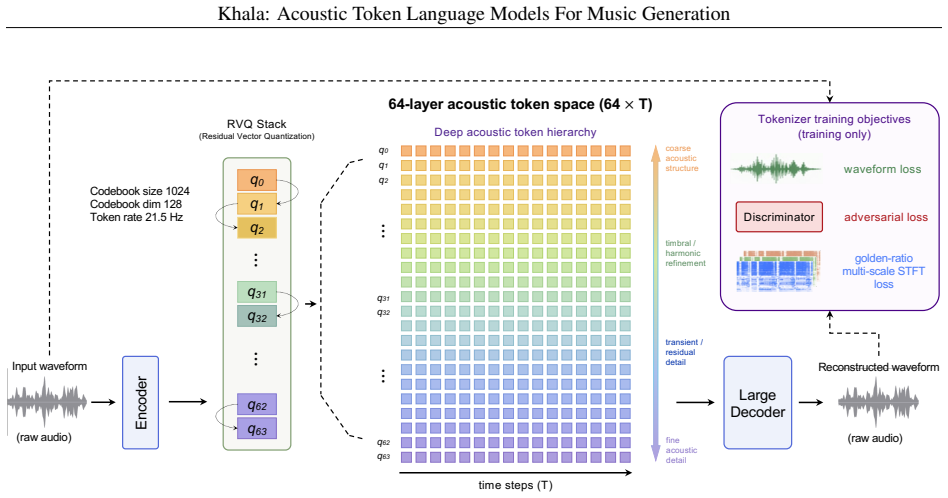
A 64-layer residual vector quantization (RVQ) acoustic hierarchy processed by a two-stage backbone-then-super-resolution language model with hybrid attention: the backbone generates coarse full-track tokens, the super-resolution model refines finer layers layer-by-layer at full-track scale in a fixed 62-step parallel-in-time process, and hybrid attention trains alignment causally while refining with full attention.
Load-bearing premise
That a single deep residual acoustic-token hierarchy is already expressive enough for coarse tokens to carry the structural and lyric-alignment information usually handled by a separate semantic or structure model.
What would settle it
Generate tracks with the full two-stage pure-acoustic system and with an otherwise matched system that inserts a separate semantic-token stage; if lyric alignment and structural coherence do not match or exceed the semantic baseline under identical listening or automatic metrics, the central claim fails.
Editorial analysis
A structured set of objections, weighed in public.
Referee Report
Summary. The manuscript proposes Shao, a high-fidelity music generation system that models both structure and acoustic fidelity inside a single deep residual vector quantization (RVQ) hierarchy rather than in heterogeneous representation spaces. It constructs a 64-layer RVQ acoustic tokenizer and a two-stage coarse-to-fine language-model pipeline: a backbone LM generates coarse acoustic tokens for the full track, and a super-resolution LM then fills finer layers within the same token space under a fixed 62-step inference schedule, with layer-wise refinement run in parallel over time. Hybrid-attention training is introduced so that a causal objective targets lyric alignment while full attention is used for layer-wise refinement. The abstract’s central claims are that text–vocal alignment can emerge from pure acoustic-token language modeling without a separate semantic-token stage, that initializing the super-resolution model from the trained backbone improves convergence and quality, and that high-quality music generation need not separate structure and fidelity into heterogeneous spaces.
Significance. If the empirical claims hold, the work would offer a simpler, more unified alternative to the dominant structure-then-diffusion/neural-decode pattern in music generation, and would show that lyric alignment can arise inside pure acoustic-token LMs. That would be a meaningful systems-level contribution for the community. The design elements highlighted—deep RVQ hierarchy, backbone-to-super-resolution initialization, hybrid attention, and fixed-step full-track refinement—are concrete and potentially reusable. Because only the abstract is available for this review, however, none of these contributions can yet be verified against metrics, ablations, baselines, or listening tests; significance therefore remains conditional on evidence that is not present in the material under review.
major comments (4)
- Abstract (central claim): The load-bearing assertion that text–vocal alignment ‘can emerge within pure acoustic-token language modeling, without requiring a separate semantic token stage’ is stated without any supporting metric (e.g., lyric alignment / ASR-based word error, CLAP-text scores, or controlled listening tests), baseline comparison to a semantic-token pipeline, or ablation that removes any residual semantic pathway. Without such evidence the claim cannot be assessed and remains the paper’s weakest assumption.
- Abstract (unified hierarchy claim): The claim that both structure and fidelity can be ‘progressively modeled within a unified acoustic-token hierarchy’ (64-layer RVQ + backbone + super-resolution) is not backed by objective quality numbers (FAD, KLD, CLAP, subjective MOS), comparisons to heterogeneous systems (MusicGen, AudioLM-style pipelines, diffusion decoders, etc.), or failure-case analysis. The abstract alone supplies no way to judge whether the coarse RVQ layers actually carry the structural information usually delegated to a separate semantic/structure model.
- Abstract (initialization claim): The statement that ‘initializing the super-resolution model from the trained backbone significantly improves convergence and final quality’ is an ad-hoc design axiom that requires a from-scratch vs. backbone-init ablation with reported curves and final metrics. No such evidence appears in the material under review, so the claimed transfer benefit cannot be verified.
- Abstract (hybrid attention): Hybrid attention (causal for alignment, full for layer-wise refinement) is presented as jointly improving lyric alignment and fine-detail reconstruction, yet no ablation of pure-causal vs. pure-full vs. hybrid attention is described. Because the hybrid split is one of the free design parameters of the system, its necessity for the central claims needs quantitative support that is currently missing.
minor comments (3)
- Abstract: The fixed ‘62-step’ inference schedule is asserted without stating how the step count is derived from the 64-layer hierarchy (e.g., which layers are generated by the backbone vs. super-resolution). Clarifying this mapping would aid reproducibility.
- Abstract: Dataset scale, training compute, sampling rate, and codebook configuration for the 64-layer RVQ are not mentioned; these are standard reporting items for acoustic-token music systems and should appear in the full manuscript.
- Abstract: The phrase ‘high-quality music generation’ is used without defining the evaluation protocol (objective metrics, listening-test design, number of raters). The full paper should specify these.
Circularity Check
No circularity: abstract-only empirical systems paper with no derivation chain, fitted constants, or load-bearing self-citations to audit.
full rationale
Only the abstract is available; there are no equations, theorems, uniqueness claims, fitted parameters renamed as predictions, or self-citation chains that reduce a claimed first-principles result to its inputs. The paper is an empirical systems proposal (64-layer RVQ, backbone then super-resolution LM, hybrid attention, backbone-init of the super-resolution stage) whose claims are about generation quality and emergent text-vocal alignment under a stated architecture. Design choices such as initializing the super-resolution model from the backbone and using hybrid causal/full attention are training recipes, not tautological definitions of the reported outcome. No step reduces by construction to a fitted input or to an author-only uniqueness theorem. Per the hard rules, an honest non-finding is required: score 0, empty steps. (Absence of metrics/ablations is a correctness/evidence risk, not circularity.)
Axiom & Free-Parameter Ledger
free parameters (3)
- RVQ depth (64 layers)
- Fixed 62-step inference schedule
- Hybrid attention objective split (causal vs full)
axioms (3)
- domain assumption Residual vector quantization acoustic tokens can represent both musical structure and fine acoustic detail at sufficient fidelity.
- domain assumption Autoregressive / language-model training over discrete acoustic tokens is a valid generator for full-track music.
- ad hoc to paper Initializing the super-resolution model from the trained backbone transfers useful representations.
invented entities (1)
-
Shao two-stage coarse-to-fine acoustic-token hierarchy with hybrid attention
no independent evidence
read the original abstract
A common design pattern in high-quality music generation is to handle structure and fidelity in different representation spaces: a generator first models high-level structure, followed by diffusion-based or neural decoding stages that reconstruct fine details. In this work, we explore an alternative view: both may be progressively modeled within a single deep acoustic-token hierarchy. To study this, we build a 64-layer residual vector quantization (RVQ) acoustic representation and propose a two-stage coarse-to-fine generation framework. A backbone model first generates coarse acoustic tokens for the full track, and a super-resolution model then completes finer tokens within the same acoustic token space. The super-resolution stage works at full-track scale and refines tokens layer by layer while running in parallel over time, leading to a fixed 62-step inference process. To jointly improve lyric alignment and fine-detail reconstruction, we further introduce hybrid-attention training: the alignment objective uses causal attention, while layer-wise refinement uses full attention. A key finding is that text-vocal alignment can emerge within pure acoustic-token language modeling, without requiring a separate semantic token stage. Moreover, initializing the super-resolution model from the trained backbone significantly improves convergence and final quality. Taken together, our results suggest that high-quality music generation can be effectively pursued without separating structure and fidelity into heterogeneous representation spaces. Instead, both can be progressively modeled within a unified acoustic-token hierarchy, pointing toward a simpler and more unified path to high-quality music generation.
Figures

Forward citations
Cited by 1 Pith paper
-
Pushing the Frontier of Full-Song Generation: Hierarchical Autoregressive Planning Meets Flow-Matching Rendering
A unified hierarchical-LM-plus-flow-matching system reports top-tier full-song vocal generation, ranking 2–3 on an external blind leaderboard, but releases neither code nor evaluation data.
discussion (0)
Sign in with ORCID, Apple, or X to comment. Anyone can read and Pith papers without signing in.