REVIEW 4 major objections 5 minor 3 cited by
On Reeb graphs induced from smooth functions on closed or open manifolds
T0 review · 4 major / 5 minor · reviewed 2026-08-14 · deepseek-v4-flash
Pith's one-line read Every balanced 0-1 labeled graph arises as a Reeb graph
desk verdict The balanced surface case is a genuine, plausible result; the higher-dimensional and unbalanced theorems are not yet proven and rely on asserted local fold maps. read the letter →
The pith
A machine-rendered reading of the paper's core claim, the machinery that carries it, and where it could break.
The reading
What carries the argument
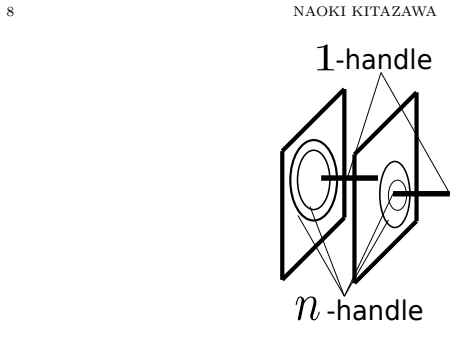
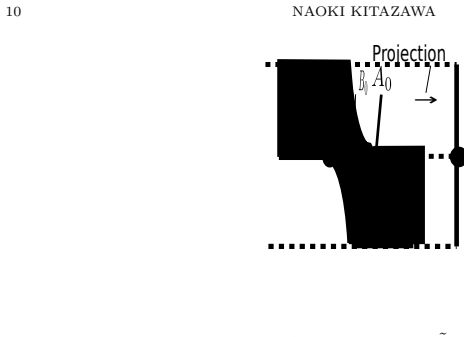
The engine is a local-to-global handle construction. Around each vertex of $G$, the paper builds a local Morse (or Morse-Bott/fold) function on a model surface whose Reeb graph is a small neighborhood of that vertex: one starts with the disjoint union of $a$ lines and $b$ circles (for the relevant triples $(a,b,c)$) crossed with an interval, attaches 1-handles (and, in dimension $n+1$, $n$-handles) to connect the components, and obtains a surface whose boundary has the required numbers of line and circle components. These local models are then glued along trivial bundles over the edges. For the cases where the balance conditions fail, the paper introduces explicit fold maps $F_0, F, F', F_1$ from open surfaces into the plane whose image is bounded by graphs of smooth functions; composing with the projection to the $y$-axis produces a function with a single singular value that changes the number of line components in the regular fibers, repairing the imbalance.
What would settle it
Check the asserted fold maps in CASE 1-A through 1-D of Section 3: attempt to write down or cite a standard construction of a smooth fold map from an open surface into the plane whose singular value set is, for example, the union of a half-line, a point, a decreasing graph, and a parabolic arc (CASE 1-B) and whose regular fibers over the complement are two points, with the specified product structure near the singular arcs. If any of these local pictures is not realizable, Theorem 4's STEP 1 fails; conversely, an explicit coordinate model would confirm them and make the unbalanced construction fully constructive.
Extended reading notes
Core claim
The central claim is that the realizability of a graph as a Reeb graph with prescribed regular fibers is governed by simple integer conditions at vertices. Given a good function $h$ on a finite connected graph $G$ and labels $0$ or $1$ on the edges, the conditions are: at a vertex where $h$ has no local extremum, the number of 1-labeled edges starting at the vertex equals the number ending there, with the extra proviso that if this number is 1 then some 0-labeled edge also meets the vertex; at a local extremum, the number of 1-labeled edges is even. Under these conditions, Theorem 2 produces a connected orientable surface $M$ and a smooth function $f : M \to \mathbb{R}$ whose Reeb graph is isomorphic to $G$, with regular preimages circles on 0-edges and lines on 1-edges, and with $f$ matching $h$ at the vertices; Theorem 3 gives the same statement with $S^n$ and $\mathbb{R}^n$ fibers on an orientable $(n+1)$-manifold. The singularities are controlled to be Morse at non-extremal vertices and Morse, Morse-Bott, or compositions of two Morse functions at extremal vertices.
Load-bearing premise
The proof of the unbalanced cases (Theorems 4 and 5, and the local fix in Theorem 6) assumes that smooth fold maps $F_0, F, F', F_1$ exist with the specific singular value sets, images, and preimage structures described in Section 3, but these maps are asserted rather than explicitly constructed; if they cannot be built as stated, those theorems do not follow.
Editorial extensions
If this is right
- Every finite connected graph with 0/1 labels satisfying the two balance conditions is realizable on some orientable surface, so the only local obstructions to Reeb-graph realization with circle/line fibers are these numerical conditions.
- The same conditions work in every dimension: for each $n \ge 1$, an orientable $(n+1)$-manifold admits a function whose Reeb graph is the given graph with $S^n$ and $\mathbb{R}^n$ regular fibers.
- Failure of the balance conditions does not prevent realization: only finitely many exceptional singular points of fold type are needed, and the regular fiber types are unchanged.
- For $n>1$, edge labels can be arbitrary non-negative integers (with degree-one edges restricted to 0, 1, or 2), yielding regular preimages diffeomorphic to $S^n$ with that many disjoint open discs removed.
- The construction respects the prescribed ordering of critical values, since the function takes the given good function's values at vertices.
Reading between the lines
- Beyond the paper's claims, the balance conditions read as a conservation law for 1-labeled (non-compact) edges through each vertex; testing whether they are also necessary for realization with exactly these fibers and singularity classes would settle the sharpness of the theorems.
- The fold maps $F_0, F, F', F_1$ in Section 3 are specified by their images and fiber structures; giving explicit coordinate formulas for them would make the unbalanced construction fully concrete and would allow computation of the resulting surface's genus.
- Theorem 6 restricts degree-one edge labels to 0, 1, or 2; an extension not attempted here would be to decide whether label 3 can be realized if more general fold singularities are permitted.
- Because 1-edges correspond to non-compact fibers, the surfaces produced when any 1-edge is present are necessarily open; spelling out how the number of 1-edges relates to the surface's ends would connect this work to the topology of non-compact surfaces.
Signed reviews
Editorial analysis
A structured set of objections, weighed in public.
Referee Report
Summary. The paper studies the realizability problem for Reeb graphs: given a finite connected graph G, a good function h, and edge labels in {0,1} (or nonnegative integers in Theorem 6), the author seeks a connected orientable surface or manifold M and a smooth function f whose Reeb graph is isomorphic to G, with regular preimages prescribed by the labels. Theorem 2 gives a positive result for surfaces under balance conditions: at non-extremal vertices the numbers of incoming and outgoing label-1 edges agree, with an extra condition when that number is 1, and at extremal vertices the number of incident label-1 edges is even; the fibers are circles for label 0 and lines for label 1. Theorem 3 states the analogous higher-dimensional statement with S^n and R^n fibers. Theorems 4 and 5 treat the unbalanced cases, where the balance conditions fail, using local fold-map models; Theorem 6 gives a further higher-dimensional construction with nonnegative edge labels and fibers obtained from S^n by deleting discs. The proofs are constructive in outline: local functions around vertices are built by handle attachments or by composing fold maps with the projection, then glued along boundary components.
Significance. If the missing details are supplied, the paper would make a substantial contribution to the Reeb-graph realization problem. It extends prior work by Sharko, Masumoto-Saeki, Michalak, and the author's own 3-dimensional construction to open manifolds and to functions with more general singularities, and it states precise combinatorial conditions that are plausibly near-optimal for the prescribed-fiber version of the problem. The approach is direct and self-contained, with no circularity or fitted parameters; the balanced surface case is credible because the handle-attachment construction is described in explicit local models. The main weakness is completeness: Theorem 3 and Theorem 5 are explicitly left to the reader, and Theorem 4 relies on asserted local fold maps without construction or verification. The significance of the results is therefore conditional on completing those proofs.
major comments (4)
- [Section 3, STEP 1 (CASE 1-A through 1-D)] The proof of Theorem 4 asserts the existence of smooth fold maps F0, F, F', and F1 with specified singular value sets, images, collar behaviors, and preimage structures, but no construction or verification is supplied. These maps are load-bearing: the desired local function is obtained by composing them with the projection p(x,y):=y and scaling, and the same models are invoked in the higher-dimensional Theorem 5 and in parts of Theorem 6. Without an explicit construction or a reference proving that such fold maps exist, the unbalanced-case theorems are not established. This is not a cosmetic gap but the central mechanism of the proof.
- [Section 2, after Remark 1] Theorem 3, which is stated as a higher-dimensional version of Theorem 2, is not proved. The text says 'Rigorous proofs are left to readers.' Remark 1 sketches handle attachments for the non-extremal vertex case, but it does not treat the extremal-vertex cases (Case 1 and Case 2) or the gluing and orientability step in dimension n+1. Since Theorem 3 is one of the paper's main advertised results, a complete proof or at least a fully detailed proof outline covering all cases must be included.
- [Section 3, Theorem 5] Theorem 5, the (n+1)-dimensional unbalanced analogue of Theorem 4, is stated with only a remark and the sentence 'rigorous proofs are left to readers.' The single remark that 'we take a standard (n-1)-dimensional sphere instead of the two point set' is not a proof. Because Theorem 5 is a central result of the paper and depends on the unproved fold-map constructions of Theorem 4, its omission is a load-bearing gap.
- [Section 2, STEP 3 of the proof of Theorem 2] The final gluing step states that gluing the local functions together on the boundary 1-manifolds gives a desired function on a surface, and that 'to make the resulting surface orientable, we must use the diffeomorphisms for the gluing carefully one after another.' Since orientability is part of the theorem's conclusion, the proof should specify the gluing diffeomorphisms and explain why they can be chosen consistently at all boundary components, including at vertices of degree greater than 2 and across edges with both label 0 and label 1. This gap is likely fixable, but as written it is a missing argument in an otherwise explicit construction.
minor comments (5)
- [Abstract and throughout] There are several typographical errors: 'gra ph' in the abstract, 'uniquey' in Definition 1, and inconsistent spacing in the author name in the header. These should be corrected.
- [Section 1, Definition and Theorem 2] The phrasing 'the number of edges 1's are assigned to and containing the vertex as the starting points' is grammatically confusing. It would be clearer to define, for each vertex, the number of incident label-1 edges oriented out of the vertex and the number oriented into the vertex, and then state the balance condition in terms of these numbers.
- [Figure 3 caption] The caption of Figure 3 contains unclear wording: 'for a n-handles' and 'to which the n-handles are attached' are awkward, and the figure omits many handles described in Remark 1. A more detailed caption or a more complete figure would help the reader follow the higher-dimensional handle attachments.
- [Section 4, Theorem 6] The condition 'if an edge contains a vertex of degree 1, then 0, 1 or 2 is assigned to the edge' is stated without explaining whether an edge with two degree-1 vertices (the single-edge graph) is allowed and what the fiber condition means in that case. This should be clarified.
- [References] Reference [4] is cited as 'arxiv:1901.04994v1' without indication of whether it has been published or revised; if a journal version exists, it should be cited. Also, the paper would benefit from more complete references to the recent realizability results mentioned in the introduction.
Circularity Check
No circularity found: the constructions are direct and self-contained; the gaps noted by the skeptic are omissions of proof, not circular reasoning.
full rationale
No circularity was identified. The paper's central constructions (Theorem 2, STEP 1–3) are explicit handle-attachment and gluing procedures: local functions are built from Morse functions and trivial bundles, then glued, and no parameter is fitted from the target Reeb graph beyond the graph itself being the prescribed input. The author's earlier results [4,5] are cited for context and as a template ("The outline of the proof is similar to that of Theorem 1"), but the proof gives its own constructions and does not infer the conclusion from those citations. The asserted but unproved existence of the fold maps F0, F, F′, F1 in Theorem 4, STEP 1, and the remarks that rigorous proofs of Theorems 3 and 5 are left to readers, are genuine completeness gaps that could undermine the unbalanced-case theorems, but they are not circular steps: the maps are asserted as new constructions with prescribed properties, not as renamed versions of the conclusion, and no self-referential definition or fitted parameter is involved. The only self-citations are to prior work used for method and motivation; they are not load-bearing in a way that makes the present derivation reduce to its own inputs. Hence the appropriate score is 0, with no circular steps recorded.
Assumptions & free parameters
assumptions (5)
- standard math Standard Morse theory: singular points of a Morse function correspond to handle attachments to level sets, and the Reeb graph near a critical value is determined by the handle data.
- standard math The quotient space of a smooth function on a manifold of the considered class is a finite graph whose vertices are the connected components of preimages containing singular points.
- domain assumption Smooth functions on open manifolds can have non-compact regular fibers (lines, Euclidean spaces) while still yielding a finite Reeb graph.
- ad hoc to paper The local smooth fold maps F0, F, F', F1 with the specified singular value sets and preimage structures exist and can be extended to the required surfaces.
- ad hoc to paper The local pieces constructed around vertices and along edges can be glued by diffeomorphisms so that the resulting surface or manifold is orientable.
Cite this review
Pith. "Pith review of On Reeb graphs induced from smooth functions on closed or open manifolds." pith.science (2026). https://pith.science/paper/MM7BHI4O
@misc{pith2026190804340,
  author       = {Pith},
  title        = {Pith review of: On Reeb graphs induced from smooth functions on closed or open manifolds},
  year         = {2026},
  howpublished = {\url{https://pith.science/paper/MM7BHI4O}},
  note         = {Machine review of arXiv:1908.04340}
}
abstract
For a smooth function on a smooth manifold of a suitable class, the space of all connected components of preimages is the graph and called the {\it Reeb graph}. Reeb graphs are fundamental tools in the algebraic and differential topological theory of Morse functions and more general functions which are not so wild. In this paper, we study whether we can construct a smooth function with good geometric properties inducing a given graph as the Reeb graph. This problem has been essentially launched by Sharko in 2000s and various answers have been given by Masumoto, Michalak, Saeki, and so on. Recently the author set a new explicit problem and gave an answer. In the studies before the result of the author, considered functions are smooth functions on closed surfaces or Morse functions such that preimages of regular values are disjoint unions of standard spheres. On the other hand, the author constructed a smooth function on a suitable $3$-dimensional closed, connected and orientable manifold inducing the Reeb graph isomorphic to the given graph such that preimages of regular values are arbitrary closed surfaces. Based on this result and method of the author, with several new ideas, we will consider smooth functions on surfaces and manifolds which may be non-closed and give answers to the problem.
Figures


Figures from the paper (6 more)


Forward citations
Cited by 3 Pith papers
-
Compactifying real analytic functions and resulting Reeb spaces
Explicit real-analytic projections on manifolds in Euclidean space realize prescribed normal graph diagrams for NF of their Reeb digraph compactifications.
-
Fundamental examples of height functions on closed manifolds and their 1st derivatives
For closed manifolds obtained by mixing two spheres and a real curve, the paper classifies the critical sets of the height function and of its newly introduced first-derivative function.
-
Regions represented as foliated forms and natural smooth maps onto them
For certain smoothly foliated regions, explicit submanifolds are built whose first-coordinate projection has no critical points, and the critical set of the induced derivative is computed in an explicit two-dimensiona...
Reference graph
Works this paper leans on
-
[1]
E. B. Batista, J. C. F. Costa and I. S. Meza-Sarmiento, Topological classification of circle- valued simple Morse Bott functions , Journal of Singularities, Volume 17 (2018), 388–402
work page 2018
-
[2]
Bott, Nondegenerate critical manifolds , Ann
R. Bott, Nondegenerate critical manifolds , Ann. of Math. 60 (1954), 248–261
1954
-
[3]
Golubitsky and V
M. Golubitsky and V. Guillemin, Stable Mappings and Their Singularities , Graduate Texts in Mathematics (14), Springer-Verlag(1974)
1974
-
[4]
Structures of cobordism-like modules induced from generic maps of codimension -2
N. Kitazawa, Structures of cobordism-like modules induced from generic maps of codimension -2, arxiv:1901.04994v1
work page Pith review arXiv 1901
-
[5]
N. Kitazawa, On Reeb graphs induced from smooth functions on 3-dimensional closed ori- entable manifolds with finitely many singular values , accepted for publication in Topol. Meth- ods in Nonlinear Anal., arxiv:1902.08841
arXiv 1902
-
[6]
J. Martinez-Alfaro, I. S. Meza-Sarmiento and R. Oliveir a, Topological classification of simple Morse Bott functions on surfaces , Contemp. Math. 675 (2016), 165–179
work page 2016
-
[7]
Masumoto and O
Y. Masumoto and O. Saeki, A smooth function on a manifold with given Reeb graph , Kyushu J. Math. 65 (2011), 75–84
2011
-
[8]
L. P. Michalak, Realization of a graph as the Reeb graph of a Morse function on a manifold . Topol. Methods in Nonlinear Anal. 52 (2) (2018), 749–762, ar xiv:1805.06727
arXiv 2018
Show all 14 references
-
[9]
L. P. Michalak, Combinatorial modifications of Reeb graphs and the realizat ion problem , Discrete & Computational Geometry 65 (2021), 1038–1060, ar xiv:1811.08031
2021 arXiv
-
[10]
Milnor, Lectures on the h-cobordism theorem , Math
J. Milnor, Lectures on the h-cobordism theorem , Math. Notes, Princeton Univ. Press, Prince- ton, N.J. 1965
1965
-
[11]
G. Reeb, Sur les points singuliers d´une forme de Pfaff compl´ etement int` egrable ou d´une fonction num´ erique, Comptes Rendus Hebdomadaires des S´ eances de I´Acad´ emiedes Sciences 222 (1946), 847–849
1946
-
[12]
Saeki, Topology of special generic maps of manifolds into Euclidea n spaces , Topology Appl
O. Saeki, Topology of special generic maps of manifolds into Euclidea n spaces , Topology Appl. 49 (1993), 265–293
1993
-
[13]
Saeki, Reeb spaces of smooth functions on manifolds , Intermational Mathematics Research Notices, maa301, https://doi.org/10.1093/imrn/maa301, arxiv:2006.01689
O. Saeki, Reeb spaces of smooth functions on manifolds , Intermational Mathematics Research Notices, maa301, https://doi.org/10.1093/imrn/maa301, arxiv:2006.01689
2006 arXiv
-
[14]
Sharko, About Kronrod-Reeb graph of a function on a manifold , Methods of Functional Analysis and Topology 12 (2006), 389–396
V. Sharko, About Kronrod-Reeb graph of a function on a manifold , Methods of Functional Analysis and Topology 12 (2006), 389–396. Institute of Mathematics for Industry, Kyushu University, 7 44 Motooka, Nishi-ku Fukuoka 819-0395, Japan Email address : n-kitazawa@imi.kyushu-u.ac...
2006
Reviewed August 14, 2026 · model on record in the stance chip above.
Discussion (0). Continue with ORCID to comment.