A Universal Dance of Galactic Disks: Ubiquitous Precession and Its Implications
Pith reviewed 2026-07-01 08:11 UTC · model grok-4.3
The pith
Galactic disks precess due to external tidal torques from anisotropic matter within 30 kpc.
A machine-rendered reading of the paper's core claim, the machinery that carries it, and where it could break.
Core claim
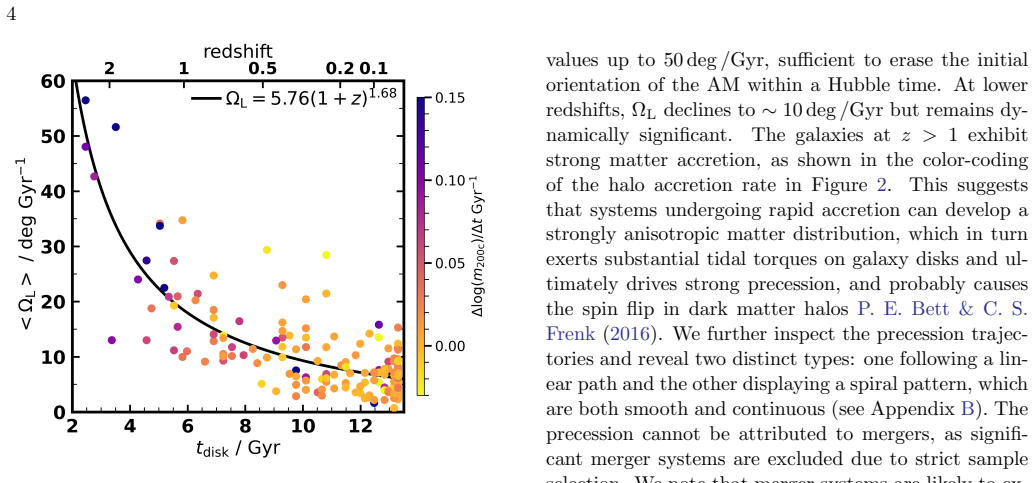
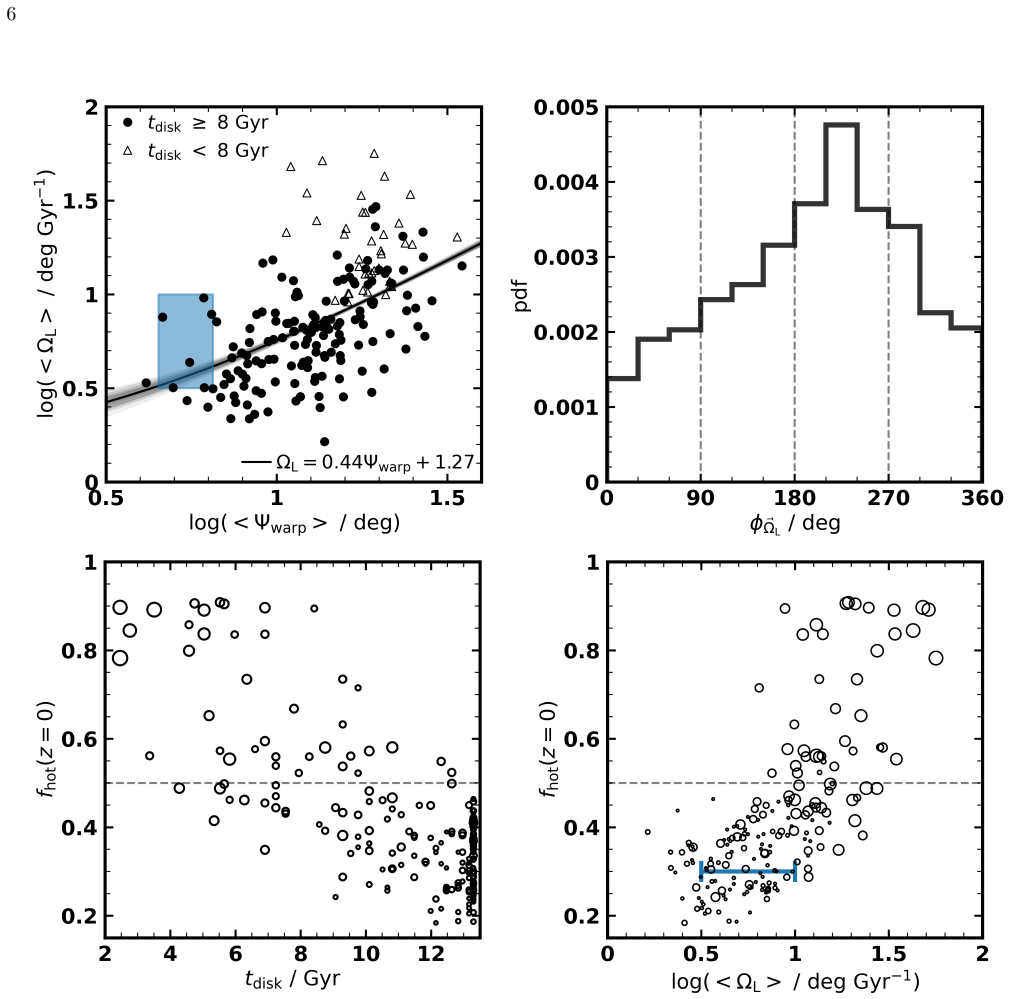
Leveraging the IllustrisTNG simulations, the authors trace the evolution of spin orientation in Milky Way-like galaxies over cosmic time. They find that disk precession is ubiquitous in galaxies and significantly affects galaxy evolution. The precession is driven by the external tidal torque originating from the anisotropic matter distribution within 30 kpc, and is violent at z > 1 and becomes gentler but significant at z ~ 0. Disk precession can induce significant cold gas warp, which is often observed in the Milky Way and nearby galaxies. The Milky Way is predicted to precess at a rate of ≃3-10 degrees per billion years at the current epoch based on its observed warp.
What carries the argument
External tidal torque from anisotropic matter distribution within 30 kpc, which drives changes in galactic disk spin orientation over time.
If this is right
- Disk precession induces significant cold gas warps observed in the Milky Way and nearby galaxies.
- Violent precession heats stellar orbits and may produce prolate elliptical galaxies.
- Tidal torque from central galaxies causes precession and radial alignment in satellite galaxy disks.
- Precession of accreted cold gas streams, regulated by galaxy torque, is crucial for disk galaxy evolution.
Where Pith is reading between the lines
- Observed warp angles in large galaxy samples could map local tidal fields without needing full dynamical modeling.
- External torques may set a floor on disk stability that internal feedback models alone cannot reproduce.
- If precession contributes to elliptical formation, the required merger fraction in simulations could be revised downward.
- Future integral-field surveys could test whether precession rates correlate with local galaxy density as predicted.
Load-bearing premise
The simulations accurately capture the external tidal torques and resulting precession without significant numerical artifacts or missing baryonic physics that would alter the torque field or disk response.
What would settle it
A direct kinematic measurement of the Milky Way disk precession rate that falls well outside the range of 3-10 degrees per billion years.
Figures





read the original abstract
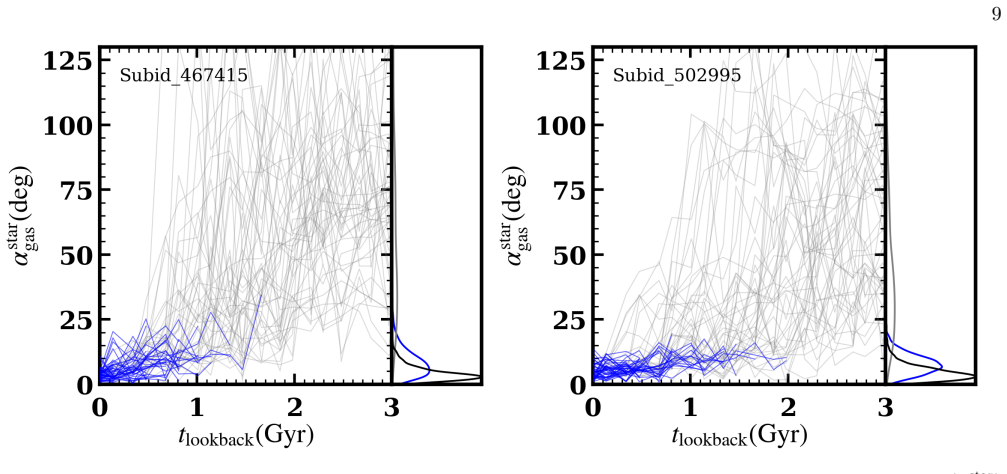
Precession is a very common phenomenon for small-scale astronomical objects. However, the precession of galactic disks, occurring on a scale larger than kilo-parsec, has barely been studied in the literature. Quantifying this precession in observations remains challenging due to the lack of high-resolution dynamical data. Cosmological simulations, where gravitational interactions are self-consistently modeled, offer a unique avenue for investigating disk precession. Leveraging the IllustrisTNG simulations, we trace the evolution of spin orientation in Milky Way-like galaxies over cosmic time. We find that disk precession is ubiquitous in galaxies and significantly affects galaxy evolution. The precession is driven by the external tidal torque originating from the anisotropic matter distribution within $30\ \mathrm{kpc}$, and is violent at $\mathrm{z} > 1$ and becomes gentler but significant at $\mathrm{z} \sim 0$, when the disks are considered dynamically settled. Disk precession can induce significant cold gas warp, which is often observed in the Milky Way and nearby galaxies. We predict that the Milky Way is precessing at a rate of $\simeq3-10$ degrees per billion years at current epoch based on its observed warp. Violent precession can heat the orbits of stars, which may eventually produce prolate elliptical galaxies. The tidal torque from central galaxies can cause the precession of nearby satellite galaxies and causes their disks to point towards the centrals, which explains the observational radial alignment. We also find that the precession of accreted cold gas stream, regulated by the galaxies' torque, is crucial for the evolution of disk galaxies.
Editorial analysis
A structured set of objections, weighed in public.
Referee Report
Summary. The paper uses IllustrisTNG cosmological simulations to trace the spin evolution of Milky Way-like galactic disks, claiming that disk precession is ubiquitous, driven by external tidal torques from anisotropic matter within 30 kpc. Precession is reported as violent at z>1 and gentler at z~0, inducing cold gas warps; the authors predict a Milky Way precession rate of ≃3-10 deg/Gyr based on its observed warp, suggest it can heat stellar orbits toward prolate ellipticals, explain radial alignments of satellites, and regulate accreted gas streams for disk evolution.
Significance. If the simulation-based results on torque-driven precession hold after validation, the work would identify a previously under-appreciated dynamical mechanism in galaxy evolution with direct links to observed warps, satellite alignments, and morphological changes. The cosmological simulation approach allows self-consistent gravitational interactions, which is a methodological strength, but the absence of shown torque decompositions, disk identification criteria, and convergence tests limits the current significance.
major comments (3)
- [Abstract] Abstract: The Milky Way precession rate of ≃3-10 deg/Gyr is obtained by scaling simulation results to match the observed warp amplitude. This reduces the quoted 'prediction' to a post-hoc normalization rather than an independent forecast from the torque model, undermining the claim of a first-principles result.
- [Simulation analysis (implied in abstract)] The central attribution of precession to external tidal torques from anisotropic matter within 30 kpc rests entirely on time evolution of spin vectors extracted from TNG MW-like galaxies, yet the manuscript provides no details on disk identification criteria, spin vector tracking method, or torque measurement/decomposition procedure. Without these, the driver identification cannot be evaluated.
- [Methods (implied)] No convergence tests, resolution studies, or cross-code comparisons are described for the gravity solver, subgrid baryonic physics effects on matter anisotropy, or numerical diffusion in spin orientation measurements. This is load-bearing because the ubiquity claim and torque attribution depend on the fidelity of the TNG torque fields.
minor comments (2)
- [Abstract] The abstract states precession 'significantly affects galaxy evolution' without quantifying the effect size (e.g., fraction of orbital heating or warp amplitude induced).
- [Abstract] Notation for the 30 kpc scale and redshift ranges is clear, but the transition from 'violent' to 'gentler' precession lacks a quantitative threshold or plot reference.
Simulated Author's Rebuttal
We thank the referee for the constructive feedback. We address each major comment below, indicating revisions where the manuscript will be updated for greater clarity and transparency.
read point-by-point responses
-
Referee: [Abstract] Abstract: The Milky Way precession rate of ≃3-10 deg/Gyr is obtained by scaling simulation results to match the observed warp amplitude. This reduces the quoted 'prediction' to a post-hoc normalization rather than an independent forecast from the torque model, undermining the claim of a first-principles result.
Authors: We agree that the quoted Milky Way precession rate is obtained by scaling the simulation-derived torque statistics to the observed warp amplitude, rather than constituting an independent first-principles forecast. In the revised manuscript we will rephrase the abstract to describe this quantity as an 'estimated' rate informed by the torque model and the observed warp, removing any implication of a pure prediction. revision: yes
-
Referee: [Simulation analysis (implied in abstract)] The central attribution of precession to external tidal torques from anisotropic matter within 30 kpc rests entirely on time evolution of spin vectors extracted from TNG MW-like galaxies, yet the manuscript provides no details on disk identification criteria, spin vector tracking method, or torque measurement/decomposition procedure. Without these, the driver identification cannot be evaluated.
Authors: We accept that the current text lacks sufficient methodological detail. The revised version will add an explicit Methods subsection specifying: (i) disk selection via a stellar circularity threshold (>0.5) combined with morphological criteria from the TNG catalogs; (ii) spin-vector computation as the total angular momentum of star particles within two effective radii; and (iii) torque decomposition obtained by summing gravitational forces from all particles inside 30 kpc after subtracting the self-torque of the central disk. These additions will allow direct evaluation of the external-torque attribution. revision: yes
-
Referee: [Methods (implied)] No convergence tests, resolution studies, or cross-code comparisons are described for the gravity solver, subgrid baryonic physics effects on matter anisotropy, or numerical diffusion in spin orientation measurements. This is load-bearing because the ubiquity claim and torque attribution depend on the fidelity of the TNG torque fields.
Authors: We acknowledge the absence of dedicated convergence tests for spin orientation within this study. The revised manuscript will include a short discussion referencing the extensive resolution and convergence tests already published for the TNG suite (Pillepich et al. 2018 and subsequent TNG papers) and noting that the precession signal remains consistent across the TNG100 and TNG300 volumes. New resolution runs or cross-code comparisons lie outside the present scope but could be addressed in follow-up work; we therefore mark this revision as partial. revision: partial
Circularity Check
MW precession 'prediction' reduces to scaling simulation results to match observed warp
specific steps
-
fitted input called prediction
[abstract]
"We predict that the Milky Way is precessing at a rate of ≃3-10 degrees per billion years at current epoch based on its observed warp."
The quoted rate is obtained by scaling the TNG-derived precession statistics to reproduce the amplitude of the observed Milky Way warp. This makes the numerical value a fitted normalization to the target datum rather than an independent forecast from the simulation torque field or first-principles torque calculation.
full rationale
The paper derives ubiquity of disk precession and its torque origin from direct tracking of spin vectors in IllustrisTNG galaxies; this is an empirical measurement from simulation output and does not reduce to its own inputs. The sole circular step is the Milky Way rate claim, which the abstract explicitly ties to scaling against the observed warp. No self-citation chains, uniqueness theorems, ansatzes smuggled via citation, or self-definitional equations appear in the provided text. The result is therefore partially circular only in the specific 'prediction' step.
Axiom & Free-Parameter Ledger
free parameters (1)
- precession rate scaling to observed warp
axioms (1)
- domain assumption External tidal torque from matter within 30 kpc dominates disk orientation change
Reference graph
Works this paper leans on
-
[1]
Abadi, M. G., Navarro, J. F., Steinmetz, M., & Eke, V. R. 2003, ApJ, 597, 21, doi: 10.1086/378316
-
[2]
Allgood, B., Flores, R. A., Primack, J. R., et al. 2006, MNRAS, 367, 1781, doi: 10.1111/j.1365-2966.2006.10094.x
-
[3]
Ann, H. B., & Park, J.-C. 2006, NewA, 11, 293, doi: 10.1016/j.newast.2005.08.006
-
[4]
Arora, A., Garavito-Camargo, N., Sanderson, R. E., et al. 2025, arXiv e-prints, arXiv:2504.20133, doi: 10.48550/arXiv.2504.20133
-
[5]
Athanassoula, E. 2003, MNRAS, 341, 1179, doi: 10.1046/j.1365-8711.2003.06473.x
-
[6]
2015, py-sphviewer: Py-SPHViewer v1.0.0, doi: 10.5281/zenodo.21703
Benitez-Llambay, A. 2015, py-sphviewer: Py-SPHViewer v1.0.0, doi: 10.5281/zenodo.21703
-
[7]
Bett, P. E., & Frenk, C. S. 2016, MNRAS, 461, 1338, doi: 10.1093/mnras/stw1395
-
[8]
1981, AJ, 86, 1825, doi: 10.1086/113063
Bosma, A. 1981, AJ, 86, 1825, doi: 10.1086/113063
-
[9]
Briggs, F. H. 1990, ApJ, 352, 15, doi: 10.1086/168512
-
[10]
2019, Nature Astronomy, 3, 320, doi: 10.1038/s41550-018-0686-7
Chen, X., Wang, S., Deng, L., et al. 2019, Nature Astronomy, 3, 320, doi: 10.1038/s41550-018-0686-7
-
[11]
, archivePrefix = "arXiv", eprint =
Primack, J. 2015, MNRAS, 449, 2087, doi: 10.1093/mnras/stv270
-
[12]
Debattista, V. P., & Sellwood, J. A. 1999, ApJL, 513, L107, doi: 10.1086/311913
-
[13]
Diemer, B., Stevens, A. R. H., Lagos, C. d. P., et al. 2019, MNRAS, 487, 1529, doi: 10.1093/mnras/stz1323
-
[15]
C., Slone, O., Lisanti, M., & Cohen, T
Dodge, B. C., Slone, O., Lisanti, M., & Cohen, T. 2023b, MNRAS, 518, 2870, doi: 10.1093/mnras/stac3249
-
[16]
2018, MNRAS, 473, 1930, doi: 10.1093/mnras/stx2482
El-Badry, K., Quataert, E., Wetzel, A., et al. 2018, MNRAS, 473, 1930, doi: 10.1093/mnras/stx2482
-
[17]
Faltenbacher, A., Li, C., Mao, S., et al. 2007, ApJL, 662, L71, doi: 10.1086/519683 18 Garc´ ıa-Conde, B., Antoja, T., Roca-F` abrega, S., et al. 2024, A&A, 683, A47, doi: 10.1051/0004-6361/202347446
-
[18]
Genel, S., Fall, S. M., Hernquist, L., et al. 2015, ApJL, 804, L40, doi: 10.1088/2041-8205/804/2/L40
-
[19]
2013, MNRAS, 435, 1426, doi: 10.1093/mnras/stt1383
Genel, S., Vogelsberger, M., Nelson, D., et al. 2013, MNRAS, 435, 1426, doi: 10.1093/mnras/stt1383
-
[20]
2025, arXiv e-prints, arXiv:2504.18042, doi: 10.48550/arXiv.2504.18042
Gong, J.-Y., Lin, W., Tang, L., & Lan, Y. 2025, arXiv e-prints, arXiv:2504.18042, doi: 10.48550/arXiv.2504.18042
-
[21]
2023, A&A, 680, A94, doi: 10.1051/0004-6361/202347125
Walker, S., & Mirakhor, M. 2023, A&A, 680, A94, doi: 10.1051/0004-6361/202347125
-
[22]
J., Conroy, C., & Hernquist, L
Han, J. J., Conroy, C., & Hernquist, L. 2023, Nature Astronomy, 7, 1481, doi: 10.1038/s41550-023-02076-9
-
[23]
2024, Nature Astronomy, 8, 1294, doi: 10.1038/s41550-024-02309-5
Huang, Y., Feng, Q., Khachaturyants, T., et al. 2024, Nature Astronomy, 8, 1294, doi: 10.1038/s41550-024-02309-5
-
[24]
Jing, Y. P., & Suto, Y. 2002, ApJ, 574, 538, doi: 10.1086/341065 J´ ozsa, G. I. G., Kenn, F., Klein, U., & Oosterloo, T. A. 2007, A&A, 468, 731, doi: 10.1051/0004-6361:20066164
-
[25]
H., Peirani, S., Kim, S., et al
Kim, J. H., Peirani, S., Kim, S., et al. 2014, ApJ, 789, 90, doi: 10.1088/0004-637X/789/1/90
-
[26]
2024, ApJ, 974, 40, doi: 10.3847/1538-4357/ad6982
Lan, Y., Tang, L., Lin, W., & Gong, J. 2024, ApJ, 974, 40, doi: 10.3847/1538-4357/ad6982
-
[27]
E., Haiman, Z., Pandey, S., & Genel, S
Lee, M. E., Haiman, Z., Pandey, S., & Genel, S. 2025, arXiv e-prints, arXiv:2504.12460, doi: 10.48550/arXiv.2504.12460
-
[28]
Levine, E. S., Blitz, L., & Heiles, C. 2006, ApJ, 643, 881, doi: 10.1086/503091
-
[29]
Lilleengen, S., Petersen, M. S., Erkal, D., et al. 2023, MNRAS, 518, 774, doi: 10.1093/mnras/stac3108
-
[30]
Lynden-Bell, D., & Kalnajs, A. J. 1972, MNRAS, 157, 1, doi: 10.1093/mnras/157.1.1
-
[31]
Non-linear generation of warps by spiral waves in galactic disks
Masset, F., & Tagger, M. 1997, A&A, 318, 747, doi: 10.48550/arXiv.astro-ph/9902123
work page internal anchor Pith review Pith/arXiv arXiv doi:10.48550/arxiv.astro-ph/9902123 1997
-
[32]
McCluskey, F., Wetzel, A., Loebman, S. R., et al. 2024, MNRAS, 527, 6926, doi: 10.1093/mnras/stad3547
-
[33]
Constraints on the relationship between stellar mass and halo mass at low and high redshift
Moster, B. P., Somerville, R. S., Maulbetsch, C., et al. 2010, ApJ, 710, 903, doi: 10.1088/0004-637X/710/2/903
work page internal anchor Pith review doi:10.1088/0004-637x/710/2/903 2010
-
[34]
2015, MNRAS, 448, 59, doi: 10.1093/mnras/stv017
Nelson, D., Genel, S., Vogelsberger, M., et al. 2015, MNRAS, 448, 59, doi: 10.1093/mnras/stv017
-
[35]
2019a, MNRAS, 490, 3234, doi: 10.1093/mnras/stz2306
Nelson, D., Pillepich, A., Springel, V., et al. 2019a, MNRAS, 490, 3234, doi: 10.1093/mnras/stz2306
work page internal anchor Pith review doi:10.1093/mnras/stz2306
-
[36]
Computational Astrophysics and Cosmology , keywords =
Nelson, D., Springel, V., Pillepich, A., et al. 2019b, Computational Astrophysics and Cosmology, 6, 2, doi: 10.1186/s40668-019-0028-x
-
[37]
2025, arXiv e-prints, arXiv:2504.05235, doi: 10.48550/arXiv.2504.05235
Pandya, S., Yang, Y., Van Alfen, N., Blazek, J., & Walters, R. 2025, arXiv e-prints, arXiv:2504.05235, doi: 10.48550/arXiv.2504.05235
-
[38]
Peebles, P. J. E. 1969, ApJ, 155, 393, doi: 10.1086/149876
-
[39]
Pereira, M. J., & Kuhn, J. R. 2005, ApJL, 627, L21, doi: 10.1086/432089
-
[40]
Simulating Galaxy Formation with the IllustrisTNG Model
Pillepich, A., Springel, V., Nelson, D., et al. 2018, MNRAS, 473, 4077, doi: 10.1093/mnras/stx2656
work page internal anchor Pith review doi:10.1093/mnras/stx2656 2018
-
[41]
2019, MNRAS, 490, 3196, doi: 10.1093/mnras/stz2338 Planck Collaboration, Ade, P
Pillepich, A., Nelson, D., Springel, V., et al. 2019, MNRAS, 490, 3196, doi: 10.1093/mnras/stz2338 Planck Collaboration, Ade, P. A. R., Aghanim, N., et al. 2016, A&A, 594, A13, doi: 10.1051/0004-6361/201525830
-
[42]
2020, Nature Astronomy, 4, 590, doi: 10.1038/s41550-020-1017-3
Poggio, E., Drimmel, R., Andrae, R., et al. 2020, Nature Astronomy, 4, 590, doi: 10.1038/s41550-020-1017-3
-
[43]
2025, A&A, 702, A164, doi: 10.1051/0004-6361/202555412
Quezada, C., Zoccali, M., Valenti, E., et al. 2025, A&A, 702, A164, doi: 10.1051/0004-6361/202555412
-
[44]
2002, A&A, 382, 513, doi: 10.1051/0004-6361:20011672
Reshetnikov, V., Battaner, E., Combes, F., & Jim´ enez-Vicente, J. 2002, A&A, 382, 513, doi: 10.1051/0004-6361:20011672
-
[45]
Statistics of optical warps in spiral disks
Reshetnikov, V., & Combes, F. 1998, A&A, 337, 9, doi: 10.48550/arXiv.astro-ph/9806114
work page internal anchor Pith review Pith/arXiv arXiv doi:10.48550/arxiv.astro-ph/9806114 1998
-
[46]
Reshetnikov, V. P., Chugunov, I. V., Marchuk, A. A., et al. 2025, A&A, 697, L1, doi: 10.1051/0004-6361/202554941
-
[47]
Rodriguez-Gomez, V., Pillepich, A., Sales, L. V., et al. 2016, MNRAS, 458, 2371, doi: 10.1093/mnras/stw456
-
[48]
Rodriguez-Gomez, V., Snyder, G. F., Lotz, J. M., et al. 2019, MNRAS, 483, 4140, doi: 10.1093/mnras/sty3345
work page internal anchor Pith review doi:10.1093/mnras/sty3345 2019
-
[49]
Rodriguez-Gomez, V., Genel, S., Fall, S. M., et al. 2022, MNRAS, 512, 5978, doi: 10.1093/mnras/stac806
-
[50]
Hot accretion onto spiral galaxies: the origin of extended and warped HI discs
Sankar, S., Stern, J., Power, C., et al. 2025, arXiv e-prints, arXiv:2511.03793, doi: 10.48550/arXiv.2511.03793
work page internal anchor Pith review Pith/arXiv arXiv doi:10.48550/arxiv.2511.03793 2025
-
[51]
Schwarzkopf, U., & Dettmar, R. J. 2001, A&A, 373, 402, doi: 10.1051/0004-6361:20010548
-
[52]
Semczuk, M., Lokas, E. L., D’Onghia, E., et al. 2020, MNRAS, 498, 3535, doi: 10.1093/mnras/staa2609
-
[53]
Shen, J., & Sellwood, J. A. 2006, MNRAS, 370, 2, doi: 10.1111/j.1365-2966.2006.10477.x
-
[54]
2024, PhRvD, 109, 123548, doi: 10.1103/PhysRevD.109.123548
Sheng, M.-J., Zhu, L., Yu, H.-R., et al. 2024, PhRvD, 109, 123548, doi: 10.1103/PhysRevD.109.123548
-
[55]
2018, ApJ, 853, 149, doi: 10.3847/1538-4357/aaa3e6
Shi, Y., Yan, L., Armus, L., et al. 2018, ApJ, 853, 149, doi: 10.3847/1538-4357/aaa3e6
-
[56]
Sparke, L. S., & Casertano, S. 1988, MNRAS, 234, 873, doi: 10.1093/mnras/234.4.873
-
[57]
2018, MNRAS, 475, 676, doi: 10.1093/mnras/stx3304
Springel, V., Pakmor, R., Pillepich, A., et al. 2018, MNRAS, 475, 676, doi: 10.1093/mnras/stx3304
-
[58]
2019, MNRAS, 484, 5587, doi: 10.1093/mnras/stz243
Torrey, P., Vogelsberger, M., Marinacci, F., et al. 2019, MNRAS, 484, 5587, doi: 10.1093/mnras/stz243
-
[59]
2023, Galaxies, 11, 59, doi: 10.3390/galaxies11020059
Vasiliev, E. 2023, Galaxies, 11, 59, doi: 10.3390/galaxies11020059
-
[60]
Wang, H., Mo, H. J., Jing, Y. P., Yang, X., & Wang, Y. 2011, MNRAS, 413, 1973, doi: 10.1111/j.1365-2966.2011.18301.x 19
-
[61]
2017, MNRAS, 465, 3291, doi: 10.1093/mnras/stw2944
Weinberger, R., Springel, V., Hernquist, L., et al. 2017, MNRAS, 465, 3291, doi: 10.1093/mnras/stw2944
work page internal anchor Pith review doi:10.1093/mnras/stw2944 2017
-
[62]
2014, MNRAS, 445, L46, doi: 10.1093/mnrasl/slu106
Peirani, S. 2014, MNRAS, 445, L46, doi: 10.1093/mnrasl/slu106
-
[63]
White, S. D. M. 1984, ApJ, 286, 38, doi: 10.1086/162573
-
[64]
Zee, W.-B. G., Jung, S. L., Paudel, S., & Yoon, S.-J. 2025, arXiv e-prints, arXiv:2510.18942, doi: 10.48550/arXiv.2510.18942
-
[65]
2026, A&A, 706, A193, doi: 10.1051/0004-6361/202557613
Zhu, L., Cai, R., Kang, X., et al. 2026, A&A, 706, A193, doi: 10.1051/0004-6361/202557613
-
[66]
Zjupa, J., Sch¨ afer, B. M., & Hahn, O. 2020, arXiv e-prints, arXiv:2010.07951, doi: 10.48550/arXiv.2010.07951
-
[67]
2017, MNRAS, 466, 1625, doi: 10.1093/mnras/stw2945
Zjupa, J., & Springel, V. 2017, MNRAS, 466, 1625, doi: 10.1093/mnras/stw2945
discussion (0)
Sign in with ORCID, Apple, or X to comment. Anyone can read and Pith papers without signing in.