A growth of early superhump: Multi color observation of the WZ Sge star TCP J23580961+5502508
Pith reviewed 2026-05-19 23:23 UTC · model grok-4.3
The pith
Observations of a WZ Sge-type dwarf nova show the accretion disk developing a leading-side flare that evolves into a two-armed pattern over three nights of early superhumps.
A machine-rendered reading of the paper's core claim, the machinery that carries it, and where it could break.
Core claim
The reconstructed structure of the accretion disk from multi-color light curves shows a prominent flaring structure on the leading side of the disk during the first two days. An additional flaring structure emerged on the opposite side on the third day, forming a two-armed pattern that can be interpreted within the framework of the 2:1 resonance model. The reconstructed disk structure in the first two days suggests the presence of an additional mechanism operating during the initial stage of early superhump development.
What carries the argument
Early superhump mapping applied to multi-color light curves to reconstruct the flaring structures of the accretion disk.
Load-bearing premise
The early superhump mapping technique applied to the multi-color light curves accurately recovers the physical flaring structure of the accretion disk without significant contamination from other variability sources or assumptions about disk temperature distribution.
What would settle it
High-resolution spectroscopic observations or hydrodynamic simulations of the disk during the first two nights of the superoutburst that show no leading-side flaring structure would challenge the reconstruction.
Figures



read the original abstract
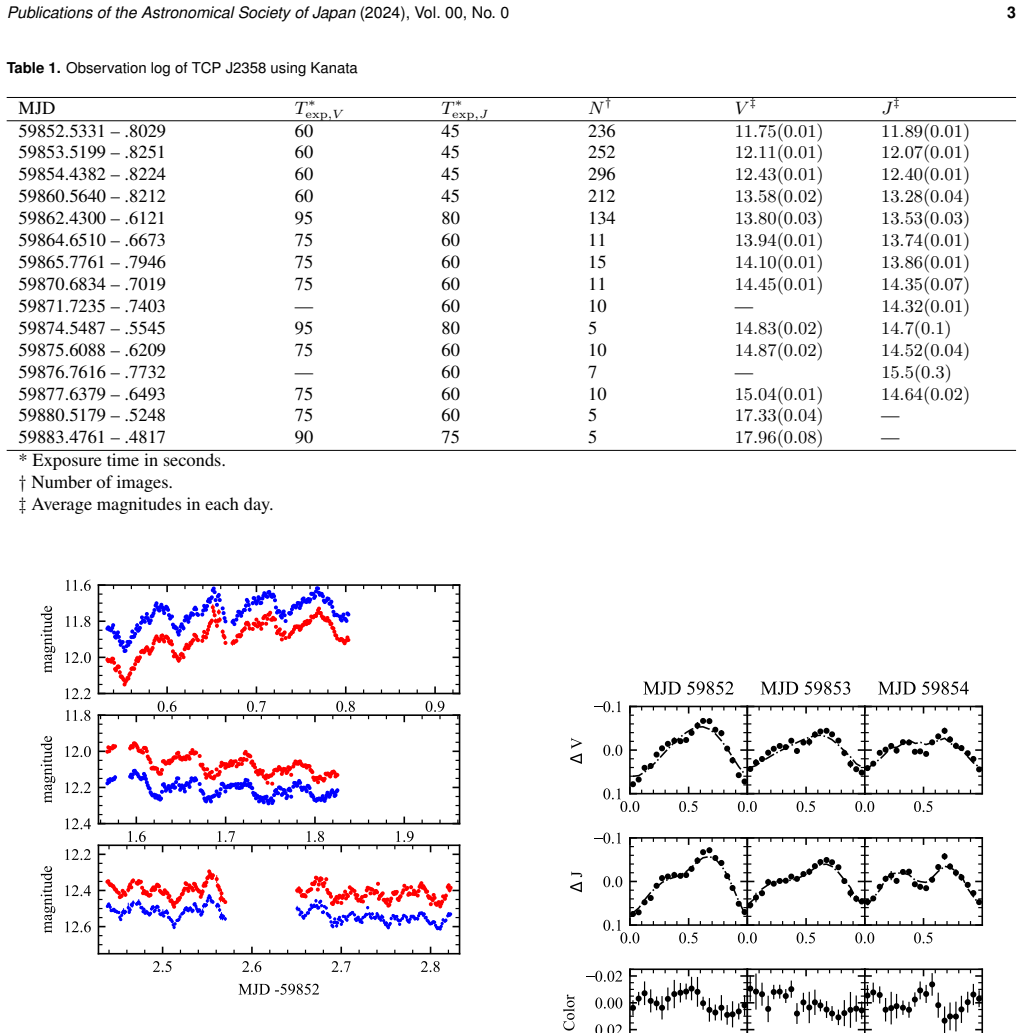
We report optical and near-infrared photometry of a WZ Sge-type dwarf nova, TCP J23580961+5502508, during its 2022 superoutburst, obtained using the 1.5-m Kanata telescope. Our observation detected early superhumps on three consecutive nights which included the rising phase toward the peak of the outburst. The early superhumps exhibited a profile dominated by the primary maximum during the first two days, while a prominent secondary minimum appeared on the third day. We reconstructed the structure of the accretion disk from multi-color light curves using the early superhump mapping. The accretion disk has a prominent flaring structure on the leading side of the disk during the first two days. An additional flaring structure emerged on the opposite side on the third day, forming a two-armed pattern that can be interpreted within the framework of the 2:1 resonance model. The reconstructed disk structure in the first two days suggests the presence of an additional mechanism operating during the initial stage of early superhump development.
Editorial analysis
A structured set of objections, weighed in public.
Referee Report
Summary. The paper reports optical and near-infrared multi-color photometry of the WZ Sge-type dwarf nova TCP J23580961+5502508 obtained with the Kanata 1.5-m telescope during its 2022 superoutburst. Early superhumps are detected over three consecutive nights spanning the rise to outburst peak; the light-curve profile is dominated by the primary maximum on the first two nights, while a secondary minimum appears on the third night. The authors apply the early superhump mapping technique to the multi-color data to reconstruct the accretion-disk structure, finding a prominent leading-side flare during the first two days and the emergence of a second flaring structure on the opposite side on day three, producing a two-armed pattern. They interpret the morphology within the 2:1 resonance framework and suggest an additional mechanism operating in the initial stage of early-superhump development.
Significance. If the disk reconstruction is robust, the work supplies new, time-resolved observational constraints on the spatial evolution of early superhumps in a WZ Sge star. The multi-color data set and the reported transition from a single leading-side flare to a two-armed pattern provide a concrete test of the 2:1 resonance model and raise the possibility of an extra initial mechanism; such results are of interest to the cataclysmic-variable community and could motivate targeted hydrodynamic simulations.
major comments (1)
- [Disk reconstruction / early superhump mapping section] The central claim that the reconstructed disk exhibits a leading-side flare on days 1–2 followed by a two-armed pattern on day 3 rests entirely on the output of the early superhump mapping. The manuscript provides no description of the forward model, regularization scheme, assumed radial temperature profile, vertical structure, or emissivity law, nor any validation against synthetic disks with known single-arm geometry. Without these elements it is impossible to determine whether the reported structures could arise from temperature fluctuations, flickering, or spiral shocks rather than geometric height changes.
minor comments (2)
- [Figure captions] Figure captions should explicitly state the phase binning, color combination, and any smoothing applied to the reconstructed surface-brightness maps so that readers can assess the robustness of the reported arm positions.
- [Discussion] A short paragraph comparing the observed superhump amplitudes and periods with those of other well-studied WZ Sge stars (e.g., WZ Sge itself or EZ Lyn) would help place the new object in context.
Simulated Author's Rebuttal
We thank the referee for their careful and constructive review of our manuscript. We address the single major comment below and describe the revisions we will implement.
read point-by-point responses
-
Referee: The central claim that the reconstructed disk exhibits a leading-side flare on days 1–2 followed by a two-armed pattern on day 3 rests entirely on the output of the early superhump mapping. The manuscript provides no description of the forward model, regularization scheme, assumed radial temperature profile, vertical structure, or emissivity law, nor any validation against synthetic disks with known single-arm geometry. Without these elements it is impossible to determine whether the reported structures could arise from temperature fluctuations, flickering, or spiral shocks rather than geometric height changes.
Authors: We agree that the manuscript does not contain a sufficient description of the early superhump mapping technique. In the revised version we will add a dedicated subsection that details the forward model, the regularization scheme, the assumed radial temperature profile, the vertical disk structure, and the emissivity law. We will also present validation results obtained by applying the method to synthetic multi-color light curves generated from disks with known single-arm and two-armed geometries. These tests will show that the reconstruction recovers the input structures and that the reported features are not produced by temperature fluctuations, flickering, or spiral shocks. The additions will directly address the referee’s concern and allow readers to evaluate the robustness of the disk maps. revision: yes
Circularity Check
No significant circularity; reconstruction grounded in new photometry and standard resonance framework
full rationale
The paper reports fresh Kanata multi-color photometry of the 2022 superoutburst and applies the early superhump mapping technique to invert the light curves into a disk-height map. The resulting leading-side flare (days 1-2) and subsequent two-armed pattern are presented as direct outputs of that inversion, then interpreted with the pre-existing 2:1 resonance model drawn from the wider literature. No equations, fitted parameters, or self-citations are shown that would make the reported flaring structures equivalent to the input light curves by construction. The derivation chain therefore remains observationally driven and externally falsifiable.
Axiom & Free-Parameter Ledger
axioms (2)
- domain assumption Early superhump mapping converts multi-color light curves into a spatial map of disk flaring.
- domain assumption The observed brightness variations are dominated by geometric effects from disk flaring rather than other sources.
Lean theorems connected to this paper
-
IndisputableMonolith/Cost/FunctionalEquation.leanwashburn_uniqueness_aczel unclear?
unclearRelation between the paper passage and the cited Recognition theorem.
We applied the early superhump mapping technique developed by Uemura et al. (2012) ... height distribution h(r, θ) ... regularized least-squares method ... w=2.0 ... Tin estimated from V−J color with T∝r^{-3/4}
-
IndisputableMonolith/Foundation/AlexanderDuality.leanalexander_duality_circle_linking unclear?
unclearRelation between the paper passage and the cited Recognition theorem.
two-armed pattern that can be interpreted within the framework of the 2:1 resonance model
What do these tags mean?
- matches
- The paper's claim is directly supported by a theorem in the formal canon.
- supports
- The theorem supports part of the paper's argument, but the paper may add assumptions or extra steps.
- extends
- The paper goes beyond the formal theorem; the theorem is a base layer rather than the whole result.
- uses
- The paper appears to rely on the theorem as machinery.
- contradicts
- The paper's claim conflicts with a theorem or certificate in the canon.
- unclear
- Pith found a possible connection, but the passage is too broad, indirect, or ambiguous to say the theorem truly supports the claim.
Reference graph
Works this paper leans on
-
[1]
2014, in Ground-based and Airborne Instrumentation for Astronomy V V ol
Nakashima, A., Sasada, M., et al. 2014, in Ground-based and Airborne Instrumentation for Astronomy V V ol. 9147(Bellingham, W A:. SPIE), pp 1520–1534
work page 2014
-
[2]
Chambers, K. C., Magnier, E. A., Metcalfe, N., Flewelling, H. A., Huber, M. E., Waters, C. Z., Denneau, L., Draper, P. W., et al. 2016, arXiv e- prints, arXiv:1612.05560 Gaia Collaboration, Vallenari, A., Brown, A. G. A., Prusti, T., de Bruijne, J. H. J., Arenou, F., Babusiaux, C., Biermann, M., et al. 2023, A&A, 674, A1
work page internal anchor Pith review Pith/arXiv arXiv 2016
-
[3]
Hameury, J. M. 2020, Advances in Space Research, 66, 1004
work page 2020
- [4]
-
[5]
Imada, A., Isogai, K., Araki, T., Tanada, S., Yanagisawa, K., & Kawai, N. 2018, PASJ, 70, 2
work page 2018
- [6]
-
[7]
2001, New Astronomy Reviews, 45, 449
Lasota, J.-P. 2001, New Astronomy Reviews, 45, 449
work page 2001
-
[8]
Lin, D. N. C. & Papaloizou, J. 1979, MNRAS, 186, 799
work page 1979
- [9]
- [10]
- [11]
-
[12]
Neustroev, V . V . & Zharikov, S. V . 2020, A&A, 642, A100
work page 2020
- [13]
- [14]
- [15]
- [16]
-
[17]
R., Breedt, E., Knigge, C., et al
Schreiber, M. R., Breedt, E., Knigge, C., et al. 2022, MNRAS, 510, 6110
work page 2022
-
[18]
Shakura, N. I. & Sunyaev, R. A. 1973, A&A, 24, 337
work page 1973
-
[19]
M., Beichman, C., Capps, R., et al
Carpenter, J. M., Beichman, C., Capps, R., et al. 2006, AJ, 131, 1163
work page 2006
-
[20]
2022, PASJ, 74, 1287 6Publications of the Astronomical Society of Japan(2024), Vol
Vanmunster, T., Itoh, H., et al. 2022, PASJ, 74, 1287 6Publications of the Astronomical Society of Japan(2024), Vol. 00, No. 0
work page 2022
-
[21]
Matsumoto, K., Matsumura, R., et al. 2026, MNRAS, 545, staf1964
work page 2026
-
[22]
Uemura, M., Kato, T., Ohshima, T., & Maehara, H. 2012, PASJ, 64, 92
work page 2012
- [23]
-
[24]
1995, Cataclysmic Variable Stars
Warner, B. 1995, Cataclysmic Variable Stars. V ol. 28 of Cambridge Astrophysics Series(Cambridge:. Cambridge University Press)
work page 1995
- [25]
-
[26]
Zorotovic, M., Schreiber, M. R., & Gänsicke, B. T. 2011, A&A, 536, A42
work page 2011
discussion (0)
Sign in with ORCID, Apple, or X to comment. Anyone can read and Pith papers without signing in.