REVIEW 1 major objections 8 minor 17 references
Efficient Diffusion Models under Nonconvex Equality and Inequality constraints via Landing
T0 review · 1 major / 8 minor · reviewed 2026-07-05 · glm-5.2
Pith's one-line read Landing replaces projection in constrained diffusion, cutting cost up to 47x
desk verdict Landing replaces per-step projections in constrained diffusion; underdamped version cuts trajectory length by up to 47x. Theory is solid in continuous time; the theory-experiment gap is the main concern. read the letter →
The pith
A machine-rendered reading of the paper's core claim, the machinery that carries it, and where it could break.
The reading
What carries the argument
The landing term is the central object. For a constraint function c(x) and its Jacobian ∇c(x), the landing term is −α ∇c(x)^T G(x)^+ c(x), where G(x) = ∇c(x)∇c(x)^T is the Gram matrix and G(x)^+ is its Moore-Penrose pseudo-inverse. This term is added to the normal component of the Langevin drift, causing c(x_t) to satisfy dc/dt = −α(t) c(x_t) and thus decay exponentially. The underdamped version (ULLA) adds a momentum variable with tangency constraints, and a specialized splitting integrator collapses the position-momentum dynamics into a second-order Markov chain on positions only, halving memory usage.
What would settle it
If one constructs a constraint set where the Jacobian rank drops in a neighborhood of the manifold at points reachable by discretized noise, the landing SDE coefficients become ill-defined and the exponential decay guarantee fails.
Extended reading notes
Core claim
The landing mechanism — a first-order correction term proportional to the constraint Jacobian, its pseudo-inverse, and the constraint violation vector — enforces exponential decay of constraint violations in continuous-time Langevin dynamics, making per-step projections onto nonconvex feasible sets unnecessary. When combined with underdamped (momentum-based) dynamics, the faster mixing allows substantially shorter forward trajectories, yielding up to 47x reduction in sampling cost and 5x in training cost while preserving sample quality competitive with projection-based methods.
Load-bearing premise
The method requires that the constraint Jacobian maintain constant rank not just on the constraint manifold itself, but in a neighborhood wide enough to contain all discretized samples — including those that wander off-manifold due to noise. If the rank of the constraint gradients changes near the manifold, the projection operator and pseudo-inverse become discontinuous, and the SDE coefficients are no longer well-defined.
Editorial extensions
If this is right
- Diffusion models for molecular generation, robotics trajectory planning, and engineering design can enforce physical and safety constraints without iterative projection solvers that may fail or scale poorly with dimension.
- The landing approach extends to any smooth nonconvex constraint set satisfying a relaxed constant-rank condition, including sets defined by learned neural-network implicit surfaces.
- The CWPM training framework removes the requirement that intermediate samples lie exactly on the manifold, making projection-free constrained diffusion training theoretically well-posed.
- The memory-efficient collapsed underdamped discretization enables training on high-dimensional constraint sets where storing full momentum trajectories would be prohibitive.
Reading between the lines
- The landing mechanism could be combined with latent-space diffusion architectures, where constraints are enforced through a decoder's Jacobian via the chain rule, potentially addressing the memory scaling limitation the authors note for high-dimensional problems.
- The exponential constraint-decay property suggests that landing could serve as a soft constraint-enforcement layer in other generative frameworks beyond diffusion, such as normalizing flows or VAEs, wherever projection onto nonconvex sets is costly.
- The observation that underdamped dynamics yield smoother score regression objectives (avoiding singularities near t=0) may motivate momentum-augmented variants of other Riemannian generative models that currently suffer from score blow-up.
Signed reviews
Editorial analysis
A structured set of objections, weighed in public.
Referee Report
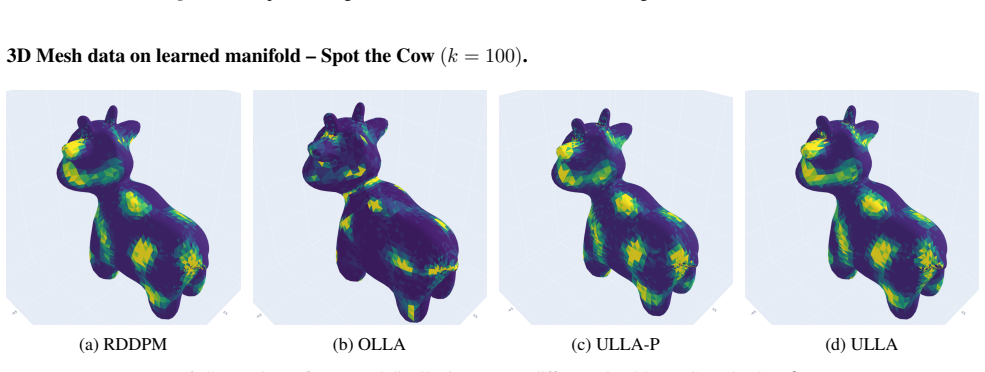
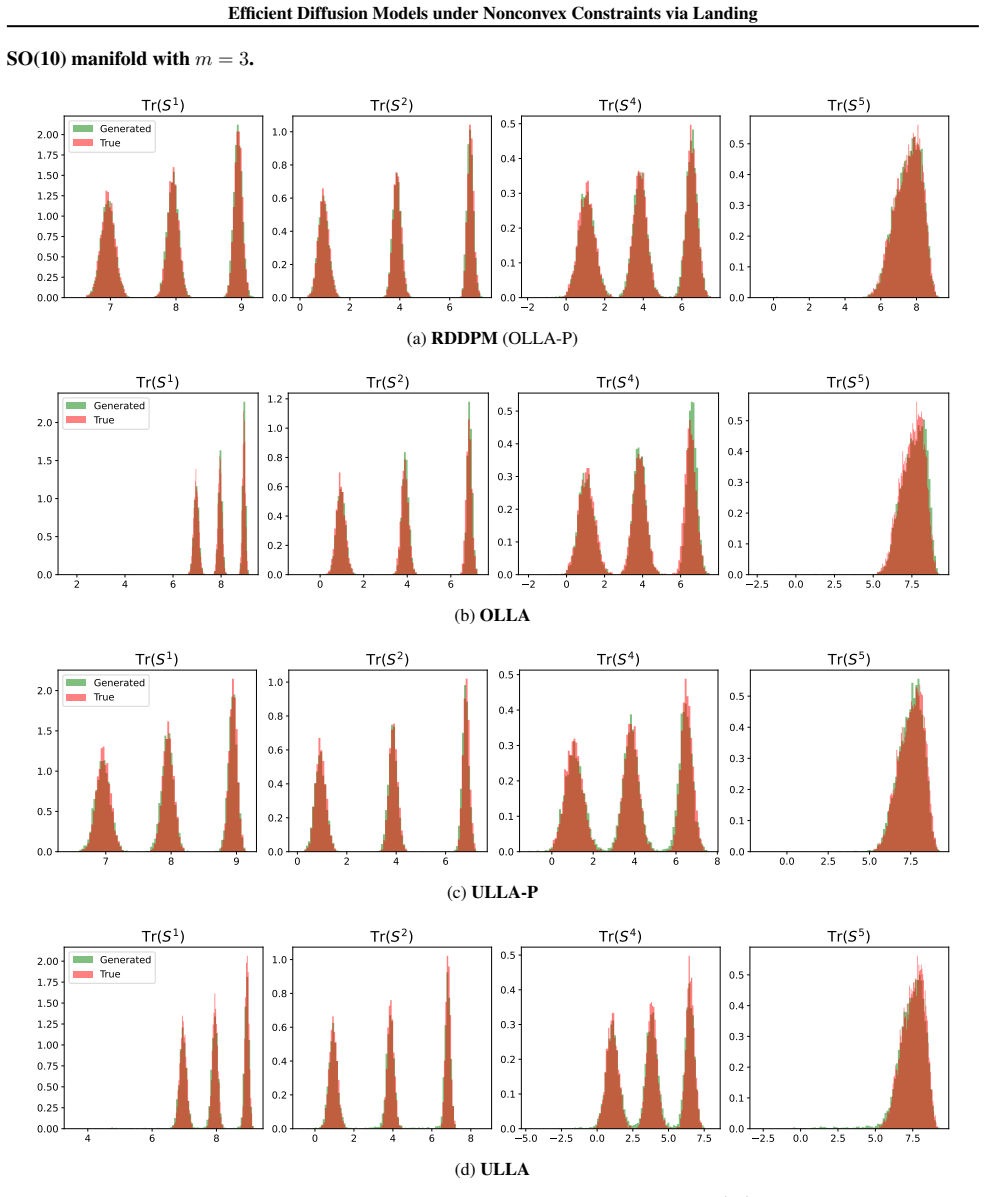
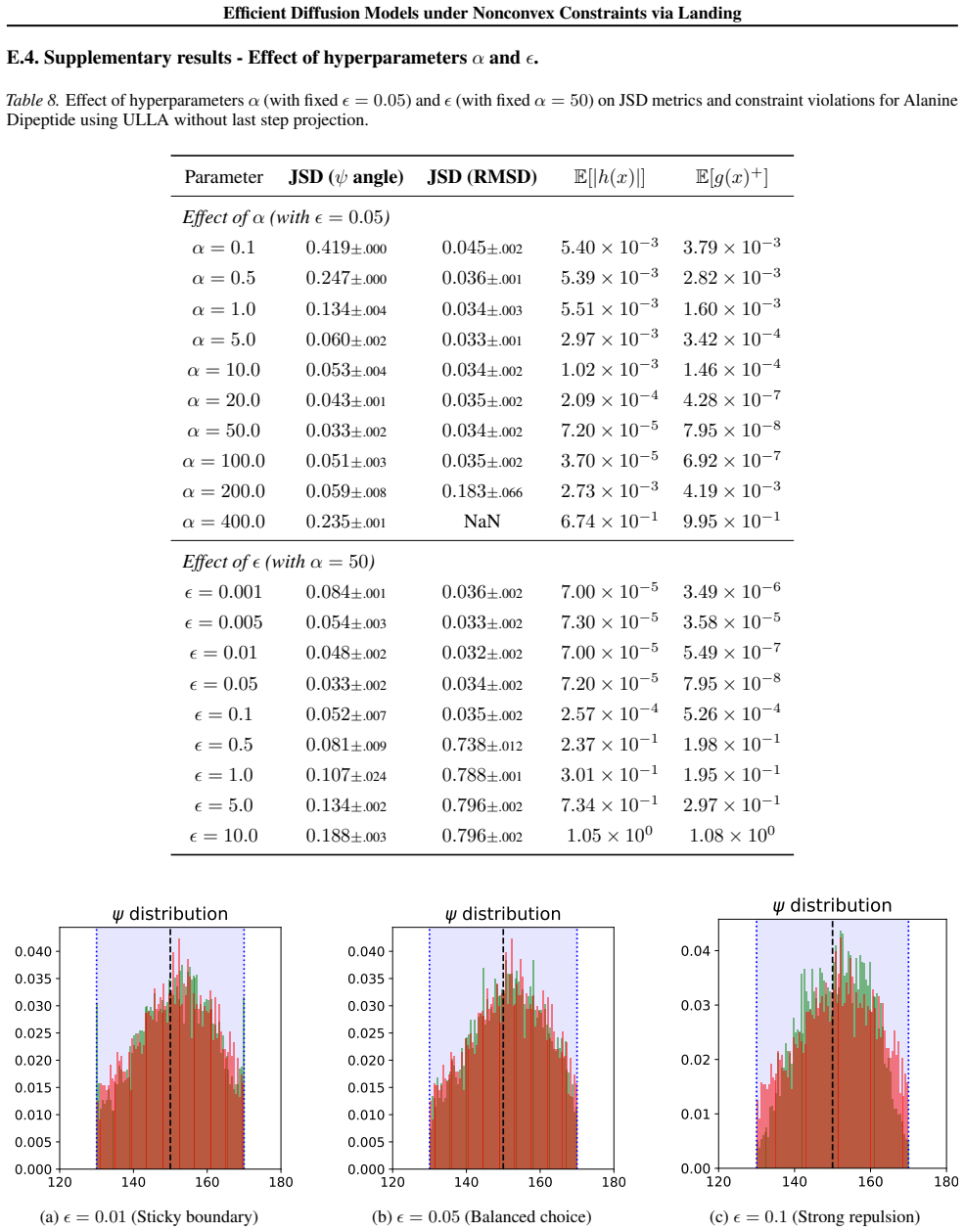
Summary. This paper introduces a landing-based framework for constrained diffusion models on nonconvex feasible sets defined by equality and inequality constraints. The key idea is to replace per-step projections onto the feasible set with a first-order normal correction (the landing term) that exponentially decays constraint violations. The framework includes both overdamped (OLLA) and underdamped (ULLA) Langevin dynamics, with the latter leveraging faster mixing to reduce forward trajectory lengths. A Conditional Wasserstein Path Matching (CWPM) loss is proposed to handle training when intermediate samples may lie off the manifold. Experiments on spheres, learned mesh manifolds, SO(10), alanine dipeptide, and a 7-DOF robot arm demonstrate competitive sample quality with reduced computational cost compared to projection-based methods like RDDPM.
Significance. The paper makes a solid contribution to constrained generative modeling. The landing mechanism is a principled way to avoid expensive per-step projections, and the extension to underdamped dynamics with a memory-efficient collapsed discretization is technically nontrivial. The CWPM loss and its connection to DT-ELBO are well-motivated. The experimental coverage is broad, spanning equality-only and mixed-constraint tasks. The code is publicly available, which is a strength. The continuous-time SDE derivations (Propositions 1-2, Lemmas B.1-B.4) are detailed with full proofs, and the stationarity results (Theorems B.2-B.3) are correctly stated under appropriate assumptions.
major comments (1)
- Remark 3 (Extended Usage in Our Framework): The rCRCQ condition is extended from the manifold Sigma to a neighborhood containing all discretized samples. This is the most load-bearing assumption in the paper: if the Jacobian rank degenerates near Sigma, the pseudo-inverse G(x)^+ and projection operator Pi(x) become discontinuous, and the SDE coefficients of OLLA/ULLA are ill-defined. The paper acknowledges this extension but provides no empirical verification that it holds in any experiment. This is most acute for the mesh datasets where c(x) = SDF_NN(x) is a learned neural network, and for mixed-constraint tasks where the active inequality set changes across strata. The reported OLLA instability on mixed-constraint tasks (Section 5.2, Table 5) is consistent with this failure mode but is not diagnosed. The authors should either (a) empirically check that the Jacobian rank remains stable沿
minor comments (8)
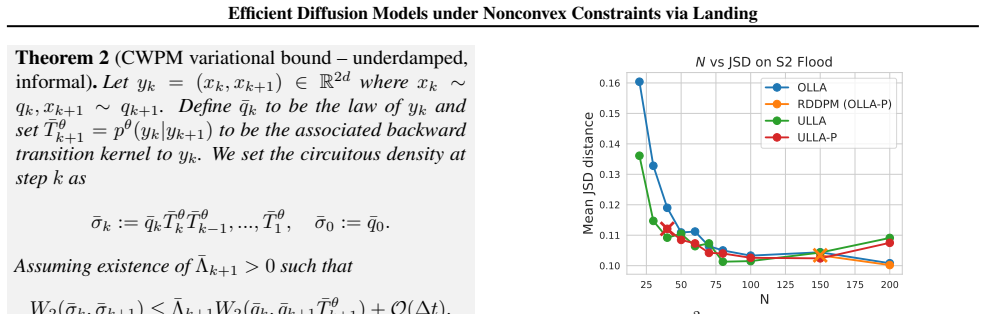
- Section 4.3, Theorems 1-2: The CWPM bound involves a constant Lambda_k >= 0 whose existence is assumed. Lemmas D.1-D.2 provide sufficient conditions, but the presentation in the main text does not clearly state what these conditions are. A brief summary of the key regularity assumptions in the main text would strengthen the presentation.
- Table 1: The 'Avg. |h|' column reports constraint violations but the notation is not defined in the table caption. It should be clarified that this measures equality constraint violations.
- Section 5.1, Figure 1: The cross marks indicating the smallest N after which projection failures no longer occur are mentioned but not clearly visible in the figure. Improving figure clarity would help.
- Algorithm 1 and 2: The notation for the approximated momentum (tilde p) and the decaying factor a_k could benefit from a brief inline definition in the algorithm comments for readability.
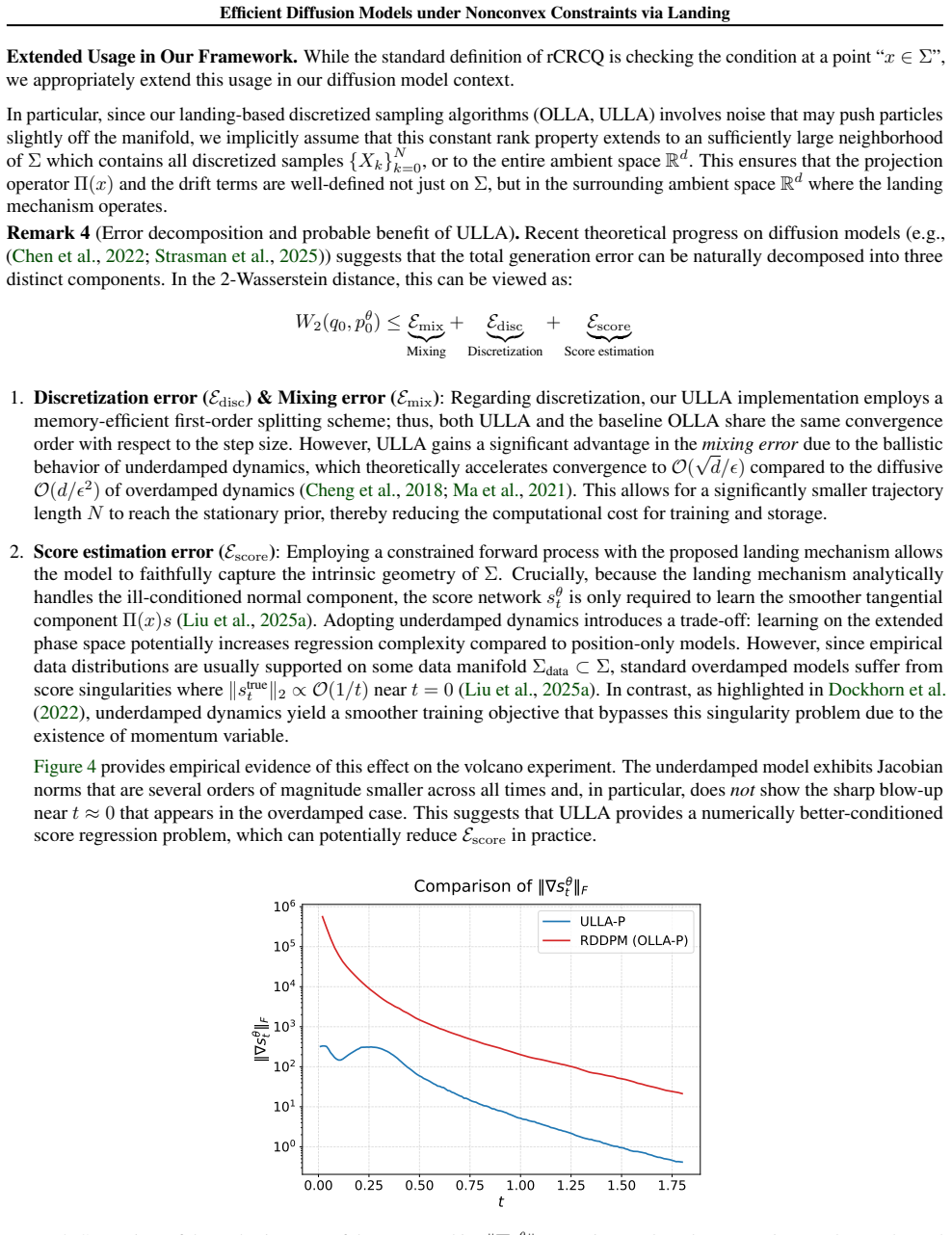
- Remark 4, Figure 5: The claim that ULLA mitigates score singularities near t=0 is supported by empirical evidence on the volcano experiment. This is an interesting observation but the connection to the error decomposition is informal. A brief discussion of whether this benefit is expected to generalize would be helpful.
- Section 6 (Limitations): The memory scaling O(Nd) is mentioned but the limitation regarding the rCRCQ neighborhood assumption is not listed here. It should be acknowledged as a limitation in the main text, not only in Remark 3.
- Table 8 (Key Notations): The table is comprehensive but some symbols (e.g., tilde p_fwd, tilde p_bwd) could use more explicit definitions in the main text where they are first introduced.
- The paper cites Jeon et al. (2025) for the constrained Langevin landing framework. The relationship between the present paper and this prior work should be made more explicit in the introduction to clearly delineate the novel contributions from the cited work.
Simulated Author's Rebuttal
We thank the referee for the careful reading and for identifying the rCRCQ neighborhood extension as the most load-bearing assumption in our framework. The comment is well-taken, and we agree that empirical verification is needed. Below we address each point.
read point-by-point responses
-
Referee: Remark 3 (Extended Usage in Our Framework): The rCRCQ condition is extended from the manifold Sigma to a neighborhood containing all discretized samples. This is the most load-bearing assumption in the paper: if the Jacobian rank degenerates near Sigma, the pseudo-inverse G(x)^+ and projection operator Pi(x) become discontinuous, and the SDE coefficients of OLLA/ULLA are ill-defined. The paper acknowledges this extension but provides no empirical verification that it holds in any experiment. This is most acute for the mesh datasets where c(x) = SDF_NN(x) is a learned neural network, and for mixed-constraint tasks where the active inequality set changes across strata. The reported OLLA instability on mixed-constraint tasks (Section 5.2, Table 5) is consistent with this failure mode but is not diagnosed. The authors should either (a) empirically check that the Jacobian rank remains stable,
Authors: We agree that the neighborhood extension of rCRCQ is the most critical assumption in our framework and that the manuscript should provide empirical evidence rather than merely acknowledging the extension. We address the three settings the referee highlights separately, as the considerations differ substantially across them. For the equality-only experiments on S² and SO(10), the constraint functions are algebraic (‖x‖²−1=0 and X^T X−I=0 respectively), and the Jacobian rank is constant everywhere in R^d (not just near Σ). For S², the Jacobian ∇h(x) = 2x^T has rank 1 for all x≠0, and the landing mechanism keeps samples away from the origin. For SO(10), the 55×100 Jacobian of the orthogonality constraints has constant rank 55 at all points where the constraints are not simultaneously degenerate, which is a measure-zero set. Thus rCRCQ is satisfied globally in these cases, and we will state this explicitly in the revision. For the mesh datasets where c(x) = SDF_NN(x), the situation is genuinely more delicate. The learned SDF network does not come with a theoretical rank guarantee. However, we can empirically verify that the Jacobian ∇c(x_k) maintains rank 1 (i.e., ‖∇c(x_k)‖ remains bounded away from zero) along all forward and backward trajectories used in our experiments. We will add this diagnostic to the revised manuscript and report the minimum Jacobian norm observed across all sampled trajectories for each mesh dataset. For the mixed-constraint tasks (Alanine dipeptide and 7-DOF robot arm), the referee correctly identifies that the active inequality set changes across strata, which is precisely the scenario rCRCQ is designed to handle (as opposed to LICQ, which would fail). The rCRCQ condition requires that the rank of the stacked Jacobian of active constraints remains revision: no
Circularity Check
No significant circularity found; one minor self-citation for framework attribution, with self-contained proofs provided in the appendix.
full rationale
The paper's derivation chain is largely self-contained. The key constructions (Propositions 1–2 for OLLA/ULLA) are derived from scratch in Appendix B using Stratonovich calculus and minimum-norm Lagrangian processes, with full proofs. The self-citation to Jeon et al. (2025) — co-authored by the same authors — is used for attribution of the landing approach in the overdamped case, but the present paper re-derives the SDE explicitly (Proposition B.1) and extends it to underdamped dynamics, inequality constraints, backward processes, and the CWPM loss. The CWPM framework (Theorems 1–2) is derived independently from the Wasserstein distance and Gelbrich distance relation, not from the DT-ELBO. The fact that CWPM loss coincides with DT-ELBO loss (Lemmas C.1–C.2) is presented as a consequence of two independent derivations converging, with CWPM being strictly more general (no on-manifold assumption required). The existence of the Λ_k constants needed for the CWPM bound is proven independently via Lemmas D.1–D.2 under stated regularity conditions. The experimental comparisons use external benchmarks (RDDPM, RFM) and standard datasets. The self-citation is minor and not load-bearing because the mathematical content is reproduced and extended in the present paper's appendices. Score 2 reflects the minor self-citation that provides context but does not form a circular dependency in the derivation chain.
Assumptions & free parameters
free parameters (6)
- alpha (landing rate) =
varies by task: 0.01-0.2 (overdamped), 0.1-0.5 (underdamped)
- epsilon (boundary repulsion rate) =
varies by task: 0.001-0.6
- gamma (friction coefficient) =
1.0-2.0
- N (trajectory length) =
30-100 (ULLA), 100 (OLLA)
- T (terminal time) =
0.2-8.0
- sigma_min, sigma_max (noise schedule) =
0.01, 100
assumptions (5)
- domain assumption rCRCQ (relaxed Constant Rank Constraint Qualification) holds on a neighborhood of Sigma containing all discretized samples
- domain assumption Sigma is a stratified manifold
- domain assumption sigma(t) is constant for stationarity proofs
- ad hoc to paper Stepwise-Lipschitz condition on transition kernels for CWPM bound
- ad hoc to paper Existence of Lambda_k >= 0 bounding W2 distance between forward and backward conditionals
invented entities (3)
-
Landing term (-alpha * sigma * grad(h)^T G^+ h(x))
independent evidence
-
CWPM (Conditional Wasserstein Path Matching) loss
independent evidence
-
Collapsed ULLA discretization (2nd-order Markov chain in positions only)
independent evidence
Cite this review
Pith. "Pith review of Efficient Diffusion Models under Nonconvex Equality and Inequality constraints via Landing." pith.science (2026). https://pith.science/paper/MV7R2XHP
@misc{pith2026260417838,
  author       = {Pith},
  title        = {Pith review of: Efficient Diffusion Models under Nonconvex Equality and Inequality constraints via Landing},
  year         = {2026},
  howpublished = {\url{https://pith.science/paper/MV7R2XHP}},
  note         = {Machine review of arXiv:2604.17838}
}
abstract
Generative modeling within constrained sets is essential for scientific and engineering applications involving physical, geometric, or safety requirements (e.g., molecular generation, robotics). We present a unified framework for constrained diffusion models on generic nonconvex feasible sets $\Sigma$ that simultaneously enforces equality and inequality constraints throughout the diffusion process. Our framework incorporates both overdamped and underdamped dynamics for forward and backward sampling. A key algorithmic innovation is a computationally efficient landing mechanism that replaces costly and often ill-defined projections onto $\Sigma$, ensuring feasibility without iterative Newton solves or projection failures. By leveraging underdamped dynamics, we accelerate mixing toward the prior distribution, effectively alleviating the high simulation costs typically associated with constrained diffusion. Empirically, this approach reduces function evaluations and memory usage during both training and inference while preserving sample quality. On benchmarks featuring equality and mixed constraints, our method achieves comparable sample quality to state-of-the-art baselines while significantly reducing computational cost, providing a practical and scalable solution for diffusion on nonconvex feasible sets.
Figures

Figures from the paper (5 more)
Reference graph
Works this paper leans on
-
[1]
Generative Aerodynamic Design with Diffusion Probabilistic Models
doi: 10.1007/BFb0121214. Jeon, K., Muehlebach, M., and Tao, M. Fast non-log- concave sampling under nonconvex equality and inequal- ity constraints with landing. InAdvances in Neural Infor- mation Processing Systems, 2025. Jing, B., Corso, G., Chang, J., Barzilay, R., and Jaakkola, T. Torsional diffusion for molecular conformer generation. InAdvances in N...
-
[2]
Discretization error (E����) & Mixing error (E��� ): Regarding discretization, our ULLA implementation employs a memory-efficient first-order splitting scheme; thus, both ULLA and the baseline OLLA share the same convergence order with respect to the step size. However, ULLA gains a significant advantage in themixing errordue to the ballistic behavior of ...
work page 2018
-
[3]
Score estimation error (E�����): Employing a constrained forward process with the proposed landing mechanism allows the model to faithfully capture the intrinsic geometry of Σ. Crucially, because the landing mechanism analytically handles the ill-conditioned normal component, the score network �θ t is only required to learn the smoother tangential compone...
work page 2025
-
[4]
There exists a measurable set Fx��� ⊂� x��� Σ such that, for every �∈ F x��� , the Newton’s method returns a unique pair(�� �)� �∈int(Σ)solving �=� k�� +� o k�� (� k�� ) +� k�� √ ∆��+∇�(� k�� )��with�s.t.�(�) = 0 with the minimal-displacement normal correction and it fails for� �∈ Fx���
-
[6]
The mapΦ k�� :F x��� →Σ x��� := Φk�� (Fx��� )⊂int(Σ)withΦ k�� (�) =�is a� � bijection. Then, the backward transition density of OLLA-P with respect to surface measure�� � is given as� θ(� k|� k�� ): �θ(� k|� k�� ) = ��det(�(� k�� )T �(� k)) �� (2�� � k�� ∆�) ��� � (1−� x��� ) exp � − ∥Π(� k�� )(� k −� o k�� (� k�� ))∥� 2� � k�� ∆� � for� k ∈Σ x��� , and� ...
-
[7]
There exists a measurable set Fx��� ⊂� x��� Σ such that, for every �∈ F x��� , the Newton’s method returns a unique pair(�� �)� �∈int(Σ)solving �=� u k�� (� k�� � �k�� ) +� � k�� ∆� � 1−� � k�� �+∇�(� k�� )��with�s.t.�(�) = 0 with the minimal-displacement normal correction and it fails for� �∈ Fx���
-
[8]
The solver success probability is1−� x��� :=P(�∈ F x��� )∈(0�1]
-
[9]
The mapΦ k�� :F x��� →Σ x��� := Φk�� (Fx��� )⊂int(Σ)withΦ k�� (�) =�is a� � bijection. 38 Efficient Diffusion Models under Nonconvex Constraints via Landing Then, the backward transition density of ULLA-P with respect to surface measure�� � is given as� θ(� k|� k�� ): �θ(� k|� k�� ) = ��det(�(� k�� )T �(� k)) �� (2�� � k�� ∆��(1−� � k�� )) ��� � (1−� x���...
work page 1990
Show all 17 references
-
[10]
And, notably, this leads to the exactly the same training loss provided in DT-ELBO, (Lemma C.1) without the requirement� k ∈Σ
in diffusion model choose the weight proportional to the inverse of variance of corresponding term, which, in our case, becomes �(�) = � �σ � ��� �t with proportional constant 1�2. And, notably, this leads to the exactly the same training loss provided in DT-ELBO, (Lemma C.1) ...
-
[11]
(Regularity of constraint functions) There exists constants� � ϕ� �� ϕ �∞such that for any square-integrable�, E∥�(�)∥ � ≤� � ϕ +� � ϕE∥�∥ �
-
[12]
That is, � θ k (·|�) =Law(� k θ (�� �))
(Regularity of function class) There exists� s� �s �∞independent of�with ∥�k θ(�)−� k θ(�)∥ ≤� s∥�−�∥�∥� k θ(�)∥ ≤� s +� s∥�∥ for all�∈ {1� ���� �}and assume∇�is Lipschitz with constant� f so that ∥�k θ(�)−� k θ(�)∥ ≤� b∥�−�∥�∥� k θ(�)∥ ≤� b(1 +∥�∥) for some constant� b� �b,�∈...
-
[13]
(Regularity of constraint functions) For every �≥1 , there exist constants �� ϕ,r� �� ϕ,r� �� ϕ,r �∞ such that, for any pair(�� �)with finite4�-th moment in�, E∥�(�� �)∥ �r ≤� � ϕ,r +� � ϕ,rE � ∥�∥ �r +∥�∥ �r� +� � ϕ,rE∥�∥ �r�
-
[14]
(Regularity of function class) There exist constants� g� �b �∞, independent of�, such that ∥�θ k�� (�� �)−� θ k�� (��� ��)∥ ≤� g (∥�−� �∥+∥�−� �∥)�∥� θ k�� (�� �)∥ ≤� b (1 +∥�∥+∥�∥)� Let ¯� θ k�� be the associated pair-kernel to ¯� θ k�� (�� � ��� � �) := (¯� θ k�� (�� � ��� �...
2019
-
[15]
Euclidean: This method performs sampling using the standard Euclidean backward without any constraint enforcement. The backward update rule is given as: � k =� k�� + � � k�� ∆� 2 � ∇�(� k�� ) +� θ k�� (� k�� ) � +� k�� √ ∆��k�� 1https://github.com/facebookresearch/riemannian-f...
-
[16]
Let ˜�k be the proposal from the Euclidean backward step
Projected: This variant strictly enforces equality constraints by projecting the sample onto Σ immediately after each Euclidean backward step. Let ˜�k be the proposal from the Euclidean backward step. Then, the final state is obtained via � k =P � (˜�k), where P� finds the roo...
2006
-
[17]
Lagrangian: This method formulates the sampling step as a constrained optimization problem using the Augmented Lagrangian Method (ALM). At each timestep, the proposal ˜�k is refined by minimizing an augmented Lagrangian objective: L(�� �� �) =�T �(�) + � 2 ∥�(�)∥ � + 1 2� � ∥R...
2025
-
[18]
summation trick
Guided: This approach utilizes constraint guidance during sampling. The standard drift term of the backward process is modified by adding a guidance term derived from the gradient of a constraint violation energy potential. This potential is defined as �(�) = � � ∥�(�)∥ � + � ...
2020
Reviewed July 5, 2026 · model on record in the stance chip above.
Discussion (0). Continue with ORCID to comment.