Frustrated shapes of solid domains in fluid membrane vesicles: From rolls and folds to crumples and wrinkles
Pith reviewed 2026-06-26 00:31 UTC · model grok-4.3
The pith
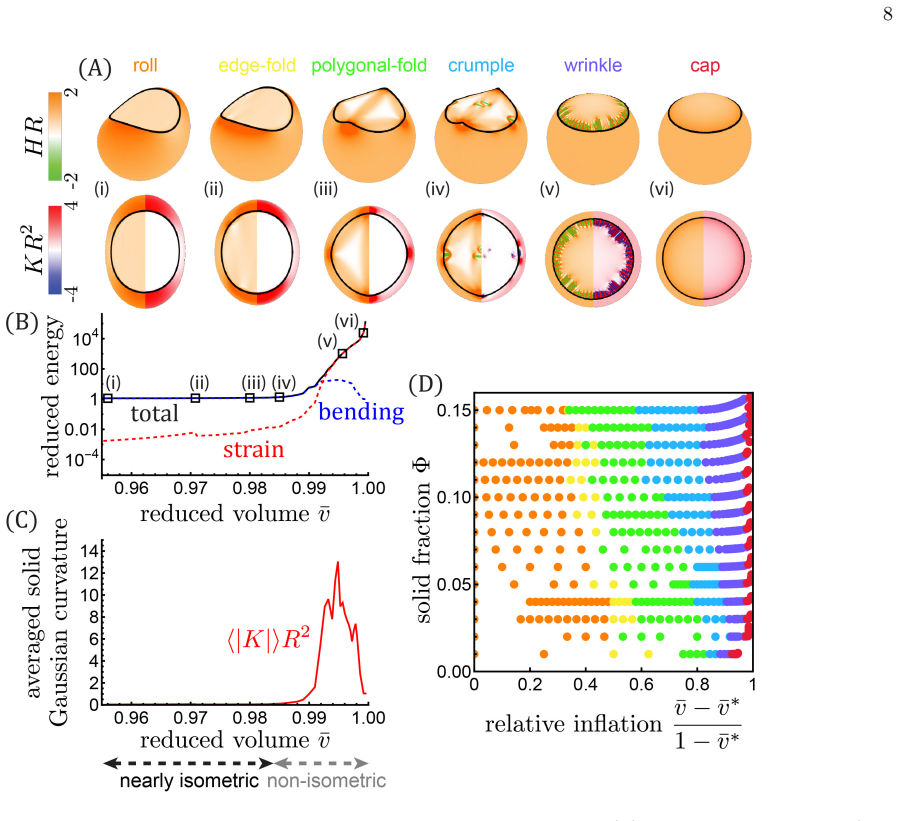
Solid domains in fluid vesicles transition from rolls and folds to crumples, wrinkles, and smooth caps with increasing inflation.
A machine-rendered reading of the paper's core claim, the machinery that carries it, and where it could break.
Core claim
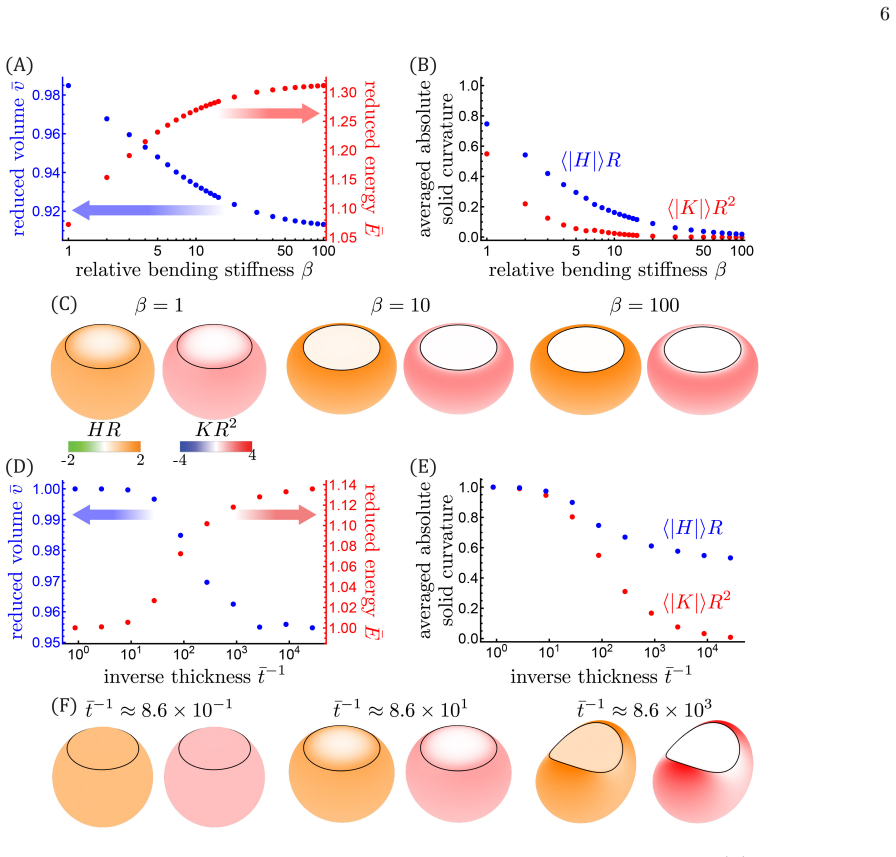
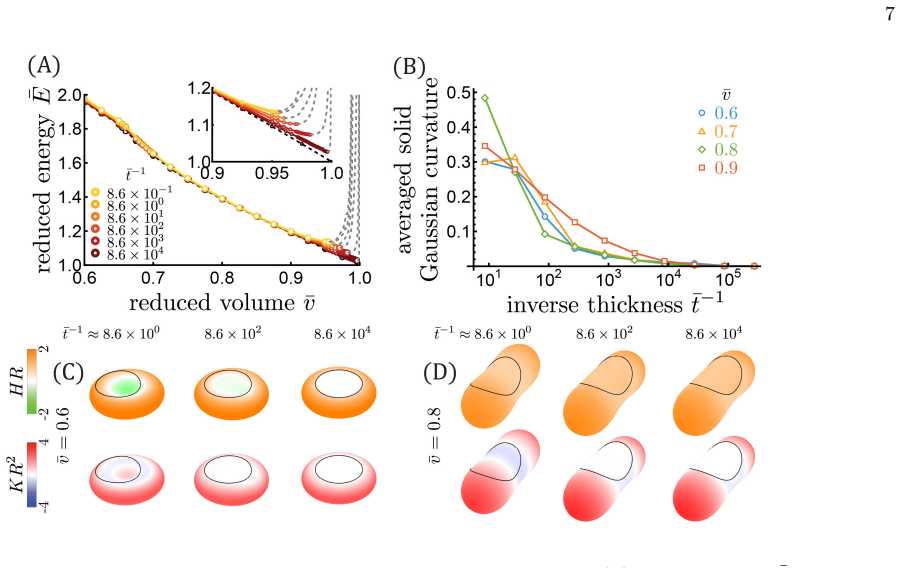
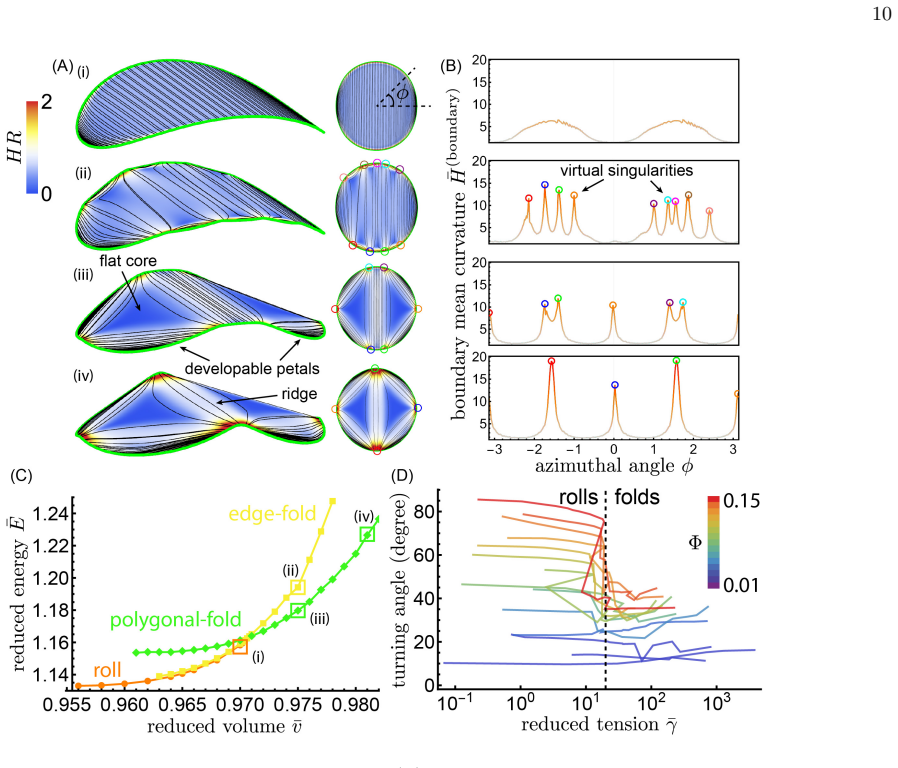
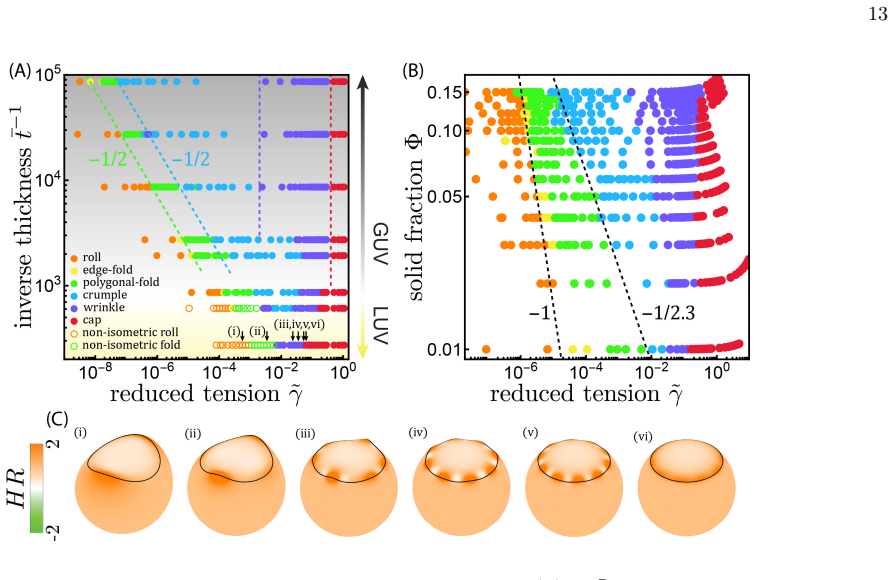
For sufficiently large thin vesicles, the ground-state patterns of the solid domain follow a generic sequence with rising inflation: cylindrical rolls and isometric folds at low inflation, spatially complex crumples and wrinkles at intermediate inflation, and smooth caps at high inflation. These non-isometric patterns at high inflation are governed by far-from-threshold mechanics identical to those describing microscopic sheets on curved liquid interfaces. Inflated shapes are therefore controlled by two basic mechanical scales of membrane tension, while shear elasticity has little effect on under-inflated morphologies. The ratio of vesicle size to solid elastic thickness sets the strength of
What carries the argument
The ratio of vesicle size to solid elastic thickness, which amplifies the solid's non-linear resistance to Gaussian curvature and triggers the far-from-threshold sequence of non-isometric patterns under two membrane-tension scales.
If this is right
- Shear elasticity of the solid has minimal impact on highly under-inflated morphologies.
- Non-linear resistance to Gaussian curvature grows with the vesicle-size-to-thickness ratio and drives the high-inflation pattern sequence.
- Inflated shapes are set by two distinct mechanical scales of membrane tension.
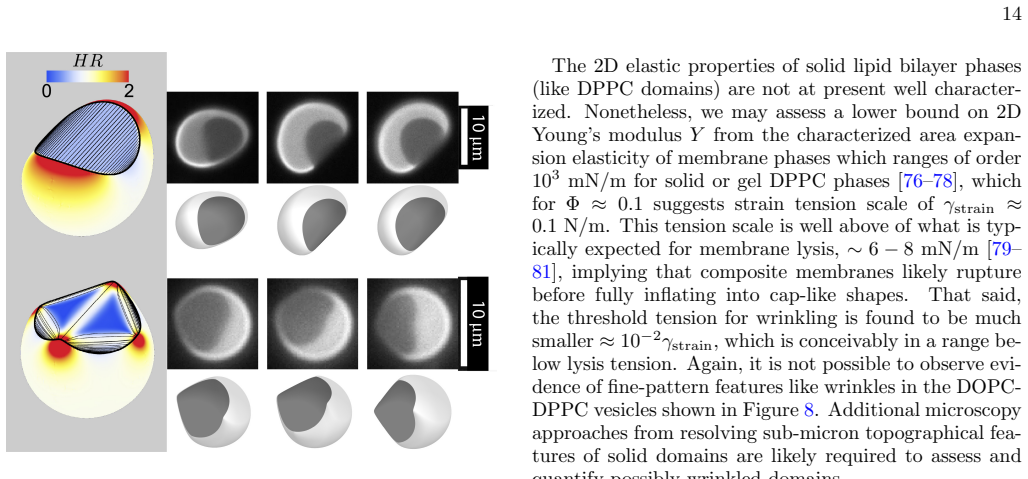
- The simulated anisotropic equilibria reproduce the shapes observed in phase-separated DPPC/DOPC giant unilamellar vesicles.
Where Pith is reading between the lines
- The same two-tension-scale description may apply to vesicles containing multiple solid domains or domains of non-circular initial shape.
- The sequence provides a route to test far-from-threshold sheet mechanics in a fully closed, topologically spherical geometry.
- Varying the bending rigidity or spontaneous curvature of the fluid membrane in simulations could reveal additional selection rules for the transition points between patterns.
Load-bearing premise
A single circular solid domain whose elastic thickness relative to vesicle size is the dominant control parameter, with no multi-domain interactions or extra three-dimensional effects required to reach the ground-state equilibria.
What would settle it
Experiments that vary vesicle radius and inflation level while tracking the solid domain would falsify the claim if they fail to produce the predicted progression from rolls to crumples to smooth caps.
Figures



read the original abstract
Fluid-solid composite vesicles, comprising 2D solid domains integrated into a topologically-closed fluid bilayer membrane, exhibit complex morphologies arising from the geometric frustration between spherical closure of the membrane and 2D solid elasticity. This scenario is distinct from the better studied case of multi-fluid domain vesicles. Here, we study the elastic energies and shape equilibria of a closed vesicle membrane containing a single, flexible circular solid domain using discrete finite-element (Surface Evolver) simulations, determining the key physical and mechanical parameters to govern shape selection. While we find that the 2D solid (shear) elasticity has minimal impact on the highly-under inflated morphologies, the geometrically non-linear resistance of the solid to Gaussian curvature substantially impacts the shape and elastic patterns form for inflated vesicles, by an amount that it grows with ratio of vesicle size to the elastic thickness of solid. For sufficiently large (thin) vesicles we characterize a generic sequence of ground state patterns of solid shape with increasing inflation: from cylindrical rolls and isometric folds to spatially complex patterns of crumples and wrinkles and ultimately to smooth caps. This sequence of non-isometric patterns at high-inflation is shown to be governed by the same far-from-threshold mechanics used to describe similar shape transitions in microscopic sheets on curved liquid interfaces, establishing that inflated shapes are governed by two basic mechanical scales of membrane tension. We find our predictions for highly-anisotropic shape equilibria of fluid-solid composite vesicles closely match experimentally observed shapes of giant unilamellar vesicles of phase-separated DPPC and DOPC.
Editorial analysis
A structured set of objections, weighed in public.
Referee Report
Summary. The manuscript uses discrete finite-element Surface Evolver simulations of a single circular solid domain embedded in a topologically closed fluid bilayer vesicle to determine the parameters governing elastic energies and shape equilibria. It reports that 2D shear elasticity has minimal impact on under-inflated morphologies while Gaussian curvature resistance grows with vesicle size to elastic thickness ratio; for sufficiently large thin vesicles it characterizes a generic inflation-driven sequence of solid-domain ground states from cylindrical rolls and isometric folds through spatially complex crumples and wrinkles to smooth caps. This high-inflation sequence is attributed to the same far-from-threshold mechanics previously applied to microscopic sheets on curved liquid interfaces, implying that inflated shapes are controlled by two basic membrane-tension scales. The simulated anisotropic equilibria are stated to match experimental shapes of phase-separated DPPC/DOPC giant unilamellar vesicles.
Significance. If the reported simulation sequence and tension-scale identification hold, the work supplies a concrete mechanical classification of geometrically frustrated shapes in fluid-solid composite vesicles and demonstrates transferability of far-from-threshold concepts from open sheets to closed vesicles. This framework could guide both theoretical modeling and experimental design of phase-separated or composite membrane systems.
major comments (2)
- [Abstract] Abstract and modeling description: the central claim that the observed sequence is 'governed by the same far-from-threshold mechanics' and controlled by 'two basic mechanical scales of membrane tension' is presented without any shown equations, explicit definitions of the two scales, tabulated tension values, or quantitative measures of how the scales vary with the vesicle-to-thickness ratio; the identification therefore rests on qualitative post-processing of unshown simulation outputs, which is load-bearing for the mechanics conclusion.
- [Modeling description] Modeling assumptions (implicit in the simulation setup): the claim of a 'generic' sequence for 'sufficiently large (thin) vesicles' is based on a single flexible circular domain; no test is reported of whether multi-domain interactions or additional 3D curvature effects alter the sequence, yet this single-domain idealization is presented as sufficient to establish the generic behavior.
minor comments (2)
- The manuscript should include a table or explicit list of the vesicle size to elastic thickness ratios explored, mesh resolutions, and convergence criteria used in the Surface Evolver minimizations.
- Clarify how the transition points between pattern classes (rolls/folds, crumples/wrinkles, smooth caps) were objectively identified from the simulation outputs rather than by visual inspection.
Simulated Author's Rebuttal
We thank the referee for their thoughtful review and constructive suggestions. We address each major comment below and indicate the revisions we will make to improve the clarity and rigor of the manuscript.
read point-by-point responses
-
Referee: [Abstract] Abstract and modeling description: the central claim that the observed sequence is 'governed by the same far-from-threshold mechanics' and controlled by 'two basic mechanical scales of membrane tension' is presented without any shown equations, explicit definitions of the two scales, tabulated tension values, or quantitative measures of how the scales vary with the vesicle-to-thickness ratio; the identification therefore rests on qualitative post-processing of unshown simulation outputs, which is load-bearing for the mechanics conclusion.
Authors: We agree that the presentation of the two tension scales could be made more explicit. In the revised manuscript, we will include explicit definitions of the two basic mechanical scales of membrane tension (the far-from-threshold in-plane tension and the Gaussian curvature resistance scale), along with equations from the far-from-threshold framework. We will also add quantitative data, such as tabulated or plotted values of these scales as a function of the vesicle-to-thickness ratio, derived from our simulation outputs to support the identification. revision: yes
-
Referee: [Modeling description] Modeling assumptions (implicit in the simulation setup): the claim of a 'generic' sequence for 'sufficiently large (thin) vesicles' is based on a single flexible circular domain; no test is reported of whether multi-domain interactions or additional 3D curvature effects alter the sequence, yet this single-domain idealization is presented as sufficient to establish the generic behavior.
Authors: Our work intentionally focuses on the single-domain case as a minimal model to clearly identify the sequence driven by the solid domain's elasticity within the closed vesicle. While we do not report multi-domain simulations here, the observed sequence arises from local mechanics that we expect to hold for sufficiently separated domains in larger systems. We will revise the text to clarify that the generic sequence is established for the single-domain idealization and add a discussion of potential effects from multi-domain interactions and additional curvature as topics for future investigation. revision: partial
Circularity Check
No significant circularity; simulations are independent numerical experiments
full rationale
The paper's central results derive from discrete Surface Evolver minimizations of a single circular solid domain in a closed vesicle. These are presented as independent numerical experiments that reveal the inflation-driven sequence (rolls/folds → crumples/wrinkles → smooth caps). The identification of two far-from-threshold tension scales is an interpretive mapping to prior literature rather than a derivation that reduces the reported patterns to fitted inputs or self-citations by construction. No equations, ansatzes, or uniqueness theorems are shown to collapse the claimed sequence onto the model's own parameters. The modeling assumptions (single domain, shear modulus secondary, Gaussian curvature resistance dominant) remain externally falsifiable via the simulations themselves.
Axiom & Free-Parameter Ledger
free parameters (1)
- vesicle size to elastic thickness ratio
axioms (2)
- domain assumption The membrane is a topologically closed fluid bilayer containing a single flexible circular solid domain.
- domain assumption Far-from-threshold mechanics and two membrane tension scales govern the high-inflation non-isometric patterns.
Reference graph
Works this paper leans on
-
[1]
Last, solid domains may take on many complex, non- circular 2D shapes in vesicles
Consequently, composite vesicles withβ >1 strongly prefer to embed the solid domain on the flat poles of an oblate shape branch, fundamentally suppressing the prolate configurations favored whenβ= 1. Last, solid domains may take on many complex, non- circular 2D shapes in vesicles. Indeed, it is well-known that geometric frustration of 2D solid forming on...
-
[2]
Geometry of crum- pled paper.Physical review letters, 94(16):166107, 2005
Daniel L Blair and Arshad Kudrolli. Geometry of crum- pled paper.Physical review letters, 94(16):166107, 2005
2005
-
[3]
Universal power law in the noise from a crumpled elastic sheet
Eric M Kramer and Alexander E Lobkovsky. Universal power law in the noise from a crumpled elastic sheet. Physical Review E, 53(2):1465, 1996
1996
-
[4]
Properties of ridges in elastic membranes.Physical Review E, 55(2):1577, 1997
Alexander E Lobkovsky and TA Witten. Properties of ridges in elastic membranes.Physical Review E, 55(2):1577, 1997
1997
-
[5]
Origami based mechan- ical metamaterials.Scientific reports, 4(1):5979, 2014
Cheng Lv, Deepakshyam Krishnaraju, Goran Konjevod, Hongyu Yu, and Hanqing Jiang. Origami based mechan- ical metamaterials.Scientific reports, 4(1):5979, 2014
2014
-
[6]
Two-dimensional poly- mers: concepts and perspectives.Chemical Communica- tions, 52(1):18–34, 2016
Payam Payamyar, Benjamin T King, Hans Christian ¨Ottinger, and A Dieter Schl¨ uter. Two-dimensional poly- mers: concepts and perspectives.Chemical Communica- tions, 52(1):18–34, 2016
2016
-
[7]
The shape of a long leaf.Proceedings of the National Academy of Sciences, 106(52):22049–22054, 2009
Haiyi Liang and Lakshminarayanan Mahadevan. The shape of a long leaf.Proceedings of the National Academy of Sciences, 106(52):22049–22054, 2009
2009
-
[8]
Geometrically frustrated rose petals.Science, 388(6746):520–524, 2025
Yafei Zhang, Omri Y Cohen, Michael Moshe, and Eran Sharon. Geometrically frustrated rose petals.Science, 388(6746):520–524, 2025
2025
-
[9]
Geometry and mechanics in the opening of chiral seed pods.Science, 333(6050):1726–1730, 2011
Shahaf Armon, Efi Efrati, Raz Kupferman, and Eran Sharon. Geometry and mechanics in the opening of chiral seed pods.Science, 333(6050):1726–1730, 2011
2011
-
[10]
Wrinkled, rippled and crumpled graphene: an overview of formation mecha- nism, electronic properties, and applications.Materials Today, 19(4):197–212, 2016
Shikai Deng and Vikas Berry. Wrinkled, rippled and crumpled graphene: an overview of formation mecha- nism, electronic properties, and applications.Materials Today, 19(4):197–212, 2016
2016
-
[11]
Graphene wrinkling: formation, evolution and col- lapse.Nanoscale, 5(10):4454–4461, 2013
Changguo Wang, Yuanpeng Liu, Lan Lan, and Huifeng Tan. Graphene wrinkling: formation, evolution and col- lapse.Nanoscale, 5(10):4454–4461, 2013
2013
-
[12]
Thermal crumpling of perforated two- dimensional sheets.Nature communications, 8(1):1381, 2017
David Yllanes, Sourav S Bhabesh, David R Nelson, and Mark J Bowick. Thermal crumpling of perforated two- dimensional sheets.Nature communications, 8(1):1381, 2017
2017
-
[13]
Stress focusing in elastic sheets.Re- views of Modern Physics, 79(2):643, 2007
Thomas A Witten. Stress focusing in elastic sheets.Re- views of Modern Physics, 79(2):643, 2007
2007
-
[14]
Ge- ometry and physics of wrinkling.Physical review letters, 90(7):074302, 2003
Enrique Cerda and Lakshminarayanan Mahadevan. Ge- ometry and physics of wrinkling.Physical review letters, 90(7):074302, 2003
2003
-
[15]
Hunter King, Robert D Schroll, Benny Davidovitch, and Narayanan Menon. Elastic sheet on a liquid drop reveals wrinkling and crumpling as distinct symmetry-breaking instabilities.Proceedings of the National Academy of Sci- ences, 109(25):9716–9720, 2012
2012
-
[16]
Curvature-induced stiffness and the spatial vari- ation of wavelength in wrinkled sheets.Proceedings of the National Academy of Sciences, 113(5):1144–1149, 2016
Joseph D Paulsen, Evan Hohlfeld, Hunter King, Jiangshui Huang, Zhanlong Qiu, Thomas P Russell, Narayanan Menon, Dominic Vella, and Benny Davi- dovitch. Curvature-induced stiffness and the spatial vari- ation of wavelength in wrinkled sheets.Proceedings of the National Academy of Sciences, 113(5):1144–1149, 2016
2016
-
[17]
Geometrically incompatible confinement of solids
Benny Davidovitch, Yiwei Sun, and Gregory M Gra- son. Geometrically incompatible confinement of solids. Proceedings of the National Academy of Sciences, 116(5):1483–1488, 2019
2019
-
[18]
Delamination from an adhe- sive sphere: Curvature-induced dewetting versus buck- ling.Proceedings of the National Academy of Sciences, 120(12):e2212290120, 2023
Finn Box, Lucie Domino, Tiago Outerelo Corvo, Mokhtar Adda-Bedia, Vincent D´ emery, Dominic Vella, and Benny Davidovitch. Delamination from an adhe- sive sphere: Curvature-induced dewetting versus buck- ling.Proceedings of the National Academy of Sciences, 120(12):e2212290120, 2023
2023
-
[19]
Optimal wrapping of liquid droplets with ultrathin sheets.Nature materials, 14(12):1206– 1209, 2015
Joseph D Paulsen, Vincent D´ emery, Christian D San- tangelo, Thomas P Russell, Benny Davidovitch, and Narayanan Menon. Optimal wrapping of liquid droplets with ultrathin sheets.Nature materials, 14(12):1206– 1209, 2015
2015
-
[20]
Stamping and wrinkling of elastic plates.Physical review letters, 109(5):054302, 2012
J´ er´ emy Hure, Benoˆ ıt Roman, and Jos´ e Bico. Stamping and wrinkling of elastic plates.Physical review letters, 109(5):054302, 2012
2012
-
[21]
Exact solutions for the wrinkle patterns of confined elastic shells.Nature Physics, 18(9):1099–1104, 2022
Ian Tobasco, Yousra Timounay, Desislava Todorova, Graham C Leggat, Joseph D Paulsen, and Eleni Kati- fori. Exact solutions for the wrinkle patterns of confined elastic shells.Nature Physics, 18(9):1099–1104, 2022
2022
-
[22]
Prototypi- cal model for tensional wrinkling in thin sheets.Proceed- ings of the National Academy of Sciences, 108(45):18227– 18232, 2011
Benny Davidovitch, Robert D Schroll, Dominic Vella, Mokhtar Adda-Bedia, and Enrique A Cerda. Prototypi- cal model for tensional wrinkling in thin sheets.Proceed- ings of the National Academy of Sciences, 108(45):18227– 18232, 2011
2011
-
[23]
Sculpting 2d crystals via membrane contractions before and during solidification.Langmuir, 42(9):6887–6902, 2026
Hao Wan, Geunwoong Jeon, Gregory M Grason, and Maria M Santore. Sculpting 2d crystals via membrane contractions before and during solidification.Langmuir, 42(9):6887–6902, 2026
2026
-
[24]
Shape transformations of vesicles: Phase diagram for spontaneous-curvature and bilayer-coupling models
Udo Seifert, Karin Berndl, and Reinhard Lipowsky. Shape transformations of vesicles: Phase diagram for spontaneous-curvature and bilayer-coupling models. Physical review A, 44(2):1182, 1991
1991
-
[25]
Shape equilibria 16 of vesicles with rigid planar inclusions.Soft Matter, 20(29):5754–5768, 2024
Geunwoong Jeon, Justin Fagnoni, Hao Wan, Maria M Santore, and Gregory M Grason. Shape equilibria 16 of vesicles with rigid planar inclusions.Soft Matter, 20(29):5754–5768, 2024
2024
-
[26]
CRC Press, 2019
Rumiana Dimova and Carlos Marques.The giant vesicle book. CRC Press, 2019
2019
-
[27]
Elastic properties of lipid bilayers: theory and possible experiments.Zeitschrift f¨ ur Natur- forschung c, 28(11-12):693–703, 1973
Wolfgang Helfrich. Elastic properties of lipid bilayers: theory and possible experiments.Zeitschrift f¨ ur Natur- forschung c, 28(11-12):693–703, 1973
1973
-
[28]
Configurations of fluid membranes and vesi- cles.Advances in physics, 46(1):13–137, 1997
Udo Seifert. Configurations of fluid membranes and vesi- cles.Advances in physics, 46(1):13–137, 1997
1997
-
[29]
Fluid lipid membranes: From differ- ential geometry to curvature stresses.Chemistry and physics of lipids, 185:11–45, 2015
Markus Deserno. Fluid lipid membranes: From differ- ential geometry to curvature stresses.Chemistry and physics of lipids, 185:11–45, 2015
2015
-
[30]
Functional rafts in cell membranes.nature, 387(6633):569–572, 1997
Kai Simons and Elina Ikonen. Functional rafts in cell membranes.nature, 387(6633):569–572, 1997
1997
-
[31]
Imaging coexisting fluid domains in biomembrane mod- els coupling curvature and line tension.Nature, 425(6960):821–824, 2003
Tobias Baumgart, Samuel T Hess, and Watt W Webb. Imaging coexisting fluid domains in biomembrane mod- els coupling curvature and line tension.Nature, 425(6960):821–824, 2003
2003
-
[32]
Domains in membranes and vesicles.Journal of Physics: Condensed Matter, 15(1):S31–S45, 2003
Reinhard Lipowsky and Rumiana Dimova. Domains in membranes and vesicles.Journal of Physics: Condensed Matter, 15(1):S31–S45, 2003
2003
-
[33]
Domain-induced budding of vesicles.Physical review letters, 70(19):2964, 1993
Frank J¨ ulicher and Reinhard Lipowsky. Domain-induced budding of vesicles.Physical review letters, 70(19):2964, 1993
1993
-
[34]
Shape transfor- mations of vesicles with intramembrane domains.Phys- ical Review E, 53(3):2670, 1996
Frank J¨ ulicher and Reinhard Lipowsky. Shape transfor- mations of vesicles with intramembrane domains.Phys- ical Review E, 53(3):2670, 1996
1996
-
[35]
Membrane elasticity in giant vesicles with fluid phase coexistence.Biophysical jour- nal, 89(2):1067–1080, 2005
Tobias Baumgart, S Das, Watt Wetmore Webb, and James Thomas Jenkins. Membrane elasticity in giant vesicles with fluid phase coexistence.Biophysical jour- nal, 89(2):1067–1080, 2005
2005
-
[36]
Mor- phology and interaction between lipid domains.Proceed- ings of the National Academy of Sciences, 106(32):13301– 13306, 2009
Tristan S Ursell, William S Klug, and Rob Phillips. Mor- phology and interaction between lipid domains.Proceed- ings of the National Academy of Sciences, 106(32):13301– 13306, 2009
2009
-
[37]
Polymorphism of vesicles with multi-domain patterns.Soft Matter, 5(17):3303–3311, 2009
Erwin Gutlederer, Thomas Gruhn, and Reinhard Lipowsky. Polymorphism of vesicles with multi-domain patterns.Soft Matter, 5(17):3303–3311, 2009
2009
-
[38]
Membrane heterogeneity–from lipid domains to curvature effects
Stefan Semrau and Thomas Schmidt. Membrane heterogeneity–from lipid domains to curvature effects. Soft Matter, 5(17):3174–3186, 2009
2009
-
[39]
Vesi- cles with multiple membrane domains.Soft Matter, 7(13):6092–6102, 2011
Jinglei Hu, Thomas Weikl, and Reinhard Lipowsky. Vesi- cles with multiple membrane domains.Soft Matter, 7(13):6092–6102, 2011
2011
-
[40]
Phase segregation in bio-inspired multi-component vesicles en- compassing double tail phospholipid species.Soft Matter, 10(32):6096–6108, 2014
Fikret Aydin, Paul Ludford, and Meenakshi Dutt. Phase segregation in bio-inspired multi-component vesicles en- compassing double tail phospholipid species.Soft Matter, 10(32):6096–6108, 2014
2014
-
[41]
Patterning of multicomponent elastic shells by gaussian curvature.Physical Review E, 109(5):054409, 2024
Curt Waltmann, Ahis Shrestha, and Monica Olvera de la Cruz. Patterning of multicomponent elastic shells by gaussian curvature.Physical Review E, 109(5):054409, 2024
2024
-
[42]
Jan Magnus Sischka and Axel Voigt. Two-phase fluid deformable surfaces with constant enclosed volume and phase-dependent bending and gaussian rigidity.Com- puter Methods in Applied Mechanics and Engineering, 445:118166, 2025
2025
-
[43]
Budding of membranes induced by intramembrane domains.Journal de Physique II, 2(10):1825–1840, 1992
Reinhard Lipowsky. Budding of membranes induced by intramembrane domains.Journal de Physique II, 2(10):1825–1840, 1992
1992
-
[44]
Domain-induced budding of fluid membranes.Biophysical Journal, 64(4):1133–1138, 1993
Reinhard Lipowsky. Domain-induced budding of fluid membranes.Biophysical Journal, 64(4):1133–1138, 1993
1993
-
[45]
Phase separation of a mixture of charged and neutral lipids on a giant vesicle induced by small cations.Chem- ical Physics Letters, 496(1-3):59–63, 2010
N Shimokawa, M Hishida, H Seto, and K Yoshikawa. Phase separation of a mixture of charged and neutral lipids on a giant vesicle induced by small cations.Chem- ical Physics Letters, 496(1-3):59–63, 2010
2010
-
[46]
Budding of domains in mixed bilayer membranes.Phys- ical Review E, 91(1):012708, 2015
Jean Wolff, Shigeyuki Komura, and David Andelman. Budding of domains in mixed bilayer membranes.Phys- ical Review E, 91(1):012708, 2015
2015
-
[47]
Multispherical shapes of vesicles with intramembrane domains.The European Physical Journal E, 47(1):4, 2024
Reinhard Lipowsky. Multispherical shapes of vesicles with intramembrane domains.The European Physical Journal E, 47(1):4, 2024
2024
-
[48]
Minimal bending energies of bilayer polyhedra.Physical review letters, 105(22):228101, 2010
Christoph A Haselwandter and Rob Phillips. Minimal bending energies of bilayer polyhedra.Physical review letters, 105(22):228101, 2010
2010
-
[49]
Haselwandter and Rob Phillips
Christoph A. Haselwandter and Rob Phillips. Elastic energy of polyhedral bilayer vesicles.Phys. Rev. E, 83:061901, Jun 2011
2011
-
[50]
Rower and Paul J
David A. Rower and Paul J. Atzberger. Coarse-grained methods for heterogeneous vesicles with phase-separated domains: Elastic mechanics of shape fluctuations, plate compression, and channel insertion.Mathematics and Computers in Simulation, 209:342–361, 2023
2023
-
[51]
Floret-shaped solid domains on giant fluid lipid vesicles induced by ph.Lang- muir, 28(9):4113–4122, 2012
Amey Bandekar and Stavroula Sofou. Floret-shaped solid domains on giant fluid lipid vesicles induced by ph.Lang- muir, 28(9):4113–4122, 2012
2012
-
[52]
Dong Chen and Maria M Santore. Large effect of mem- brane tension on the fluid–solid phase transitions of two- component phosphatidylcholine vesicles.Proceedings of the national academy of sciences, 111(1):179–184, 2014
2014
-
[53]
Solid-like domains in fluid membranes.Journal of Physics: Condensed Matter, 17(45):S3341–S3346, 2005
Paul A Beales, Vernita D Gordon, Zhijun Zhao, Stefan U Egelhaaf, and Wilson CK Poon. Solid-like domains in fluid membranes.Journal of Physics: Condensed Matter, 17(45):S3341–S3346, 2005
2005
-
[54]
Lipid organization and the morphology of solid- like domains in phase-separating binary lipid membranes
VD Gordon, PA Beales, Z Zhao, C Blake, FC MacKin- tosh, PD Olmsted, ME Cates, SU Egelhaaf, and WCK Poon. Lipid organization and the morphology of solid- like domains in phase-separating binary lipid membranes. Journal of Physics: Condensed Matter, 18(32):L415– L420, 2006
2006
-
[55]
Shapes of crystalline do- mains on spherical fluid vesicles.EPL (Europhysics Let- ters), 70(1):136–142, 2005
S Schneider and G Gompper. Shapes of crystalline do- mains on spherical fluid vesicles.EPL (Europhysics Let- ters), 70(1):136–142, 2005
2005
-
[56]
Solid domains in lipid vesi- cles and scars.EPL (Europhysics Letters), 72(5):767– 773, 2005
Y Chushak and A Travesset. Solid domains in lipid vesi- cles and scars.EPL (Europhysics Letters), 72(5):767– 773, 2005
2005
-
[57]
Lateral phase separation in tense membranes.Soft Matter, 7(19):9061–9068, 2011
Tsutomu Hamada, Yuko Kishimoto, Takeshi Nagasaki, and Masahiro Takagi. Lateral phase separation in tense membranes.Soft Matter, 7(19):9061–9068, 2011
2011
-
[58]
Platonic and archimedean geometries in mul- ticomponent elastic membranes.Proceedings of the Na- tional Academy of Sciences, 108(11):4292–4296, 2011
Graziano Vernizzi, Rastko Sknepnek, and Monica Olvera de la Cruz. Platonic and archimedean geometries in mul- ticomponent elastic membranes.Proceedings of the Na- tional Academy of Sciences, 108(11):4292–4296, 2011
2011
-
[59]
Buckling of multicomponent elastic shells with line tension.Soft Matter, 8:636–644, 2012
Rastko Sknepnek, Graziano Vernizzi, and Monica Olvera de la Cruz. Buckling of multicomponent elastic shells with line tension.Soft Matter, 8:636–644, 2012
2012
-
[60]
Flower-shaped 2d crys- tals grown in curved fluid vesicle membranes.Nature Communications, 15(1):3442, 2024
Hao Wan, Geunwoong Jeon, Weiyue Xin, Gregory M Grason, and Maria M Santore. Flower-shaped 2d crys- tals grown in curved fluid vesicle membranes.Nature Communications, 15(1):3442, 2024
2024
-
[61]
Thermal preconditioning of membrane stress to control the shapes of ultrathin crystals.Soft Matter, 20(35):6984–6994, 2024
Hao Wan, Geunwoong Jeon, Gregory M Grason, and Maria M Santore. Thermal preconditioning of membrane stress to control the shapes of ultrathin crystals.Soft Matter, 20(35):6984–6994, 2024
2024
-
[62]
L. D. Landau, E. M. Lifshitz, A. M. Kosevich, and L. P. Pitaevskii.Theory of elasticity: volume 7, volume 7. El- sevier, 1986. 17
1986
-
[63]
The geometry of soft materials: a primer.Reviews of Modern physics, 74(4):953, 2002
Randall D Kamien. The geometry of soft materials: a primer.Reviews of Modern physics, 74(4):953, 2002
2002
-
[64]
The surface evolver.Experimental mathematics, 1(2):141–165, 1992
Kenneth A Brakke. The surface evolver.Experimental mathematics, 1(2):141–165, 1992
1992
-
[65]
The surface evolver.https:// kenbrakke.com/evolver/html/evolver.htm, 2013
Kenneth A Brakke. The surface evolver.https:// kenbrakke.com/evolver/html/evolver.htm, 2013
2013
-
[66]
Pomeau.Elasticity and geome- try: from hair curls to the non-linear response of shells
Basile Audoly and Yves. Pomeau.Elasticity and geome- try: from hair curls to the non-linear response of shells. Oxford University Press, 2010
2010
-
[67]
Effect of chain length and unsatu- ration on elasticity of lipid bilayers.Biophysical journal, 79(1):328–339, 2000
Wies lawa Rawicz, K Cc Olbrich, T McIntosh, D Need- ham, and E Evans. Effect of chain length and unsatu- ration on elasticity of lipid bilayers.Biophysical journal, 79(1):328–339, 2000
2000
-
[68]
Perspective: Geometrically frus- trated assemblies.The Journal of Chemical Physics, 145(11), 2016
Gregory M Grason. Perspective: Geometrically frus- trated assemblies.The Journal of Chemical Physics, 145(11), 2016
2016
-
[69]
Elastic instability of a crystal growing on a curved surface.Science, 343(6171):634–637, 2014
Guangnan Meng, Jayson Paulose, David R Nelson, and Vinothan N Manoharan. Elastic instability of a crystal growing on a curved surface.Science, 343(6171):634–637, 2014
2014
-
[70]
Nonaxisymmetric phos- pholipid vesicles: Rackets, boomerangs, and starfish
Primoˇ z Ziherl and Saˇ sa Svetina. Nonaxisymmetric phos- pholipid vesicles: Rackets, boomerangs, and starfish. EPL (Europhysics Letters), 70(5):690–696, 2005
2005
-
[71]
Stationary shapes of axisym- metric vesicles beyond lowest-energy configurations.Soft matter, 20(10):2258–2271, 2024
Rodrigo B Reboucas, Hammad A Faizi, Michael J Mik- sis, and Petia M Vlahovska. Stationary shapes of axisym- metric vesicles beyond lowest-energy configurations.Soft matter, 20(10):2258–2271, 2024
2024
-
[72]
Barakat and Todd M
Joseph M. Barakat and Todd M. Squires. Curvature- mediated forces on elastic inclusions in fluid interfaces. Langmuir, 38(3):1099–1105, 2022. PMID: 35015555
2022
-
[73]
The shape of a m¨ obius strip.Nature materials, 6(8):563–567, 2007
Evgueni L Starostin and Gert HM Van der Heijden. The shape of a m¨ obius strip.Nature materials, 6(8):563–567, 2007
2007
-
[74]
Capillary origami: spontaneous wrapping of a droplet with an elas- tic sheet.Physical review letters, 98(15):156103, 2007
Charlotte Py, Paul Reverdy, Lionel Doppler, Jos´ e Bico, Benoit Roman, and Charles N Baroud. Capillary origami: spontaneous wrapping of a droplet with an elas- tic sheet.Physical review letters, 98(15):156103, 2007
2007
-
[75]
Crumples as a generic stress-focusing instability in con- fined sheets.Physical Review X, 10(2):021008, 2020
Yousra Timounay, Raj De, Jessica L Stelzel, Zachariah S Schrecengost, Monica M Ripp, and Joseph D Paulsen. Crumples as a generic stress-focusing instability in con- fined sheets.Physical Review X, 10(2):021008, 2020
2020
-
[76]
Dynamics and insta- bilities of lipid bilayer membrane shapes.Advances in colloid and interface science, 208:76–88, 2014
Zheng Shi and Tobias Baumgart. Dynamics and insta- bilities of lipid bilayer membrane shapes.Advances in colloid and interface science, 208:76–88, 2014
2014
-
[77]
Elasticity and phase behavior of dppc membrane modu- lated by cholesterol, ergosterol, and ethanol.Biophysical journal, 89(4):2481–2493, 2005
Kara J Tierney, David E Block, and Marjorie L Longo. Elasticity and phase behavior of dppc membrane modu- lated by cholesterol, ergosterol, and ethanol.Biophysical journal, 89(4):2481–2493, 2005
2005
-
[78]
Comparing experimental and simulated pressure-area isotherms for dppc.Biophysical journal, 94(8):2965–2986, 2008
Susan L Duncan and Ronald G Larson. Comparing experimental and simulated pressure-area isotherms for dppc.Biophysical journal, 94(8):2965–2986, 2008
2008
-
[79]
Mechanical proper- ties determination of dmpc, dppc, dspc, and hspc solid- ordered bilayers.Langmuir, 36(14):3826–3835, 2020
Dominik Drabik, Grzegorz Chodaczek, Sebastian Kraszewski, and Marek Langner. Mechanical proper- ties determination of dmpc, dppc, dspc, and hspc solid- ordered bilayers.Langmuir, 36(14):3826–3835, 2020
2020
-
[80]
Water permeability and mechanical strength of polyunsaturated lipid bilayers.Biophysical journal, 79(1):321–327, 2000
K Olbrich, W Rawicz, D Needham, and E Evans. Water permeability and mechanical strength of polyunsaturated lipid bilayers.Biophysical journal, 79(1):321–327, 2000
2000
discussion (0)
Sign in with ORCID, Apple, or X to comment. Anyone can read and Pith papers without signing in.