A Unified CutFEM Formulation for Finite-Strain Elasticity: Energy Minimisation and Corner Singularities
Pith reviewed 2026-07-03 07:38 UTC · model grok-4.3
The pith
An energy-minimization formulation unifies the CutFEM for finite-strain elasticity with automatic differentiation and cut-independent analysis.
A machine-rendered reading of the paper's core claim, the machinery that carries it, and where it could break.
Core claim
The discrete solution is defined as the critical point of the augmented energy functional, and the linearisation of this nonlinear problem at each Newton iteration satisfies the conditions of the Brezzi-Rappaz-Raviart framework independently of the mesh cut, thereby proving quasi-optimal convergence rates for regular solutions; the same formulation reveals that the convergence rate is limited by the strength of corner singularities in the same manner as conventional fitted methods.
What carries the argument
The augmented energy functional (bulk hyperelastic energy plus Nitsche terms plus ghost-penalty stabilisation), whose stationarity condition supplies the discrete equations and whose successive variations yield the residual and tangent via automatic differentiation.
If this is right
- The formulation applies to arbitrary hyperelastic constitutive models without manual derivation of derivatives.
- Cut-independent coercivity and continuity hold for the linearised problems solved at each Newton step.
- Quasi-optimal convergence holds for regular solutions through the Brezzi-Rappaz-Raviart framework.
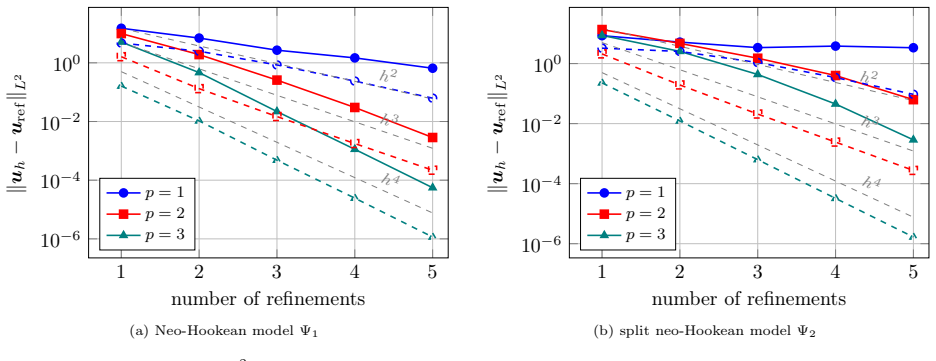
- Optimal h-convergence is observed for polynomial degrees one through three on smooth test cases.
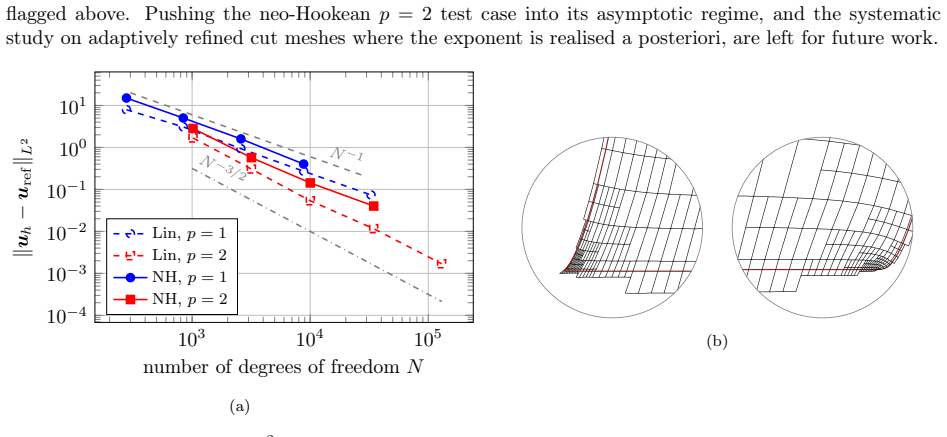
- Local mesh refinement recovers optimal convergence rates despite the presence of corner singularities.
Where Pith is reading between the lines
- Swapping hyperelastic models requires only a change to the scalar energy density function, which could simplify implementation in engineering codes.
- The shared singularity limit between fitted and unfitted schemes implies that unfitted methods do not introduce extra accuracy penalties at corners.
- Similar energy-based constructions might be tested on other nonlinear problems such as plasticity or contact to check if the cut-independence carries over.
Load-bearing premise
The stationarity condition of the augmented energy functional produces a discrete problem whose Newton linearisation satisfies the hypotheses of the Brezzi-Rappaz-Raviart framework.
What would settle it
If the observed convergence rate on a corner-singularity problem exceeds the rate given by the Kolosov-Muskhelishvili equation, or if the condition number depends on cut position, the central claims would be falsified.
Figures



read the original abstract
We present a fully variational, model-independent formulation of the Cut Finite Element Method (CutFEM) for finite-strain elasticity. The discrete problem is the stationarity condition of a augmented energy functional consisting of the bulk hyperelastic energy, the Nitsche terms that impose the boundary conditions weakly, and the ghost-penalty stabilisation. The residual and the (symmetrised) tangent follow from this functional by successive variations. Automatic differentiation (AD) generates the first Piola--Kirchhoff stress tensor and the elasticity tensor directly from the scalar energy density, avoiding manual re-derivation when exchanging hyperelastic models. To our knowledge, this is the first unfitted finite-strain scheme combining an energy-only, model-independent construction with AD and an accuracy analysis at unfitted boundaries. Analysis of the linearised problem solved at each Newton step establishes cut-independent coercivity, continuity, and an $O(h^{-2})$ condition number bound, yielding a quasi-optimal convergence theorem for regular solutions through the Brezzi--Rappaz--Raviart framework. Numerically, the method attains optimal $h$-convergence for linear, quadratic, and cubic elements on a smooth test case. Furthermore, we quantify the method's accuracy limit at mixed Dirichlet--Neumann junctions using the Kolosov--Muskhelishvili characteristic equation. The exact solution's corner singularity caps the convergence rate identically for fitted and unfitted methods. We demonstrate that local mesh refinement removes this bound, with the unfitted discretisation inheriting the recovered optimal rates and cut-independent constants.
Editorial analysis
A structured set of objections, weighed in public.
Referee Report
Summary. The paper introduces a fully variational CutFEM formulation for finite-strain elasticity based on stationarity of an augmented energy functional (bulk hyperelastic energy + Nitsche boundary terms + ghost-penalty stabilisation). The residual and symmetrised tangent are obtained by successive variations, with automatic differentiation used to generate the first Piola-Kirchhoff stress and elasticity tensor directly from the scalar energy density, making the scheme model-independent. Analysis of the linearised problem at each Newton step establishes cut-independent coercivity, continuity, and an O(h^{-2}) condition-number bound, which is used with the Brezzi-Rappaz-Raviart framework to obtain a quasi-optimal convergence theorem for regular solutions. Numerical experiments demonstrate optimal h-convergence for linear, quadratic, and cubic elements on smooth problems, while corner singularities at mixed Dirichlet-Neumann junctions are shown to limit convergence rates identically for fitted and unfitted schemes, with local refinement recovering optimal rates.
Significance. If the stability and convergence claims hold, the work supplies the first unfitted finite-strain scheme that is simultaneously energy-only, model-independent via AD, and equipped with an accuracy analysis at unfitted boundaries. This combination removes the need for manual re-derivation of stress and tangent tensors when changing hyperelastic models and provides a variational route to cut-independent constants, which would be a meaningful contribution to the CutFEM literature in nonlinear solid mechanics.
major comments (2)
- [analysis of the linearised problem] Abstract and analysis section: the central quasi-optimal convergence theorem rests on the linearised problem at each Newton step satisfying the hypotheses of the Brezzi-Rappaz-Raviart framework with cut-independent constants; the manuscript must supply the explicit coercivity and continuity estimates (including the dependence on the ghost-penalty and Nitsche parameters) that establish the O(h^{-2}) condition-number bound independently of the cut location.
- [formulation and analysis] Abstract: the claim that the stationarity condition of the augmented energy defines a discrete problem whose linearisation inherits the required BRR properties is load-bearing for the convergence result; the paper should clarify how the ghost-penalty stabilisation is chosen to guarantee the necessary inf-sup or coercivity constants remain uniform with respect to the interface position.
minor comments (2)
- [abstract] Abstract: the phrase 'the (symmetrised) tangent' should be expanded to indicate whether symmetrisation is performed for theoretical convenience or for numerical robustness of the Newton solver.
- [numerical results] The numerical section should report the observed condition numbers versus h to corroborate the O(h^{-2}) bound claimed in the analysis.
Simulated Author's Rebuttal
We thank the referee for the constructive report and the recognition of the paper's contributions. The major comments correctly identify that the convergence analysis would benefit from more explicit detail on the estimates. We will revise the manuscript to supply these.
read point-by-point responses
-
Referee: [analysis of the linearised problem] Abstract and analysis section: the central quasi-optimal convergence theorem rests on the linearised problem at each Newton step satisfying the hypotheses of the Brezzi-Rappaz-Raviart framework with cut-independent constants; the manuscript must supply the explicit coercivity and continuity estimates (including the dependence on the ghost-penalty and Nitsche parameters) that establish the O(h^{-2}) condition-number bound independently of the cut location.
Authors: We agree that the explicit estimates are required for full rigor. The current analysis section derives cut-independent coercivity and continuity for the linearised problem and states the resulting O(h^{-2}) bound, but does not expand the intermediate steps showing the precise dependence on the Nitsche and ghost-penalty parameters. In the revision we will insert these estimates (with the standard scaling γ_N ~ 1/h and γ_G ~ 1 chosen to absorb the cut-dependent trace inequalities) and verify that the constants remain independent of the interface location. revision: yes
-
Referee: [formulation and analysis] Abstract: the claim that the stationarity condition of the augmented energy defines a discrete problem whose linearisation inherits the required BRR properties is load-bearing for the convergence result; the paper should clarify how the ghost-penalty stabilisation is chosen to guarantee the necessary inf-sup or coercivity constants remain uniform with respect to the interface position.
Authors: We will add a dedicated paragraph in the analysis section that recalls the ghost-penalty form, states the admissible range for its coefficient (independent of the cut ratio), and shows how the resulting coercivity constant is bounded below by a positive number that does not deteriorate when the interface approaches an element boundary. This choice is the standard one already used in the numerical experiments and is sufficient to transfer the BRR hypotheses to the nonlinear setting. revision: yes
Circularity Check
No significant circularity; derivation self-contained
full rationale
The paper constructs a discrete problem as the stationarity condition of an augmented energy functional (bulk hyperelastic energy + Nitsche terms + ghost-penalty), derives the residual and tangent via variations, and applies automatic differentiation to obtain stress and elasticity tensors from the scalar energy density. The convergence analysis then invokes the standard Brezzi--Rappaz--Raviart framework on the linearised problem at each Newton step after establishing cut-independent coercivity, continuity, and an O(h^{-2}) condition-number bound. These steps rest on the variational structure and an external mathematical framework rather than reducing any claimed prediction or theorem to a fitted input, self-definition, or self-citation chain. The corner-singularity bound is taken from the classical Kolosov--Muskhelishvili equation and applies equally to fitted and unfitted schemes. No load-bearing step collapses to its own inputs by construction.
Axiom & Free-Parameter Ledger
axioms (2)
- domain assumption Existence and twice differentiability of a scalar hyperelastic energy density function
- domain assumption The linearised problem at each Newton step satisfies the hypotheses of the Brezzi--Rappaz--Raviart theory
Reference graph
Works this paper leans on
-
[1]
G. A. Holzapfel, Nonlinear solid mechanics: A continuum approach for engineering, John Wiley & Sons, 2000
2000
-
[2]
Ogden, Non-linear Elastic Deformations, Dover Civil and Mechanical Engineering, Dover Publica- tions, 1997
R. Ogden, Non-linear Elastic Deformations, Dover Civil and Mechanical Engineering, Dover Publica- tions, 1997
1997
-
[3]
Bathe, Finite Element Procedures, 1st Edition, Klaus-Jürgen Bathe, 2006
K.-J. Bathe, Finite Element Procedures, 1st Edition, Klaus-Jürgen Bathe, 2006
2006
-
[4]
O. C. Zienkiewicz, R. L. Taylor, P. Nithiarasu, J. Z. Zhu, The Finite Element Method, Elsevier/Butterworth-Heinemann, 2005. 26
2005
-
[5]
P. G. Ciarlet, The finite element method for elliptic problems, North-Holland Pub. Co.; Sole distributors for the U.S.A. and Canada, Elsevier North-Holland, 1978
1978
-
[6]
A. Fumagalli, E. Keilegavlen, S. Scialò, Conforming, non-conforming and non-matching discretization couplings in discrete fracture network simulations, Journal of Computational Physics 376 (2019) 694– 712.doi:https://doi.org/10.1016/j.jcp.2018.09.048. URLhttps://www.sciencedirect.com/science/article/pii/S0021999118306508
-
[7]
D. Boffi, A. Cangiani, M. Feder, L. Gastaldi, L. Heltai, A comparison of non-matching techniques for the finite element approxi mation of interface problemsimage 1, Computers & Mathematics with Applications 151 (2023) 101–115.doi:https://doi.org/10.1016/j.camwa.2023.09.017. URLhttps://www.sciencedirect.com/science/article/pii/S0898122123004029
-
[9]
J. Melenk, I. Babuška, The partition of unity finite element method: Basic theory and applications, Computer Methods in Applied Mechanics and Engineering 139 (1) (1996) 289–314.doi:https://doi. org/10.1016/S0045-7825(96)01087-0. URLhttps://www.sciencedirect.com/science/article/pii/S0045782596010870
-
[10]
Strouboulis, K
T. Strouboulis, K. Copps, I. Babuška, The generalized finite element method, Computer Methods in Applied Mechanics and Engineering 190 (32) (2001) 4081–4193.doi:https://doi.org/10.1016/ S0045-7825(01)00188-8. URLhttps://www.sciencedirect.com/science/article/pii/S0045782501001888
2001
-
[11]
T. Fries, T. Belytschko, The extended/generalized finite element method: An overview of the method and its applications, International Journal for Numerical Methods in Engineering 84 (3) (2010) 253–304. doi:10.1002/nme.2914
-
[12]
L. Zhang, A. Gerstenberger, X. Wang, W. K. Liu, Immersed finite element method, Computer Methods in Applied Mechanics and Engineering 193 (21) (2004) 2051–2067, flow Simulation and Modeling.doi: https://doi.org/10.1016/j.cma.2003.12.044. URLhttps://www.sciencedirect.com/science/article/pii/S0045782504000672
-
[13]
A. Main, G. Scovazzi, The shifted boundary method for embedded domain computations. part i: Poisson and stokes problems, Journal of Computational Physics 372 (2018) 972–995.doi:https://doi.org/ 10.1016/j.jcp.2017.10.026. URLhttps://www.sciencedirect.com/science/article/pii/S0021999117307799
-
[14]
A. Hansbo, P. Hansbo, An unfitted finite element method, based on nitsche’s method, for elliptic interface problems, Computer Methods in Applied Mechanics and Engineering 191 (47) (2002) 5537– 5552.doi:https://doi.org/10.1016/S0045-7825(02)00524-8. URLhttps://www.sciencedirect.com/science/article/pii/S0045782502005248
-
[15]
E. Burman, P. Hansbo, M. G. Larson, S. Zahedi, Cut finite element methods, Acta Numerica 34 (2025) 1–121.doi:10.1017/S0962492925000017
-
[16]
J. Nitsche, Über ein variationsprinzip zur lösung von dirichlet-problemen bei verwendung von teilräu- men, die keinen randbedingungen unterworfen sind, Abhandlungen aus dem Mathematischen Seminar der Universität Hamburg 36 (1) (1971) 9–15.doi:10.1007/BF02995904. URLhttps://doi.org/10.1007/BF02995904
-
[17]
I. Babuška, The finite element method with lagrangian multipliers, Numerische Mathematik 20 (3) (1973) 179–192.doi:10.1007/BF01436561. URLhttps://doi.org/10.1007/BF01436561 27
-
[18]
R. Stenberg, On some techniques for approximating boundary conditions in the finite element method, Journal of Computational and Applied Mathematics 63 (1) (1995) 139–148, proceedings of the Interna- tional Symposium on Mathematical Modelling and Computational Methods Modelling 94.doi:https: //doi.org/10.1016/0377-0427(95)00057-7. URLhttps://www.sciencedi...
-
[19]
E. Burman, P. Hansbo, Fictitious domain finite element methods using cut elements: I. a stabilized lagrange multiplier method, Computer Methods in Applied Mechanics and Engineering 199 (41) (2010) 2680–2686.doi:https://doi.org/10.1016/j.cma.2010.05.011. URLhttps://www.sciencedirect.com/science/article/pii/S004578251000160X
-
[20]
E. Burman, Ghost penalty, Comptes Rendus Mathematique 348 (21) (2010) 1217–1220.doi:https: //doi.org/10.1016/j.crma.2010.10.006. URLhttps://www.sciencedirect.com/science/article/pii/S1631073X10002827
-
[21]
E. Burman, S. Claus, P. Hansbo, M. G. Larson, A. Massing, Cutfem: Discretizing geometry and partial differential equations, International Journal for Numerical Methods in Engineering 104 (7) (2014) 472–501.doi:10.1002/nme.4823
-
[22]
P. Hansbo, M. G. Larson, K. Larsson, Cut Finite Element Methods for Linear Elasticity Problems, Springer International Publishing, 2017, Ch. 2, pp. 25–63.doi:10.1007/978-3-319-71431-8_2. URLhttp://dx.doi.org/10.1007/978-3-319-71431-8_2
-
[23]
F. Yang, The least squares finite element method for elasticity interface problem on unfitted mesh (2023).arXiv:2306.08801. URLhttps://arxiv.org/abs/2306.08801
-
[24]
C. Ager, B. Schott, M. Winter, W. Wall, A nitsche-based cut finite element method for the coupling of incompressible fluid flow with poroelasticity, Computer Methods in Applied Mechanics and Engineering 351 (2019) 253–280.doi:https://doi.org/10.1016/j.cma.2019.03.015. URLhttps://www.sciencedirect.com/science/article/pii/S0045782519301446
-
[25]
E. Burman, M. A. Fernández, An unfitted nitsche method for incompressible fluid–structure interaction using overlapping meshes, Computer Methods in Applied Mechanics and Engineering 279 (2014) 497– 514.doi:https://doi.org/10.1016/j.cma.2014.07.007. URLhttps://www.sciencedirect.com/science/article/pii/S0045782514002291
-
[26]
M. Winter, B. Schott, A. Massing, W. Wall, A nitsche cut finite element method for the oseen problem with general navier boundary conditions, Computer Methods in Applied Mechanics and Engineering 330 (2018) 220–252.doi:https://doi.org/10.1016/j.cma.2017.10.023. URLhttps://www.sciencedirect.com/science/article/pii/S0045782517306965
-
[27]
Deriving robust unfitted finite element methods from augmented Lagrangian formulations
E. Burman, P. Hansbo, Deriving robust unfitted finite element methods from augmented lagrangian formulations (2017).arXiv:1702.08340. URLhttps://arxiv.org/abs/1702.08340
work page internal anchor Pith review Pith/arXiv arXiv 2017
-
[28]
S. Claus, P. Kerfriden, F. Moshfeghifar, S. Darkner, K. Erleben, C. Wong, Contact modeling from images using cut finite element solvers, Advanced Modeling and Simulation in Engineering Sciences 8 (1) (2021) 13.doi:10.1186/s40323-021-00197-2. URLhttps://doi.org/10.1186/s40323-021-00197-2
-
[29]
S. Claus, P. Kerfriden, A stable and optimally convergent latin-cutfem algorithm for multiple unilateral contact problems, International Journal for Numerical Methods in Engineering 113 (6) (2017) 938–966. doi:10.1002/nme.5694
-
[30]
T. Rüberg, F. Cirak, J. M. García Aznar, An unstructured immersed finite element method for nonlinear solid mechanics, Advanced Modeling and Simulation in Engineering Sciences 3 (1) (2016) 22.doi: 10.1186/s40323-016-0077-5. URLhttps://doi.org/10.1186/s40323-016-0077-5 28
-
[31]
M. Poluektov, L. Figiel, A numerical method for finite-strain mechanochemistry with localised chemical reactions treated using a nitsche approach, Computational Mechanics 63 (5) (2019) 885–911.doi: 10.1007/s00466-018-1628-z. URLhttps://doi.org/10.1007/s00466-018-1628-z
-
[32]
URLhttps://www.sciencedirect.com/science/article/pii/S0045782521004242
S.Badia, M.A.Caicedo, A.F.Martín, J.Principe, Arobustandscalableunfittedadaptivefiniteelement framework for nonlinear solid mechanics, Computer Methods in Applied Mechanics and Engineering 386 (2021) 114093.doi:https://doi.org/10.1016/j.cma.2021.114093. URLhttps://www.sciencedirect.com/science/article/pii/S0045782521004242
-
[33]
M. Poluektov, L. Figiel, A cut finite-element method for fracture and contact problems in large- deformation solid mechanics, Computer Methods in Applied Mechanics and Engineering 388 (2022) 114234.doi:https://doi.org/10.1016/j.cma.2021.114234. URLhttps://www.sciencedirect.com/science/article/pii/S0045782521005600
-
[34]
A. Vigliotti, F. Auricchio, Automatic differentiation for solid mechanics, Archives of Computational Methods in Engineering 28 (3) (2020) 875–895.doi:10.1007/s11831-019-09396-y. URLhttp://dx.doi.org/10.1007/s11831-019-09396-y
-
[35]
J. Simo, R. Taylor, Consistent tangent operators for rate-independent elastoplasticity, Computer Meth- ods in Applied Mechanics and Engineering 48 (1) (1985) 101–118.doi:https://doi.org/10.1016/ 0045-7825(85)90070-2. URLhttps://www.sciencedirect.com/science/article/pii/0045782585900702
-
[36]
A. G. Baydin, B. A. Pearlmutter, A. A. Radul, J. M. Siskind, Automatic differentiation in machine learning: a survey (2018).arXiv:1502.05767. URLhttps://arxiv.org/abs/1502.05767
work page internal anchor Pith review Pith/arXiv arXiv 2018
-
[37]
M. Hillgärtner, T. Guo, M. Itskov, Automatic differentiation of strain-energy functions in the context of user–defined materials for the finite element method, Proceedings in Applied Mathematics & Mechanics (PAMM) 20 (1) (2021) e202000050.doi:10.1002/pamm.202000050. URLhttps://doi.org/10.1002/pamm.202000050
-
[38]
X. Li, S. Liu, W. Huang, P. Wen, Finite block method with automatic differentiation algorithm for reissner plate nonlinear analysis, Engineering Analysis with Boundary Elements 179 (2025) 106354. doi:https://doi.org/10.1016/j.enganabound.2025.106354. URLhttps://www.sciencedirect.com/science/article/pii/S0955799725002425
-
[39]
A. A. Ramabathiran, S. Gopalakrishnan, Automatic finite element formulation and assembly of hy- perelastic higher order structural models, Applied Mathematical Modelling 38 (11) (2014) 2867–2883. doi:https://doi.org/10.1016/j.apm.2013.11.021. URLhttps://www.sciencedirect.com/science/article/pii/S0307904X13007579
-
[40]
M. Neunteufel, A. S. Pechstein, J. Schöberl, Three-field mixed finite element methods for nonlinear elasticity, Computer Methods in Applied Mechanics and Engineering 382 (2021) 113857.doi:https: //doi.org/10.1016/j.cma.2021.113857. URLhttps://www.sciencedirect.com/science/article/pii/S0045782521001948
-
[41]
J. Schröder, O. Klaas, E. Stein, C. Miehe, A physically nonlinear dual mixed finite element formulation, Computer Methods in Applied Mechanics and Engineering 144 (1) (1997) 77–92.doi:https://doi. org/10.1016/S0045-7825(96)01169-3. URLhttps://www.sciencedirect.com/science/article/pii/S0045782596011693
-
[43]
Brezzi, J
F. Brezzi, J. Rappaz, P.-A. Raviart, Finite dimensional approximation of nonlinear problems. Part I: Branches of nonsingular solutions, Numerische Mathematik 36 (1) (1980) 1–25. 29
1980
-
[44]
Grisvard, Elliptic Problems in Nonsmooth Domains, Vol
P. Grisvard, Elliptic Problems in Nonsmooth Domains, Vol. 24 of Monographs and Studies in Mathe- matics, Pitman, Boston, 1985
1985
-
[45]
A. Rössle, Corner singularities and regularity of weak solutions for the two-dimensional lamé equa- tions on domains with angular corners, Journal of Elasticity 60 (1) (2000) 57–75.doi:10.1023/A: 1007639413619
work page doi:10.1023/a: 2000
-
[46]
Wichrowski, M
M. Wichrowski, M. Rezaee-Hajidehi, J. Korelc, M. Kronbichler, S. Stupkiewicz, Matrix-free methods for finite-strain elasticity: Automatic code generation with no performance overhead, International Journal for Numerical Methods in Engineering 126 (22) (2025) e70166
2025
-
[47]
Bonet, R
J. Bonet, R. D. Wood, Nonlinear continuum mechanics for finite element analysis, Cambridge University Press, Cambridge, England, 1997
1997
-
[48]
A matrix-free approach for finite-strain hyperelastic problems using geometric multigrid
D. Davydov, J.-P. Pelteret, D. Arndt, P. Steinmann, A matrix-free approach for finite-strain hyperelastic problems using geometric multigrid (2019).arXiv:1904.13131. URLhttps://arxiv.org/abs/1904.13131
work page internal anchor Pith review Pith/arXiv arXiv 2019
-
[49]
R. Schussnig, N. Fehn, P. Munch, M. Kronbichler, Matrix-free higher-order finite element methods for hyperelasticity, Computer Methods in Applied Mechanics and Engineering 435 (2025) 117600.doi: 10.1016/j.cma.2024.117600. URLhttp://dx.doi.org/10.1016/j.cma.2024.117600
-
[50]
Brezis, Functional analysis, Sobolev spaces and partial differential equations by Haim Brezis, Springer New York, 2011
H. Brezis, Functional analysis, Sobolev spaces and partial differential equations by Haim Brezis, Springer New York, 2011
2011
-
[51]
M. Wichrowski, Matrix-free ghost penalty evaluation via tensor product factorization (2025).arXiv: 2503.00246. URLhttps://arxiv.org/abs/2503.00246
-
[52]
J. Benzaken, J. A. Evans, R. Tamstorf, Constructing nitsche’s method for variational problems, Archives of Computational Methods in Engineering 31 (4) (2024) 1867–1896.doi:10.1007/ s11831-023-09953-6. URLhttps://doi.org/10.1007/s11831-023-09953-6
-
[53]
S. Sticko, G. Ludvigsson, G. Kreiss, High-order cut finite elements for the elastic wave equation, Ad- vances in Computational Mathematics 46 (3) (2020) 45.doi:10.1007/s10444-020-09785-z. URLhttps://doi.org/10.1007/s10444-020-09785-z
-
[54]
S. Badia, E. Neiva, F. Verdugo, Linking ghost penalty and aggregated unfitted methods (06 2021). doi:10.48550/arXiv.2106.13728
-
[55]
Arndt, W
D. Arndt, W. Bangerth, M. Bergbauer, B. Blais, M. Fehling, R. Gassmöller, T. Heister, L. Heltai, M. Kronbichler, M. Maier, P. Munch, S. Scheuerman, B. Turcksin, S. Uzunbajakau, D. Wells, M. Wichrowski, Step 85: The cut finite element method (2024). URLhttps://dealii.org/current/doxygen/deal.II/step_85.html
2024
-
[56]
R. I. Saye, High-order quadrature methods for implicitly defined surfaces and volumes in hyperrectan- gles, SIAM J. Sci. Comput. 37 (2) (2015) A993–A1019
2015
-
[57]
Massing, M
A. Massing, M. G. Larson, A. Logg, M. E. Rognes, A stabilized Nitsche fictitious domain method for the Stokes problem, Journal of Scientific Computing 61 (2014) 604–628
2014
-
[58]
Braess, Finite Elemente, 5th Edition, Masterclass, Springer, Wiesbaden, Germany, 2013
D. Braess, Finite Elemente, 5th Edition, Masterclass, Springer, Wiesbaden, Germany, 2013
2013
-
[59]
L. C. Evans, Partial differential equations, American Mathematical Society, Providence, RI, 2022
2022
-
[60]
Caloz, J
G. Caloz, J. Rappaz, Numerical analysis for nonlinear and bifurcation problems, in: Handbook of Numerical Analysis, Vol. 5, Elsevier, 1997, pp. 487–637. 30
1997
-
[61]
Davydov, J.-P
D. Davydov, J.-P. Pelteret, D. Arndt, M. Kronbichler, P. Steinmann, A matrix-free approach for finite- strain hyperelastic problems using geometric multigrid, International Journal for Numerical Methods in Engineering 121 (13) (2020) 2874–2895
2020
-
[62]
R. W. Ogden, Large deformation isotropic elasticity – on the correlation of theory and experiment for incompressible rubberlike solids, Proceedings of the Royal Society of London. A. Mathematical and Physical Sciences 326 (1567) (1972) 565–584
1972
-
[63]
L. R. G. Treloar, The mechanics of rubber elasticity, Proceedings of the Royal Society of London. A. Mathematical and Physical Sciences 351 (1666) (1976) 301–330
1976
-
[64]
J. C. Simo, K. S. Pister, Remarks on rate constitutive equations for finite deformation problems: compu- tational implications, Computer Methods in Applied Mechanics and Engineering 46 (2) (1984) 201–215
1984
-
[65]
J. C. Simo, Numerical analysis and simulation of plasticity, in: Handbook of Numerical Analysis, Vol. 6, Elsevier, 1998, pp. 183–499
1998
-
[66]
Babuška, M
I. Babuška, M. Suri, Locking effects in the finite element approximation of elasticity problems, Nu- merische Mathematik 62 (1) (1992) 439–463
1992
-
[67]
I. Babuška, M. Suri, The optimal convergence rate of thep-version of the finite element method, SIAM Journal on Numerical Analysis 24 (4) (1987) 750–776.doi:10.1137/0724049
-
[68]
A. H. Schatz, L. B. Wahlbin, Maximum norm estimates in the finite element method on plane polygonal domains. part 2, refinements, Mathematics of Computation 33 (146) (1979) 465–492.doi:10.1090/ S0025-5718-1979-0502067-6
1979
-
[69]
I. Babuška, R. B. Kellogg, J. Pitkäranta, Direct and inverse error estimates for finite elements with mesh refinements, Numerische Mathematik 33 (4) (1979) 447–471.doi:10.1007/BF01399326
-
[70]
Apel, Anisotropic Finite Elements: Local Estimates and Applications, Advances in Numerical Math- ematics, Teubner, Stuttgart, 1999
T. Apel, Anisotropic Finite Elements: Local Estimates and Applications, Advances in Numerical Math- ematics, Teubner, Stuttgart, 1999
1999
-
[71]
J. K. Knowles, E. Sternberg, An asymptotic finite-deformation analysis of the elastostatic field near the tip of a crack, Journal of Elasticity 3 (2) (1973) 67–107.doi:10.1007/BF00045816
-
[72]
J. K. Knowles, E. Sternberg, Finite-deformation analysis of the elastostatic field near the tip of a crack: Reconsideration and higher-order results, Journal of Elasticity 4 (3) (1974) 201–233.doi: 10.1007/BF00049265
-
[73]
Strang, G
G. Strang, G. J. Fix, An Analysis of the Finite Element Method, Series in Automatic Computation, Prentice-Hall, Englewood Cliffs, NJ, 1973
1973
-
[74]
H. Blum, M. Dobrowolski, On finite element methods for elliptic equations on domains with corners, Computing 28 (1) (1982) 53–63.doi:10.1007/BF02237995
-
[75]
G. J. Fix, S. Gulati, G. I. Wakoff, On the use of singular functions with finite element approximations, Journal of Computational Physics 13 (2) (1973) 209–228.doi:10.1016/0021-9991(73)90023-5
-
[76]
V. A. Kozlov, V. G. Maz’ya, J. Rossmann, Spectral Problems Associated with Corner Singularities of Solutions to Elliptic Equations, Vol. 85 of Mathematical Surveys and Monographs, American Mathe- matical Society, Providence, RI, 2001
2001
-
[77]
V.G.Maz’ya, J.Rossmann, EllipticEquationsinPolyhedralDomains, Vol.162ofMathematicalSurveys and Monographs, American Mathematical Society, Providence, RI, 2010
2010
-
[78]
Dauge, Elliptic Boundary Value Problems on Corner Domains, Vol
M. Dauge, Elliptic Boundary Value Problems on Corner Domains, Vol. 1341 of Lecture Notes in Math- ematics, Springer, Berlin, 1988.doi:10.1007/BFb0086682. 31 Appendix A. Local-size CutFEM stability on graded meshes This appendix proves Assumption 2: the cut-independent stability of Section 4, established there for a globally quasi-uniform background mesh, ...
discussion (0)
Sign in with ORCID, Apple, or X to comment. Anyone can read and Pith papers without signing in.