Don't Retrain, Just Reuse: Recovering Dual-Target Molecules from Single-Target Diffusion Models
Pith reviewed 2026-06-29 22:39 UTC · model grok-4.3
The pith
Dual-target molecules can be recovered from the input space of a frozen single-target diffusion model via evolutionary search without retraining or altering the diffusion process.
A machine-rendered reading of the paper's core claim, the machinery that carries it, and where it could break.
Core claim
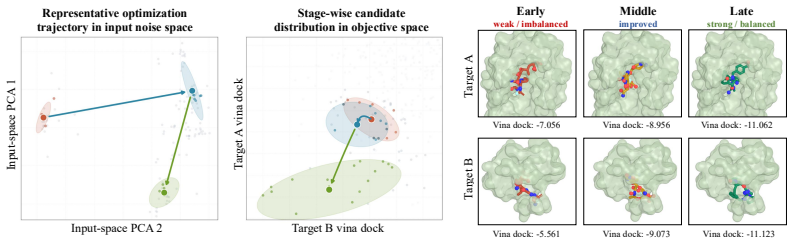
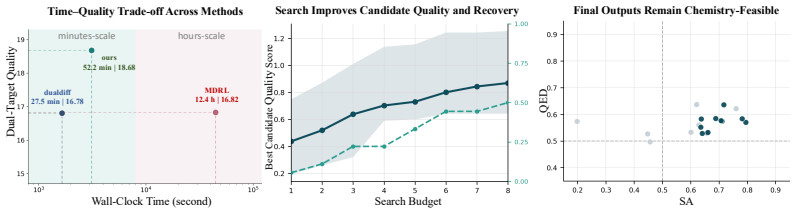
Dual-target candidates can be recovered from the input space of a frozen single-target diffusion model without modifying its parameters or denoising dynamics by formulating the task as constrained multi-objective optimization and solving it with a hierarchical evolutionary input-space search framework called REUSE that combines pair-conditioned exploration with structured multi-stage selection.
What carries the argument
REUSE, a hierarchical evolutionary input-space search framework that performs pair-conditioned exploration followed by multi-stage selection to enforce dual-target affinity, chemical quality, and diversity.
If this is right
- Dual-target generation becomes possible with any pretrained single-target diffusion model without additional training data or compute for retraining.
- Affinity balance improves because the search directly optimizes the two objectives rather than relying on time-dependent weighting during denoising.
- Molecular quality and diversity remain competitive because the original model's learned prior is left unchanged.
- The approach scales to new target pairs by simply changing the affinity oracles used in the selection stages.
Where Pith is reading between the lines
- The same input-space search idea could be applied to other frozen generative models beyond diffusion, such as autoregressive or flow-based molecule generators.
- If the single-target model was trained on a broad chemical space, the recovered dual-target molecules may inherit better coverage of drug-like regions than models trained from scratch on sparse dual data.
- The method opens a route to multi-target generation by extending the evolutionary search to three or more affinity oracles without retraining.
Load-bearing premise
Molecules that bind both targets at high affinity already exist among the outputs that a single-target diffusion model can produce when its inputs are suitably chosen.
What would settle it
An exhaustive or large-scale search over the input space of the frozen single-target model that finds no molecules simultaneously satisfying high affinity to both targets and the quality filters.
Figures





read the original abstract
Designing a single molecule that modulates two targets is a promising strategy for polypharmacology, but it remains substantially harder than standard single-target generation because one candidate must satisfy two binding requirements while preserving drug-likeness and synthesizability. Existing dual-target generative methods typically introduce dual-target capability by either retraining the generator or intervening in the diffusion process during sampling. The former can be costly and difficult to stabilize when dual-target supervision is sparse, while the latter may be sensitive to denoising-time target balancing and competing update directions. These limitations motivate a generator-preserving alternative that keeps the pretrained prior intact: can dual-target candidates instead be recovered from the input space of a frozen single-target diffusion model, without modifying its parameters or denoising dynamics? We formulate this task as a constrained multi-objective optimization problem and propose REUSE, a hierarchical evolutionary input-space search framework that combines pair-conditioned exploration with structured multi-stage selection to enforce dual-target affinity, chemical quality, and diversity. Experiments show that, compared with methods that modify the diffusion process, REUSE consistently improves dual-target affinity and balance, achieving a 20.9-percentage-point gain in Dual High Affinity over the strongest prior baseline while maintaining competitive molecular quality.
Editorial analysis
A structured set of objections, weighed in public.
Referee Report
Summary. The manuscript proposes REUSE, a hierarchical evolutionary input-space search framework to recover dual-target molecules from a frozen single-target diffusion model without retraining or modifying its parameters or denoising dynamics. It formulates the task as constrained multi-objective optimization combining pair-conditioned exploration and multi-stage selection, and reports that this yields a 20.9-percentage-point gain in Dual High Affinity over the strongest baseline that modifies the diffusion process while preserving competitive molecular quality.
Significance. If the reported gains are reproducible, the result would be significant for polypharmacology applications because it demonstrates a generator-preserving route that avoids the cost and instability of dual-target retraining or denoising-time interventions, allowing reuse of existing single-target diffusion priors via input-space search.
major comments (2)
- [Abstract and Experimental Results] Abstract and Experimental Results: the central quantitative claim of a 20.9-percentage-point gain in Dual High Affinity is presented without any description of dataset splits, baseline implementations, metric definitions for dual affinity, statistical significance testing, or controls for molecular quality, rendering the support for the generator-preserving premise impossible to evaluate.
- [Methods] Methods: the hierarchical evolutionary search, pair-conditioned exploration, and structured multi-stage selection are described at a high level but without concrete algorithmic details, objective functions, or constraint-handling mechanisms, so it is not possible to verify that the approach truly leaves the pretrained diffusion model unmodified during sampling.
minor comments (1)
- Notation for the input-space search variables and the multi-objective formulation could be introduced earlier and used consistently to improve readability.
Simulated Author's Rebuttal
We thank the referee for the constructive feedback highlighting needs for greater clarity in experimental reporting and methods. We address each major comment below and commit to revisions that enhance reproducibility without altering the core claims.
read point-by-point responses
-
Referee: [Abstract and Experimental Results] Abstract and Experimental Results: the central quantitative claim of a 20.9-percentage-point gain in Dual High Affinity is presented without any description of dataset splits, baseline implementations, metric definitions for dual affinity, statistical significance testing, or controls for molecular quality, rendering the support for the generator-preserving premise impossible to evaluate.
Authors: We agree the abstract is concise and omits these specifics. The full experimental results section reports: dataset splits drawn from standard single-target benchmarks (e.g., kinase and GPCR subsets with held-out test molecules); baseline implementations reproduced from the original papers with identical hyperparameters; Dual High Affinity defined as the fraction of generated molecules exceeding affinity thresholds on both targets (using fixed pretrained predictors); statistical significance via means and standard deviations over three independent runs with seed variation; and molecular quality controls via QED, synthetic accessibility, and diversity metrics with explicit comparisons. To improve accessibility, we will expand the abstract with a one-sentence summary of these elements and add explicit cross-references in the results section. This strengthens evaluation of the generator-preserving premise. revision: yes
-
Referee: [Methods] Methods: the hierarchical evolutionary search, pair-conditioned exploration, and structured multi-stage selection are described at a high level but without concrete algorithmic details, objective functions, or constraint-handling mechanisms, so it is not possible to verify that the approach truly leaves the pretrained diffusion model unmodified during sampling.
Authors: We acknowledge the methods section prioritizes high-level description. The manuscript states that the diffusion model is frozen (no parameter changes or denoising modifications), with all adaptation occurring via input-space evolutionary search. In revision we will add: (i) pseudocode for the hierarchical evolutionary algorithm including pair-conditioned mutation and crossover operators; (ii) explicit multi-objective fitness functions combining dual-affinity scores, quality penalties, and diversity terms; (iii) constraint-handling details such as validity checks and rejection of invalid candidates. These additions will confirm that sampling invokes only the unmodified pretrained denoiser on evolved inputs. revision: yes
Circularity Check
No significant circularity
full rationale
The paper's central claim is an empirical performance gain from an evolutionary input-space search (REUSE) over baselines that alter diffusion dynamics, resting on external experimental comparisons of affinity metrics and molecular quality. No load-bearing equations, fitted parameters renamed as predictions, or self-citation chains appear in the provided text; the generator-preserving premise is presented as a methodological motivation rather than a derived result. The derivation chain is therefore self-contained against external benchmarks.
Axiom & Free-Parameter Ledger
axioms (1)
- domain assumption Dual-target candidates can be recovered from the input space of a frozen single-target diffusion model without modifying its parameters or denoising dynamics
Reference graph
Works this paper leans on
-
[1]
Medicinal polypharmacology—a scientific glossary of terminology and concepts.Frontiers in Pharmacology, 15:1419110, 2024
Sven Marcel Stefan and Muhammad Rafehi. Medicinal polypharmacology—a scientific glossary of terminology and concepts.Frontiers in Pharmacology, 15:1419110, 2024
2024
-
[2]
Polypharmacology: new drugs in 2023–2024.Pharmacological Reports, 77(3):543–560, 2025
Piotr Ryszkiewicz, Barbara Malinowska, and Eberhard Schlicker. Polypharmacology: new drugs in 2023–2024.Pharmacological Reports, 77(3):543–560, 2025
2023
-
[3]
Deshaies
Raymond J. Deshaies. How multispecific molecules are transforming pharmacotherapy.Nature Reviews Drug Discovery, 24:945–957, 2025
2025
-
[4]
Repro- gramming pretrained target-specific diffusion models for dual-target drug design
Xiangxin Zhou, Jiaqi Guan, Yijia Zhang, Xingang Peng, Liang Wang, and Jianzhu Ma. Repro- gramming pretrained target-specific diffusion models for dual-target drug design. InAdvances in Neural Information Processing Systems 37 (NeurIPS), volume 37, pages 87255–87281. Curran Associates, Inc., 2024
2024
-
[5]
A 3D genera- tion framework using diffusion model and reinforcement learning to generate multi-target compounds with desired properties.Journal of Cheminformatics, 17(1):93, 2025
Yongna Yuan, Xiaohang Pan, Xiaohong Li, Ruisheng Zhang, and Wei Su. A 3D genera- tion framework using diffusion model and reinforcement learning to generate multi-target compounds with desired properties.Journal of Cheminformatics, 17(1):93, 2025
2025
-
[6]
Blundell, Pietro Lio, Max Welling, Michael Bronstein, and Bruno Correia
Arne Schneuing, Charles Harris, Yuanqi Du, Kieran Didi, Arian Jamasb, Ilia Igashov, Weitao Du, Carla Gomes, Tom L. Blundell, Pietro Lio, Max Welling, Michael Bronstein, and Bruno Correia. Structure-based drug design with equivariant diffusion models.Nature Computational Science, 4:899–909, 2024
2024
-
[7]
A survey of generative AI for de novo drug design: new frontiers in molecule and protein generation.Briefings in Bioinformatics, 25(4):bbae338, 2024
Xiangru Tang, Howard Dai, Elizabeth Knight, Fang Wu, Yunyang Li, Tianxiao Li, and Mark Gerstein. A survey of generative AI for de novo drug design: new frontiers in molecule and protein generation.Briefings in Bioinformatics, 25(4):bbae338, 2024
2024
-
[8]
Enabling multi-target drug discovery through latent evolutionary optimization and synthesis-aware prioritization (EVOSYNTH)
Viet Thanh Duy Nguyen, Phuc Pham, and Truong-Son Hy. Enabling multi-target drug discovery through latent evolutionary optimization and synthesis-aware prioritization (EVOSYNTH). Communications Chemistry, 9:133, 2026
2026
-
[9]
Wei, David Duvenaud, José Miguel Hernández-Lobato, Benjamín Sánchez-Lengeling, Dennis Sheberla, Jorge Aguilera-Iparraguirre, Timothy D
Rafael Gómez-Bombarelli, Jennifer N. Wei, David Duvenaud, José Miguel Hernández-Lobato, Benjamín Sánchez-Lengeling, Dennis Sheberla, Jorge Aguilera-Iparraguirre, Timothy D. Hirzel, Ryan P. Adams, and Alán Aspuru-Guzik. Automatic chemical design using a data-driven continuous representation of molecules.ACS Central Science, 4(2):268–276, 2018
2018
-
[10]
Efficient multi-objective molecular optimization in a continuous latent space.Chemical Science, 10(34):8016–8024, 2019
Robin Winter, Floriane Montanari, Andreas Steffen, Hans Briem, Frank Noé, and Djork-Arné Clevert. Efficient multi-objective molecular optimization in a continuous latent space.Chemical Science, 10(34):8016–8024, 2019
2019
-
[11]
Urban, M
A N M Nafiz Abeer, Nathan M. Urban, M. Ryan Weil, Francis J. Alexander, and Byung-Jun Yoon. Multi-objective latent space optimization of generative molecular design models.Patterns, 5(10):101042, 2024
2024
-
[12]
Lillich, Johanna H
Laura Isigkeit, Tim Hörmann, Espen Schallmayer, Katharina Scholz, Felix F. Lillich, Johanna H. M. Ehrler, Benedikt Hufnagel, Jasmin Büchner, Julian A. Marschner, Jörg Pabel, Ewgenij Proschak, and Daniel Merk. Automated design of multi-target ligands by generative deep learning.Nature Communications, 15:7946, 2024
2024
-
[13]
MTMol- GPT: De novo multi-target molecular generation with transformer-based generative adversarial imitation learning.PLOS Computational Biology, 20(6):e1012229, 2024
Chengwei Ai, Hongpeng Yang, Xiaoyi Liu, Ruihan Dong, Yijie Ding, and Fei Guo. MTMol- GPT: De novo multi-target molecular generation with transformer-based generative adversarial imitation learning.PLOS Computational Biology, 20(6):e1012229, 2024
2024
-
[14]
A dual diffusion model enables 3D molecule generation and lead optimization based on target pockets.Nature Communications, 15:2657, 2024
Lei Huang, Tingyang Xu, Yang Yu, Peilin Zhao, Xingjian Chen, Jing Han, Zhi Xie, Hailong Li, Wenge Zhong, Ka-Chun Wong, and Hengtong Zhang. A dual diffusion model enables 3D molecule generation and lead optimization based on target pockets.Nature Communications, 15:2657, 2024
2024
-
[15]
PocketFlow is a data-and- knowledge-driven structure-based molecular generative model.Nature Machine Intelligence, 6:326–337, 2024
Yuanyuan Jiang, Guo Zhang, Jing You, Hailin Zhang, Rui Yao, Huanzhang Xie, Liyun Zhang, Ziyi Xia, Mengzhe Dai, Yunjie Wu, Linli Li, and Shengyong Yang. PocketFlow is a data-and- knowledge-driven structure-based molecular generative model.Nature Machine Intelligence, 6:326–337, 2024. 10
2024
-
[16]
Target-aware 3D molecular generation based on guided equivariant diffusion.Nature Communications, 16:7928, 2025
Qiaoyu Hu, Changzhi Sun, Huan He, Jiazheng Xu, Danlin Liu, Wenqing Zhang, Sumeng Shi, Kai Zhang, and Honglin Li. Target-aware 3D molecular generation based on guided equivariant diffusion.Nature Communications, 16:7928, 2025
2025
-
[17]
Pocket2Mol: Effi- cient molecular sampling based on 3D protein pockets
Xingang Peng, Shitong Luo, Jiaqi Guan, Qi Xie, Jian Peng, and Jianzhu Ma. Pocket2Mol: Effi- cient molecular sampling based on 3D protein pockets. InProceedings of the 39th International Conference on Machine Learning (ICML), volume 162 ofProceedings of Machine Learning Research, pages 17644–17655. PMLR, 2022
2022
-
[18]
3D equivariant diffusion for target-aware molecule generation and affinity prediction
Jiaqi Guan, Wesley Wei Qian, Xingang Peng, Yufeng Su, Jian Peng, and Jianzhu Ma. 3D equivariant diffusion for target-aware molecule generation and affinity prediction. InThe Eleventh International Conference on Learning Representations (ICLR), 2023
2023
-
[19]
DecompDiff: Diffusion models with decomposed priors for structure- based drug design
Jiaqi Guan, Xiangxin Zhou, Yuwei Yang, Yu Bao, Jian Peng, Jianzhu Ma, Qiang Liu, Liang Wang, and Quanquan Gu. DecompDiff: Diffusion models with decomposed priors for structure- based drug design. InProceedings of the 40th International Conference on Machine Learning (ICML), volume 202 ofProceedings of Machine Learning Research, pages 11827–11846. PMLR, 2023
2023
-
[20]
MolDiff: Addressing the atom- bond inconsistency problem in 3D molecule diffusion generation
Xingang Peng, Jiaqi Guan, Qiang Liu, and Jianzhu Ma. MolDiff: Addressing the atom- bond inconsistency problem in 3D molecule diffusion generation. InProceedings of the 40th International Conference on Machine Learning (ICML), volume 202 ofProceedings of Machine Learning Research, pages 27611–27629. PMLR, 2023
2023
-
[21]
Learning subpocket prototypes for generalizable structure-based drug design
Zaixi Zhang and Qi Liu. Learning subpocket prototypes for generalizable structure-based drug design. InProceedings of the 40th International Conference on Machine Learning (ICML), volume 202 ofProceedings of Machine Learning Research, pages 41382–41398. PMLR, 2023
2023
-
[22]
Munson, Michael Chen, Audrey Bogosian, Jason F
Brenton P. Munson, Michael Chen, Audrey Bogosian, Jason F. Kreisberg, Katherine Licon, Ruben Abagyan, Brent M. Kuenzi, and Trey Ideker. De novo generation of multi-target compounds using deep generative chemistry.Nature Communications, 15:3636, 2024
2024
-
[23]
Richard Bickerton, Gaia V
G. Richard Bickerton, Gaia V . Paolini, Jérémy Besnard, Sorel Muresan, and Andrew L. Hopkins. Quantifying the chemical beauty of drugs.Nature Chemistry, 4(2):90–98, 2012
2012
-
[24]
Estimation of synthetic accessibility score of drug-like molecules based on molecular complexity and fragment contributions.Journal of Cheminfor- matics, 1(1):8, 2009
Peter Ertl and Ansgar Schuffenhauer. Estimation of synthetic accessibility score of drug-like molecules based on molecular complexity and fragment contributions.Journal of Cheminfor- matics, 1(1):8, 2009
2009
-
[25]
Extended-connectivity fingerprints.Journal of Chemical Information and Modeling, 50(5):742–754, 2010
David Rogers and Mathew Hahn. Extended-connectivity fingerprints.Journal of Chemical Information and Modeling, 50(5):742–754, 2010
2010
-
[26]
DrugComb update: a more comprehensive drug sensitivity data repository and analysis portal.Nucleic Acids Research, 49(W1):W174–W184, 2021
Shuyu Zheng, Jehad Aldahdooh, Tolou Shadbahr, Yinyin Wang, Dalal Aldahdooh, Jie Bao, Wenyu Wang, and Jing Tang. DrugComb update: a more comprehensive drug sensitivity data repository and analysis portal.Nucleic Acids Research, 49(W1):W174–W184, 2021
2021
-
[27]
PDB-wide collection of binding data: current status of the PDBbind database
Zhihai Liu, Yan Li, Li Han, Jie Li, Jie Liu, Zhixiong Zhao, Wei Nie, Yuchen Liu, and Renx- iao Wang. PDB-wide collection of binding data: current status of the PDBbind database. Bioinformatics, 31(3):405–412, 2015
2015
-
[28]
Berman, John Westbrook, Zukang Feng, Gary Gilliland, T
Helen M. Berman, John Westbrook, Zukang Feng, Gary Gilliland, T. N. Bhat, Helge Weissig, Ilya N. Shindyalov, and Philip E. Bourne. The Protein Data Bank.Nucleic Acids Research, 28(1):235–242, 2000
2000
-
[29]
AlphaFold protein structure database: massively expanding the structural coverage of protein-sequence space with high-accuracy models.Nucleic Acids Research, 50(D1):D439–D444, 2022
Mihaly Varadi, Stephen Anyango, Mandar Deshpande, Sreenath Nair, Cindy Natassia, Galabina Yordanova, David Yuan, Oana Stroe, Gemma Wood, Agata Laydon, Augustin Žídek, Tim Green, Kathryn Tunyasuvunakool, Stig Petersen, John Jumper, Ellen Clancy, Richard Green, Ankur V ora, Mira Lutfi, Michael Figurnov, Andrew Cowie, Nicole Hobbs, Pushmeet Kohli, Gerard Kle...
2022
-
[30]
P2Rank: machine learning based tool for rapid and accurate prediction of ligand binding sites from protein structure.Journal of Cheminformatics, 10(1):39, 2018
Radoslav Krivák and David Hoksza. P2Rank: machine learning based tool for rapid and accurate prediction of ligand binding sites from protein structure.Journal of Cheminformatics, 10(1):39, 2018
2018
-
[31]
Oleg Trott and Arthur J. Olson. AutoDock Vina: improving the speed and accuracy of docking with a new scoring function, efficient optimization, and multithreading.Journal of Computa- tional Chemistry, 31(2):455–461, 2010
2010
-
[32]
Equivariant 3D-conditional diffusion model for molecular linker design.Nature Machine Intelligence, 6:417–427, 2024
Ilia Igashov, Hannes Stärk, Clément Vignac, Arne Schneuing, Victor Garcia Satorras, Pascal Frossard, Max Welling, Michael Bronstein, and Bruno Correia. Equivariant 3D-conditional diffusion model for molecular linker design.Nature Machine Intelligence, 6:417–427, 2024
2024
-
[33]
LinkerNet: Fragment poses and linker co-design with 3D equivariant diffusion
Jiaqi Guan, Xingang Peng, Peiqi Jiang, Yunan Luo, Jian Peng, and Jianzhu Ma. LinkerNet: Fragment poses and linker co-design with 3D equivariant diffusion. InAdvances in Neural Infor- mation Processing Systems 36 (NeurIPS), volume 36, pages 77503–77519. Curran Associates, Inc., 2023
2023
-
[34]
Multi-fidelity active learning with GFlowNets.Transactions on Machine Learning Research, 2024
Alex Hernández-García, Nikita Saxena, Moksh Jain, Cheng-Hao Liu, and Yoshua Bengio. Multi-fidelity active learning with GFlowNets.Transactions on Machine Learning Research, 2024
2024
-
[35]
Gilson, and Rose Yu
Peter Eckmann, Dongxia Wu, Germano Heinzelmann, Michael K. Gilson, and Rose Yu. MF- LAL: Drug compound generation using multi-fidelity latent space active learning. InPro- ceedings of the 42nd International Conference on Machine Learning (ICML), volume 267 of Proceedings of Machine Learning Research, pages 14972–14988. PMLR, 2025
2025
-
[36]
Sample-efficient generative molecular design using memory manipulation.Nature Machine Intelligence, 8:449–460, 2026
Jeff Guo, Junwu Chen, Anthony GX-Chen, and Philippe Schwaller. Sample-efficient generative molecular design using memory manipulation.Nature Machine Intelligence, 8:449–460, 2026
2026
-
[37]
Genetic-guided GFlowNets for sample efficient molecular optimization
Hyeonah Kim, Minsu Kim, Sanghyeok Choi, and Jinkyoo Park. Genetic-guided GFlowNets for sample efficient molecular optimization. InAdvances in Neural Information Processing Systems 37 (NeurIPS), volume 37, pages 42618–42648. Curran Associates, Inc., 2024
2024
-
[38]
van der Sloot, Piotr Gai´nski, Yoshua Bengio, Cheng-Hao Liu, Mike Tyers, and Robert A
Michał Koziarski, Andrei Rekesh, Dmytro Shevchuk, Almer M. van der Sloot, Piotr Gai´nski, Yoshua Bengio, Cheng-Hao Liu, Mike Tyers, and Robert A. Batey. RGFN: Synthesizable molecular generation using GFlowNets. InAdvances in Neural Information Processing Systems 37 (NeurIPS), volume 37, pages 46908–46955. Curran Associates, Inc., 2024
2024
-
[39]
Bemis and Mark A
Guy W. Bemis and Mark A. Murcko. The properties of known drugs. 1. molecular frameworks. Journal of Medicinal Chemistry, 39(15):2887–2893, 1996. 12 Overview In this appendix, we provide additional details and supplementary analyses for REUSE, our frame- work for recovering dual-target molecules by searching the input space of a frozen single-target diffus...
1996
-
[40]
Variation in noise space:generate new offspring from selected parents through mutation, crossover, and immigration
-
[41]
Environmental selection:filter decoded molecules under feasibility, affinity, chemistry, and diversity criteria
-
[42]
Operationally, REUSE does not perform a single global panel optimization over the union of all decoded molecules seen across the entire run
Panel construction and incumbent tracking:select a feasible and diverse subset maximiz- ingJ p(S)and keep the best-so-far panel across iterations. Operationally, REUSE does not perform a single global panel optimization over the union of all decoded molecules seen across the entire run. Instead, it constructs a panel from the current iteration’s terminal ...
discussion (0)
Sign in with ORCID, Apple, or X to comment. Anyone can read and Pith papers without signing in.