Gamma-ray Bursts and Kilonovae from Gravitational Wave Events
Pith reviewed 2026-06-26 03:47 UTC · model grok-4.3
The pith
Radio observations remain the most effective method for identifying and tracking gravitational wave merger counterparts over long periods.
A machine-rendered reading of the paper's core claim, the machinery that carries it, and where it could break.
Core claim
Radio emission from gamma-ray burst afterglows, whether on- or off-axis, remains detectable for very long time, making radio observations the most effective method for identifying and tracking gravitational wave merger counterparts. These observations enable precise characterization of system evolution, detailed probing of gamma-ray burst jet structures, and possible detection of misaligned jets once their velocity becomes non-relativistic. Even in its initial configuration the SKAO will provide the sensitivity and field of view needed to complement gravitational wave counterpart searches during the next observing run and beyond.
What carries the argument
The SKAO in its initial configuration, which supplies the sensitivity and field of view required for long-term radio monitoring of gamma-ray burst afterglows from gravitational wave events.
If this is right
- Precise characterization of the evolution of systems producing gravitational wave mergers.
- Detailed probing of gamma-ray burst jet structures through long-term radio data.
- Detection of misaligned jets once their velocity becomes non-relativistic.
- Population studies of the properties of both long and short gamma-ray bursts, their jets, and their environments.
Where Pith is reading between the lines
- Radio monitoring could extend the scientific return from next-generation gravitational wave detectors planned for the 2030s by providing extended electromagnetic coverage.
- Long-baseline radio data might reveal new statistical links between kilonova properties and gamma-ray burst jet parameters across large samples.
- The same observations could test whether off-axis events dominate the undetected fraction of short gamma-ray bursts.
Load-bearing premise
The initial SKAO configuration supplies the sensitivity and field of view needed to complement gravitational wave counterpart searches during the next observing run and beyond.
What would settle it
Absence of detectable radio afterglow emission from a confirmed gravitational wave merger event over multi-year timescales would undermine the claim that radio provides the most effective long-term tracking method.
Figures

read the original abstract
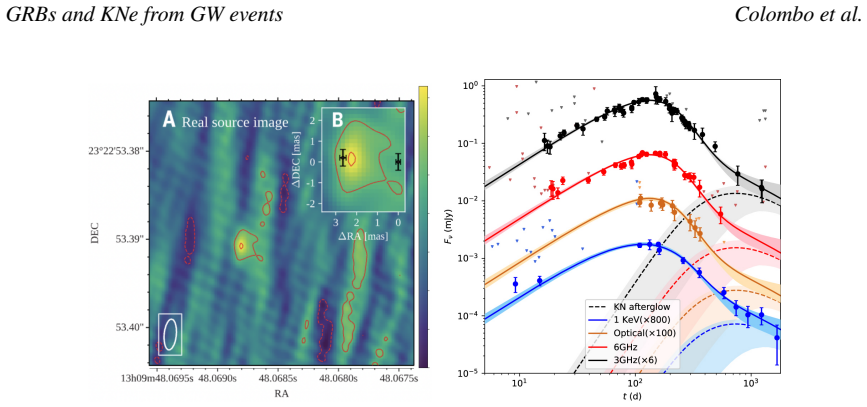
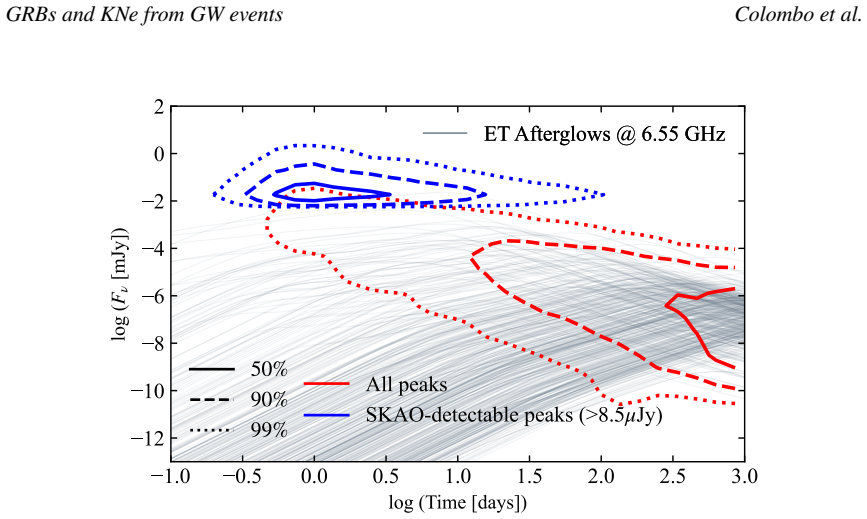
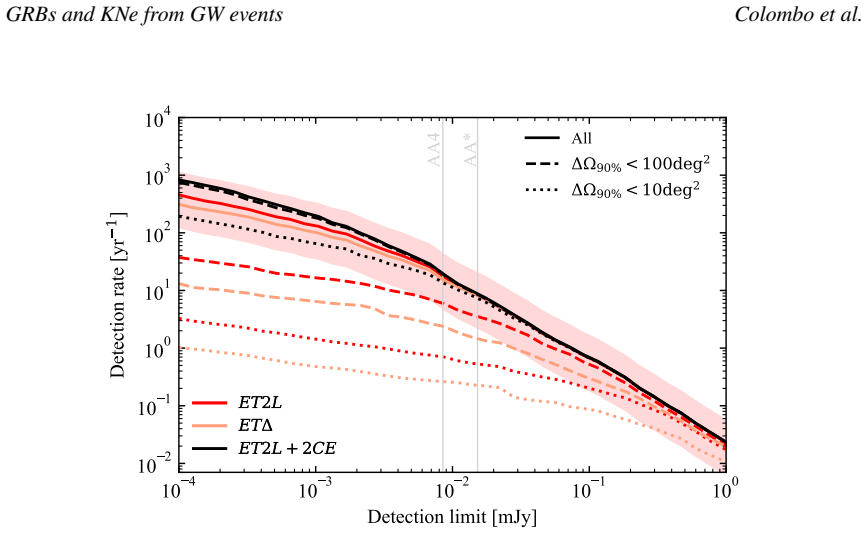
The detection of gravitational waves (GWs) from binary black holes in 2015 and the joint GW-electromagnetic (EM) observation of the binary neutron star merger GW170817 set a milestone in the multimessenger era in astrophysics. After four observing runs by the LIGO, Virgo, and KAGRA interferometers, a new cycle is planned for 2028, paving the way for next-generation detectors in the 2030s -- such as the Einstein Telescope, Cosmic Explorer, and LISA. The prospects for joint GW-EM studies, including kilonova searches in wide optical surveys, are vast but demanding. In the radio domain, connected interferometers and VLBI arrays have already proven essential in constraining the ejecta properties of GW170817. Radio emission from gamma-ray burst (GRB) afterglows, whether on- or off-axis, remains detectable for very long time, making radio observations the most effective method for identifying and tracking GW merger counterparts. These observations enable precise characterization of system evolution, detailed probing of GRB jet structures, and possible detection of misaligned jets once their velocity becomes non-relativistic. Even in its initial configuration (AA*), the SKAO will provide the sensitivity and field of view needed to complement GW counterpart searches during O5 and beyond, offering unmatched capabilities for long-term monitoring. Furthermore, independent of the GW detections, SKAO will enable population studies of the properties of both long (produced by the collapse of massive stars) and short (produced by the merger of neutron stars) GRBs, of their jets and of their environment. We present an overview of this evolving observational landscape and of the key scientific questions SKAO will address.
Editorial analysis
A structured set of objections, weighed in public.
Referee Report
Summary. The paper is a review/overview of the multimessenger prospects for gravitational-wave events from binary neutron star mergers, focusing on associated gamma-ray bursts, kilonovae, and the unique long-term role of radio afterglow observations; it argues that radio remains detectable longest, making it the most effective method for identifying/tracking counterparts and characterizing evolution, and asserts that even the initial AA* SKAO configuration will suffice for O5-era searches while also enabling independent GRB population studies.
Significance. If the descriptive claims hold, the review usefully frames the radio domain's advantages for GW-EM follow-up and SKAO's enabling role in long-term monitoring and GRB jet/environment studies, providing context for planning with upcoming LIGO/Virgo/KAGRA runs and next-generation detectors.
major comments (1)
- [Abstract] Abstract (and corresponding discussion of SKAO capabilities): the central assertion that 'Even in its initial configuration (AA*), the SKAO will provide the sensitivity and field of view needed to complement GW counterpart searches during O5 and beyond' is presented without any quantitative support, such as predicted late-time synchrotron flux densities from standard afterglow models compared against AA* noise levels, integration-time estimates, or direct sensitivity/FOV comparisons versus VLA or MeerKAT; this is load-bearing for the claim that radio observations are the most effective method.
minor comments (1)
- [Abstract] Abstract: minor grammatical phrasing ('remains detectable for very long time') could be tightened for clarity.
Simulated Author's Rebuttal
We thank the referee for their constructive review and for highlighting the need for quantitative support in our claims about SKAO capabilities. We address the major comment below and will revise the manuscript to strengthen the presentation.
read point-by-point responses
-
Referee: [Abstract] Abstract (and corresponding discussion of SKAO capabilities): the central assertion that 'Even in its initial configuration (AA*), the SKAO will provide the sensitivity and field of view needed to complement GW counterpart searches during O5 and beyond' is presented without any quantitative support, such as predicted late-time synchrotron flux densities from standard afterglow models compared against AA* noise levels, integration-time estimates, or direct sensitivity/FOV comparisons versus VLA or MeerKAT; this is load-bearing for the claim that radio observations are the most effective method.
Authors: We agree that the central claim regarding SKAO AA* would be strengthened by explicit quantitative support, as the current text relies on the established longevity of radio afterglow emission without direct sensitivity calculations. In the revised version we will add a dedicated subsection (likely in Section 3 or 4 on observational prospects) that includes: (i) predicted late-time (months to years) synchrotron flux densities for GW170817-like events using standard afterglow models (e.g., with microphysical parameters ε_e=0.1, ε_B=0.01, p=2.2); (ii) direct comparison of these fluxes to the expected rms noise levels and integration times for SKAO AA* at 1.4 GHz and 5 GHz; and (iii) side-by-side sensitivity and field-of-view metrics versus the VLA and MeerKAT. We will also insert a brief parenthetical reference to these calculations in the abstract. This revision directly addresses the load-bearing nature of the claim while preserving the review's overview character. revision: yes
Circularity Check
No circularity: purely descriptive review with no derivations or self-referential reductions
full rationale
The manuscript is an overview paper containing no equations, no fitted parameters, no predictions derived from models, and no derivation chain. All claims (including the SKAO AA* sensitivity statement) are presented as descriptive assertions without reduction to inputs by construction, self-citation load-bearing logic, or renaming of known results. The absence of any mathematical or predictive structure means no steps qualify under the enumerated circularity patterns. This is the expected outcome for a review without new derivations.
Axiom & Free-Parameter Ledger
axioms (1)
- domain assumption Standard assumptions about long-term detectability of GRB afterglows in radio bands from prior events.
Reference graph
Works this paper leans on
-
[1]
doi: 10.1088/0264-9381/ 32/11/115012
J.Aasietal.ClassicalandQuantumGravity,32(11):115012,June2015. doi: 10.1088/0264-9381/ 32/11/115012. A. Abac et al.JCAP, 2026(3):081, Mar
-
[2]
doi: 10.1088/1475-7516/2026/03/081. B. P. Abbott et al.PhRvL, 119(16):161101, Oct. 2017a. doi: 10.1103/PhysRevLett.119.161101. B. P. Abbott et al.ApJL, 848(2):L12, Oct. 2017b. doi: 10.3847/2041-8213/aa91c9. B. P. Abbott et al.Living Reviews in Relativity, 21(1):3, Dec
-
[3]
doi: 10.3847/2041-8213/aad637. L. Amati et al.Experimental Astronomy, 52(3):183–218, Dec
-
[4]
doi: 10.1007/ s10686-021-09807-8. G. E. Anderson et al.MNRAS, 503(3):4372–4386, May 2021a. doi: 10.1093/mnras/stab727. G. E. Anderson et al.PASA, 38:e026, June 2021b. doi: 10.1017/pasa.2021.15. G. E. Anderson et al.ApJ, 994(1):5, Nov
-
[5]
doi: 10.3847/1538-4357/adfed7. A. Andersson et al. InAdvancing Astrophysics with the SKA – II (AASKAII)
-
[6]
doi: 10.3847/1538-4365/ac617c. Y. Aso et al.Phys. Rev. D, 88(4):043007, Aug
-
[7]
doi: 10.1103/PhysRevD.88.043007. A. Balasubramanian et al.ApJL, 914(1):L20, June
-
[8]
doi: 10.3847/2041-8213/abfd38. A. Balasubramanian et al.ApJ, 938(1):12, Oct
-
[9]
doi: 10.3847/1538-4357/ac9133. C. Barbieri et al.A&A, 625:A152, May
-
[10]
doi: 10.1051/0004-6361/201935443. E. Bempong-Manful et al. InAdvancing Astrophysics with the SKA – II (AASKAII)
-
[11]
arXiv search: Report number AASKAII/Bempong-Manful01. M. Branchesi et al.JCAP, 2023(7):068, July
2023
-
[12]
doi: 10.1088/1475-7516/2023/07/068. D. Burlon et al. InAdvancing Astrophysics with the Square Kilometre Array (AASKA14), page 52, Apr
-
[13]
doi: 10.22323/1.215.0052. G. Castignani et al. InAdvancing Astrophysics with the SKA – II (AASKAII)
-
[14]
doi: 10.1093/mnras/stad438. P. Chandra and D. A. Frail.ApJ, 746(2):156, Feb
-
[15]
doi: 10.1088/0004-637X/746/2/156. S. I. Chastain et al.arXiv, art. arXiv:2603.19047, Mar
-
[16]
CherenkovTelescopeArrayConsortiumetal.SciencewiththeCherenkovTelescopeArray.WORLD SCIENTIFIC,
doi: 10.48550/arXiv.2603.19047. CherenkovTelescopeArrayConsortiumetal.SciencewiththeCherenkovTelescopeArray.WORLD SCIENTIFIC,
-
[17]
doi: 10.1142/10986. C. T. Christy et al.arXiv, art. arXiv:2604.27480, Apr
work page internal anchor Pith review Pith/arXiv arXiv doi:10.1142/10986
-
[18]
doi: 10.48550/arXiv.2604.27480. A. Colombo et al.arXiv, art. arXiv:2503.00116, Feb
work page internal anchor Pith review Pith/arXiv arXiv doi:10.48550/arxiv.2604.27480
-
[19]
doi: 10.48550/arXiv.2503.00116. A. Corsi et al.ApJL, 861(1):L10, July
-
[20]
doi: 10.3847/2041-8213/aacdfd. A. Corsi et al.ApJ, 953(2):179, Aug
-
[21]
doi: 10.3847/1538-4357/acd3f2. D. Dobie et al.ApJL, 858(2):L15, May
-
[22]
doi: 10.3847/2041-8213/aac105. D. Dobie et al.MNRAS, 494(2):2449–2464, May
-
[23]
doi: 10.1093/mnras/staa789. D. Dobie et al.MNRAS, 505(2):2647–2661, Aug
-
[24]
doi: 10.1093/mnras/stab1468. D. Dobie et al.MNRAS, 510(3):3794–3805, Mar
-
[25]
doi: 10.1093/mnras/stab3628. F. Fiore et al. In J.-W. A. den Herder, S. Nikzad, and K. Nakazawa, editors,Space Telescopes and Instrumentation 2020: Ultraviolet to Gamma Ray, volume 11444 ofSociety of Photo- Optical Instrumentation Engineers (SPIE) Conference Series, page 114441R, Dec
-
[26]
doi: 10.1117/12.2560680. G. Ghirlanda et al.PASA, 31:e022, May
-
[27]
doi: 10.1017/pasa.2014.14. G. Ghirlanda et al.A&A, 578:A71, June
-
[28]
doi: 10.1051/0004-6361/201526112. G. Ghirlanda et al.Sci, 363(6430):968–971, Mar
-
[29]
doi: 10.1126/science.aau8815. G. Ghirlanda et al.A&A, 689:A175, Sept
-
[30]
doi: 10.1051/0004-6361/202450006. S. Giarratana et al.GCN, 39520:1, Feb
-
[31]
doi: 10.3847/1538-4357/ae4351. A. Hajela et al.ApJL, 927(1):L17, Mar
-
[32]
doi: 10.3847/2041-8213/ac504a. G. Hallinan et al.Sci, 358(6370):1579–1583, Dec
-
[33]
doi: 10.1126/science.aap9855. K. M. Hambleton et al.PASP, 135(1052):105002, Oct
-
[34]
doi: 10.1088/1538-3873/acdb9a. K. Hotokezaka and T. Piran.MNRAS, 450(2):1430–1440, June
-
[35]
doi: 10.1093/mnras/stv620. K. Hotokezaka et al.NatAs, 3:940–944, July
-
[36]
doi: 10.1038/s41550-019-0820-1. Ž. Ivezić et al.ApJ, 873(2):111, Mar
-
[37]
doi: 10.3847/1538-4357/ab042c. E. F. Jiménez-Andrade et al.ApJ, 972(1):89, Sept
-
[38]
doi: 10.3847/1538-4357/ad5b5c. T. Laskar et al.ApJL, 878(1):L26, June
-
[39]
doi: 10.3847/2041-8213/ab2247. T. Laskar et al.ApJL, 946(1):L23, Mar
-
[40]
doi: 10.3847/2041-8213/acbfad. J. K. Leung et al.MNRAS, 503(2):1847–1863, May
-
[41]
doi: 10.1093/mnras/stab326. J. K. Leung et al.MNRAS, 523(3):4029–4048, Aug
-
[42]
doi: 10.1093/mnras/stad1670. A. J. Levan et al.Nature, 626(8000):737–741, Feb
-
[43]
Science with an ngVLA: Radio Emission from Short Gamma-ray Bursts in the Multi-Messenger Era
doi: 10.1038/s41586-023-06759-1. N.M.Lloyd-Ronning.arXiv,art.arXiv:1709.08512,Sept.2017. doi: 10.48550/arXiv.1709.08512. E. Loffredo et al.A&A, 697:A36, May
work page internal anchor Pith review Pith/arXiv arXiv doi:10.1038/s41586-023-06759-1 2017
-
[44]
doi: 10.1051/0004-6361/202452863. V. Mainieri et al.arXiv e-prints, art. arXiv:2403.05398, Mar
-
[45]
doi: 10.48550/arXiv.2403. 05398. A.Marconietal. InC.J.Evans,J.J.Bryant,andK.Motohara,editors,Ground-basedandAirborne Instrumentation for Astronomy IX, volume 12184 ofSociety of Photo-Optical Instrumentation Engineers (SPIE) Conference Series, page 1218424, Aug
-
[46]
doi: 10.1117/12.2628689. T. Mauch et al.ApJ, 888(2):61, Jan
-
[47]
doi: 10.3847/1538-4357/ab5d2d. K. P. Mooley et al.Natur, 561(7723):355–359, Sept. 2018a. doi: 10.1038/s41586-018-0486-3. K. P. Mooley et al.Natur, 554(7691):207–210, Feb. 2018b. doi: 10.1038/nature25452. K. P. Mooley, J. Anderson, and W. Lu.Nature, 610(7931):273–276, Oct
-
[48]
doi: 10.1038/nature10365. K. Nandra et al.arXiv e-prints, art. arXiv:1306.2307, June
work page internal anchor Pith review Pith/arXiv arXiv doi:10.1038/nature10365
-
[49]
doi: 10.48550/arXiv.1306.2307. L. Resmi.Journal of Astrophysics and Astronomy, 38(3):56, Sept
work page internal anchor Pith review Pith/arXiv arXiv doi:10.48550/arxiv.1306.2307
-
[50]
doi: 10.1093/mnras/stab640. L. Rhodes et al.MNRAS, 533(4):4435–4449, Oct
-
[51]
doi: 10.1093/mnras/stae2050. S. Ronchini et al.A&A, 665:A97, Sept
-
[52]
doi: 10.1051/0004-6361/202243705. G. Schroeder et al.ApJ, 940(1):53, Nov
-
[53]
doi: 10.3847/1538-4357/ac8feb. G. Schroeder et al.ApJ, 970(2):139, Aug
-
[54]
doi: 10.3847/1538-4357/ad49ab. G. Schroeder et al.ApJ, 982(1):42, Mar. 2025a. doi: 10.3847/1538-4357/ada9e5. G. Schroeder et al.ApJ, 995(1):61, Dec. 2025b. doi: 10.3847/1538-4357/ae129b. G. Schroeder et al.ApJ, 998(1):93, Feb
-
[55]
doi: 10.3847/1538-4357/ae3009. The LIGO Scientific Collaboration et al.arXiv e-prints, art. arXiv:2508.18082, Aug
work page internal anchor Pith review Pith/arXiv arXiv doi:10.3847/1538-4357/ae3009
-
[56]
doi: 10.48550/arXiv.2508.18082. E. Troja et al.MNRAS, 489(2):1919–1926, Oct
work page internal anchor Pith review Pith/arXiv arXiv doi:10.48550/arxiv.2508.18082 1919
-
[57]
13 GRBs and KNe from GW events Colombo et al
doi: 10.1093/mnras/stz2248. 13 GRBs and KNe from GW events Colombo et al. C. S. Unnikrishnan.International Journal of Modern Physics D, 22(1):1341010, Jan
-
[58]
doi: 10.1142/S0218271813410101. A. J. van der Horst et al.A&A, 480(1):35–43, Mar
-
[59]
doi: 10.1051/0004-6361:20078051. Y.-Y. Wang, S.-P. Tang, Z.-P. Jin, and Y.-Z. Fan.ApJ, 943(1):13, Jan
-
[60]
doi: 10.3847/ 1538-4357/aca96c. J. Wei et al.arXiv e-prints, art. arXiv:1610.06892, Oct
-
[61]
doi: 10.48550/arXiv.1610.06892. W. Yuan et al.Science China Physics, Mechanics, and Astronomy, 68(3):239501, Mar
work page internal anchor Pith review Pith/arXiv arXiv doi:10.48550/arxiv.1610.06892
-
[62]
doi: 10.1007/s11433-024-2600-3. 14
discussion (0)
Sign in with ORCID, Apple, or X to comment. Anyone can read and Pith papers without signing in.