Conversable Complexity: Agentic LLM Collectives as Interpretable Substrates
Pith reviewed 2026-07-02 12:44 UTC · model grok-4.3
The pith
Collectives of agentic LLMs can serve as a computational substrate for artificial life research because their natural language communication makes collective behavior directly interrogable.
A machine-rendered reading of the paper's core claim, the machinery that carries it, and where it could break.
Core claim
Populations of LLMs display emergent dynamics absent from isolated models when endowed with persistent memory, tools, shared skills, and the capacity to initiate actions unprompted. Because the agents communicate in natural language, their collective behaviour can be directly interrogated by examining textual traces and asking the agents themselves, allowing such collectives to serve as a computational substrate for Artificial Life research.
What carries the argument
Agentic LLM collectives: multiple language models equipped with memory, tools, and action initiation that interact through natural language, turning static models into a substrate whose dynamics can be read from text.
If this is right
- Collective behavior becomes open to direct textual inspection rather than requiring reverse-engineering of internal states.
- Interpretability concepts developed for single language models extend to groups of interacting agents.
- Existing agent collectives already function as working examples of the proposed substrate in both lab and deployed settings.
- ALife experiments can combine rich emergence with the ability to query participants about their own actions.
Where Pith is reading between the lines
- Researchers could design experiments that ask agents to explain group-level patterns after they appear.
- The substrate might allow ALife questions about social coordination or cultural transmission to be studied with readable records.
- If language traces prove insufficient for some dynamics, hybrid observation methods mixing text and internal activations could be tested.
Load-bearing premise
Emergent dynamics produced by LLM agent interactions will stay rich enough to interest ALife researchers while remaining fully accessible and non-misleading through natural language traces.
What would settle it
A controlled demonstration that important collective behaviors in these systems cannot be recovered or verified from their text exchanges or from direct questions posed to the agents.
Figures

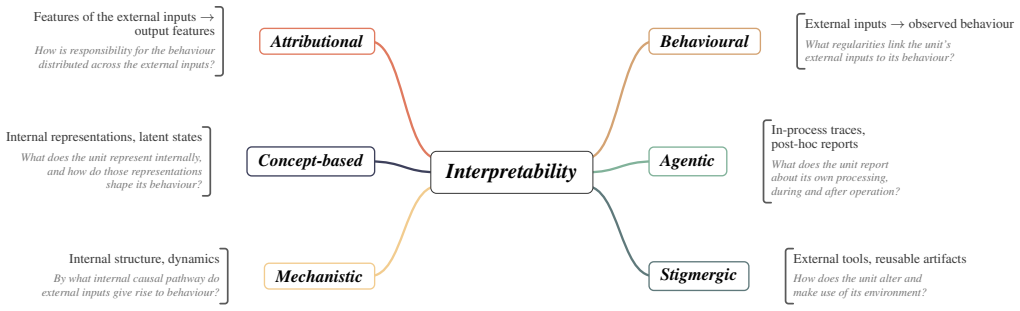
read the original abstract
Complexity and interpretability rarely coincide: systems rich enough for complex behaviours to emerge are usually too opaque to question, while transparent ones are too simple for anything complex to emerge. A single large language model (LLM) is a static artefact, hardly exhibiting any of the emergent properties we associate with life. This changes through interaction: populations of LLMs display emergent dynamics absent from isolated models. Furthermore, LLMs can be endowed with persistent memory, tools and shared skills, and the capacity to initiate actions unprompted, i.e., turning LLMs agentic. In this paper, we argue that such collectives of agents can serve as a computational substrate for Artificial Life (ALife) research. Critically, since the agents communicate in natural language, their collective behaviour can be directly interrogated by examining textual traces and asking the agents themselves. We outline the notion of interpretability in language-model research and extend it for collectives of agents. Lastly, we survey recent examples of agentic LLM collectives that already instantiate the idea of agentic substrates, from controlled experiments to deployments in the wild.
Editorial analysis
A structured set of objections, weighed in public.
Referee Report
Summary. The paper claims that collectives of agentic LLMs—endowed with persistent memory, tools, shared skills, and the capacity for unprompted action—exhibit emergent dynamics absent in isolated models and can serve as a computational substrate for ALife research. Because agents communicate in natural language, collective behavior can be directly interrogated via textual traces and by querying the agents themselves, resolving the usual complexity-interpretability trade-off. The manuscript extends the notion of interpretability to such collectives and surveys recent examples ranging from controlled experiments to real-world deployments.
Significance. If the premise that natural-language traces and agent self-queries yield faithful access to emergent dynamics holds, the proposal could supply an accessible, human-readable platform for studying ALife phenomena such as self-organization and collective behavior. The survey of existing instantiations provides concrete grounding and suggests near-term utility. The conceptual framing is clear, but the manuscript contains no empirical tests or formal analysis, so significance remains prospective.
major comments (1)
- [Abstract] Abstract, paragraph 3: The claim that collective behaviour 'can be directly interrogated by examining textual traces and asking the agents themselves' is load-bearing for the asserted interpretability advantage over traditional substrates. The text does not examine or mitigate the risk that LLM agents will produce post-hoc rationalizations or confabulations diverging from the actual token-level interaction history, a known property of language models. Without proposed validation methods (e.g., consistency checks against full traces or external oracles), the central advantage remains an untested assumption.
minor comments (2)
- The manuscript would benefit from explicit definitions or operational criteria for 'emergent dynamics' and 'agentic' to allow readers to assess when the substrate claim applies.
- Consider situating the proposal against prior ALife work on language-based or symbolic substrates to clarify novelty.
Simulated Author's Rebuttal
We thank the referee for their constructive feedback. The report accurately notes that the manuscript is conceptual rather than empirical and that the interpretability claim rests on an assumption requiring further scrutiny. We address the single major comment below and commit to revisions that qualify the claim and discuss the identified limitation.
read point-by-point responses
-
Referee: [Abstract] Abstract, paragraph 3: The claim that collective behaviour 'can be directly interrogated by examining textual traces and asking the agents themselves' is load-bearing for the asserted interpretability advantage over traditional substrates. The text does not examine or mitigate the risk that LLM agents will produce post-hoc rationalizations or confabulations diverging from the actual token-level interaction history, a known property of language models. Without proposed validation methods (e.g., consistency checks against full traces or external oracles), the central advantage remains an untested assumption.
Authors: We agree that the risk of post-hoc rationalizations is a substantive concern for any claim that agent self-queries provide faithful access to internal dynamics. The manuscript is a position paper surveying the potential of agentic LLM collectives as an ALife substrate; it contains no new empirical tests or formal validation of interpretability. The textual traces themselves constitute a direct, verbatim record of communications and do not rely on agent introspection. When agents are queried for explanations, however, the possibility of confabulation must be acknowledged. In revision we will (1) qualify the abstract sentence to distinguish between trace examination (primary) and agent self-reports (supplementary), and (2) add a dedicated 'Limitations' subsection that explicitly flags the confabulation risk, cites relevant LLM literature, and outlines validation approaches such as trace-consistency checks and external oracles as necessary future work. These changes will make the prospective nature of the interpretability advantage explicit without overstating current evidence. revision: yes
Circularity Check
Conceptual proposal with no equations, fits, or self-referential derivations
full rationale
The paper advances a conceptual argument that collectives of agentic LLMs can function as an ALife substrate because natural-language traces enable direct interrogation of collective behavior. No equations, parameters, fitted quantities, or quantitative predictions appear in the provided text. The central claim does not reduce to a self-definition, a renamed known result, or a load-bearing self-citation chain; the reasoning is presented as an independent proposal rather than a closed loop that reconstructs its own inputs by construction.
Axiom & Free-Parameter Ledger
axioms (2)
- domain assumption Populations of LLMs display emergent dynamics absent from isolated models
- domain assumption Natural language traces allow direct interrogation of collective behaviour without loss of relevant information
Reference graph
Works this paper leans on
-
[1]
, title =
Author, A. , title =. Journal Name , year =
-
[2]
and Author, C
Author, B. and Author, C. , title =. Another Journal , year =
-
[3]
Agents of chaos , author=. arXiv preprint arXiv:2602.20021 , year=
work page internal anchor Pith review Pith/arXiv arXiv
-
[4]
2026 , eprint=
The Moltbook Observatory Archive: an incremental dataset of agent-only social network activity , author=. 2026 , eprint=
2026
-
[5]
arXiv preprint arXiv:2603.16910 , year=
TerraLingua: Emergence and Analysis of Open-endedness in LLM Ecologies , author=. arXiv preprint arXiv:2603.16910 , year=
-
[6]
arXiv preprint arXiv:2601.10567 , year=
Generative AI collective behavior needs an interactionist paradigm , author=. arXiv preprint arXiv:2601.10567 , year=
-
[7]
Artificial Life Conference Proceedings 37 , volume=
Spore in the Wild: A Case Study of Spore.fun as an Open-Environment Evolution Experiment with Sovereign AI Agents on TEE-Secured Blockchains , author=. Artificial Life Conference Proceedings 37 , volume=. 2025 , publisher=
2025
-
[8]
arXiv preprint arXiv:2602.14951 , year=
Sovereign Agents: Towards Infrastructural Sovereignty and Diffused Accountability in Decentralized AI , author=. arXiv preprint arXiv:2602.14951 , year=
-
[9]
and Christakis, Nicholas A
Grossmann, Igor and Feinberg, Matthew and Parker, Dawn C. and Christakis, Nicholas A. and Tetlock, Philip E. and Cunningham, William A. , title =. Science , volume =. 2023 , month = jun, issn =
2023
-
[10]
Ashery, Ariel Flint and Aiello, Luca Maria and Baronchelli, Andrea , title =. Sci. Adv. , volume =. 2025 , month = may, issn =
2025
-
[11]
Artificial Life , volume=
Open problems in artificial life , author=. Artificial Life , volume=. 2000 , publisher=
2000
-
[12]
Artificial Intelligence , volume=
Explanation in artificial intelligence: Insights from the social sciences , author=. Artificial Intelligence , volume=. 2019 , publisher=
2019
-
[13]
Towards A Rigorous Science of Interpretable Machine Learning
Towards a rigorous science of interpretable machine learning , author=. arXiv preprint arXiv:1702.08608 , year=
work page internal anchor Pith review Pith/arXiv arXiv
-
[14]
Advances in Neural Information Processing Systems , volume=
Examples are not enough, learn to criticize! Criticism for interpretability , author=. Advances in Neural Information Processing Systems , volume=. 2016 , url=
2016
-
[15]
Mechanistic Interpretability for
Bereska, Leonard and Gavves, Efstratios , year =. Mechanistic Interpretability for. Transactions on Machine Learning Research , url =
-
[16]
and Ameisen, Emmanuel and Chen, James and Kishylau, Dzmitry and Pearce, Adam and Tarng, Julius and Wu, Alex and Wu, Jeff and Zhang, Yang and Ziegler, Daniel M
Fraser-Taliente, Kit and Kantamneni, Subhash and Ong, Euan and Mossing, Dan and Lu, Christina and Bogdan, Paul C. and Ameisen, Emmanuel and Chen, James and Kishylau, Dzmitry and Pearce, Adam and Tarng, Julius and Wu, Alex and Wu, Jeff and Zhang, Yang and Ziegler, Daniel M. and Hubinger, Evan and Batson, Joshua and Lindsey, Jack and Zimmerman, Samuel and M...
2026
-
[17]
2023 , url =
Neuronpedia: Interactive Reference and Tooling for Analyzing Neural Networks , author =. 2023 , url =
2023
-
[18]
Transformer Circuits Thread , year =
In-context Learning and Induction Heads , author =. Transformer Circuits Thread , year =
-
[19]
Transformer Circuits Thread , year =
On the Biology of a Large Language Model , author =. Transformer Circuits Thread , year =
-
[20]
and McDougall, Callum and MacDiarmid, Monte and Freeman, C
Templeton, Adly and Conerly, Tom and Marcus, Jonathan and Lindsey, Jack and Bricken, Trenton and Chen, Brian and Pearce, Adam and Citro, Craig and Ameisen, Emmanuel and Jones, Andy and Cunningham, Hoagy and Turner, Nicholas L. and McDougall, Callum and MacDiarmid, Monte and Freeman, C. Daniel and Sumers, Theodore R. and Rees, Edward and Batson, Joshua and...
2024
-
[21]
Findings of the Association for Computational Linguistics: ACL 2023 , pages=
Discovering Language Model Behaviors with Model-Written Evaluations , author=. Findings of the Association for Computational Linguistics: ACL 2023 , pages=. 2023 , eprint=
2023
-
[22]
Proceedings of the 7th BlackboxNLP Workshop: Analyzing and Interpreting Neural Networks for NLP , pages=
Attribution Patching Outperforms Automated Circuit Discovery , author=. Proceedings of the 7th BlackboxNLP Workshop: Analyzing and Interpreting Neural Networks for NLP , pages=. 2024 , eprint=
2024
-
[23]
2020 , publisher =
Model Organisms , author =. 2020 , publisher =
2020
-
[24]
2016 , publisher =
Data-Centric Biology: A Philosophical Study , author =. 2016 , publisher =
2016
-
[25]
2010 , publisher =
Science in the Age of Computer Simulation , author =. 2010 , publisher =
2010
-
[26]
2013 , publisher =
Simulation and Similarity: Using Models to Understand the World , author =. 2013 , publisher =
2013
-
[27]
Artificial Life: The Proceedings of an Interdisciplinary Workshop on the Synthesis and Simulation of Living Systems , editor =
Artificial Life , author =. Artificial Life: The Proceedings of an Interdisciplinary Workshop on the Synthesis and Simulation of Living Systems , editor =
-
[28]
Advances in neural information processing systems , volume=
Language models are few-shot learners , author=. Advances in neural information processing systems , volume=
-
[29]
Synthese , volume =
Gr. Synthese , volume =. 2009 , month = aug, issn =
2009
-
[30]
and Axtell, Robert L
Epstein, Joshua M. and Axtell, Robert L. , title =. MIT Press , year =
-
[31]
SpringerLink , pages =
Axelrod, Robert , title =. SpringerLink , pages =. 1997 , isbn =
1997
-
[32]
MIT Press , year =
Nisioti, Eleni and Risi, Sebastian and Momennejad, Ida and Oudeyer, Pierre-Yves and Moulin-Frier, Cl. MIT Press , year =
-
[33]
Nature human behaviour , volume=
How large language models can reshape collective intelligence , author=. Nature human behaviour , volume=. 2024 , publisher=
2024
-
[34]
Artificial Life Conference Proceedings 36 , volume=
From text to life: On the reciprocal relationship between artificial life and large language models , author=. Artificial Life Conference Proceedings 36 , volume=. 2024 , organization=
2024
-
[35]
The Past, Present, and Future of Artificial Life , journal =
Aguilar, Wendy and Santamar. The Past, Present, and Future of Artificial Life , journal =. 2014 , volume =
2014
-
[36]
and Varela, Francisco J
Maturana, Humberto R. and Varela, Francisco J. , title =. 1980 , doi =
1980
-
[37]
, title =
Beer, Randall D. , title =. Artificial Life , year =
-
[38]
and Ay, Nihat , title =
Krakauer, David and Bertschinger, Nils and Olbrich, Eckehard and Flack, Jessica C. and Ay, Nihat , title =. Theory in Biosciences , year =
-
[39]
, title =
Ray, Thomas S. , title =. Artificial Life II , editor =. 1991 , pages =
1991
-
[40]
, title =
Ofria, Charles and Wilke, Claus O. , title =. Artificial Life , year =
-
[41]
La reconstruction du nid et les coordinations interindividuelles chez
Grass. La reconstruction du nid et les coordinations interindividuelles chez. Insectes Sociaux , year =
-
[42]
Artificial Life , year =
Theraulaz, Guy and Bonabeau, Eric , title =. Artificial Life , year =
-
[43]
Proceedings of the 21st Annual Conference on Computer Graphics and Interactive Techniques (SIGGRAPH '94) , year =
Sims, Karl , title =. Proceedings of the 21st Annual Conference on Computer Graphics and Interactive Techniques (SIGGRAPH '94) , year =
-
[44]
Complex Systems , year =
Chan, Bert Wang-Chak , title =. Complex Systems , year =
-
[45]
The Major Transitions in Evolution , publisher =
Maynard Smith, John and Szathm. The Major Transitions in Evolution , publisher =. 1995 , isbn =
1995
-
[46]
Physica D: Nonlinear Phenomena , year =
Harnad, Stevan , title =. Physica D: Nonlinear Phenomena , year =
-
[47]
2015 , publisher =
Steels, Luc , title =. 2015 , publisher =
2015
-
[48]
Proceedings of the National Academy of Sciences , year =
Kirby, Simon and Cornish, Hannah and Smith, Kenny , title =. Proceedings of the National Academy of Sciences , year =
-
[49]
and Stanton, Adam and Timperley, Christopher and Vostinar, Anya and Wiser, Michael , title =
Taylor, Tim and Bedau, Mark and Channon, Alastair and Ackley, David and Banzhaf, Wolfgang and Beslon, Guillaume and Dolson, Emily and Froese, Tom and Hickinbotham, Simon and Ikegami, Takashi and McMullin, Barry and Packard, Norman and Rasmussen, Steen and Virgo, Nathaniel and Agmon, Eran and Clark, Edward and McGregor, Simon and Ofria, Charles and Ropella...
-
[50]
, title =
Lehman, Joel and Stanley, Kenneth O. , title =. Evolutionary Computation , year =
-
[51]
and Isola, Phillip and Ha, David , title =
Kumar, Akarsh and Lu, Chris and Kirsch, Louis and Tang, Yujin and Stanley, Kenneth O. and Isola, Phillip and Ha, David , title =. Artificial Life , year =
-
[52]
and Maturana, Humberto R
Varela, Francisco G. and Maturana, Humberto R. and Uribe, Ricardo , title =. BioSystems , year =
-
[53]
, title =
McMullin, Barry and Varela, Francisco J. , title =. Proceedings of the Fourth European Conference on Artificial Life (ECAL97) , editor =. 1997 , pages =
1997
-
[54]
and Barandiaran, Xabier E
Egbert, Matthew D. and Barandiaran, Xabier E. and Di Paolo, Ezequiel A. , title =. PLoS Computational Biology , year =
-
[55]
and Knoester, David B
Goldsby, Heather J. and Knoester, David B. and Ofria, Charles and Kerr, Benjamin , title =. PLoS Biology , year =
-
[56]
2002 , isbn =
Simulating the Evolution of Language , publisher =. 2002 , isbn =
2002
-
[57]
, title =
Varela, Francisco J. , title =. 1979 , isbn =
1979
-
[58]
, title =
Beer, Randall D. , title =. Adaptive Behavior , year =
-
[59]
2010 , isbn =
Adamatzky, Andrew , title =. 2010 , isbn =
2010
-
[60]
Flow-Lenia: Towards Open-Ended Evolution in Cellular Automata through Mass Conservation and Parameter Localization , booktitle =
Plantec, Erwan and Hamon, Gautier and Etcheverry, Mayalen and Oudeyer, Pierre-Yves and Moulin-Frier, Cl. Flow-Lenia: Towards Open-Ended Evolution in Cellular Automata through Mass Conservation and Parameter Localization , booktitle =. 2023 , doi =
2023
-
[61]
Artificial Life III , editor =
Yaeger, Larry , title =. Artificial Life III , editor =. 1994 , publisher =
1994
-
[62]
Advances in Artificial Life: Proceedings of the Sixth European Conference on Artificial Life (ECAL 2001) , editor =
Channon, Alastair , title =. Advances in Artificial Life: Proceedings of the Sixth European Conference on Artificial Life (ECAL 2001) , editor =. 2001 , publisher =
2001
-
[63]
and Stanley, Kenneth O
Soros, Lisa B. and Stanley, Kenneth O. , title =. Artificial Life 14: Proceedings of the Fourteenth International Conference on the Synthesis and Simulation of Living Systems , editor =. 2014 , publisher =
2014
-
[64]
and Rodriguez, Adelein and Campbell, Adam and Folsom-Kovarik, Jeremiah T
Secretan, Jimmy and Beato, Nicholas and D'Ambrosio, David B. and Rodriguez, Adelein and Campbell, Adam and Folsom-Kovarik, Jeremiah T. and Stanley, Kenneth O. , title =. Evolutionary Computation , year =
-
[65]
Philosophy of biology , pages=
Artificial life , author=. Philosophy of biology , pages=. 2007 , publisher=
2007
-
[66]
Journal of Mathematical Sociology , year=
Dynamic models of segregation , author=. Journal of Mathematical Sociology , year=
-
[67]
Proceedings of the 14th annual conference on Computer graphics and interactive techniques , pages=
Flocks, herds and schools: A distributed behavioral model , author=. Proceedings of the 14th annual conference on Computer graphics and interactive techniques , pages=
-
[68]
Neural MMO: A Massively Multiagent Game Environment for Training and Evaluating Intelligent Agents
Neural MMO: A massively multiagent game environment for training and evaluating intelligent agents , author=. arXiv preprint arXiv:1903.00784 , year=
work page internal anchor Pith review Pith/arXiv arXiv 1903
-
[69]
Science Robotics , volume=
A cellular platform for the development of synthetic living machines , author=. Science Robotics , volume=. 2021 , publisher=
2021
-
[70]
Nature , volume=
Automatic design and manufacture of robotic lifeforms , author=. Nature , volume=. 2000 , publisher=
2000
-
[71]
Nature , volume=
Design, fabrication and control of soft robots , author=. Nature , volume=. 2015 , publisher=
2015
-
[72]
Science , volume=
Programmable self-assembly in a thousand-robot swarm , author=. Science , volume=. 2014 , publisher=
2014
- [73]
-
[74]
Kumar, Akarsh and Bahlous-Boldi, Ryan and Sharma, Prafull and Isola, Phillip and Risi, Sebastian and Tang, Yujin and Ha, David , title =. arXiv , year =. 2601.03335 , doi =
-
[75]
Dewdney, A. K. , title =. Sci. Am. , year =
-
[76]
and Bernard, Samuel and Beslon, Guillaume and Bryson, David M
Lehman, Joel and Clune, Jeff and Misevic, Dusan and Adami, Christoph and Altenberg, Lee and Beaulieu, Julie and Bentley, Peter J. and Bernard, Samuel and Beslon, Guillaume and Bryson, David M. and Chrabaszcz, Patryk and Cheney, Nick and Cully, Antoine and Doncieux, Stephane and Dyer, Fred C. and Ellefsen, Kai Olav and Feldt, Robert and Fischer, Stephan an...
-
[77]
Passive dynamic walking , author=. Int. J. Robotics Res. , volume=
-
[78]
The American Naturalist , volume=
Niche construction , author=. The American Naturalist , volume=. 1996 , publisher=
1996
-
[79]
2025 , eprint=
Because we have LLMs, we Can and Should Pursue Agentic Interpretability , author=. 2025 , eprint=
2025
-
[80]
Proceedings of the 36th annual acm symposium on user interface software and technology , pages=
Generative agents: Interactive simulacra of human behavior , author=. Proceedings of the 36th annual acm symposium on user interface software and technology , pages=
discussion (0)
Sign in with ORCID, Apple, or X to comment. Anyone can read and Pith papers without signing in.