A Deployment Audit of Release-Side Risk in Conformal Triage under Prevalence Shift
Pith reviewed 2026-05-21 06:10 UTC · model grok-4.3
The pith
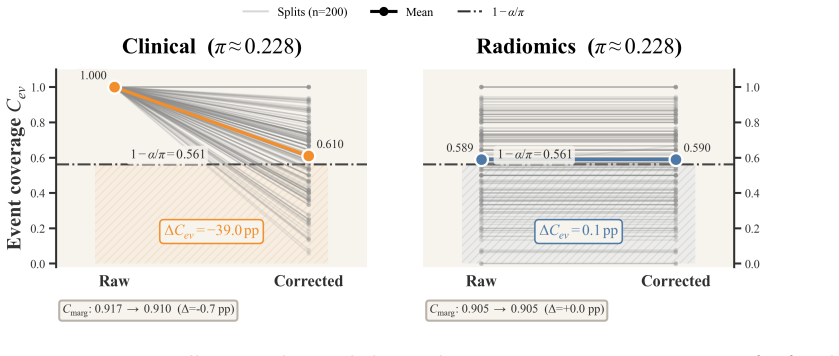
Prevalence-corrected conformal triage lowers review rates by releasing some event-positive patients without review.
A machine-rendered reading of the paper's core claim, the machinery that carries it, and where it could break.
Core claim
By partitioning subjects into prevalence-correction, conformal-calibration, and held-out evaluation sets, the audit can evaluate release actions directly: after prevalence correction the pooled conformal branch reduces human review volume yet releases additional event-positive patients without review, and the classwise branch functions as a scarcity diagnostic revealing that the pilot lacks sufficient event labels to certify safe low-review deployment.
What carries the argument
Leakage-aware deployment audit that assigns target subjects to three non-overlapping roles—prevalence correction, conformal calibration, and held-out release-safety evaluation—to measure event-positive releases without review.
If this is right
- After prevalence correction the pooled conformal branch reduces review volume by releasing more patients, some of whom are event-positive.
- The classwise conformal branch diagnoses when a pilot has too few event labels to certify safe low-review release.
- Standard marginal coverage and review-rate summaries miss the safety question of whether true event-positive cases are cleared without review.
- Role separation supports unbiased evaluation of release safety under prevalence shift.
Where Pith is reading between the lines
- The same audit structure could be used in other clinical prediction tasks to check for hidden release of high-risk cases after prevalence adjustment.
- Conformal triage deployments may need explicit checks for both prevalence shift and label sufficiency before moving to low-review operation.
- Pilots aiming for reduced review should first verify they hold enough event-positive labels in the calibration partition.
Load-bearing premise
Partitioning subjects into three non-overlapping roles for prevalence correction, calibration, and evaluation prevents leakage and permits unbiased counting of event-positive patients released without review.
What would settle it
Re-applying the audit to the same NSCLC pilot data and counting zero event-positive patients released without review in the held-out set under the prevalence-corrected pooled conformal branch would show the reported risk does not appear.
Figures



read the original abstract
Conformal triage converts predictive scores into deployment actions that either release a case, flag it for urgent attention, or defer it to human review. Under prevalence shift, however, the usual summaries of marginal coverage and human-review rate can miss the safety-critical question of whether patients who truly experience the target event are released without review. To address this gap, we introduce a leakage-aware deployment audit for release-side conformal triage. It first assigns target subjects to three non-overlapping roles: prevalence correction, conformal calibration, and held-out release-safety evaluation. This separation then lets the audit evaluate release directly: how many event-positive patients are cleared without review, whether the pilot has enough event labels for calibration, and how the safety-review trade-off shifts. Applying this audit to a retrospective NSCLC pilot shows why lower review can be misleading: after prevalence correction, the pooled conformal branch lowers review by releasing more patients, some of whom are event-positive. Within the audit, the classwise branch acts as a scarcity diagnostic: the pilot has too few event labels to certify safe low-review release.
Editorial analysis
A structured set of objections, weighed in public.
Referee Report
Summary. The paper introduces a leakage-aware deployment audit for conformal triage under prevalence shift. Target subjects are partitioned into three non-overlapping roles (prevalence correction, conformal calibration, and held-out release-safety evaluation) to directly assess whether event-positive patients are released without review. In a retrospective NSCLC pilot, the audit shows that after prevalence correction the pooled conformal branch lowers review rates by releasing additional patients including some event-positives, while the classwise branch diagnoses insufficient event labels to certify safe low-review release.
Significance. If the audit holds, the work fills an important gap by focusing on release-side safety for true event-positives rather than marginal coverage or review rates alone. The explicit role separation provides a practical, leakage-controlled framework for auditing conformal methods in shifted medical settings, and the pilot illustrates how lower review can mask risk when labels are scarce. This could inform safer deployment protocols and encourage more targeted evaluation of conformal triage systems.
major comments (1)
- [Results / NSCLC pilot application] In the retrospective NSCLC application, the manuscript reports that the pooled conformal branch releases additional event-positive patients without review but supplies no counts of such releases, no confidence intervals, and no sensitivity checks across partitions. Given the classwise branch's scarcity diagnostic and the expectation of very few positives in the held-out set, this leaves the central safety claim vulnerable to sampling variation rather than a stable signal.
minor comments (2)
- [Audit procedure] Clarify in the methods section how the three-role partition sizes are chosen in practice and whether any power analysis supports reliable detection of released positives.
- [Abstract] The abstract would benefit from a brief quantitative qualifier on the pilot findings (or their absence) to better align reader expectations with the reported results.
Simulated Author's Rebuttal
We thank the referee for the constructive feedback and for recognizing the importance of a leakage-aware release-side audit for conformal triage. We address the single major comment below and will revise the manuscript accordingly to strengthen the empirical presentation of the NSCLC pilot.
read point-by-point responses
-
Referee: [Results / NSCLC pilot application] In the retrospective NSCLC application, the manuscript reports that the pooled conformal branch releases additional event-positive patients without review but supplies no counts of such releases, no confidence intervals, and no sensitivity checks across partitions. Given the classwise branch's scarcity diagnostic and the expectation of very few positives in the held-out set, this leaves the central safety claim vulnerable to sampling variation rather than a stable signal.
Authors: We agree that the current presentation of the NSCLC pilot results would benefit from greater transparency on the exact release counts for event-positive cases, uncertainty quantification, and checks for partition sensitivity. The pilot is deliberately small and retrospective, with the classwise branch explicitly diagnosing label scarcity in the held-out set; the pooled branch is shown to release additional event-positives precisely to illustrate how reduced review rates can mask release-side risk under prevalence shift. To make this illustration more robust, we will add: (i) the raw counts of released event-positive patients under each conformal branch, (ii) bootstrap or exact confidence intervals on the release proportions where the small sample permits, and (iii) sensitivity results obtained by re-running the audit under alternative random partitions and different prevalence-correction splits. These additions will be placed in a new subsection of the results and will not alter the core methodological contribution or the scarcity diagnostic. revision: yes
Circularity Check
No circularity: audit defined by explicit role separation on held-out data
full rationale
The paper introduces a leakage-aware deployment audit by partitioning target subjects into three non-overlapping roles (prevalence correction, conformal calibration, held-out release-safety evaluation). This partition is presented as a methodological definition to enable direct evaluation of released event-positives, and the procedure is then applied to retrospective NSCLC pilot data. No equations, fitted parameters, or derivations are shown that reduce by construction to the inputs; the role separation is an external design choice rather than a self-referential quantity. The analysis remains self-contained against external data splits and does not rely on self-citation chains or ansatzes smuggled from prior author work.
Axiom & Free-Parameter Ledger
axioms (1)
- domain assumption Standard conformal prediction assumptions such as exchangeability hold after prevalence correction is applied.
Reference graph
Works this paper leans on
-
[1]
Vovk, Vladimir and Gammerman, Alex and Shafer, Glenn , title =
-
[2]
Classification with Valid and Adaptive Coverage , booktitle =
Romano, Yaniv and Sesia, Matteo and Cand. Classification with Valid and Adaptive Coverage , booktitle =
-
[3]
Angelopoulos, Anastasios N. and Bates, Stephen , title =. Foundations and Trends in Machine Learning , volume =. 2023 , doi =
work page 2023
-
[4]
and Bates, Stephen and Fisch, Adam and Lei, Lihua and Schuster, Tal , title =
Angelopoulos, Anastasios N. and Bates, Stephen and Fisch, Adam and Lei, Lihua and Schuster, Tal , title =. International Conference on Learning Representations (
-
[5]
and Lei, Lihua and Malik, Jitendra and Jordan, Michael I
Bates, Stephen and Angelopoulos, Anastasios N. and Lei, Lihua and Malik, Jitendra and Jordan, Michael I. , title =. Journal of the. 2021 , doi =
work page 2021
-
[6]
Deployment of Image Analysis Algorithms under Prevalence Shifts , booktitle =
Godau, Patrick and Kalinowski, Piotr and Christodoulou, Evanthia and Reinke, Annika and Tizabi, Mehdi and Ferrer, Lucia and J. Deployment of Image Analysis Algorithms under Prevalence Shifts , booktitle =
- [7]
-
[8]
Bakr, Shaimaa and Gevaert, Olivier and Echegaray, Salvador and Ayers, Kelsey and others , title =. Scientific Data , volume =. 2018 , doi =
work page 2018
-
[9]
Conformal Prediction beyond Exchangeability , journal =
Barber, Rina Foygel and Cand. Conformal Prediction beyond Exchangeability , journal =. 2023 , doi =
work page 2023
-
[10]
Proceedings of the 37th Conference on Uncertainty in Artificial Intelligence (
Podkopaev, Alexander and Ramdas, Aaditya , title =. Proceedings of the 37th Conference on Uncertainty in Artificial Intelligence (
-
[11]
Saerens, Marco and Latinne, Patrice and Decaestecker, Christine , title =. Neural Computation , volume =. 2002 , doi =
work page 2002
-
[12]
Aerts, Hugo J. W. L. , title =. 2014 , doi =
work page 2014
-
[13]
Bakr, Shaimaa and Gevaert, Olivier and Echegaray, Salvador and Ayers, Kelsey and others , title =. 2017 , doi =
work page 2017
- [14]
-
[15]
Angelopoulos, Anastasios N. and Pomerantz, Stuart R. and Do, Synho and Bates, Stephen and others , title =. 2024 , doi =
work page 2024
- [16]
-
[17]
Journal of Open Source Software , volume =
Davidson-Pilon, Cameron , title =. Journal of Open Source Software , volume =. 2019 , doi =
work page 2019
-
[18]
Advances in Neural Information Processing Systems (
Geifman, Yonatan and El-Yaniv, Ran , title =. Advances in Neural Information Processing Systems (
-
[19]
and Barber, Rina Foygel and Cand
Tibshirani, Ryan J. and Barber, Rina Foygel and Cand. Conformal Prediction under Covariate Shift , booktitle =
-
[20]
and Bates, Stephen and Jordan, Michael I
Ding, Tiffany and Angelopoulos, Anastasios N. and Bates, Stephen and Jordan, Michael I. and Tibshirani, Ryan J. , title =. Advances in Neural Information Processing Systems (
-
[21]
Journal of Machine Learning Research , volume =
El-Yaniv, Ran and Wiener, Yair , title =. Journal of Machine Learning Research , volume =
-
[22]
Dataset Shift in Machine Learning , publisher =
Qui. Dataset Shift in Machine Learning , publisher =
-
[23]
International Conference on Machine Learning (
Lipton, Zachary and Wang, Yu-Xiang and Smola, Alexander , title =. International Conference on Machine Learning (
-
[24]
Journal of Machine Learning Research , volume =
Shafer, Glenn and Vovk, Vladimir , title =. Journal of Machine Learning Research , volume =
-
[25]
Chow, C. K. , title =. IEEE Transactions on Information Theory , volume =
-
[26]
International Journal of Computer Vision , volume =
Yang, Jingkang and Zhou, Kaiyang and Li, Yixuan and Liu, Ziwei , title =. International Journal of Computer Vision , volume =. 2024 , doi =
work page 2024
-
[27]
International Conference on Learning Representations (
Hendrycks, Dan and Gimpel, Kevin , title =. International Conference on Learning Representations (
-
[28]
Advances in Neural Information Processing Systems , volume =
Liu, Weitang and Wang, Xiaoyun and Owens, John and Li, Yixuan , title =. Advances in Neural Information Processing Systems , volume =
-
[29]
Li, Yucen Lily and Lu, Daohan and Kirichenko, Polina and Qiu, Shikai and Rudner, Tim G. J. and Bruss, C. Bayan and Wilson, Andrew Gordon , title =. International Conference on Machine Learning (
-
[30]
Medical Image Computing and Computer Assisted Intervention -- MICCAI 2023 , editor =
Zhan, Chenlu and Peng, Peng and Zhang, Hanrong and Sun, Haiyue and Shang, Chunnan and Chen, Tao and Wang, Hongsen and Wang, Gaoang and Wang, Hongwei , title =. Medical Image Computing and Computer Assisted Intervention -- MICCAI 2023 , editor =. 2023 , isbn =
work page 2023
-
[31]
Classification with Confidence , author =. Biometrika , volume =. 2014 , doi =
work page 2014
-
[32]
Journal of the American Statistical Association , volume =
Least Ambiguous Set-Valued Classifiers With Bounded Error Levels , author =. Journal of the American Statistical Association , volume =. 2019 , doi =
work page 2019
-
[33]
Proceedings of the AAAI Conference on Artificial Intelligence , volume =
Fair Conformal Predictors for Applications in Medical Imaging , author =. Proceedings of the AAAI Conference on Artificial Intelligence , volume =. 2022 , doi =
work page 2022
-
[34]
Algorithmic Learning Theory , series =
Learning with Rejection , author =. Algorithmic Learning Theory , series =. 2016 , doi =
work page 2016
- [35]
-
[36]
Proceedings of the 37th International Conference on Machine Learning , pages =
Consistent Estimators for Learning to Defer to an Expert , author =. Proceedings of the 37th International Conference on Machine Learning , pages =. 2020 , editor =
work page 2020
-
[37]
Pattern Recognition , volume =
A Unifying View on Dataset Shift in Classification , author =. Pattern Recognition , volume =. 2012 , doi =
work page 2012
-
[38]
Proceedings of the 34th International Conference on Machine Learning , pages =
On Calibration of Modern Neural Networks , author =. Proceedings of the 34th International Conference on Machine Learning , pages =. 2017 , editor =
work page 2017
-
[39]
Advances in Neural Information Processing Systems , volume =
Can You Trust Your Model's Uncertainty? Evaluating Predictive Uncertainty Under Dataset Shift , author =. Advances in Neural Information Processing Systems , volume =
-
[40]
Do No Harm: A Roadmap for Responsible Machine Learning for Health Care , author =. Nature Medicine , volume =. 2019 , doi =
work page 2019
-
[41]
npj Digital Medicine , volume =
Clinical Artificial Intelligence Quality Improvement: Towards Continual Monitoring and Updating of AI Algorithms in Healthcare , author =. npj Digital Medicine , volume =. 2022 , doi =
work page 2022
-
[42]
Advances in Neural Information Processing Systems , volume =
Conformal Prediction Under Covariate Shift , author =. Advances in Neural Information Processing Systems , volume =
discussion (0)
Sign in with ORCID, Apple, or X to comment. Anyone can read and Pith papers without signing in.