Maximal Minimal Spacing for Random Points
Pith reviewed 2026-06-28 04:04 UTC · model grok-4.3
The pith
The maximal minimal spacing from grouping random gaps equals the number of threshold resets completed by a random walk.
A machine-rendered reading of the paper's core claim, the machinery that carries it, and where it could break.
Core claim
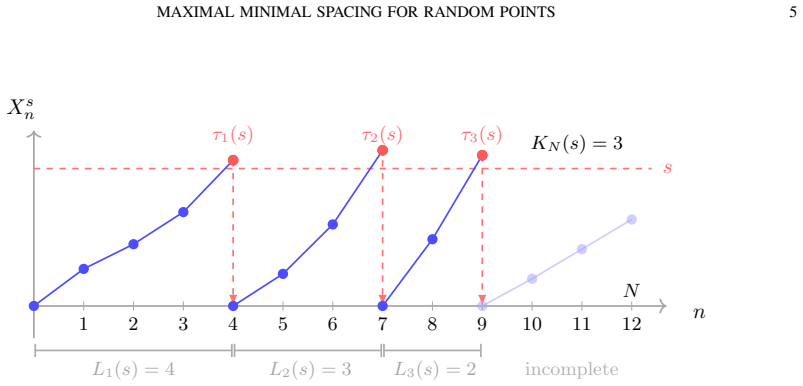
For arbitrary i.i.d. gap distributions and every M ≤ N, the distribution of the maximal minimal spacing is given exactly by the distribution of the number of threshold-reset cycles completed by an associated random walk; in particular, the survival function of the optimal spacing equals the probability that the walk completes at least M resets within N increments.
What carries the argument
The threshold-resetting random walk, which takes successive random steps and returns to the origin whenever its position crosses a fixed threshold; the number of such completed cycles directly encodes the largest achievable minimal block sum.
If this is right
- The cumulative distribution function of the optimal spacing is identical to the cumulative distribution of the number of resets in the walk.
- Asymptotics of the optimal spacing for large N follow from the large-deviation or renewal properties of the resetting walk.
- The same mapping supplies a Monte-Carlo scheme that samples reset cycles rather than enumerating partitions, accurate for regimes where direct search over groupings becomes infeasible.
Where Pith is reading between the lines
- The walk representation may allow transfer of known limit theorems for first-passage processes directly to spacing problems without re-deriving them.
- If the gap distribution belongs to a domain of attraction, the resetting walk may inherit a scaling limit that yields a closed-form asymptotic law for the maximal minimal spacing.
- The equivalence could be tested numerically for non-i.i.d. gaps to see how far the cycle-count picture extends beyond the stated assumption.
Load-bearing premise
The gaps between the original N+1 points are independent and identically distributed.
What would settle it
For small fixed N and M, generate many realizations of N i.i.d. gaps, compute the exact maximal minimal block sum by enumeration, and check whether its empirical distribution matches the cycle-count distribution obtained from the corresponding resetting walk.
Figures
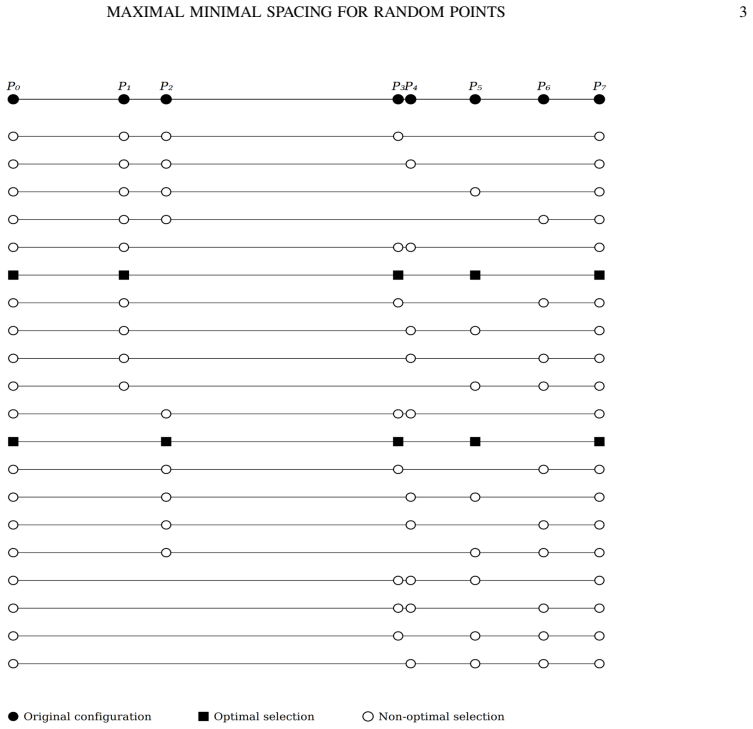
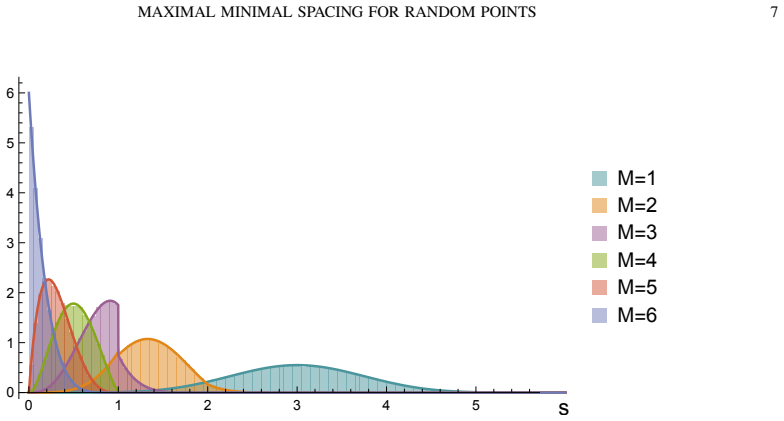
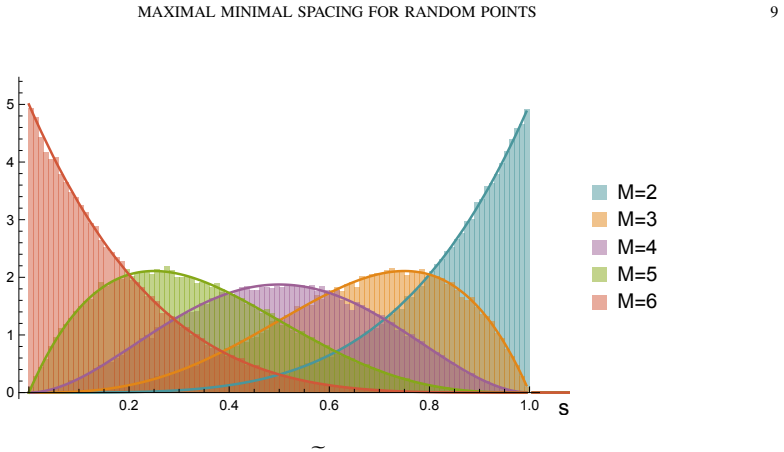
read the original abstract
From $N+1$ random points on a line we wish to select $M+1$ points so as to maximize the minimal spacing between them. We consider an initial configuration with independent and identically distributed spacings. The problem is equivalent to optimally grouping consecutive gaps into $M$ blocks and maximizing the smallest block sum. For general gap distributions, and for all $M\leq N$, we derive exact distributional identities for the optimal spacing and obtain its asymptotic behavior. The problem admits a reformulation in terms of a threshold-resetting random walk. The walk advances by successive random increments and is reset to the origin upon exceeding a fixed threshold. The probability that the optimal spacing exceeds a given value coincides with the probability that the walk completes at least $M$ reset cycles within $N$ steps. This yields an exact representation in terms of first-passage functionals of the walk. The same mapping suggests a numerical scheme for the max-min spacing problem in the regime of large $N$ and $M$, whose accuracy is tested against the exact results obtained here.
Editorial analysis
A structured set of objections, weighed in public.
Referee Report
Summary. The paper investigates selecting M+1 points out of N+1 random points on a line to maximize the minimal spacing. Assuming i.i.d. spacings, it equates this to maximizing the smallest sum when grouping consecutive gaps into M blocks. For general gap distributions, exact distributional identities for the optimal spacing are derived for all M ≤ N, along with asymptotic behavior. The problem is mapped to a threshold-resetting random walk, where the probability that the optimal spacing exceeds a threshold equals the probability of completing at least M reset cycles in N steps. This gives an exact representation using first-passage functionals and a numerical scheme for large N, M tested against the exact identities.
Significance. The equivalence between the max-min spacing problem and the number of reset cycles in a random walk is a significant contribution if the identities hold, as it provides exact results for general distributions and links to established random walk theory. The ability to obtain exact distributional identities and test numerical methods against them strengthens the work. This could have implications for optimization in random media and stochastic processes.
minor comments (1)
- [Abstract] The abstract is quite dense; expanding slightly on how the random walk equivalence is constructed from the gap grouping would improve accessibility for readers.
Simulated Author's Rebuttal
We thank the referee for the positive assessment of our work, the recognition of the equivalence to reset cycles in a random walk as a significant contribution, and the recommendation of minor revision. No specific major comments were provided in the report.
Circularity Check
No significant circularity; derivation is self-contained
full rationale
The paper derives an exact equivalence between the maximal minimal spacing and the number of reset cycles in a threshold-resetting random walk directly from the i.i.d. gap assumption via consecutive block sums and first-passage functionals. No fitted parameters are renamed as predictions, no self-citations serve as load-bearing uniqueness theorems, and no ansatz is smuggled in. The identities are obtained by explicit grouping of sums, which is a definitional mapping rather than a reduction to the input by construction. This is the standard case of an internally consistent exact result with no circular steps.
Axiom & Free-Parameter Ledger
axioms (1)
- domain assumption Spacings between the initial N+1 points are independent and identically distributed.
Reference graph
Works this paper leans on
-
[1]
Daniels, H. E. , title =. The Annals of Mathematical Statistics , year =
-
[2]
G. Haj. Elementary Proofs of Some Basic Facts Concerning Order Statistics , journal =. 1954 , month = mar, doi =
1954
-
[3]
and Balakrishnan, N
Arnold, Barry C. and Balakrishnan, N. and Nagaraja, H. N. , TITLE =. 2008 , DOI =
2008
-
[4]
Journal of Physics A: Mathematical and Theoretical , volume=
Volume of the set of LOCC-convertible quantum states , author=. Journal of Physics A: Mathematical and Theoretical , volume=. 2020 , publisher=
2020
-
[5]
2004 , publisher=
Order statistics , author=. 2004 , publisher=
2004
-
[6]
2024 , publisher =
Statistics of Extremes and Records in Random Sequences , author =. 2024 , publisher =
2024
-
[7]
Proceedings of the fourth
R. Proceedings of the fourth. Contributions to Biology and Problems of Medicine , volume=. 1961 , publisher=
1961
-
[8]
Generic aspects of the resource theory of quantum coherence , author =. Phys. Rev. A , volume =. 2021 , publisher =. doi:10.1103/PhysRevA.103.022401 , url =
-
[9]
, title =
Pyke, R. , title =. Journal of the Royal Statistical Society. Series B (Methodological) , year =
-
[10]
Statistical Papers , year =
Bairamov, Ismihan and Berred, Alexandre and Stepanov, Alexei , title =. Statistical Papers , year =
-
[11]
Acta Math
Elementary proofs of some basic facts concerning order statistics , author=. Acta Math. Acad. Sci. Hungar , volume=
-
[12]
Journal of Physics A: Mathematical and Theoretical , volume =
Cunden, Fabio Deelan and Cuppone, Noemi and Gramegna, Giovanni and Vivo, Pierpaolo , title =. Journal of Physics A: Mathematical and Theoretical , volume =. 2026 , doi =
2026
-
[13]
, title =
Pyke, R. , title =. Proceedings of the Sixth Berkeley Symposium on Mathematical Statistics and Probability , volume =
-
[14]
, title =
Devroye, L. , title =. The Annals of Probability , volume =. 1981 , doi =
1981
-
[15]
The Annals of Probability , volume =
Deheuvels, Paul , title =. The Annals of Probability , volume =. 1982 , doi =
1982
-
[16]
On the Weak Limit Law of the Maximal Uniform
Mijatovi. On the Weak Limit Law of the Maximal Uniform. Advances in Applied Probability , volume =. 2016 , doi =
2016
-
[17]
Arnold, B. C. and Balakrishnan, N. and Nagaraja, H. N. , title =
-
[18]
David, H. A. and Nagaraja, H. N. , title =
-
[19]
Majumdar, S. N. and Schehr, G. , title =. 2024 , doi =
2024
-
[20]
and Majumdar, S
Schehr, G. and Majumdar, S. N. , title =. Physical Review Letters , volume =. 2012 , doi =
2012
-
[21]
Majumdar, S. N. and Mounaix, Ph. and Schehr, G. , title =. Physical Review Letters , volume =. 2013 , doi =
2013
-
[22]
Majumdar, S. N. , title =. Physica A: Statistical Mechanics and its Applications , volume =. 2010 , doi =
2010
-
[23]
Evans, M. R. and Majumdar, S. N. , title =. Physical Review Letters , volume =. 2011 , doi =
2011
-
[24]
Evans, M. R. and Majumdar, S. N. and Schehr, G. , title =. Journal of Physics A: Mathematical and Theoretical , volume =. 2020 , doi =
2020
-
[25]
Majumdar, S. N. and Sabhapandit, S. and Schehr, G. , title =. Physical Review E , volume =. 2015 , doi =
2015
-
[26]
, title =
Feller, W. , title =
-
[27]
, title =
Redner, S. , title =. 2001 , doi =
2001
-
[28]
, title =
Kuby, M. , title =. Geographical Analysis , volume =. 1987 , doi =
1987
-
[29]
and Neuman, S
Erkut, E. and Neuman, S. , title =. European Journal of Operational Research , volume =. 1989 , doi =
1989
-
[30]
Ravi, S. S. and Rosenkrantz, D. J. and Tayi, G. K. , title =. Algorithms and Data Structures (WADS 1991) , series =. 1991 , doi =
1991
-
[31]
and Duarte, A
Mart\'i, R. and Duarte, A. and Gort\'azar, C. and Gallego, M. , title =. European Journal of Operational Research , volume =. 2022 , doi =
2022
-
[32]
and Mar\'in, A
Fern\'andez, E. and Mar\'in, A. and Berb\'e, A. , title =. Omega , volume =. 2013 , doi =
2013
-
[33]
On a one-dimensional problem concerning random space filling , journal =
R. On a one-dimensional problem concerning random space filling , journal =
-
[34]
and de Azevedo-Lopes, A
Mazzarisi, O. and de Azevedo-Lopes, A. and Arenzon, J. J. and Corberi, F. , title =. Physical Review Letters , volume =. 2021 , doi =
2021
-
[35]
, title =
Touchette, H. , title =. Physics Reports , volume =. 2009 , doi =
2009
-
[36]
Kingman, J. F. C. , title =
-
[37]
Extreme Gaps between Eigenvalues of Random Matrices , journal =
Ben Arous, G. Extreme Gaps between Eigenvalues of Random Matrices , journal =. 2013 , doi =
2013
-
[38]
The Annals of Probability , volume =
Feng, Renjie and Wei, Dongyi , title =. The Annals of Probability , volume =. 2025 , doi =. 1807.02149 , archivePrefix =
arXiv 2025
-
[39]
Journal of the European Mathematical Society , volume =
Bourgade, Paul , title =. Journal of the European Mathematical Society , volume =. 2022 , doi =
2022
-
[40]
, title =
Dyson, Freeman J. , title =. Journal of Mathematical Physics , volume =. 1962 , doi =
1962
-
[41]
Journal of Approximation Theory , volume =
Widom, Harold , title =. Journal of Approximation Theory , volume =. 1994 , doi =
1994
-
[42]
and Pal, Arnab , title =
Biswas, Arup and Majumdar, Satya N. and Pal, Arnab , title =. Physical Review Letters , volume =. 2025 , doi =
2025
-
[43]
and Schehr, Gr
Biroli, Marco and Majumdar, Satya N. and Schehr, Gr. First-Passage Resetting Gas , journal =. 2026 , doi =
2026
discussion (0)
Sign in with ORCID, Apple, or X to comment. Anyone can read and Pith papers without signing in.