REVIEW 5 major objections 7 minor 2 cited by
SignAligner: Harmonizing Complementary Pose Modalities for Coherent Sign Language Generation
T0 review · 5 major / 7 minor · reviewed 2026-08-07 · deepseek-v4-flash
Pith's one-line read The paper claims that jointly generating and correcting three complementary pose representations — 2D skeletons, 3D hand meshes, and 3D body models — before rendering yields sign language videos that are both semantically more accurate…
desk verdict The dataset extension is genuinely useful, but the headline accuracy gains rest on an evaluator trained on the authors' own pseudo-labels, with no error bars or human evaluation to back them up. read the letter →
The pith
A machine-rendered reading of the paper's core claim, the machinery that carries it, and where it could break.
The reading
What carries the argument
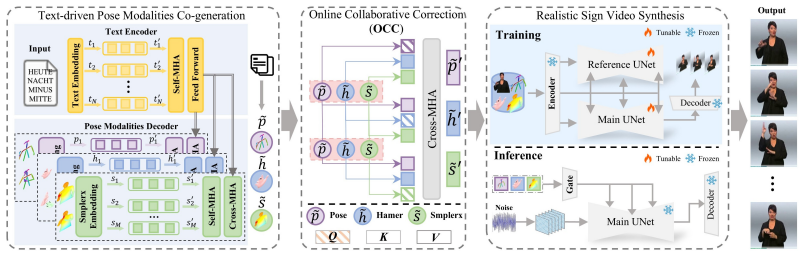
The load-bearing mechanism is a three-stage pipeline built on cross-modal attention between text and three pose modalities. In stage one, a Transformer text encoder extracts gloss semantics, and three Transformer decoders generate the Pose, Hamer, and Smplerx sequences simultaneously under an MAE reconstruction loss, so the three modalities share temporal structure from the start. In stage two, online collaborative correction runs a triple cross-modal attention pathway: each modality is refined using the other two as context, and a softmax-normalized set of learnable weights $w_A, w_B, w_C$ rebalances the three $\ell^2$ losses so the correction can adapt during training. In stage three, the corrected skeletons, hand meshes, and 3D body parameters pass through a pose gating module into RealisDance, retrained on PHOENIX14T+, which renders the final sign video under a reconstruction-plus-adversarial loss. The key idea is that skeleton motion priors focus spatial attention on hand features, while hand motion semantics enhance the whole-body spatiotemporal representation.
What would settle it
Take a random sample of PHOENIX14T+ clips, have human annotators directly judge or re-estimate the extracted hand meshes and 3D body parameters, and compare them with the automatic DWPose, HaMeR, and SMPLer-X outputs; if a substantial fraction of frames disagree, or if SignAligner's reported BLEU gains shrink when the back-translation evaluator is trained on real sign videos instead of the rendered modalities, the central claim would be weakened.
Extended reading notes
Core claim
The paper's central claim is that multi-modal co-generation plus online cross-modal correction yields sign language videos that are closer to the text semantics and to real signer appearance than any single-modality pipeline. The operative evidence is Table 2: on the PHOENIX14T+ test set, SignAligner scores BLEU-1 20.56, BLEU-4 8.17, ROUGE 20.88, SSIM 0.73, PSNR 15.32, and FID 26.26, versus PTSLP+RealisDance at BLEU-1 8.86 and FID 52.12 and CogvideoX at BLEU-1 8.40 and FID 264.75. The ablation in Table 3 supports the design: dropping co-generation lowers BLEU-1 to 14.50, and dropping online collaborative correction lowers it to 17.84, with corresponding drops in SSIM, PSNR, and FID. The paper further claims that the same architecture gives the strongest reported text-to-pose result on PHOENIX14T+ (BLEU-1 24.39, WER 73.89) and large gains on text-to-Hamer and text-to-Smplerx, which it takes as evidence that hand and body expressiveness are both preserved.
Load-bearing premise
The load-bearing premise is that the Pose, Hamer, and Smplerx annotations extracted by DWPose, HaMeR, and SMPLer-X are accurate enough to serve as both training targets and evaluation labels; if those automatic estimates are systematically wrong on fast, self-occluding sign hand motions, the whole pipeline is trained and scored against incorrect targets.
Editorial extensions
If this is right
- If the central claim holds, existing sign corpora can be upgraded into multimodal resources using off-the-shelf pose estimators, and generation quality should improve without new manual annotation.
- The three-stage design predicts that co-generation and online correction are both necessary; dropping either one should cost at least several BLEU-1 points, as reported.
- The method implies that fine-grained hand information (Hamer) is a major semantic bottleneck, since correcting the skeleton with hand meshes gives large reported gains in both accuracy and visual fidelity.
- Retraining RealisDance on PHOENIX14T+ makes the rendering stage pose-conditioned, so the same corrected modalities should be usable with other video synthesis networks.
- The reported text-to-pose, text-to-Hamer, and text-to-Smplerx results suggest the architecture can serve as a single backbone for all three sign generation subtasks.
Reading between the lines
- Editorial inference: because the automatic extractors also define the evaluation labels, the reported improvements may partly measure how well SignAligner imitates the extractors' characteristic rendering, not only semantic sign accuracy; independent human evaluation of the generated videos would settle this.
- Editorial inference: a minimal control experiment the paper does not report is replacing the three-modality input with the single best modality, for example Hamer alone, through the same RealisDance stage; without that ablation, the multimodality claim is not fully isolated from the benefit of having any dense pose conditioning.
- Editorial inference: if the method transfers, it should work on other sign corpora and languages by rerunning the same three extractors; a testable extension is applying the pipeline to a large-vocabulary corpus where hand-shape confusions are frequent and measuring whether the Hamer channel reduces confusion pairs.
Editorial analysis
A structured set of objections, weighed in public.
Referee Report
Summary. This paper introduces PHOENIX14T+, an extended version of PHOENIX14T in which every video is supplemented with three automatically extracted pose modalities (2D skeletons with face/hand keypoints from DWPose, hand meshes from HaMeR, and 3D body meshes from SMPLer-X), and presents SignAligner, a three-stage sign language generation method. Stage one co-generates the three pose modalities from gloss text using per-modality Transformer decoders with cross-modal attention; stage two performs online collaborative correction (OCC) by passing the generated modalities through cross-attention and a dynamic loss-weighting mechanism; stage three feeds the corrected modalities into a retrained RealisDance network to synthesize video. The authors report large improvements over a two-stage pose-to-video baseline (PTSLP+RealisDance) and over a text-to-video diffusion baseline (CogvideoX) in BLEU, ROUGE, SSIM, PSNR, and FID on the new dataset, and ablation results supporting the contribution of each stage.
Significance. If the reported results hold, the multi-modal co-generation/correction framework is a plausible step toward more semantically accurate and visually faithful sign video generation, and the PHOENIX14T+ dataset could be a useful multi-modal resource. The paper's internal ablations (Table 3) and the text-to-pose results (Table 4) are encouraging, and the proposed use of three complementary pose representations is well motivated. However, the accuracy claim rests on a back-translation evaluator whose training data are not fully specified and on automatically extracted pseudo-labels that are not quality-verified; the comparison to baselines also conflates the proposed architecture with the presence of additional supervision. With single-run results and no human evaluation, the magnitude of the claimed gains is not yet established.
major comments (5)
- [Section 5.1, Evaluation Metrics; Table 2] The paper states that for Hamer, Smplerx, and video it "adopt[s] the GFSLT method [40] and train[s] it on the PHOENIX14T+." Because PHOENIX14T+ is defined (Section 3) to include rendered HaMeR and SMPLer-X pseudo-label representations, the GFSLT video evaluator used to produce the BLEU and ROUGE scores in Table 2 may have been trained on videos that contain the same automatically extracted and rendered annotations that SignAligner is explicitly trained to reproduce (Eqs. 6 and 9). If so, the evaluation would reward agreement with the extractors' noise and rendering style rather than genuine sign-language semantics, making the reported accuracy gains partially circular. The authors must specify the exact training data of the video back-translator; if it includes any rendered pseudo-label frames, they should retrain it on the original RWTH-PHOENIX-Weather 2014T videos only and re-report all video BLEU/ROUGE numbers in Table 2.
- [Table 2; Section 5.1] Table 2, which is the headline comparison for the central claim of improved accuracy, omits Word Error Rate (WER), the standard complementary metric for sign language production and the metric the authors themselves report for the text-to-pose task in Table 4. Since BLEU and ROUGE from the ambiguously specified GFSLT back-translator are not independently sufficient to establish semantic accuracy, the paper should report WER for the generated videos (e.g., using a sign language recognizer or back-translator applied to the synthesized video) in Table 2.
- [Section 3; Eqs. (6), (9)] All training targets for the Hamer and Smplerx modalities in Eqs. (6) and (9), and all evaluation labels for those modalities in Table 5, are automatically extracted with HaMeR and SMPLer-X, both of which are known to produce noisy estimates on fast, self-occluding hand and finger motion typical of sign language. The paper gives no failure-rate statistics, no manual verification of the extracted annotations, and no confidence filtering or alternative-estimator comparison. If the pseudo-labels are systematically wrong, the co-generation and OCC stages are trained toward incorrect targets and the reported gains may reflect fitting extractor noise. The authors should add an annotation-quality analysis (e.g., manual inspection of a random sample, per-sequence confidence scores, or agreement with a second estimator) and, if possible, ablate the method on a subset with manually verified annotations.
- [Section 5.2, Table 2] The comparison to PTSLP+RealisDance and CogvideoX does not isolate the proposed architecture's contribution, because those baselines do not have access to the three pseudo-label modalities that SignAligner uses as additional supervision. The large BLEU/ROUGE gains could therefore be due to the extra supervisory information (Hamer and Smplerx targets) rather than to the co-generation and OCC mechanisms. To support the claim that the multi-modal co-generation/correction design is responsible for the improvement, the authors should include a baseline that uses the same multi-modal pseudo-labels (e.g., independent per-modality PTSLP-style generators plus RealisDance fusion) or explicitly quantify the contribution of the additional modalities over a pose-only variant.
- [All experiments; Tables 2-5] All results are single-run point estimates with no error bars, no significance testing, and no human evaluation, despite the Abstract's claim that SignAligner "significantly improves" accuracy and expressiveness. Differences such as BLEU-4 8.47 vs. 8.01 in Table 4 are small enough that run-to-run variance could change the ranking. The authors should report multiple seeds with mean and standard deviation (and paired tests where appropriate) and ideally add a human evaluation, such as comprehension ratings by deaf signers or expert naturalness ratings, to substantiate the expressiveness claim.
minor comments (7)
- [Section 4.1.2, Eq. (4)] The third line of the display should use bias term "bs", not "bp" as written.
- [Section 4.2, Eq. (9)] The notation "bpM m=1, bhM m=1 and bsM m=1" is unclear; use indexed notation like bpm, bhm, bsm with m = 1,...,M.
- [Section 5.1] "Peak Signal-to-Noise Ratioand" is missing a closing parenthesis and should read "Peak Signal-to-Noise Ratio (PSNR)".
- [Section 4.3 and Table 2] The spelling "RealiDance" (Eq. 10) and "RealisDance" (Table 2, Section 4.3) is inconsistent; please unify.
- [Table 5] In the Text to Smplerx row, the ROUGE entry for Ours is written as "27"; a decimal value appears to be lost, and the entry should be completed.
- [Section 5.2] The reported gains of 10.78% and 11.83% do not match Table 2 (DEV ROUGE gain is 11.93, TEST gains are 11.70 for BLEU-1 and 12.05 for ROUGE); please clarify which split and which numbers these refer to.
- [Section 4.2, Eq. (8)] "sof tmax" has a stray space, and defining wA, wB, wC as a vector-valued softmax would be more standard than the current notation.
Circularity Check
No significant circularity: SignAligner's training objectives and evaluation protocol are not equivalent by construction; noisy extractor labels are a quality limitation, not a circular step.
full rationale
I walked the claimed derivation chain from text to pose modalities to video. The training losses (Eq. 6 and Eq. 9) directly supervise generated Pose, Hamer, and Smplerx against fixed extractor outputs (DWPose, HaMeR, SMPLer-X) on the authors' PHOENIX14T+ extension, while the video stage (Eq. 10, Eq. 11) is trained against the original RWTH-PHOENIX-Weather 2014T videos through RealisDance. Evaluation does not reduce to the method's own fitted values: pose is back-translated with the external NSLT tool, video is evaluated with GFSLT, which is trained on PHOENIX14T+ video, whose video component is the original corpus, not SignAligner's generated samples, and all baselines in Tables 2, 4, and 5 are measured under the same protocol. No load-bearing claim is justified by a self-citation chain, uniqueness theorem, or ansatz smuggled in via citation. The use of automatically extracted Hamer/Smplerx pseudo-labels as ground truth is a legitimate data-quality and external-validity concern, but it is not a circular step: the model predicts fixed targets and is not fitting the evaluator, and the evaluator is not trained on the model's outputs. Thus the central claim has independent content, and the paper's own equations do not make any predicted quantity equal to an input by construction.
Assumptions & free parameters
free parameters (2)
- alpha, beta, gamma (dynamic loss weights) =
learned during training
- lambda (adversarial loss weight) =
unspecified
assumptions (4)
- domain assumption The extracted representations (DWPose, HaMeR, SMPLer-X) are accurate enough on sign language video to serve as ground truth
- domain assumption Back-translation BLEU/ROUGE measured by the authors' retrained GFSLT and NSLT models faithfully reflects sign language semantic quality
- domain assumption The original PHOENIX14T gloss-to-video alignment remains valid for the re-rendered and re-extracted representations
- standard math Standard transformer, softmax attention, and cross-attention machinery behave as expected
Cite this review
Pith. "Pith review of SignAligner: Harmonizing Complementary Pose Modalities for Coherent Sign Language Generation." pith.science (2026). https://pith.science/paper/NIOXK4Y7
@misc{pith2026250611621,
  author       = {Pith},
  title        = {Pith review of: SignAligner: Harmonizing Complementary Pose Modalities for Coherent Sign Language Generation},
  year         = {2026},
  howpublished = {\url{https://pith.science/paper/NIOXK4Y7}},
  note         = {Machine review of arXiv:2506.11621}
}
read the original abstract
Sign language generation aims to produce diverse sign representations based on spoken language. However, achieving realistic and naturalistic generation remains a significant challenge due to the complexity of sign language, which encompasses intricate hand gestures, facial expressions, and body movements. In this work, we introduce PHOENIX14T+, an extended version of the widely-used RWTH-PHOENIX-Weather 2014T dataset, featuring three new sign representations: Pose, Hamer and Smplerx. We also propose a novel method, SignAligner, for realistic sign language generation, consisting of three stages: text-driven pose modalities co-generation, online collaborative correction of multimodality, and realistic sign video synthesis. First, by incorporating text semantics, we design a joint sign language generator to simultaneously produce posture coordinates, gesture actions, and body movements. The text encoder, based on a Transformer architecture, extracts semantic features, while a cross-modal attention mechanism integrates these features to generate diverse sign language representations, ensuring accurate mapping and controlling the diversity of modal features. Next, online collaborative correction is introduced to refine the generated pose modalities using a dynamic loss weighting strategy and cross-modal attention, facilitating the complementarity of information across modalities, eliminating spatiotemporal conflicts, and ensuring semantic coherence and action consistency. Finally, the corrected pose modalities are fed into a pre-trained video generation network to produce high-fidelity sign language videos. Extensive experiments demonstrate that SignAligner significantly improves both the accuracy and expressiveness of the generated sign videos.
Figures


Figures from the paper (1 more)

Forward citations
Cited by 2 Pith papers
-
Motion is the Choreographer: Learning Latent Pose Dynamics for Seamless Sign Language Generation
A motion-first framework builds a signer-independent lexicon of discrete sign motions and learns smooth transitions, enabling video generation of arbitrary signers from text without signer-specific sentence data.
-
Text2Lip: Progressive Lip-Synced Talking Face Generation from Text via Viseme-Guided Rendering
A text-only talking face generator maps text to visemes, hallucinates pseudo-audio, and renders lip-synced video; the paper's headline metrics are partially contradicted by its own tables.
Reference graph
Works this paper leans on
-
[40]
Gloss-free sign language translation: Improving from visual-language pretraining,
B. Zhou, Z. Chen, A. Clapés, J. Wan, Y . Liang, S. Escalera, Z. Lei, and D. Zhang, “Gloss-free sign language translation: Improving from visual-language pretraining,” in Proceedings of the IEEE/CVF International Conference on Computer Vision, 2023, pp. 20 871–20 881
work page 2023
-
[1]
Automatic translation system to spanish sign language with a virtual interpreter,
S. Baldassarri, E. Cerezo, and F. Royo-Santas, “Automatic translation system to spanish sign language with a virtual interpreter,” vol. 5726, pp. 196–199, 2009
work page 2009
-
[2]
Vanessa – a system for communi- cation between deaf and hearing people,
J. Glauert, R. Elliott, S. Cox, J. Tryggvason, and M. Sheard, “Vanessa – a system for communi- cation between deaf and hearing people,”Technology and Disability, vol. 18, no. 4, pp. 207–216, 2006
work page 2006
-
[3]
Nn-based czech sign language synthesis,
J. Zelinka, J. Kanis, and P. Salajka, “Nn-based czech sign language synthesis,” inInternational Conference on Speech and Computer, 2019, pp. 559–568
work page 2019
-
[4]
Deep gesture video generation with learning on regions of interest,
R. Cui, Z. Cao, W. Pan, C. Zhang, and J. Wang, “Deep gesture video generation with learning on regions of interest,” IEEE Transactions on Multimedia, vol. 22, no. 10, pp. 2551–2563, 2019
work page 2019
-
[5]
S. Stoll, N. C. Camgoz, S. Hadfield, and R. Bowden, “Text2sign: Towards sign language production using neural machine translation and generative adversarial networks,”International Journal of Computer Vision, vol. 128, no. 4, pp. 891–908, 2020
work page 2020
-
[6]
Gan based indian sign language synthesis,
S. Krishna and J. Ukey, “Gan based indian sign language synthesis,” inIndian Conference on Vision, Graphics and Image Processing, 2021, pp. 1–8
work page 2021
-
[7]
Non-autoregressive sign language production with gaussian space,
E. Hwang, J.-H. Kim, and J.-C. Park, “Non-autoregressive sign language production with gaussian space,” in British Machine Vision Conference, 2021, pp. 1–13
work page 2021
Show all 41 references
-
[8]
Skeleton-based chinese sign language recognition and generation for bidirectional communication between deaf and hearing people,
Q. Xiao, M. Qin, and Y . Yin, “Skeleton-based chinese sign language recognition and generation for bidirectional communication between deaf and hearing people,” Neural Networks, vol. 125, pp. 41–55, 2020
2020
-
[9]
Berttune: Fine-tuning neural machine translation with bertscore,
I. J. Unanue, J. Parnell, and M. Piccardi, “Berttune: Fine-tuning neural machine translation with bertscore,” in Association for Computational Linguistics, 2021, pp. 915–924
2021
-
[10]
Learning transferable visual models from natural language supervi- sion,
A. Radford, J. W. Kim, C. Hallacy, A. Ramesh, G. Goh, S. Agarwal, G. Sastry, A. Askell, P. Mishkin, J. Clark et al., “Learning transferable visual models from natural language supervi- sion,” in International Conference on Machine Learning, 2021, pp. 8748–8763
2021
-
[11]
Progressive transformers for end-to-end sign language production,
B. Saunders, N. C. Camgoz, and R. Bowden, “Progressive transformers for end-to-end sign language production,” in European Conference on Computer Vision, 2020, pp. 687–705
2020
-
[12]
Towards fast and high-quality sign language production,
W. Huang, W. Pan, Z. Zhao, and Q. Tian, “Towards fast and high-quality sign language production,” in ACM International Conference on Multimedia, 2021, pp. 3172–3181
2021
-
[13]
Linguistics-vision monotonic consistent network for sign language production,
X. Wang, S. Tang, P. Song, S. Wang, D. Guo, and R. Hong, “Linguistics-vision monotonic consistent network for sign language production,” in International Conference on Acoustics, Speech, and Signal Processing, 2025
2025
-
[14]
Sign-idd: Iconicity disentangled diffusion for sign language production,
S. Tang, J. He, D. Guo, Y . Wei, F. Li, and R. Hong, “Sign-idd: Iconicity disentangled diffusion for sign language production,” in AAAI Conference on Artificial Intelligence, vol. 39, no. 7, 2025, pp. 7266–7274
2025
-
[15]
Speculative ensemble: Fast large language model ensemble via speculation,
J. Fu, Y . Jiang, J. Chen, J. Fan, X. Geng, and X. Yang, “Speculative ensemble: Fast large language model ensemble via speculation,” arXiv preprint arXiv:2502.01662, 2025
2025 arXiv
-
[16]
Pre-trained language models for interactive decision-making,
S. Li, X. Puig, C. Paxton, Y . Du, C. Wang, L. Fan, T. Chen, D.-A. Huang, E. Akyürek, A. Anandkumar et al., “Pre-trained language models for interactive decision-making,” Neural Information Processing Systems, vol. 35, pp. 31 199–31 212, 2022
2022
-
[17]
A survey of knowledge enhanced pre-trained language models,
L. Hu, Z. Liu, Z. Zhao, L. Hou, L. Nie, and J. Li, “A survey of knowledge enhanced pre-trained language models,” IEEE Transactions on Knowledge and Data Engineering, vol. 36, no. 4, pp. 1413–1430, 2023
2023
-
[18]
Signing at scale: Learning to co-articulate signs for large-scale photo-realistic sign language production,
B. Saunders, N. C. Camgoz, and R. Bowden, “Signing at scale: Learning to co-articulate signs for large-scale photo-realistic sign language production,” in Proceedings of the IEEE/CVF Conference on Computer Vision and Pattern Recognition, 2022, pp. 5141–5151. 10
2022
-
[19]
Sign language production with latent motion transformer,
P. Xie, T. Peng, Y . Du, and Q. Zhang, “Sign language production with latent motion transformer,” in Proceedings of the IEEE/CVF Winter Conference on Applications of Computer Vision, 2024, pp. 3024–3034
2024
-
[20]
Neural sign language translation,
N. C. Camgoz, S. Hadfield, O. Koller, H. Ney, and R. Bowden, “Neural sign language translation,” in Computer Vision and Pattern Recognition, 2018, pp. 7784–7793
2018
-
[21]
Gloss-driven conditional diffusion models for sign language production,
S. Tang, F. Xue, J. Wu, S. Wang, and R. Hong, “Gloss-driven conditional diffusion models for sign language production,” ACM Transactions on Multimedia Computing, Communications and Applications, vol. 21, no. 4, pp. 1–17, 2025
2025
-
[22]
Neural sign language synthesis: Words are our glosses,
J. Zelinka and J. Kanis, “Neural sign language synthesis: Words are our glosses,” in Winter Conference on Applications of Computer Vision, 2020, pp. 3395–3403
2020
-
[23]
Generation of indian sign language by sentence processing and generative adversarial networks,
N. Vasani, P. Autee, S. Kalyani, and R. Karani, “Generation of indian sign language by sentence processing and generative adversarial networks,” inInternational Conference on Information Systems Security, 2020, pp. 1250–1255
2020
-
[24]
Lmm-r1: Empowering 3b lmms with strong reasoning abilities through two-stage rule-based rl,
Y . Peng, G. Zhang, M. Zhang, Z. You, J. Liu, Q. Zhu, K. Yang, X. Xu, X. Geng, and X. Yang, “Lmm-r1: Empowering 3b lmms with strong reasoning abilities through two-stage rule-based rl,” arXiv preprint arXiv:2503.07536, 2025
2025 arXiv
-
[25]
Exploring diverse in-context configurations for image captioning,
X. Yang, Y . Wu, M. Yang, H. Chen, and X. Geng, “Exploring diverse in-context configurations for image captioning,” Neural Information Processing Systems, vol. 36, pp. 40 924–40 943, 2023
2023
-
[26]
G2p-ddm: Generating sign pose se- quence from gloss sequence with discrete diffusion model,
P. Xie, Q. Zhang, P. Taiying, H. Tang, Y . Du, and Z. Li, “G2p-ddm: Generating sign pose se- quence from gloss sequence with discrete diffusion model,” in Association for the Advancement of Artificial Intelligence, 2024, pp. 6234–6242
2024
-
[27]
T2s-gpt: Dynamic vector quantization for autoregressive sign language production from text,
A. Yin, H. Li, K. Shen, S. Tang, and Y . Zhuang, “T2s-gpt: Dynamic vector quantization for autoregressive sign language production from text,”arXiv preprint arXiv:2406.07119, 2024
2024 arXiv
-
[28]
Neural sign actors: a diffusion model for 3d sign language production from text,
V . Baltatzis, R. A. Potamias, E. Ververas, G. Sun, J. Deng, and S. Zafeiriou, “Neural sign actors: a diffusion model for 3d sign language production from text,” in Proceedings of the IEEE/CVF Conference on Computer Vision and Pattern Recognition, 2024, pp. 1985–1995
2024
-
[29]
Hamnosys to sigml conversion system for sign language automation,
K. Kaur and P. Kumar, “Hamnosys to sigml conversion system for sign language automation,” Procedia Computer Science, vol. 89, pp. 794–803, 2016
2016
-
[30]
Learning three-dimensional skeleton data from sign language video,
H. Brock, F. Law, K. Nakadai, and Y . Nagashima, “Learning three-dimensional skeleton data from sign language video,” ACM Transactions on Intelligent Systems and Technology (TIST), vol. 11, no. 3, pp. 1–24, 2020
2020
-
[31]
Sign language production using neural machine translation and generative adversarial networks,
S. Stoll, N. C. Camgöz, S. Hadfield, and R. Bowden, “Sign language production using neural machine translation and generative adversarial networks,” in Proceedings of the 29th British Machine Vision Conference (BMVC 2018). British Machine Vision Association, 2018
2018
-
[32]
Effective whole-body pose estimation with two-stages distillation,
Z. Yang, A. Zeng, C. Yuan, and Y . Li, “Effective whole-body pose estimation with two-stages distillation,” in Proceedings of the IEEE/CVF International Conference on Computer Vision, 2023, pp. 4210–4220
2023
-
[33]
Realtime multi-person 2d pose estimation using part affinity fields,
Z. Cao, T. Simon, S.-E. Wei, and Y . Sheikh, “Realtime multi-person 2d pose estimation using part affinity fields,” in Computer Vision and Pattern Recognition, 2017, pp. 7291–7299
2017
-
[34]
Reconstructing hands in 3d with transformers,
G. Pavlakos, D. Shan, I. Radosavovic, A. Kanazawa, D. Fouhey, and J. Malik, “Reconstructing hands in 3d with transformers,” in Proceedings of the IEEE/CVF Conference on Computer Vision and Pattern Recognition, 2024, pp. 9826–9836
2024
-
[35]
Smpler-x: Scaling up expressive human pose and shape estimation,
Z. Cai, W. Yin, A. Zeng, C. Wei, Q. Sun, W. Yanjun, H. E. Pang, H. Mei, M. Zhang, L. Zhang et al., “Smpler-x: Scaling up expressive human pose and shape estimation,” Neural Information Processing Systems, vol. 36, pp. 11 454–11 468, 2023. 11
2023
-
[36]
Attention is all you need,
A. Vaswani, N. Shazeer, N. Parmar, J. Uszkoreit, L. Jones, A. N. Gomez, Ł. Kaiser, and I. Polosukhin, “Attention is all you need,” inNeural Information Processing Systems, 2017, pp. 1–11
2017
-
[37]
Realisdance: Equip controllable character animation with realistic hands,
J. Zhou, B. Wang, W. Chen, J. Bai, D. Li, A. Zhang, H. Xu, M. Yang, and F. Wang, “Realisdance: Equip controllable character animation with realistic hands,” arXiv preprint arXiv:2409.06202, 2024
2024 arXiv
-
[38]
Cogvideox: Text-to-video diffusion models with an expert transformer,
Z. Yang, J. Teng, W. Zheng, M. Ding, S. Huang, J. Xu, Y . Yang, W. Hong, X. Zhang, G. Feng et al., “Cogvideox: Text-to-video diffusion models with an expert transformer,”arXiv preprint arXiv:2408.06072, 2024
2024 arXiv
-
[39]
Gloss semantic-enhanced network with online back- translation for sign language production,
S. Tang, R. Hong, D. Guo, and M. Wang, “Gloss semantic-enhanced network with online back- translation for sign language production,” in ACM International Conference on Multimedia, 2022, pp. 5630–5638
2022
-
[41]
Including facial expressions in contextual embeddings for sign language generation,
C. Viegas, M. Inan, L. Quandt, and M. Alikhani, “Including facial expressions in contextual embeddings for sign language generation,” in Joint Conference on Lexical and Computational Semantics, 2023, pp. 1–10. 12
2023
Reviewed August 7, 2026 · model on record in the stance chip above.
Discussion (0). Continue with ORCID to comment.