REVIEW 2 major objections 4 minor 1 cited by
Thermally inflated accretors in post-mass transfer binaries: Abell 35 and its class revisited
T0 review · 2 major / 4 minor · reviewed 2026-08-02 · deepseek-v4-flash
Pith's one-line read The companion in Abell 35 is not an evolved subgiant but a main-sequence star temporarily inflated by a recent mass-transfer episode, observed roughly 10^5 to 10^6 years after accretion ended.
desk verdict Strong observational case for A35's inflated-accretor status, but the model's central assumption on accretion entropy is untested — needs careful review. read the letter →
The pith
A machine-rendered reading of the paper's core claim, the machinery that carries it, and where it could break.
The reading
What carries the argument
The load-bearing device is a modified accretion prescription in the binary evolution code: instead of assuming accreted material enters with the entropy of the stellar surface, the model assumes the material has been virialized and retains a fraction f_E = 0.5 of its infall gravitational energy as entropy deposited in the accretor's envelope (Equation 2). This extra entropy is what makes a low-mass star with a convective envelope expand rather than merely swallow mass; under the default prescription the same stars do not inflate. The same machinery also sets the star spinning near critical rotation, which later yields the observed 1–10 day rotation periods during contraction.
What would settle it
A direct, resolved 3D radiation-hydrodynamic simulation of mass accretion onto a ~1 M_sun convective-envelope star that measures the fraction of infall energy actually retained as entropy — if it returns f_E < 0.2, the inflation engine is removed. Observationally, finding an A35-type system whose companion's mass and age match an evolved star rather than a recently contracted main-sequence star would also falsify the class.
Extended reading notes
Core claim
In the paper's own terms: the subgiant companions in Abell 35-type binaries are main-sequence accretors temporarily inflated out of thermal equilibrium by recent mass transfer. The accretor expands dramatically during rapid accretion but does not fill its Roche lobe, so mass transfer remains stable even at rates and mass ratios classically thought unstable. After the donor's envelope is stripped, the inflated accretor thermally relaxes back to the main sequence over 10^4–10^6 years, passing through exactly the temperatures, radii, and spin rates observed in the A35-type population. For Abell 35 itself, the revised distance, 790-day astrometric orbit, and rotational alignment with the orbit a
Load-bearing premise
The whole inflation rests on the assumption that accreted matter deposits half of its infall gravitational energy as entropy in the star's envelope; if the real deposited fraction is much smaller, the inflation disappears, and the paper's numerical setup cannot probe values below f_E ≈ 0.2.
Editorial extensions
If this is right
- Most AU-scale companions to hot white dwarfs (T_eff ≳ 50,000 K) should appear inflated and evolved, while companions to cooler white dwarfs should look like ordinary main-sequence stars.
- Abell 35-type binaries, post-AGB binaries, blue lurkers, and wide WD+main-sequence binaries are successive stages of a single post-mass-transfer pathway.
- Stable mass transfer can survive accretion rates up to ~10^-2 M_sun/yr and mass ratios once considered unstable, so inflated accretors may be common rather than exceptional.
- A35's companion is currently contracting and spinning down; its rotational axis aligned with the orbit is a direct relic of accretion-induced spin-up.
Reading between the lines
- If the inflated-accretor picture is right, the apparent 'subgiant' luminosity of A35's companion is temporary; in a few million years the star will look like a normal main-sequence star, so the present population of A35-type systems is a snapshot of a transient phase, and a larger census should find more systems outside planetary nebulae than inside.
- The f_E = 0.5 assumption is the weakest physical input, and the paper cannot numerically test f_E ≲ 0.2; a 3D simulation of the accretion boundary layer on a low-mass convective star would directly measure this parameter and could either confirm or remove the inflation mechanism.
- Applying the same contraction tracks backwards, some systems currently classified as post-AGB binaries with 'two evolved stars' may in fact be one evolved donor plus one inflated main-sequence accretor; checking whether the secondary's mass matches its pre-accretion zero-age main-sequence mass would test this.
Editorial analysis
A structured set of objections, weighed in public.
Referee Report
Summary. The paper argues that the subgiant companions in Abell 35–type binaries are main-sequence accretors temporarily inflated by recent mass transfer, rather than evolved subgiants. It presents a new Gaia DR3 astrometric orbit for A35 (P_orb = 790 d, e ≈ 0.05, i ≈ 26°), a revised SED and spectroscopic analysis giving T_eff ≈ 4925 K, R ≈ 2.95 R_sun, near-solar metallicity, and v_rot sin i = 86 km/s, with the rotation axis aligned to the orbit. The authors disfavor a coeval twin-binary origin using a comparison of astrometric masses with an IFMR-based initial-mass estimate, and then present MESA binary models with a new accretion prescription (Eq. 2, f_E = 0.5) that inflates low-mass convective-envelope accretors. They find that the post-mass-transfer contraction phase passes through the observed A35-like parameters at ages ~10^4–10^6 yr, and propose a unifying evolutionary sequence connecting post-AGB binaries, blue lurkers, and wide WD+MS binaries.
Significance. If the inflated-accretor interpretation holds, the paper resolves a long-standing population puzzle without invoking finely tuned twin binaries, and it provides a testable evolutionary framework. The observational contribution is genuinely strong: a new astrometric orbit, a careful MCMC SED fit, four independent spectroscopic cross-checks, a Na-D–based reddening estimate, and a dynamical-mass argument. The MESA models are reproducible (public github repository), and the paper makes falsifiable predictions, e.g., that most AU-scale companions to hot WDs should appear inflated. The main weakness is that the inflation in the models is driven by a new, largely unvalidated accretion prescription, and the mass argument relies on an extrapolated IFMR. These issues are load-bearing and need to be addressed before the central claim is fully supported, but they do not invalidate the observational data or the overall scenario, which is plausible and timely.
major comments (2)
- [§3.1.1, Eq. (2), Appendix C (Figs. 15–16)] The central modeled phenomenon—inflation of a low-mass convective-envelope accretor—appears only with the new prescription f_E = 0.5. With MESA's default surface-entropy accretion, a 1 M_sun accretor does not inflate (Fig. 15, right). The paper states in §3.1.1 that f_E ≲ 0.2 is numerically unstable, so the weak-deposition regime is untested. Because f_E = 0.5 is an order-of-magnitude estimate from a Keplerian disk, and boundary layers may radiate a large fraction of the infall energy, the calculation does not currently demonstrate that the inflation is robust. I request (a) a numerical method to access lower f_E, or (b) an explicit calibration/error budget for f_E from independent constraints, or (c) a clear qualification in the abstract/conclusions that the inflation prediction depends on this untested parameter.
- [§2.3, Fig. 6] The argument against the evolved-subgiant interpretation hinges on comparing astrometry-allowed subgiant masses with initial masses from the Cunningham et al. (2024) IFMR extrapolated below 1 M_sun. The paper acknowledges the IFMR is not calibrated there. Binary interactions may truncate WD masses (as the authors note, citing Ironi et al. 2025), but the adopted extrapolation could also err in the opposite direction, and the derived tension is therefore not robust. Please quantify how much the IFMR would need to shift to restore a twin-binary solution, or redo the comparison with a plausible binary-IFMR range, and state whether the conclusion survives.
minor comments (4)
- [§2.2.1] Typo 'T rff,SG' should be 'T_eff,SG'. Also, in Table 1, the WD row has 'WDT_eff #' and 'log(g) # 7.2±0.3K'—the K unit does not belong on log g, and the formatting is broken.
- [§2.3] Typos: 'dyanamical' should be 'dynamical'; 'componant' should be 'component'.
- [Table 1 / §2.2.2] The text quotes v_rot ≈ 195 km/s (derived from P_phot and R_SG), while Table 1 lists v_rot sin i = 86 km/s and P_phot = 0.767 d. Please clarify explicitly that 195 km/s is the deprojected equatorial value obtained by dividing by sin i ≈ 0.44, to avoid apparent inconsistency.
- [§2.2.3] Define 'HPDP photometry' (IUE High Prime Data Products?) at first use, since many readers will not recognize the acronym.
Circularity Check
No significant circularity: the inflated-accretor interpretation rests on independent Gaia/SED/spectroscopic evidence; the f_E=0.5 accretion prescription is a disclosed model assumption, not a fitted target.
full rationale
The central claim—that A35-type companions are main-sequence accretors inflated by recent mass transfer—is supported by a chain that is largely independent of the MESA models: the Gaia DR3 astrometric orbit and revised distance, the SED-derived Teff and radius, the new FEROS spectroscopy giving v_rot sin i and solar metallicity, the spin-orbit alignment, and the dynamical-mass versus IFMR argument against a coeval twin-binary origin. The MESA calculations are presented as a plausibility test of the evolutionary scenario, and the paper explicitly states that the models are 'tailored for A35' rather than fitted to it. The main caveat is that the inflation of low-mass convective-envelope accretors appears only with the new accretion prescription (Eq. 2 with f_E=0.5), and the paper itself notes that f_E≲0.2 is numerically unstable, so the weak-deposition regime cannot be probed. This is a genuine model-assumption sensitivity, and it weakens the strength of the MESA support as an independent test, but it is not circular: f_E is not calibrated to A35's Teff or radius, the prescription is physically motivated from a Keplerian-disk estimate, and the conclusion does not reduce to the prescription by construction. The observational facts—large radius, rapid aligned rotation, young hot WD, dynamical mass tension—stand independently. Self-citations in the paper are methodological or contextual and are not load-bearing in a circular way. Thus no circular step meets the standard of 'prediction equivalent to input by construction.'
Assumptions & free parameters
free parameters (6)
- f_E — retained fraction of infall energy deposited in the accretor =
0.5
- β — mass retention fraction of transferred mass =
0.5 (models A, C); 0.05 (model B)
- Initial conditions for MESA models =
M_d = 1.2 M_sun; M_a = 0.5 M_sun (A, C), 0.7 M_sun (B); P_i = 1000 d (A, B), 600 d (C)
- R_WD — white dwarf radius in the SED fit =
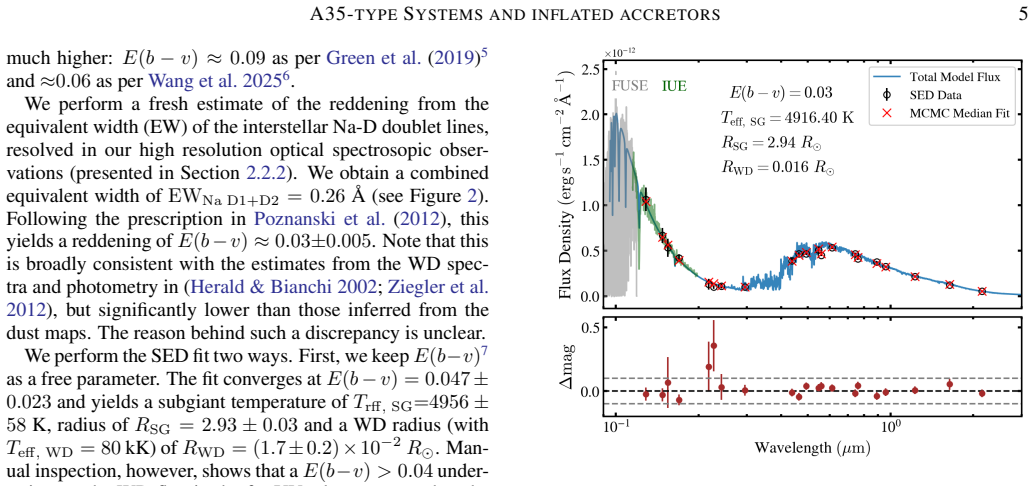
(1.62 ± 0.02) × 10^-2 R_sun (fixed E(b-v) = 0.03); (1.7 ± 0.2) × 10^-2 R_sun (free reddening)
- E(b-v) — reddening =
0.047 ± 0.023 when free; fixed to 0.03 from Na D EW in the adopted fit
- log(g)_SG fixed at 3.5 in the SED fit =
3.5
assumptions (8)
- domain assumption MESA r24.03.1 microphysics package: Ledoux convection, MLT α = 1.9, semiconvection α_sc = 0.1, core/shell overshoot f/f0 = 0.129/0.0129 and 0.0174/0.00174, Reimers wind η_R = 0.1, Bloecker wind η_B = 0.2, energy eqn 'dedt'
- domain assumption Kolb & Ritter (1990) Roche-lobe overflow mass transfer prescription
- ad hoc to paper Cunningham et al. (2024) initial-final mass relation extrapolated to initial masses < 1 M_sun
- domain assumption Rappaport et al. (1983) magnetic braking with γ = 4 for accretor spin-down
- domain assumption Temmink et al. (2023) stability criteria (Mdot < Mdot_KH) and L3-overfill analysis
- domain assumption P_phot = 0.767 d is the accretor's rotation period
- domain assumption Gaia DR3 astrometric orbital solution for A35 is reliable; the single-star parallax is unusable (RUWE ≈ 16)
- domain assumption WD parameters T_WD = 80 ± 10 kK and log g ≈ 7.5 adopted from Herald & Bianchi (2002)/Ziegler et al. (2012) as inputs
Cite this review
Pith. "Pith review of Thermally inflated accretors in post-mass transfer binaries: Abell 35 and its class revisited." pith.science (2026). https://pith.science/paper/NKHCL5XJ
@misc{pith2026260323756,
  author       = {Pith},
  title        = {Pith review of: Thermally inflated accretors in post-mass transfer binaries: Abell 35 and its class revisited},
  year         = {2026},
  howpublished = {\url{https://pith.science/paper/NKHCL5XJ}},
  note         = {Machine review of arXiv:2603.23756}
}
abstract
A small but growing class of binaries containing hot ($T_{\rm eff}\sim10^5\ {\rm K}$) white dwarfs (WDs) and rapidly rotating, apparently subgiant companions -- including the prototype, Abell 35 -- show companions that are too large and luminous to be ordinary main-sequence stars yet too numerous to be explained as finely tuned near-twin binaries. We argue that these stars are instead main-sequence accretors temporarily inflated out of thermal equilibrium by recent mass transfer. For the subgiant of Abell 35, a new Gaia DR3 astrometric orbit ($P_{\rm orb}=790\ {\rm d}$), combined with updated photometric and spectroscopic constraints, yields $T_{\rm eff}\approx4925\pm75\ {\rm K}$, $R\approx3\pm0.05\ R_{\odot}$, near-solar metallicity, and rapid rotation aligned with the orbit ($v_{\rm rot}\approx195\pm3\ {\rm km\ s^{-1}}$), indicating substantial recent accretion and spin-up. Dynamical mass limits disfavor a coeval twin-binary origin, supporting the inflated-accretor interpretation. We test this scenario using self-consistent MESA binary evolution calculations with a new accretion prescription in which accreted material retains a fraction of its infall energy, rather than adopting the default assumption that its entropy equals that of the accretor's surface. The accretor expands to giant-like radii when $\dot{M}$ is high yet remains within its Roche lobe, allowing stable mass transfer even for mass ratios traditionally considered unstable. After mass transfer ceases, the star contracts on Myr timescales through a bloated, rapidly rotating phase whose temperatures, radii, and spins match those observed in Abell 35-type systems. This framework naturally explains the population and unifies Abell 35-type binaries with post-AGB binaries, blue lurkers, and wide WD+main-sequence systems as successive stages of the same post-mass-transfer evolutionary pathway.
Figures


Figures from the paper (12 more)


Forward citations
Cited by 1 Pith paper
-
Mass-Orbital Period Distribution of Massive White Dwarfs Formed Through Stable Mass Transfer
Simulations show that intermediate-mass progenitors with non-degenerate cores before helium burning produce a mass-orbital period relation for massive white dwarfs that accounts for long-period systems.
Reference graph
Works this paper leans on
-
[1]
Abell, G. O. 1955, PASP, 67, 258, doi: 10.1086/126815
-
[2]
2018, MNRAS, 476, 1140, doi: 10.1093/mnras/sty174
Aller, A., Lillo-Box, J., Vuˇckovi´c, M., et al. 2018, MNRAS, 476, 1140, doi: 10.1093/mnras/sty174
-
[3]
2023, A&A, 674, A27, doi: 10.1051/0004-6361/202243462 Astropy Collaboration, Robitaille, T
Andrae, R., Fouesneau, M., Sordo, R., et al. 2023, A&A, 674, A27, doi: 10.1051/0004-6361/202243462 Astropy Collaboration, Robitaille, T. P., Tollerud, E. J., et al. 2013, A&A, 558, A33, doi: 10.1051/0004-6361/201322068 Astropy Collaboration, Price-Whelan, A. M., Sip˝ocz, B. M., et al. 2018, AJ, 156, 123, doi: 10.3847/1538-3881/aabc4f
-
[4]
Belloni, D., Schreiber, M. R., & Zorotovic, M. 2024, A&A, 687, A12, doi: 10.1051/0004-6361/202449320
-
[5]
Bhattacharjee, S., Kulkarni, S. R., Kong, A. K. H., et al. 2025, PASP, 137, 024201, doi: 10.1088/1538-3873/ada702
-
[6]
2019, MNRAS, 486, 2075, doi: 10.1093/mnras/stz549
Blanco-Cuaresma, S. 2019, MNRAS, 486, 2075, doi: 10.1093/mnras/stz549
-
[7]
2014, A&A, 569, A111, doi: 10.1051/0004-6361/201423945
Blanco-Cuaresma, S., Soubiran, C., Heiter, U., & Jofr´e, P. 2014, A&A, 569, A111, doi: 10.1051/0004-6361/201423945
-
[8]
1995, A&A, 297, 727
Bloecker, T. 1995, A&A, 297, 727
1995
Show all 129 references
-
[9]
C., M´esz´aros, S., Fleming, S
Bohlin, R. C., M´esz´aros, S., Fleming, S. W., et al. 2017, AJ, 153, 234, doi: 10.3847/1538-3881/aa6ba9
2017 doi
- [10]
-
[11]
E., & Zeimann, G
Bond, H. E., & Zeimann, G. R. 2024, ApJ, 967, 122, doi: 10.3847/1538-4357/ad3df9
2024 doi
-
[12]
2017, PASP, 129, 034002, doi: 10.1088/1538-3873/aa5455
Brahm, R., Jord´an, A., & Espinoza, N. 2017, PASP, 129, 034002, doi: 10.1088/1538-3873/aa5455
2017 doi
-
[13]
2025, Nature Astronomy, 9, 380, doi: 10.1038/s41550-024-02446-x
Budaj, J., Bernhard, K., Jones, D., & Munday, J. 2025, Nature Astronomy, 9, 380, doi: 10.1038/s41550-024-02446-x
2025 doi
-
[14]
E., et al
Buder, S., Kos, J., Wang, X. E., et al. 2025, PASA, 42, e051, doi: 10.1017/pasa.2025.26
2025 doi
-
[15]
2016, ApJ, 823, 102, doi: 10.3847/0004-637X/823/2/102
Choi, J., Dotter, A., Conroy, C., et al. 2016, ApJ, 823, 102, doi: 10.3847/0004-637X/823/2/102
2016 doi
-
[16]
P., & Giuli, R
Cox, J. P., & Giuli, R. T. 1968, Principles of stellar structure
1968
-
[17]
O’Brien, M
Cunningham, T., Tremblay, P.-E., & W. O’Brien, M. 2024, MNRAS, 527, 3602, doi: 10.1093/mnras/stad3275
2024 doi
-
[18]
D., Andrews, J
Decleir, M., Gordon, K. D., Andrews, J. E., et al. 2022, ApJ, 930, 15, doi: 10.3847/1538-4357/ac5dbe
2022 doi
-
[19]
T., & O’Connell, R
Dorman, B., Rood, R. T., & O’Connell, R. W. 1993, ApJ, 419, 596, doi: 10.1086/173511
1993 doi
-
[20]
2016, ApJS, 222, 8, doi: 10.3847/0067-0049/222/1/8
Dotter, A. 2016, ApJS, 222, 8, doi: 10.3847/0067-0049/222/1/8
2016 doi
-
[21]
2025, The Open Journal of Astrophysics, 8, 62, doi: 10.33232/001c.138448
El-Badry, K. 2025, The Open Journal of Astrophysics, 8, 62, doi: 10.33232/001c.138448
2025 doi
-
[22]
2018, Monthly Notices of the Royal Astronomical Society, 480, 4884, doi: 10.1093/mnras/sty2186
El-Badry, K., & Rix, H.-W. 2018, Monthly Notices of the Royal Astronomical Society, 480, 4884, doi: 10.1093/mnras/sty2186
2018 doi
-
[23]
2022, MNRAS, 512, 5620, doi: 10.1093/mnras/stac815
El-Badry, K., Seeburger, R., Jayasinghe, T., et al. 2022, MNRAS, 512, 5620, doi: 10.1093/mnras/stac815
2022 doi
-
[24]
Clayton, G. C. 2019, ApJ, 886, 108, doi: 10.3847/1538-4357/ab4c3a
2019 doi
-
[25]
W., Lang, D., & Goodman, J
Foreman-Mackey, D., Hogg, D. W., Lang, D., & Goodman, J. 2013, PASP, 125, 306, doi: 10.1086/670067
2013 doi
-
[26]
Y ., & Iben, Jr., I
Fujimoto, M. Y ., & Iben, Jr., I. 1989, ApJ, 341, 306, doi: 10.1086/167495 Gaia Collaboration, Montegriffo, P., Bellazzini, M., et al. 2023, A&A, 674, A33, doi: 10.1051/0004-6361/202243709 A35-TYPESYSTEMS AND INFLATED ACCRETORS21
1989 doi
-
[27]
A., Parsons, S
Garbutt, J. A., Parsons, S. G., Toloza, O., et al. 2024, MNRAS, 529, 4840, doi: 10.1093/mnras/stae807
2024 doi
- [28]
-
[29]
F., Chen, X., & Han, Z
Ge, H., Webbink, R. F., Chen, X., & Han, Z. 2020, ApJ, 899, 132, doi: 10.3847/1538-4357/aba7b7
2020 doi
-
[30]
M., Brasseur, C
Ginsburg, A., Sip˝ocz, B. M., Brasseur, C. E., et al. 2019, AJ, 157, 98, doi: 10.3847/1538-3881/aafc33
2019 doi
-
[31]
2024a, dust extinction: Interstellar Dust Extinction Models, v1.5, Zenodo, doi: 10.5281/zenodo.4658887 —
Gordon, K. 2024a, dust extinction: Interstellar Dust Extinction Models, v1.5, Zenodo, doi: 10.5281/zenodo.4658887 —. 2024b, The Journal of Open Source Software, 9, 7023, doi: 10.21105/joss.07023
-
[32]
D., Cartledge, S., & Clayton, G
Gordon, K. D., Cartledge, S., & Clayton, G. C. 2009, ApJ, 705, 1320, doi: 10.1088/0004-637X/705/2/1320
2009 doi
-
[33]
D., Clayton, G
Gordon, K. D., Clayton, G. C., Decleir, M., et al. 2023, ApJ, 950, 86, doi: 10.3847/1538-4357/accb59
2023 doi
-
[34]
D., Misselt, K
Gordon, K. D., Misselt, K. A., Bouwman, J., et al. 2021, ApJ, 916, 33, doi: 10.3847/1538-4357/ac00b7
2021 doi
-
[35]
2023, ApJ, 950, 27, doi: 10.3847/1538-4357/acc86e
Gossage, S., Kalogera, V ., & Sun, M. 2023, ApJ, 950, 27, doi: 10.3847/1538-4357/acc86e
2023 doi
- [36]
-
[37]
M., Schlafly, E., Zucker, C., Speagle, J
Green, G. M., Schlafly, E., Zucker, C., Speagle, J. S., & Finkbeiner, D. 2019, ApJ, 887, 93, doi: 10.3847/1538-4357/ab5362
2019 doi
-
[38]
2024, ApJL, 970, L11, doi: 10.3847/2041-8213/ad5e63
Hallakoun, N., Shahaf, S., Mazeh, T., Toonen, S., & Ben-Ami, S. 2024, ApJL, 970, L11, doi: 10.3847/2041-8213/ad5e63
2024 doi
-
[39]
Han, Z., Podsiadlowski, P., Maxted, P. F. L., & Marsh, T. R. 2003, MNRAS, 341, 669, doi: 10.1046/j.1365-8711.2003.06451.x
2003
-
[40]
R., Millman, K
Harris, C. R., Millman, K. J., van der Walt, S. J., et al. 2020, Nature, 585, 357, doi: 10.1038/s41586-020-2649-2
2020 doi
- [41]
-
[42]
2016, A&A, 588, L1, doi: 10.1051/0004-6361/201628125
Hillen, M., Kluska, J., Le Bouquin, J.-B., et al. 2016, A&A, 588, L1, doi: 10.1051/0004-6361/201628125
2016 doi
-
[43]
Hunter, J. D. 2007, Computing in Science & Engineering, 9, 90, doi: 10.1109/MCSE.2007.55
2007 doi
-
[44]
2013, A&A, 553, A6, doi: 10.1051/0004-6361/201219058
Husser, T.-O., Wende-von Berg, S., Dreizler, S., et al. 2013, A&A, 553, A6, doi: 10.1051/0004-6361/201219058
2013 doi
-
[45]
Hwang, H.-C., & Zakamska, N. L. 2025, ApJ, 991, 226, doi: 10.3847/1538-4357/adfa1c
2025 doi
-
[46]
P., Perets, H
Igoshev, A. P., Perets, H. B., & Michaely, E. 2020, MNRAS, 494, 1448, doi: 10.1093/mnras/staa833
2020 doi
-
[47]
2025, ApJ, 982, 20, doi: 10.3847/1538-4357/adb5f2
Ironi, O., Ben-Ami, S., Hallakoun, N., & Shahaf, S. 2025, ApJ, 982, 20, doi: 10.3847/1538-4357/adb5f2
2025 doi
-
[48]
2013, A&A Rv, 21, 59, doi: 10.1007/s00159-013-0059-2
Ivanova, N., Justham, S., Chen, X., et al. 2013, A&A Rv, 21, 59, doi: 10.1007/s00159-013-0059-2
2013 doi
-
[49]
Jacoby, G. H. 1981, ApJ, 244, 903, doi: 10.1086/158765
1981 doi
-
[50]
A., Kochanek, C
Jayasinghe, T., Thompson, T. A., Kochanek, C. S., et al. 2022, MNRAS, 516, 5945, doi: 10.1093/mnras/stac2187
2022 doi
-
[51]
A., Petigura, E
Johnson, J. A., Petigura, E. A., Fulton, B. J., et al. 2017, AJ, 154, 108, doi: 10.3847/1538-3881/aa80e7
2017 doi
-
[52]
2020, in Reviews in Frontiers of Modern Astrophysics; From Space Debris to Cosmology, 123–153, doi: 10.1007/978-3-030-38509-5 5
Jones, D. 2020, in Reviews in Frontiers of Modern Astrophysics; From Space Debris to Cosmology, 123–153, doi: 10.1007/978-3-030-38509-5 5
2020 doi
-
[53]
Jones, D., Boffin, H. M. J., Brown, A. J., et al. 2022, MNRAS, 516, 4833, doi: 10.1093/mnras/stac2501
2022 doi
-
[54]
2017, A&A, 600, L9, doi: 10.1051/0004-6361/201730700
Jones, D., Van Winckel, H., Aller, A., Exter, K., & De Marco, O. 2017, A&A, 600, L9, doi: 10.1051/0004-6361/201730700
2017 doi
-
[55]
2009, A&A, 498, 489, doi: 10.1051/0004-6361/200810703
Jorissen, A., Frankowski, A., Famaey, B., & van Eck, S. 2009, A&A, 498, 489, doi: 10.1051/0004-6361/200810703
2009 doi
-
[56]
1999, The Messenger, 95, 8
Kaufer, A., Stahl, O., Tubbesing, S., et al. 1999, The Messenger, 95, 8
1999
-
[57]
2018, AJ, 155, 144, doi: 10.3847/1538-3881/aaaaaf
Kawahara, H., Masuda, K., MacLeod, M., et al. 2018, AJ, 155, 144, doi: 10.3847/1538-3881/aaaaaf
2018 doi
-
[58]
1977, A&A, 54, 539
Kippenhahn, R., & Meyer-Hofmeister, E. 1977, A&A, 54, 539
1977
-
[59]
Knigge, C., Toonen, S., & Boekholt, T. C. N. 2022, MNRAS, 514, 1895, doi: 10.1093/mnras/stac1336
2022 doi
-
[60]
1990, A&A, 236, 385
Kolb, U., & Ritter, H. 1990, A&A, 236, 385
1990
- [61]
-
[62]
2014, Science, 344, 275, doi: 10.1126/science.1251999
Kruse, E., & Agol, E. 2014, Science, 344, 275, doi: 10.1126/science.1251999
2014 doi
-
[63]
Lau, M. Y . M., Hirai, R., Mandel, I., & Tout, C. A. 2024, ApJL, 966, L7, doi: 10.3847/2041-8213/ad3d50
2024 doi
-
[64]
1947, ApJ, 105, 305, doi: 10.1086/144905
Ledoux, P. 1947, ApJ, 105, 305, doi: 10.1086/144905
1947 doi
-
[65]
Smith, J. C. 2019, ApJ, 881, 47, doi: 10.3847/1538-4357/ab2bf8
2019 doi
-
[66]
M., Gosnell, N
Leiner, E. M., Gosnell, N. M., Geller, A. M., et al. 2025, ApJL, 979, L1, doi: 10.3847/2041-8213/ad9d0c
2025 doi
-
[67]
2019, ApJ, 871, 148, doi: 10.3847/1538-4357/aaf9a1
Li, Z., Chen, X., Chen, H.-L., & Han, Z. 2019, ApJ, 871, 148, doi: 10.3847/1538-4357/aaf9a1
2019 doi
-
[68]
Lidov, M. L. 1962, Planet. Space Sci., 9, 719, doi: 10.1016/0032-0633(62)90129-0 L¨obling, L., Boffin, H. M. J., & Jones, D. 2019, A&A, 624, A1, doi: 10.1051/0004-6361/201834466 L¨obling, L., Maney, M. A., Rauch, T., et al. 2020, MNRAS, 492, 528, doi: 10.1093/mnras/stz3247
1962 doi
-
[69]
2023, MNRAS, 519, 1409, doi: 10.1093/mnras/stac3621
Lu, W., Fuller, J., Quataert, E., & Bonnerot, C. 2023, MNRAS, 519, 1409, doi: 10.1093/mnras/stac3621
2023 doi
-
[70]
W., et al
Masuda, K., Kawahara, H., Latham, D. W., et al. 2019, ApJL, 881, L3, doi: 10.3847/2041-8213/ab321b M´esz´aros, S., Bohlin, R., Allende Prieto, C., et al. 2024, A&A, 688, A197, doi: 10.1051/0004-6361/202449306
2019 doi
-
[71]
1979, A&A, 78, 167 Miller Bertolami, M
Meyer, F., & Meyer-Hofmeister, E. 1979, A&A, 78, 167 Miller Bertolami, M. M. 2016, A&A, 588, A25, doi: 10.1051/0004-6361/201526577
1979 doi
-
[72]
2017, ApJS, 230, 15, doi: 10.3847/1538-4365/aa6fb6
Moe, M., & Di Stefano, R. 2017, ApJS, 230, 15, doi: 10.3847/1538-4365/aa6fb6
2017 doi
-
[73]
Moe, M., & Kratter, K. M. 2021, MNRAS, 507, 3593, doi: 10.1093/mnras/stab2328 22 BHATTACHARJEE ET AL
2021 doi
-
[74]
2024, PASP, 136, 094203, doi: 10.1088/1538-3873/ad7981
Nagarajan, P., & El-Badry, K. 2024, PASP, 136, 094203, doi: 10.1088/1538-3873/ad7981
2024 doi
-
[75]
2016, ARA&A, 54, 441, doi: 10.1146/annurev-astro-081915-023315
Naoz, S. 2016, ARA&A, 54, 441, doi: 10.1146/annurev-astro-081915-023315
2016 doi
-
[76]
1977a, PASJ, 29, 249, doi: 10.1093/pasj/29.2.249 —
Neo, S., Miyaji, S., Nomoto, K., & Sugimoto, D. 1977a, PASJ, 29, 249, doi: 10.1093/pasj/29.2.249 —. 1977b, PASJ, 29, 249, doi: 10.1093/pasj/29.2.249
- [77]
- [78]
-
[79]
2018, A&A, 620, A85, doi: 10.1051/0004-6361/201833816
Oomen, G.-M., Van Winckel, H., Pols, O., et al. 2018, A&A, 620, A85, doi: 10.1051/0004-6361/201833816
2018 doi
-
[80]
1981, A&A, 102, 17 pandas development team, T
Packet, W. 1981, A&A, 102, 17 pandas development team, T. 2020, pandas-dev/pandas: Pandas, latest, Zenodo, doi: 10.5281/zenodo.3509134
1981 doi
-
[81]
G., Rebassa-Mansergas, A., Schreiber, M
Parsons, S. G., Rebassa-Mansergas, A., Schreiber, M. R., et al. 2016, MNRAS, 463, 2125, doi: 10.1093/mnras/stw2143
2016 doi
-
[82]
2011, ApJS, 192, 3, doi: 10.1088/0067-0049/192/1/3
Paxton, B., Bildsten, L., Dotter, A., et al. 2011, ApJS, 192, 3, doi: 10.1088/0067-0049/192/1/3
2011 doi
-
[83]
2015, ApJS, 220, 15, doi: 10.1088/0067-0049/220/1/15
Paxton, B., Marchant, P., Schwab, J., et al. 2015, ApJS, 220, 15, doi: 10.1088/0067-0049/220/1/15
2015 doi
-
[84]
2019, ApJS, 243, 10, doi: 10.3847/1538-4365/ab2241
Paxton, B., Smolec, R., Schwab, J., et al. 2019, ApJS, 243, 10, doi: 10.3847/1538-4365/ab2241
2019 doi
- [85]
-
[86]
Perryman, M. A. C., Lindegren, L., Kovalevsky, J., et al. 1997, A&A, 323, L49
1997
-
[87]
A., Howard, A
Petigura, E. A., Howard, A. W., Marcy, G. W., et al. 2017, AJ, 154, 107, doi: 10.3847/1538-3881/aa80de
2017 doi
-
[88]
1991, ApJ, 370, 604, doi: 10.1086/169847
Popham, R., & Narayan, R. 1991, ApJ, 370, 604, doi: 10.1086/169847
1991 doi
-
[89]
X., & Bloom, J
Poznanski, D., Prochaska, J. X., & Bloom, J. S. 2012, MNRAS, 426, 1465, doi: 10.1111/j.1365-2966.2012.21796.x
2012
-
[90]
A., Henry, T
Raghavan, D., McAlister, H. A., Henry, T. J., et al. 2010, ApJS, 190, 1, doi: 10.1088/0067-0049/190/1/1
2010 doi
-
[91]
S., Hamers, A
Rajamuthukumar, A. S., Hamers, A. S., Neunteufel, P., Pakmor, R., & de Mink, S. E. 2023, ApJ, 950, 9, doi: 10.3847/1538-4357/acc86c
2023 doi
-
[92]
S., Korol, V ., Stegmann, J., et al
Rajamuthukumar, A. S., Korol, V ., Stegmann, J., et al. 2025, arXiv e-prints, arXiv:2502.09607, doi: 10.48550/arXiv.2502.09607
2025 doi
-
[93]
1995, MNRAS, 273, 731, doi: 10.1093/mnras/273.3.731
Han, Z. 1995, MNRAS, 273, 731, doi: 10.1093/mnras/273.3.731
1995 doi
-
[94]
Rappaport, S., Verbunt, F., & Joss, P. C. 1983, ApJ, 275, 713, doi: 10.1086/161569
1983 doi
- [95]
-
[96]
R., & Koester, D
Schreiber, M. R., & Koester, D. 2007, MNRAS, 382, 1377, doi: 10.1111/j.1365-2966.2007.12288.x
2007
-
[97]
1975, Memoires of the Societe Royale des Sciences de Liege, 8, 369
Reimers, D. 1975, Memoires of the Societe Royale des Sciences de Liege, 8, 369
1975
-
[98]
2001, A&A, 365, 465, doi: 10.1051/0004-6361:20000146
Reyniers, M., & Van Winckel, H. 2001, A&A, 365, 465, doi: 10.1051/0004-6361:20000146
2001 doi
-
[99]
2025, ApJ, 990, 172, doi: 10.3847/1538-4357/adf067
Scherbak, P., Lu, W., & Fuller, J. 2025, ApJ, 990, 172, doi: 10.3847/1538-4357/adf067
2025 doi
-
[100]
2025, ApJ, 981, 54, doi: 10.3847/1538-4357/adb156
Shahaf, S. 2025, ApJ, 981, 54, doi: 10.3847/1538-4357/adb156
2025 doi
-
[101]
2023, MNRAS, 518, 2991, doi: 10.1093/mnras/stac3290
Shahaf, S., Bashi, D., Mazeh, T., et al. 2023, MNRAS, 518, 2991, doi: 10.1093/mnras/stac3290
2023 doi
-
[102]
2025a, PASP, 137, 094201, doi: 10.1088/1538-3873/adfb30
Shariat, C., El-Badry, K., & Naoz, S. 2025a, PASP, 137, 094201, doi: 10.1088/1538-3873/adfb30
-
[103]
2025b, PASP, 137, 074201, doi: 10.1088/1538-3873/add5a1
Roestel, J. 2025b, PASP, 137, 074201, doi: 10.1088/1538-3873/add5a1
-
[104]
2025c, ApJ, 978, 47, doi: 10.3847/1538-4357/ad944a
Shariat, C., Naoz, S., El-Badry, K., et al. 2025c, ApJ, 978, 47, doi: 10.3847/1538-4357/ad944a
-
[105]
Shariat, C., Naoz, S., Hansen, B. M. S., et al. 2023, ApJL, 955, L14, doi: 10.3847/2041-8213/acf76b
2023 doi
-
[106]
S., Naoz, S., & Rose, S
Shariat, C., Ye, C. S., Naoz, S., & Rose, S. 2025d, arXiv e-prints, arXiv:2511.18678, doi: 10.48550/arXiv.2511.18678
-
[107]
2015, Journal of Astronomical Telescopes, Instruments, and Systems, 1, 035002, doi: 10.1117/1.JATIS.1.3.035002
Sheinis, A., Anguiano, B., Asplund, M., et al. 2015, Journal of Astronomical Telescopes, Instruments, and Systems, 1, 035002, doi: 10.1117/1.JATIS.1.3.035002
2015 doi
- [108]
-
[109]
2018, ApJ, 858, 14, doi: 10.3847/1538-4357/aab9a4
Sun, M., & Arras, P. 2018, ApJ, 858, 14, doi: 10.3847/1538-4357/aab9a4
2018 doi
-
[110]
D., Pols, O
Temmink, K. D., Pols, O. R., Justham, S., Istrate, A. G., & Toonen, S. 2023, A&A, 669, A45, doi: 10.1051/0004-6361/202244137
2023 doi
-
[111]
1997, A&A, 320, 913
Thevenin, F., & Jasniewicz, G. 1997, A&A, 320, 913
1997
-
[112]
2014, AJ, 147, 86, doi: 10.1088/0004-6256/147/4/86
Tokovinin, A. 2014, AJ, 147, 86, doi: 10.1088/0004-6256/147/4/86
2014 doi
-
[113]
Toonen, S., Boekholt, T. C. N., & Portegies Zwart, S. 2022, A&A, 661, A61, doi: 10.1051/0004-6361/202141991
2022 doi
-
[114]
2016, Computational Astrophysics and Cosmology, 3, 6, doi: 10.1186/s40668-016-0019-0
Toonen, S., Hamers, A., & Portegies Zwart, S. 2016, Computational Astrophysics and Cosmology, 3, 6, doi: 10.1186/s40668-016-0019-0
2016 doi
-
[115]
S., & Bandopadhyay, D
Toonen, S., Portegies Zwart, S., Hamers, A. S., & Bandopadhyay, D. 2020, A&A, 640, A16, doi: 10.1051/0004-6361/201936835
2020 doi
-
[116]
A., Jones, D., Boffin, H
Tyndall, A. A., Jones, D., Boffin, H. M. J., et al. 2013, MNRAS, 436, 2082, doi: 10.1093/mnras/stt1713 van Winckel, H. 2003, ARA&A, 41, 391, doi: 10.1146/annurev.astro.41.071601.170018 A35-TYPESYSTEMS AND INFLATED ACCRETORS23 Van Winckel, H., Jorissen, A., Exter, K., et al. 20...
2013
-
[117]
2007, A&A, 470, L21, doi: 10.1051/0004-6361:20077840
Verhoelst, T., van Aarle, E., & Acke, B. 2007, A&A, 470, L21, doi: 10.1051/0004-6361:20077840
2007 doi
-
[118]
E., et al
Virtanen, P., Gommers, R., Oliphant, T. E., et al. 2020, Nature Methods, 17, 261, doi: 10.1038/s41592-019-0686-2
2020 doi
-
[119]
2025, ApJS, 280, 15, doi: 10.3847/1538-4365/adea39
Wang, T., Yuan, H., Chen, B., et al. 2025, ApJS, 280, 15, doi: 10.3847/1538-4365/adea39
2025 doi
-
[120]
2020, A&A, 642, A228, doi: 10.1051/0004-6361/202038574
Werner, K., Reindl, N., L¨obling, L., et al. 2020, A&A, 642, A228, doi: 10.1051/0004-6361/202038574
2020 doi
-
[121]
G., Henry, T
Winters, J. G., Henry, T. J., Jao, W.-C., et al. 2019, AJ, 157, 216, doi: 10.3847/1538-3881/ab05dc
2019 doi
-
[122]
J., & Stickland, D
Wonnacott, D., Kellett, B. J., & Stickland, D. J. 1993, MNRAS, 262, 277, doi: 10.1093/mnras/262.2.277
1993 doi
-
[123]
R., et al
Yamaguchi, N., El-Badry, K., Ciardi, D. R., et al. 2024a, PASP, 136, 074201, doi: 10.1088/1538-3873/ad5ebd
-
[124]
R., et al
Yamaguchi, N., El-Badry, K., Rees, N. R., et al. 2024b, PASP, 136, 084202, doi: 10.1088/1538-3873/ad6809
-
[125]
2025, PASP, 137, 104205, doi: 10.1088/1538-3873/ae0d30
Yamaguchi, N., El-Badry, K., & Shahaf, S. 2025, PASP, 137, 104205, doi: 10.1088/1538-3873/ae0d30
2025 doi
-
[126]
2024c, MNRAS, 527, 11719, doi: 10.1093/mnras/stad4005
Yamaguchi, N., El-Badry, K., Fuller, J., et al. 2024c, MNRAS, 527, 11719, doi: 10.1093/mnras/stad4005
-
[127]
Zahn, J. P. 1977, A&A, 57, 383
1977
-
[128]
2024, MNRAS, 531, L45, doi: 10.1093/mnrasl/slae029
Zhao, Z.-Q., Li, Z.-W., Xiao, L., Ge, H.-W., & Han, Z.-W. 2024, MNRAS, 531, L45, doi: 10.1093/mnrasl/slae029
2024 doi
-
[129]
Ziegler, M., Rauch, T., Werner, K., K¨oppen, J., & Kruk, J. W. 2012, A&A, 548, A109, doi: 10.1051/0004-6361/201219536
2012 doi
Reviewed August 2, 2026 · model on record in the stance chip above.
Discussion (0). Sign in to comment.