REVIEW 4 major objections 5 minor 1 cited by
Stereo-based 3D Anomaly Object Detection for Autonomous Driving: A New Dataset and Baseline
T0 review · 4 major / 5 minor · reviewed 2026-08-06 · deepseek-v4-flash
Pith's one-line read The paper claims that a stereo detector can locate and size road anomalies never seen during training by decoupling 2D and 3D supervision and scoring foreground confidence, and that the synthetic KITTI-AR dataset lifts out-of-distribution…
desk verdict Solid stereo 3D anomaly-detection paper with a useful dataset, but the headline 74.35 AP is measured on synthetic OoD data from the same rendering pipeline as the added training data, so read it as a benchmark result, not proof of real-world zero-shot transfer. read the letter →
The pith
A machine-rendered reading of the paper's core claim, the machinery that carries it, and where it could break.
The reading
What carries the argument
The central mechanism is the decoupled dual-anchor sampling strategy: anchors matched to 3D boxes drive depth, orientation, and scale losses, while a larger set matched only to 2D boxes drives 2D regression, known-class classification, and the binary foreground head. This lets the model consume cheap 2D-only labels and pseudo-labels from an open-vocabulary 2D detector. The foreground head is fed only the stereo correlation feature $f_s$, and the anomaly score is RbAF: $c_{fg} - \frac{1}{N}\sum_n \sigma(c_n)$, a foreground-aware analogue of the 'rejected by all' pixel score. A unified, rather than per-class, normalization for 3D scales is what lets the regressor output sizes for unseen classes.
What would settle it
Evaluate the same model on a real stereo anomaly set, or on composites rendered by a different engine with different lighting and texture statistics, and compare 3D AP on the same 58 categories; if performance drops far below 74.35 toward the 9.09 of KITTI-only training, the benchmark gain is largely renderer-specific. A minimal version: run the KITTI-only model and the ExD-trained model on real photographs of the OoD object classes and check whether the decoupling still yields a large gap.
Extended reading notes
Core claim
On the paper's own terms, the discovery is that a stereo detector can detect, localize, and size objects from categories it has never seen, provided the foreground and 3D estimation are decoupled from texture-bound category classification and trained on diverse scales. The binary foreground head takes only stereo disparity features, so it learns geometric foregroundness rather than appearance; the 3D regression head is supervised normally across all classes with a unified scale normalization, so it can predict dimensions for novel objects instead of collapsing onto known-class sizes. Anomalies are then declared by the RbAF score, which subtracts the mean known-class rejection from foreground confidence. The reported evidence is that on KITTI-AR-OoD, KITTI-only training scores 9.09 AP3D, adding 2D-only extra labels scores 21.05, and adding 3D extra labels scores 74.35, with the Pedestrian in-distribution class also improving.
Load-bearing premise
The load-bearing premise is that the OoD test images, rendered with the same Blender pipeline as the extra training images, are representative of real-world road anomalies; if the renderer leaves any systematic cue, the 74.35 AP may be an artifact of that cue rather than of true geometric generalization.
Editorial extensions
If this is right
- 2D-only annotations for arbitrary foreground objects give a real 3D out-of-distribution gain, so anomaly 3D detection can be bootstrapped at low labeling cost.
- A disparity-only foreground head generalizes across categories without overfitting to known textures, making it usable as a generic obstacle detector.
- Anchor-level anomaly scoring yields instance-level 3D anomaly boxes with distance estimates, which 2D pixel-level segmentation methods do not provide.
- The KITTI-AR synthesis procedure can supply training scales far beyond KITTI's eight categories and improves in-distribution classes as well.
- Stereo-based anomaly detection reaches out-of-distribution AP3D comparable with a LiDAR-plus-monocular open-vocabulary detector while using a cheaper sensor setup.
Reading between the lines
- If the renderer-shared-cue concern is real, the practical recipe still stands: decoupling plus diverse scales is the mechanism, but the dataset benchmark would need a real-world counterpart to certify the absolute numbers.
- The decoupling recipe transfers: a monocular or LiDAR detector could adopt the same dual-anchor scheme with open-vocabulary 2D pseudo-labels to gain open-set 3D ability without new 3D labels.
- The RbAF score suggests a general pattern for open-set perception: when a model can say 'something is there' independently of 'what it is,' the gap between those two confidences is a cheap and informative anomaly score, applicable beyond driving scenes.
Editorial analysis
A structured set of objections, weighed in public.
Referee Report
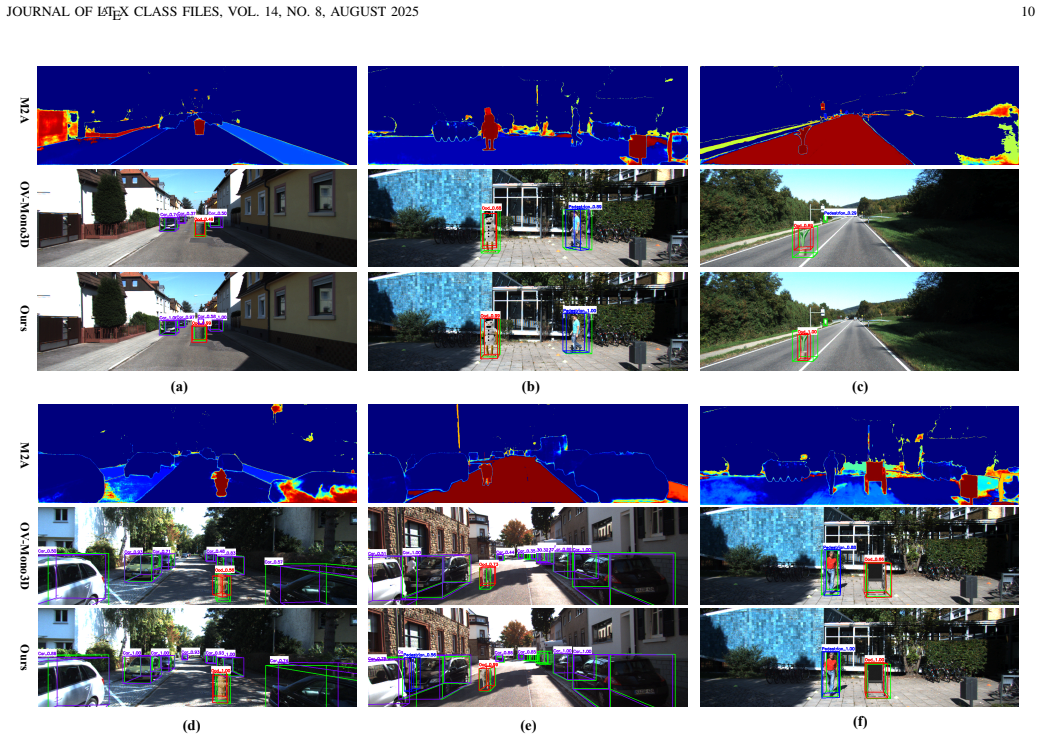
Summary. The paper addresses 3D anomaly object detection for autonomous driving from stereo cameras. It proposes S3AD, a stereo-based detector built on YOLOStereo3D, with (i) a category-agnostic binary foreground head that uses stereo correlation features, (ii) decoupled 2D and 3D supervision so that extra 2D-only annotations can improve OoD 3D detection, and (iii) an anomaly score RbAF that combines foreground confidence with the average known-class confidence. To support training and evaluation, the authors build KITTI-AR, a Blender-based augmented-reality stereo dataset: KITTI-AR-ExD adds 39 common categories as extra training data, and KITTI-AR-OoD adds 58 rare categories used only for zero-shot evaluation. Experiments report that adding KITTI-AR-ExD 3D boxes raises AP3D on OoD categories from 9.09 to 74.35 on the synthetic KITTI-AR-OoD test set, and that S3AD outperforms a re-implemented OV-Mono3D on that benchmark. A real-image experiment treats KITTI Pedestrian as OoD and reports an OoD AP3D of 21.37 for the stereo version.
Significance. If the reported results hold, the paper would provide a valuable low-cost stereo baseline for 3D anomaly detection and a large-scale synthetic dataset with 97 new categories. The strengths include: a real-image anchor (Table II) comparing against OV-Uni3DETR and OV-Mono3D; a clean ablation of decoupled 2D vs. 3D supervision (Table III); the use of Grounding DINO pseudo-labels as a proxy for low-cost 2D annotation (Table V); and a fixed anomaly-scoring formula with no fitted constants (Eq. 17). The code and dataset are promised for release, which would enable reproducibility. However, the headline 74.35 AP3D number is measured on a synthetic test set rendered with the same pipeline as the added training set, and the paper does not yet show that the gain transfers to real-world multi-category anomalies. The contribution is therefore significant but contingent on additional cross-domain or real-image validation.
major comments (4)
- [§III-E, Table III] The headline 3D APOoD improvement from 9.09 (KITTI only) to 74.35 (+KITTI-AR-ExD 3D) is measured on KITTI-AR-OoD, which is produced by the same Blender rendering procedure used to create KITTI-AR-ExD (Section III-E and Figure 5). The training and test renders share the camera-recovery-from-KITTI-annotations step, the 'reasonable size' scaling rule, the placement policy, and the random-lighting distribution. Neither the disparity-only foreground head (Eq. 5) nor the class-agnostic 3D regressor is shown to be insensitive to such shared pipeline-specific cues, so part or all of the 65-point gain could be a renderer shortcut rather than generic 3D anomaly detection. The only real-image OoD experiment (Table II) uses a single class (Pedestrian) and deliberately does not use rendered objects; it cannot validate the 74.35 figure. Please address this by (i) evaluating the model trained on KITTI-AR-ExD on a test set rendered with a different simulator or different rendering parameters, or (ii) evaluating on real anomaly images with 3D ground truth, and by reporting per-category APs on KITTI-AR-OoD to show the gain is not driven by a few categories.
- [§IV-B, Table II] The claim that S3AD is ready for 'zero-shot scenarios in real-world settings' (Abstract/Introduction) is supported only by the Pedestrian-as-OoD experiment on real KITTI images. That setup uses a known category as OoD, and the authors themselves note in Section IV-B that Pedestrian and Cyclist have similar textures and 3D scales, so the observed transfer may benefit from semantic overlap. A multi-class real-image OoD evaluation with varied object sizes (or at least a stereo real-image dataset with a few genuinely novel categories) is needed before the real-world generalization claim can be accepted. Without it, the paper should restrict its claims to synthetic-pipeline evaluation.
- [§IV-B, Table III] The OoD AP metric is not precisely defined. It is unclear whether APOoD is a macro-average over the 58 KITTI-AR-OoD categories or a pooled AP treating all OoD ground-truth boxes as one class, and it is unclear how a detection is assigned to the OoD set rather than to a known class (e.g., whether an anchor with high foreground score but no known-class match is a true positive). The 11-recall-point evaluation and the confidence threshold used for the lowered threshold mentioned in Section III-B should be stated, because the 74.35 value is not comparable across papers without this protocol.
- [§III-C, Eq. (5), Table VII] The text states that foreground classification is 'based solely on disparity features' (Section III-A, Eq. 5), but fs in Eq. (1) is the output of the stereo multi-scale correlation fusion module and is computed from the monocular features fL and fR; it is not a disparity map. The ablation in Table VII shows that using fs alone gives 74.35, whereas using monocular fL alone gives 72.73 and [fs, fL] gives 74.87. The differences are small, so the claim that disparity features are what provide robustness to texture overfitting needs a stronger analysis (e.g., ablating on real images or artificially removing appearance cues).
minor comments (5)
- [§III-E] Please provide more details on the Blender camera model, lighting distribution, mesh statistics, and the 'reasonable size' scaling rule so that the dataset construction is reproducible.
- [§IV-B] The text reports '21.00%' for the +KITTI-AR-ExD 2D OoD AP3D, while Table III gives 21.05; please make the numbers consistent.
- [Figures 10 and Table VIII] There are typos 'KIITTI' and 'KTTTI' in Figure 10 and Section IV-C; please correct them.
- [Eq. (17)] Please define the range and activation of cf_g and clarify that σ(·) = sigmoid(·) in Eq. (17) while RbA used tanh(·); currently the notation is introduced only in the surrounding text.
- [Table V] The text uses both 'Ground DINO' and 'Grounding DINO'; please standardize the name.
Circularity Check
No significant circularity: the headline 74.35 AP is a measured held-out result on OoD categories excluded from training, with independent anchors from real-KITTI evaluation and external pseudo-labels; the shared renderer is an external-validity concern, not a derivation-level circularity.
full rationale
The paper's claimed derivation chain is: decouple foreground binary classification from normal-class classification, decouple 2D and 3D supervision, add extra 2D/3D labels from the synthetic KITTI-AR-ExD set, score anomalies via the fixed RbAF formula, and measure AP on KITTI-AR-OoD. None of these steps defines its output in terms of its input. RbAF (Eq. 17) is a fixed algebraic combination of foreground confidence and the mean known-class confidence; it has no fitted constants and is not trained to match the OoD AP. The performance improvements in Tables III and VIII are measured effects of adding training data, not quantities derived from the training labels by construction. The paper's own statement that 'the 58 categories in the KITTI-AR-OoD subset are used strictly for testing and are excluded from any training stage' confirms that the OoD labels are not used as supervision. The evaluation also includes independent anchors: Table II uses real KITTI with Pedestrian held out and explicitly notes that 'no synthetic datasets were used in our method in Table II,' and Table V uses real KITTI plus Grounding DINO pseudo-labels, an external open-vocabulary detector. The shared Blender rendering pipeline between KITTI-AR-ExD and KITTI-AR-OoD is a legitimate external-validity concern about renderer-specific shortcuts, but it does not amount to a circular derivation: the method does not fit any parameter to the OoD ground truth, and the 74.35 AP is an empirical measurement rather than a tautological consequence of the equations. There are no load-bearing self-citations, no imported uniqueness theorems, and no renamed known results that reduce by construction to the inputs. The paper's stated limitation that Table II cannot fully expose OoD shortcomings is an honest acknowledgment of evaluation scope, not a circular step.
Assumptions & free parameters
free parameters (1)
- Unified 3D scale normalization mean and standard deviation =
Not reported in paper
assumptions (3)
- domain assumption Disparity features alone are sufficient for binary foreground detection
- domain assumption Blender-rendered objects composited into KITTI images are a valid proxy for real road anomalies
- domain assumption The 58 OoD categories are strictly excluded from all training stages
Cite this review
Pith. "Pith review of Stereo-based 3D Anomaly Object Detection for Autonomous Driving: A New Dataset and Baseline." pith.science (2026). https://pith.science/paper/NRPVXFHH
@misc{pith2026250709214,
  author       = {Pith},
  title        = {Pith review of: Stereo-based 3D Anomaly Object Detection for Autonomous Driving: A New Dataset and Baseline},
  year         = {2026},
  howpublished = {\url{https://pith.science/paper/NRPVXFHH}},
  note         = {Machine review of arXiv:2507.09214}
}
read the original abstract
3D detection technology is widely used in the field of autonomous driving, with its application scenarios gradually expanding from enclosed highways to open conventional roads. For rare anomaly categories that appear on the road, 3D detection models trained on closed sets often misdetect or fail to detect anomaly objects. To address this risk, it is necessary to enhance the generalization ability of 3D detection models for targets of arbitrary shapes and to possess the capability to filter out anomalies. The generalization of 3D detection is limited by two factors: the coupled training of 2D and 3D, and the insufficient diversity in the scale distribution of training samples. This paper proposes a Stereo-based 3D Anomaly object Detection (S3AD) algorithm, which decouples the training strategy of 3D and 2D to release the generalization ability for arbitrary 3D foreground detection, and proposes an anomaly scoring algorithm based on foreground confidence prediction, achieving target-level anomaly scoring. In order to further verify and enhance the generalization of anomaly detection, we use a 3D rendering method to synthesize two augmented reality binocular stereo 3D detection datasets which named KITTI-AR. KITTI-AR extends upon KITTI by adding 97 new categories, totaling 6k pairs of stereo images. The KITTI-AR-ExD subset includes 39 common categories as extra training data to address the sparse sample distribution issue. Additionally, 58 rare categories form the KITTI-AR-OoD subset, which are not used in training to simulate zero-shot scenarios in real-world settings, solely for evaluating 3D anomaly detection. Finally, the performance of the algorithm and the dataset is verified in the experiments. (Code and dataset can be obtained at https://github.com/shiyi-mu/S3AD-Code).
Figures


Figures from the paper (7 more)




Forward citations
Cited by 1 Pith paper
-
DDStereo: Efficient Dual Decoder Transformers for Stereo 3D Road Anomaly Detection
DDStereo uses two lightweight decoder branches sharing object queries plus a compact disparity extractor to deliver SOTA closed- and open-set accuracy with real-time inference on stereo 3D benchmarks.
Reference graph
Works this paper leans on
-
[1]
Road anomaly detection by partial image reconstruction with segmenta- tion coupling,
T. V ojir, T. ˇSipka, R. Aljundi, N. Chumerin, D. O. Reino, and J. Matas, “Road anomaly detection by partial image reconstruction with segmenta- tion coupling,” in Proceedings of the IEEE/CVF international conference on computer vision , 2021, pp. 15 651–15 660
work page 2021
-
[2]
Road obstacle detection method based on an autoencoder with semantic segmentation,
T. Ohgushi, K. Horiguchi, and M. Yamanaka, “Road obstacle detection method based on an autoencoder with semantic segmentation,” in proceedings of the Asian conference on computer vision , 2020
work page 2020
-
[3]
Rba: Segmenting unknown regions rejected by all,
N. Nayal, M. Yavuz, J. a. Henriques, and F. G ¨uney, “Rba: Segmenting unknown regions rejected by all,” ICCV23, Nov 2022
work page 2022
-
[4]
Unmasking anomalies in road-scene segmentation,
S. Rai, F. Cermelli, D. Fontanel, C. Masone, and B. Caputo, “Unmasking anomalies in road-scene segmentation,” ICCV23 oral, Jul 2023
work page 2023
-
[5]
Mask2anomaly: Mask transformer for universal open-set segmentation,
S. N. Rai, F. Cermelli, B. Caputo, and C. Masone, “Mask2anomaly: Mask transformer for universal open-set segmentation,” IEEE Transac- tions on Pattern Analysis and Machine Intelligence , vol. 46, no. 12, pp. 9286–9302, 2024
work page 2024
-
[6]
Sotif entropy: Online sotif risk quantification and mitigation for autonomous driving,
L. Peng, B. Li, W. Yu, K. Yang, W. Shao, and H. Wang, “Sotif entropy: Online sotif risk quantification and mitigation for autonomous driving,” IEEE Transactions on Intelligent Transportation Systems , 2023
work page 2023
-
[7]
Towards corner case detection by modeling the uncertainty of instance segmentation networks,
F. Heidecker, A. Hannan, M. Bieshaar, and B. Sick, “Towards corner case detection by modeling the uncertainty of instance segmentation networks,” in Pattern Recognition. ICPR International Workshops and Challenges: Virtual Event, January 10–15, 2021, Proceedings, Part IV . Springer, 2021, pp. 361–374
work page 2021
-
[8]
Ensemble uncertainty guided road scene anomaly detection: A simple meta-learning approach,
Y . Liu, X. Wei, P. Lasang, S. Pranata, K. Subramanian, and H. Seow, “Ensemble uncertainty guided road scene anomaly detection: A simple meta-learning approach,” IEEE Transactions on Intelligent Transporta- tion Systems, 2024
work page 2024
Show all 76 references
-
[9]
Promptdet: Towards open-vocabulary detection using uncurated images,
C. Feng, Y . Zhong, Z. Jie, X. Chu, H. Ren, X. Wei, W. Xie, and L. Ma, “Promptdet: Towards open-vocabulary detection using uncurated images,” in European Conference on Computer Vision. Springer, 2022, pp. 701–717
2022
-
[10]
Yolo- world: Real-time open-vocabulary object detection,
T. Cheng, L. Song, Y . Ge, W. Liu, X. Wang, and Y . Shan, “Yolo- world: Real-time open-vocabulary object detection,” in Proceedings of the IEEE/CVF Conference on Computer Vision and Pattern Recognition, 2024, pp. 16 901–16 911
2024
-
[11]
Ov-uni3detr: Towards unified open-vocabulary 3d object detection via cycle-modality propa- gation,
Z. Wang, Y . Li, T. Liu, H. Zhao, and S. Wang, “Ov-uni3detr: Towards unified open-vocabulary 3d object detection via cycle-modality propa- gation,” in European Conference on Computer Vision . Springer, 2024, pp. 73–89
2024
-
[12]
Pixel-wise anomaly detection in complex driving scenes,
G. Di Biase, H. Blum, R. Siegwart, and C. Cadena, “Pixel-wise anomaly detection in complex driving scenes,” in CVPR2021, 2021
2021
-
[13]
Cor- ner cases for visual perception in automated driving: some guidance on detection approaches,
J. Breitenstein, J.-A. Term ¨ohlen, D. Lipinski, and T. Fingscheidt, “Cor- ner cases for visual perception in automated driving: some guidance on detection approaches,” arXiv preprint arXiv:2102.05897 , 2021
2021 arXiv
-
[14]
Pesotif: A challenging visual dataset for perception sotif problems in long-tail traffic scenarios,
L. Peng, J. Li, W. Shao, and H. Wang, “Pesotif: A challenging visual dataset for perception sotif problems in long-tail traffic scenarios,” in 2023 IEEE Intelligent Vehicles Symposium (IV) . IEEE, 2023, pp. 1–8
2023
-
[15]
Lost and found: detecting small road hazards for self-driving vehicles,
P. Pinggera, S. Ramos, S. Gehrig, U. Franke, C. Rother, and R. Mester, “Lost and found: detecting small road hazards for self-driving vehicles,” in 2016 IEEE/RSJ International Conference on Intelligent Robots and Systems (IROS). IEEE, 2016, pp. 1099–1106
2016
-
[16]
Detecting the unexpected via image resynthesis,
K. Lis, K. Nakka, P. Fua, and M. Salzmann, “Detecting the unexpected via image resynthesis,” in Proceedings of the IEEE/CVF International Conference on Computer Vision , 2019, pp. 2152–2161
2019
-
[17]
Carla: An open urban driving simulator,
A. Dosovitskiy, G. Ros, F. Codevilla, A. Lopez, and V . Koltun, “Carla: An open urban driving simulator,” in Conference on robot learning . PMLR, 2017, pp. 1–16
2017
-
[18]
Towards open-set camera 3d object detection,
Z. He, X. Li, H. Gao, J. Tang, S. Qiu, W. Wang, L. Lu, X. Qiu, X. Xue, and J. Pu, “Towards open-set camera 3d object detection,”arXiv preprint arXiv:2406.17297, 2024
2024
-
[19]
A survey of 3d object detection,
W. Liang, P. Xu, L. Guo, H. Bai, Y . Zhou, and F. Chen, “A survey of 3d object detection,” Multimedia Tools and Applications , vol. 80, no. 19, pp. 29 617–29 641, 2021
2021
-
[20]
3d object detection for autonomous driving: A comprehensive survey,
J. Mao, S. Shi, X. Wang, and H. Li, “3d object detection for autonomous driving: A comprehensive survey,” International Journal of Computer Vision, vol. 131, no. 8, pp. 1909–1963, 2023
1909
-
[21]
3d object detection for autonomous driving: A survey,
R. Qian, X. Lai, and X. Li, “3d object detection for autonomous driving: A survey,” Pattern Recognition, vol. 130, p. 108796, 2022
2022
-
[22]
Robustness-aware 3d object detection in autonomous driving: A review and outlook,
Z. Song, L. Liu, F. Jia, Y . Luo, C. Jia, G. Zhang, L. Yang, and L. Wang, “Robustness-aware 3d object detection in autonomous driving: A review and outlook,” IEEE Transactions on Intelligent Transportation Systems , 2024
2024
-
[23]
Geometry- based distance decomposition for monocular 3d object detection,
X. Shi, Q. Ye, X. Chen, C. Chen, Z. Chen, and T.-K. Kim, “Geometry- based distance decomposition for monocular 3d object detection,” in Proceedings of the IEEE/CVF International Conference on Computer Vision, 2021, pp. 15 172–15 181
2021
-
[24]
Occlusion-aware plane-constraints for monocular 3d object detection,
H. Yao, J. Chen, Z. Wang, X. Wang, P. Han, X. Chai, and Y . Qiu, “Occlusion-aware plane-constraints for monocular 3d object detection,” IEEE Transactions on Intelligent Transportation Systems , 2023
2023
-
[25]
Objects are different: Flexible monocular 3d object detection,
Y . Zhang, J. Lu, and J. Zhou, “Objects are different: Flexible monocular 3d object detection,” in Proceedings of the IEEE/CVF Conference on Computer Vision and Pattern Recognition , 2021, pp. 3289–3298
2021
-
[26]
Boosting monocular 3d object detection with object-centric auxiliary depth supervision,
Y . Kim, S. Kim, S. Sim, J. W. Choi, and D. Kum, “Boosting monocular 3d object detection with object-centric auxiliary depth supervision,” IEEE Transactions on Intelligent Transportation Systems, vol. 24, no. 2, pp. 1801–1813, 2022
2022
-
[27]
Monocular 3d object detection utilizing auxiliary learning with deformable convolution,
J. Chen, J. Shieh, M. A. Haq, and S. Ruan, “Monocular 3d object detection utilizing auxiliary learning with deformable convolution,” IEEE Transactions on Intelligent Transportation Systems , 2023
2023
-
[28]
Camrl: A joint method of channel attention and multidimensional regression loss for 3d object detection in automated vehicles,
H. Gao, D. Fang, J. Xiao, W. Hussain, and J. Y . Kim, “Camrl: A joint method of channel attention and multidimensional regression loss for 3d object detection in automated vehicles,”IEEE Transactions on Intelligent Transportation Systems, vol. 24, no. 8, pp. 8831–8845, 2022
2022
-
[29]
One stage monocular 3d object detection utilizing discrete depth and orientation representation,
M. A. Haq, S.-J. Ruan, M.-E. Shao, Q. M. U. Haq, P.-J. Liang, and D.-Q. Gao, “One stage monocular 3d object detection utilizing discrete depth and orientation representation,” IEEE Transactions on Intelligent Transportation Systems, vol. 23, no. 11, pp. 21 630–21 640, 2022
2022
-
[30]
Monodetr: Depth-guided transformer for monocular 3d object detection,
R. Zhang, H. Qiu, T. Wang, Z. Guo, Z. Cui, Y . Qiao, H. Li, and P. Gao, “Monodetr: Depth-guided transformer for monocular 3d object detection,” in Proceedings of the IEEE/CVF International Conference on Computer Vision , 2023, pp. 9155–9166
2023
-
[31]
Monopstr: Monocular 3d object detection with dynamic position & scale-aware transformer,
F. Yang, X. He, W. Chen, P. Zhou, and Z. Li, “Monopstr: Monocular 3d object detection with dynamic position & scale-aware transformer,” IEEE Transactions on Instrumentation and Measurement , 2024
2024
-
[32]
Pyramid stereo matching network,
J. Chang and Y . Chen, “Pyramid stereo matching network,” in Proceed- ings of the IEEE conference on computer vision and pattern recognition, 2018, pp. 5410–5418
2018
-
[33]
Disp r-cnn: Stereo 3d object detection via shape prior guided instance disparity estimation,
J. Sun, L. Chen, Y . Xie, S. Zhang, Q. Jiang, X. Zhou, and H. Bao, “Disp r-cnn: Stereo 3d object detection via shape prior guided instance disparity estimation,” in Proceedings of the IEEE/CVF conference on computer vision and pattern recognition , 2020, pp. 10 548–10 557
2020
-
[34]
Real-time stereo 3d car detec- tion with shape-aware non-uniform sampling,
A. Gao, J. Cao, Y . Pang, and X. Li, “Real-time stereo 3d car detec- tion with shape-aware non-uniform sampling,” IEEE Transactions on Intelligent Transportation Systems, vol. 24, no. 4, pp. 4027–4037, 2023
2023
-
[35]
Yolostereo3d: A step back to 2d for efficient stereo 3d detection,
Y . Liu, L. Wang, and M. Liu, “Yolostereo3d: A step back to 2d for efficient stereo 3d detection,” in 2021 IEEE international conference on Robotics and automation (ICRA) . IEEE, 2021, pp. 13 018–13 024
2021
-
[36]
Towards domain generalization for multi-view 3d object detection in bird-eye-view,
S. Wang, X. Zhao, H.-M. Xu, Z. Chen, D. Yu, J. Chang, Z. Yang, and F. Zhao, “Towards domain generalization for multi-view 3d object detection in bird-eye-view,” inProceedings of the IEEE/CVF Conference on Computer Vision and Pattern Recognition , 2023, pp. 13 333–13 342
2023
-
[37]
Bevdepth: Acquisition of reliable depth for multi-view 3d object detec- tion,
Y . Li, Z. Ge, G. Yu, J. Yang, Z. Wang, Y . Shi, J. Sun, and Z. Li, “Bevdepth: Acquisition of reliable depth for multi-view 3d object detec- tion,” in Proceedings of the AAAI Conference on Artificial Intelligence , vol. 37, no. 2, 2023, pp. 1477–1485
2023
-
[38]
Bevformer: Learning bird’s-eye-view representation from multi-camera images via spatiotemporal transformers,
Z. Li, W. Wang, H. Li, E. Xie, C. Sima, T. Lu, Y . Qiao, and J. Dai, “Bevformer: Learning bird’s-eye-view representation from multi-camera images via spatiotemporal transformers,” in European conference on computer vision. Springer, 2022, pp. 1–18
2022
-
[39]
Bevdet4d: Exploit temporal cues in multi- camera 3d object detection,
J. Huang and G. Huang, “Bevdet4d: Exploit temporal cues in multi- camera 3d object detection,” arXiv preprint arXiv:2203.17054 , 2022
2022 arXiv
-
[40]
Fast-bev: A fast and strong bird’s-eye view perception baseline,
Y . Li, B. Huang, Z. Chen, Y . Cui, F. Liang, M. Shen, F. Liu, E. Xie, L. Sheng, W. Ouyang et al. , “Fast-bev: A fast and strong bird’s-eye view perception baseline,” IEEE Transactions on Pattern Analysis and Machine Intelligence, 2024
2024
-
[41]
Exploiting label uncertainty for enhanced 3d object detection from point clouds,
Y . Sun, B. Lu, Y . Liu, Z. Yang, A. Behera, R. Song, H. Yuan, and H. Jiang, “Exploiting label uncertainty for enhanced 3d object detection from point clouds,” IEEE Transactions on Intelligent Transportation Systems, 2024
2024
-
[42]
Anchorpoint: Query design for transformer-based 3d object detection and tracking,
H. Liu, Y . Ma, H. Wang, C. Zhang, and Y . Guo, “Anchorpoint: Query design for transformer-based 3d object detection and tracking,” IEEE Transactions on Intelligent Transportation Systems , vol. 24, no. 10, pp. 10 988–11 000, 2023. JOURNAL OF LATEX CLASS FILES, VOL. 14, NO. 8,...
2023
-
[43]
Rs- aug: Improve 3d object detection on lidar with realistic simulator based data augmentation,
P. An, J. Liang, J. Ma, Y . Chen, L. Wang, Y . Yang, and Q. Liu, “Rs- aug: Improve 3d object detection on lidar with realistic simulator based data augmentation,” IEEE Transactions on Intelligent Transportation Systems, vol. 24, no. 9, pp. 10 165–10 176, 2023
2023
-
[44]
Focal distillation from high-resolution data to low-resolution data for 3d object detection,
J. Shan, G. Zhang, C. Tang, H. Pan, Q. Yu, G. Wu, and X. Hu, “Focal distillation from high-resolution data to low-resolution data for 3d object detection,” IEEE Transactions on Intelligent Transportation Systems , 2023
2023
-
[45]
Svdnet: Singular value control and distance alignment network for 3d object detection,
M. Chang, C. Cheng, C. Hsiao, Y . Li, and C. Huang, “Svdnet: Singular value control and distance alignment network for 3d object detection,” IEEE Transactions on Intelligent Transportation Systems, vol. 24, no. 9, pp. 9281–9295, 2023
2023
-
[46]
Collaborative 3d object detection for autonomous vehicles via learnable communications,
J. Wang, Y . Zeng, and Y . Gong, “Collaborative 3d object detection for autonomous vehicles via learnable communications,” IEEE Transactions on Intelligent Transportation Systems , vol. 24, no. 9, pp. 9804–9816, 2023
2023
-
[47]
Transformer3d-det: Improving 3d object detection by vote refinement,
L. Zhao, J. Guo, D. Xu, and L. Sheng, “Transformer3d-det: Improving 3d object detection by vote refinement,” IEEE Transactions on Circuits and Systems for Video Technology, vol. 31, no. 12, pp. 4735–4746, 2021
2021
-
[48]
Ppf-det: Point-pixel fusion for multi-modal 3d object detection,
G. Xie, Z. Chen, M. Gao, M. Hu, and X. Qin, “Ppf-det: Point-pixel fusion for multi-modal 3d object detection,” IEEE Transactions on Intelligent Transportation Systems, 2024
2024
-
[49]
A smart iot enabled end-to-end 3d object detection system for autonomous vehicles,
I. Ahmed, G. Jeon, and A. Chehri, “A smart iot enabled end-to-end 3d object detection system for autonomous vehicles,” IEEE Transactions on Intelligent Transportation Systems , vol. 24, no. 11, pp. 13 078–13 087, 2022
2022
-
[50]
Stereo rgb and deeper lidar-based network for 3d object detection in autonomous driving,
Q. He, Z. Wang, H. Zeng, Y . Zeng, Y . Liu, S. Liu, and B. Zeng, “Stereo rgb and deeper lidar-based network for 3d object detection in autonomous driving,” IEEE Transactions on Intelligent Transportation Systems, vol. 24, no. 1, pp. 152–162, 2022
2022
-
[51]
Gal: Graph-induced adaptive learning for weakly supervised 3d object detection,
D. Yin, H. Yu, N. Liu, F. Yao, Q. He, J. Li, Y . Yang, S. Yan, and X. Sun, “Gal: Graph-induced adaptive learning for weakly supervised 3d object detection,” IEEE Transactions on Intelligent Transportation Systems, vol. 24, no. 9, pp. 9684–9697, 2023
2023
-
[52]
Fs- net: Lidar-camera fusion with matched scale for 3d object detection in autonomous driving,
L. Zhang, X. Li, K. Tang, Y . Jiang, L. Yang, Y . Zhang, and X. Chen, “Fs- net: Lidar-camera fusion with matched scale for 3d object detection in autonomous driving,” IEEE Transactions on Intelligent Transportation Systems, vol. 24, no. 11, pp. 12 154–12 165, 2023
2023
-
[53]
Object detection with deep learning: A review,
Z. Zhao, P. Zheng, S. Xu, and X. Wu, “Object detection with deep learning: A review,” IEEE transactions on neural networks and learning systems, vol. 30, no. 11, pp. 3212–3232, 2019
2019
-
[54]
End-to-end object detection with transformers,
N. Carion, F. Massa, G. Synnaeve, N. Usunier, A. Kirillov, and S. Zagoruyko, “End-to-end object detection with transformers,” in European conference on computer vision . Springer, 2020, pp. 213– 229
2020
-
[55]
Anomaly detection in autonomous driving: A survey,
D. Bogdoll, M. Nitsche, and J. M. Z ¨ollner, “Anomaly detection in autonomous driving: A survey,” inProceedings of the IEEE/CVF confer- ence on computer vision and pattern recognition , 2022, pp. 4488–4499
2022
-
[56]
Detecting road obstacles by erasing them,
K. Lis, S. Honari, P. Fua, and M. Salzmann, “Detecting road obstacles by erasing them,” IEEE transactions on pattern analysis and machine intelligence, 2023
2023
-
[57]
Towards total recall in industrial anomaly detection,
K. Roth, L. Pemula, J. Zepeda, B. Sch ¨olkopf, T. Brox, and P. Gehler, “Towards total recall in industrial anomaly detection,” in Proceedings of the IEEE/CVF conference on computer vision and pattern recognition , 2022, pp. 14 318–14 328
2022
-
[58]
Deeproad: Gan-based metamorphic testing and input validation framework for autonomous driving systems,
M. Zhang, Y . Zhang, L. Zhang, C. Liu, and S. Khurshid, “Deeproad: Gan-based metamorphic testing and input validation framework for autonomous driving systems,” in Proceedings of the 33rd ACM/IEEE International Conference on Automated Software Engineering , Sep 2018
2018
-
[59]
Residual pattern learning for pixel-wise out-of-distribution detection in semantic segmentation,
Y . Liu, C. Ding, Y . Tian, G. Pang, V . Belagiannis, I. Reid, and G. Carneiro, “Residual pattern learning for pixel-wise out-of-distribution detection in semantic segmentation,” ICCV23, Nov 2022
2022
-
[60]
Dropout as a bayesian approximation: Representing model uncertainty in deep learning,
Y . Gal and Z. Ghahramani, “Dropout as a bayesian approximation: Representing model uncertainty in deep learning,” in international conference on machine learning . PMLR, 2016, pp. 1050–1059
2016
-
[61]
Bayesian segnet: Model uncertainty in deep convolutional encoder-decoder architectures for scene understanding,
A. Kendall, V . Badrinarayanan, and R. Cipolla, “Bayesian segnet: Model uncertainty in deep convolutional encoder-decoder architectures for scene understanding,” arXiv preprint arXiv:1511.02680 , 2015
2015 arXiv
-
[62]
Uncertainty evaluation of object detection algorithms for autonomous vehicles,
L. Peng, H. Wang, and J. Li, “Uncertainty evaluation of object detection algorithms for autonomous vehicles,” Automotive Innovation , vol. 4, no. 3, pp. 241–252, 2021
2021
-
[63]
A baseline for detecting misclassified and out-of-distribution examples in neural networks,
D. Hendrycks and K. Gimpel, “A baseline for detecting misclassified and out-of-distribution examples in neural networks,” Learning,Learning, Oct 2016
2016
-
[64]
Masked-attention mask transformer for universal image segmentation,
B. Cheng, I. Misra, A. G. Schwing, A. Kirillov, and R. Girdhar, “Masked-attention mask transformer for universal image segmentation,” in Proceedings of the IEEE/CVF conference on computer vision and pattern recognition, 2022, pp. 1290–1299
2022
-
[65]
Open-set 3d object detection,
J. Cen, P. Yun, J. Cai, M. Y . Wang, and M. Liu, “Open-set 3d object detection,” in 2021 International conference on 3D vision (3DV). IEEE, 2021, pp. 869–878
2021
-
[66]
Identifying unknown instances for autonomous driving,
K. Wong, S. Wang, M. Ren, M. Liang, and R. Urtasun, “Identifying unknown instances for autonomous driving,” in Conference on Robot Learning. PMLR, 2020, pp. 384–393
2020
-
[67]
Open vocabulary monocular 3d object detection,
J. Yao, H. Gu, X. Chen, J. Wang, and Z. Cheng, “Open vocabulary monocular 3d object detection,” arXiv preprint arXiv:2411.16833, 2024
2024
-
[68]
Focal loss for dense object detection,
T. Lin, P. Goyal, R. Girshick, K. He, and P. Dollar, “Focal loss for dense object detection,” in Proceedings of the IEEE international conference on computer vision , 2017, pp. 2980–2988
2017
-
[69]
Yolov3: An incremental improvement,
J. Redmon, “Yolov3: An incremental improvement,” arXiv preprint arXiv:1804.02767, 2018
2018 arXiv
-
[70]
Grounding dino: Marrying dino with grounded pre- training for open-set object detection,
S. Liu, Z. Zeng, T. Ren, F. Li, H. Zhang, J. Yang, C. Li, J. Yang, H. Su, J. Zhu et al., “Grounding dino: Marrying dino with grounded pre- training for open-set object detection,” arXiv preprint arXiv:2303.05499, 2023
2023 arXiv
-
[71]
Are we ready for autonomous driving? the kitti vision benchmark suite,
A. Geiger, P. Lenz, and R. Urtasun, “Are we ready for autonomous driving? the kitti vision benchmark suite,” in 2012 IEEE Conference on Computer Vision and Pattern Recognition , Jun 2012
2012
-
[72]
Virtual worlds as proxy for multi-object tracking analysis,
A. Gaidon, Q. Wang, Y . Cabon, and E. Vig, “Virtual worlds as proxy for multi-object tracking analysis,” in Proceedings of the IEEE conference on Computer Vision and Pattern Recognition , 2016, pp. 4340–4349
2016
-
[73]
3d object proposals for accurate object class detection,
X. Chen, K. Kundu, Y . Zhu, A. Berneshawi, H. Ma, S. Fidler, and R. Urtasun, “3d object proposals for accurate object class detection,” Neural Information Processing Systems,Neural Information Processing Systems, Dec 2015
2015
-
[74]
Pointclip: Point cloud understanding by clip,
R. Zhang, Z. Guo, W. Zhang, K. Li, X. Miao, B. Cui, Y . Qiao, P. Gao, and H. Li, “Pointclip: Point cloud understanding by clip,” in Proceedings of the IEEE/CVF conference on computer vision and pattern recognition, 2022, pp. 8552–8562
2022
-
[75]
Pointclip v2: Prompting clip and gpt for powerful 3d open-world learning,
X. Zhu, R. Zhang, B. He, Z. Guo, Z. Zeng, Z. Qin, S. Zhang, and P. Gao, “Pointclip v2: Prompting clip and gpt for powerful 3d open-world learning,” in Proceedings of the IEEE/CVF International Conference on Computer Vision , 2023, pp. 2639–2650
2023
-
[76]
Learning transferable visual models from natural language supervision,
A. Radford, J. W. Kim, C. Hallacy, A. Ramesh, G. Goh, S. Agarwal, G. Sastry, A. Askell, P. Mishkin, J. Clark et al., “Learning transferable visual models from natural language supervision,” in International conference on machine learning . PMLR, 2021, pp. 8748–8763. Shiyi Mu r...
2021
Reviewed August 6, 2026 · model on record in the stance chip above.
Discussion (0). Sign in to comment.