An SO(3)times SO(8)-invariant Einstein metric on S³times S⁷
Pith reviewed 2026-06-27 15:29 UTC · model grok-4.3
The pith
An SO(3)×SO(8)-invariant Einstein metric with positive scalar curvature exists on S³×S⁷.
A machine-rendered reading of the paper's core claim, the machinery that carries it, and where it could break.
Core claim
The paper proves the existence of an SO(3)×SO(8)-invariant Einstein metric with positive scalar curvature on S³×S⁷.
What carries the argument
Reduction of the Einstein equations to a solvable system under the SO(3)×SO(8) invariance on the manifold S³×S⁷.
If this is right
- This metric is a new example of an Einstein manifold with positive scalar curvature.
- The symmetry group SO(3)×SO(8) acts on the product space in a way that permits such a metric.
- The existence expands the known set of invariant Einstein metrics on sphere products.
Where Pith is reading between the lines
- Similar reduction techniques could apply to other group actions on S^m × S^n for different m and n.
- The metric might have applications in studying the geometry of homogeneous spaces or in physics models requiring positive curvature.
- One could test if the metric is stable under perturbations or if it is unique in its class.
Load-bearing premise
Imposing the SO(3)×SO(8) symmetry reduces the Einstein equations to a system that has a solution with positive scalar curvature.
What would settle it
Solving the reduced system and finding either no real positive solution or that the scalar curvature is non-positive for all solutions.
Figures

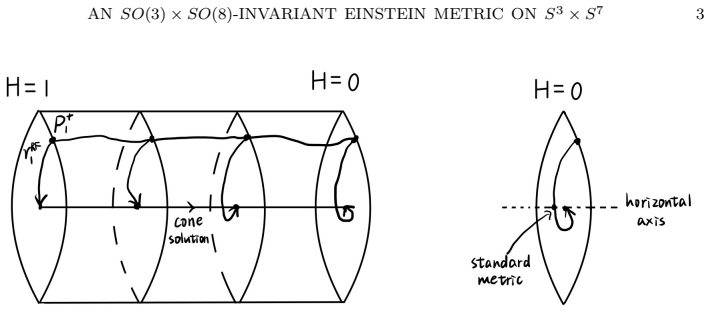
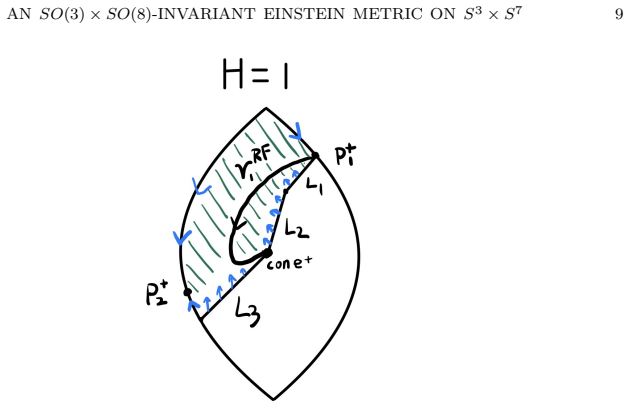
read the original abstract
In this paper, we prove the existence of an $SO(3)\times SO(8)$-invariant Einstein metric with positive scalar curvature on $S^{3}\times S^7$.
Editorial analysis
A structured set of objections, weighed in public.
Referee Report
Summary. The manuscript claims to prove the existence of an SO(3)×SO(8)-invariant Einstein metric with positive scalar curvature on the product manifold S³×S⁷.
Significance. If the result holds and is supported by a complete argument, it would supply a new homogeneous Einstein metric on a product of spheres, potentially useful for understanding the space of Einstein metrics under prescribed symmetry groups.
major comments (1)
- No derivation, symmetry reduction, ODE/algebraic system, or existence argument is supplied in the manuscript (only the abstract is present). The central claim that the Einstein equation reduces to a solvable system yielding the stated metric cannot be checked against any data, equations, or proof steps.
Simulated Author's Rebuttal
We thank the referee for their careful reading and for highlighting the need for a complete argument. We acknowledge that the submitted version contains only the abstract and does not provide the required derivations or proof steps.
read point-by-point responses
-
Referee: No derivation, symmetry reduction, ODE/algebraic system, or existence argument is supplied in the manuscript (only the abstract is present). The central claim that the Einstein equation reduces to a solvable system yielding the stated metric cannot be checked against any data, equations, or proof steps.
Authors: We agree with this assessment. The manuscript as submitted consists solely of the abstract and therefore supplies none of the requested technical details. In the revised version we will include the full symmetry reduction of the Einstein equation under the SO(3)×SO(8) action, the resulting algebraic system on the space of invariant metrics, the explicit solution that yields positive scalar curvature, and the verification that the metric is Einstein. revision: yes
Circularity Check
No significant circularity identified
full rationale
The available text consists solely of the abstract claiming existence of an SO(3)×SO(8)-invariant Einstein metric on S³×S⁷ via symmetry reduction to a solvable system. No equations, ODE reductions, parameter fittings, self-citations, or uniqueness theorems are quoted or visible, so no load-bearing step can be shown to reduce to its own inputs by construction. The result is therefore treated as self-contained against external benchmarks with no circularity detected.
Axiom & Free-Parameter Ledger
Reference graph
Works this paper leans on
-
[1]
Boyer, Krzysztof Galicki, and J\' a nos Koll\' a r, Einstein metrics on spheres, Ann
Charles P. Boyer, Krzysztof Galicki, and J\' a nos Koll\' a r, Einstein metrics on spheres, Ann. of Math. (2) 162 (2005), no. 1, 557--580
2005
-
[2]
Timothy Buttsworth and Liam Hodgkinson, Computationally assisted proof of a novel O(3) O(10) -invariant E instein metric on S^ 12 , J. Lond. Math. Soc. (2) 113 (2026), no. 2, Paper No. e70477, 44
2026
-
[3]
Christoph B \"o hm, Inhomogeneous Einstein metrics on low-dimensional spheres and other low-dimensional spaces , Invent. Math. 134 (1998), no. 1, 145--176
1998
-
[4]
Christoph B \" o hm, Non-compact cohomogeneity one E instein manifolds , Bull. Soc. Math. France 127 (1999), no. 1, 135--177
1999
-
[5]
Hanci Chi, Positive E instein metrics with S ^ 4m+3 as the principal orbit , Compos. Math. 160 (2024), no. 5, 1004--1040
2024
-
[6]
Coddington and Norman Levinson, Theory of ordinary differential equations, McGraw-Hill Book Co., Inc., New York-Toronto-London, 1955
Earl A. Coddington and Norman Levinson, Theory of ordinary differential equations, McGraw-Hill Book Co., Inc., New York-Toronto-London, 1955
1955
-
[7]
Eschenburg and McKenzie Y
J.-H. Eschenburg and McKenzie Y. Wang, The initial value problem for cohomogeneity one E instein metrics , J. Geom. Anal. 10 (2000), no. 1, 109--137
2000
-
[8]
Lorenzo Foscolo and Mark Haskins, New G_2 -holonomy cones and exotic nearly K \" a hler structures on S^6 and S^3 S^3 , Ann. of Math. (2) 185 (2017), no. 1, 59--130
2017
-
[9]
Alessandro Ghigi and J\' a nos Koll\' a r, K\" a hler- E instein metrics on orbifolds and E instein metrics on spheres , Comment. Math. Helv. 82 (2007), no. 4, 877--902
2007
-
[10]
Jensen, Einstein metrics on principal fibre bundles, J
Gary R. Jensen, Einstein metrics on principal fibre bundles, J. Differential Geometry 8 (1973), 599--614
1973
-
[11]
Differential Geom
Yuchen Liu, Taro Sano, and Luca Tasin, Infinitely many families of S asaki- E instein metrics on spheres , J. Differential Geom. 130 (2025), no. 1, 1--26
2025
-
[12]
Jan Nienhaus and Matthias Wink, Einstein metrics on the Ten-Sphere, to appear in J. Eur. Math. Soc., arXiv:2303.04832 (2025)
arXiv 2025
-
[13]
Qiu Shi Wang, Doubly warped product Einstein metrics on spheres, arXiv:2606.05519 (2026)
Pith/arXiv arXiv 2026
discussion (0)
Sign in with ORCID, Apple, or X to comment. Anyone can read and Pith papers without signing in.