REVIEW 3 major objections 6 minor 14 references
Newton's Second Law: A Theoretical Identity Derived from the Principle of Excluded Perpetual Motion and the Weak Equivalence Principle
T0 review · 3 major / 6 minor · reviewed 2026-08-07 · deepseek-v4-flash
Pith's one-line read Newton's second law, F=ma, is a theoretical identity, not an empirical law: it follows from two deeper physical principles.
desk verdict A serious attempt that fails at the load-bearing step: Galileo's sine law is imported rather than derived, so the central identity collapses, but the Suppes formalization and WEP discussion are worth a referee's time. read the letter →
The pith
A machine-rendered reading of the paper's core claim, the machinery that carries it, and where it could break.
The reading
What carries the argument
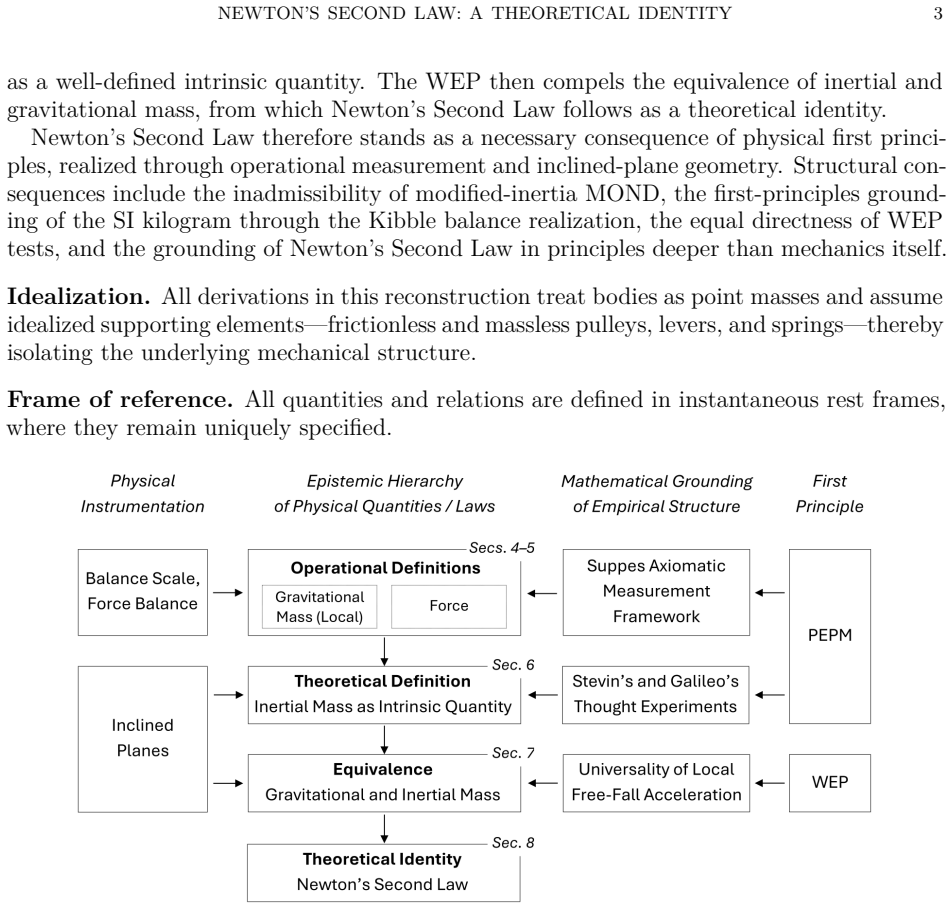
The load-bearing object is the combined Stevin-Galileo equation, which arises from two sine laws: the static law F_parallel^L(B) = W_L(B) sin($\theta$) from the necklace argument, and the kinematic law a_L(B) = g_L(B) sin($\theta$) from the equal-heights argument. On the same incline angle, dividing the first by the second gives F/a(B,F) = gamma_L m_G^L(B)/g_L(B), independent of the force value and its realization; that is what turns inertial mass into an intrinsic property of the body. The weak equivalence principle then makes the ratio of gravitational to inertial mass constant across bodies and positions, and a rescaling of the force unit makes the two masses numerically equal. The whole chain is anchored to gravity because weight is the one force that is operationally identical to gravitational mass, but the final identity does not depend on the mechanism of the force.
What would settle it
An experiment in which the ratio F/a for a single body changes with the value or the delivery of the applied force, while energy conservation and universal free fall are preserved, would refute the claim that F/a is an intrinsic quantity; a concrete version is a torsion-balance test of mass equivalence and a free-fall test of the weak equivalence principle at the same site giving different results, since the paper's derivation forces those two tests to share the same epistemic content.
Extended reading notes
Core claim
On the paper's own terms, the central discovery is Proposition 8.1: with the force unit chosen so that the constant c equals 1, F = m_G^L(B) a(B,F) is a theoretical identity between independently defined quantities, gravitational mass by the balance scale and force by the force balance. The derivation has three load-bearing steps: the measurement framework makes mass and force well-defined primitives; the combined static and kinematic sine laws on inclined planes, both derived from the no-perpetual-motion principle, make F/a an object-intrinsic quantity and hence define inertial mass; and the weak equivalence principle forces m_G^L(B)/m_I(B) to be independent of body and position, so the definition of inertial mass becomes the law F=ma.
Load-bearing premise
The single load-bearing premise is that a body starting from rest under a fixed force moves with uniform acceleration, so $v^{2}$ = 2as; that kinematic assumption is a special case of the very law being derived, and if modified-inertia dynamics replace it, the proof that F/a is intrinsic to the body no longer goes through.
Editorial extensions
If this is right
- In the instantaneous rest frame of a body, whenever the operational definitions apply, F=ma holds exactly; no separate empirical calibration of the law is needed.
- Modified-inertia formulations of MOND are inadmissible under the two principles, so viable alternatives are pushed into the gravitational sector, such as dark matter or modified gravity.
- The cross-location reproducibility of the Kibble-balance realization of the SI kilogram is grounded in the theoretical identity, not in empirical adequacy of W=mg.
- Under the PEPM alone, free-fall and torsion-balance experiments are equally direct tests of the weak equivalence principle; the choice between them is practical, not epistemic.
- Newton's Second Law is not an autonomous axiom of mechanics but a consequence of energy conservation and the Einstein Equivalence Principle.
Reading between the lines
- If the argument is right, any empirically successful modification of F=ma must be interpreted as a modification of the gravitational force law or of energy conservation, which sharpens the experimental search: falsifying MOND would require violating WEP or PEPM.
- The same structural argument would apply to emergent-gravity or entropic-gravity proposals that modify inertia, not just MOND, because those would also break the claimed object-intrinsicality of F/a.
- The paper's equivalence between free-fall and torsion-balance WEP tests suggests a concrete new cross-check: running both tests at the same location with matched systematic budgets would provide a previously unrecognized consistency test of the derivation's assumptions.
Editorial analysis
A structured set of objections, weighed in public.
Referee Report
Summary. The paper claims that Newton's Second Law, F = ma, can be derived as a theoretical identity from two principles: the Principle of Excluded Perpetual Motion (PEPM) and the Weak Equivalence Principle (WEP). The argument uses Suppes' measurement theory to give operational definitions of gravitational mass and force, then combines Stevin's static and Galileo's kinematic sine laws for the inclined plane to define inertial mass as F/a, shows this ratio is object-intrinsic, and invokes the WEP to equate inertial and gravitational mass. Substituting this equivalence into the definition yields F = m_G a as a theoretical identity. The paper also draws consequences for MOND, the Kibble balance, and the interpretation of WEP tests.
Significance. If the derivation were sound, it would reclassify Newton's Second Law from an empirical generalization to a necessary consequence of energy conservation and the equivalence principle, with implications for modified-inertia theories and metrology. The paper is clearly structured, explicitly engages with the traditional circularity objections to definitions of mass and force, and makes a falsifiable claim about MOND. However, the central derivation contains a load-bearing gap that undermines the main result.
major comments (3)
- [§6.2, Proposition 6.2] The proof of Galileo's sine law writes 'by uniform-acceleration kinematics from rest, 2s a_L(B) = v^2 = 2h g_L(B)' and concludes a_L/g_L = sin θ. Uniform acceleration along the incline is not derived from the PEPM or from the Principle of Equal Heights; it is an imported dynamical premise. The PEH fixes only the speed attained from a given height, i.e., the path integral of acceleration (v^2 = 2∫ a ds = 2gh), not the pointwise value of a(s). A position-dependent acceleration profile satisfying the PEH but violating the sine law is consistent with the stated assumptions. Thus the load-bearing step presupposes the constant-force special case of the very law the paper aims to derive.
- [§6.3(iii)] The reduction from nB to B uses constant-acceleration kinematics for a spring stroke, v^2 = 2 a(B,F) ds + o(ds), and for the vertical rise, v^2 = 2 g_L(B) h. As in Proposition 6.2, this assumes that acceleration is uniform under a constant force, which is precisely the content of Newton's Second Law for constant forces. The closed-cycle argument then forces h1 = n hn, but the scaling a(B,F)/g_L(B) = n a(nB,F)/g_L(nB) is only as secure as the imported acceleration law. Without an independent derivation of uniform acceleration from the PEPM, the ratio F/a(B,F) is not shown to be independent of force-value or to be an intrinsic property of the body.
- [Definition 6.4 and Proposition 8.1] Because inertial mass is defined as F/a(B,F) in Eq. (7), the statement F = m_I a is true by definition. The paper's claim that Eq. (11) is a theoretical identity between independently defined quantities rests on Proposition 7.2 equating m_I with m_G. That equivalence is derived from the Combined Stevin–Galileo Equation, Eq. (8), which inherits the unproven assumptions of Propositions 6.2 and 6.3. Consequently, the central derivation is circular: the object-intrinsicality of m_I, and hence the WEP-based equivalence, presuppose the very law being derived.
minor comments (6)
- [Throughout] There are numerous typographical errors, including 'sufficient' in Proposition 3.1 and Proposition 5.2, which should read 'sufficient'.
- [Table 1] The table lists both M.5 (Connectedness) and M.6 (Right-Cancellability) as 'replaces Suppes' A.V'; it would be clearer to state that together they replace Axiom V.
- [Proposition 5.2] The proof says the argument for M.2–M.7 'carries over unchanged' from Proposition 4.2, but the force-balance configuration differs from the balance scale; a brief explanation of how the cycle argument operates with pulleys and antiparallel forces would improve clarity.
- [§3.2] The proof of Proposition 3.1 cites specific theorems in Suppes without reproducing them; a reader without access to the original paper cannot verify the sufficiency claim without additional detail.
- [§9] The claims about MICROSCOPE and Eöt-Wash as equally direct WEP tests would benefit from explicit citations to those experiments.
- [§1] The phrase 'instantaneous rest frames' is used to specify the frame of reference, but for an accelerating body an instantaneous rest frame is not inertial; clarifying that these are momentarily comoving inertial frames would avoid ambiguity.
Circularity Check
Central claim reduces to definition: inertial mass is defined as F/a, the force unit is rescaled so m_G=m_I, and Galileo's sine law is imported via uniform-acceleration kinematics, a special case of the target law.
-
other
[Section 6.2, Proposition 6.2 (Galileo's sine law), proof]
"From the PEH, together with symmetry of motion and inclined-plane geometry, a body descending one incline and ascending another to the same height must satisfy, by uniform-acceleration kinematics from rest, 2saL(B) = v2 = 2hgL(B), where v is the velocity at the low point; thus aL(B)/gL(B) = h/s = sin(θ)."
Uniform acceleration from rest on an incline under a constant parallel force is the constant-force special case of Newton's Second Law, the very law the paper aims to derive. The PEPM and PEH fix only the path-integrated speed, v^2 = 2∫a ds = 2gh, and do not force pointwise constancy of a along the incline; a nonuniform acceleration profile would still satisfy the PEH. The sine law for acceleration therefore presupposes an N2-like dynamical premise rather than deriving it from the stated first principles.
-
other
[Section 6.3, Proposition 6.3 proof, step (iii)]
"On the horizontal segment, a spring operating over an infinitesimal stroke ds between two stops represents F up to o(ds) along that stroke. From rest, constant-acceleration kinematics gives v2 = 2 a(B, F )ds + o(ds)."
The reduction argument that establishes F/a(B,F) as independent of force-value and object-intrinsic again uses constant-acceleration kinematics under a constant force. This is precisely the constant-force content of the law the paper claims to prove. Hence the object-intrinsicality of inertial mass, on which the later identification with gravitational mass rests, is not derived from the PEPM but imported from a special case of Newton's Second Law.
2 more flagged steps
-
self definitional
[Definition 6.4 and Proposition 8.1]
"The inertial mass of B is given by mI(B) def = F/a(B,F). ... Then F = mG_L(B)a(B,F) is a theoretical identity between independently defined quantities. Proof. Definition 6.4 and Proposition 7.2."
Because m_I is defined as F/a, the statement F = m_I a is an algebraic tautology. Proposition 7.2(b) rescales the force unit so that m_G = m_I, and Proposition 8.1 then reduces to F = (F/a)a. The alleged 'independently defined quantities' are not independent: inertial mass is constructed from the very F and a that appear in the law. The final identity is thus the definition of inertial mass plus a unit choice, not a derived empirical law.
-
self definitional
[Definition 6.4, Remark]
"Although this definition formally resembles Newton's Second Law, it remains a definition rather than a law; to read it as a law would render the relation tautological."
The paper itself concedes that reading m_I := F/a as a law makes the relation tautological. Its escape—later showing m_I equals the independently defined gravitational mass—does not remove the definitional character of F = m_I a; it only adds a unit-rescaled identification. Combined with the imported uniform-acceleration premise in Proposition 6.2, the central claim remains equivalent to its inputs by construction.
full rationale
This is not a self-citation case; no load-bearing self-citation appears. The circularity is internal to the derivation. Proposition 6.2's proof uses 'uniform-acceleration kinematics from rest' to obtain Galileo's sine law, but the PEPM/PEH fix only the path integral of acceleration, not pointwise constancy; uniform acceleration under constant force is the constant-force special case of Newton's Second Law. The same premise reappears in Proposition 6.3(iii), so the claimed object-intrinsicality of F/a presupposes the target law. Definition 6.4 then makes F = m_I a true by definition, and Proposition 7.2(b) chooses the force unit so m_G = m_I, so Proposition 8.1's 'theoretical identity' is the definition plus a unit rescaling. If one grants uniform-acceleration kinematics and the WEP, the internal logic is coherent, but the paper's reclassification of F=ma as a derived necessity is not secured; the final equation reduces to its inputs by construction. Score 8 rather than 10 because Stevin's statics and the WEP contribute some independent content, yet the central claim collapses without the imported constant-acceleration premise.
Assumptions & free parameters
free parameters (1)
- c (mass-force standard reconciliation constant) =
set to 1 by force-unit rescaling
assumptions (5)
- domain assumption Principle of Excluded Perpetual Motion (PEPM): no cyclic mechanical process can raise a weight indefinitely without external input.
- domain assumption Weak Equivalence Principle (WEP): locally, all bodies share the same free-fall acceleration, independent of mass or composition.
- domain assumption Domain-bounding axioms of the measurement framework: closure (M.1) and Archimedean property (M.8) for the sets of masses and forces.
- ad hoc to paper Uniform acceleration under a constant force (implicit in the proof of Galileo's sine law).
- domain assumption Idealized point masses and massless, frictionless supporting elements.
Cite this review
Pith. "Pith review of Newton's Second Law: A Theoretical Identity Derived from the Principle of Excluded Perpetual Motion and the Weak Equivalence Principle." pith.science (2026). https://pith.science/paper/NTR24HPA
@misc{pith2026260806266,
  author       = {Pith},
  title        = {Pith review of: Newton's Second Law: A Theoretical Identity Derived from the Principle of Excluded Perpetual Motion and the Weak Equivalence Principle},
  year         = {2026},
  howpublished = {\url{https://pith.science/paper/NTR24HPA}},
  note         = {Machine review of arXiv:2608.06266}
}
read the original abstract
For more than three centuries, Newton's Second Law (F=ma) has governed mechanics with undisputed success, yet its epistemic authority has rested on empirical adequacy alone. That empirical contingency vanishes under two physical principles - the Principle of Excluded Perpetual Motion (PEPM) and the Weak Equivalence Principle (WEP) - from which the law emerges as a structural necessity of admissible mechanics. Under the PEPM constraint, Suppes' operational measurement protocol grounds gravitational mass and force as independent primitives. The fusion of Stevin's static and Galileo's kinematic inclined-plane analyses establishes F/a as a well-defined, object-intrinsic quantity - the operational definition of inertial mass. The WEP compels the equivalence of inertial and gravitational mass without presupposing Newton's Second Law. Substituting this equivalence into the definition of inertial mass yields the law as a theoretical identity between independently defined quantities. The derivation is anchored in gravity because weight uniquely bridges statics and kinematics, yet the result is independent of the underlying force mechanism. The derivation carries structural consequences: modified-inertia formulations of MOND are inadmissible under the PEPM-WEP constraint; the location-invariance of the Kibble-balance realization of the SI kilogram is secured on first principles; and under the PEPM alone, torsion-balance and free-fall experiments constitute equally direct tests of the WEP. More fundamentally, Newton's Second Law is not an irreducible axiom of mechanics, but a structural consequence of deeper physical principles: energy conservation and the Einstein Equivalence Principle.
Figures


Figures from the paper (2 more)


Reference graph
Works this paper leans on
-
[1]
Philosophiæ Naturalis Principia Mathematica
Isaac Newton. Philosophiæ Naturalis Principia Mathematica . Jussu Societatis Regiae ac Typis Josephi Streater, London, 1687. English translation: The Mathematical Principles of Natural Philosophy , trans. Motte, A., Benjamin Motte, London (1729)
-
[2]
M. Milgrom. A modification of the Newtonian dynamics as a possible alternative to the hidden mass hypothesis. Astrophysical Journal, 270(2):365–389, 1983
work page 1983
-
[3]
Die Mechanik in ihrer Entwicklung: Historisch-kritisch dargestellt
Ernst Mach. Die Mechanik in ihrer Entwicklung: Historisch-kritisch dargestellt. F.A. Brockhaus, Leipzig, 1883. English translation: The Science of Mechanics: A Critical and Historical Account of its Development , trans. McCormack, T.J., Open Court Publishing, Chicago (1893)
-
[4]
Henri Poincaré. La Science et l’Hypothèse. Flammarion, Paris, 1902. English translation: Science and Hypothesis , trans. Greenstreet, W.J., Walter Scott Publishing Co, London (1905)
work page 1905
- [5]
-
[6]
P. Suppes. A set of axioms for extensive quantities. Portugaliae Mathematica, 10(4):163– 172, 1951
work page 1951
-
[7]
D.H. Krantz. Fundamental measurement of force and Newton’s first and second laws of motion. Philosophy of Science , 40(4):481–495, 1973
work page 1973
-
[8]
Axiomatic foundations of classical particle mechanics
McKinsey, J.C., Sugar, A.C., and Suppes, P. Axiomatic foundations of classical particle mechanics. Journal of Rational Mechanics and Analysis , 2(2):253–272, 1953
work page 1953
Show all 14 references
-
[9]
P. Suppes. The structure of theories and the analysis of data. In F. Suppe, editor, The Structure of Scientific Theories , pages 266–283. University of Illinois Press, Urbana, Illinois, 1974
1974
-
[10]
W. Noll. The foundations of mechanics and thermodynamics. Technical report, De- partment of Mathematics, Carnegie Institute of Technology, Pittsburgh, PA, 1959. Reprinted in: The Foundations of Mechanics and Thermodynamics: Selected Papers. Springer-Verlag, New York (1974)
1974
-
[11]
van Fraassen
B.C. van Fraassen. Scientific Representation: Paradoxes of Perspective . Oxford Univer- sity Press, Oxford, 2008
2008
-
[12]
De Beghinselen der Weeghconst
Simon Stevin. De Beghinselen der Weeghconst . Christoffel Plantijn, Leiden, 1586. Eng- lish translation: The Principal Works of Simon Stevin; Vol I: Mechanics: The Art of Weighing and Motion , trans. Dikshoorn, C., Dijksterhuis, E.J. Ed., C.V. Swets & Zeitlinger, Amsterdam (19...
1955
-
[13]
Discorsi e dimostrazioni matematiche intorno a due nuove scienze
Galileo Galilei. Discorsi e dimostrazioni matematiche intorno a due nuove scienze. Elsevier, Leiden, 1638. English translation: Dialogues Concerning Two New Sciences , trans. Crew, H., de Salvio, A., Macmillan, New York (1914)
1914
-
[14]
Über das Relativitätsprinzip und die aus demselben gezogenen Fol- gerungen
Albert Einstein. Über das Relativitätsprinzip und die aus demselben gezogenen Fol- gerungen. Jahrbuch der Radioaktivität und Elektronik , 4(4):411–462, 1907. English translation: The Collected Papers of Albert Einstein, Vol 2: The Swiss Years: Writings, 1900-1909, trans. Beck,...
1989
Reviewed August 7, 2026 · model on record in the stance chip above.
Discussion (0). Continue with ORCID to comment.