REVIEW 3 major objections 5 minor 27 references
Semi-on-Demand Transit Feeders with Shared Autonomous Vehicles and Reinforcement-Learning-Based Zonal Dispatching Control
T0 review · 3 major / 5 minor · reviewed 2026-08-05 · deepseek-v4-flash
Pith's one-line read Zonal RL dispatch lets semi-on-demand bus feeders carry 16% more riders
desk verdict Useful RL dispatch study, but the headline 16% passenger gain is partly an artifact of an uncalibrated linear demand model; the RL-vs-nominal comparison is cleaner but statistically untested. read the letter →
The pith
A machine-rendered reading of the paper's core claim, the machinery that carries it, and where it could break.
The reading
What carries the argument
The semi-on-demand (SoD) route structure: vehicles follow a fixed-route segment from the terminus, then enter a predetermined flexible zone where they make on-demand stops, then return to the fixed-route schedule. The zonal dispatch is posed as a Markov decision process with four actions (regular route, Zone 1, Zone 2, or hold), and solved with the policy-gradient algorithm Proximal Policy Optimization (PPO), which clips policy updates to keep training stable. The reward is the negative count of request rejections due to excessive waiting.
What would settle it
Run the same simulation with the demand model modified to keep demand fixed regardless of walking time, holding all other settings identical. If the RL-zonal service then serves roughly the same number of passengers as the fixed-route baseline (rather than 16% more), the headline gain is an artifact of the assumed demand elasticity rather than of the dispatching policy.
Extended reading notes
Core claim
The central claim is that dynamic zonal dispatching—deciding, at each departure, whether a shared autonomous vehicle should serve the regular route, flexible Zone 1, or flexible Zone 2—is best handled by a deep reinforcement-learning policy trained with Proximal Policy Optimization. The policy observes 18 state variables (vehicle counts, demand forecast, unassigned requests, scheduled flexible time, and boarding/alighting loads per zone) and acts to minimize rejected requests. After training on 2,000 demand instances and evaluating on 100 separate instances, the RL-zonal service serves 16% more passengers than the fixed-route service and 2.4% more than a nominal zonal service, with generaliz
Load-bearing premise
Demand is assumed to grow linearly as walking time decreases (up to 10 minutes), but the slope of that relationship is not calibrated to any observed data; if real ridership responds less strongly to reduced walking, the reported 16% passenger gain shrinks or disappears.
Editorial extensions
If this is right
- If the claim holds, transit operators can extend fixed-route service into low-density areas without a full demand-responsive system, using spare autonomous vehicles to serve flexible zones on demand.
- The RL policy learns to hold vehicles at the terminus to avoid bunching and to serve future demand, a behavior not explicitly programmed, implying that learned dispatch can adapt to demand fluctuation.
- The 16% passenger gain includes induced demand from reduced walking access: semi-on-demand service eliminates walking in the flexible zone, which attracts riders who would otherwise not use the service.
- The cost breakdown shows the trade-off is mostly access time saved versus waiting and riding time increased; the RL controller keeps the extra cost small while adding riders.
- The framework is demonstrated on a directional feeder corridor in off-peak conditions; the same structure could generalize to other directional feeders with predictable demand patterns.
Reading between the lines
- The measured 16% gain depends on the paper's assumption that demand rises linearly with reduced walking time (up to 10 minutes), but the slope of that demand response is not calibrated to data; if real-world response is flatter, the service may still improve access but serve fewer additional passengers.
- A field test or a stated-preference study that measures actual ridership change under a semi-on-demand feeder could directly validate the demand-induction assumption; that result is the most falsifiable piece of the claim.
- The RL controller's advantage over nominal zonal assignment is modest (2.4% more passengers, 1.4% higher cost), suggesting that the bigger win is the hybrid route design itself, not the learning algorithm—though the learning algorithm also avoids the need to hand-tune zone dispatch frequencies.
- The state representation and action space are small and the training budget modest (24 hours, 2.88 million steps); the policy might transfer to other feeder routes with similar demand shapes, but that transfer is not demonstrated.
Editorial analysis
A structured set of objections, weighed in public.
Referee Report
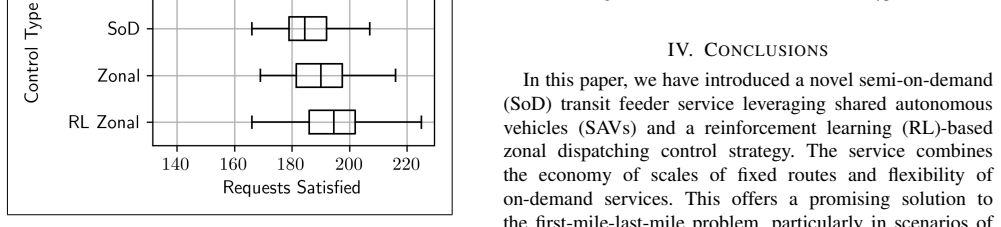
Summary. This paper proposes a semi-on-demand (SoD) feeder service using shared autonomous vehicles, in which vehicles first serve fixed-route stops and then serve a flexible-route area on demand. A proximal policy optimization (PPO) agent dynamically decides whether to dispatch an available vehicle to one of two zones, to the regular SoD route, or to hold the vehicle. The agent-based simulation uses FleetPy on Munich bus route 193 with demand adapted from a boarding/alighting dataset. The paper reports that RL-zonal SoD serves 16% more passengers than fixed-route service at 13% higher generalized cost, and that the RL control contributes 2.4% more passengers at 1.4% higher cost relative to nominal zonal dispatching. The central claims are that the SoD concept increases served passengers and that RL zonal control improves operational efficiency relative to fixed zonal rules.
Significance. The methodological core is sound: the MDP formulation is reasonable; PPO is implemented with standard clipping, GAE, and reported hyperparameters; training uses 2,000 demand instances with a separate 100-instance held-out evaluation; and the simulation is built on the open-source FleetPy framework with all key hyperparameters listed. If the empirical claims hold, the paper provides a practical, transferable control design for an important first-mile/last-mile problem. The main caveat is that the passenger-serving advantage is conditional on a demand model whose elasticity is neither calibrated nor reported, so the headline improvement is not fully identified.
major comments (3)
- [Section III-A] The demand model is stated as 'a linear function of walking time (maximum 10 min)' but no slope, intercept, calibration source, or functional form is given. Because SoD removes nearly all walking/access time relative to the fixed-route baseline, this assumption mechanically generates additional trip requests; Section III-B attributes 10% of the passenger gain to SoD before any RL effect. The headline 16% gain over fixed route therefore mixes an unquantified induced-demand elasticity with operational efficiency. Please report the demand model parameters and generated request counts, and add a sensitivity analysis with fixed demand or flatter demand responses so the reader can separate supply-side gains from demand-side assumptions.
- [Section III-B, Figs. 7-9] The reported percentages are averages over 100 simulation runs, but the paper presents only boxplots and no confidence intervals or paired-difference tests for the mean passenger counts or generalized costs. Given the stochasticity of the demand instances, the '16% more' and '2.4% more' claims could be within sampling noise. Please report the means with standard errors or confidence intervals, and ideally paired differences between control types on the same demand instances.
- [Section III-A] The paper states that trip origins and destinations are 'adapted from a boarding and alighting dataset' but does not describe the transformation: no scaling, spatial aggregation, temporal profile, or procedure for applying the walking-time elasticity is provided. This makes the simulation non-reproducible and prevents an independent check of the linear demand assumption. Please add a data-generation appendix or pseudocode, and clarify whether the demand elasticity applies to trip generation, OD selection, or both.
minor comments (5)
- [Section III-A] The long list of simulation and RL parameters is given in prose. A table would improve readability and reduce the chance of transcription errors.
- [Section II-B] The paper mentions 18 state variables but does not itemize them. Please provide the explicit list, including how the 15-min demand forecast is represented.
- [Fig. 4] 'M.A.' in the caption should be defined. Also, the reward plot would benefit from a pre-training or random-policy baseline.
- [Abstract / Section III-B] The phrase 'efficient training' is not supported by a comparison of training budgets or sample efficiency; consider softening or adding evidence.
- [Equation (2)] Please define each cost component in the text immediately after the equation, especially the relationship between access time, waiting time, and riding time for a request.
Circularity Check
No significant circularity: RL dispatch comparison is an out-of-sample simulation result; demand model is an explicit input assumption, not a fitted predictor.
full rationale
The paper's central claim is that RL zonal dispatching serves 2.4% more passengers at 1.4% higher costs compared to nominal zonal dispatching. This result comes from 100 demand instances separate from the RL training set, as stated: "The results of each control type are from simulations on 100 demand instances (separate from the RL training set)." The RL policy is trained on 2000 instances and then evaluated statically, so the comparison is genuinely out-of-sample and not a fitted artifact. The larger 16% gain over fixed-route service is partly driven by the demand model: "demand is assumed to be a linear function of walking time (maximum 10 min)" (Section III-A). This is an explicit input assumption, not a hidden fit. The paper transparently attributes the difference to convenience: "The convenience of SoD service to pick up and drop off passengers attracts more demand, resulting in 10% more passengers served on average compared to the fixed route." While the demand model's parameters are unreported, that is a reproducibility weakness, not circularity, because the passenger counts are neither equivalent to the demand function nor statistically forced from a fitted parameter. The authors' self-citations (e.g., [5] for zone sizes, [21] for the simulation adaptation) are references to prior tools and parameter choices, not to the claimed efficiency result. No equation or result reduces to its own input by construction. The RL reward is based on rejections, and the reported passenger counts and costs are simulated outputs, not the reward itself. Thus, no circular step is present.
Assumptions & free parameters
free parameters (4)
- Demand response coefficients (linear demand as a function of walking time)
- Generalized cost weights (gamma_A, gamma_W, gamma_T, gamma_O, gamma_V) =
33 $/h, 24.75 $/h, 16.5 $/h, 0.694 $/km, 7.59 $/h
- PPO hyperparameters =
epsilon=0.2, gamma=0.99, lambda=0.95, learning rate=0.003, batch size=64, epochs=10, network 64x64
- Insertion objective penalties (gamma_R, gamma_S) =
10^6 each
assumptions (4)
- domain assumption The FleetPy agent-based simulator faithfully represents SAV operations, including vehicle movement, request insertion, and schedule adherence.
- ad hoc to paper Trip demand is a linear function of walking time with a 10-minute cap.
- domain assumption The 18 state variables and the 15-minute demand forecast satisfy the Markov property for the dispatching MDP.
- domain assumption Generalized-cost coefficients from the literature apply unchanged to the Munich scenario.
Cite this review
Pith. "Pith review of Semi-on-Demand Transit Feeders with Shared Autonomous Vehicles and Reinforcement-Learning-Based Zonal Dispatching Control." pith.science (2026). https://pith.science/paper/NUMZMWIZ
@misc{pith2026250901883,
  author       = {Pith},
  title        = {Pith review of: Semi-on-Demand Transit Feeders with Shared Autonomous Vehicles and Reinforcement-Learning-Based Zonal Dispatching Control},
  year         = {2026},
  howpublished = {\url{https://pith.science/paper/NUMZMWIZ}},
  note         = {Machine review of arXiv:2509.01883}
}
read the original abstract
This paper develops a semi-on-demand transit feeder service using shared autonomous vehicles (SAVs) and zonal dispatching control based on reinforcement learning (RL). This service combines the cost-effectiveness of fixed-route transit with the adaptability of demand-responsive transport to improve accessibility in lower-density areas. Departing from the terminus, SAVs first make scheduled fixed stops, then offer on-demand pick-ups and drop-offs in a pre-determined flexible-route area. Our deep RL model dynamically assigns vehicles to subdivided flexible-route zones in response to real-time demand fluctuations and operations, using a policy gradient algorithm - Proximal Policy Optimization. The methodology is demonstrated through agent-based simulations on a real-world bus route in Munich, Germany. Results show that after efficient training of the RL model, the semi-on-demand service with dynamic zonal control serves 16% more passengers at 13% higher generalized costs on average compared to traditional fixed-route service. The efficiency gain brought by RL control brings 2.4% more passengers at 1.4% higher costs. This study not only showcases the potential of integrating SAV feeders and machine learning techniques into public transit, but also sets the groundwork for further innovations in addressing first-mile-last-mile problems in multimodal transit systems.
Figures


Figures from the paper (4 more)


Reference graph
Works this paper leans on
-
[1]
Intermodal Autonomous Mobility-on-Demand,
M. Salazar, N. Lanzetti, F. Rossi, M. Schiffer, and M. Pavone, “Intermodal Autonomous Mobility-on-Demand,” IEEE Transactions on Intelligent Transportation Systems , vol. 21, no. 9, pp. 3946–3960, Sept. 2020
work page 2020
-
[2]
Enhanced Mobility With Con- nectivity and Automation: A Review of Shared Autonomous Vehicle Systems,
L. Zhao and A. A. Malikopoulos, “Enhanced Mobility With Con- nectivity and Automation: A Review of Shared Autonomous Vehicle Systems,” IEEE Intelligent Transportation Systems Magazine , vol. 14, no. 1, pp. 87–102, Jan. 2022
work page 2022
-
[3]
A survey on demand-responsive public bus systems,
P. Vansteenwegen, L. Melis, D. Aktas ¸, B. D. G. Montenegro, F. Sar- tori Vieira, and K. S ¨orensen, “A survey on demand-responsive public bus systems,” Transportation Research Part C: Emerging Technolo- gies, vol. 137, p. 103573, 2022
work page 2022
-
[4]
Redesigning large-scale multimodal transit networks with shared autonomous mobility services,
M. T. M. Ng, H. S. Mahmassani, O. Verbas, T. Cokyasar, and R. Engelhardt, “Redesigning large-scale multimodal transit networks with shared autonomous mobility services,” Transportation Research Part C: Emerging Technologies , p. 104575, Mar. 2024
work page 2024
-
[5]
Autonomous Minibus Service With Semi-on-Demand Routes in Grid Networks,
M. T. M. Ng and H. S. Mahmassani, “Autonomous Minibus Service With Semi-on-Demand Routes in Grid Networks,” Transportation Research Record, vol. 2677, no. 1, pp. 178–200, 2023
work page 2023
-
[6]
A survey on planning semi-flexible transit systems: Methodological issues and a unifying framework,
F. Errico, T. G. Crainic, F. Malucelli, and M. Nonato, “A survey on planning semi-flexible transit systems: Methodological issues and a unifying framework,” Transportation Research Part C: Emerging Technologies, vol. 36, pp. 324–338, 2013
work page 2013
-
[7]
C. Frei, M. Hyland, and H. S. Mahmassani, “Flexing service schedules: Assessing the potential for demand-adaptive hybrid transit via a stated preference approach,” Transportation Research Part C: Emerging Technologies, vol. 76, pp. 71–89, Mar. 2017
work page 2017
-
[8]
Semi-on-Demand Hybrid Transit Route Design with Shared Autonomous Mobility Services,
M. T. M. Ng, F. Dandl, H. S. Mahmassani, and K. Bogenberger, “Semi-on-Demand Hybrid Transit Route Design with Shared Autonomous Mobility Services,” in 103rd Transportation Research Board Annual Meeting , Washington, D.C., 2024. [Online]. Available: http://arxiv.org/abs/2403.15804
Show all 27 references
-
[9]
2-Vehicle zone optimal design for feeder transit services,
X. Li and L. Quadrifoglio, “2-Vehicle zone optimal design for feeder transit services,” Public Transport , vol. 3, no. 1, pp. 89–104, Feb. 2011
2011
-
[10]
Optimal Zonal Design for Flexible Bus Service Under Spatial and Temporal Demand Uncertainty,
E. Lee, H. K. Lo, and M. Li, “Optimal Zonal Design for Flexible Bus Service Under Spatial and Temporal Demand Uncertainty,” IEEE Transactions on Intelligent Transportation Systems , vol. 25, no. 1, pp. 251–262, Jan. 2024
2024
-
[11]
SAMoD: Shared Autonomous Mobility- on-Demand using Decentralized Reinforcement Learning,
M. Gueriau and I. Dusparic, “SAMoD: Shared Autonomous Mobility- on-Demand using Decentralized Reinforcement Learning,” in 2018 21st International Conference on Intelligent Transportation Systems (ITSC). Maui, HI: IEEE, Nov. 2018, pp. 1558–1563
2018
-
[12]
Dispatch of autonomous ve- hicles for taxi services: A deep reinforcement learning approach,
C. Mao, Y . Liu, and Z.-J. M. Shen, “Dispatch of autonomous ve- hicles for taxi services: A deep reinforcement learning approach,” Transportation Research Part C: Emerging Technologies , vol. 115, p. 102626, June 2020
2020
-
[13]
Context-Aware Taxi Dispatching at City- Scale Using Deep Reinforcement Learning,
Z. Liu, J. Li, and K. Wu, “Context-Aware Taxi Dispatching at City- Scale Using Deep Reinforcement Learning,” IEEE Transactions on Intelligent Transportation Systems, vol. 23, no. 3, pp. 1996–2009, Mar. 2022
1996
-
[14]
Deep dispatching: A deep reinforcement learning approach for vehicle dispatching on on- line ride-hailing platform,
Y . Liu, F. Wu, C. Lyu, S. Li, J. Ye, and X. Qu, “Deep dispatching: A deep reinforcement learning approach for vehicle dispatching on on- line ride-hailing platform,” Transportation Research Part E: Logistics and Transportation Review , vol. 161, p. 102694, May 2022
2022
-
[15]
Reinforcement learning for ridesharing: An extended survey,
Z. T. Qin, H. Zhu, and J. Ye, “Reinforcement learning for ridesharing: An extended survey,” Transportation Research Part C: Emerging Technologies, vol. 144, p. 103852, Nov. 2022
2022
-
[16]
Deep Reinforcement Learning for In- telligent Transportation Systems: A Survey,
A. Haydari and Y . Yilmaz, “Deep Reinforcement Learning for In- telligent Transportation Systems: A Survey,” IEEE Transactions on Intelligent Transportation Systems, vol. 23, no. 1, pp. 11–32, Jan. 2022
2022
-
[17]
A Multiline Customized Bus Planning Method Based on Reinforcement Learning and Spatiotemporal Clustering Algorithm,
W. Li, L. Zheng, L. Liao, X. Yang, D. Sun, and W. Liu, “A Multiline Customized Bus Planning Method Based on Reinforcement Learning and Spatiotemporal Clustering Algorithm,” IEEE Transactions on Computational Social Systems , pp. 1–15, 2024
2024
-
[18]
Multi-agent deep rein- forcement learning based real-time planning approach for responsive customized bus routes,
B. Wu, X. Zuo, G. Chen, G. Ai, and X. Wan, “Multi-agent deep rein- forcement learning based real-time planning approach for responsive customized bus routes,” Computers & Industrial Engineering, vol. 188, p. 109840, Feb. 2024
2024
-
[19]
Proximal Policy Optimization Algorithms,
J. Schulman, F. Wolski, P. Dhariwal, A. Radford, and O. Klimov, “Proximal Policy Optimization Algorithms,” Aug. 2017. [Online]. Available: http://arxiv.org/abs/1707.06347
2017 arXiv
-
[20]
FleetPy: A Modular Open-Source Simulation Tool for Mobility On-Demand Services,
R. Engelhardt, F. Dandl, A.-A. Syed, Y . Zhang, F. Fehn, F. Wolf, and K. Bogenberger, “FleetPy: A Modular Open-Source Simulation Tool for Mobility On-Demand Services,” 2022. [Online]. Available: http://arxiv.org/abs/2207.14246
2022 arXiv
-
[21]
Simulating Semi-on-Demand Hybrid Route Transit Feeders with Shared Autonomous Mobility Services,
M. T. Ng, R. Engelhardt, F. Dandl, K. Bogenberger, and H. S. Mah- massani, “Simulating Semi-on-Demand Hybrid Route Transit Feeders with Shared Autonomous Mobility Services,” in12th Symposium of the European Association for Research in Transportation , Espoo, 2024
2024
-
[22]
A Closer Look at Invalid Action Masking in Policy Gradient Algorithms,
S. Huang and S. Onta ˜n´on, “A Closer Look at Invalid Action Masking in Policy Gradient Algorithms,” The International FLAIRS Conference Proceedings, vol. 35, May 2022
2022
-
[23]
High-Dimensional Continuous Control Using Generalized Advantage Estimation,
J. Schulman, P. Moritz, S. Levine, M. Jordan, and P. Abbeel, “High-Dimensional Continuous Control Using Generalized Advantage Estimation,” Oct. 2018. [Online]. Available: http://arxiv.org/abs/1506.02438 [Accessed: 2024-04-22]
2018 arXiv
-
[24]
MVG timetable data in GTFS format,
MVG, “MVG timetable data in GTFS format,” 2024. [Online]. Avail- able: https://www.mvg.de/services/fahrgastservice/fahrplandaten.html [Accessed: 2024-01-26]
2024
-
[25]
OSMnx: New methods for acquiring, constructing, an- alyzing, and visualizing complex street networks,
G. Boeing, “OSMnx: New methods for acquiring, constructing, an- alyzing, and visualizing complex street networks,” Computers, Envi- ronment and Urban Systems , vol. 65, pp. 126–139, 2017
2017
-
[26]
The economics of automated public transport: Effects on operator cost, travel time, fare and subsidy,
A. Tirachini and C. Antoniou, “The economics of automated public transport: Effects on operator cost, travel time, fare and subsidy,” Economics of Transportation , vol. 21, p. 100151, 2020
2020
-
[27]
Stable-baselines3: Reliable reinforcement learning im- plementations,
A. Raffin, A. Hill, A. Gleave, A. Kanervisto, M. Ernestus, and N. Dormann, “Stable-baselines3: Reliable reinforcement learning im- plementations,” Journal of Machine Learning Research , vol. 22, no. 268, pp. 1–8, 2021
2021
Reviewed August 5, 2026 · model on record in the stance chip above.
Discussion (0). Continue with ORCID to comment.