Spatially Coupled MacKay-Neal/Hsu-Anastasopoulos CSS Codes Achieve the Quantum-Erasure Hashing Bound by Seeded BP Decoding
Pith reviewed 2026-07-01 05:00 UTC · model grok-4.3
The pith
Spatially coupled MN/HA CSS codes reach the quantum-erasure hashing bound under seeded BP decoding at the density-evolution level.
A machine-rendered reading of the paper's core claim, the machinery that carries it, and where it could break.
Core claim
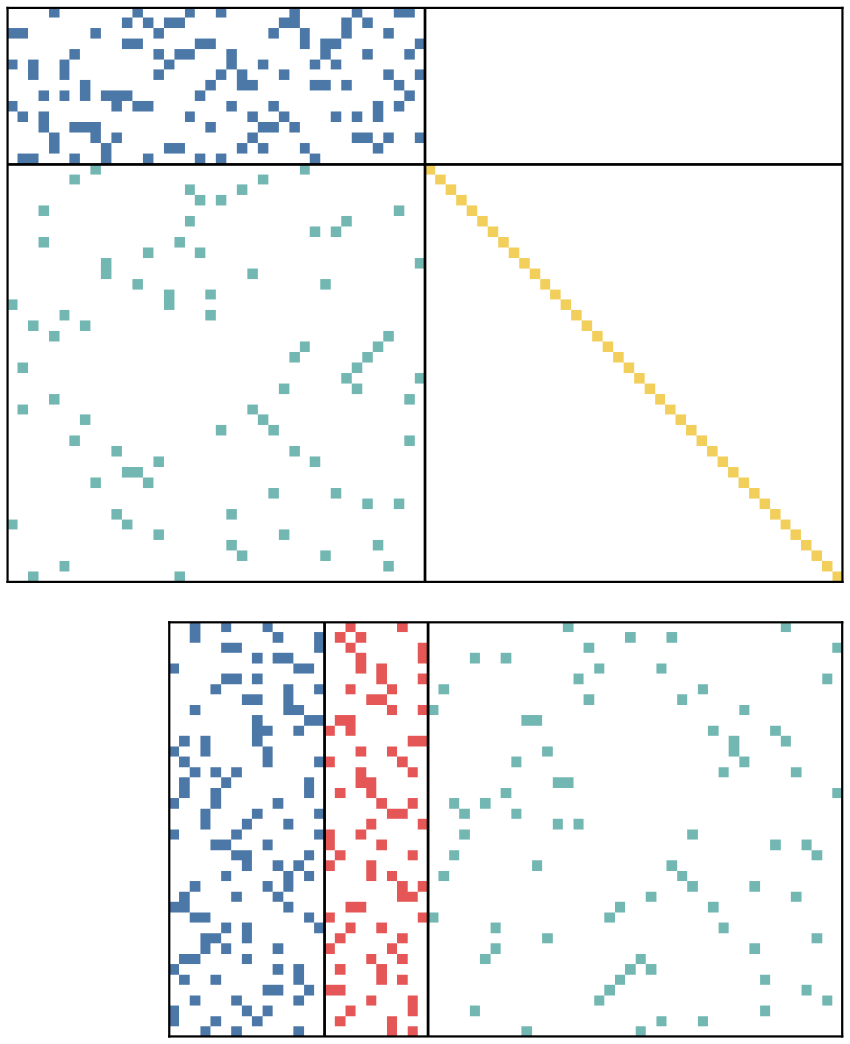
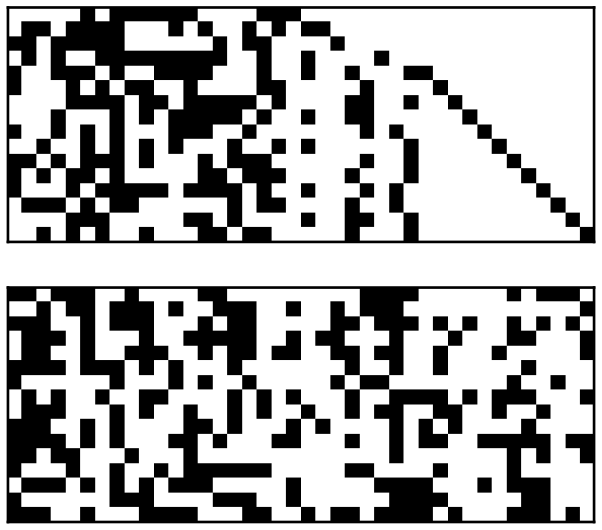
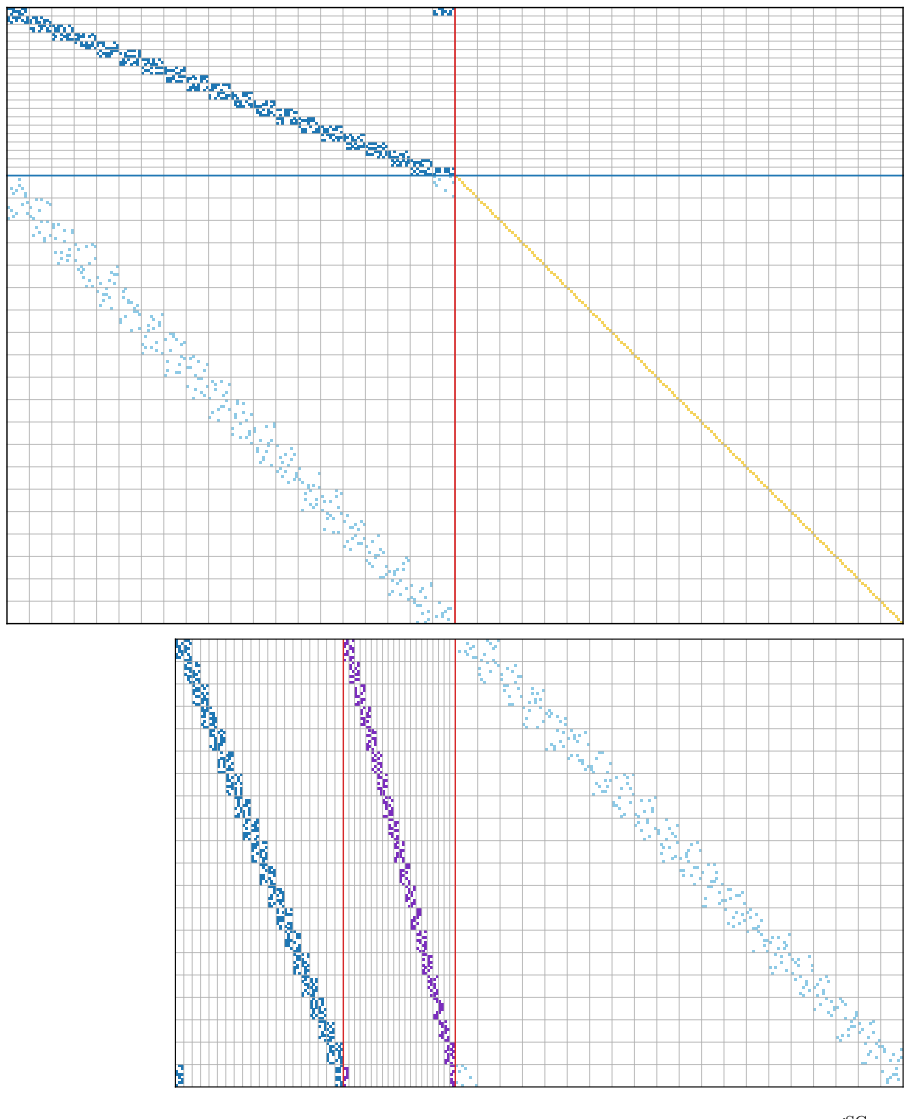
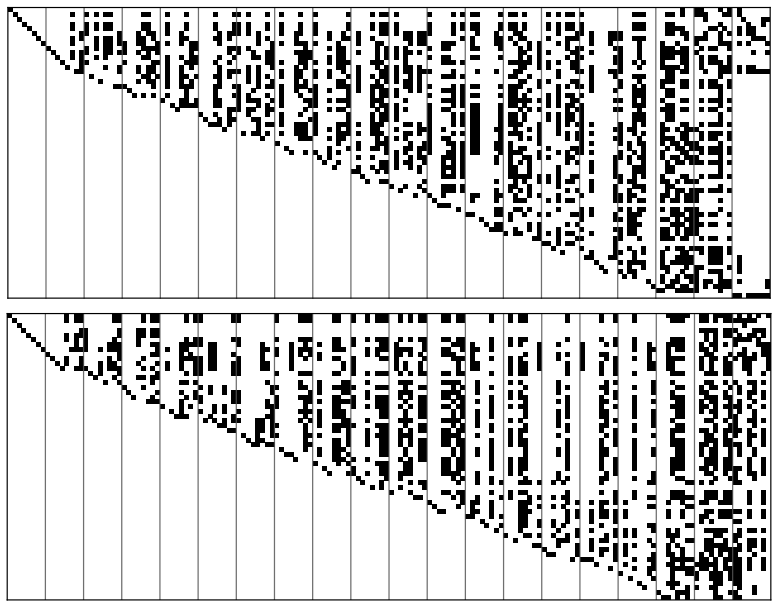
The paper claims that seeded BP decoding on the spatially coupled MN/HA-type CSS codes with fixed finite Z-side, X-side, and check degrees reaches the smaller of the Z-side degree ratio and the X-side complementary degree ratio. In the X/Z equal-rate specialization, where the Z-side and X-side constituent design rates are equal, this BP threshold equals the hashing-bound channel parameter determined by the design rate. The claim is established at the density-evolution level for hard-erasure CSS decoding by decomposing the five-message uncoupled recursion into two constituent systems and applying the coupled-vector potential method separately to each.
What carries the argument
The five-message uncoupled density-evolution recursion, decomposed into independent Z-side and X-side constituent systems, with the coupled-vector potential method applied to each to locate the BP threshold.
If this is right
- Seeded BP on the coupled ensemble attains the hashing-bound parameter for every equal-rate X/Z family.
- The result holds for any fixed finite degrees of the underlying factor graphs.
- Spatial coupling lifts BP performance from the uncoupled threshold to the area threshold of the MN/HA CSS ensemble.
- The decomposition into Z-side and X-side systems allows the threshold to be read directly from the two degree ratios.
Where Pith is reading between the lines
- The same decomposition may permit threshold calculations for asymmetric quantum channels beyond the erasure channel.
- Finite-length concentration and explicit seed construction remain necessary to translate the DE result into block-error guarantees for actual codes.
- The approach could be tested by constructing small coupled MN/HA CSS matrices and measuring their BP performance against the predicted erasure threshold.
Load-bearing premise
The five-message uncoupled density-evolution recursion accurately models seeded decoding on the CSS ensemble, and the coupled-vector potential method applied separately to the two constituents correctly identifies the BP threshold.
What would settle it
Numerical iteration of the five-message DE recursion on the coupled system that converges to an erasure probability strictly above the predicted hashing-bound value for the design rate would falsify the threshold equality.
Figures
read the original abstract
In classical sparse-graph coding, spatial coupling is a mechanism by which belief-propagation (BP) decoding attains the maximum-a-posteriori (MAP) or area-threshold performance of the uncoupled system. Since MacKay-Neal/Hsu-Anastasopoulos (MN/HA) punctured sparse ensembles achieve capacity under MAP decoding, it is natural to ask whether spatially coupled MN/HA-type Calderbank-Shor-Steane (CSS) codes can reach the hashing bound on the quantum erasure channel under seeded BP decoding. We answer this question at the density evolution (DE) level for hard-erasure CSS decoding. On an erased coordinate, the two binary Pauli components remain unresolved, equivalently the erased qubit is represented by the four Pauli possibilities. We first define the CSS ensemble through sparse punctured matrices and the corresponding dense parity-check matrices. For fixed finite Z-side, X-side, and check degrees, we then derive a five-message uncoupled DE recursion, decompose it into Z-side and X-side constituent systems, and define the two constituent potentials. Applying the coupled-vector potential method to the two constituents separately proves that seeded BP decoding on the resulting finite-degree factor graphs reaches the smaller of the Z-side degree ratio and the X-side complementary degree ratio. In the X/Z equal-rate specialization, where the Z-side and X-side constituent design rates are equal, this BP threshold is the hashing-bound channel parameter determined by the design rate. Thus the paper gives a DE-level proof that seeded BP decoding with finite-degree factor graphs achieves the hashing bound for the X/Z equal-rate family. Finite-length BP concentration, block-error convergence, and a finite-code realization of the ideal DE seed are separate questions.
Editorial analysis
A structured set of objections, weighed in public.
Referee Report
Summary. The paper claims that spatially coupled MacKay-Neal/Hsu-Anastasopoulos CSS codes achieve the quantum-erasure hashing bound under seeded BP decoding at the density-evolution level. It defines the CSS ensemble via sparse punctured matrices, derives a five-message uncoupled DE recursion for hard-erasure decoding, decomposes the recursion into independent Z-side and X-side constituent systems, defines the two constituent potentials, and applies the coupled-vector potential method separately to each to prove that the BP threshold equals the smaller of the Z-side degree ratio and the X-side complementary degree ratio; in the equal-rate specialization this equals the hashing-bound parameter fixed by the design rate.
Significance. If the result holds, the work supplies a DE-level proof that finite-degree spatially coupled CSS ensembles attain the hashing bound under seeded BP, extending classical spatial-coupling capacity-achieving results to quantum CSS codes on the erasure channel. The explicit derivation of the five-message recursion and the separate application of the coupled-vector potential method to the decomposed constituents are concrete technical strengths supporting the threshold equality for the X/Z equal-rate family.
major comments (2)
- [Abstract / DE derivation] Abstract / DE derivation: the central claim rests on decomposing the five-message uncoupled recursion into independent Z-side and X-side systems to which the potential method is applied separately, yet the manuscript does not exhibit the explicit message-update equations confirming that Z-updates depend only on Z-variables (and likewise for X). Because an erased qubit leaves the four Pauli possibilities jointly unresolved, it is necessary to verify that no cross-side statistical dependencies remain after decomposition.
- [Application of coupled-vector potential method] Application of coupled-vector potential method: the separate application to the two constituents assumes the decomposition is exact and that the joint BP threshold on the CSS factor graph is correctly bounded by the independent potentials; if joint dependencies survive, the min-of-ratios threshold result does not follow.
Simulated Author's Rebuttal
We thank the referee for the careful reading and for identifying the need for explicit verification of the decomposition. We address both major comments below and will revise the manuscript to include the requested equations and supporting arguments.
read point-by-point responses
-
Referee: [Abstract / DE derivation] Abstract / DE derivation: the central claim rests on decomposing the five-message uncoupled recursion into independent Z-side and X-side systems to which the potential method is applied separately, yet the manuscript does not exhibit the explicit message-update equations confirming that Z-updates depend only on Z-variables (and likewise for X). Because an erased qubit leaves the four Pauli possibilities jointly unresolved, it is necessary to verify that no cross-side statistical dependencies remain after decomposition.
Authors: We agree that the explicit five-message update equations are not displayed in the current version, which is an omission. In the revision we will insert a new subsection that first writes the full uncoupled DE recursion (five message types: two for Z-side variable-to-check and check-to-variable, two for X-side, and one joint erasure indicator) and then shows the updates. The Z-side updates depend only on Z-variables because the CSS parity-check matrix is block-diagonal in the X/Z basis and the hard-erasure messages, after the seeded initialization that resolves the four Pauli possibilities into independent X and Z erasure indicators, factorize completely; the same holds for the X-side. The revised text will contain these equations and a short proof that the joint distribution factors, eliminating cross-side dependencies. revision: yes
-
Referee: [Application of coupled-vector potential method] Application of coupled-vector potential method: the separate application to the two constituents assumes the decomposition is exact and that the joint BP threshold on the CSS factor graph is correctly bounded by the independent potentials; if joint dependencies survive, the min-of-ratios threshold result does not follow.
Authors: Once the explicit equations are supplied, the decomposition is exact: the CSS factor graph separates into two independent subgraphs for message passing under the seeded hard-erasure model. Consequently the joint BP threshold is bounded above by the minimum of the two constituent thresholds (the smaller of the Z-side degree ratio and the X-side complementary degree ratio). The coupled-vector potential method is therefore applied separately to each constituent, and the min-of-ratios statement follows directly. We will add a short paragraph after the potential definitions that makes this bounding argument explicit. revision: yes
Circularity Check
No significant circularity; derivation derives new recursion then applies general method
full rationale
The paper first defines the CSS ensemble via sparse punctured matrices, derives a five-message uncoupled DE recursion for the quantum erasure channel, decomposes it into independent Z-side and X-side constituent systems, and defines the associated potentials. It then applies the coupled-vector potential method (a general analytical technique) separately to each constituent to establish that the BP threshold equals the relevant degree ratio, which coincides with the hashing-bound parameter in the equal-rate specialization. This chain does not reduce the claimed threshold result to a fitted parameter or self-citation by construction; the recursion and decomposition steps are presented as independent derivations from the ensemble definition, and the potential method functions as an external tool rather than a load-bearing self-referential premise. No quoted reduction of the final claim to its inputs is identifiable.
Axiom & Free-Parameter Ledger
axioms (3)
- domain assumption The CSS ensemble defined through sparse punctured matrices yields the corresponding dense parity-check matrices for the factor graph.
- domain assumption The five-message uncoupled DE recursion decomposes into independent Z-side and X-side constituent systems.
- domain assumption The coupled-vector potential method establishes the BP threshold for the spatially coupled system.
Reference graph
Works this paper leans on
-
[1]
Good quantum error-correcting codes exist,
A. R. Calderbank and P. W. Shor, “Good quantum error-correcting codes exist,”Physical Review A, vol. 54, no. 2, pp. 1098–1105, 1996
1996
-
[2]
Error correcting codes in quantum theory,
A. M. Steane, “Error correcting codes in quantum theory,”Physical Review Letters, vol. 77, no. 5, pp. 793–797, 1996
1996
-
[3]
Low-density parity-check codes,
R. G. Gallager, “Low-density parity-check codes,”IRE Transactions on Information Theory, vol. 8, no. 1, pp. 21–28, 1962
1962
-
[4]
Richardson and R
T. Richardson and R. Urbanke,Modern Coding Theory. Cambridge University Press, 2008
2008
-
[5]
Near Shannon limit performance of low density parity check codes,
D. J. C. MacKay and R. M. Neal, “Near Shannon limit performance of low density parity check codes,”Electronics Letters, vol. 32, no. 18, pp. 1645–1646, 1996
1996
-
[6]
Capacity-achievingcodeswithboundedgraphicalcomplex- ity and maximum likelihood decoding,
C.-H.HsuandA.Anastasopoulos, “Capacity-achievingcodeswithboundedgraphicalcomplex- ity and maximum likelihood decoding,”IEEE Transactions on Information Theory, vol. 56, no. 3, pp. 992–1006, 2010. 27
2010
-
[7]
Quantum LDPC codes with positive rate and minimum distance proportionaltothesquarerootoftheblocklength,
J.-P. Tillich and G. Zémor, “Quantum LDPC codes with positive rate and minimum distance proportionaltothesquarerootoftheblocklength,”IEEE Transactions on Information Theory, vol. 60, no. 2, pp. 1193–1202, 2014
2014
-
[8]
Asymptotically good quantum and locally testable classical LDPC codes,
P. Panteleev and G. Kalachev, “Asymptotically good quantum and locally testable classical LDPC codes,” inProceedings of the 54th Annual ACM SIGACT Symposium on Theory of Computing, ser. STOC 2022. Association for Computing Machinery, 2022, pp. 375–388
2022
-
[9]
Spatially coupled quasi-cyclic quantum LDPC codes,
M. Hagiwara, K. Kasai, H. Imai, and K. Sakaniwa, “Spatially coupled quasi-cyclic quantum LDPC codes,” inProceedings of the 2011 IEEE International Symposium on Information Theory, 2011, pp. 638–642
2011
-
[10]
Spatially coupled quantum LDPC codes,
I. Andriyanova, D. Maurice, and J.-P. Tillich, “Spatially coupled quantum LDPC codes,” in Proceedings of the 2012 IEEE Information Theory Workshop, 2012, pp. 327–331
2012
-
[11]
Spatially-coupled QLDPC codes,
S. Yang and R. Calderbank, “Spatially-coupled QLDPC codes,”Quantum, vol. 9, p. 1693, 2025
2025
-
[12]
Time-varying periodic convolutional codes with low- density parity-check matrix,
A. J. Felstrom and K. S. Zigangirov, “Time-varying periodic convolutional codes with low- density parity-check matrix,”IEEE Transactions on Information Theory, vol. 45, no. 6, pp. 2181–2191, 1999
1999
-
[13]
Terminated LDPC convolutional codes with thresholds close to capacity,
M. Lentmaier, A. Sridharan, K. S. Zigangirov, and J. Daniel J. Costello, “Terminated LDPC convolutional codes with thresholds close to capacity,” inProceedings of the 2005 IEEE Inter- national Symposium on Information Theory, 2005, pp. 1372–1376
2005
-
[14]
Iterative decoding threshold analysis for LDPC convolutional codes,
M. Lentmaier, A. Sridharan, J. Daniel J. Costello, and K. S. Zigangirov, “Iterative decoding threshold analysis for LDPC convolutional codes,”IEEE Transactions on Information Theory, vol. 56, no. 10, pp. 5274–5289, 2010
2010
-
[15]
Asymptotically good LDPC convolutional codes based on protographs,
D. G. M. Mitchell, A. E. Pusane, K. S. Zigangirov, and J. Daniel J. Costello, “Asymptotically good LDPC convolutional codes based on protographs,” inProceedings of the 2008 IEEE International Symposium on Information Theory, 2008, pp. 1030–1034
2008
-
[16]
Spatially coupled LDPC codes constructed from protographs,
D. G. M. Mitchell, M. Lentmaier, and J. Daniel J. Costello, “Spatially coupled LDPC codes constructed from protographs,”IEEE Transactions on Information Theory, vol. 61, no. 9, pp. 4866–4889, 2015
2015
-
[17]
Threshold saturation via spatial coupling: Why convolutional LDPC ensembles perform so well over the BEC,
S. Kudekar, T. J. Richardson, and R. L. Urbanke, “Threshold saturation via spatial coupling: Why convolutional LDPC ensembles perform so well over the BEC,”IEEE Transactions on Information Theory, vol. 57, no. 2, pp. 803–834, 2011
2011
-
[18]
A simple proof of threshold saturation for coupled vector recursions,
A. Yedla, Y.-Y. Jian, P. S. Nguyen, and H. D. Pfister, “A simple proof of threshold saturation for coupled vector recursions,” inProceedings of the 2012 IEEE Information Theory Workshop, 2012, pp. 25–29
2012
-
[19]
Spatially-Coupled MacKay-Neal Codes and Hsu-Anastasopoulos Codes
K. Kasai and K. Sakaniwa, “Spatially-coupled MacKay-Neal codes and Hsu-Anastasopoulos codes,”IEICE Transactions on Fundamentals of Electronics, Communications and Computer Sciences, vol. E94-A, no. 11, pp. 2161–2168, 2011, arXiv:1102.4612 [cs.IT]
work page internal anchor Pith review Pith/arXiv arXiv 2011
-
[20]
Asymptotic analysis of spatially coupled MacKay-Neal and Hsu-Anastasopoulos LDPC codes,
D. G. M. Mitchell, K. Kasai, M. Lentmaier, and J. Daniel J. Costello, “Asymptotic analysis of spatially coupled MacKay-Neal and Hsu-Anastasopoulos LDPC codes,” inProceedings of the 2012 International Symposium on Information Theory and its Applications, 2012, pp. 337–341. 28
2012
-
[21]
Spatially-coupled multi-edge type LDPC codes with bounded degrees that achieve capacity on the BEC under BP decoding,
N. Obata, Y.-Y. Jian, K. Kasai, and H. D. Pfister, “Spatially-coupled multi-edge type LDPC codes with bounded degrees that achieve capacity on the BEC under BP decoding,” inProceed- ings of the 2013 IEEE International Symposium on Information Theory, 2013, pp. 2433–2437
2013
-
[22]
Spatially-Coupled MacKay-Neal Codes with No Bit Nodes of Degree Two Achieve the Capacity of BEC
T. Okazaki and K. Kasai, “Spatially-coupled MacKay-Neal codes with no bit nodes of degree two achieve the capacity of BEC,” inProceedings of the 2014 IEEE International Symposium on Information Theory, 2014, pp. 506–510, arXiv:1401.7289 [cs.IT]
work page internal anchor Pith review Pith/arXiv arXiv 2014
-
[23]
M. Fukushima, T. Okazaki, and K. Kasai, “Spatially-coupled MacKay-Neal codes universally achieve the symmetric information rate of arbitrary generalized erasure channels with mem- ory,” inProceedings of the 2015 IEEE International Symposium on Information Theory, 2015, pp. 899–903, arXiv:1501.06736 [cs.IT]
work page internal anchor Pith review Pith/arXiv arXiv 2015
-
[24]
Finite-degree quantum LDPC codes reaching the Gilbert–Varshamov bound,
K. Kasai, “Finite-degree quantum LDPC codes reaching the Gilbert–Varshamov bound,” 2026, arXiv:2603.24588 [quant-ph]
-
[25]
Linear-time maximum likelihood decoding of surface codes over the quantum erasure channel,
N. Delfosse and G. Zémor, “Linear-time maximum likelihood decoding of surface codes over the quantum erasure channel,”Physical Review Research, vol. 2, no. 3, p. 033042, 2020
2020
-
[26]
Trimming decoding of color codes over the quantum erasure channel,
S. Lee, M. Mhalla, and V. Savin, “Trimming decoding of color codes over the quantum erasure channel,” inProceedings of the 2020 IEEE International Symposium on Information Theory, 2020, pp. 1886–1890
2020
-
[27]
Fast erasure decoder for hypergraph product codes,
N. Connolly, V. Londe, A. Leverrier, and N. Delfosse, “Fast erasure decoder for hypergraph product codes,”Quantum, vol. 8, p. 1450, 2024
2024
-
[28]
Erasure decoding for quantum LDPC codes via belief propagation with guided decimation,
M. Gökduman, H. Yao, and H. D. Pfister, “Erasure decoding for quantum LDPC codes via belief propagation with guided decimation,” inProceedings of the 2024 60th Annual Allerton Conference on Communication, Control, and Computing, 2024, pp. 1–8, arXiv:2411.08177 [cs.IT]
-
[29]
Cluster decomposition for improved erasure decod- ing of quantum LDPC codes,
H. Yao, M. Gökduman, and H. D. Pfister, “Cluster decomposition for improved erasure decod- ing of quantum LDPC codes,”IEEE Journal on Selected Areas in Information Theory, vol. 6, pp. 176–188, 2025
2025
-
[30]
Degenerate quantum erasure decoding,
K.-Y. Kuo and Y. Ouyang, “Degenerate quantum erasure decoding,”npj Quantum Informa- tion, vol. 12, p. 75, 2026
2026
-
[31]
Stabilizer-assisted inactivation decoding of quantum error-correcting codes with erasures,
G. Pech, M. Gökduman, H. Yao, and H. D. Pfister, “Stabilizer-assisted inactivation decoding of quantum error-correcting codes with erasures,” 2026, arXiv:2601.14236 [cs.IT]
-
[32]
Quantum Maxwell erasure decoder for qLDPC codes,
B. C. A. Freire, F.-M. L. Régent, and A. Leverrier, “Quantum Maxwell erasure decoder for qLDPC codes,” 2026, arXiv:2601.10713 [quant-ph]
-
[33]
Capacities of quantum erasure channels,
C. H. Bennett, D. P. DiVincenzo, and J. A. Smolin, “Capacities of quantum erasure channels,” Physical Review Letters, vol. 78, no. 16, pp. 3217–3220, 1997
1997
-
[34]
An analysis of the block error probability performance of iterative decoding,
M. Lentmaier, D. Truhachev, K. S. Zigangirov, and J. Daniel J. Costello, “An analysis of the block error probability performance of iterative decoding,”IEEE Transactions on Information Theory, vol. 51, no. 11, pp. 3834–3855, 2005. 29
2005
discussion (0)
Sign in with ORCID, Apple, or X to comment. Anyone can read and Pith papers without signing in.