Parametrically Adaptive Transition Polynomial: a Signed-Parity Continuous-alpha Extension of Kunchenko Stochastic Polynomials
Pith reviewed 2026-05-20 21:19 UTC · model grok-4.3
The pith
The Parametrically Adaptive Transition Polynomial extends Kunchenko's method using a continuous alpha to handle fractional powers in semiparametric estimation.
A machine-rendered reading of the paper's core claim, the machinery that carries it, and where it could break.
Core claim
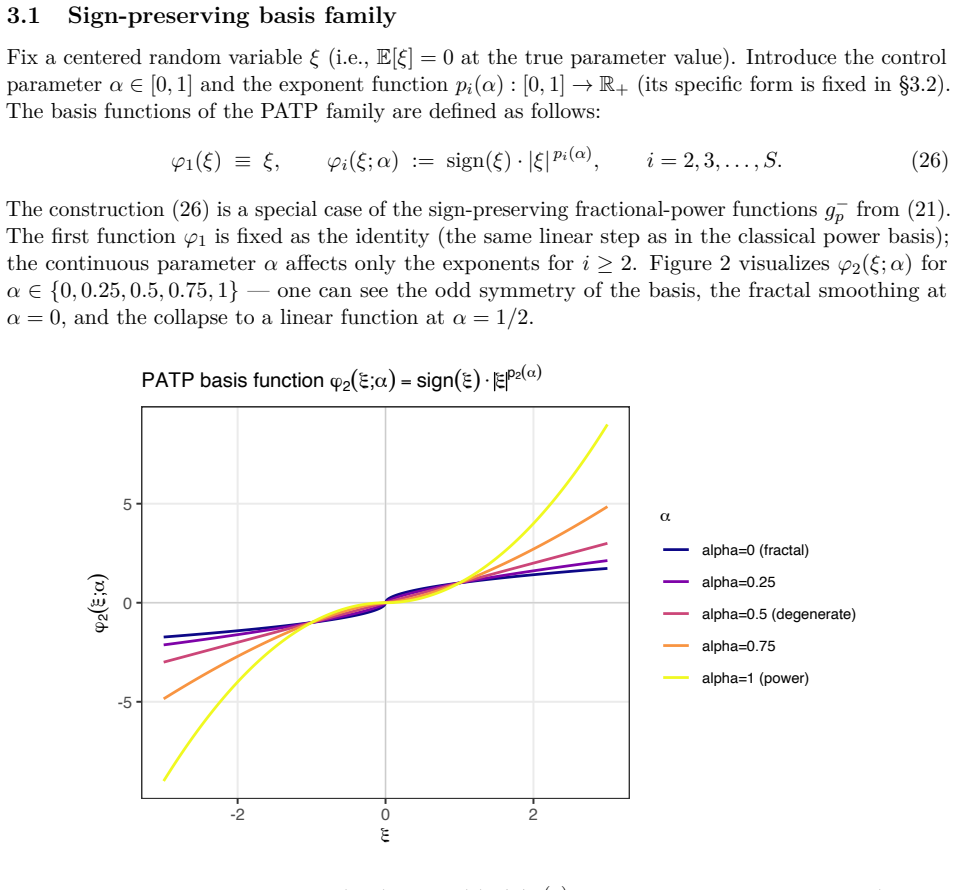
The Parametrically Adaptive Transition Polynomial is a signed-parity fractional-power family controlled by a continuous parameter alpha in [0,1]. The quadratic exponent map p_i(alpha) connects the fractal regime p_i(0)=1/i, the degenerate linear point p_i(1/2)=1, and the signed-parity integer-power regime p_i(1)=i. For the degree-S=2 case a closed-form variance-reduction coefficient g_2(alpha) is derived in terms of signed and absolute fractional moments, with identification of singular behavior at alpha=1/2 and statement of the moment and regularity conditions under which the formula is meaningful. The construction is a Form-B PATP analogue within Kunchenko's generalized apparatus.
What carries the argument
The Parametrically Adaptive Transition Polynomial (PATP) with its quadratic exponent map p_i(alpha) that defines the power for each basis element as a continuous function of alpha.
If this is right
- The variance reduction can be calculated explicitly for quadratic estimators using fractional moments instead of integer ones.
- The formula has a singularity at alpha=1/2 requiring separate treatment or limits.
- The method applies under stated moment and regularity conditions for distributions like those with finite fractional but not integer moments.
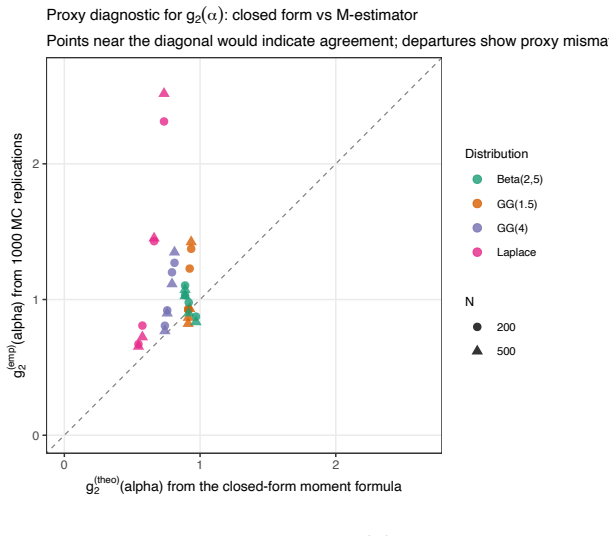
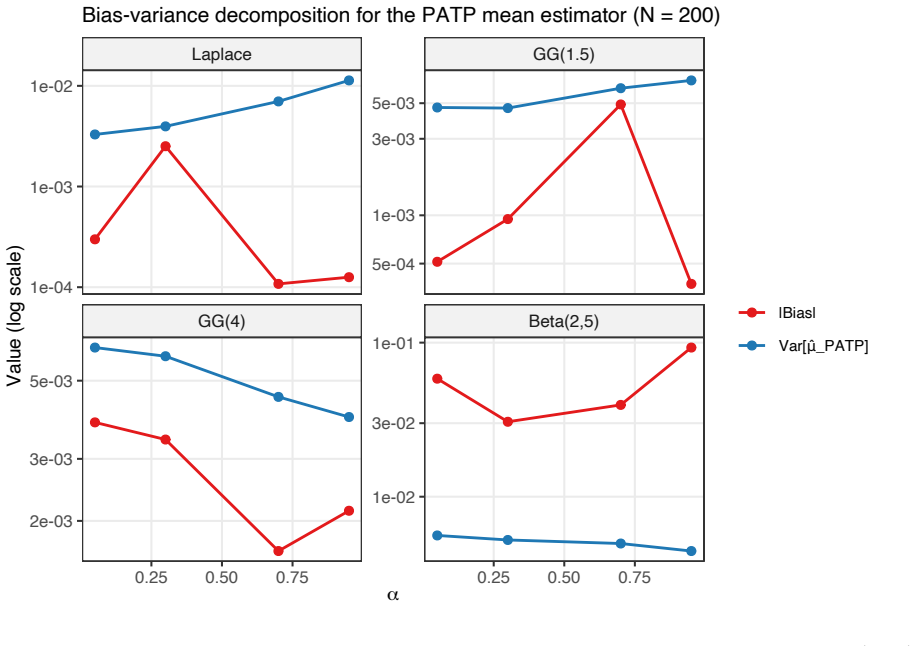
- Numerical studies on canonical distributions confirm finite-sample performance and mark limits for extremely heavy-tailed cases such as Cauchy.
Where Pith is reading between the lines
- This continuous parameterization might allow optimization of alpha for specific distributions to maximize variance reduction.
- Extensions to higher degree S could follow similar derivation paths using the same transition mechanism.
- Applications in robust statistics for data with unknown tail indices could benefit from choosing alpha based on estimated moments.
Load-bearing premise
The moment and regularity conditions under which the closed-form variance-reduction coefficient g_2(alpha) formula is meaningful must hold.
What would settle it
Numerical computation of the variance reduction for a known distribution with fractional moments at a chosen alpha not equal to 1/2, compared directly against the derived closed-form g_2(alpha).
Figures




read the original abstract
Kunchenko's method of polynomial maximization provides a semiparametric apparatus for parameter estimation under non-Gaussian errors, but its classical power basis relies on finite higher-order integer moments. This paper introduces the Parametrically Adaptive Transition Polynomial (PATP), a signed-parity fractional-power family controlled by a continuous parameter alpha in [0,1]. The quadratic exponent map p_i(alpha) connects the fractal regime p_i(0)=1/i, the degenerate linear point p_i(1/2)=1, and the signed-parity integer-power regime p_i(1)=i. For the degree-S=2 case we derive a closed-form variance-reduction coefficient g_2(alpha) in terms of signed and absolute fractional moments, identify the singular behavior at alpha=1/2, and state the moment and regularity conditions under which the formula is meaningful. The construction should be read as a Form-B PATP analogue within Kunchenko's generalized apparatus, not as an exact recovery of the canonical even-power PMM basis at alpha=1. Numerical illustrations on canonical distributions are used to examine the finite-sample behavior of the signed-parity estimator and to mark the boundary of applicability for extremely heavy-tailed cases such as Cauchy.
Editorial analysis
A structured set of objections, weighed in public.
Referee Report
Summary. The manuscript introduces the Parametrically Adaptive Transition Polynomial (PATP) as a signed-parity continuous-alpha extension of Kunchenko stochastic polynomials for semiparametric estimation under non-Gaussian errors. For the quadratic (S=2) case, it derives a closed-form variance-reduction coefficient g_2(alpha) in terms of signed and absolute fractional moments of orders p_i(alpha), identifies singular behavior at alpha=1/2, and states the associated moment and regularity conditions. Numerical illustrations on canonical distributions examine finite-sample behavior of the signed-parity estimator and mark applicability boundaries for heavy-tailed cases such as Cauchy.
Significance. If the closed-form derivation of g_2(alpha) holds rigorously under the stated conditions and the signed-parity construction provides genuine variance reduction without circularity, the work could extend Kunchenko-type methods to a continuous family bridging fractal, linear, and integer-power regimes. The explicit treatment of the alpha=1/2 singularity and numerical checks on heavy tails are positive features that could aid applicability in non-Gaussian settings.
major comments (2)
- [§4] §4 (closed-form derivation of g_2(alpha)): The variance-reduction coefficient is expressed via signed and absolute fractional moments. The paper states moment and regularity conditions and notes singular behavior at alpha=1/2 (where p_i(1/2)=1), but does not verify that the derivation steps remain valid when absolute moments of order 1 diverge (as occurs for Cauchy or near-Cauchy tails) while signed moments may remain finite. This is load-bearing for the claimed applicability in the transition regime.
- [Numerical illustrations] Numerical section (finite-sample illustrations): The examples examine behavior on canonical distributions and mark boundaries for extremely heavy-tailed cases, but it is not shown whether any tested distribution approaches the moment-existence boundary near alpha=1/2; without such a check the illustrations do not fully address the weakest assumption that the regularity conditions hold for the target distributions.
minor comments (2)
- [Introduction] The distinction between Form-B PATP and the canonical even-power PMM basis at alpha=1 could be stated more explicitly in the introduction to avoid potential misreading of the construction as an exact recovery.
- Notation for signed-parity combinations and the quadratic exponent map p_i(alpha) would benefit from an early explicit definition or table before the derivation of g_2(alpha).
Simulated Author's Rebuttal
We thank the referee for the careful reading and constructive comments. We address each major comment below and indicate planned revisions.
read point-by-point responses
-
Referee: [§4] §4 (closed-form derivation of g_2(alpha)): The variance-reduction coefficient is expressed via signed and absolute fractional moments. The paper states moment and regularity conditions and notes singular behavior at alpha=1/2 (where p_i(1/2)=1), but does not verify that the derivation steps remain valid when absolute moments of order 1 diverge (as occurs for Cauchy or near-Cauchy tails) while signed moments may remain finite. This is load-bearing for the claimed applicability in the transition regime.
Authors: The closed-form derivation of g_2(alpha) is carried out under the moment and regularity conditions explicitly stated in the manuscript, which require the relevant signed and absolute fractional moments to be finite. When absolute moments of order 1 diverge (as for Cauchy or near-Cauchy tails), those conditions are violated and the formula is not asserted to apply. The singularity at alpha=1/2 is already identified because p_i(1/2)=1. We will revise §4 to state more explicitly that the derivation steps presuppose finite moments and to discuss the consequences for heavy-tailed cases in which absolute moments diverge while signed moments may remain finite (e.g., via principal-value interpretations). This will clarify the scope of applicability in the transition regime. revision: yes
-
Referee: [Numerical illustrations] Numerical section (finite-sample illustrations): The examples examine behavior on canonical distributions and mark boundaries for extremely heavy-tailed cases, but it is not shown whether any tested distribution approaches the moment-existence boundary near alpha=1/2; without such a check the illustrations do not fully address the weakest assumption that the regularity conditions hold for the target distributions.
Authors: The numerical illustrations employ canonical distributions, including heavy-tailed examples such as Cauchy, to examine finite-sample behavior and to delineate applicability boundaries. We acknowledge that the current set does not specifically include distributions approaching the moment-existence boundary as alpha approaches 1/2. We will add further numerical checks or targeted analysis in the revised manuscript to probe behavior near the regularity-condition boundaries, thereby addressing the concern about the weakest assumptions for the target distributions. revision: yes
Circularity Check
No significant circularity detected in derivation of g_2(alpha)
full rationale
The paper presents a mathematical derivation of the closed-form variance-reduction coefficient g_2(alpha) expressed via signed and absolute fractional moments for the degree-S=2 case, along with identification of singular behavior at alpha=1/2 and explicit statement of the moment and regularity conditions required for the formula to be meaningful. This is framed as a Form-B PATP analogue within Kunchenko's apparatus rather than a recovery of a prior basis. No quoted step reduces the claimed result to its own inputs by construction, no fitted parameter is renamed as a prediction, and no load-bearing premise rests solely on self-citation; the derivation remains self-contained as an algebraic identity under the stated conditions on the underlying distribution.
Axiom & Free-Parameter Ledger
free parameters (1)
- alpha
axioms (1)
- domain assumption Moment and regularity conditions under which the g_2(alpha) formula is meaningful
invented entities (1)
-
Parametrically Adaptive Transition Polynomial (PATP)
no independent evidence
Lean theorems connected to this paper
-
IndisputableMonolith/Cost/FunctionalEquation.leanwashburn_uniqueness_aczel unclear?
unclearRelation between the paper passage and the cited Recognition theorem.
For the degree-S=2 case we derive a closed-form variance-reduction coefficient g_2(alpha) in terms of signed and absolute fractional moments... identify the singular behavior at alpha=1/2
-
IndisputableMonolith/Foundation/RealityFromDistinction.leanreality_from_one_distinction unclear?
unclearRelation between the paper passage and the cited Recognition theorem.
Lean 4 verified algebraic facts support the structural part of the derivation
What do these tags mean?
- matches
- The paper's claim is directly supported by a theorem in the formal canon.
- supports
- The theorem supports part of the paper's argument, but the paper may add assumptions or extra steps.
- extends
- The paper goes beyond the formal theorem; the theorem is a base layer rather than the whole result.
- uses
- The paper appears to rely on the theorem as machinery.
- contradicts
- The paper's claim conflicts with a theorem or certificate in the canon.
- unclear
- Pith found a possible connection, but the passage is too broad, indirect, or ambiguous to say the theorem truly supports the claim.
Forward citations
Cited by 1 Pith paper
-
Polynomial Maximization Method with Fractional Polynomial Basis: A Frequentist Bridge to Bayesian Fractional Polynomials
PMM-FP extends polynomial maximization to fractional polynomial bases and derives a closed-form variance-reduction coefficient g2 for asymmetric non-Gaussian errors, formalized in Lean 4 and checked via Monte Carlo.
Reference graph
Works this paper leans on
-
[1]
doi: 10.1002/047174882X. Elsayed A. H. Elamir and Allan H. Seheult. Trimmed l-moments.Computational Statistics & Data Analysis, 43(3):299–314,
-
[2]
Christel Faes, Helena Geys, Marc Aerts, and Geert Molenberghs
doi: 10.1016/S0167-9473(02)00250-5. Christel Faes, Helena Geys, Marc Aerts, and Geert Molenberghs. Use of fractional polynomials for dose-response modelling and quantitative risk assessment in developmental toxicity studies. Statistical Modelling, 3(2):109–125,
-
[3]
doi: 10.1191/1471082X03ST051OA. Lars Peter Hansen. Large sample properties of generalized method of moments estimators.Econo- metrica, 50(4):1029–1054,
-
[4]
doi: 10.2307/1912775. Jonathan R. M. Hosking. L-moments: Analysis and estimation of distributions using linear combi- nations of order statistics.Journal of the Royal Statistical Society. Series B, 52(1):105–124,
-
[5]
doi: 10.1111/j.2517-6161.1990.tb01775.x. Peter J. Huber.Robust Statistics. Wiley, New York,
-
[6]
doi: 10.1002/0471725250. Yuriy P. Kunchenko.Polynomial Parameter Estimations of Close to Gaussian Random Variables. Shaker Verlag, Aachen,
-
[7]
Foundations of Computational Mathematics , author =
doi: 10.1007/s10208-019-09427-x. Muneya Matsui and Zbyněk Pawlas. Fractional absolute moments of heavy tailed distributions. Brazilian Journal of Probability and Statistics, 30(2):272–298,
-
[8]
doi: 10.1214/15-BJPS280. Stanislav Minsker. Geometric median and robust estimation in banach spaces.Bernoulli, 21(4): 2308–2335,
-
[9]
doi: 10.3150/14-BEJ645. JohnP.Nolan.Univariate Stable Distributions: Models for Heavy Tailed Data. SpringerSeriesinOper- ations Research and Financial Engineering. Springer, Cham,
-
[10]
doi: 10.1007/978-3-030-52915-4. Pavel V. Novitsky and Igor A. Zograf.Estimation of Measurement Result Errors. Energoatomizdat, Leningrad, 2 edition,
-
[11]
doi: 10.2307/2986270. Patrick Royston and Willi Sauerbrei.Multivariable Model-Building: A Pragmatic Approach to Regression Analysis Based on Fractional Polynomials for Modelling Continuous Variables. Wiley, Chichester,
-
[12]
doi: 10.1111/1467-985X.00122. Min Shao and Chrysostomos L. Nikias. Signal processing with fractional lower order moments: Stable processes and their applications.Proceedings of the IEEE, 81(7):986–1010,
-
[13]
Liqun Wang and Alexandre Leblanc
doi: 10.1109/5.231338. Liqun Wang and Alexandre Leblanc. Second-order nonlinear least squares estimation.Annals of the Institute of Statistical Mathematics, 60(4):883–900,
-
[14]
doi: 10.1007/s10463-007-0139-z. S. Zabolotnii, Z. L. Warsza, and O. Tkachenko. Estimation of linear regression parameters of symmetric non-gaussian errors by polynomial maximization method. InAdvances in Intelligent Systems and Computing, volume 920, pages 636–649. Springer, Cham,
-
[15]
doi: 10.1007/ 978-3-030-13273-6_59. S. Zabolotnii, O. Tkachenko, W. Nowakowski, and Z. L. Warsza. Application of the polynomial maximization method for estimating nonlinear regression parameters with non-gaussian asymmetric errors. InAutomation 2024: Advances in Automation, Robotics and Measurement Techniques, volume 1219 ofLecture Notes in Networks and S...
work page 2024
-
[16]
doi: 10.1007/978-3-031-78266-4_30. Serhii Zabolotnii.EstemPMM: Polynomial Maximization Method for Non-Gaussian Regression and Time Series in R,
-
[17]
doi: 10.1017/9781139019647. 39
discussion (0)
Sign in with ORCID, Apple, or X to comment. Anyone can read and Pith papers without signing in.