A new analysis of the "hep" S-factor and the "hen" cross section
Pith reviewed 2026-05-20 04:23 UTC · model grok-4.3
The pith
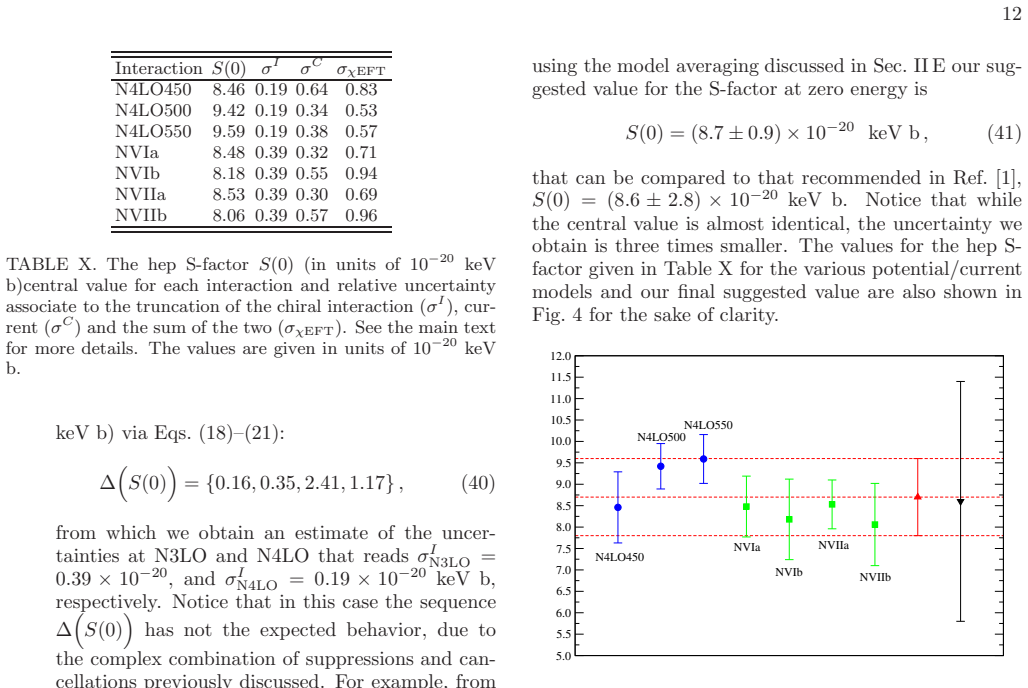
Chiral effective field theory yields a hep S-factor of (8.7 ± 0.9) × 10^{-20} keV b at zero energy.
A machine-rendered reading of the paper's core claim, the machinery that carries it, and where it could break.
Core claim
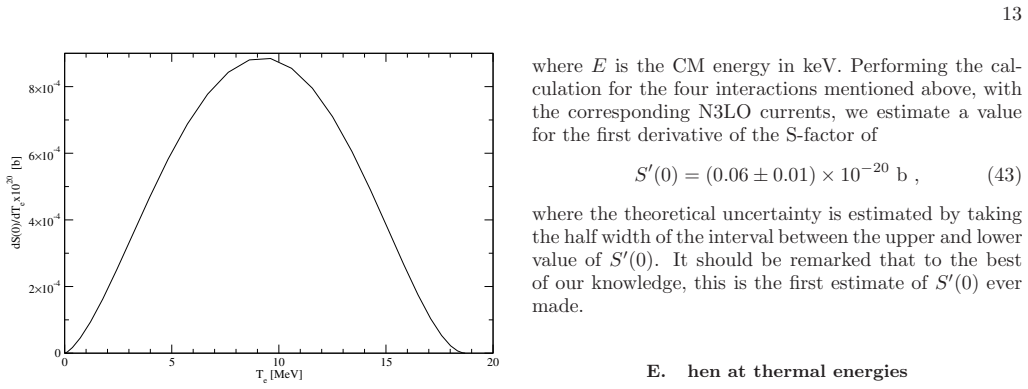
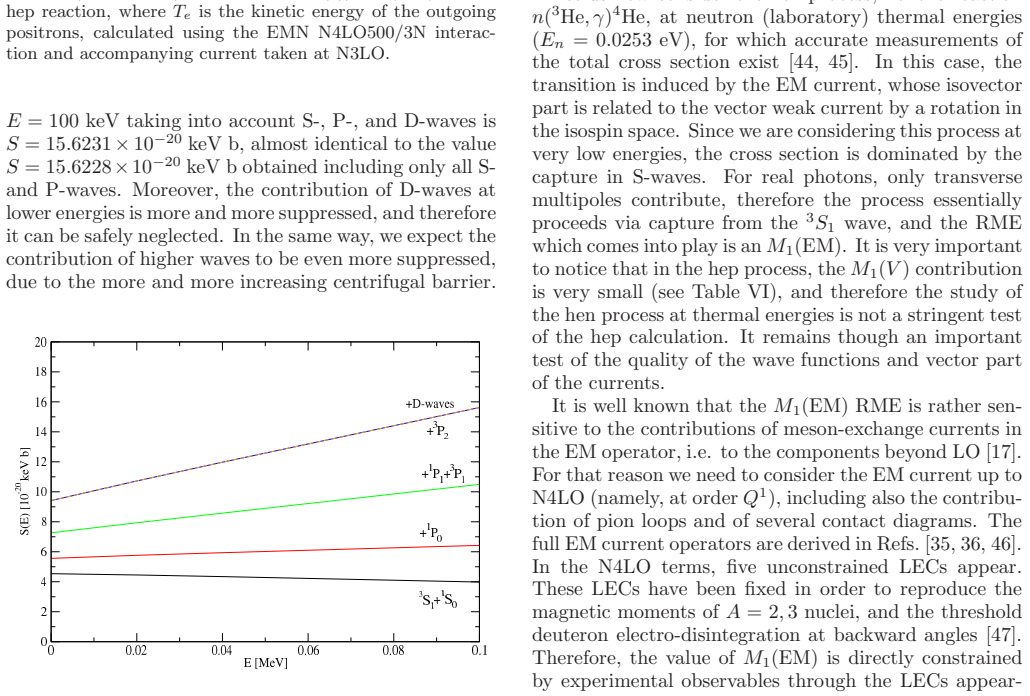
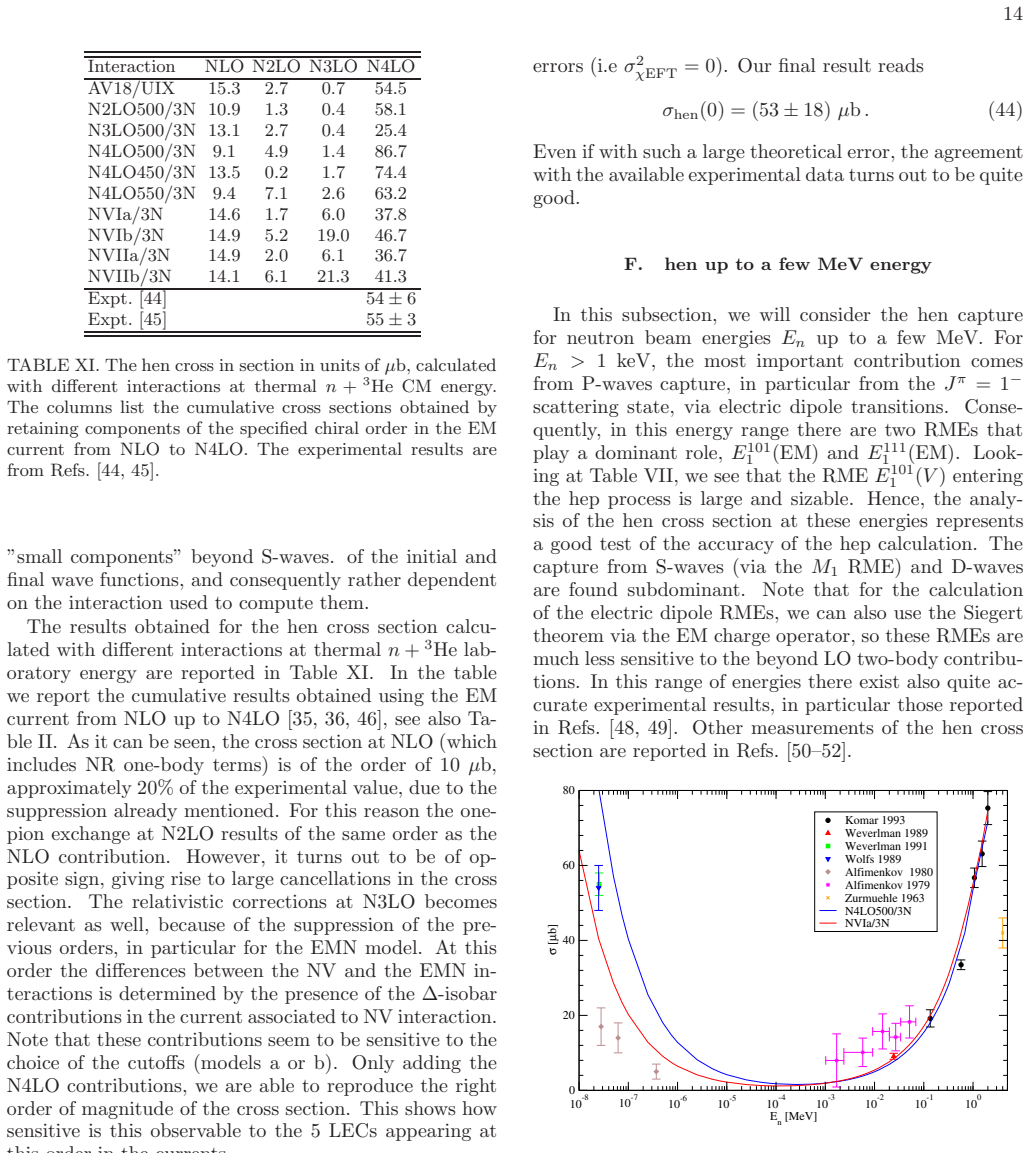
The S-factor for the ^3He(p,e+νe)^4He reaction at zero energy is calculated to be (8.7 ± 0.9) × 10^{-20} keV b by solving the four-nucleon problem with the hyperspherical harmonic expansion method and employing chiral effective field theory interactions and electroweak currents; uncertainties arising from truncation of the chiral series and from model dependence are quantified, the outgoing positron energy spectrum is presented, and the sister ^3He(n,γ)^4He cross section is shown to reproduce experimental values from thermal energies to a few MeV.
What carries the argument
The S-factor for the hep reaction, obtained from hyperspherical harmonic expansion of four-nucleon scattering and bound-state wave functions combined with chiral effective field theory interactions and currents.
If this is right
- The new S-factor value can be inserted into solar neutrino production codes to refine predictions for the high-energy hep neutrino flux.
- The provided positron spectrum supplies a concrete observable for planned or future low-background detectors.
- Agreement with hen data supports use of the same theoretical framework for other weak four-nucleon processes at low energy.
- Quantified uncertainties allow solar modelers to propagate a well-defined theoretical error on this reaction.
Where Pith is reading between the lines
- If the value is adopted, one source of uncertainty in solar neutrino analyses shrinks, which could tighten constraints on solar core temperature or composition once other inputs are fixed.
- The same hyperspherical-plus-chiral approach could be applied to compute rates for other rare stellar reactions where direct data remain unavailable.
- Differences from earlier results may trace to the consistent inclusion of two- and three-body currents within the chiral expansion.
Load-bearing premise
Truncation error estimates and model dependence within the chiral expansion of interactions and currents are sufficient to capture the dominant theoretical uncertainty at astrophysical energies.
What would settle it
A direct measurement of the hep reaction rate or the positron energy spectrum at low energies that lies outside the interval 7.8–9.6 × 10^{-20} keV b would falsify the central result.
Figures



read the original abstract
We present a new accurate analysis of the $^3$He$(p,e^+\nu_e)$${}^4$He (''hep'') reaction at astrophysical energies. The S-factor is computed using a state-of-the-art method to calculate the four-nucleon scattering and bound-state wave functions (the hyperspherical harmonic expansion), and by using nuclear interactions and accompanying electroweak nuclear currents obtained within the chiral effective field theory framework. Our analysis includes a detailed examination of the theoretical uncertainties coming from two different sources: the truncation of the interaction and current chiral expansions, and the model dependence. Our recommended final theoretical value for the hep S-factor at zero energyis $S(0)=(8.7\pm 0.9)\times 10^{-20}$ keV b. We provide also the energy spectrum of the outgoing hep positrons which may be measured in future experiments. We include also an analysis of the ''sister'' reaction $^3$He$(n,\gamma)$${}^4$He (''hen'') at low energies, showing that the calculation well reproduce the total cross section from thermal energies to few MeV, validating our results on the hep reaction.
Editorial analysis
A structured set of objections, weighed in public.
Referee Report
Summary. The manuscript computes the hep S-factor at zero energy via hyperspherical-harmonic expansion of four-nucleon wave functions combined with chiral-EFT interactions and currents. It quantifies theoretical uncertainties from chiral truncation and model dependence, recommends the final value S(0)=(8.7±0.9)×10^{-20} keV b, supplies the positron energy spectrum, and validates the framework by reproducing the hen total cross section from thermal energies to a few MeV.
Significance. If the quoted uncertainty is robust, the result supplies a more reliable theoretical anchor for the high-energy solar-neutrino flux from the hep reaction. The explicit cross-check against measured hen cross sections provides an independent validation that reduces reliance on the chiral-EFT fit data alone and strengthens the overall credibility of the calculation.
major comments (1)
- [Uncertainty analysis (around the discussion of truncation and model dependence)] The central uncertainty budget rests on the assumption that varying chiral order and a limited set of model Hamiltonians brackets residual cutoff and higher-order effects in the dominant N3LO two-body axial current. The manuscript should demonstrate explicitly (e.g., by showing results at two or more regulator values for the leading axial operator) that the quoted ±0.9 band already encompasses the regulator dependence; otherwise the error estimate risks being too narrow.
minor comments (1)
- [Abstract] Abstract: 'zero energyis' is missing a space and should read 'zero energy is'.
Simulated Author's Rebuttal
We thank the referee for the careful reading of our manuscript and the positive overall assessment. The single major comment concerns the robustness of our uncertainty estimate with respect to regulator dependence in the N3LO two-body axial current. We address this point directly below and will revise the manuscript to incorporate an explicit demonstration as requested.
read point-by-point responses
-
Referee: The central uncertainty budget rests on the assumption that varying chiral order and a limited set of model Hamiltonians brackets residual cutoff and higher-order effects in the dominant N3LO two-body axial current. The manuscript should demonstrate explicitly (e.g., by showing results at two or more regulator values for the leading axial operator) that the quoted ±0.9 band already encompasses the regulator dependence; otherwise the error estimate risks being too narrow.
Authors: We agree that an explicit check of regulator dependence for the leading axial current would further strengthen the presentation of our uncertainty budget. Our original analysis already incorporates model dependence through several chiral Hamiltonians that employ different cutoff scales, together with a standard chiral truncation error estimate. To directly respond to the referee's suggestion, we will add in the revised manuscript explicit results for the hep S-factor obtained with two different regulator values (Λ=500 MeV and Λ=600 MeV) applied to the N3LO two-body axial operator. These additional calculations show that the variation lies comfortably inside the quoted ±0.9×10^{-20} keV b band. The revised text will include a short discussion and a supplementary figure documenting this check. revision: yes
Circularity Check
No significant circularity in the hep S-factor derivation chain
full rationale
The paper computes the hep S-factor from four-nucleon wave functions obtained via hyperspherical-harmonic expansion and from electroweak currents constructed in chiral EFT. Low-energy constants are determined by fits to external NN phase shifts and few-body observables reported in prior literature; the hep reaction itself is not used in those fits. The hen cross section is calculated separately and compared to experimental data as an independent validation step rather than an input. Truncation errors are estimated by explicit variation of chiral order and regulator, without reference to the target hep observable. No equation reduces the output S(0) to a fitted parameter or self-citation by construction, and the central result remains a genuine prediction within the stated framework.
Axiom & Free-Parameter Ledger
free parameters (1)
- chiral low-energy constants
axioms (2)
- domain assumption Chiral effective field theory provides a systematic expansion of nuclear interactions and electroweak currents at low energies.
- domain assumption The hyperspherical harmonic expansion converges sufficiently for the four-nucleon bound and scattering states at astrophysical energies.
Lean theorems connected to this paper
-
IndisputableMonolith/Cost/FunctionalEquation.leanwashburn_uniqueness_aczel unclear?
unclearRelation between the paper passage and the cited Recognition theorem.
Our recommended final theoretical value for the hep S-factor at zero energy is S(0)=(8.7±0.9)×10^{-20} keV b... using nuclear interactions and accompanying electroweak nuclear currents obtained within the chiral effective field theory framework... LEC dR... fixed to reproduce the GTME
-
IndisputableMonolith/Foundation/AbsoluteFloorClosure.leanabsolute_floor_iff_bare_distinguishability unclear?
unclearRelation between the paper passage and the cited Recognition theorem.
The analysis of the uncertainty due to the truncation of the chiral expansion has been performed using the method proposed in Ref. [23]... x = Q/Λb ... σI/Ci = δI/CNiLO / √3
What do these tags mean?
- matches
- The paper's claim is directly supported by a theorem in the formal canon.
- supports
- The theorem supports part of the paper's argument, but the paper may add assumptions or extra steps.
- extends
- The paper goes beyond the formal theorem; the theorem is a base layer rather than the whole result.
- uses
- The paper appears to rely on the theorem as machinery.
- contradicts
- The paper's claim conflicts with a theorem or certificate in the canon.
- unclear
- Pith found a possible connection, but the passage is too broad, indirect, or ambiguous to say the theorem truly supports the claim.
Reference graph
Works this paper leans on
-
[1]
The matrix elements of these components can then be written as ⟨Ψ 4|ρ†(q)|Ψ ph,LSJJ z ⟩ =√ 4π(− i)J (− )J− Jz DJ − Jz, 0(− φ, − θ, 0)CLSJ J (q) , (6) ⟨Ψ 4|ˆe∗ z ·JW †(q)|Ψ ph,LSJJ z ⟩ =√ 4π(− i)J (− )J− Jz DJ − Jz, 0(− φ, − θ, 0)LLSJ J (q) , (7) ⟨Ψ 4|ˆe∗ λ ·JW †(q)|Ψ ph,LSJJ z ⟩ = − √ 2π (− i)J (− )J− Jz DJ − Jz, − λ (− φ, − θ, 0) × [ λM LSJ J (q) + ELSJ ...
-
[2]
19 × 10− 20 keV b, respectively
39 × 10− 20, and σ I N4LO = 0 . 19 × 10− 20 keV b, respectively. Notice that in this case the sequence ∆ ( S(0) ) has not the expected behavior, due to the complex combination of suppressions and can- cellations previously discussed. For example, from Fig. 3, we note that most LO500 RMEs are rather at variance with those calculated with the EMN interactio...
work page 1993
-
[3]
By definition, the per- mutation p = 1 is chosen to correspond to the order 1, 2, 3 and 4
The HH expansion basis for bound-state wave functions We start with the definition of the Jacobi vectors which, for a system of four identical particles (disregard- ing the proton-neutron mass difference), are given by x1p = √ 3 2 ( rl − ri + rj + rk 3 ) , x2p = √ 4 3 ( rk − ri + rj 2 ) , (A1) x3p = rj − ri , where p specifies a permutation corresponding to ...
-
[4]
The scattering wave function In the following, a specific clusterization A + B will be denoted by the index γ. More specifically, γ = 1, 2, and 3 will stand for the clusterization p + 3H, n + 3He, and p + 3He, respectively. Let us consider a scattering state with total angular momentum quantum number J Jz, and parity π . The wave function Ψ γLS , describing...
-
[5]
B. Acharya, M. Aliotta, A. B. Balantekin, D. Bem- merer, C. A. Bertulani, A. Best, C. R. Brune, R. Buom- pane, L. Gialanella, F. Cavanna, J. W. Chen, J. Col- gan, A. Czarnecki, B. Davids, R. J. deBoer, F. Delahaye, R. Depalo, A. Guglielmetti, A. Garc ´ ıa, R. G. H. Robert- son, M. Gatu Johnson, D. Gazit, U. Greife, D. Guffanti, K. Hambleton, W. C. Haxton, ...
work page 2025
-
[6]
L. E. Marcucci, R. Schiavilla, M. Viviani, A. Kievsky, and S. Rosati, Phys. Rev. Lett. 84, 5959 (2000)
work page 2000
-
[7]
L. E. Marcucci, R. Schiavilla, M. Viviani, A. Kievsky, S. Rosati, and J. F. Beacom, Phys. Rev. C 63, 015801 (2000)
work page 2000
-
[8]
T. S. Park, L. E. Marcucci, R. Schiavilla, M. Viviani, A. Kievsky, S. Rosati, K. Kubodera, D. P. Min, and M. Rho, Phys. Rev. C 67, 055206 (2003)
work page 2003
- [9]
- [10]
-
[11]
R. B. Wiringa, V. G. J. Stoks, and R. Schiavilla, Phys. Rev. C 51, 38 (1995)
work page 1995
-
[12]
B. S. Pudliner, V. R. Pandharipande, J. Carlson, and R. B. Wiringa, Phys. Rev. Lett. 74, 4396 (1995)
work page 1995
- [13]
-
[14]
L. E. Marcucci, R. Schiavilla, and M. Viviani, Phys. Rev. Lett. 110, 192503 (2013), [Erratum: Phys. Rev. Lett. 123, 019901 (2019)]
work page 2013
- [15]
- [16]
-
[17]
L. Ceccarelli, A. Gnech, L. E. Marcucci, M. Piarulli, an d M. Viviani, Front. in Phys. 10, 1049919 (2023)
work page 2023
- [18]
-
[19]
L. E. Marcucci, A. Kievsky, S. Rosati, R. Schiavilla, an d M. Viviani, Phys. Rev. Lett. 108, 052502 (2012), [Erra- tum: Phys.Rev.Lett. 121, 049901 (2018)]
work page 2012
- [20]
-
[21]
L. Girlanda, A. Kievsky, L. E. Marcucci, S. Pastore, R. Schiavilla, and M. Viviani, Phys. Rev. Lett. 105, 232502 (2010)
work page 2010
-
[22]
M. Viviani, E. Filandri, L. Girlanda, C. Gustavino, A. Kievsky, L. E. Marcucci, and R. Schiavilla, Phys. Rev. C 105, 014001 (2022)
work page 2022
- [23]
-
[24]
A. Kievsky, S. Rosati, M. Viviani, L. Marcucci, and L. Girlanda, J. Phys. G 35, 063101 (2008)
work page 2008
-
[25]
L. E. Marcucci, J. Dohet-Eraly, L. Girlanda, A. Gnech, 19 A. Kievsky, and M. Viviani, Front. in Phys. 8, 69 (2020)
work page 2020
-
[26]
M. Viviani, L. Girlanda, A. Kievsky, and L. E. Marcucci, Phys. Rev. C 102, 034007 (2020)
work page 2020
- [27]
-
[28]
D. R. Entem, R. Machleidt, and Y. Nosyk, Phys. Rev. C96, 024004 (2017)
work page 2017
-
[29]
Minimally non-local nucleon-nucleon potentials with chiral two-pion exchange including $\Delta$'s
M. Piarulli, L. Girlanda, R. Schiavilla, R. Navarro P´ e rez, J. E. Amaro, and E. Ruiz Arriola, Phys. Rev. C 91, 024003 (2015), arXiv:1412.6446 [nucl-th]
work page internal anchor Pith review Pith/arXiv arXiv 2015
-
[30]
M. Piarulli, L. Girlanda, R. Schiavilla, A. Kievsky, A. Lo- vato, L. E. Marcucci, S. C. Pieper, M. Viviani, and R. B. Wiringa, Phys. Rev. C 94, 054007 (2016)
work page 2016
-
[31]
E. Epelbaum, A. Nogga, W. Gl¨ ockle, H. Kamada, U.- G. Meiß ner, and H. Witala, Phys. Rev. C 66, 064001 (2002)
work page 2002
- [32]
-
[33]
V. Bernard, E. Epelbaum, H. Krebs, and U.-G. Meißner, Phys. Rev. C77, 064004 (2008)
work page 2008
-
[34]
V. Bernard, E. Epelbaum, H. Krebs, and U.-G. Meißner, Phys. Rev. C84, 054001 (2011)
work page 2011
- [35]
- [36]
-
[37]
L. Girlanda, A. Kievsky, and M. Viviani, Phys. Rev. C 84, 014001 (2011), [Erratum: Phys.Rev.C 102, 019903 (2020)]
work page 2011
- [38]
-
[39]
S. Pastore, L. Girlanda, R. Schiavilla, M. Viviani, and R. B. Wiringa, Phys. Rev. C 80, 034004 (2009)
work page 2009
-
[40]
M. Piarulli, L. Girlanda, L. E. Marcucci, S. Pastore, R. Schiavilla, and M. Viviani, Phys. Rev. C 87, 014006 (2013)
work page 2013
-
[41]
J. D. Walecka, Theoretical nuclear and subnuclear physics (Oxford University Press, New York, 1995)
work page 1995
-
[42]
Edmonds, Angular Momentum in Quantum Mechan- ics (Princeton University Press, Princeton, 1957)
A. Edmonds, Angular Momentum in Quantum Mechan- ics (Princeton University Press, Princeton, 1957)
work page 1957
-
[43]
J. A. Melendez, R. J. Furnstahl, D. R. Phillips, M. T. Pratola, and S. Wesolowski, Phys. Rev. C 100, 044001 (2019)
work page 2019
-
[44]
V. Barlucchi, A. Gnech, S. Degl’Innocenti, and L. E. Marcucci, (2026), arXiv:2603.25465 [nucl-th]
-
[45]
D. G. McDonald, W. Haeberli, and L. W. Morrow, Phys. Rev. 133, B1178 (1964)
work page 1964
-
[46]
M. T. Alley and L. D. Knutson, Phys. Rev. C 48, 1890 (1993)
work page 1993
-
[47]
T. V. Daniels, C. W. Arnold, J. M. Cesaratto, T. B. Clegg, A. H. Couture, H. J. Karwowski, and T. Katabuchi, Phys. Rev. C 82, 034002 (2010)
work page 2010
-
[48]
F. L. H. Wolfs, S. J. Freedman, J. E. Nelson, M. S. Dewey, and G. L. Greene, Phys. Rev. Lett. 63, 2721 (1989)
work page 1989
-
[49]
R. Wervelman, K. Abrahams, H. Postma, J. G. L. Booten, and A. G. M. Van Hees, Nucl. Phys. A 526, 265 (1991)
work page 1991
-
[50]
S. Pastore, L. Girlanda, R. Schiavilla, and M. Viviani, Phys. Rev. C 84, 024001 (2011)
work page 2011
- [51]
-
[52]
R. J. Komar, H. B. Mak, J. R. Leslie, H. C. Evans, E. Bonvin, E. D. Earle, and T. K. Alexander, Phys. Rev. C 48, 2375 (1993)
work page 1993
-
[53]
R. Wervelman, H. Postma, K. Abrahams, F. Stecher- Rasmussen, G. J. Davids, and G. J. C. Bots, Nucl. Sci. Eng. 102, 428 (1989)
work page 1989
-
[54]
R. W. Zurmuhle, W. E. Stephens, and H. H. Staub, Phys. Rev. 132, 751 (1963)
work page 1963
-
[55]
V. P. Alfimenkov, S. B. Borzakov, G. G. Bunatyan, J. Wierzbicki, L. B. Pikelner, and E. I. Sharapov, Sov. J. Nucl. Phys. 31, 10 (1980)
work page 1980
-
[56]
V. P. Alfimenkov, S. B. Borzakov, J. Wierzbicki, O. O. N., L. B. Pikelner, and E. I. Sharapov, JETP Lett. 29, 91 (1979)
work page 1979
-
[57]
L. Marcucci, M. Viviani, R. Schiavilla, A. Kievsky, and S. Rosati, Phys. Rev. C 72, 014001 (2005), arXiv:nucl- th/0502048
- [58]
- [59]
-
[60]
M. Abramowitz and I. Stegun, Handbook of Mathematical Functions (Dover Publications, Inc., New York, 1970)
work page 1970
- [61]
-
[62]
P. Y. Duerinck, A. Deltuva, J. Dohet-Eraly, M. Gatto- bigio, A. Kievsky, R. Lazauskas, D. Likandrovas, and M. Viviani, Phys. Rev. C 112, 044001 (2025)
work page 2025
discussion (0)
Sign in with ORCID, Apple, or X to comment. Anyone can read and Pith papers without signing in.