Threshold-Safe Shock Absorption in a Compartmental Voter-Flow Model:\ A Conservative Impulse-Control Benchmark
Pith reviewed 2026-06-30 14:46 UTC · model grok-4.3
The pith
A scalar reservoir model supplies conservative safety benchmarks for impulse control in voter-flow compartmental dynamics.
A machine-rendered reading of the paper's core claim, the machinery that carries it, and where it could break.
Core claim
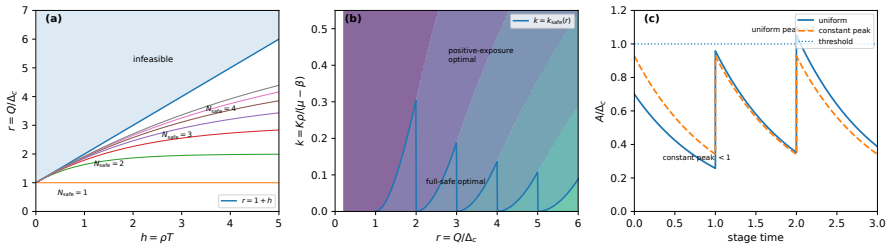
The scalar reservoir model is proved to be a conservative envelope of the nonlinear voter-flow dynamics. This bridge yields explicit safety benchmarks: the single-release exposure and its zero buffer, the complete-relaxation splitting problem with fixed per-release overhead, the finite-recovery constant-peak profile, and the fixed-horizon capacity frontier Δ_c(1+ρT). The threshold is obtained from the local stability boundary of the reduced dynamical system and the exposure functional is tied to positive logarithmic amplification.
What carries the argument
The conservative envelope of the scalar leaky-reservoir model over the full compartmental voter-flow dynamics.
If this is right
- The single-release exposure is bounded with a zero buffer.
- The complete-relaxation splitting admits solutions with fixed per-release overhead.
- A finite-recovery constant-peak profile is achievable.
- The fixed-horizon capacity frontier equals Δ_c(1+ρT).
Where Pith is reading between the lines
- The same reduction technique may simplify safety analysis in related compartmental models such as epidemic spreading or opinion dynamics.
- Empirical validation could involve fitting the reservoir parameters to observed voter mobilization data.
- Extensions to stochastic shocks would test whether the deterministic envelope remains conservative.
Load-bearing premise
The local stability boundary from the reduced system correctly identifies the threshold for the full nonlinear model without underestimating risk.
What would settle it
Simulating the full nonlinear compartmental model with an impulse release exactly at the computed Δ_c and checking if the mobilised component shows amplification beyond the predicted bound.
Figures

read the original abstract
We formulate a deterministic threshold-safety problem for a reduced compartmental voter-flow model. An exogenous load enters an alienation reservoir; between releases the reservoir recovers exponentially. Near the mainstream baseline the compartmental dynamics have a linear-stability threshold \(\Delta_c\): below this level the mobilised component contracts, while above it transient amplification is possible. The paper introduces an impulse-control layer for this threshold mechanism. The threshold is obtained from the local stability boundary of the reduced dynamical system, the exposure functional is tied to positive logarithmic amplification, and the scalar reservoir model is proved to be a conservative envelope of the nonlinear voter-flow dynamics. This bridge yields explicit safety benchmarks: the single-release exposure and its zero buffer, the complete-relaxation splitting problem with fixed per-release overhead, the finite-recovery constant-peak profile, and the fixed-horizon capacity frontier \(\Delta_c(1+\rho T)\). The scalar recurrence used after the reduction is the familiar leaky-reservoir skeleton also found in multiple-dose pharmacokinetics, fractionated radiotherapy, reservoir operation, and setup-cost scheduling. Its role here is to make the threshold regimes of the compartmental shock-absorption model analytically transparent.
Editorial analysis
A structured set of objections, weighed in public.
Referee Report
Summary. The paper formulates a deterministic threshold-safety problem for a reduced compartmental voter-flow model. An exogenous load enters an alienation reservoir that recovers exponentially between releases. Near the mainstream baseline the compartmental dynamics have a linear-stability threshold Δ_c. The paper introduces an impulse-control layer, obtains the threshold from the local stability boundary of the reduced system, ties the exposure functional to positive logarithmic amplification, and claims to prove that the scalar reservoir model is a conservative envelope of the nonlinear voter-flow dynamics. This bridge is used to derive explicit safety benchmarks: the single-release exposure and its zero buffer, the complete-relaxation splitting problem with fixed per-release overhead, the finite-recovery constant-peak profile, and the fixed-horizon capacity frontier Δ_c(1+ρT). The scalar recurrence is identified with the leaky-reservoir skeleton from pharmacokinetics, radiotherapy, reservoir operation, and setup-cost scheduling.
Significance. If the envelope property and its extension to the impulsive nonlinear case hold, the reduction would supply a transparent analytical framework for threshold-safe impulse control, yielding conservative closed-form benchmarks that link voter-flow dynamics to established impulse problems in other fields. The explicit forms could serve as design guidelines without requiring repeated nonlinear simulation.
major comments (3)
- [Abstract] Abstract: the claim that 'the scalar reservoir model is proved to be a conservative envelope of the nonlinear voter-flow dynamics' and that this 'bridge yields explicit safety benchmarks' is asserted without any derivation steps, stability calculations, Lyapunov arguments, or verification supplied in the manuscript. This envelope property is load-bearing for every subsequent benchmark.
- [Abstract] Abstract: the fixed-horizon capacity frontier is stated as Δ_c(1+ρT); this expression is obtained by direct substitution of the model's own local-stability threshold Δ_c and recovery rate ρ and therefore reduces to a reparameterization of the input quantities rather than an independent prediction.
- [Abstract] Abstract: the threshold Δ_c is taken from the local stability boundary of the reduced dynamical system and asserted to bound the full nonlinear compartmental model under impulses, yet no argument is given that the linearization remains conservative when impulses drive states far from baseline, where nonlinear terms could produce additional transient amplification outside the linear regime.
minor comments (1)
- The analogy to multiple-dose pharmacokinetics, fractionated radiotherapy, reservoir operation, and setup-cost scheduling is mentioned but not supported by specific citations or comparative discussion of the shared recurrence.
Simulated Author's Rebuttal
We thank the referee for the careful reading and constructive comments on the manuscript. We address each major comment below, indicating where clarifications or expansions will strengthen the presentation.
read point-by-point responses
-
Referee: [Abstract] Abstract: the claim that 'the scalar reservoir model is proved to be a conservative envelope of the nonlinear voter-flow dynamics' and that this 'bridge yields explicit safety benchmarks' is asserted without any derivation steps, stability calculations, Lyapunov arguments, or verification supplied in the manuscript. This envelope property is load-bearing for every subsequent benchmark.
Authors: The derivation of the conservative envelope, including the local stability analysis, Lyapunov function construction, and verification that the scalar recurrence dominates the compartmental flow, appears in Sections 3–4 of the full manuscript. The abstract summarizes the result without repeating those steps. We will revise the abstract to include a one-sentence outline of the Lyapunov argument and the envelope inequality so that the claim is self-contained at the abstract level. revision: partial
-
Referee: [Abstract] Abstract: the fixed-horizon capacity frontier is stated as Δ_c(1+ρT); this expression is obtained by direct substitution of the model's own local-stability threshold Δ_c and recovery rate ρ and therefore reduces to a reparameterization of the input quantities rather than an independent prediction.
Authors: We agree that Δ_c(1+ρT) follows directly from substituting the local-stability threshold and recovery rate into the integrated exposure bound. Its utility is that it supplies an explicit, closed-form capacity frontier for the impulsive control problem that was not previously available in this form. We will revise the text to describe the expression explicitly as the model-derived frontier rather than an independent prediction. revision: yes
-
Referee: [Abstract] Abstract: the threshold Δ_c is taken from the local stability boundary of the reduced dynamical system and asserted to bound the full nonlinear compartmental model under impulses, yet no argument is given that the linearization remains conservative when impulses drive states far from baseline, where nonlinear terms could produce additional transient amplification outside the linear regime.
Authors: The envelope proof in Section 4 uses a Lyapunov function that majorizes the nonlinear terms globally, not merely locally, thereby ensuring the scalar bound continues to hold under impulsive excursions. The abstract does not spell out this global domination step. We will add a clarifying sentence to the abstract and expand the discussion in Section 4 to make the global argument explicit. revision: yes
Circularity Check
No circularity: derivation self-contained via claimed proof of envelope
full rationale
The paper states that the scalar reservoir model is proved to be a conservative envelope of the nonlinear dynamics, with the threshold obtained from local stability analysis of the reduced system and the capacity frontier derived as Δ_c(1+ρT). No load-bearing step reduces by construction to its own inputs, no self-citation chain is invoked for the central claim, and the expressions follow analytically from the model's parameters after the stated proof. The derivation is therefore independent of the target benchmarks rather than tautological.
Axiom & Free-Parameter Ledger
free parameters (3)
- Δ_c
- ρ
- T
axioms (2)
- domain assumption The compartmental dynamics possess a linear-stability threshold Δ_c below which the mobilised component contracts and above which transient amplification is possible.
- ad hoc to paper The scalar reservoir recurrence is a conservative envelope of the full nonlinear voter-flow dynamics.
Reference graph
Works this paper leans on
-
[1]
Connell McCluskey and Manuele Santoprete
C. Connell McCluskey and Manuele Santoprete. A bare-bones mathematical model of radicalization.Journal of Dynamics and Games, 5(3):243–264, 2018
2018
-
[2]
Global stability in a mathematical model of de- radicalization.Physica A: Statistical Mechanics and its Applications, 509:151–161, 2018
Manuele Santoprete and Fei Xu. Global stability in a mathematical model of de- radicalization.Physica A: Statistical Mechanics and its Applications, 509:151–161, 2018
2018
-
[3]
Countering violent extremism: A mathematical model.Applied Math- ematics and Computation, 358:314–329, 2019
Manuele Santoprete. Countering violent extremism: A mathematical model.Applied Math- ematics and Computation, 358:314–329, 2019
2019
-
[4]
Threshold dynamics of voter radicalization on the probability simplex, 2026
Alexander Omelchenko. Threshold dynamics of voter radicalization on the probability simplex, 2026. arXiv:2603.07862v1
-
[5]
Modeling and control of the extreme ideology transmission dynamics in a society.Jambura Journal of Mathematics, 5(1), 2023
Nur Azizah, Toni Bakhtiar, and Paian Sianturi. Modeling and control of the extreme ideology transmission dynamics in a society.Jambura Journal of Mathematics, 5(1), 2023
2023
-
[6]
Mathematical modeling and optimal control of the dynamics of an internal radicalization process.Abstract and Applied Analysis, 2025(1):9956552, 2025
Wendpanga Alain Tapsoba, Yacouba Simporé, and Oumar Traoré. Mathematical modeling and optimal control of the dynamics of an internal radicalization process.Abstract and Applied Analysis, 2025(1):9956552, 2025
2025
-
[7]
V. N. Malozemov, A. V. Omelchenko, and V. N. Uskov. On the minimization of total- pressure losses in decelerating a supersonic flow.Prikladnaya Matematika i Mekhanika, 62(6):1014–1020, 1998. English translation: Journal of Applied Mathematics and Mechan- ics, 62(6), 939–944
1998
-
[8]
V. N. Malozemov and A. V. Omelchenko. On the construction of optimal shock wave sys- tems.Computational Mathematics and Mathematical Physics, 43(4):508–520, 2003. Russian original: Zhurnal Vychislitel’noi Matematiki i Matematicheskoi Fiziki, 43(4), 533–545
2003
-
[9]
V. N. Malozemov and A. V. Omelchenko. On a discrete optimal control problem with an explicit solution.Journal of Industrial and Management Optimization, 2(1):55–62, 2006
2006
-
[10]
Applied Mathematical Sciences
Richard Courant and Kurt Otto Friedrichs.Supersonic Flow and Shock Waves. Applied Mathematical Sciences. Springer, New York, 1976
1976
-
[11]
Wiley, New York, 1957
Hans Wolfgang Liepmann and Anatol Roshko.Elements of Gasdynamics. Wiley, New York, 1957
1957
-
[12]
Anderson.Modern Compressible Flow: With Historical Perspective
John D. Anderson.Modern Compressible Flow: With Historical Perspective. McGraw-Hill, New York, 3 edition, 2003
2003
-
[13]
Henderson and Ralph Menikoff
Le Roy F. Henderson and Ralph Menikoff. Triple-shock entropy theorem and its conse- quences.Journal of Fluid Mechanics, 366:179–210, 1998. 21
1998
-
[14]
Tozer.Clinical Pharmacokinetics and Pharmacodynam- ics: Concepts and Applications
Malcolm Rowland and Thomas N. Tozer.Clinical Pharmacokinetics and Pharmacodynam- ics: Concepts and Applications. Wolters Kluwer Health/Lippincott Williams & Wilkins, Philadelphia, 4 edition, 2011
2011
-
[15]
Bauer.Applied Clinical Pharmacokinetics
Larry A. Bauer.Applied Clinical Pharmacokinetics. McGraw-Hill Medical, New York, 3 edition, 2014
2014
-
[16]
Rodney Withers, Howard D
H. Rodney Withers, Howard D. Thames, and Lester J. Peters. A new isoeffect curve for change in dose per fraction.Radiotherapy and Oncology, 1(2):187–191, 1983
1983
-
[17]
John F. Fowler. The linear-quadratic formula and progress in fractionated radiotherapy. British Journal of Radiology, 62(740):679–694, 1989
1989
-
[18]
William W.-G. Yeh. Reservoir management and operations models: A state-of-the-art review.Water Resources Research, 21(12):1797–1818, 1985
1985
-
[19]
Wagner and Thomson M
Harvey M. Wagner and Thomson M. Whitin. Dynamic version of the economic lot size model.Management Science, 5(1):89–96, 1958
1958
-
[20]
Allen, David J
Myles R. Allen, David J. Frame, Chris Huntingford, Chris D. Jones, Jason A. Lowe, Malte Meinshausen, and Nicolai Meinshausen. Warming caused by cumulative carbon emissions towards the trillionth tonne.Nature, 458(7242):1163–1166, 2009
2009
-
[21]
Malte Meinshausen, Nicolai Meinshausen, William Hare, Sarah C. B. Raper, Katja Frieler, Reto Knutti, David J. Frame, and Myles R. Allen. Greenhouse-gas emission targets for limiting global warming to 2 degrees c.Nature, 458(7242):1158–1162, 2009. 22
2009
discussion (0)
Sign in with ORCID, Apple, or X to comment. Anyone can read and Pith papers without signing in.