Planckian dissipation from classical hydrodynamics
Pith reviewed 2026-05-20 02:54 UTC · model grok-4.3
The pith
Classical hydrodynamics stays self-consistent at low temperatures only if relaxation rates reach at least the Planckian scale.
A machine-rendered reading of the paper's core claim, the machinery that carries it, and where it could break.
Core claim
The quantum fluctuation-dissipation theorem, read in the time domain, blurs fine details of correlation functions on a Planckian time scale. Tracking this blurring along rays inside the light cone for diffusion, telegraph, and diffusive-telegraph equations shows the interior splitting into a classical region where correlation and response obey the classical fluctuation-dissipation relation and a quantum region where they deviate sharply. Preserving a finite classical region as temperature is lowered forces the effective relaxation rate to be at least Planckian, recovering bounds on diffusivity, equilibration time, and shear viscosity.
What carries the argument
The split of the light-cone interior into classical and quantum regions according to whether correlation and response satisfy the classical fluctuation-dissipation relation under quantum blurring.
If this is right
- Diffusivity is bounded below by a value set by the Planck time and a characteristic length.
- Equilibration time cannot fall below the Planck time.
- Shear viscosity to entropy density ratio acquires a lower bound of order ħ over k_B.
- Planckian scaling of transport coefficients follows from demanding classical hydrodynamics persist to low temperatures.
Where Pith is reading between the lines
- The argument frames Planckian dissipation as the cost of classical long-wavelength description rather than a direct microscopic quantum bound.
- Similar blurring analysis could be applied to other effective classical theories such as kinetic equations or mean-field dynamics.
- The approach suggests testing whether systems that violate Planckian bounds also lose their classical hydrodynamic regime at low temperature.
Load-bearing premise
The phenomenological hydrodynamic equations remain valid descriptions of long-wavelength dynamics even after quantum blurring from the fluctuation-dissipation theorem is imposed on the correlation functions.
What would settle it
Observation of a system whose long-wavelength dynamics follow one of the hydrodynamic equations yet whose relaxation rate remains slower than Planckian at arbitrarily low temperature.
Figures


read the original abstract
In this work we ask what the self-consistency of a classical hydrodynamic description imposes on a quantum system. The quantum fluctuation-dissipation theorem, when read in the time domain, acts as a blurring of the fine details of the correlation functions on a Plankian time-scale. We track this blurring along rays inside the light cone for three phenomenological hydrodynamic equations -- diffusion, telegraph and diffusive-telegraph -- and find that the interior of the cone splits into a classical region, where correlation and response satisfy the classical fluctuation-dissipation relation, and a quantum region, where they deviate sharply from it. Preserving a finite classical region as the temperature is lowered forces the effective relaxation rate to be at least Planckian, recovering bounds on diffusivity, equilibration time and shear viscosity. In this way, Planckian scaling of the diffusion constant emerges not as a quantum constraint on microscopic dynamics, but as the price a system pays to remain describable by classical hydrodynamics down to low temperatures.
Editorial analysis
A structured set of objections, weighed in public.
Referee Report
Summary. The manuscript claims that imposing the blurring effect of the quantum fluctuation-dissipation theorem (in the time domain) on correlation functions of three classical hydrodynamic models—diffusion, telegraph, and diffusive-telegraph—splits the interior of the light cone into a classical region (where classical FDT holds) and a quantum region. Maintaining a finite classical region as temperature is lowered requires the effective relaxation rate to satisfy a Planckian lower bound (≳ k_B T / ħ), which in turn recovers known bounds on diffusivity, equilibration time, and shear viscosity. Planckian scaling thus emerges as a consistency condition for classical hydrodynamics to remain valid at low T rather than a direct quantum constraint on microscopic dynamics.
Significance. If the argument is robust, the work supplies a conceptually economical route to Planckian dissipation by tying it to the persistence of a classical hydrodynamic regime under quantum blurring. This framing may be useful for interpreting transport in strange metals and other Planckian systems. The approach recovers existing bounds rather than generating new quantitative predictions or falsifiable tests beyond the literature, which caps its immediate novelty but still offers a useful consistency perspective. The absence of explicit derivations, numerical checks, or machine-checked steps limits the strength of the evidence presented.
major comments (2)
- [Analysis of the telegraph and diffusive-telegraph models] The central construction solves the classical hydrodynamic equations and then applies quantum FDT blurring to identify the classical region, but the manuscript does not demonstrate that the blurring leaves the form and coefficients of the long-wavelength equations themselves unmodified. If the quantum correction alters the effective hydrodynamics, the classical/quantum split and the resulting bound become model-dependent rather than a self-consistent constraint (see the discussion following the definition of the classical region in the telegraph and diffusive-telegraph cases).
- [Derivation of the relaxation-rate bound] The recovery of the Planckian bound on the relaxation rate is stated as following from preservation of a nonzero classical region, yet no explicit step-by-step derivation or numerical evaluation of the blurred correlation functions is provided to show how the bound emerges quantitatively without parameter adjustment. This step is load-bearing for the claim that the result is non-circular.
minor comments (2)
- [Abstract] The abstract contains the typo 'Plankian' (should be 'Planckian').
- [Main text] Notation for the light-cone rays and the precise definition of the classical-region boundary could be clarified with an additional equation or diagram for readers unfamiliar with the ray-tracing procedure.
Simulated Author's Rebuttal
We thank the referee for their careful reading and constructive comments, which have helped clarify points where the manuscript's presentation could be strengthened. We have revised the manuscript to include additional discussion on the invariance of the hydrodynamic equations and explicit derivations of the relaxation-rate bound. Our responses to the major comments are provided below.
read point-by-point responses
-
Referee: [Analysis of the telegraph and diffusive-telegraph models] The central construction solves the classical hydrodynamic equations and then applies quantum FDT blurring to identify the classical region, but the manuscript does not demonstrate that the blurring leaves the form and coefficients of the long-wavelength equations themselves unmodified. If the quantum correction alters the effective hydrodynamics, the classical/quantum split and the resulting bound become model-dependent rather than a self-consistent constraint (see the discussion following the definition of the classical region in the telegraph and diffusive-telegraph cases).
Authors: We agree that explicit justification is needed to confirm self-consistency. The hydrodynamic equations are effective long-wavelength descriptions derived from conservation laws and constitutive relations. The quantum FDT blurring operates on the short Planckian timescale ħ/k_B T and acts as a time-domain convolution on the correlation functions. In the revised manuscript, we have added a paragraph after the definition of the classical region for the telegraph and diffusive-telegraph models. This shows that the long-time, long-wavelength asymptotics of the blurred correlators remain unchanged from the classical solutions, with quantum corrections decaying exponentially beyond the Planckian scale. Consequently, the form and coefficients of the effective equations are unmodified in the hydrodynamic limit, rendering the classical/quantum split a robust consistency condition rather than a model-dependent artifact. revision: yes
-
Referee: [Derivation of the relaxation-rate bound] The recovery of the Planckian bound on the relaxation rate is stated as following from preservation of a nonzero classical region, yet no explicit step-by-step derivation or numerical evaluation of the blurred correlation functions is provided to show how the bound emerges quantitatively without parameter adjustment. This step is load-bearing for the claim that the result is non-circular.
Authors: We acknowledge that the original manuscript would benefit from more detailed quantitative support. In the revised version, we have added an appendix containing explicit step-by-step derivations and numerical evaluations of the blurred correlation functions. For the diffusion model, we analytically convolve the classical correlator with the quantum FDT kernel and demonstrate that a finite classical region persists at low T only if the diffusivity satisfies the Planckian bound. For the telegraph and diffusive-telegraph models, we provide numerical results showing the shrinkage of the classical region unless the relaxation rate Γ ≳ k_B T / ħ. These calculations are performed directly from the definitions without auxiliary parameter adjustments, establishing that the bound emerges as a necessary condition for the survival of the classical regime and is therefore non-circular. revision: yes
Circularity Check
No significant circularity: direct consistency condition within phenomenological model
full rationale
The paper solves the classical diffusion/telegraph/diffusive-telegraph equations, imposes the quantum FDT to identify the classical region inside the light cone, and shows mathematically that preserving a finite size for this region as T is lowered requires the relaxation rate to satisfy a Planckian lower bound. This is a straightforward consequence of the chosen equations and the FDT relation, not a reduction of the output to the input by construction, a fitted parameter renamed as prediction, or a load-bearing self-citation. The derivation is self-contained against the model's assumptions and explicitly frames the result as what self-consistency of classical hydrodynamics imposes, without claiming an independent microscopic derivation.
Axiom & Free-Parameter Ledger
axioms (2)
- domain assumption Quantum fluctuation-dissipation theorem holds and induces blurring on a Planckian time scale when read in the time domain.
- domain assumption Classical hydrodynamic equations (diffusion, telegraph, diffusive-telegraph) remain applicable descriptions of the dynamics.
Lean theorems connected to this paper
-
IndisputableMonolith/Foundation/ArrowOfTime.leanarrow_from_z echoes?
echoesECHOES: this paper passage has the same mathematical shape or conceptual pattern as the Recognition theorem, but is not a direct formal dependency.
The quantum fluctuation-dissipation theorem, when read in the time domain, acts as a blurring of the fine details of the correlation functions on a Plankian time-scale... Preserving a finite classical region as the temperature is lowered forces the effective relaxation rate to be at least Planckian
-
IndisputableMonolith/Foundation/AbsoluteFloorClosure.leanabsolute_floor_iff_bare_distinguishability unclear?
unclearRelation between the paper passage and the cited Recognition theorem.
the interior of the cone splits into a classical region, where correlation and response satisfy the classical fluctuation–dissipation relation, and a quantum region
What do these tags mean?
- matches
- The paper's claim is directly supported by a theorem in the formal canon.
- supports
- The theorem supports part of the paper's argument, but the paper may add assumptions or extra steps.
- extends
- The paper goes beyond the formal theorem; the theorem is a base layer rather than the whole result.
- uses
- The paper appears to rely on the theorem as machinery.
- contradicts
- The paper's claim conflicts with a theorem or certificate in the canon.
- unclear
- Pith found a possible connection, but the passage is too broad, indirect, or ambiguous to say the theorem truly supports the claim.
Reference graph
Works this paper leans on
-
[1]
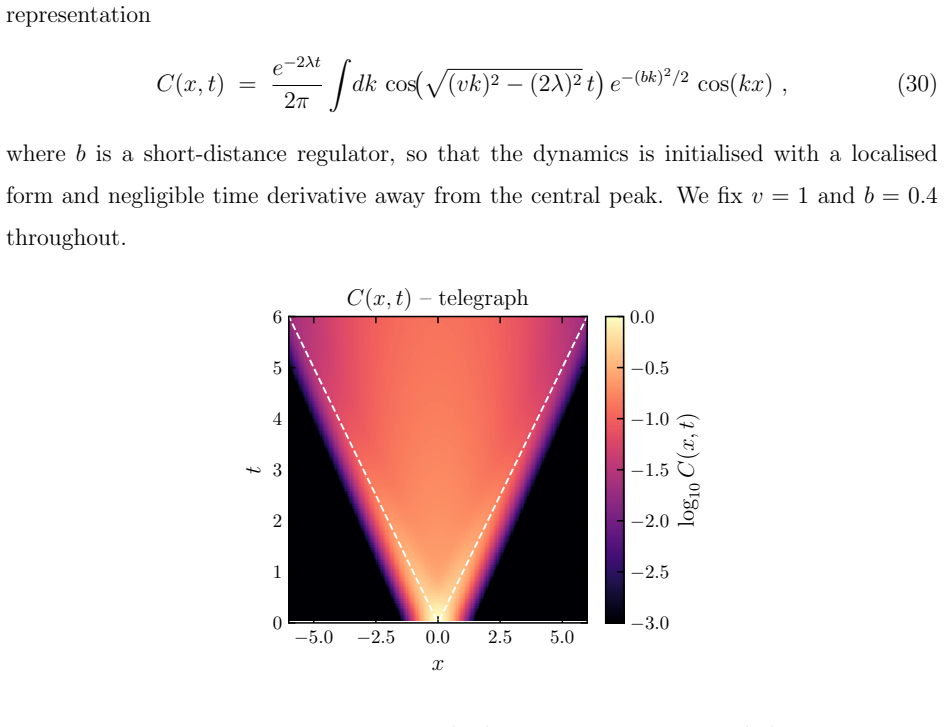
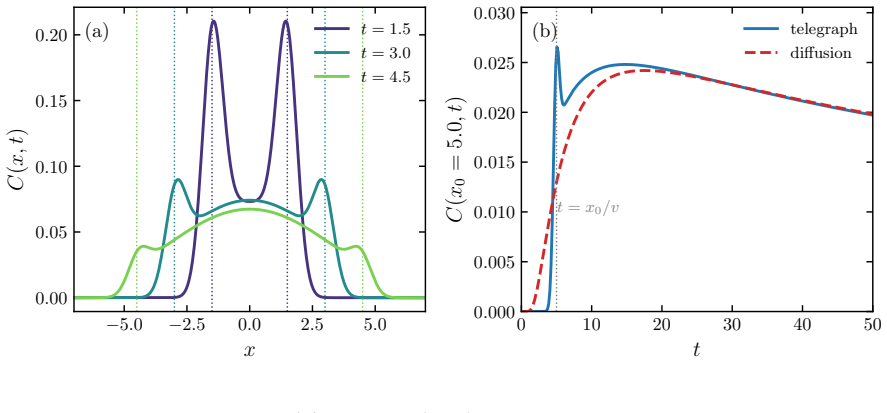
Diffusion equation Fick’s lawj=−D∇ncombined with continuity gives the heat equation∂ tn=D∆n, with the familiar Gaussian C(x, t) = 1√ 4πDt e−x2/(4Dt) .(18) Diffusion propagates at infinite speed and has no intrinsic light cone; one must import a maximal velocityvfrom outside, for instance as a Lieb–Robinson velocity. With this input, the ray parametera=x/(...
-
[2]
Telegraph equation If the current relaxes to Fick’s law with a finite timeτ(Cattaneo’s lawτ ∂ tj+j=−D∇n), continuity gives the telegraph equation [24, 26] ∂2 t n+ 4λ ∂ tn=v 2∆n ,(21) with 4λ=τ −1 andv 2 =D/τ. Unlike diffusion, the equation is hyperbolic: it interpolates between a wave equation at short times and diffusion at late times, with a sharp light...
-
[3]
The diffusive timescale is again D=v 2/(4λ)
Diffusive telegraph equation A Jeffreys-type refinement of Cattaneo’s law allows the current to respond also to∇∂ tn, τ ∂tj+j=−D∇n−τ κ∇∂ tn, giving ∂2 t n+ 4λ∂ tn=v 2∆n+ 2κ ∂ t∆n .(27) This still describes a conserved density with finite propagation speed and late-time diffusion, but the crossover is smoothed by the extra gradient term. The diffusive time...
work page 2030
-
[4]
S. A. Hartnoll and A. P. Mackenzie, Colloquium: Planckian dissipation in metals, Rev. of Mod. Phys.94, 041002 (2022)
work page 2022
-
[5]
D. Chowdhury, A. Georges, O. Parcollet, and S. Sachdev, Sachdev-ye-kitaev models and be- yond: Window into non-fermi liquids, Rev. of Mod. Phys.94, 035004 (2022)
work page 2022
-
[6]
Zaanen, Why the temperature is high, Nature430, 512 (2004)
J. Zaanen, Why the temperature is high, Nature430, 512 (2004)
work page 2004
- [7]
-
[8]
J. Maldacena, S. H. Shenker, and D. Stanford, A bound on chaos, Journal of High Energy Physics2016, 106 (2016)
work page 2016
-
[9]
T. Hartman, S. A. Hartnoll, and R. Mahajan, Upper bound on diffusivity, Phys. Rev. Lett. 119, 141601 (2017)
work page 2017
-
[10]
L. V. Delacretaz, A bound on thermalization from diffusive fluctuations, Nature Physics21, 669 (2025)
work page 2025
- [11]
-
[12]
Planckian bound on quantum dynamical entropy
X. Cao, Planckian bound on quantum dynamical entropy, arXiv preprint arXiv:2507.20914 (2025)
work page internal anchor Pith review Pith/arXiv arXiv 2025
- [13]
-
[14]
S. Pappalardi, L. Foini, and J. Kurchan, Quantum bounds and fluctuation-dissipation rela- tions, SciPost Physics12, 130 (2022). 17
work page 2022
-
[15]
E. H. Lieb and D. W. Robinson, The finite group velocity of quantum spin systems, Commu- nications in mathematical physics28, 251 (1972)
work page 1972
-
[16]
P. Calabrese and J. Cardy, Time dependence of correlation functions following a quantum quench, Phys. Rev. Lett.96, 136801 (2006)
work page 2006
-
[17]
A. M. L¨ auchli and C. Kollath, Spreading of correlations and entanglement after a quench in the one-dimensional bose–hubbard model, Journal of Statistical Mechanics: Theory and Experiment2008, P05018 (2008)
work page 2008
-
[18]
S. R. Manmana, S. Wessel, R. M. Noack, and A. Muramatsu, Time evolution of correlations in strongly interacting fermions after a quantum quench, Phys. Rev. B79, 155104 (2009)
work page 2009
- [19]
-
[20]
M. Cheneau, P. Barmettler, D. Poletti, M. Endres, P. Schauß, T. Fukuhara, C. Gross, I. Bloch, C. Kollath, and S. Kuhr, Light-cone-like spreading of correlations in a quantum many-body system, Nature481, 484 (2012)
work page 2012
- [21]
- [22]
-
[23]
P. Romatschke, New developments in relativistic viscous hydrodynamics, International Journal of Modern Physics E19, 1 (2010)
work page 2010
-
[24]
W. Israel, Nonstationary irreversible thermodynamics: a causal relativistic theory, Annals of Physics100, 310 (1976)
work page 1976
-
[25]
S. Caron-Huot and G. D. Moore, Spacelike thermal correlators are almost time independent, Phys. Rev. D106, 125015 (2022)
work page 2022
-
[26]
The left-hand side of (13) is an increasing function ofathat vanishes ata= 0 (since Φ(0) = 0 and Φ′(0) = 0)
-
[27]
D. D. Joseph and L. Preziosi, Heat waves, Rev. of Mod. Phys.61, 41 (1989)
work page 1989
-
[28]
The relationS Ψ =D Ω ∗S C guarantees the FDT condition Ψ =D Ω ∗C
CallingGthe Green function andSthe sources:G −1 ∗Ψ =S Ψ ⇒Ψ =G∗S Ψ,G −1 ∗C= SC ⇒C=G∗S C. The relationS Ψ =D Ω ∗S C guarantees the FDT condition Ψ =D Ω ∗C. 18
-
[29]
A. D. Kolesnik, Slow diffusion by markov random flights, Physica A: Statistical Mechanics and its Applications499, 186 (2018)
work page 2018
-
[30]
G. D. Mahan, Many-Particle Physics, 3rd ed. (Springer, New York, 2000)
work page 2000
-
[31]
N. Pottier and A. Mauger, Quantum fluctuation-dissipation theorem: a time-domain formu- lation, Physica A: Statistical Mechanics and its Applications291, 327 (2001)
work page 2001
-
[32]
L. F. Cugliandolo, J. Kurchan, and L. Peliti, Energy flow, partial equilibration, and effective temperatures in systems with slow dynamics, Phys. Rev. E55, 3898 (1997)
work page 1997
-
[33]
The code will be made available at publication. Appendix A: The quantum FDT in the time domain In this appendix we collect some results obtained using or deriving different FDT relations in the time domain. We split the discussion in two parts. The first presents the direct statement of the FDT in terms of a differential operator acting onF, which allows ...
-
[34]
Assuming F(x, t)≃e −λ tΦ x/(vt) ,(A6) Eq
FromFtoCandR: the differential operator form We define SAB(t) = 1 Z Tr e−βH A(t)B =C AB(t) +ℏR ′′ AB(t),(A1) withC AB(t) andR ′′ AB(t) related to standard fluctuations and response as CAB(t) = 1 2 1 Z Tr e−βH {A(t), B} ,(A2a) RAB(t) = 2iθ(t)R′′ AB(t) = i ℏ θ(t) 1 Z Tr e−βH [A(t), B] .(A2b) The quantum FDT in frequency reads CAB(ω) = cosh βℏω 2 FAB(ω) (A3)...
-
[35]
Telescoping and dyadic sum of blurred kernels In Ref. [28], Mauger–Pottier derived iℏR ′′ BA(t) = 1 π CBA ∗pv Ω sinh(Ωt) ,(A8) CBA(t) =− iℏ π R′′ BA ∗pv Ω coth(Ωt) ,(A9) where∗denotes convolution. We wish to relateTΨ AB andC AB, which classically coincide at equilibrium. The FDT relation in frequency reads bΨAB(ω) = 2 ℏω tanh βℏω 2 bCAB(ω),(A10) bCAB(ω) =...
discussion (0)
Sign in with ORCID, Apple, or X to comment. Anyone can read and Pith papers without signing in.