On the Contribution of Local Sources to the Galactic Cosmic-Ray Spectrum: An Exact Series Solution for Two-Zone Diffusion
Pith reviewed 2026-06-26 16:41 UTC · model grok-4.3
The pith
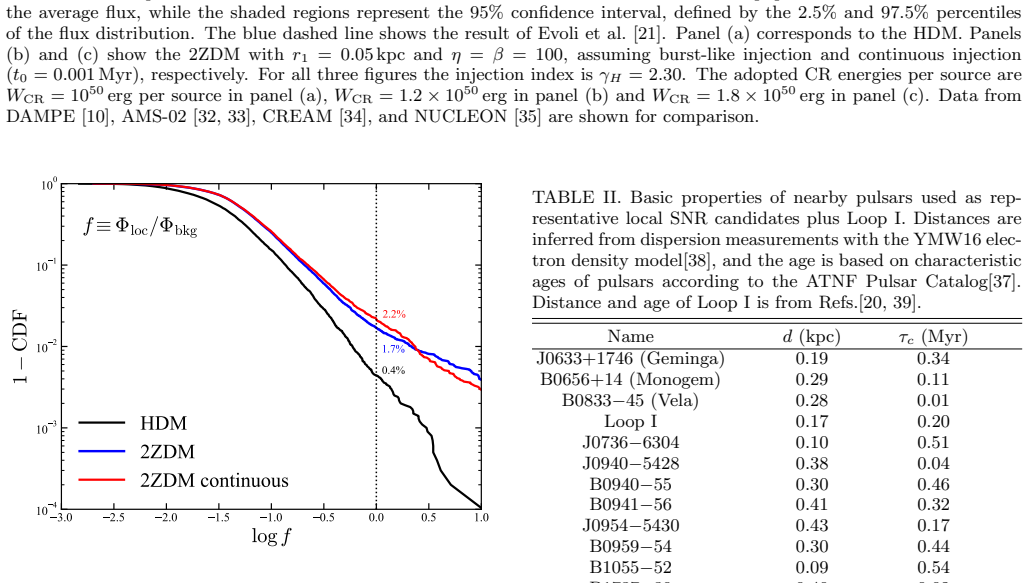
Two-zone diffusion with slow inner zones raises the probability that a local source dominates the cosmic-ray flux at 10 TeV from 0.4 percent to 1.7-2.2 percent.
A machine-rendered reading of the paper's core claim, the machinery that carries it, and where it could break.
Core claim
An exact series Green's function for two-zone diffusion enables fast evaluation of cosmic-ray spectra from many sources; Monte Carlo runs with this solution demonstrate that inefficient near-source transport raises the probability of a dominant local contribution at 10 TeV from 0.4 percent to 1.7-2.2 percent, while catalog comparisons show that matching observed features demands additional assumptions about injection spectra and diffusion parameters.
What carries the argument
The exact series Green's function for two-zone diffusion, which solves the transport equation across an inner slow-diffusion zone matched to gamma-ray observations and an outer normal-diffusion zone.
If this is right
- The probability that the strongest local source reaches background levels at 10 TeV rises to 1.7-2.2 percent.
- The inner slow zone delays particle escape and redistributes flux in time and energy.
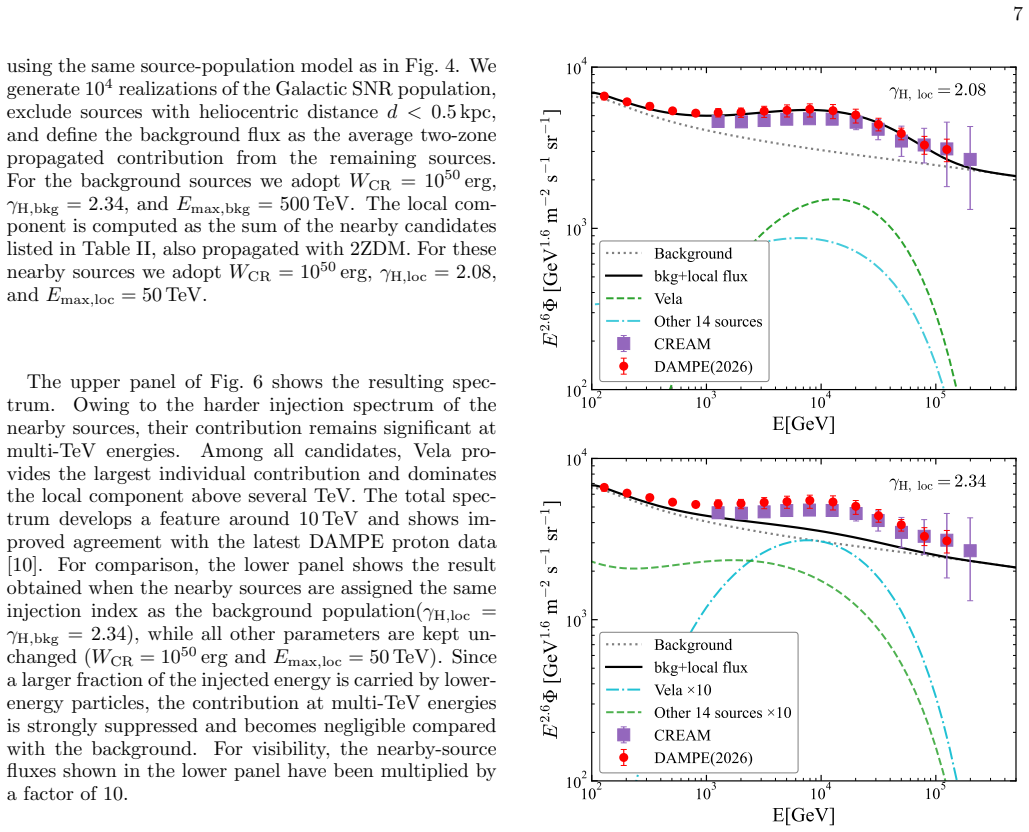
- Reproducing a 10 TeV feature from cataloged sources requires a harder local injection spectrum and favorable diffusion coefficient.
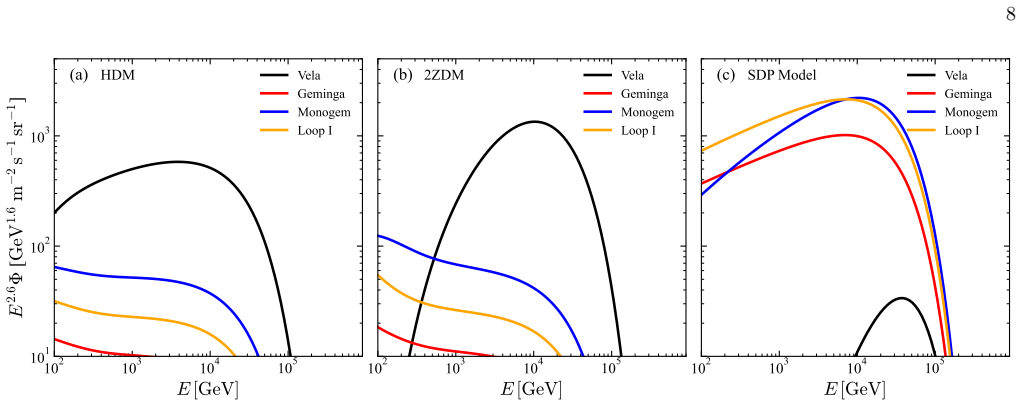
- The predicted flux from any given source changes strongly across different transport models.
Where Pith is reading between the lines
- Independent gamma-ray mapping of extended emission around more accelerators could tighten the allowed range for inner-zone parameters.
- The same series method could be used to test whether two-zone effects alter the expected contribution of local sources to the electron or positron spectrum.
- If the inner-zone picture holds, efforts to explain spectral features should prioritize local turbulence measurements over global diffusion assumptions.
Load-bearing premise
That inefficient transport near sources can be represented by a distinct slow-diffusion inner zone whose radius and coefficient are chosen to match extended gamma-ray observations.
What would settle it
A measurement of the arrival-time distribution or spectral shape from a known nearby source that cannot be reproduced by the two-zone model for any choice of inner radius and diffusion coefficient.
Figures


read the original abstract
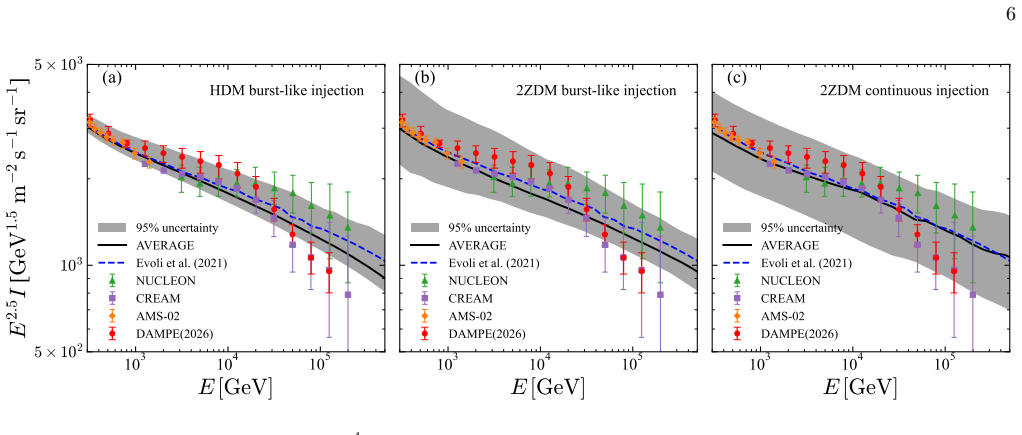
Measurements of cosmic-ray proton and helium spectra below the knee show deviations from simple power laws, including multi-TeV structures. A possible explanation is that one or a few nearby sources contribute an additional component to the local spectrum. However, previous study shows that a dominant local contribution is statistically unlikely under a homogeneous diffusion model. In this work, we investigate how this probability changes if cosmic rays experience inefficient transport near their sources, motivated by observations of extended gamma-ray emission around Galactic accelerators. We derive a series Green's function that enables fast calculation of the particle distribution in this scenario, making Monte Carlo calculations for Galactic source populations feasible. The inner slow-diffusion region delays escape and redistributes the arriving particles in time and energy. In Monte Carlo realizations, the probability that the strongest local source becomes comparable to the background at $10\,\rm{TeV}$ increases from about $0.4\%$ in homogeneous diffusion to $1.7$--$2.2\%$ in the two-zone models. Thus inhibited near-source transport weakens, but does not remove, the statistical difficulty. We then examine cataloged nearby candidate supernova remnants and show that a $10\,\rm{TeV}$ feature can be reproduced only with additional assumptions, especially a harder local injection spectrum and a favorable diffusion coefficient. The predicted contribution of a given source changes strongly among different particle transport model. Therefore, the local source interpretations are plausible but highly model dependent, and require independent constraints on source injection history, particle transport mechanisms, and local interstellar turbulence.
Editorial analysis
A structured set of objections, weighed in public.
Referee Report
Summary. The manuscript derives an exact series Green's function for cosmic-ray propagation in a two-zone diffusion model with an inner slow-diffusion region around sources, motivated by gamma-ray halo observations. This enables Monte Carlo simulations of Galactic source populations, showing that the probability of the strongest local source contributing comparably to the background at 10 TeV increases from ~0.4% under homogeneous diffusion to 1.7--2.2% in the two-zone models. The authors further examine cataloged nearby supernova remnants and conclude that local-source interpretations of spectral features remain plausible but are highly model-dependent, requiring additional assumptions on injection spectra and transport.
Significance. If the results hold, the work supplies a new analytical tool (the series Green's function) that renders population-level calculations in two-zone geometries computationally feasible, a clear technical advance over prior homogeneous or numerical approaches. The quantitative finding that near-source inhibition modestly raises local-source probabilities, combined with the explicit demonstration of strong model dependence, provides useful guidance for interpreting multi-TeV cosmic-ray spectral structures. The derivation itself is parameter-free within the assumed geometry and the Monte Carlo sampling is independent of pre-fitted data.
major comments (2)
- [Abstract] Abstract: the reported probability increase from 0.4% to 1.7--2.2% is obtained only after fixing an inner-zone radius and reduced diffusivity chosen to reproduce extended gamma-ray halos. Gamma-ray morphology constrains the product of gas density and CR density rather than the diffusion coefficient at 10 TeV for protons; applying the same parameters uniformly to every Monte Carlo source therefore inherits an unquantified mapping uncertainty that is load-bearing for the central claim.
- [Methods (series solution) and Results (Monte Carlo)] The series Green's function is stated to be exact only inside the assumed two-zone geometry. The Monte Carlo results and the conclusion that local interpretations are 'highly model dependent' therefore inherit the same geometric restriction; no sensitivity test is described for variations in zone radius or diffusivity that would be consistent with the gamma-ray data within their uncertainties.
minor comments (1)
- [Abstract] The abstract and text use 'rm' for roman font in math mode; consistent use of m or ext for units would improve readability.
Simulated Author's Rebuttal
We thank the referee for the positive evaluation of the technical advance represented by the series Green's function and for the constructive comments. We address each major comment below, proposing targeted revisions to clarify uncertainties and strengthen the discussion of model dependence.
read point-by-point responses
-
Referee: [Abstract] Abstract: the reported probability increase from 0.4% to 1.7--2.2% is obtained only after fixing an inner-zone radius and reduced diffusivity chosen to reproduce extended gamma-ray halos. Gamma-ray morphology constrains the product of gas density and CR density rather than the diffusion coefficient at 10 TeV for protons; applying the same parameters uniformly to every Monte Carlo source therefore inherits an unquantified mapping uncertainty that is load-bearing for the central claim.
Authors: We agree that gamma-ray halo morphology constrains the product of target gas density and cosmic-ray density rather than the diffusion coefficient directly, and that mapping to the proton diffusion coefficient at 10 TeV introduces assumptions. The parameters adopted are fiducial values chosen to be consistent with observed halo extents; the Monte Carlo results are presented to illustrate the effect of a slow-diffusion zone within this framework, and the text already stresses that local-source interpretations remain highly model-dependent. In revision we will expand the abstract and methods discussion to explicitly note the mapping assumptions and state that the quoted probability range applies to the representative two-zone parameters motivated by the gamma-ray data. revision: partial
-
Referee: [Methods (series solution) and Results (Monte Carlo)] The series Green's function is stated to be exact only inside the assumed two-zone geometry. The Monte Carlo results and the conclusion that local interpretations are 'highly model dependent' therefore inherit the same geometric restriction; no sensitivity test is described for variations in zone radius or diffusivity that would be consistent with the gamma-ray data within their uncertainties.
Authors: The series solution is derived for the specific two-zone geometry with fixed inner radius and diffusivity contrast, as stated. A comprehensive sensitivity scan over all parameter combinations consistent with gamma-ray uncertainties would require either repeated analytic derivations or numerical methods for each case. We will add a dedicated paragraph in the discussion section that uses scaling arguments to estimate how plausible variations in zone radius (within the range allowed by current halo observations) would affect the local-source probabilities, thereby quantifying the geometric restriction to the extent feasible without expanding the scope of the Monte Carlo campaign. revision: partial
Circularity Check
No circularity: exact series Green's function is independent derivation; MC probabilities are direct sampling output
full rationale
The central result is an exact series solution for the Green's function in the two-zone geometry, derived mathematically from the diffusion equation without reference to fitted cosmic-ray data or prior results by the same authors. Monte Carlo realizations then sample source populations using this function to compute probabilities; these are not obtained by fitting parameters to the target 10 TeV spectrum or by renaming any input. The two-zone parameters are taken from external gamma-ray morphology constraints and applied as fixed inputs, with the paper explicitly noting model dependence rather than claiming a data-independent prediction. No self-definitional, fitted-input, or self-citation load-bearing steps are present in the derivation chain.
Axiom & Free-Parameter Ledger
free parameters (2)
- slow-diffusion zone radius
- slow-zone diffusion coefficient
axioms (1)
- domain assumption Cosmic-ray transport obeys the diffusion equation with a piecewise-constant diffusion coefficient separating an inner slow zone from an outer normal zone.
Forward citations
Cited by 1 Pith paper
-
A Boundary-Consistent Two-Zone Electron Kernel for Distant Pulsar Contributions to Positron Flux and Anisotropy
A boundary-consistent two-zone kernel shows that distant pulsars beyond 1 kpc can contribute 37-47% of the 10-100 GeV positron flux for a 0.2 kpc disk thickness, with Geminga-like halos compatible with AMS-02 data whe...
Reference graph
Works this paper leans on
-
[1]
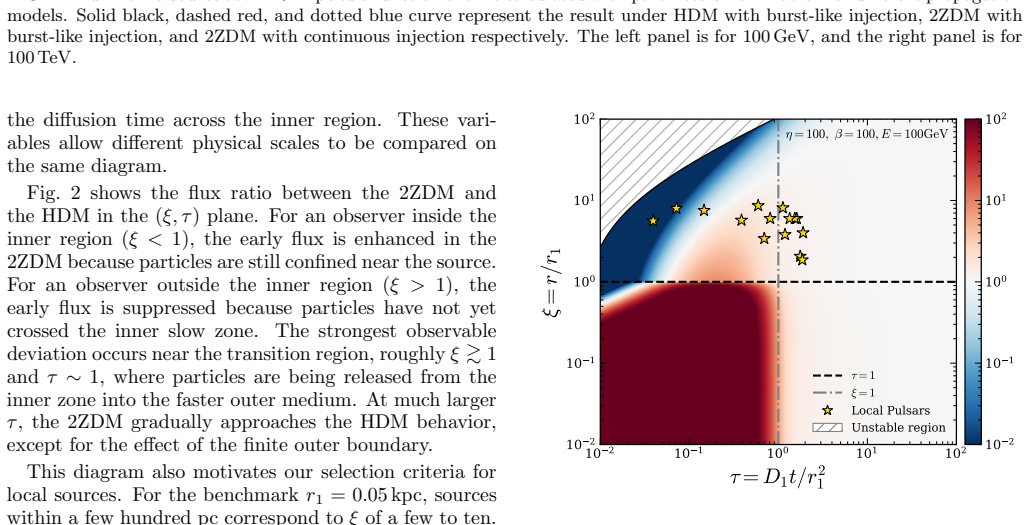
Yellow stars mark the selected nearby pulsars listed in Table II
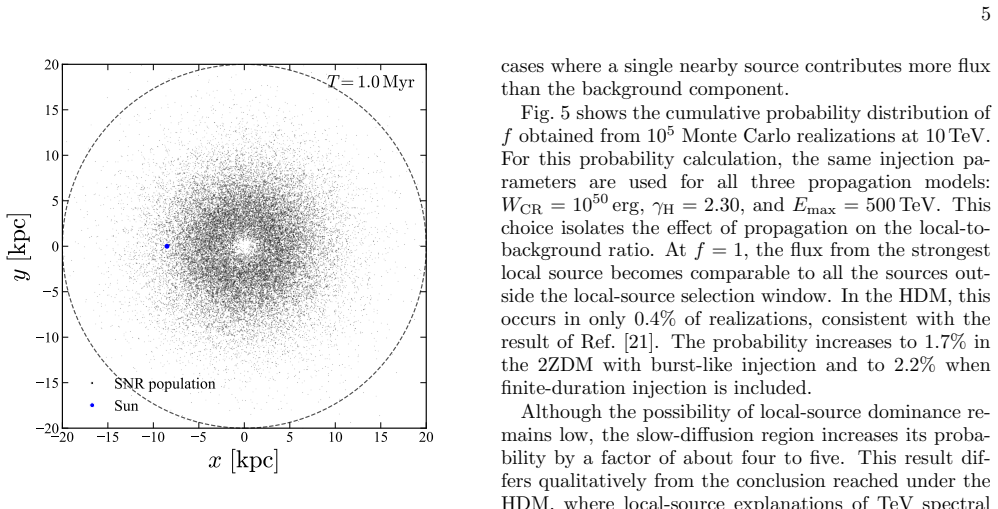
The hatched area marks the region where the physical flux at the observer is exponentially small and the finite-precision modal sum is not reliable. Yellow stars mark the selected nearby pulsars listed in Table II. distribution of SNRs is PR(R)∝ R R⊙ a exp −b R−R ⊙ R⊙ ,(20) whereRis the Galactocentric radius andR ⊙ = 8.5 kpc is the Galactocentric distance...
2054
-
[2]
Adrianiet al.(PAMELA Collaboration), Science332, 69 (2011), arXiv:1103.4055 [astro-ph.HE]
O. Adrianiet al.(PAMELA Collaboration), Science332, 69 (2011), arXiv:1103.4055 [astro-ph.HE]
Pith/arXiv arXiv 2011
-
[3]
Aguilaret al.(AMS Collaboration), Physical Review Letters114, 171103 (2015)
M. Aguilaret al.(AMS Collaboration), Physical Review Letters114, 171103 (2015)
2015
-
[4]
Aguilaret al.(AMS Collaboration), Physical Review Letters115, 211101 (2015)
M. Aguilaret al.(AMS Collaboration), Physical Review Letters115, 211101 (2015)
2015
-
[5]
Y. S. Yoonet al., Astrophysical Journal839, 5 (2017), arXiv:1704.02512 [astro-ph.HE]
Pith/arXiv arXiv 2017
-
[6]
Atkinet al., JETP Letters108, 5 (2018), arXiv:1805.07119 [astro-ph.HE]
E. Atkinet al., JETP Letters108, 5 (2018), arXiv:1805.07119 [astro-ph.HE]
Pith/arXiv arXiv 2018
-
[7]
Anet al.(DAMPE Collaboration), Science Advances 5, eaax3793 (2019)
Q. Anet al.(DAMPE Collaboration), Science Advances 5, eaax3793 (2019)
2019
-
[8]
F. Alemannoet al.(DAMPE Collaboration), Physical Review Letters126, 201102 (2021), arXiv:2105.09073 [astro-ph.HE]
arXiv 2021
-
[9]
O. Adrianiet al.(CALET Collaboration), Physical Review Letters129, 101102 (2022), arXiv:2209.01302 [astro-ph.HE]. 12
arXiv 2022
-
[10]
F. Alemannoet al.(DAMPE Collaboration), Physical Review D109, L121101 (2024), arXiv:2304.00137 [astro- ph.HE]
arXiv 2024
-
[11]
DAMPE Collaboration, Nature653, 52 (2026), arXiv:2511.05409 [astro-ph.HE]
Pith/arXiv arXiv 2026
-
[12]
P. Blasi, E. Amato, and P. D. Serpico, Physical Re- view Letters109, 061101 (2012), arXiv:1207.3706 [astro- ph.HE]
Pith/arXiv arXiv 2012
-
[13]
Tomassetti, Astrophysical Journal Letters752, L13 (2012), arXiv:1204.4492 [astro-ph.HE]
N. Tomassetti, Astrophysical Journal Letters752, L13 (2012), arXiv:1204.4492 [astro-ph.HE]
Pith/arXiv arXiv 2012
-
[14]
Ptuskin, V
V. Ptuskin, V. Zirakashvili, and E.-S. Seo, Astrophysical Journal763, 47 (2013)
2013
-
[15]
G. Bernard, T. Delahaye, P. Salati, and R. Tail- let, Astronomy & Astrophysics544, A92 (2012), arXiv:1204.6289 [astro-ph.HE]
Pith/arXiv arXiv 2012
-
[16]
G. Bernard, T. Delahaye, Y.-Y. Keum, W. Liu, P. Salati, and R. Taillet, Astronomy & Astrophysics555, A48 (2013), arXiv:1207.4670 [astro-ph.HE]
Pith/arXiv arXiv 2013
-
[17]
S. Thoudam and J. R. H¨ orandel, Monthly Notices of the Royal Astronomical Society421, 1209 (2012), arXiv:1112.3020 [astro-ph.HE]
Pith/arXiv arXiv 2012
- [18]
-
[19]
B. Zhao, W. Liu, Q. Yuan, and X.-J. Bi, Astrophysical Journal926, 41 (2022)
2022
-
[20]
A. Li, W. Liu, and Y. Guo, Symmetry16, 236 (2024)
2024
- [21]
- [22]
-
[23]
S. Gabici, F. A. Aharonian, and S. Casanova, Monthly Notices of the Royal Astronomical Society396, 1629 (2009), arXiv:0901.4549 [astro-ph.HE]
Pith/arXiv arXiv 2009
-
[24]
Y. Fujita, Y. Ohira, and F. Takahara, Astrophysi- cal Journal Letters712, L153 (2010), arXiv:1002.4871 [astro-ph.HE]
Pith/arXiv arXiv 2010
-
[25]
L. Nava, S. Gabici, A. Marcowith, G. Morlino, and V. S. Ptuskin, Monthly Notices of the Royal Astronomical So- ciety461, 3552 (2016), arXiv:1606.06902 [astro-ph.HE]
Pith/arXiv arXiv 2016
-
[26]
LHAASO Collaboration, Science Bulletin69, 449 (2024), arXiv:2310.10100 [astro-ph.HE]
arXiv 2024
-
[27]
A. U. Abeysekaraet al.(HAWC Collaboration), Science 358, 911 (2017), arXiv:1711.06223 [astro-ph.HE]
Pith/arXiv arXiv 2017
-
[28]
F. Aharonianet al.(LHAASO Collaboration), Physi- cal Review Letters126, 241103 (2021), arXiv:2106.09396 [astro-ph.HE]
arXiv 2021
-
[29]
R.-Y. Liu, H. Yan, and H. Zhang, Physical Review Let- ters123, 221103 (2019)
2019
-
[30]
S. Recchia, M. Di Mauro, F. A. Aharonian, L. Orusa, F. Donato, S. Gabici, and S. Manconi, Physical Review D104, 123017 (2021), arXiv:2106.02275 [astro-ph.HE]
arXiv 2021
-
[31]
K. Yan, S. Wu, and R.-Y. Liu, Astrophysical Journal 987, 19 (2025), arXiv:2507.08526 [astro-ph.HE]
arXiv 2025
-
[32]
Osipov, A
S. Osipov, A. Bykov, A. Petrov, and V. Romansky, in Journal of Physics: Conference Series, Vol. 1697 (IOP Publishing, 2020) p. 012009
2020
-
[33]
Aguilar, D
M. Aguilar, D. Aisa, B. Alpat, A. Alvino, G. Ambrosi, K. Andeen, L. Arruda, N. Attig, P. Azzarello, A. Bach- lechner,et al., Physical review letters114, 171103 (2015)
2015
-
[34]
Aguilar, L
M. Aguilar, L. A. Cavasonza, G. Ambrosi, L. Arruda, N. Attig, F. Barao, L. Barrin, A. Bartoloni, S. Ba¸ se˘ gmez- du Pree, J. Bates,et al., Physics reports894, 1 (2021)
2021
-
[35]
Y. S. Yoon, T. Anderson, A. Barrau, N. Conklin, S. Coutu, L. Derome, J. Han, J. Jeon, K. Kim, M. Kim, et al., The Astrophysical Journal839, 5 (2017)
2017
-
[36]
Grebenyuk, D
V. Grebenyuk, D. Karmanov, I. Kovalev, I. Kudryashov, A. Kurganov, A. Panov, D. Podorozhny, A. Tkachenko, L. Tkachev, A. Turundaevskiy,et al., Advances in Space Research64, 2546 (2019)
2019
-
[37]
Tang, Z.-Q
T.-P. Tang, Z.-Q. Xia, Z.-Q. Shen, L. Zu, L. Feng, Q. Yuan, Y.-Z. Fan, and J. Wu, Physics Letters B825, 136884 (2022)
2022
-
[38]
R. N. Manchester, G. B. Hobbs, A. Teoh, and M. Hobbs, Astronomical Journal129, 1993 (2005), arXiv:astro- ph/0412641
arXiv 1993
-
[39]
J. M. Yao, R. N. Manchester, and N. Wang, Astrophys. J.835, 29 (2017), arXiv:1610.09448 [astro-ph.GA]
Pith/arXiv arXiv 2017
-
[40]
Dickinson, Galaxies6(2018), 10.3390/galax- ies6020056
C. Dickinson, Galaxies6(2018), 10.3390/galax- ies6020056
-
[41]
LHAASO Collaboration, Z. Cao, F. Aharonian, Y.-X. Bai, Y.-W. Bao, D. Bastieri, X.-J. Bi, Y.-J. Bi, W.- Y. Bian, A. V. Bukevich, C. Cai, W.-Y. Cao, Z. Cao, J. Chang, J.-F. Chang, A. Chen, E.-S. Chen, G. Chen, H.-X. Chen, L. Chen, L. Chen, M.-J. Chen, M.-L. Chen, Q.-H. Chen, S. Chen, S.-H. Chen, S.-Z. Chen, T.-L. Chen, X.-B. Chen, X. Chen, Y. Chen, N. Cheng...
arXiv 2025
-
[42]
LHAASO Collaboration, Z. Cao, F. Aharonian, Y. X. Bai, Y. W. Bao, D. Bastieri, X. J. Bi, Y. J. Bi, W. Bian, J. Blunier, A. V. Bukevich, C. M. Cai, Y. Y. Cai, W. Y. Cao, Z. Cao, J. Chang, J. F. Chang, E. S. Chen, G. H. Chen, H. K. Chen, L. F. Chen, L. Chen, L. Chen, M. J. Chen, M. L. Chen, Q. H. Chen, S. Chen, S. H. Chen, S. Z. 13 Chen, T. L. Chen, X. B. C...
Pith/arXiv arXiv 2025
-
[43]
LHAASO Collaboration, Z. Cao, F. Aharonian, Q. An, Axikegu, L. X. Bai, Y. X. Bai, Y. W. Bao, D. Bastieri, X. J. Bi, Y. J. Bi, H. Cai, J. T. Cai, Z. Cao, J. Chang, J. F. Chang, B. M. Chen, E. S. Chen, J. Chen, L. Chen, L. Chen, L. Chen, M. J. Chen, M. L. Chen, Q. H. Chen, S. H. Chen, S. Z. Chen, T. L. Chen, X. L. Chen, Y. Chen, N. Cheng, Y. D. Cheng, S. W....
arXiv 2021
-
[44]
LHAASO Collaboration, Z. Cao, F. Aharonian, Y. X. Bai, Y. W. Bao, D. Bastieri, X. J. Bi, Y. J. Bi, W. Bian, A. V. Bukevich, C. M. Cai, W. Y. Cao, Z. Cao, J. Chang, J. F. Chang, A. M. Chen, E. S. Chen, G. H. Chen, H. X. Chen, L. Chen, L. Chen, M. J. Chen, M. L. Chen, Q. H. Chen, S. Chen, S. H. Chen, S. Z. Chen, T. L. Chen, X. B. Chen, X. J. Chen, Y. Chen, ...
-
[45]
J. ´Alvarez-Mu˜ niz, R. Alves Batista, A. Balagopal V., J. Bolmont, M. Bustamante, W. Carvalho, D. Char- rier, I. Cognard, V. Decoene, P. B. Denton, S. De Jong, K. D. De Vries, R. Engel, K. Fang, C. Fin- ley, S. Gabici, Q. Gou, J. Gu, C. Gu´ epin, H. Hu, Y. Huang, K. Kotera, S. Le Coz, J.-P. Lenain, G. L¨ u, O. Martineau-Huynh, M. Mostaf´ a, F. Mottez, K....
Pith/arXiv arXiv 2020
-
[46]
Novotn´ y, arXiv e-prints , arXiv:2501.01736 (2025), arXiv:2501.01736 [astro-ph.HE]
V. Novotn´ y, arXiv e-prints , arXiv:2501.01736 (2025), arXiv:2501.01736 [astro-ph.HE]
arXiv 2025
-
[47]
R. U. Abbasi, M. Abe, T. Abu-Zayyad, M. Allen, R. Azuma, E. Barcikowski, J. W. Belz, D. R. Bergman, S. A. Blake, R. Cady, B. G. Cheon, J. Chiba, M. Chikawa, A. Di Matteo, T. Fujii, K. Fujita, M. Fukushima, G. Furlich, T. Goto, W. Hanlon, M. Hayashi, Y. Hayashi, N. Hayashida, K. Hibino, K. Honda, D. Ikeda, N. Inoue, T. Ishii, R. Ishimori, H. Ito, D. Ivanov...
arXiv 2018
discussion (0)
Sign in with ORCID, Apple, or X to comment. Anyone can read and Pith papers without signing in.