Non-Orthogonal Multiple Access (NOMA): How It Meets 5G and Beyond
Pith reviewed 2026-05-24 16:51 UTC · model grok-4.3
The pith
NOMA achieves higher spectral efficiency than orthogonal multiple access and suits 5G and beyond.
A machine-rendered reading of the paper's core claim, the machinery that carries it, and where it could break.
Core claim
The paper claims that compared to orthogonal multiple access techniques, NOMA is superior in spectral efficiency and is thus appropriate for 5G and Beyond. It supports this by laying out the fundamentals of power-domain NOMA with single and multiple antennas, the principles of code-domain NOMA, resource allocation strategies, cooperative NOMA variants, and the opportunities plus challenges of combining NOMA with heterogeneous networks and millimeter-wave communications.
What carries the argument
Power-domain NOMA, in which users are multiplexed by allocating different power levels on the same resource block, and code-domain NOMA, which uses spreading codes for separation.
If this is right
- NOMA can support a larger number of simultaneous users on limited spectrum in both uplink and downlink.
- User pairing combined with power allocation becomes a central design step for realizing the efficiency gains.
- Cooperative NOMA variants can further improve reliability for cell-edge users.
- Integration with millimeter-wave bands opens pathways for higher data rates while retaining the non-orthogonal sharing benefit.
Where Pith is reading between the lines
- If power allocation algorithms scale well, NOMA could reduce the need for additional spectrum auctions in dense urban areas.
- The same non-orthogonality principle might extend to grant-free access schemes for massive machine-type communications.
- Compatibility challenges with existing orthogonal standards suggest hybrid NOMA-OMA deployments as a practical transition path.
Load-bearing premise
That the resource allocation methods and compatibility with heterogeneous networks or millimeter-wave systems can be implemented in practice without major unresolved technical barriers.
What would settle it
Field measurements in a 5G-like deployment showing that NOMA delivers no spectral-efficiency gain over orthogonal schemes under realistic channel conditions and user densities.
Figures
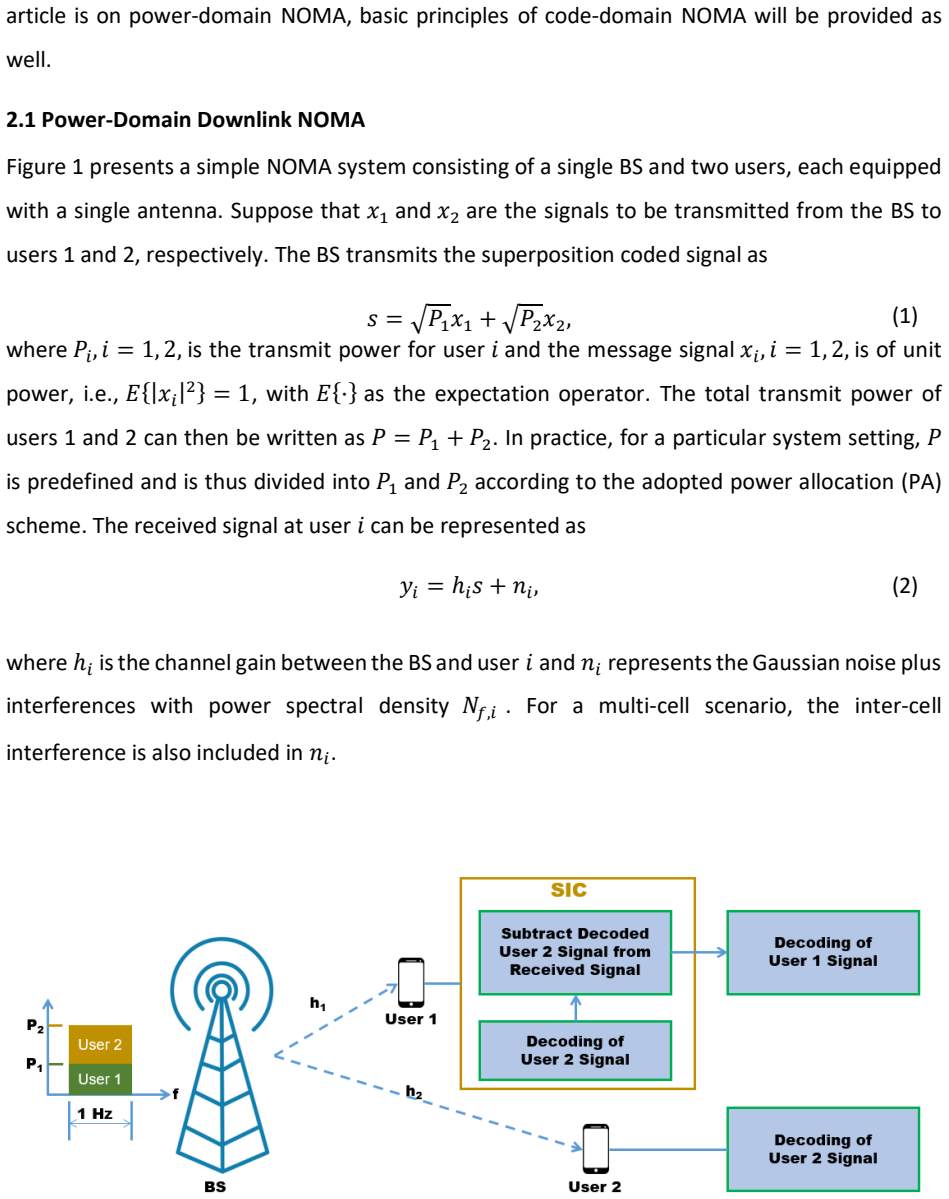
read the original abstract
Due to massive connectivity and increasing demands of various services and data-hungry applications, a full-scale implementation of the fifth generation (5G) wireless systems requires more effective radio access techniques. In this regard, non-orthogonal multiple access (NOMA) has recently gained ever-growing attention from both academia and industry. Compared to orthogonal multiple access (OMA) techniques, NOMA is superior in terms of spectral efficiency and is thus appropriate for 5G and Beyond. In this article, we provide an overview of NOMA principles and applications. Specifically, the article discusses the fundamentals of power-domain NOMA with single and multiple antennas in both uplink and downlink settings. In addition, the basic principles of code-domain NOMA are elaborated. Further, the article explains various resource allocation techniques such as user pairing and power allocation for NOMA systems; discusses the basic form of cooperative NOMA and its variants; and addresses several opportunities and challenges associated with the compatibility of NOMA with other advanced communication paradigms such as heterogeneous networks and millimeter wave communications.
Editorial analysis
A structured set of objections, weighed in public.
Referee Report
Summary. The manuscript is a survey article providing an overview of non-orthogonal multiple access (NOMA) for 5G and beyond. It reviews the fundamentals of power-domain NOMA (single- and multi-antenna, uplink and downlink), code-domain NOMA, resource allocation techniques including user pairing and power allocation, cooperative NOMA and its variants, and the opportunities and challenges of integrating NOMA with heterogeneous networks and millimeter-wave communications. The central claim, drawn from the reviewed literature, is that NOMA achieves superior spectral efficiency relative to orthogonal multiple access (OMA) and is therefore suitable for 5G and future systems.
Significance. If the synthesis accurately reflects the cited literature, the paper offers a structured consolidation of NOMA principles and practical considerations that can serve as a useful entry point for researchers. The balanced discussion of both opportunities (e.g., compatibility with HetNets and mmWave) and challenges strengthens its reference value for the field.
Simulated Author's Rebuttal
We thank the referee for the positive review and recommendation to accept the manuscript. The assessment that the survey provides a structured consolidation of NOMA principles with balanced discussion of opportunities and challenges is appreciated.
Circularity Check
No significant circularity: survey paper with no new derivations
full rationale
This is a review/overview article that summarizes existing NOMA literature, fundamentals of power- and code-domain NOMA, resource allocation methods, cooperative variants, and compatibility with HetNets/mmWave. The central claim of spectral-efficiency superiority over OMA is presented as established motivation drawn from the reviewed prior work rather than a novel derivation or prediction within the paper itself. No equations, fitted parameters, self-citations as load-bearing uniqueness theorems, or ansatzes are introduced that reduce to the paper's own inputs by construction. The manuscript explicitly discusses opportunities and challenges, confirming it does not claim to prove new results.
Axiom & Free-Parameter Ledger
Reference graph
Works this paper leans on
-
[1]
(2019) Introduction to Cellular Mobile Communications
Boccuzzi J. (2019) Introduction to Cellular Mobile Communications. In: Vaezi M., Ding Z., Poor H. (eds) Multiple Access Techniques for 5G Wireless Networks and Beyond. Springer, Cham
work page 2019
- [2]
-
[3]
Syste m-level Performance of Downlink NOMA for Future LTE Enhancements,
A. Benjebbovu, A. Li, Y. Saito, Y. Kishiyama, A. Harada, and T. Nakamura, “Syste m-level Performance of Downlink NOMA for Future LTE Enhancements,” in Proc. IEEE Global Communications Conference (GLOBECOM), Atlanta, USA, 2013, pp. 66–70
work page 2013
-
[4]
Power-Domain Non-Orthogonal Multiple Access (NOMA) in 5G Systems: Potentials and Challenges,
S. M. R. Islam, N. Avazov, O. A. Dobre and K. Kwak, "Power-Domain Non-Orthogonal Multiple Access (NOMA) in 5G Systems: Potentials and Challenges," IEEE Communications Surveys and Tutorials, vol. 19, no. 2, pp. 721-742, Second quarter 2017
work page 2017
-
[5]
A Survey on Non- Orthogonal Multiple Access for 5G Networks: Research Challenges and Future Trends,
Z. Ding, X. Lei, G. K. Karagiannidis, R. Schober, J. Yuan and V. K. Bhargava, "A Survey on Non- Orthogonal Multiple Access for 5G Networks: Research Challenges and Future Trends," IEEE Journal on Selected Areas in Communications, vol. 35, no. 10, pp. 2181-2195, Oct. 2017
work page 2017
-
[6]
Nonorthogonal Multiple Access for 5G and Beyond,
Y. Liu, Z. Qin, M. Elkashlan, Z. Ding, A. Nallanathan and L. Hanzo, "Nonorthogonal Multiple Access for 5G and Beyond," Proceedings of the IEEE, vol. 105, no. 12, pp. 2347-2381, Dec. 2017
work page 2017
-
[7]
Non-Orthogonal Multiple Access (NOMA) with Successive Interference Cancellation,
K. Higuchi and A. Benjebbour, “Non-Orthogonal Multiple Access (NOMA) with Successive Interference Cancellation,” IEICE Transactions on Communications, vol. E98-B, no. 3, pp. 403– 414, Mar. 2015
work page 2015
-
[8]
A Survey of Non-Orthogonal Multiple Access for 5G,
L. Dai, B. Wang, Z. Ding, Z. Wang, S. Chen and L. Hanzo, "A Survey of Non-Orthogonal Multiple Access for 5G," IEEE Communications Surveys & Tutorials, vol. 20, no. 3, pp. 2294 -2323, third quarter 2018
work page 2018
-
[9]
NOMA in 5G Systems: Exciting Possibilities for Enhancing Spectral Efficiency,
SMR Islam, M Zeng, and Octavia A. Dobre, "NOMA in 5G Systems: Exciting Possibilities for Enhancing Spectral Efficiency," IEEE 5G Tech Foucs, vol. 1, no. 2, Jun. 2017
work page 2017
-
[10]
M. Mohammadkarimi, M. A. Raza and O. A. Dobre, "Signature -Based Non-orthogonal Massive Multiple Access for Future Wireless Networks: Uplink Massive Connectivity for Machine- Type Communications," IEEE Vehicular Technology Magazine, vol. 13, no. 4, pp. 40-50, Dec. 2018
work page 2018
-
[11]
Novel Low-Density Signature for Synchronous CDMA Systems over AWGN Channel,
R. Hoshyar, F. P. Wathan, and R. Tafazolli, “Novel Low-Density Signature for Synchronous CDMA Systems over AWGN Channel,” IEEE Transactions on Signal Processing, vol. 56, no. 4, pp. 1616–1626, Apr. 2008
work page 2008
-
[12]
LDS-OFDM an Efficient Multiple Access Technique,
R. Hoshyar, R. Razavi, and M. Al-Imari, “LDS-OFDM an Efficient Multiple Access Technique,” in Proc. IEEE Vehicular Technology Conference (IEEE VTC Spring), Taipei, Taiwan, 2010, pp. 1–5
work page 2010
-
[13]
H. Nikopour and H. Baligh, “Sparse Code Multiple Access,” in Proc. IEEE Int ernational Symposium on Personal Indoor Mobile Radio Communications (IEEE PIMRC), London, U.K., 2013, pp. 332–336
work page 2013
-
[14]
Fairness for Non-Orthogonal Multiple Access in 5G Systems,
S. Timotheou and I. Krikidis, “Fairness for Non-Orthogonal Multiple Access in 5G Systems,” IEEE Signal Processing Letters, vol. 22, no. 10, pp. 1647–1651, Oct. 2015
work page 2015
-
[15]
Blind Detection of SCMA for Uplink Grant- free Multiple-Access,
A. Bayesteh, E. Yi, H. Nikopour, and H. Baligh, “Blind Detection of SCMA for Uplink Grant- free Multiple-Access,” in Proc. IEEE Wireless Communications Systems, Barcelona, Spain, 2014, pp. 853–857
work page 2014
-
[16]
Uplink Vs. Downlink NOMA in Cellular Networks: Challenges and Research Directions,
H. Tabassum, M. S. Ali, E. Hossain, M. J. Hossain and D. I. Kim, "Uplink Vs. Downlink NOMA in Cellular Networks: Challenges and Research Directions," in Proc. IEEE Vehicular Technology Conference (VTC Spring), Sydney, Australia, 2017, pp. 1-7
work page 2017
-
[17]
Cooperative Non-Orthogonal Multiple Access in 5G Systems,
Z. Ding, M. Peng and H. V. Poor, "Cooperative Non-Orthogonal Multiple Access in 5G Systems," IEEE Communications Letters, vol. 19, no. 8, pp. 1462-1465, Aug. 2015
work page 2015
-
[18]
Cooperative Diversity in Wireless Networks: Efficient Protocols and Outage Behavior,
J. N. Laneman, D. N. C. Tse, and G. W. Wornell, “Cooperative Diversity in Wireless Networks: Efficient Protocols and Outage Behavior,” IEEE Transactions on Information Theory, vol. 50, no. 12, pp. 3062–3080, Dec. 2004
work page 2004
-
[19]
Capacity Analysis of Cooperative Relaying Systems Using Non- orthogonal Multiple Access,
J. B. Kim and I. H. Lee, " Capacity Analysis of Cooperative Relaying Systems Using Non- orthogonal Multiple Access," IEEE Communications Letters, vol. 19, no. 11, pp. 1949-1952, Nov. 2015
work page 1949
-
[20]
On the Performance of NOMA -based Cooperative Relaying Systems over Rician Fading Channels,
R. Jiao, L. Dai, J. Zhang, R. MacKenzie, and M. Hao, " On the Performance of NOMA -based Cooperative Relaying Systems over Rician Fading Channels," IEEE Trans actions on Vehicular Technology, vol. 66, no. 12, pp. 11409-11413, Dec. 2017
work page 2017
-
[21]
Novel Receiver Design for the Cooperative Relaying System with Non-orthogonal Multiple Access,
M. Xu, F. Ji, M. Wen and W. Duan, " Novel Receiver Design for the Cooperative Relaying System with Non-orthogonal Multiple Access," IEEE Communications Letters, vol. 20, no. 8, pp. 1679-1682, Aug. 2016
work page 2016
-
[22]
Relay-aided NOMA in Uplink Cellular Networks,
W. Shin, H. Ya ng, M. Vaezi, J. Lee and H. V. Poor, " Relay-aided NOMA in Uplink Cellular Networks," IEEE Signal Processing Letters, vol. 24, no. 12, pp. 1842-1846, Dec. 2017
work page 2017
-
[23]
Exploiting Non-orthogonal Multiple Access in Cooperative Relay Sharing,
M. F. Kader, M. B. Shahab and S. Y. Shin, " Exploiting Non-orthogonal Multiple Access in Cooperative Relay Sharing," IEEE Commun ications Letters, vol. 21, no. 5, pp. 1159-1162, May 2017
work page 2017
-
[24]
Capacity and Outage Analysis of a Dual- Hop Decode -and-Forward Relay -Aided NOMA Scheme,
M. F. Kader, M. B. Uddin, SMR Islam and S. Y. Shin, "Capacity and Outage Analysis of a Dual- Hop Decode -and-Forward Relay -Aided NOMA Scheme," Digital Signal Processing, vol. 88, pp. 138-148, May 2019
work page 2019
-
[25]
Non -Orthogonal Multiple Access in Coordinated Direct and Relay Transmission,
J. Kim and I. Lee, "Non -Orthogonal Multiple Access in Coordinated Direct and Relay Transmission," IEEE Communications Letters, vol. 19, no. 11, pp. 2037-2040, Nov. 2015
work page 2037
-
[26]
Non-orthogonal Multiple Access for Multiple-antenna Relaying Networks
J. Men and J. Ge, "Non-orthogonal Multiple Access for Multiple-antenna Relaying Networks", IEEE Communications Letters, vol. 19, no. 10, pp. 1686-1689, Oct. 2015
work page 2015
-
[27]
Single and Multiple Relay Selection Schemes and Their Achievable Diversity Orders,
Y. Jing and H. Jafarkhani, “Single and Multiple Relay Selection Schemes and Their Achievable Diversity Orders,” IEEE Transactions on Wireless Communications, vol. 8, no. 3, pp. 1414 –1423, Mar. 2009
work page 2009
-
[28]
Relay Selection for Cooperative NOMA,
Z. Ding, H. Dai and H. V. Poor, "Relay Selection for Cooperative NOMA," in IEEE Wireless Communications Letters, vol. 5, no. 4, pp. 416-419, Aug. 2016
work page 2016
-
[29]
Cooperative Bandwidth Sharing for 5G Heterogeneous Network Using Game Theory,
S. Yuan and Q. Liang, "Cooperative Bandwidth Sharing for 5G Heterogeneous Network Using Game Theory," in IEEE International Conference on Networking, Architecture and Storage (NAS), Long Beach, CA, 2016, pp. 1-6
work page 2016
-
[30]
Non-Orthogonal Multiple Access in Large-Scale Heterogeneous Networks
Y. Liu, Z. Qin, M. Elkashlan, A. Nallanatha n, J. A. McCann, "Non-Orthogonal Multiple Access in Large-Scale Heterogeneous Networks", IEEE Journal on Selected Areas in Communications, vol. 35, no. 12, pp. 2667-2680, Dec. 2017
work page 2017
-
[31]
Coverage Analysis for Dense Heterogeneous Networks with Cooperative NOMA
C.-H. Liu, D.-C. Liang, P.-C. Chen and J.-R. Yang, "Coverage Analysis for Dense Heterogeneous Networks with Cooperative NOMA", in Proc. IEEE Vehicular Technology Conference, Toronto, Canada, 2017, pp. 1-6
work page 2017
-
[32]
On Downlink NOMA in Heterogeneous Networks with Non-Uniform Small Cell Deployment,
T. Han, J . Gong, Z . Lio, SMR Islam, Q . Li, Z . Bai and K . S. Kwak, "On Downlink NOMA in Heterogeneous Networks with Non-Uniform Small Cell Deployment," IEEE Access, vol. 6. pp. 31099-31109, Jun. 2018
work page 2018
-
[33]
W. Shin, M. Vaezi, B. Lee, D.J. Love, J. Lee and H. V. Poor, "Non-Orthogonal Multiple Access in Multi-Cell Networks: Theory, Performance, and Practical Challenges," IEEE Communications Magazine, vol. 55, no. 10, pp. 176–183, Oct. 2017
work page 2017
-
[34]
Millimeter Wave Mobile Communications for 5G Cellular: It Will Work!,
T. S. Rappaport et al., "Millimeter Wave Mobile Communications for 5G Cellular: It Will Work!," IEEE Access, vol. 1, pp. 335-349, May 2013
work page 2013
-
[35]
L. Kong, M. K. Khan, F. Wu, G. Chen and P. Zeng, "Millimeter-Wave Wireless Communications for IoT -Cloud Supported Autonomous Vehicles: Overview, Design, and Challenges," IEEE Communications Magazine, vol. 55, no. 1, pp. 62–68, Jan. 2017
work page 2017
-
[36]
Random Beamforming in Millimeter-Wave NOMA Networks,
Z. Ding, P. Fan and H. V. Poor, "Random Beamforming in Millimeter-Wave NOMA Networks," IEEE Access, vol. 5, pp. 7667-7681, Feb. 2017
work page 2017
-
[37]
W. Hao, M. Zeng, Z. Chu and S. Yang, "Energy-Efficient Power Allocation in Millimeter Wave Massive MIMO with Non -Orthogonal Multiple Access," IEEE Wireless Commu nications Letters, vol. 6, no. 6, pp. 782-785, Dec. 2017
work page 2017
-
[38]
Millimeter -Wave NOMA Transmission in Cellular M2M Communications for Internet of Things,
T. Lv, Y. Ma, J. Zeng and P. T. Mathiopoulos, "Millimeter -Wave NOMA Transmission in Cellular M2M Communications for Internet of Things," IEEE Internet of Things Journal, vol. 5, no. 3, pp. 1989-2000, Jun. 2018
work page 1989
-
[39]
Coverage and Rate Analysis of Millimeter Wave NOMA Networks with Beam Misalignment,
Y. Zhou, V. W. S. Wong and R. Schober, "Coverage and Rate Analysis of Millimeter Wave NOMA Networks with Beam Misalignment," IEEE Transactions on Wireless Communications, vol. 17, no. 12, pp. 8211-8227, Dec. 2018
work page 2018
-
[40]
Arnon, Visible Light Communication
S. Arnon, Visible Light Communication. Cambridge University Press, New York, NY, USA, 2015
work page 2015
-
[41]
Performance Evaluation of Non -Orthogonal Multiple Access in Visible Light Communication,
L. Yin, W. O. Popoola, X. Wu and H. Haas, "Performance Evaluation of Non -Orthogonal Multiple Access in Visible Light Communication," IEEE Transactions on Communications, vol. 64, no. 12, pp. 5162-5175, Dec. 2016
work page 2016
-
[42]
Y. Sun, D.W.K. Ng , Z. Ding and R. Schober, "Optimal Joint Power and Subcarrier Allocation for Full-duplex Multicarrier Non-orthogonal Multiple Access Systems," IEEE Transactions on Communications, vol. 65, no. 3, pp. 1077–1091, Mar. 2017
work page 2017
-
[43]
Cooperative NOMA in Multi -Content Multimedia Broadcasting,
N. A. K. Beigi and M. R. Sole ymani, "Cooperative NOMA in Multi -Content Multimedia Broadcasting," in Proc. IEEE International Conference on Communications Workshops (ICC Workshops), Kansas City, USA, 2018, pp. 1-6
work page 2018
-
[44]
NOMA Assisted Wireless Caching: Strategies and Performance Analysis,
Z. Ding, P. Fan, G. K. Karagiannidis, R. Schober and H. V. Poor, " NOMA Assisted Wireless Caching: Strategies and Performance Analysis," in IEEE Transactions on Communications, vol. 66, no. 10, pp. 4854-4876, Oct. 2018
work page 2018
-
[45]
Study on Downlink Multiuser Superposition Transmission for LTE
"Study on Downlink Multiuser Superposition Transmission for LTE", Document, 3rd Generation Partnership Project (3GPP), Jun. 2015
work page 2015
-
[46]
Optimal Precoding for a QoS Optimization Problem in Two-user MISO-NOMA Downlink,
Z. Chen, Z. Ding, P. Xu and X. Dai, “Optimal Precoding for a QoS Optimization Problem in Two-user MISO-NOMA Downlink,” IEEE Communications Letters, vol. 20, no. 6, pp. 1263 –1266, Jun. 2016
work page 2016
-
[47]
The Application of MIMO to Non-orthogonal Multiple Access,
Z. Ding, F. Adachi and H. V. Poor, “The Application of MIMO to Non-orthogonal Multiple Access,” IEEE Transactions on Wireless Communications, vol. 15, no. 1, pp. 537–552, Jan. 2016
work page 2016
-
[48]
A General MIMO Framework for NOMA Downlink and Uplink Transmission Based on Signal Alignment,
Z. Ding, R. Schober and H. V. Poor, “A General MIMO Framework for NOMA Downlink and Uplink Transmission Based on Signal Alignment,” IEEE Transactions on Wireless Communications, vol. 15, no. 6, pp. 4438–4454, Jun. 2016
work page 2016
-
[49]
Capacity Comparison between MIM O-NOMA and MIMO-OMA with Multiple Users in a Cluster,
M. Zeng, A. Yadav, O. A. Dobre, G. I. Tsiropoulos and H. V. Poor, “Capacity Comparison between MIM O-NOMA and MIMO-OMA with Multiple Users in a Cluster,” IEEE Journal on Selected Areas in Communications, vol. 35, no. 10, pp. 2413–2424, Oct. 2017
work page 2017
-
[50]
On the Sum Rate of MIMO -NOMA and MIMO -OMA Systems,
—, “On the Sum Rate of MIMO -NOMA and MIMO -OMA Systems,” IEEE Wireless Communications letters, vol. 6, no. 4, pp. 534–537, Aug. 2017
work page 2017
-
[51]
Non -orthogonal Multiple Access (NOMA) for Cellular Future Radio Access,
Y. Saito et al., “Non -orthogonal Multiple Access (NOMA) for Cellular Future Radio Access,” in Proc. IEEE Vehicular Technology Conference (VTC Spring) , Dresden, Germany, Jun. 2013, pp. 1–5
work page 2013
-
[52]
Non -orthogonal Multiple Access in a Downlink Multiuser Beamforming System,
B. Kimy et al., “Non -orthogonal Multiple Access in a Downlink Multiuser Beamforming System,” in Proc. IEEE Military Communications Conference (MILCOM), San Diego, CA, USA, Nov. 2013, pp. 1278–1283
work page 2013
-
[53]
Non-orthogonal Access with Random Beamforming and Intra- beam SIC for Cellular MIMO Downlink,
K. Higuchi and Y. Kishiyama, “Non-orthogonal Access with Random Beamforming and Intra- beam SIC for Cellular MIMO Downlink,” in Proc. IEEE Vehicular Technology Conference (VTC Fall), Las Vegas, NV, USA, Sep. 2013, pp. 1–5
work page 2013
-
[54]
On the Ergodic Capacity of MIMO NOMA systems,
Q. Sun, S. Han, I. Chin -Lin and Z. Pan, “On the Ergodic Capacity of MIMO NOMA systems,” IEEE Wireless Communications letters, vol. 4, no. 4, pp. 405–408, Dec. 2015
work page 2015
-
[55]
On the Power Allocation for MIMO-NOMA Systems with Layered Transmissions,
J. Choi, “On the Power Allocation for MIMO-NOMA Systems with Layered Transmissions,” IEEE Transactions on Wireless Communications, vol. 15, no. 5, pp. 3226–3237, May 2016
work page 2016
-
[56]
M. F. Hanif, Z. Ding, T. Ratnarajah and G. K. Karagiannidis, “A Minorization-maximization Method for Optimizing Sum Rate in the Downlink of Non-orthogonal Multiple Access Systems,” IEEE Transations on Signal Processing, vol. 64, no. 1, pp. 76–88, Jan. 2016
work page 2016
-
[57]
Energy -efficient Power Allocation in Uplink mmWave Massive MIMO with NOMA,
M. Zeng, W. Hao, O. A. Dobre and H. V. Poor, “Energy -efficient Power Allocation in Uplink mmWave Massive MIMO with NOMA,” IEEE Transactions on Vehicular Technology , vol. 68, no. 3, pp. 3000-3004, Mar. 2019
work page 2019
-
[58]
Optimal Joint Subcarrier and Power Allocation in NOMA is Strongly NP-hard,
L. Salaun, C. S. Chen and M. Coupechoux, “Optimal Joint Subcarrier and Power Allocation in NOMA is Strongly NP-hard,” in Proc. IEEE International Conference on Communications (ICC), Kansas City, MO, USA, May 2018, pp. 1–7
work page 2018
-
[59]
L. Lei, D. Yuan, C. K. Ho and S. Sun, “Power and Channel Allocation for Non-orthogonal Multiple Access in 5G Systems: Tractability and Computation,” IEEE Transactions on Wireless Communications, vol. 15, no. 12, pp. 8580–8594, Dec. 2016
work page 2016
-
[60]
B. Di, L. Song and Y. Li, “Sub-channel assignment, Power Allocation, and User Scheduling for Non-orthogonal Multiple Access Networks,” IEEE Transactions on Wireless Communications, vol. 15, no. 11, pp. 7686–7698, Nov. 2016
work page 2016
-
[61]
Impact of User Pairing on 5G Non-orthogonal Multiple Access Downlink Transmissions,
Z. Ding, P. Fan and H. V. Poor, “Impact of User Pairing on 5G Non-orthogonal Multiple Access Downlink Transmissions,” IEEE Transactions on Vehicular Technology , vol. 65, no. 8, pp. 6010 – 6023, Aug. 2016
work page 2016
-
[62]
Resource Allocation for Downlink NOMA Systems: Key Techniques and Open Issues,
S. M. R. Islam, M. Zeng, O. A. Dobre and K. Kwak, “Resource Allocation for Downlink NOMA Systems: Key Techniques and Open Issues,” IEEE Wireless Communications Magazine, vol. 25, no. 2, pp. 40–47, April 2018
work page 2018
-
[63]
Optimal User Pairing for Downlink Non- orthogonal Multiple Access (NOMA),
L. Zhu, J. Zhang, Z. Xiao, X. Cao and D. O. Wu, “Optimal User Pairing for Downlink Non- orthogonal Multiple Access (NOMA),” IEEE Wireless Communications letters , vol. 8, no. 2, pp. 328–331, Apr. 2019
work page 2019
-
[64]
Optimal Joint Power and Subcarrier Allocation for MC -NOMA systems,
Y. Sun, D. W. K. Ng, Z. Ding and R. Schober, “Optimal Joint Power and Subcarrier Allocation for MC -NOMA systems,” in Proc. IEEE Global Communications Conference (GLOBECOM) , Washington, DC, USA, Dec 2016, pp. 1–6
work page 2016
-
[65]
A Game Theory Approach for User Grouping in Hybrid Non- orthogonal Multiple Access Systems,
K. Wang, Z. Ding and W. Liang, “A Game Theory Approach for User Grouping in Hybrid Non- orthogonal Multiple Access Systems,” in Proc. IEEE International Symposium on Wireless Communication Systems (ISWCS), Poznan, Poland, Sep. 2016, pp. 643–647
work page 2016
-
[66]
A Stackelberg Game Approach for NOMA in mmwave Systems,
K. Wang, J. Cui, Z. Ding and P. Fan, “A Stackelberg Game Approach for NOMA in mmwave Systems,” in Proc. IEEE Global Communications Conference (GLOBECOM) , Abu Dhabi, United Arab Emirates, Dec 2018, pp. 1–6
work page 2018
-
[67]
J. Ding, J. Cai and C. Yi, “An Improved Coalition Game Approach for MIMO-NOMA Clustering Integrating Beamforming and Power Allocation,” IEEE Transactions on Vehicular Technology, vol. 68, no. 2, pp. 1672–1687, Feb. 2019
work page 2019
-
[68]
Matching Theory for Future Wireless Networks: Fundamentals and Applications,
Y. Gu, W. Saad, M. Bennis, M. Debbah and Z. Han, “Matching Theory for Future Wireless Networks: Fundamentals and Applications,” IEEE Commun ications Magazine, vol. 53, no. 5, pp. 52–59, May 2015
work page 2015
-
[69]
Energy -efficient Joint User-RB Association and Power Allocation for Uplink Hybrid NOMA-OMA,
M. Zeng, A. Yadav, O. A. Dobre and H. V. Poor, “Energy -efficient Joint User-RB Association and Power Allocation for Uplink Hybrid NOMA-OMA,” IEEE Internet of Things J ournal, pp. 1–1, 2019, doi: 10.1109/JIOT.2019.2896946
-
[70]
User Pairing for Downlink Non-orthogonal Multiple Access Networks Using Matching Algorithm,
W. Liang, Z. Ding, Y. Li and L. Song, “User Pairing for Downlink Non-orthogonal Multiple Access Networks Using Matching Algorithm,” IEEE Transactions on Communications, vol. 65, no. 12, pp. 5319–5332, Dec. 2017
work page 2017
-
[71]
M. B. Shahab, M. F. Kader and S. Y. Shin, “A Virtual User Pairing Scheme to Optimally Utilize the Spectrum of Unpaired Users in Non-orthogonal Multiple Access,” IEEE Signal Process ing Letters, vol. 23, no. 12, pp. 1766–1770, Dec. 2016
work page 2016
-
[72]
Power Allocation for Cognitive Radio Networks Employing Non-orthogonal Multiple Access,
M. Zeng, G. I. Tsiropoulos, O. A. Dobre and M. H. Ahmed, “Power Allocation for Cognitive Radio Networks Employing Non-orthogonal Multiple Access,” in Proc . IEEE Global Communications Conference (GLOBECOM), Washington DC, USA, Dec. 2016, pp. 1-5
work page 2016
-
[73]
Energy-efficient Power Allocation for MIMO- NOMA with Multiple Users in a Cluster,
M. Zeng, A. Yadav, O. A. Dobre and H. V. Poor, “Energy-efficient Power Allocation for MIMO- NOMA with Multiple Users in a Cluster,” IEEE Access, vol. 6, pp. 5170–5181, Feb. 2018
work page 2018
-
[74]
A Two-phase Power Allocation Scheme for CRNs Employing NOMA,
M. Zeng, G. I. Tsiropoulos, A. Yada v, O. A. Dobre and M. H. Ahmed, “A Two-phase Power Allocation Scheme for CRNs Employing NOMA,” in Proc. IEEE Global Communications Conference (GLOBECOM), Singapore, Singapore, Dec. 2017, pp. 1–6
work page 2017
-
[75]
Energy-efficient Power Allocation for Uplink NOMA,
M. Zeng, A. Yadav, O. A. Dobre and H. V. Poor, “Energy-efficient Power Allocation for Uplink NOMA,” in Proc IEEE Global Communications Conference (GLOBECOM) , Abu Dhabi, UAE, Dec. 2018, pp. 1–6
work page 2018
-
[76]
Securing Downlink Massive MIMO- NOMA Networks with Artificial Noise,
M. Zeng, N. P. Nguyen, O. A. Dobre and H. V. Poor, “Securing Downlink Massive MIMO- NOMA Networks with Artificial Noise,” IEEE Journals on Selected Topics in Signal Processing, pp. 1–1, Feb. 2019, doi: 10.1109/JSTSP.2019.2901170
-
[77]
S. Shi, L. Yang and H. Zhu, “Outage Balancing in Downlink Nonorthogonal Multiple Access with Statistical Channel State Information,” IEEE Transactions on Wireless Communications, vol. 15, no. 7, pp. 4718–4731, Jul. 2016
work page 2016
-
[78]
A Fair Individual Rate Comparison between MIMO-NOMA and MIMO-OMA,
M. Zeng, A. Yadav, O. A. Dobre and H. V. Poor, “A Fair Individual Rate Comparison between MIMO-NOMA and MIMO-OMA,” in Proc IEEE Global Communications Conference (GL OBECOM) Wkshps, Singapore, Dec 2017, pp. 1–5
work page 2017
-
[79]
Energy -efficient Power Allocation for Hybrid Multiple Access Systems,
—, “Energy -efficient Power Allocation for Hybrid Multiple Access Systems,” in Proc. IEEE International Conference on Communications Workshops (ICC Workshops), Kansas City, MO, USA, May 2018, pp. 1–5
work page 2018
-
[80]
Spectral and Energy Efficient Resource Allocation for Multi-carrier Uplink NOMA Systems,
M. Zeng, N. P. Nguyen, O. A. Dobre, Z. Ding and H. V. Poor, “Spectral and Energy Efficient Resource Allocation for Multi-carrier Uplink NOMA Systems,” IEEE Transactions on Vehicular Technology, submitted
discussion (0)
Sign in with ORCID, Apple, or X to comment. Anyone can read and Pith papers without signing in.