Constraining the jet base emission of M87* with past and future Event Horizon Telescope observations
Pith reviewed 2026-06-28 04:49 UTC · model grok-4.3
The pith
The current EHT array is already sensitive to weak jet emission at horizon scales in M87*.
A machine-rendered reading of the paper's core claim, the machinery that carries it, and where it could break.
Core claim
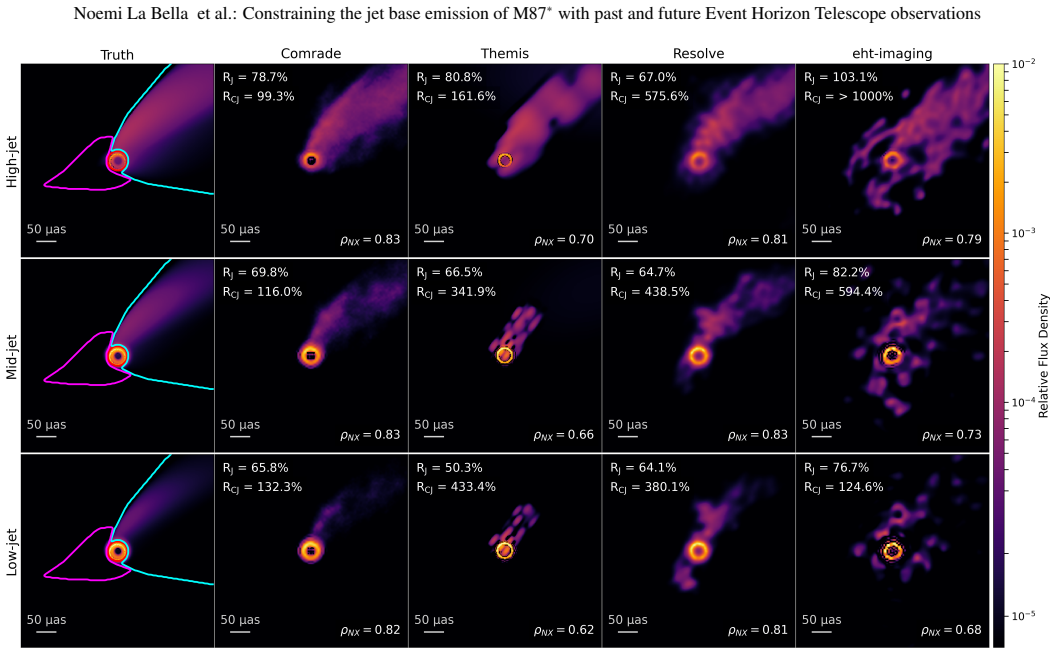
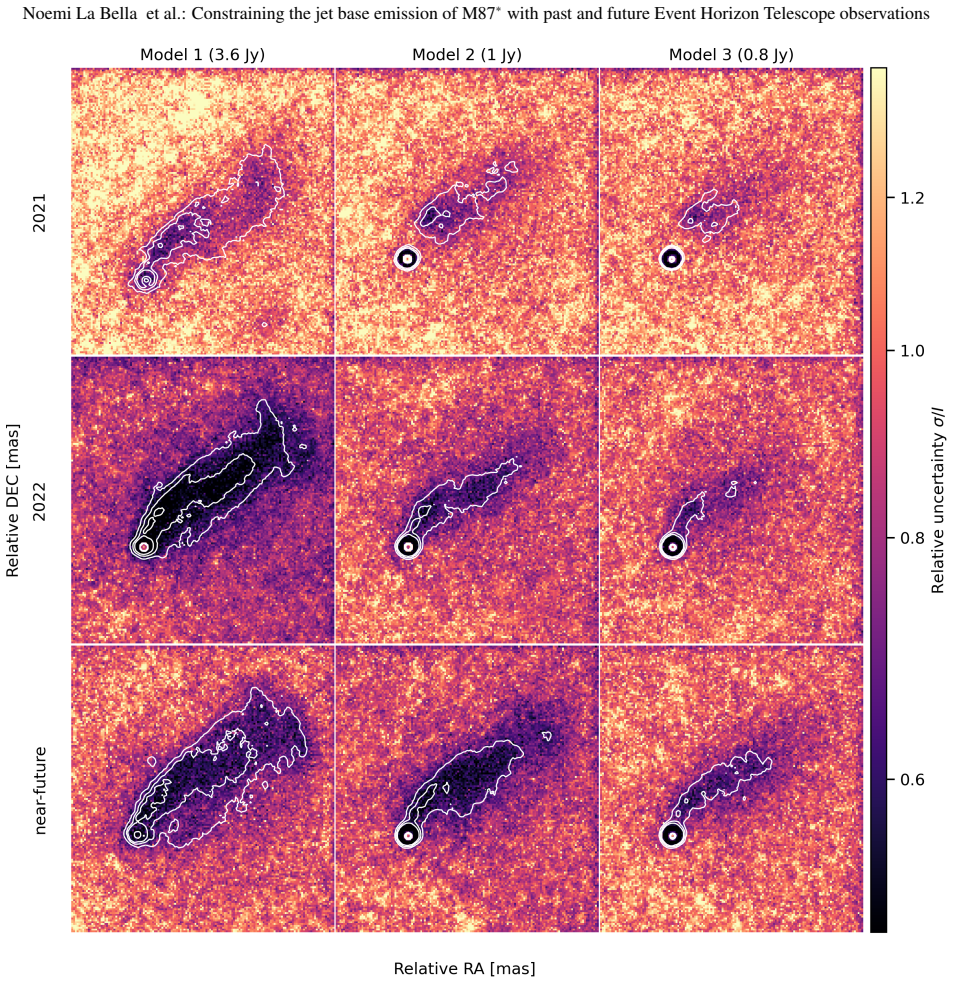
Using semi-analytic accretion jet models in which jet emission can be tuned independently of the accretion flow, synthetic EHT data for the 2021, 2022, and future array configurations are generated and reconstructed with regularized maximum likelihood and Bayesian imaging. Jet detectability is evaluated via flux density recovery, image fidelity, and uncertainty maps. The 2022 array improves reconstruction of faint jet features, and the current EHT is sensitive to weak jet emission at horizon scales in M87*. If the inner jet contributes significantly to unresolved compact flux, it should become visible in post-2021 observations; otherwise the horizon-scale jet is only a small part of the comp
What carries the argument
Semi-analytic accretion jet models allowing independent tuning of jet emission, combined with synthetic EHT data reconstruction using regularized maximum likelihood and Bayesian imaging to measure flux recovery and image fidelity across array configurations.
If this is right
- The 2022 EHT array configuration enables more robust reconstruction of faint jet features than earlier arrays.
- If the inner jet contributes a significant fraction of the unresolved compact flux, it should become visible in post-2021 observations.
- If no clear jet signature appears, the horizon-scale jet contributes only a small part of the compact emission.
- Continued expansion of the EHT will further improve detection of such jet emission in M87*.
Where Pith is reading between the lines
- A non-detection would directly constrain the fraction of compact flux originating in the jet versus the accretion flow.
- Future array improvements could separate jet and disk contributions more cleanly at event-horizon scales.
- Repeated observations might track changes in jet base brightness over time.
Load-bearing premise
The semi-analytic accretion jet models produce realistic synthetic data that match the true emission properties at EHT frequencies.
What would settle it
Absence of any recoverable jet signature in 2022 EHT data when the jet intensity in the models exceeds the derived lower limit for reliable detection.
Figures

read the original abstract
We investigate the detectability of the jet base of M87* at Event Horizon Telescope (EHT) observing frequencies. Although M87 is known to host a prominent relativistic jet, detecting jet emission close to the black hole at horizon scales remains challenging. Our goal is to determine the minimum jet intensity that can be reliably detected with the recent EHT array configurations. We use synthetic EHT data generated for three array configurations corresponding to the 2021 and 2022 observing campaigns and to a near future EHT campaign. As input models, we employ semi analytic accretion jet models in which the jet emission can be tuned independently of the accretion flow. The synthetic data are reconstructed with regularized maximum likelihood and Bayesian imaging. Jet detectability is assessed through flux density recovery, image fidelity, and uncertainty maps. We find that jet detectability strongly depends on the jet intensity, the array configuration, and imaging methodology. Using our analysis, we determine a lower limit on the jet intensity that can be reliably recovered. The 2022 EHT array configuration represents a significant improvement over earlier arrays, enabling a more robust reconstruction of faint jet features. Our results indicate that the current EHT array is already sensitive to weak jet emission at horizon scales in M87*. The improved short-baseline coverage introduced in 2022 makes faint inner jet features more easily detectable. If the inner jet contributes a significant fraction of the unresolved compact flux, it should become visible in post-2021 observations. On the other hand, if no clear jet signature is found, this would suggest that the horizon-scale jet contributes only a small part of the compact emission. The continued expansion of the EHT will further improve the detection of such jet emission in M87*.
Editorial analysis
A structured set of objections, weighed in public.
Referee Report
Summary. The manuscript investigates the detectability of faint jet-base emission at horizon scales in M87* using synthetic EHT visibilities generated from semi-analytic accretion+jet models. Jet intensity is treated as an independent tunable parameter. Synthetic data are produced for the 2021, 2022, and a near-future array configuration, then reconstructed with regularized maximum likelihood and Bayesian imaging. Detectability is quantified via flux-density recovery, image fidelity, and uncertainty maps. The central conclusion is that the 2022 array already provides sufficient sensitivity to recover weak jet emission if it contributes appreciably to the compact flux, while non-detection would imply a negligible jet contribution.
Significance. If the modeling assumptions hold, the work supplies a practical lower limit on detectable jet intensity and demonstrates that incremental improvements in short-baseline coverage (2022 array) meaningfully enhance recovery of faint inner-jet features. This directly informs interpretation of existing and upcoming EHT data on M87*, offering a route to test whether the unresolved compact flux is dominated by the accretion flow or by the jet base. The forward-modeling framework with multiple array realizations and two independent imaging pipelines is a strength.
major comments (1)
- [Model description and input models] The central claim that the 2022 array is already sensitive to weak horizon-scale jet emission rests on the assumption that independently tuned jet intensity in the semi-analytic models produces realistic morphological and spectral properties at 230 GHz. If magnetic-flux or plasma-β coupling between jet and disk introduces additional compact structure or polarization signatures not present in the decoupled models, the reported flux-recovery thresholds and uncertainty maps could shift. This assumption is load-bearing for translating the synthetic lower limit to actual M87* observations (see model description and § on input models).
minor comments (2)
- [Abstract] The abstract states that a lower limit on jet intensity is determined but does not quote the numerical value or associated uncertainty; including these quantities would improve immediate readability.
- Notation for the jet intensity scaling factor should be defined explicitly on first use and kept consistent across figures and text.
Simulated Author's Rebuttal
We thank the referee for their constructive review and for identifying a key modeling assumption. We address the major comment below and propose targeted revisions to the manuscript.
read point-by-point responses
-
Referee: The central claim that the 2022 array is already sensitive to weak horizon-scale jet emission rests on the assumption that independently tuned jet intensity in the semi-analytic models produces realistic morphological and spectral properties at 230 GHz. If magnetic-flux or plasma-β coupling between jet and disk introduces additional compact structure or polarization signatures not present in the decoupled models, the reported flux-recovery thresholds and uncertainty maps could shift. This assumption is load-bearing for translating the synthetic lower limit to actual M87* observations (see model description and § on input models).
Authors: We agree that the decoupling of jet and disk emission is a simplifying assumption whose realism must be qualified. The semi-analytic framework was deliberately chosen to permit independent variation of jet intensity, enabling a controlled exploration of the minimum detectable jet contribution—an approach not readily available in fully coupled GRMHD simulations. We will revise the model-description and discussion sections to (i) explicitly state that the reported thresholds assume no additional compact structure from magnetic or β coupling, (ii) note that such coupling could either enhance or dilute the jet signature depending on the sign of the correlation, and (iii) frame the derived lower limit as a conservative benchmark that future coupled simulations can refine. These additions will not change the quantitative results but will strengthen the caveats attached to observational interpretation. revision: partial
Circularity Check
No circularity: simulation-derived detectability threshold is independent of inputs
full rationale
The paper generates synthetic visibilities from semi-analytic models with jet intensity as an explicit free parameter, reconstructs the data with RML and Bayesian imaging, and reports the minimum intensity for which recovery metrics succeed. This threshold is an output of the forward-modeling pipeline rather than a redefinition, fitted input renamed as prediction, or self-citation chain. No equations or steps reduce the claimed sensitivity limit to the model inputs by construction. The analysis remains self-contained against external benchmarks of array performance.
Axiom & Free-Parameter Ledger
free parameters (1)
- jet intensity scaling factor
axioms (2)
- domain assumption Semi-analytic accretion jet models accurately represent horizon-scale emission when jet and accretion components are decoupled.
- domain assumption Regularized maximum likelihood and Bayesian imaging recover true source structure when the model is within the array's resolution and sensitivity.
Reference graph
Works this paper leans on
-
[1]
Properties of Trans-fast Magnetosonic Jets in Black Hole Magnetospheres. , keywords =. doi:10.3847/1538-4357/ab77ab , archivePrefix =. 2002.08185 , primaryClass =
-
[2]
Probing the innermost accretion flow geometry of Sgr A* with Event Horizon Telescope
Probing the Innermost Accretion Flow Geometry of Sgr A* with Event Horizon Telescope. , keywords =. doi:10.3847/1538-4357/aad086 , archivePrefix =. 1807.01817 , primaryClass =
work page internal anchor Pith review Pith/arXiv arXiv doi:10.3847/1538-4357/aad086
-
[3]
Publications of Lick Observatory , year = 1918, month = jan, volume =
A Study of Occulting Matter in the Spiral Nebulae. Publications of Lick Observatory , year = 1918, month = jan, volume =
1918
-
[4]
Astrophys
Relativistic fluid disks in orbit around Kerr black holes. Astrophys. J. , year = 1976, month = aug, volume =
1976
-
[5]
, year = 1977, month = may, volume =
Electromagnetic extraction of energy from Kerr black holes. , year = 1977, month = may, volume =
1977
-
[6]
and Livio, Mario , title =
Junor, William and Biretta, John A. and Livio, Mario , title =. Nature , year =
-
[7]
Viewing the Shadow of the Black Hole at the Galactic Center
Viewing the Shadow of the Black Hole at the Galactic Center. , year = 2000, month = jan, volume =. doi:10.1086/312423 , archivePrefix =. astro-ph/9912263 , primaryClass =
work page internal anchor Pith review Pith/arXiv arXiv doi:10.1086/312423 2000
-
[8]
M87 at 90cm: A Different Picture
M87 at 90 Centimeters: A Different Picture. , year = 2000, month = nov, volume =. doi:10.1086/317151 , archivePrefix =. astro-ph/0006150 , primaryClass =
work page internal anchor Pith review Pith/arXiv arXiv doi:10.1086/317151 2000
-
[9]
A High Resolution X-ray Image of the Jet in M 87
A High-Resolution X-Ray Image of the Jet in M87. , year = 2002, month = jan, volume =. doi:10.1086/324396 , archivePrefix =. astro-ph/0109160 , primaryClass =
work page internal anchor Pith review Pith/arXiv arXiv doi:10.1086/324396 2002
-
[10]
On the stability of thick accretion disks around black holes
On the Stability of Thick Accretion Disks around Black Holes. , year = 2002, month = dec, volume =. doi:10.1086/345942 , archivePrefix =. astro-ph/0211102 , primaryClass =
work page internal anchor Pith review Pith/arXiv arXiv doi:10.1086/345942 2002
-
[11]
Three-dimensional MHD Simulations of Radiatively Inefficient Accretion Flows
Three-dimensional Magnetohydrodynamic Simulations of Radiatively Inefficient Accretion Flows. , year = 2003, month = aug, volume =. doi:10.1086/375769 , archivePrefix =. astro-ph/0301402 , primaryClass =
work page internal anchor Pith review Pith/arXiv arXiv doi:10.1086/375769 2003
-
[12]
Magnetically Arrested Disk: An Energetically Efficient Accretion Flow
Magnetically Arrested Disk: an Energetically Efficient Accretion Flow. , year = 2003, month = dec, volume =. doi:10.1093/pasj/55.6.L69 , archivePrefix =. astro-ph/0305029 , primaryClass =
work page internal anchor Pith review Pith/arXiv arXiv doi:10.1093/pasj/55.6.l69 2003
-
[13]
Imaging optically-thin hotspots near the black hole horizon of Sgr A* at radio and near-infrared wavelengths. , year = 2006, month = apr, volume =. doi:10.1111/j.1365-2966.2006.10152.x , archivePrefix =. astro-ph/0509237 , primaryClass =
-
[14]
Methods for detecting flaring structures in Sagittarius A* with high frequency VLBI
Detecting Flaring Structures in Sagittarius A* with High-Frequency VLBI. , year = 2009, month = apr, volume =. doi:10.1088/0004-637X/695/1/59 , archivePrefix =. 0809.3424 , primaryClass =
work page internal anchor Pith review Pith/arXiv arXiv doi:10.1088/0004-637x/695/1/59 2009
-
[15]
, month = may, pages =
-
[16]
Evidence for Low Black Hole Spin and Physically Motivated Accretion Models from Millimeter-VLBI Observations of Sagittarius A*. , year = 2011, month = jul, volume =. doi:10.1088/0004-637X/735/2/110 , archivePrefix =. 1011.2770 , primaryClass =
work page internal anchor Pith review Pith/arXiv arXiv doi:10.1088/0004-637x/735/2/110 2011
-
[17]
The Black-Hole Mass in M87 from Gemini/NIFS Adaptive Optics Observations
The Black Hole Mass in M87 from Gemini/NIFS Adaptive Optics Observations. , year = 2011, month = mar, volume =. doi:10.1088/0004-637X/729/2/119 , archivePrefix =. 1101.1954 , primaryClass =
work page internal anchor Pith review Pith/arXiv arXiv doi:10.1088/0004-637x/729/2/119 2011
-
[18]
Nature , year =
Hada, Kazuhiro and Doi, Akihiro and Kino, Motoki and Nagai, Hiroshi and Hagiwara, Yoshiaki and Kawaguchi, Noriyuki , title =. Nature , year =
-
[19]
Optical Polarization and Spectral Variability in the M87 Jet
Optical Polarization and Spectral Variability in the M87 Jet. , year = 2011, month = dec, volume =. doi:10.1088/0004-637X/743/2/119 , archivePrefix =. 1109.6252 , primaryClass =
work page internal anchor Pith review Pith/arXiv arXiv doi:10.1088/0004-637x/743/2/119 2011
-
[20]
Hubble Space Telescope Observations of Superluminal Motion in the M87 Jet. , keywords =. doi:10.1086/307499 , adsurl =
-
[21]
2011, MNRAS, 418, L20, doi: 10.1111/j.1745-3933.2011.01134.x
Efficient generation of jets from magnetically arrested accretion on a rapidly spinning black hole. , year = 2011, month = nov, volume =. doi:10.1111/j.1745-3933.2011.01147.x , archivePrefix =. 1108.0412 , primaryClass =
-
[22]
GRMHD simulations of magnetized advection-dominated accretion on a non-spinning black hole: role of outflows. , keywords =. doi:10.1111/j.1365-2966.2012.22002.x , archivePrefix =. 1206.1213 , primaryClass =
-
[23]
M87 at metre wavelengths: the LOFAR picture
M 87 at metre wavelengths: the LOFAR picture. , year = 2012, month = nov, volume =. doi:10.1051/0004-6361/201220209 , archivePrefix =. 1210.1346 , primaryClass =
work page internal anchor Pith review Pith/arXiv arXiv doi:10.1051/0004-6361/201220209 2012
-
[24]
doi:10.1088/0004-637X/765/1/63 , year =
Doi, Akihiro and Kohno, Kotaro and Nakanishi, Kouichiro and Kameno, Seiji and Inoue, Makoto and Hada, Kazuhiro and Sorai, Kazuo , title =. doi:10.1088/0004-637X/765/1/63 , year =
-
[25]
The Greenland Telescope (GLT): Antenna status and future plans
The Greenland Telescope (GLT): antenna status and future plans. Ground-based and Airborne Telescopes V , year = 2014, editor =. doi:10.1117/12.2056836 , archivePrefix =. 1407.4902 , primaryClass =
work page internal anchor Pith review Pith/arXiv arXiv doi:10.1117/12.2056836 2014
-
[26]
The Astrophysical Journal Letters , year =
Asada, Keiichi and Nakamura, Masanori and Doi, Akihiro and Nagai, Hiroshi and Inoue, Makoto , title =. The Astrophysical Journal Letters , year =
-
[27]
The 4th Annual Conference on High Energy Astrophysics in Southern Africa (HEASA 2016) , year = 2016, month = jan, eid =
The Africa Millimetre Telescope. The 4th Annual Conference on High Energy Astrophysics in Southern Africa (HEASA 2016) , year = 2016, month = jan, eid =
2016
-
[28]
High Resolution Linear Polarimetric Imaging for the Event Horizon Telescope
High-resolution Linear Polarimetric Imaging for the Event Horizon Telescope. , year = 2016, month = sep, volume =. doi:10.3847/0004-637X/829/1/11 , archivePrefix =. 1605.06156 , primaryClass =
work page internal anchor Pith review Pith/arXiv arXiv doi:10.3847/0004-637x/829/1/11 2016
-
[29]
General relativistic magnetohydrodynamical simulations of the jet in M87
General relativistic magnetohydrodynamical simulations of the jet in M 87. , year = 2016, month = feb, volume =. doi:10.1051/0004-6361/201526630 , archivePrefix =. 1510.07243 , primaryClass =
work page internal anchor Pith review Pith/arXiv arXiv doi:10.1051/0004-6361/201526630 2016
-
[30]
Dynamical Imaging with Interferometry
Dynamical Imaging with Interferometry. , year = 2017, month = dec, volume =. doi:10.3847/1538-4357/aa97dd , archivePrefix =. 1711.01286 , primaryClass =
work page internal anchor Pith review Pith/arXiv arXiv doi:10.3847/1538-4357/aa97dd 2017
-
[31]
The black hole accretion code. Computational Astrophysics and Cosmology , year = 2017, month = may, volume =. doi:10.1186/s40668-017-0020-2 , archivePrefix =. 1611.09720 , primaryClass =
work page internal anchor Pith review Pith/arXiv arXiv doi:10.1186/s40668-017-0020-2 2017
-
[32]
Interferometric Imaging Directly with Closure Phases and Closure Amplitudes
Interferometric Imaging Directly with Closure Phases and Closure Amplitudes. , year = 2018, month = apr, volume =. doi:10.3847/1538-4357/aab6a8 , archivePrefix =. 1803.07088 , primaryClass =
work page internal anchor Pith review Pith/arXiv arXiv doi:10.3847/1538-4357/aab6a8 2018
-
[33]
Electron and Proton Acceleration in Trans-relativistic Magnetic Reconnection: Dependence on Plasma Beta and Magnetization. Astrophys. J. , year = "2018", month = jul, volume =. doi:10.3847/1538-4357/aac820 , archivePrefix =. 1803.05556 , primaryClass =
work page internal anchor Pith review Pith/arXiv arXiv doi:10.3847/1538-4357/aac820 2018
-
[34]
doi:10.5281/zenodo.1173414 , version =
Eht-Imaging: Tools For Imaging And Simulating Vlbi Data. doi:10.5281/zenodo.1173414 , version =
-
[35]
and Lu, Ru-Sen and Ros, Eduardo and Bach, Uwe and Bremer, Michael and de Vicente, Pablo and Lindqvist, Michael and Zensus, J
Kim, Jae-Young and Krichbaum, Thomas P. and Lu, Ru-Sen and Ros, Eduardo and Bach, Uwe and Bremer, Michael and de Vicente, Pablo and Lindqvist, Michael and Zensus, J. Anton , title =. Astronomy & Astrophysics , year =
-
[36]
Parabolic Jets from the Spinning Black Hole in M87
Parabolic Jets from the Spinning Black Hole in M87. , year = 2018, month = dec, volume =. doi:10.3847/1538-4357/aaeb2d , archivePrefix =. 1810.09963 , primaryClass =
work page internal anchor Pith review Pith/arXiv arXiv doi:10.3847/1538-4357/aaeb2d 2018
-
[37]
Craig and Hardee, Phillip E
Walker, R. Craig and Hardee, Phillip E. and Davies, Frederick B. and Ly, Chun and Junor, William , title =. The Astrophysical Journal , year =
-
[38]
ALMA2019: Science Results and Cross-Facility Synergies , year = 2019, month = dec, eid =
The Size, Shape, and Scattering of Sagittarius A* at 86 GHz. ALMA2019: Science Results and Cross-Facility Synergies , year = 2019, month = dec, eid =
2019
-
[39]
Bulletin of the American Astronomical Society , year = 2019, volume =
Studying Black Holes on Horizon Scales with VLBI Ground Arrays. Bulletin of the American Astronomical Society , year = 2019, volume =
2019
-
[40]
Modeling non-thermal emission from the jet-launching region of M 87 with adaptive mesh refinement. Astron. Astrophys. , year = "2019", month = dec, volume =. doi:10.1051/0004-6361/201936150 , archivePrefix =. 1906.10065 , primaryClass =
-
[41]
Science , year = 2019, month = aug, volume =
Relativistic redshift of the star S0-2 orbiting the Galactic Center supermassive black hole. Science , year = 2019, month = aug, volume =. doi:10.1126/science.aav8137 , archivePrefix =. 1907.10731 , primaryClass =
-
[42]
Mid-scale RI-1 (M1:DP): Next Generation Event Horizon Telescope Design
-
[43]
rPICARD: A CASA-based calibration pipeline for VLBI data. Calibration and imaging of 7 mm VLBA observations of the AGN jet in M 87. , year = 2019, month = jun, volume =. doi:10.1051/0004-6361/201935181 , archivePrefix =. 1902.01749 , primaryClass =
work page internal anchor Pith review Pith/arXiv arXiv doi:10.1051/0004-6361/201935181 2019
-
[44]
, year = 2020, month = jul, volume =
THEMIS: A Parameter Estimation Framework for the Event Horizon Telescope. , year = 2020, month = jul, volume =
2020
-
[45]
How to tell an accreting boson star from a black hole. Mon. Not. R. Astron. Soc. , year = 2020, month = jul, volume =. doi:10.1093/mnras/staa1878 , archivePrefix =. 1809.08682 , primaryClass =
-
[46]
and Walker, R
Ly, C. and Walker, R. C. and Junor, W. , title =. The Astrophysical Journal , year =
-
[47]
Simulating Event Horizon Telescope observations of M 87
SYMBA: An end-to-end VLBI synthetic data generation pipeline. Simulating Event Horizon Telescope observations of M 87. , year = 2020, month = apr, volume =. doi:10.1051/0004-6361/201936622 , archivePrefix =. 2004.01161 , primaryClass =
-
[48]
Nature , year = 2021, month = sep, volume =
Accurate energetic and morphological modelling of the launching site of the M87 jet. Nature , year = 2021, month = sep, volume =
2021
-
[49]
Nature Astronomy , year = 2021, month = jul, volume =
Event Horizon Telescope observations of the jet launching and collimation in Centaurus A. Nature Astronomy , year = 2021, month = jul, volume =. doi:10.1038/s41550-021-01417-w , archivePrefix =. 2111.03356 , primaryClass =
-
[50]
, year = 2021, month = sep, volume =
Comparison of the ion-to-electron temperature ratio prescription: GRMHD simulations with electron thermodynamics. , year = 2021, month = sep, volume =. doi:10.1093/mnras/stab1753 , archivePrefix =. 2106.09272 , primaryClass =
-
[51]
Nature Astronomy , year = 2021, month = nov, doi =
State-of-the-art energetic and morphological modelling of the launching site of the M87 jet. Nature Astronomy , year = 2021, month = nov, doi =
2021
-
[52]
Variable structures in M87* from space, time and frequency resolved interferometry , journal =
Arras, Philipp and Frank, Philipp and Haim, Philipp and Knollm. Variable structures in M87* from space, time and frequency resolved interferometry , journal =. 2022 , doi =
2022
-
[53]
The Photon Ring in M87*. , keywords =. doi:10.3847/1538-4357/ac7c1d , archivePrefix =. 2208.09004 , primaryClass =
-
[54]
Hybrid Very Long Baseline Interferometry Imaging and Modeling with THEMIS. , keywords =. doi:10.3847/1538-4357/ab9c1f , archivePrefix =. 2208.09003 , primaryClass =
-
[55]
Characterizing and Mitigating Intraday Variability: Reconstructing Source Structure in Accreting Black Holes with mm-VLBI. , keywords =. doi:10.3847/2041-8213/ac6584 , adsurl =
-
[56]
and Thyagarajan, Nithyanandan , title =
Carilli, Christopher L. and Thyagarajan, Nithyanandan , title =. The Astrophysical Journal , volume =
-
[57]
, year = 2022, month = apr, volume =
Impact of non-thermal particles on the spectral and structural properties of M87. , year = 2022, month = apr, volume =. doi:10.1051/0004-6361/202142295 , archivePrefix =. 2111.02518 , primaryClass =
-
[58]
, year = 2022, month = jul, volume =
The Jet and Resolved Features of the Central Supermassive Black Hole of M87 Observed with the Event Horizon Telescope (EHT). , year = 2022, month = jul, volume =. doi:10.3847/1538-4357/ac6ddb , archivePrefix =. 2205.04623 , primaryClass =
-
[59]
, year = 2022, month = may, volume =
MeqSilhouette v2: spectrally resolved polarimetric synthetic data generation for the event horizon telescope. , year = 2022, month = may, volume =. doi:10.1093/mnras/stac531 , archivePrefix =. 2202.11478 , primaryClass =
-
[60]
Collimation of the Relativistic Jet in the Quasar 3C 273 , journal =
Okino, Hiroki and Akiyama, Kazunori and Asada, Keiichi and G. Collimation of the Relativistic Jet in the Quasar 3C 273 , journal =. 2022 , volume =
2022
-
[61]
The Journal of Open Source Software , year = 2022, month = aug, volume =
Comrade: Composable Modeling of Radio Emission. The Journal of Open Source Software , year = 2022, month = aug, volume =
2022
-
[62]
Hierarchical Interferometric Bayesian Imaging. , keywords =. doi:10.3847/1538-4357/ae2749 , archivePrefix =. 2511.17706 , primaryClass =
-
[63]
, year = 2023, month = apr, volume =
Expanding Sgr A* dynamical imaging capabilities with an African extension to the Event Horizon Telescope. , year = 2023, month = apr, volume =. doi:10.1051/0004-6361/202245344 , archivePrefix =. 2301.11384 , primaryClass =
-
[64]
Modeling the inner part of the jet in M87: Confronting jet morphology with theory. Science Advances , keywords =. doi:10.1126/sciadv.adn3544 , archivePrefix =. 2403.15950 , primaryClass =
-
[65]
, year = 2023, month = apr, volume =
A ring-like accretion structure in M87 connecting its black hole and jet. , year = 2023, month = apr, volume =. doi:10.1038/s41586-023-05843-w , archivePrefix =. 2304.13252 , primaryClass =
-
[66]
Resolving Horizon-Scale Dynamics of Sagittarius A*. arXiv e-prints , keywords =. doi:10.48550/arXiv.2310.16889 , archivePrefix =. 2310.16889 , primaryClass =
-
[67]
, year = 2024, month = dec, volume =
Broadband multi-wavelength properties of M87 during the 2018 EHT campaign including a very high energy flaring episode. , year = 2024, month = dec, volume =. doi:10.1051/0004-6361/202450497 , archivePrefix =. 2404.17623 , primaryClass =
-
[68]
, year = 2025, month = mar, volume =
A multifrequency study of sub-parsec jets with the Event Horizon Telescope. , year = 2025, month = mar, volume =. doi:10.1051/0004-6361/202452600 , archivePrefix =. 2501.05518 , primaryClass =
-
[69]
Journal of Korean Astronomical Society , year = 2025, month = jan, volume =
Enhanced Imaging of M87*: Simulations with the EHT and Extended-KVN. Journal of Korean Astronomical Society , year = 2025, month = jan, volume =. doi:10.5303/JKAS.2025.58.1.17 , archivePrefix =. 2501.11822 , primaryClass =
-
[70]
Calibration improvements and a comprehensive synthetic data library
Deep learning inference with the Event Horizon Telescope: I. Calibration improvements and a comprehensive synthetic data library. , year = 2025, month = jun, volume =. doi:10.1051/0004-6361/202553784 , archivePrefix =. 2506.13873 , primaryClass =
-
[71]
The ZINGULARITY framework for Bayesian artificial neural networks
Deep learning inference with the Event Horizon Telescope: II. The ZINGULARITY framework for Bayesian artificial neural networks. , year = 2025, month = jun, volume =. doi:10.1051/0004-6361/202553785 , archivePrefix =. 2506.13875 , primaryClass =
-
[72]
ZINGULARITY results from the 2017 observations and predictions for future array expansions
Deep learning inference with the Event Horizon Telescope: III. ZINGULARITY results from the 2017 observations and predictions for future array expansions. , year = 2025, month = jun, volume =. doi:10.1051/0004-6361/202553786 , archivePrefix =. 2506.13877 , primaryClass =
-
[73]
Imaging a ring-like structure and the extended jet of M87 at 86 GHz , journal =
Kim, Jong-Seo and M. Imaging a ring-like structure and the extended jet of M87 at 86 GHz , journal =. 2025 , volume =
2025
-
[74]
and Roth, Jakob and Ensslin, Torsten A
Kim, Jong-Seo and Nikonov, Aleksei S. and Roth, Jakob and Ensslin, Torsten A. and Janssen, Michael and Arras, Philipp and Mueller, Hendrik and Lobanov, Andrei P. , title =. Astronomy & Astrophysics , volume =. 2024 , doi =. 2407.14873 , archivePrefix =
arXiv 2024
-
[75]
M 87: a cosmic laboratory for deciphering black hole accretion and jet formation. , keywords =. doi:10.1007/s00159-024-00155-y , archivePrefix =. 2412.07083 , primaryClass =
-
[76]
The 2010 very high energy gamma-ray flare & 10 years of multi-wavelength observations of M 87
The 2010 Very High Energy -Ray Flare and 10 Years of Multi-wavelength Observations of M 87. , keywords =. doi:10.1088/0004-637X/746/2/151 , archivePrefix =. 1111.5341 , primaryClass =
work page internal anchor Pith review Pith/arXiv arXiv doi:10.1088/0004-637x/746/2/151 2010
-
[77]
The kinematic of HST-1 in the jet of M87
The kinematic of HST-1 in the jet of M 87. , keywords =. doi:10.1051/0004-6361/201218794 , archivePrefix =. 1202.0013 , primaryClass =
work page internal anchor Pith review Pith/arXiv arXiv doi:10.1051/0004-6361/201218794
-
[78]
Image plane models for AGN jets at horizon scale. , keywords =. doi:10.1093/mnras/stag566 , adsurl =
-
[79]
Algaba, J. C. and others , title =. The Astrophysical Journal Letters , volume =. 2021 , doi =
2021
-
[80]
Tsunetoe, Yuh and Pesce, Dominic W. and Narayan, Ramesh and Chael, Andrew and Gelles, Zachary and Gammie, Charles F. and Quataert, Eliot and Palumbo, Daniel C. M. , title =. The Astrophysical Journal , year =. doi:10.3847/1538-4357/adc37a , eprint =
discussion (0)
Sign in with ORCID, Apple, or X to comment. Anyone can read and Pith papers without signing in.