White paper on the relevance of the European Solar Telescope (EST) for the French heliophysics
Pith reviewed 2026-06-25 23:07 UTC · model grok-4.3
The pith
The 4.2 m European Solar Telescope will supply French heliophysicists with high-resolution data on the solar photosphere and chromosphere for space weather studies.
A machine-rendered reading of the paper's core claim, the machinery that carries it, and where it could break.
Core claim
The EST will provide unprecedented observations of the solar photosphere and chromosphere and unrivaled datasets of high interest in the framework of space weather. It will advance numerous topics of solar physics as well as solar adaptive optics developments while supplying data sets relevant to French heliophysicists.
What carries the argument
The 4.2 m aperture telescope with multi-conjugate adaptive optics, light-polarisation analyser, imaging spectrograph and integral field unit spectrographs.
If this is right
- Progress on French-priority topics in solar atmosphere dynamics and adaptive optics.
- New high-resolution datasets for modeling solar events that affect Earth.
- Support for space weather forecasting efforts using photospheric and chromospheric observations.
- Strengthened French participation in European solar infrastructure projects.
Where Pith is reading between the lines
- Securing access could position French teams to lead targeted programs on specific solar features.
- The resulting data streams might be combined with existing French ground- and space-based assets for multi-instrument studies.
- Long-term operation could shift European priorities toward sustained ground-based solar monitoring.
Load-bearing premise
The EST project will move beyond its crystallisation phase to full operation and French researchers will obtain access to its data.
What would settle it
Absence of an operational European Research Infrastructure Consortium or lack of formal data-access agreements for French institutions would prevent the described scientific benefits.
Figures

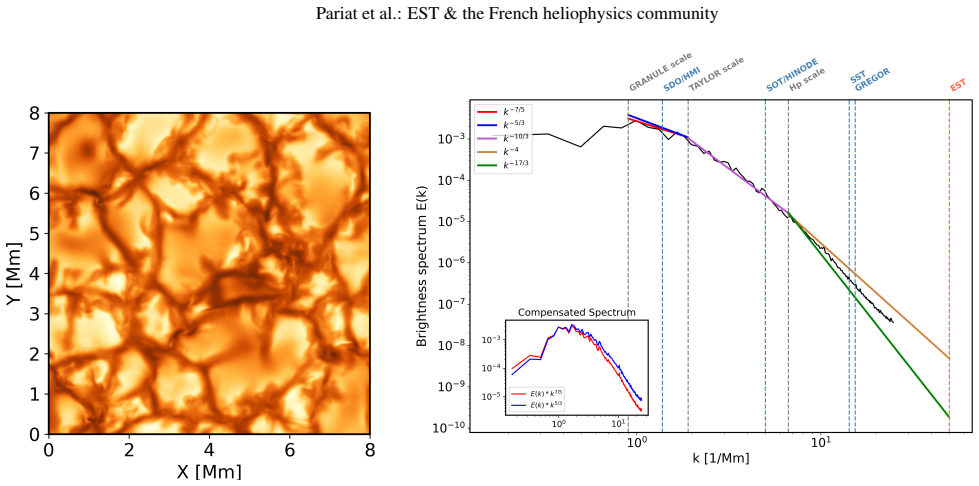


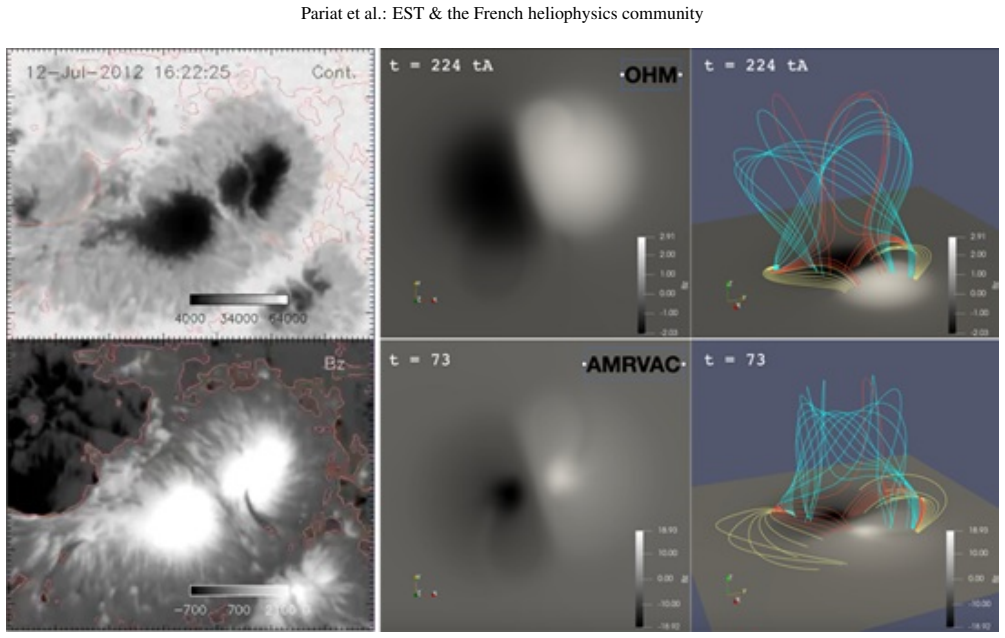


read the original abstract
The project of the European Solar Telescope aims to provide a state-of-the art infrastructure to study the Sun and its interactions with Earth and the heliosphere. This 4.2m aperture telescope will be equipped with multi conjugate adaptive optics, light-polarisation analyser, imaging spectrograph and integral field unit spectrographs. It will provide unprecedented observations of the solar photosphere and chromosphere and of the dynamical events and features that pertains to the low solar atmosphere. The EST project is presently in a phase of crystallisation, aiming at the creation of an European Research Infrastructure Consortium. While the French community has continuously been associated with the development of the EST project, some specific scientific aspects are more particularly relevant for the French astrophysics and heliophysics communities. The present review highlights the scientific research axes of high interest from the French community that shall strongly benefit from EST. The later will not only advance numerous topics of solar physics, as well as solar adaptive optics developments, but will also provide unrivaled datasets of high interest in the framework of space weather. This review also aims to highlight the space weather use that can be done with future EST observations, that will be particularly relevant for French heliophysicists.
Editorial analysis
A structured set of objections, weighed in public.
Referee Report
Summary. The manuscript is a white paper advocating for the European Solar Telescope (EST), a 4.2 m aperture facility equipped with multi-conjugate adaptive optics, light-polarisation analyser, imaging spectrograph and integral-field-unit spectrographs. It states that the project is currently in a crystallisation phase aimed at ERIC creation and argues that EST will deliver unprecedented observations of the solar photosphere and chromosphere together with unrivaled datasets of high interest for space weather. The paper highlights specific scientific research axes of particular relevance to the French heliophysics and astrophysics communities and notes ongoing French involvement in the project.
Significance. If the EST reaches full operation and French researchers obtain data access, the facility would supply high-resolution, multi-diagnostic observations that could advance studies of solar atmospheric dynamics, adaptive-optics techniques and space-weather forecasting, aligning with stated French community priorities. The document's primary value lies in community coordination and science-case articulation rather than new empirical results or derivations.
major comments (1)
- Abstract: all forward-looking claims that EST 'will provide unprecedented observations ... and unrivaled datasets' rest on the premise that the project will advance from its described crystallisation phase to construction, commissioning and data access for the French community; the manuscript supplies no risk assessment, timeline or contingency discussion for these steps, leaving the central advocacy conditional on an external premise that is not examined within the document.
minor comments (2)
- Abstract: 'The later will not only advance' should read 'The latter will not only advance' for grammatical clarity.
- Abstract: 'dynamical events and features that pertains to the low solar atmosphere' should read 'pertain' for subject-verb agreement.
Simulated Author's Rebuttal
We thank the referee for their review and for recognizing the value of the white paper in articulating science cases and community priorities. We address the single major comment below.
read point-by-point responses
-
Referee: [—] Abstract: all forward-looking claims that EST 'will provide unprecedented observations ... and unrivaled datasets' rest on the premise that the project will advance from its described crystallisation phase to construction, commissioning and data access for the French community; the manuscript supplies no risk assessment, timeline or contingency discussion for these steps, leaving the central advocacy conditional on an external premise that is not examined within the document.
Authors: We acknowledge that the manuscript's forward-looking statements are conditional on the EST advancing beyond its current crystallisation phase. However, this document is a community white paper whose purpose is to outline the scientific relevance of EST for French heliophysics and space-weather research, not to serve as a project-management or risk-analysis report. The crystallisation phase and ERIC goal are stated explicitly, and the text focuses on the observational capabilities and French-relevant science axes that would become accessible if the facility is realized. Detailed timelines, contingencies, and risk assessments belong in dedicated EST project documentation rather than in a science-case white paper, which is the standard approach taken by similar community documents. We therefore see no need to expand the manuscript in this direction. revision: no
Circularity Check
No circularity; white paper is a review without derivations or reducible predictions
full rationale
The document is a white paper advocating for the European Solar Telescope, containing no equations, mathematical derivations, parameter fits, or predictions that reduce by construction to the paper's own inputs. Claims about future observations are forward-looking statements conditional on project progress, not derived results. No self-citation load-bearing steps, uniqueness theorems, or ansatzes appear. The paper is self-contained as a statement of community interest and is scored 0 per the default expectation for non-derivational manuscripts.
Axiom & Free-Parameter Ledger
Reference graph
Works this paper leans on
-
[1]
2020, The Astrophysical Journal, 890, 22
Abbasvand, V ., Sobotka, M., Heinzel, P., et al. 2020, The Astrophysical Journal, 890, 22
2020
-
[2]
L., Rivera, Y
Alterman, B. L., Rivera, Y . J., Lepri, S. T., Raines, J. M., & D’Amicis, R. 2025, A&A, 700, A23
2025
-
[3]
& Aly, J
Amari, T. & Aly, J. J. 1989, A&A, 208, 361
1989
-
[4]
2013, A&A, 553, A43
Amari, T., Aly, J.-J., Canou, A., & Mikic, Z. 2013, A&A, 553, A43
2013
-
[5]
2014, Nature, 514, 465
Amari, T., Canou, A., & Aly, J.-J. 2014, Nature, 514, 465
2014
-
[6]
2018, Nature, 554, 211
Amari, T., Canou, A., Aly, J.-J., Delyon, F., & Alauzet, F. 2018, Nature, 554, 211
2018
-
[7]
2025, ApJ, 984, L37
Amari, T., Canou, A., Velli, M., et al. 2025, ApJ, 984, L37
2025
-
[8]
A., Nakariakov, V
Anfinogentov, S. A., Nakariakov, V . M., & Nisticò, G. 2015, A&A, 583, A136
2015
-
[9]
Antiochos, S. K. & Klimchuk, J. A. 1991, The Astrophysical Journal, 378, 372
1991
-
[10]
2022, Cool Multiphase Plasma in Hot
Antolin, P., Auchère, F., Ayres, T., et al. 2022, Cool Multiphase Plasma in Hot
2022
-
[11]
& Froment, C
Antolin, P. & Froment, C. 2022, Frontiers in Astronomy and Space Sciences, 9, 40
2022
-
[12]
Antolin, P., Vissers, G., Pereira, T. M. D., Rouppe van der V oort, L., & Scullion, E. 2015, ApJ, 806, 81
2015
-
[13]
Antolin, P., Vissers, G., Pereira, T. M. D., V oort, L. R. v. d., & Scullion, E. 2015, The Astrophysical Journal, 806, 81
2015
-
[14]
2012, Solar Physics, 280, 457
Antolin, P., Vissers, G., & Rouppe van der V oort, L. 2012, Solar Physics, 280, 457
2012
-
[15]
N., Leisner, A., Antiochos, S
Arge, C. N., Leisner, A., Antiochos, S. K., Wallace, S., & Henney, C. J. 2024, ApJ, 964, 115
2024
-
[16]
J., Fletcher, L., Schrijver, C
Aschwanden, M. J., Fletcher, L., Schrijver, C. J., & Alexander, D. 1999, ApJ, 520, 880 Auchère, F., Bocchialini, K., Solomon, J., & Tison, E. 2014,\aap, 563, A8 Auchère, F., Froment, C., Soubrié, E., et al. 2018, The Astrophysical Journal, 853, 176
1999
-
[17]
2014, Proceedings of the International Astronomical Union, 8, 184
Aulanier, G. 2014, Proceedings of the International Astronomical Union, 8, 184
2014
-
[18]
E., Antiochos, S
Aulanier, G., DeLuca, E. E., Antiochos, S. K., McMullen, R. A., & Golub, L. 2000, ApJ, 540, 1126
2000
-
[19]
& Demoulin, P
Aulanier, G. & Demoulin, P. 1998, A&A, 329, 1125
1998
-
[20]
& Démoulin, P
Aulanier, G. & Démoulin, P. 2003, A&A, 402, 769
2003
-
[21]
1999, A&A, 342, 867
Aulanier, G., Démoulin, P., Mein, N., et al. 1999, A&A, 342, 867
1999
-
[22]
J., et al
Aulanier, G., Démoulin, P., Schrijver, C. J., et al. 2013, A&A, 549, A66
2013
-
[23]
2012, Astronomy and Astrophysics, 543, A110
Aulanier, G., Janvier, M., & Schmieder, B. 2012, Astronomy and Astrophysics, 543, A110
2012
-
[24]
Aulanier, G., Pariat, E., Démoulin, P., & Devore, C. R. 2006, Sol. Phys., 238, 347
2006
-
[25]
2005, Astronomy and Astrophysics, 444, 961
Aulanier, G., Pariat, E., & Démoulin, P. 2005, Astronomy and Astrophysics, 444, 961
2005
-
[26]
& Schmieder, B
Aulanier, G. & Schmieder, B. 2002, A&A, 386, 1106
2002
-
[27]
Avrett, E. H. & Loeser, R. 2008, The Astrophysical Journal Supplement Series, 175, 229
2008
-
[28]
H., Démoulin, P., et al
Baker, D., Brooks, D. H., Démoulin, P., et al. 2013, The Astrophysical Journal, 778, 69
2013
-
[29]
L., et al
Baker, D., Démoulin, P., Yardley, S. L., et al. 2023, ApJ, 950, 65
2023
-
[30]
M., & Frank, Z
Ballot, J., Roudier, T., Malherbe, J. M., & Frank, Z. 2021, A&A, 652, A103
2021
-
[31]
2025, A&A, 704, A231
Baratashvili, T., Davies, E., Weiler, E., et al. 2025, A&A, 704, A231
2025
-
[32]
2020, The Astrophysical Journal, 895, 18 Bellot Rubio, L
Barczynski, K., Aulanier, G., Janvier, M., Schmieder, B., & Masson, S. 2020, The Astrophysical Journal, 895, 18 Bellot Rubio, L. & Orozco Suárez, D. 2019, Living Reviews in Solar Physics, 16, 1
2020
-
[33]
F., Reep, J
Benavitz, L. F., Reep, J. W., Tarr, L. A., & To, A. S. 2025, The Astrophysical Journal, 992, 4
2025
-
[34]
1946, Die Naturwissenschaften, 33, 118
Biermann, L. 1946, Die Naturwissenschaften, 33, 118
1946
-
[35]
C., Proxauf, B., Duvall, T
Birch, A. C., Proxauf, B., Duvall, T. L., et al. 2024, Physics of Fluids, 36, 117136
2024
-
[36]
S., Dudok de Wit, T., & Velli, M
Bizien, N., Froment, C., Madjarska, M. S., Dudok de Wit, T., & Velli, M. 2025, A&A, 694, A181
2025
-
[37]
2013, Physics Research International, 2013, 1
Bommier, V . 2013, Physics Research International, 2013, 1
2013
-
[38]
L., Landolfi, M., & Molodij, G
Bommier, V ., Degl’Innocenti, E. L., Landolfi, M., & Molodij, G. 2007, Astron- omy & Astrophysics, 464, 323
2007
-
[39]
Braileanu, B. P. & Keppens, R. 2025, Astronomy & Astrophysics, 698, A189, publisher: EDP Sciences
2025
-
[40]
2025, As- tronomy & Astrophysics, 693, A74
Brchnelova, M., Gudiksen, B., Carlsson, M., Lani, A., & Poedts, S. 2025, As- tronomy & Astrophysics, 693, A74
2025
-
[41]
2023, Astronomy & Astrophysics, 678, A117
Brchnelova, M., Ku´ zma, B., Zhang, F., Lani, A., & Poedts, S. 2023, Astronomy & Astrophysics, 678, A117
2023
-
[42]
H., Ugarte-Urra, I., & Warren, H
Brooks, D. H., Ugarte-Urra, I., & Warren, H. P. 2015, Nature Communications, 6, 5947
2015
-
[43]
Brooks, D. H. & Warren, H. P. 2011, The Astrophysical Journal Letters, 727, L13
2011
-
[44]
Brun, A. S. & Browning, M. K. 2017, Living Reviews in Solar Physics, 14, 4
2017
-
[45]
2009, ApJ, 693, L27
Canou, A., Amari, T., Bommier, V ., et al. 2009, ApJ, 693, L27
2009
-
[46]
Carlsson, M., De Pontieu, B., & Hansteen, V . H. 2019, Annual Review of As- tronomy and Astrophysics, 57, 189
2019
-
[47]
& Stein, R
Carlsson, M. & Stein, R. F. 1992, The Astrophysical Journal, 397, L59
1992
-
[48]
2021, ApJ, 922, 227
Chandra, R., Démoulin, P., Devi, P., Joshi, R., & Schmieder, B. 2021, ApJ, 922, 227
2021
-
[49]
& Chen, Y
Chen, Z.-C. & Chen, Y . 1989, Sol. Phys., 119, 279
1989
-
[50]
J., & Noraz, Q
Cherry, G., Gudiksen, B., Finley, A. J., & Noraz, Q. 2026, Astronomy & Astro- physics, 705, A42
2026
-
[51]
2008, in Society of Photo-Optical Instrumentation Engineers (SPIE) Conference Series, V ol
Collados, M. 2008, in Society of Photo-Optical Instrumentation Engineers (SPIE) Conference Series, V ol. 7012, Ground-based and Airborne Telescopes II, ed. L. M. Stepp & R. Gilmozzi, 70120J
2008
-
[52]
2010, Astronomische Nachrichten, 331, 615
Collados, M., Bettonvil, F., Cavaller, L., et al. 2010, Astronomische Nachrichten, 331, 615
2010
-
[53]
2013, Mem
Collados, M., Bettonvil, F., Cavaller, L., et al. 2013, Mem. Soc. Astron. Italiana, 84, 379
2013
-
[54]
2025, A&A, 702, A93
Corbard, T., Faurobert, M., Gelly, B., Douet, R., & Laforgue, D. 2025, A&A, 702, A93
2025
-
[55]
& Thompson, M
Corbard, T. & Thompson, M. J. 2002, Sol. Phys., 205, 211
2002
-
[56]
2017, Phys
Cunnyngham, I., Emilio, M., Kuhn, J., Scholl, I., & Bush, R. 2017, Phys. Rev. Lett., 118, 051102
2017
-
[57]
Dakeyo, J.-B., Maksimovic, M., Démoulin, P., Halekas, J., & Stevens, M. L. 2022, ApJ, 940, 130
2022
-
[58]
2015, The Astrophysical Journal, 810, 17 De Pontieu, B., Rouppe van der V oort, L., McIntosh, S
Dalmasse, K., Aulanier, G., Démoulin, P., et al. 2015, The Astrophysical Journal, 810, 17 De Pontieu, B., Rouppe van der V oort, L., McIntosh, S. W., et al. 2014, Science, 346, 1255732 Del Zanna, G. 2013, A&A, 558, A73 Del Zanna, G. & Mason, H. E. 2014, A&A, 565, A14
2015
-
[59]
C., Priest, E
Demoulin, P., Henoux, J. C., Priest, E. R., & Mandrini, C. H. 1996, A&A, 308, 643
1996
-
[60]
2021, A&A, 647, A85 Dudík, J., Aulanier, G., Lörinˇcík, J., & Zemanová, A
Devi, P., Démoulin, P., Chandra, R., et al. 2021, A&A, 647, A85 Dudík, J., Aulanier, G., Lörinˇcík, J., & Zemanová, A. 2025, Sol. Phys., 300, 139 Dudík, J., Janvier, M., Aulanier, G., et al. 2014, ApJ, 784, 144 Dudík, J., Lörinˇcík, J., Aulanier, G., Zemanová, A., & Schmieder, B. 2019, ApJ, 887, 71
2021
-
[61]
V ., & De Moortel, I
Enerhaug, E., Carlsson, M., Szydlarski, M., Gudiksen, B. V ., & De Moortel, I. 2025, Astronomy & Astrophysics, 701, A137
2025
-
[62]
2013, The Astrophysical Journal Letters, 771, L29
Fang, X., Xia, C., & Keppens, R. 2013, The Astrophysical Journal Letters, 771, L29
2013
-
[63]
2016, A&A, 595, A71
Faurobert, M., Balasubramanian, R., & Ricort, G. 2016, A&A, 595, A71
2016
-
[64]
2023, A&A, 676, L4
Faurobert, M., Corbard, T., Gelly, B., Douet, R., & Laforgue, D. 2023, A&A, 676, L4
2023
-
[65]
& Ricort, G
Faurobert, M. & Ricort, G. 2015, A&A, 582, A95
2015
-
[66]
& Ricort, G
Faurobert, M. & Ricort, G. 2021, A&A, 651, A21
2021
-
[67]
& Widing, K
Feldman, U. & Widing, K. G. 2003, Space Science Reviews, 107, 665
2003
-
[68]
Finley, A. J. 2024, A&A, 692, A29
2024
-
[69]
J., Brun, A
Finley, A. J., Brun, A. S., Strugarek, A., & Perri, B. 2025, A&A, 697, A217
2025
-
[70]
1978, The Astrophysical Journal, 223, 1046, publisher: IOP ADS Bib- code: 1978ApJ...223.1046F
Foukal, P. 1978, The Astrophysical Journal, 223, 1046, publisher: IOP ADS Bib- code: 1978ApJ...223.1046F
1978
-
[71]
Froment, C., Antolin, P., Henriques, V . M. J., Kohutova, P., & Rouppe van der V oort, L. H. M. 2020, A&A, 633, A11
2020
-
[72]
Froment, C., Antolin, P., Henriques, V . M. J., Kohutova, P., & V oort, L. H. M. R. v. d. 2020, Astronomy & Astrophysics, 633, A11
2020
-
[73]
2017, The Astrophysical Journal, 835, 272
Froment, C., Auchère, F., Aulanier, G., et al. 2017, The Astrophysical Journal, 835, 272
2017
-
[74]
2015, The Astrophysical Journal, 807, 158
Froment, C., Auchère, F., Bocchialini, K., et al. 2015, The Astrophysical Journal, 807, 158
2015
-
[75]
Furuseth, S. V . & Aulanier, G. 2025, arXiv e-prints, arXiv:2512.20716
arXiv 2025
-
[76]
M., Steiner, H
Gandorfer, A. M., Steiner, H. P. P. P., Aebersold, F., et al. 2004, A&A, 422, 703
2004
-
[77]
1995, Space Science Reviews, 72, 49
Geiss, J., Gloeckler, G., & von Steiger, R. 1995, Space Science Reviews, 72, 49
1995
-
[78]
2016, in Society of Photo-Optical In- strumentation Engineers (SPIE) Conference Series, V ol
Gelly, B., Langlois, M., Moretto, G., et al. 2016, in Society of Photo-Optical In- strumentation Engineers (SPIE) Conference Series, V ol. 9906, Ground-based and Airborne Telescopes VI, ed. H. J. Hall, R. Gilmozzi, & H. K. Marshall, 99065A
2016
-
[79]
K., Bloomfield, D
Georgoulis, M. K., Bloomfield, D. S., Piana, M., et al. 2021, Journal of Space Weather and Space Climate, 11, 39
2021
-
[80]
Goode, P. R. & Cao, W. 2012, in Society of Photo-Optical Instrumentation Engi- neers (SPIE) Conference Series, V ol. 8444, Ground-based and Airborne Tele- scopes IV , ed. L. M. Stepp, R. Gilmozzi, & H. J. Hall, 844403
2012
discussion (0)
Sign in with ORCID, Apple, or X to comment. Anyone can read and Pith papers without signing in.