Injecting Image Guidance into Text-Conditioned Diffusion Models at Inference
Pith reviewed 2026-06-30 12:08 UTC · model grok-4.3
The pith
Visual Concept Fusion enables dual image and text conditioning in diffusion models at inference time without any training.
A machine-rendered reading of the paper's core claim, the machinery that carries it, and where it could break.
Core claim
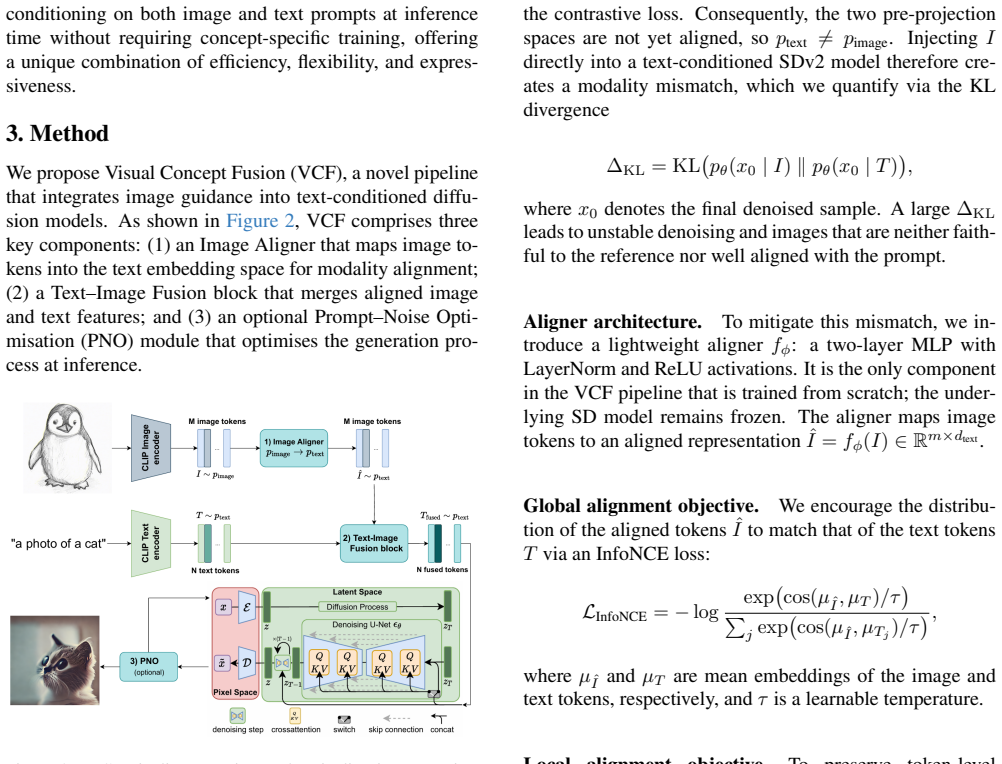
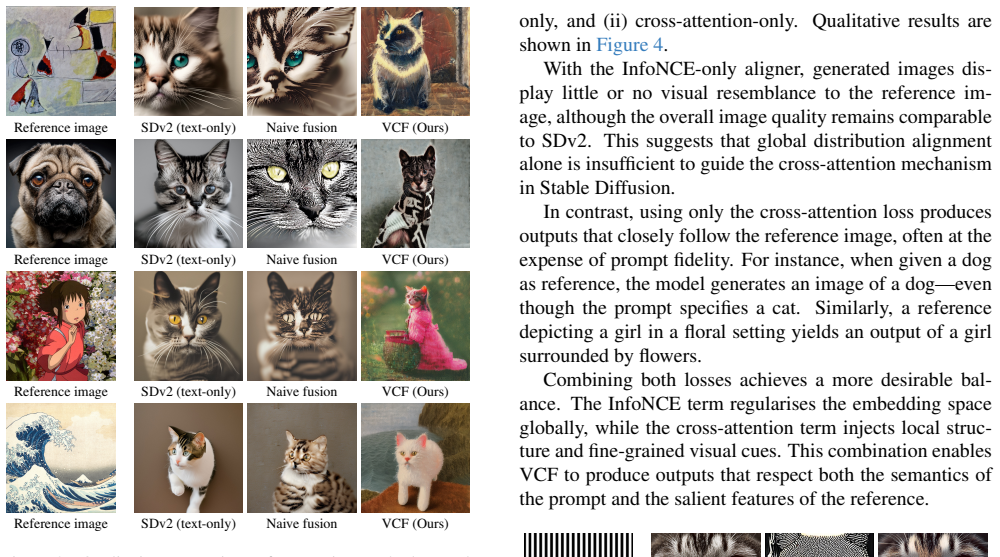
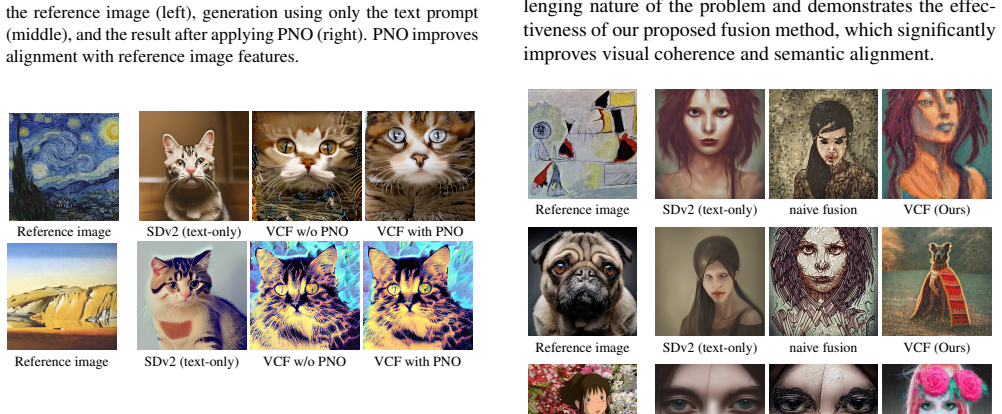
VCF is the first method offering dual conditioning on both an image and text prompt at inference time without any concept-specific training. It consists of a lightweight aligner that maps image tokens to the text embedding manifold, a fusion strategy that preserves textual and visual semantics, and an optional PNO module for test-time refinement. Experiments show successful transfer of visual attributes while maintaining prompt adherence, with a trade-off between CLIP score for text alignment and LPIPS for visual correspondence, and outperformance over baselines in reference fidelity.
What carries the argument
The lightweight aligner that maps image tokens to the text embedding manifold using InfoNCE and cross-attention reconstruction losses, which carries the argument by enabling visual concept injection into Stable Diffusion at inference.
If this is right
- VCF transfers visual attributes including style, composition, and color palette from reference images while maintaining prompt adherence.
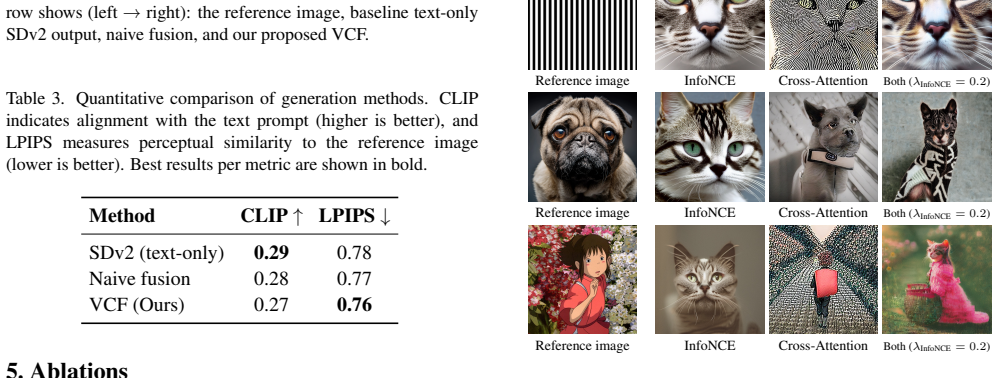
- Quantitative results demonstrate a trade-off between text alignment via CLIP score and visual correspondence via LPIPS.
- VCF outperforms baselines in reference fidelity without requiring retraining.
Where Pith is reading between the lines
- If the aligner preserves alignment across diverse references, VCF could apply to other text-to-image models beyond Stable Diffusion.
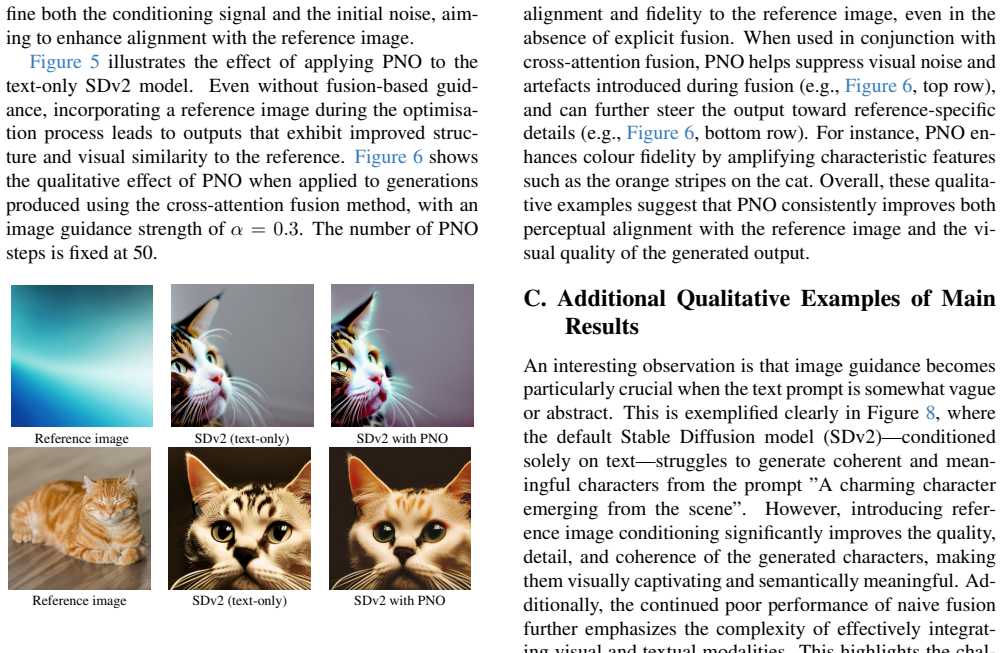
- The optional PNO module suggests test-time optimization could be combined with other conditioning techniques for further refinement.
Load-bearing premise
The assumption that a lightweight aligner trained on InfoNCE and cross-attention reconstruction losses can map arbitrary reference image tokens onto the text embedding manifold while preserving semantic alignment with the textual prompt.
What would settle it
A test where generated images using VCF show neither improved LPIPS correspondence to the reference image nor maintained CLIP alignment to the text prompt compared to baselines would falsify the dual conditioning claim.
Figures



read the original abstract
Text-to-image diffusion models like Stable Diffusion generate high-quality images from text, but lack a way to inject visual guidance (e.g. sketches, styles) at inference without retraining. Existing methods either require computationally expensive fine-tuning or rely on style transfer techniques that risk semantic misalignment with textual prompts. We introduce Visual Concept Fusion (VCF), the first method offering dual conditioning on both an image and text prompt at inference time without any concept-specific training. VCF enables visual concept injection into Stable Diffusion by aligning CLIP image features with the text embedding space. VCF consists of three components: (1) a lightweight aligner that maps image tokens to the text embedding manifold using InfoNCE and cross-attention reconstruction losses, (2) a fusion strategy that preserves both textual and visual semantics, and (3) an optional Prompt-Noise Optimization (PNO) module for test-time refinement. Our experiments demonstrate that VCF successfully transfers visual attributes including style, composition, and color palette from reference images while maintaining prompt adherence. Quantitative results show a trade-off between text alignment (CLIP score) and visual correspondence (LPIPS), with VCF outperforming baselines in reference fidelity.
Editorial analysis
A structured set of objections, weighed in public.
Referee Report
Summary. The paper introduces Visual Concept Fusion (VCF), claimed as the first method for dual text-and-image conditioning of diffusion models (e.g., Stable Diffusion) at inference time without concept-specific training or fine-tuning. VCF comprises (1) a lightweight aligner that maps CLIP image tokens into the text embedding manifold via InfoNCE and cross-attention reconstruction losses, (2) a fusion strategy intended to preserve both textual and visual semantics, and (3) an optional Prompt-Noise Optimization (PNO) module. Experiments are said to demonstrate successful transfer of visual attributes (style, composition, color) while maintaining prompt adherence, with a reported trade-off between CLIP text-alignment scores and LPIPS visual correspondence, and outperformance over baselines in reference fidelity.
Significance. If the central claims hold with rigorous validation, VCF would offer a practical advance in controllable generation by removing the need for per-concept training or expensive fine-tuning. The reliance on standard contrastive and reconstruction losses is a methodological strength in terms of simplicity and reproducibility. However, the current high-level experimental statements limit the assessed significance.
major comments (2)
- [Abstract] Abstract: the quantitative claims of outperformance in reference fidelity and the reported CLIP/LPIPS trade-off rest on high-level statements only, with no error bars, exact baseline implementations, dataset details, or ablation results provided. This makes it impossible to evaluate whether the central performance assertions are load-bearing or reproducible.
- [Method description] Method (aligner component): the claim that the lightweight aligner maps arbitrary reference-image tokens onto the text embedding manifold while preserving semantic alignment with the textual prompt is supported only by the choice of InfoNCE and cross-attention reconstruction losses. No analysis, injectivity argument, or out-of-distribution robustness test is supplied to show that the learned mapping avoids semantic drift or collapse for reference images distant from the aligner’s training distribution.
minor comments (2)
- [Abstract] The abstract states that VCF is 'the first method' offering dual conditioning without concept-specific training; a more explicit comparison table against prior image-guidance techniques would strengthen this positioning.
- Notation for the three VCF components and the fusion step should be introduced with explicit equations or pseudocode rather than prose descriptions alone.
Simulated Author's Rebuttal
We thank the referee for the constructive feedback. We address each major comment below and commit to revisions that strengthen the presentation of quantitative results and the justification of the aligner component.
read point-by-point responses
-
Referee: [Abstract] Abstract: the quantitative claims of outperformance in reference fidelity and the reported CLIP/LPIPS trade-off rest on high-level statements only, with no error bars, exact baseline implementations, dataset details, or ablation results provided. This makes it impossible to evaluate whether the central performance assertions are load-bearing or reproducible.
Authors: We agree that the abstract presents the quantitative findings at a high level. In the revised manuscript we will update the abstract to reference the specific experimental results, including error bars, exact baseline implementations, dataset details, and key ablation outcomes that appear in the experiments section, thereby making the performance claims more directly verifiable. revision: yes
-
Referee: [Method description] Method (aligner component): the claim that the lightweight aligner maps arbitrary reference-image tokens onto the text embedding manifold while preserving semantic alignment with the textual prompt is supported only by the choice of InfoNCE and cross-attention reconstruction losses. No analysis, injectivity argument, or out-of-distribution robustness test is supplied to show that the learned mapping avoids semantic drift or collapse for reference images distant from the aligner’s training distribution.
Authors: The aligner is trained with InfoNCE and cross-attention reconstruction losses chosen to encourage both contrastive alignment and faithful reconstruction of attention patterns. While the current manuscript does not include a formal injectivity argument or dedicated OOD robustness tests, the empirical results across diverse reference images support semantic preservation. We will add a discussion of the mapping properties, including observed behavior on out-of-distribution inputs and acknowledged limitations, to the method section. revision: yes
Circularity Check
No significant circularity; method uses standard losses and architecture
full rationale
The paper presents VCF as a method with a lightweight aligner trained via InfoNCE and cross-attention reconstruction losses, a fusion strategy, and optional PNO. No equations or steps reduce a claimed prediction or result to its own fitted inputs by construction. No self-citations are invoked as load-bearing uniqueness theorems. The derivation chain consists of standard training objectives and inference-time components whose outputs are evaluated against external metrics (CLIP score, LPIPS), making the central claim self-contained rather than tautological.
Axiom & Free-Parameter Ledger
free parameters (1)
- Aligner network weights
axioms (1)
- domain assumption CLIP image features lie on a manifold that can be mapped to the text embedding space while preserving semantics
Reference graph
Works this paper leans on
-
[1]
Microsoft COCO Captions: Data Collection and Evaluation Server
Xinlei Chen, Hao Fang, Tsung-Yi Lin, Ramakrishna Vedan- tam, Saurabh Gupta, Piotr Doll ´ar, and C Lawrence Zitnick. Microsoft coco captions: Data collection and evaluation server.arXiv preprint arXiv:1504.00325, 2015. 5
work page internal anchor Pith review Pith/arXiv arXiv 2015
-
[2]
Bermano, Gal Chechik, and Daniel Cohen-Or
Rinon Gal, Yuval Alaluf, Yuval Atzmon, Or Patashnik, Amit H. Bermano, Gal Chechik, and Daniel Cohen-Or. An image is worth one word: Personalizing text-to-image gen- eration using textual inversion, 2022. 2
2022
-
[3]
R-lpips: An adversarially robust perceptual similarity metric.arXiv preprint arXiv:2307.15157, 2023
Sara Ghazanfari, Siddharth Garg, Prashanth Krishnamurthy, Farshad Khorrami, and Alexandre Araujo. R-lpips: An adversarially robust perceptual similarity metric.arXiv preprint arXiv:2307.15157, 2023. 6
-
[4]
Goodfellow, Jean Pouget-Abadie, Mehdi Mirza, Bing Xu, David Warde-Farley, Sherjil Ozair, Aaron Courville, and Yoshua Bengio
Ian J. Goodfellow, Jean Pouget-Abadie, Mehdi Mirza, Bing Xu, David Warde-Farley, Sherjil Ozair, Aaron Courville, and Yoshua Bengio. Generative adversarial networks, 2014. 2
2014
-
[5]
Denoising diffu- sion probabilistic models, 2020
Jonathan Ho, Ajay Jain, and Pieter Abbeel. Denoising diffu- sion probabilistic models, 2020. 2
2020
-
[6]
Arbitrary style transfer in real-time with adaptive instance normalization, 2017
Xun Huang and Serge Belongie. Arbitrary style transfer in real-time with adaptive instance normalization, 2017. 1
2017
-
[7]
A style-based generator architecture for generative adversarial networks,
Tero Karras, Samuli Laine, and Timo Aila. A style-based generator architecture for generative adversarial networks,
-
[8]
Analyzing and improving the image quality of stylegan, 2020
Tero Karras, Samuli Laine, Miika Aittala, Janne Hellsten, Jaakko Lehtinen, and Timo Aila. Analyzing and improving the image quality of stylegan, 2020. 2
2020
-
[9]
Auto-encoding varia- tional bayes, 2013
Diederik P Kingma and Max Welling. Auto-encoding varia- tional bayes, 2013. 2
2013
-
[10]
Multi-concept customization of text-to-image diffusion, 2023
Nupur Kumari, Bingliang Zhang, Richard Zhang, Eli Shechtman, and Jun-Yan Zhu. Multi-concept customization of text-to-image diffusion, 2023. 2
2023
-
[11]
Vivian Liu and Lydia B. Chilton. Design guidelines for prompt engineering text-to-image generative models, 2023. 1
2023
-
[12]
Sdedit: Guided image synthesis and editing with stochastic differential equa- tions, 2022
Chenlin Meng, Yutong He, Yang Song, Jiaming Song, Jia- jun Wu, Jun-Yan Zhu, and Stefano Ermon. Sdedit: Guided image synthesis and editing with stochastic differential equa- tions, 2022. 3, 8
2022
-
[13]
T2i- adapter: Learning adapters to dig out more controllable abil- ity for text-to-image diffusion models, 2023
Chong Mou, Xintao Wang, Liangbin Xie, Yanze Wu, Jian Zhang, Zhongang Qi, Ying Shan, and Xiaohu Qie. T2i- adapter: Learning adapters to dig out more controllable abil- ity for text-to-image diffusion models, 2023. 1, 2, 3
2023
-
[14]
A taxonomy of prompt modifiers for text-to-image generation.Behaviour & Information Tech- nology, 43(15):3763–3776, 2023
Jonas Oppenlaender. A taxonomy of prompt modifiers for text-to-image generation.Behaviour & Information Tech- nology, 43(15):3763–3776, 2023. 3
2023
-
[15]
Safeguarding text-to-image genera- tion via inference-time prompt-noise optimization, 2024
Jiangweizhi Peng, Zhiwei Tang, Gaowen Liu, Charles Flem- ing, and Mingyi Hong. Safeguarding text-to-image genera- tion via inference-time prompt-noise optimization, 2024. 5, 9
2024
-
[16]
Flickr30k entities: Collecting region-to-phrase corre- spondences for richer image-to-sentence models
Bryan A Plummer, Liwei Wang, Chris M Cervantes, Juan C Caicedo, Julia Hockenmaier, and Svetlana Lazeb- nik. Flickr30k entities: Collecting region-to-phrase corre- spondences for richer image-to-sentence models. InPro- ceedings of the IEEE international conference on computer vision, pages 2641–2649, 2015. 8
2015
-
[17]
Learning transferable visual models from natural language supervision, 2021
Alec Radford, Jong Wook Kim, Chris Hallacy, Aditya Ramesh, Gabriel Goh, Sandhini Agarwal, Girish Sastry, 8 Amanda Askell, Pamela Mishkin, Jack Clark, Gretchen Krueger, and Ilya Sutskever. Learning transferable visual models from natural language supervision, 2021. 2
2021
-
[18]
Sam 2: Segment anything in images and videos,
Nikhila Ravi, Valentin Gabeur, Yuan-Ting Hu, Ronghang Hu, Chaitanya Ryali, Tengyu Ma, Haitham Khedr, Roman R¨adle, Chloe Rolland, Laura Gustafson, Eric Mintun, Junt- ing Pan, Kalyan Vasudev Alwala, Nicolas Carion, Chao- Yuan Wu, Ross Girshick, Piotr Doll´ar, and Christoph Feicht- enhofer. Sam 2: Segment anything in images and videos,
-
[19]
High-resolution image syn- thesis with latent diffusion models, 2021
Robin Rombach, Andreas Blattmann, Dominik Lorenz, Patrick Esser, and Bj¨orn Ommer. High-resolution image syn- thesis with latent diffusion models, 2021. 1, 2
2021
-
[20]
Dreambooth: Fine tuning text-to-image diffusion models for subject-driven generation, 2023
Nataniel Ruiz, Yuanzhen Li, Varun Jampani, Yael Pritch, Michael Rubinstein, and Kfir Aberman. Dreambooth: Fine tuning text-to-image diffusion models for subject-driven generation, 2023. 1, 2
2023
-
[21]
Sara Mahdavi, Rapha Gontijo Lopes, Tim Salimans, Jonathan Ho, David J Fleet, and Mohammad Norouzi
Chitwan Saharia, William Chan, Saurabh Saxena, Lala Li, Jay Whang, Emily Denton, Seyed Kamyar Seyed Ghasemipour, Burcu Karagol Ayan, S. Sara Mahdavi, Rapha Gontijo Lopes, Tim Salimans, Jonathan Ho, David J Fleet, and Mohammad Norouzi. Photorealistic text-to-image diffusion models with deep language understanding, 2022. 3
2022
-
[22]
Ludovica Schaerf, Andrea Alfarano, Fabrizio Silvestri, and Leonardo Impett. Training-free style and content transfer by leveraging u-net skip connections in stable diffusion 2.arXiv preprint arXiv:2501.14524, 2025. 3, 8
-
[23]
Very deep convo- lutional networks for large-scale image recognition, 2015
Karen Simonyan and Andrew Zisserman. Very deep convo- lutional networks for large-scale image recognition, 2015. 6
2015
-
[24]
Styledrop: Text-to-image generation in any style, 2023
Kihyuk Sohn, Nataniel Ruiz, Kimin Lee, Daniel Castro Chin, Irina Blok, Huiwen Chang, Jarred Barber, Lu Jiang, Glenn Entis, Yuanzhen Li, Yuan Hao, Irfan Essa, Michael Rubinstein, and Dilip Krishnan. Styledrop: Text-to-image generation in any style, 2023. 2
2023
-
[25]
Denois- ing diffusion implicit models, 2022
Jiaming Song, Chenlin Meng, and Stefano Ermon. Denois- ing diffusion implicit models, 2022. 3
2022
-
[26]
Add-it: Training-free object inser- tion in images with pretrained diffusion models, 2024
Yoad Tewel, Rinon Gal, Dvir Samuel, Yuval Atzmon, Lior Wolf, and Gal Chechik. Add-it: Training-free object inser- tion in images with pretrained diffusion models, 2024. 3
2024
-
[27]
Plug-and-play diffusion features for text-driven image-to-image translation, 2022
Narek Tumanyan, Michal Geyer, Shai Bagon, and Tali Dekel. Plug-and-play diffusion features for text-driven image-to-image translation, 2022. 3
2022
-
[28]
IP-Adapter: Text Compatible Image Prompt Adapter for Text-to-Image Diffusion Models
Hu Ye, Jun Zhang, Sibo Liu, Xiao Han, and Wei Yang. Ip- adapter: Text compatible image prompt adapter for text-to- image diffusion models.arXiv preprint arXiv:2308.06721,
work page internal anchor Pith review Pith/arXiv arXiv
-
[29]
Adding conditional control to text-to-image diffusion models.2023 IEEE/CVF International Conference on Computer Vision (ICCV), pages 3813–3824, 2023
Lvmin Zhang, Anyi Rao, and Maneesh Agrawala. Adding conditional control to text-to-image diffusion models.2023 IEEE/CVF International Conference on Computer Vision (ICCV), pages 3813–3824, 2023. 1, 3 APPENDIX A. Prompt-Noise Optimisation (PNO) Details As introduced in subsection 3.3, Prompt–Noise Optimisa- tion (PNO) is an optional, test-time procedure th...
2023
discussion (0)
Sign in with ORCID, Apple, or X to comment. Anyone can read and Pith papers without signing in.