REVIEW 5 major objections 5 minor 14 references
EpiCoDe: Boosting Model Performance Beyond Training with Extrapolation and Contrastive Decoding
T0 review · 5 major / 5 minor · reviewed 2026-08-07 · deepseek-v4-flash
Pith's one-line read EpiCoDe claims that chaining model extrapolation with contrastive decoding, using the vanilla finetuned model as the weak model, yields consistent training-free accuracy gains in data-scarcity finetuning.
desk verdict EpiCoDe is a plausible training-free boost on small finetuned LLMs, but its claimed synergy may just be a finer hyperparameter grid in disguise. read the letter →
The pith
A machine-rendered reading of the paper's core claim, the machinery that carries it, and where it could break.
The reading
What carries the argument
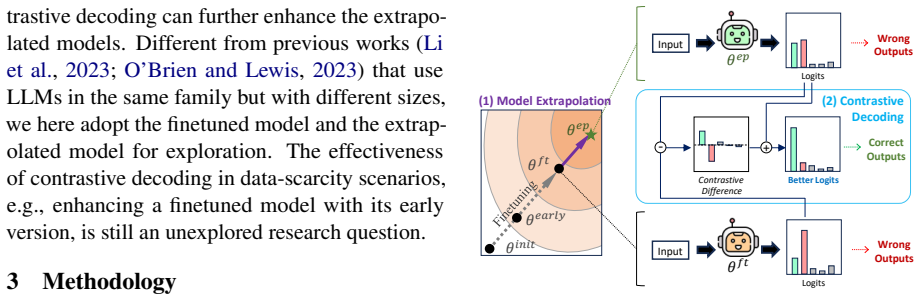
The central object is the contrastive difference $c(x_{<i}) = L_{\text{ep}}(x_{<i}) - L_{\text{ft}}(x_{<i})$ applied on top of the extrapolation identity $\theta_{\text{ep}} = \theta_{\text{ft}} + \mu(\theta_{\text{ft}} - \theta_{\text{early}})$. Locality, defined as parameter-space proximity between $\theta_{\text{ep}}$ and $\theta_{\text{ft}}$, is the mechanism that ensures the two models share error patterns; the variance lower bound $(1 - \lambda(k-1))\epsilon$ is the theoretical tool that turns locality into a model-selection rule for the weak model.
What would settle it
On a held-out task, estimate the per-token logit-error vectors $\delta(\theta_{\text{ep}})$ and $\delta(\theta_{\text{ft}})$ relative to a reference model, compute their correlation, and test EpiCoDe against vanilla finetuning in runs where the correlation is near zero or negative; if the accuracy gain persists, the variance-reduction mechanism is not what drives the improvement. Alternatively, train with a much larger learning rate or more epochs so the early and final checkpoints are far apart in parameter space, and check whether EpiCoDe's contrastive decoding then falls below vanilla finetuning.
Extended reading notes
Core claim
On its own terms, the paper establishes that $\theta_{\text{ep}} = \theta_{\text{ft}} + \mu(\theta_{\text{ft}} - \theta_{\text{early}})$ followed by $L_{\text{CD}} = L_{\text{ep}} + \lambda(L_{\text{ep}} - L_{\text{ft}})$ consistently outperforms vanilla finetuning, model extrapolation alone, and contrastive decoding alone in data-scarce finetuning. The enabling fact is locality: because $\theta_{\text{ep}}$ and $\theta_{\text{ft}}$ are close in parameter space, their logit errors are positively correlated, so subtracting the weak model's logits reduces error variance instead of adding it. The theoretical framework treats logit errors as zero-mean normal with the weak model's variance $k^2$ times the strong model's, and shows the variance of contrastive-decoded logits approaches $(1 - \lambda(k-1))\epsilon$ under perfect positive correlation while growing under independence. This is why the paper selects $\theta_{\text{ft}}$, not $\theta_{\text{early}}$ or $\theta_{\text{init}}$, as the weak model.
Load-bearing premise
The load-bearing premise is that the extrapolated model and the vanilla finetuned model make errors in the same places, so subtracting their logits cancels shared mistakes rather than suppressing correct tokens; the paper infers this locality from parameter-space closeness without measuring logit-error correlation.
Editorial extensions
If this is right
- In any data-scarcity finetuning run that saves an early checkpoint, EpiCoDe provides a training-free accuracy boost over the finetuned model.
- The recipe turns one finetuning run's checkpoints into an inference-time decoding change, requiring no new data, optimization, or model editing beyond a parameter-space extrapolation.
- The locality principle predicts that choosing a far checkpoint such as $\theta_{\text{early}}$ or $\theta_{\text{init}}$ as the weak model should neutralize or reverse the gains, which the experiments confirm.
- The variance-reduction argument gives a general weak-model selection rule for contrastive decoding: prefer the checkpoint closest to the strong model over the one with the largest capability gap.
Reading between the lines
- The locality premise is inferred from parameter-space distance rather than measured logit-error correlation; a direct test would correlate $\delta(\theta_{\text{ep}})$ and $\delta(\theta_{\text{ft}})$ per task and check whether EpiCoDe's gains track that correlation.
- The two-stage recipe should transfer to any finetuning pipeline that leaves intermediate checkpoints, such as instruction tuning or domain adaptation, and could be applied to larger models where data scarcity is more acute.
- A dynamic variant that selects the checkpoint whose logit errors correlate most strongly with $\theta_{\text{ep}}$ on a held-out set might reduce the residual failures that the fixed $\theta_{\text{ft}}$ choice still shows.
- The concentration of gains on hard, long-output subsets suggests the method works by improving multi-step reasoning tokens; measuring improvement per token position would reveal whether the mechanism is exactly variance reduction on those tokens.
Editorial analysis
A structured set of objections, weighed in public.
Referee Report
Summary. The paper introduces EpiCoDe, a training-free inference method that applies model extrapolation to a finetuned LLM checkpoint (θep = θft + µ(θft − θearly)) and then uses contrastive decoding between θep and θft (LCD = Lep + λ(Lep − Lft)). It reports experiments on three Chinese reasoning tasks (law, math, logic) with four LLMs, repeating each finetuning with 10 seeds, and claims consistent, significant improvements over either technique alone. The paper also proposes a logit-error variance framework to explain contrastive decoding and argues for choosing the finetuned model (rather than earlier checkpoints or the initial model) as the weak model due to 'locality'.
Significance. If the empirical claim holds, EpiCoDe is a simple and attractive recipe for low-resource finetuning, and the paper covers a useful range of model families and scales. The 10-seed paired design and the weak-model-selection study are assets. However, the theoretical section is conditional on an unverified positive-correlation premise, the statistical reporting is incomplete, and the claimed synergy over model extrapolation is not distinguished from a finer hyperparameter search. These issues are fixable without changing the method, so the contribution is worth pursuing, but the current manuscript overstates what is demonstrated.
major comments (5)
- [§6, Table 3] The significance test is misstated. The null hypothesis is written as 'EpiCoDe performs better than each of the two baseline methods,' which is an alternative hypothesis; with that wording the reported α values cannot be 'the probability of mistakenly rejecting the null hypothesis.' Moreover, Table 2 reports only 10-seed averages, with no per-seed differences, standard deviations, or confidence intervals, so the paired t-test cannot be checked. The claim of 'significant and robust improvement' requires a correctly stated test and transparent variance reporting.
- [§3.2, §4.2, Appendix A] Under the paper's own first-order approximation, LCD ≈ Lft + (1+λ)µ J(θft − θearly), which is exactly the logit change produced by model extrapolation with µ' = (1+λ)µ. The manuscript never compares EpiCoDe against ME with this effective µ'. Since the ME grid is coarse ({1,2,4,6,8}×{10^−4,…,10^−1}) while λ is searched on a finer grid ({0.1,0.2,0.4,0.6,0.8,1.0}), the reported gains over ME could be attributable to hyperparameter granularity rather than to a genuine combination of mechanisms. Please add the missing comparison and discuss the synergy claim accordingly.
- [§4.2] The key premise that θep and θft have positively correlated logit errors is asserted from parameter-space closeness ('θep and θft naturally have locality, ensuring their similar error patterns'), but no measurement of logit-error correlation is provided. The variance decomposition in §4.1 is conditional on this correlation, so the theory does not derive the success of EpiCoDe; it only formalizes a favorable case. The Limitations section does not acknowledge this unverified assumption. Please measure the correlation on held-out data or explicitly present the theory as conditional and rely on the §7.2 weak-model-selection experiments as empirical support.
- [§5 and Appendix A] The hyperparameters µ and λ selected for each model and task are not reported; the appendix provides only the search grids and the statement that µ is optimized before λ. Without the chosen values, the main results in Table 2 are not reproducible. In addition, Table 2 reports only averages across the 10 seeds, with no standard deviation, making the robustness claim in Table 4 hard to assess quantitatively.
- [§4.2, variance bound] The variance bound is misstated. For perfect positive correlation the standard deviation of the contrastive-decoding logit error is |1 − λ(k−1)|ε, and it decreases only for λ(k−1) < 1; for larger λ(k−1) the variance starts to increase. The paper's claim that a larger k 'helps to degrade the lower bound' is therefore not monotone and needs qualification.
minor comments (5)
- [§4.2] The formula '∆L = µ(θep − θft)·∇L(θft)' appears to contain a typo: since θep − θft = µ(θft − θearly), the first-order change should be µ(θft − θearly)·∇L(θft).
- [Figure 2] The caption says the comparison is 'to the performance of vanilla finetuned model θinit'; the vanilla finetuned model should be θft, not θinit.
- [Table 2] The abbreviation for model extrapolation is inconsistent: Table 2 uses EP, while the text and Table 3 use ME; please standardize.
- [§7.1] There is a typo 'EpiCoDE' in the first sentence; also in Appendix A the reference to 'Figure 7' for the λ ablation should be 'Table 7'.
- [Table 3] The column heading 'Significance Level α' is misleading; these values are p-values from one-sided paired tests and should be labeled as such.
Circularity Check
EpiCoDe's theoretical and synergy claims reduce by the paper's own equations: the locality premise is definitional (θep = θft + µ(θft − θearly)), the variance-reduction mechanism is asserted and negligible at k≈1, and under the paper's first-order linearization L_CD equals plain ME at step (1+λ)µ, a step the ME baseline's coarser grid never evaluates.
-
self definitional
[Section 3.2 (definition of θep) and Section 4.2 ('Locality in EpiCoDe')]
"We argue that θep and θft naturally have locality, ensuring their similar error patterns. ... To ensure model extrapolation can bring positive effects, we have to limit µ≪1 and estimate the improvement by ∆L= µ(θep −θft)·∇L(θft). ... Note that θep lies within the neighborhood of θft. The locality in model extrapolation ensures them with similar capabilities and patterns to make mistakes."
θep is defined in Section 3.2 as θep = θft + µ(θft − θearly), so 'locality' (neighborhood in parameter space) is true by construction, not an empirical or derived fact. The claimed mechanism — contrastive decoding lowers logit-error variance toward the bound (1−λ(k−1))ε — requires positively correlated errors δ(θep) and δ(θft); that correlation is asserted from the definitional locality, never measured or derived. Moreover, the framework's own weak-model gap k>1 is near 1 for the chosen adjacent pair θft/θep, making the claimed reduction λ(k−1)ε negligible in the regime the method actually uses, so the stated mechanism cannot explain EpiCoDe's reported gains.
-
self definitional
[Section 3.2 (L_CD = L_ep + λ(L_ep − L_ft)) with Section 4.2's linearization; Appendix A hyper-parameter grids]
"The contrastive difference can be refined as c(x<i) =Lep(x<i)−Lft(x<i) ... we represent the logit scores in contrastive decoding as LCD =Lep(x<i) +λc(x<i). ... To ensure model extrapolation can bring positive effects, we have to limit µ≪1 and estimate the improvement by ∆L= µ(θep −θft)·∇L(θft)."
By the Section 3.2 definition, L_CD = L_ep + λ(L_ep − L_ft), so exactly L_CD − L_ft = (1+λ)(L_ep − L_ft): the 'contrastive' correction is the extrapolation's own logit shift scaled by λ. Under the paper's own first-order linearity assumption (Section 4.2, which its extrapolation analysis requires), L_ep ≈ L_ft + µJ(θft − θearly), hence L_CD ≈ L_ft + (1+λ)µJ(θft − θearly), i.e., model extrapolation at step µ' = (1+λ)µ. No independent mechanism survives within the paper's own theory.
full rationale
The empirical backbone of this paper — 10-seed runs, paired significance tests, hold-out test sets, fixed external benchmarks — is genuine and not a fit: no parameter is fitted to the test set and then renamed a prediction, and no load-bearing self-citation exists (the extrapolation formula is credited to Zheng et al. 2024, external work). The circularity sits in the interpretation layer. First, the theoretical framework's operative premise (θep and θft share correlated error patterns) is definitional: θep is constructed from θft, so locality holds by construction, and the variance-reduction conclusion is the assumption restated; moreover the framework's own bound shrinks toward zero as k→1, the regime the chosen adjacent pair actually occupies, so the theory does not predict the reported gains. Second, combining the exact definition L_CD = L_ep + λ(L_ep − L_ft) with the paper's own first-order logit linearity yields L_CD ≡ ME at step (1+λ)µ, so the claimed synergy over ME reduces to a rescaling of one mechanism; the baseline's coarser µ-grid (Appendix A, Table 6) and the absence of an ME(µ'=(1+λ)µ) control make the 'consistent significant improvement' claim consistent with step-size granularity. Because a central theoretical claim and the central synergy claim reduce by construction, the circularity score is 6, not 0-2; it is not 8-10 because the empirical measurements themselves are real, externally benchmarked observations rather than outputs forced by the definition.
Assumptions & free parameters
free parameters (3)
- mu =
selected from {1,2,4,6,8} x {1e-4,1e-3,1e-2,1e-1} on dev sets per setting
- lambda =
selected from {0.1,0.2,0.4,0.6,0.8,1.0} on dev sets
- alpha =
0.1 (fixed)
assumptions (5)
- domain assumption The finetuned strong model can be modeled as a linear merge of the weak model and an ultra-strong model, so extrapolation yields a better model.
- domain assumption Models trained on the same data share error patterns.
- ad hoc to paper Logit errors delta(theta_s) ~ N(0,epsilon^2) and delta(theta_w) ~ N(0,(k*epsilon)^2) with k > 1.
- ad hoc to paper theta_ep and theta_ft are close enough in parameter space that their logit errors are positively correlated.
- ad hoc to paper The loss change under extrapolation is captured by a first-order Taylor expansion and is negative.
Cite this review
Pith. "Pith review of EpiCoDe: Boosting Model Performance Beyond Training with Extrapolation and Contrastive Decoding." pith.science (2026). https://pith.science/paper/ONGZ3HF5
@misc{pith2026250603489,
  author       = {Pith},
  title        = {Pith review of: EpiCoDe: Boosting Model Performance Beyond Training with Extrapolation and Contrastive Decoding},
  year         = {2026},
  howpublished = {\url{https://pith.science/paper/ONGZ3HF5}},
  note         = {Machine review of arXiv:2506.03489}
}
read the original abstract
The remarkable performance of Large language models (LLMs) relies heavily on the availability of abundant high-quality training data. However, the high cost of acquiring annotated data often prevents models from obtaining capabilities to tackle downstream tasks. In this paper, we introduce a novel method, EpiCoDe that boosts model performance in data-scarcity scenarios without extra training. We first employ model extrapolation to enhance a finetuned model with its inferior version, and then adopt contrastive decoding to further reduce predicted errors, by comparing the logit scores given by the extrapolated and the vanilla finetuned model. Experiments across three tasks over four different LLMs show that EpiCoDe consistently outperforms existing methods with significant and robust improvement. We also propose a new theoretical framework to reveal the mechanism behind contrastive decoding in data-scarcity scenarios, which further helps us better understand the effectiveness of EpiCoDe.
Figures

Reference graph
Works this paper leans on
-
[2]
Explain- ing and improving contrastive decoding by extrap- 9 olating the probabilities of a huge and hypotheti- cal LM. In Proceedings of the 2024 Conference on Empirical Methods in Natural Language Processing, pages 8503–8526, Miami, Florida, USA. Association for Computational Linguistics. Junying Chen, Zhenyang Cai, Ke Ji, Xidong Wang, Wanlong Liu, Rong...
work page 2024
-
[3]
Huatuogpt-o1, towards medical complex reasoning with llms. Preprint, arXiv:2412.18925. Leshem Choshen, Elad Venezian, Noam Slonim, and Yoav Katz
-
[7]
Contrastive de- coding improves reasoning in large language models. Preprint, arXiv:2309.09117. Long Ouyang, Jeffrey Wu, Xu Jiang, Diogo Almeida, Carroll Wainwright, Pamela Mishkin, Chong Zhang, Sandhini Agarwal, Katarina Slama, Alex Gray, John Schulman, Jacob Hilton, Fraser Kelton, Luke Miller, Maddie Simens, Amanda Askell, Peter Welinder, Paul Christian...
-
[8]
The llama 3 herd of models. Preprint, arXiv:2407.21783. Jason Wei, Xuezhi Wang, Dale Schuurmans, Maarten Bosma, brian ichter, Fei Xia, Ed H. Chi, Quoc V Le, and Denny Zhou
-
[9]
Qwen2 techni- cal report. Preprint, arXiv:2407.10671. Longhui Yu, Weisen Jiang, Han Shi, Jincheng YU, Zhengying Liu, Yu Zhang, James Kwok, Zhenguo Li, Adrian Weller, and Weiyang Liu
-
[10]
Disc-lawllm: Fine-tuning large lan- guage models for intelligent legal services. Preprint, arXiv:2309.11325. Chujie Zheng, Ziqi Wang, Heng Ji, Minlie Huang, and Nanyun Peng
-
[11]
In ICML 2024 Workshop on Models of Human Feedback for AI Alignment
Weak-to-strong extrapolation expedites alignment. In ICML 2024 Workshop on Models of Human Feedback for AI Alignment. Haoxi Zhong, Chaojun Xiao, Cunchao Tu, Tianyang Zhang, Zhiyuan Liu, and Maosong Sun
work page 2024
-
[13]
The highest results are madebold, with the second underlined
Magnitude ofλDS-7B QW-1.5B QW-7B LM-3B 0 (only using ME) 58.89 53.63 67.60 55.11 0.1 58.86 53.64 67.59 56.27 0.258.9753.5768.0656.68 0.4 58.7753.79 68.0356.80 0.6 58.46 53.74 67.97 57.16 0.8 58.55 53.48 67.8157.33 1.0 58.34 52.98 67.49 57.06 Table 7: Performance of contrastive decoding on Logic under different λ. The highest results are madebold, with the...
Show all 14 references
-
[14]
For all experiments, we search the optimal hyper- parameters on development sets, and then employ the same hyper-parameters to evaluate models on hold-out test sets
decoding, we choose the hyper-parameter λ within {0.1,0.2,0.4,0.6,0.8,1.0}. For all experiments, we search the optimal hyper- parameters on development sets, and then employ the same hyper-parameters to evaluate models on hold-out test sets. Since EpiCoDe can be regarded as a ...
2023
-
[2019]
Preprint, arXiv:1911.12011
Jec- qa: A legal-domain question answering dataset. Preprint, arXiv:1911.12011. A Hyper-Parameter Selection For model extrapolation, we empirically choose the hyper-parameter µ from 1e-4 to 0.8 by logarithmic interval, within {1,2,4,6,8} × {10−4,10 −3,10 −2,10 −1}. And for con...
1911 arXiv
-
[2022]
Preprint, arXiv:2204.03044
Fusing finetuned models for better pretraining. Preprint, arXiv:2204.03044. DeepSeek-AI, Daya Guo, Dejian Yang, Haowei Zhang, Junxiao Song, Ruoyu Zhang, Runxin Xu, Qihao Zhu, Shirong Ma, Peiyi Wang, Xiao Bi, Xiaokang Zhang, Xingkai Yu, Yu Wu, Z. F. Wu, Zhibin Gou, Zhihong Shao...
-
[2023]
Preprint, arXiv:2305.15062
Lawyer llama technical report. Preprint, arXiv:2305.15062. Tero Karras, Miika Aittala, Tuomas Kynkäänniemi, Jaakko Lehtinen, Timo Aila, and Samuli Laine
-
[2024]
Preprint, arXiv:2401.02954
Deepseek llm: Scaling open-source language models with longtermism. Preprint, arXiv:2401.02954. Haw-Shiuan Chang, Nanyun Peng, Mohit Bansal, Anil Ramakrishna, and Tagyoung Chung
-
[2025]
Preprint, arXiv:2501.12948
Deepseek-r1: Incen- tivizing reasoning capability in llms via reinforce- ment learning. Preprint, arXiv:2501.12948. Quzhe Huang, Mingxu Tao, Chen Zhang, Zhenwei An, Cong Jiang, Zhibin Chen, Zirui Wu, and Yansong Feng
Reviewed August 7, 2026 · model on record in the stance chip above.
Discussion (0). Continue with ORCID to comment.