TeV gamma-ray spectral spikes produced by magnetic reconnection in blazar jets: the case of the 2014 high state of Markarian 501
Pith reviewed 2026-06-28 18:04 UTC · model grok-4.3
The pith
Two leptonic regions in a reconnecting blazar jet explain the narrow TeV spike and X-ray flare in Markarian 501's 2014 high state.
A machine-rendered reading of the paper's core claim, the machinery that carries it, and where it could break.
Core claim
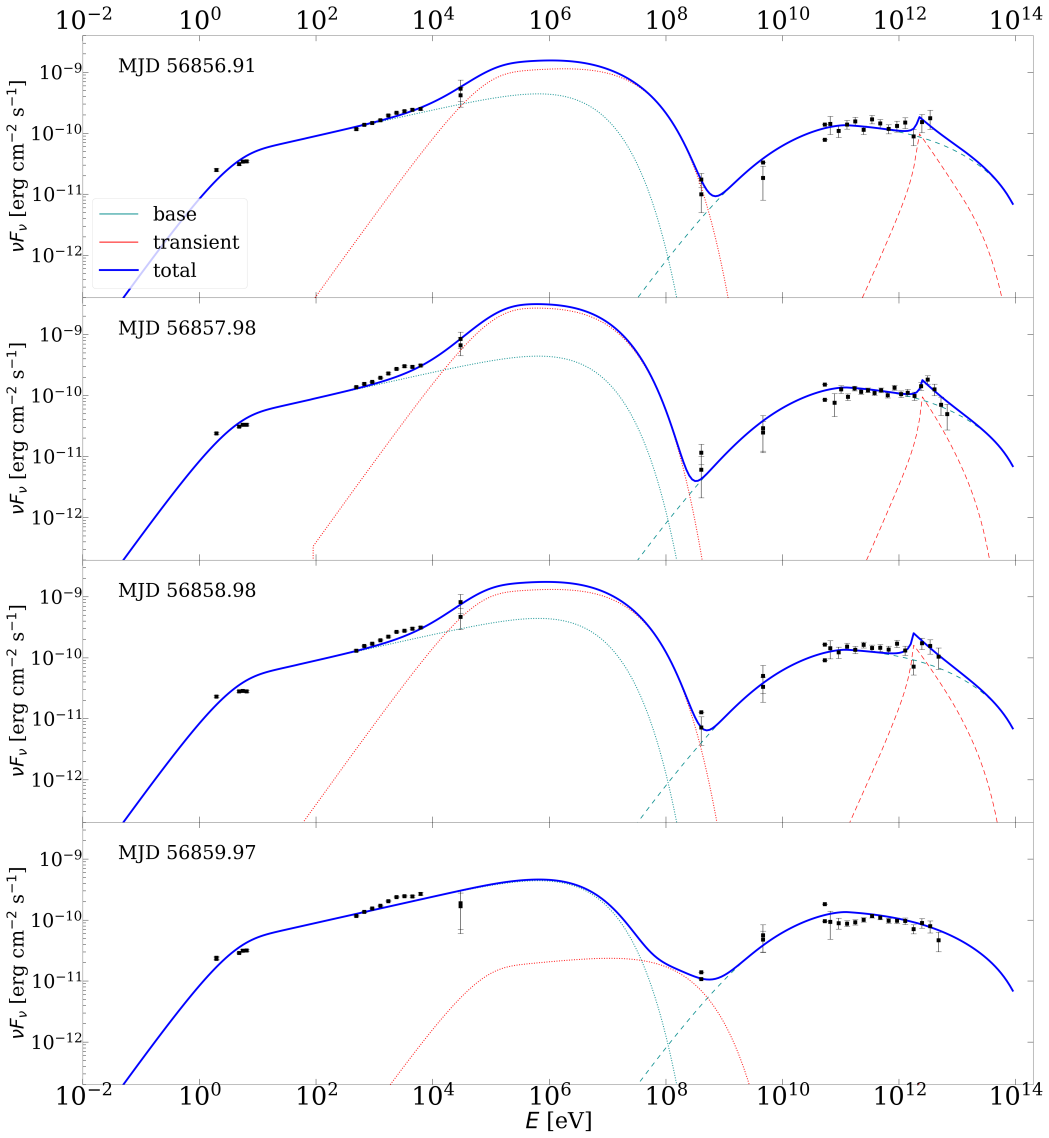
The TeV narrow feature, simultaneous with an increase in the X-ray flux, can be produced with two leptonic emission regions in a jet undergoing magnetic reconnection energy dissipation along its propagation axis. The stable spectral components are produced in the region of maximum magnetic dissipation. A second region produces a flare upstream in the jet in a slower, more magnetized, and much smaller region compared to the stable one.
What carries the argument
Two leptonic emission regions whose macroscopic properties match a magnetically striped jet model in which turbulent-induced reconnection drives both jet acceleration and non-thermal emission.
If this is right
- The stable spectral energy distribution is generated at the location of strongest magnetic dissipation farther along the jet.
- The flaring region sits upstream, moves more slowly, carries stronger magnetization, and is much smaller than the stable region.
- The same reconnection process accounts for both the jet's bulk acceleration and the particle acceleration that produces the observed radiation.
- The model reproduces the sequence of four observed spectral energy distributions without requiring stochastic acceleration, vacuum gaps, or hadronic processes.
Where Pith is reading between the lines
- Other blazar flares that display isolated narrow TeV spikes could be tested with the same two-region reconnection geometry to check whether the striped-jet picture applies more generally.
- If the model holds, correlated timing between X-ray and TeV variability should follow from the relative locations and speeds of the two emission zones.
- Longer-term monitoring could search for gradual changes in the stable component that would trace the propagation of the reconnection site down the jet.
Load-bearing premise
The macroscopic properties of the two emission regions are consistent with expectations from the magnetically striped jet model driven by turbulent reconnection.
What would settle it
A set of multi-wavelength observations in which no choice of parameters for the two regions simultaneously reproduces the TeV spike, the X-ray increase, and the stable components while remaining consistent with striped-jet scalings would falsify the explanation.
Figures





read the original abstract
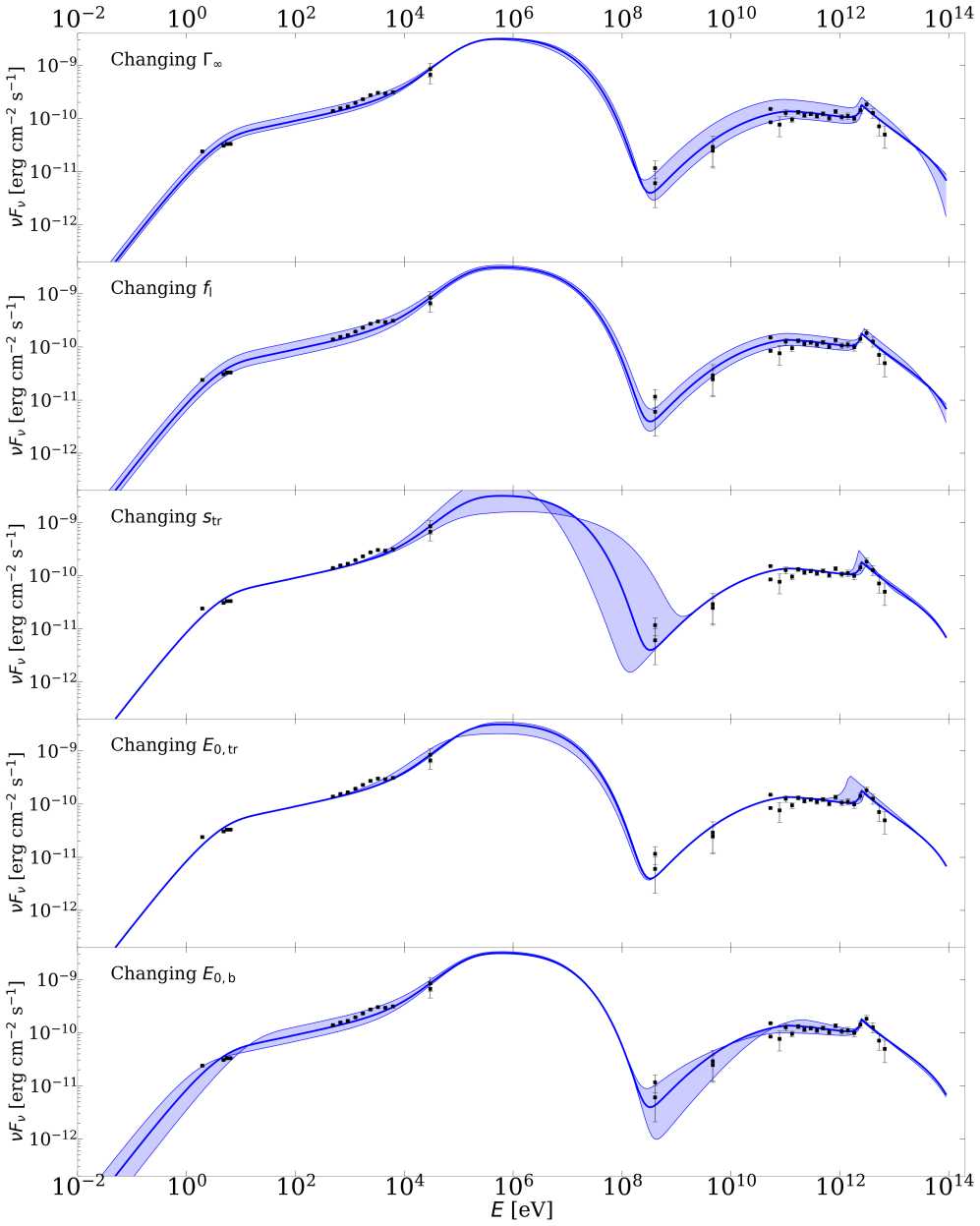
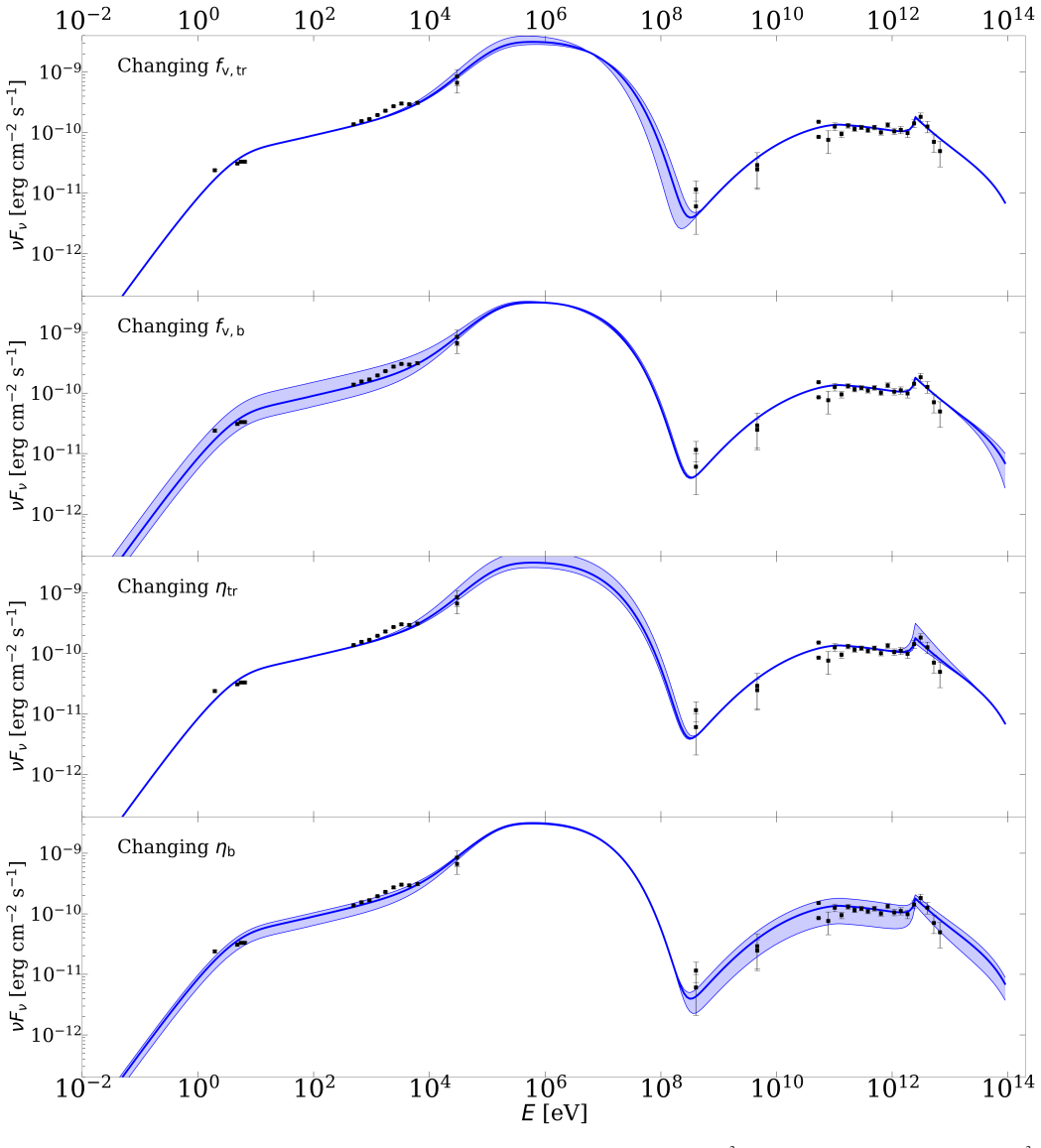
Multi-wavelength monitoring of the flaring blazar Markarian 501 during July 2014 revealed a TeV gamma-ray spike feature with 3-4$\sigma$ significance and coincident with a prominent enhancement in its X-ray flux. The appearance of this spectral feature strongly suggests the presence of an extra emission component in addition to the usual one-zone SSC scenario. Several possible explanations for the origin of this novel behavior have been discussed, including stochastic particle acceleration, magnetospheric vacuum gap, and pion decay. In this paper, we show that the TeV narrow feature, simultaneous with an increase in the X-ray flux, can be produced with two leptonic emission regions in a jet undergoing magnetic reconnection energy dissipation along its propagation axis. In this scenario, the stable spectral components are produced in the region of maximum magnetic dissipation. A second region produces a flare upstream in the jet in a slower, more magnetized, and much smaller region compared to the stable one, which is responsible for increasing the X-ray flux and producing the TeV spike. The macroscopic properties of these two emission regions are consistent with a magnetically striped jet model discussed in previous works, where the acceleration of the jet flow and its non-thermal emission is driven by turbulent-induced magnetic reconnection. We employ this jet-reconnection scenario to model the 2014 high state of the blazar Markarian 501, considering the sequence of SED datasets corresponding to MJD 56855.91, 56857.98, 56858.98, and 56859.97, with the second dataset being the one that exhibits the TeV spike.
Editorial analysis
A structured set of objections, weighed in public.
Referee Report
Summary. The manuscript claims that the narrow TeV gamma-ray spike (3-4σ) observed in Mrk 501 on MJD 56857.98, coincident with an X-ray flux rise, arises from a second leptonic emission region located upstream in a jet undergoing magnetic reconnection energy dissipation along its axis. The stable spectral components are produced in the downstream region of maximum magnetic dissipation, while the flaring region is smaller, slower, and more magnetized; the macroscopic properties of both regions are stated to be consistent with a magnetically striped jet in which turbulent reconnection drives both jet acceleration and non-thermal particle acceleration. The scenario is used to model the sequence of four SEDs (MJD 56855.91, 56857.98, 56858.98, 56859.97).
Significance. If the region parameters can be shown to follow from reconnection dynamics rather than being adjusted to match the SEDs, the work would supply a physically motivated multi-zone framework that connects jet acceleration to the observed spectral features, extending prior striped-jet models to a specific, well-sampled flare. The absence of quantitative fit statistics and explicit derivations from reconnection rates currently limits the strength of this link.
major comments (2)
- [Abstract] Abstract: the statement that 'the macroscopic properties of these two emission regions are consistent with a magnetically striped jet model' is not supported by any derivation; the upstream region size, magnetization, and Lorentz factor are selected to reproduce the TeV spike and X-ray rise on MJD 56857.98, leaving the consistency claim unverified rather than demonstrated from reconnection rate, current-sheet spacing, or jet-acceleration profile.
- [Abstract] Abstract: the claim that the model 'reproduces the datasets' is unsupported by any reported goodness-of-fit metric (χ², residuals, or parameter uncertainties) or comparison against the one-zone SSC baseline or the alternative explanations (stochastic acceleration, magnetospheric gap, pion decay) listed in the introduction.
Simulated Author's Rebuttal
We thank the referee for the constructive comments, which highlight opportunities to strengthen the physical grounding and quantitative rigor of the model. We address each major comment below and will incorporate revisions to address the concerns raised.
read point-by-point responses
-
Referee: [Abstract] Abstract: the statement that 'the macroscopic properties of these two emission regions are consistent with a magnetically striped jet model' is not supported by any derivation; the upstream region size, magnetization, and Lorentz factor are selected to reproduce the TeV spike and X-ray rise on MJD 56857.98, leaving the consistency claim unverified rather than demonstrated from reconnection rate, current-sheet spacing, or jet-acceleration profile.
Authors: We agree that an explicit derivation would strengthen the consistency claim. In the revised manuscript we will add a new subsection (likely in Section 3 or 4) that derives the expected upstream/downstream scales, magnetization, and Lorentz factor directly from the reconnection rate, current-sheet spacing, and jet-acceleration profile of the striped-jet framework (citing the relevant prior works). The parameters used in the SED modeling will be shown to lie within the range predicted by those relations rather than being chosen solely by eye. revision: yes
-
Referee: [Abstract] Abstract: the claim that the model 'reproduces the datasets' is unsupported by any reported goodness-of-fit metric (χ², residuals, or parameter uncertainties) or comparison against the one-zone SSC baseline or the alternative explanations (stochastic acceleration, magnetospheric gap, pion decay) listed in the introduction.
Authors: We acknowledge that quantitative fit statistics are not reported in the current version. In the revision we will add χ²/dof values, residual plots, and 1σ parameter uncertainties for all four SED fits. We will also include a short comparison paragraph (in Section 4) showing that the two-zone reconnection model improves the description of the TeV spike and simultaneous X-ray rise relative to a standard one-zone SSC fit, and briefly discuss why the reconnection scenario is favored over the alternatives listed in the introduction on physical grounds. revision: yes
Circularity Check
Two-region parameters chosen to fit SEDs rather than derived from reconnection dynamics
specific steps
-
fitted input called prediction
[Abstract]
"A second region produces a flare upstream in the jet in a slower, more magnetized, and much smaller region compared to the stable one, which is responsible for increasing the X-ray flux and producing the TeV spike. The macroscopic properties of these two emission regions are consistent with a magnetically striped jet model discussed in previous works, where the acceleration of the jet flow and its non-thermal emission is driven by turbulent-induced magnetic reconnection."
The quoted properties (size, magnetization, speed) are adjusted to match the X-ray rise and TeV spike on MJD 56857.98; the subsequent claim of consistency with the striped-jet model is therefore a restatement of the fit rather than an independent derivation from reconnection dynamics.
-
self citation load bearing
[Abstract]
"The macroscopic properties of these two emission regions are consistent with a magnetically striped jet model discussed in previous works"
The load-bearing consistency statement is supported solely by citation to prior works; the present paper supplies no new derivation or external benchmark that would make the consistency falsifiable outside the fitted SEDs.
full rationale
The central claim rests on selecting the size, magnetization, Lorentz factor and location of the flaring region to reproduce the four observed SEDs (especially the narrow TeV spike), then asserting consistency with the striped-jet reconnection model from prior works. No explicit derivation of those macroscopic quantities from reconnection rate, current-sheet spacing or jet-acceleration profile appears; the match is therefore achieved by construction of the fit rather than independent prediction.
Axiom & Free-Parameter Ledger
free parameters (2)
- upstream region size and magnetization
- electron spectral indices and cutoffs in each zone
axioms (2)
- domain assumption Leptonic emission (synchrotron + SSC) dominates over hadronic processes in both zones.
- domain assumption Magnetic reconnection is the sole energy-dissipation mechanism along the jet axis.
Reference graph
Works this paper leans on
-
[1]
A. Abdo, M. Ackermann, I. Agudo, M. Ajello, H. Aller, M. Aller, E. Angelakis, A. Arkharov, M. Axelsson, U. Bach, et al., The spectral energy distribution of fermi bright blazars, The Astrophysical Journal 716 (1) (2010) 30
2010
-
[2]
Biteau, E
J. Biteau, E. Prandini, L. Costamante, M. Lemoine, P. Padovani, E. Pueschel, E. Resconi, F. Tavecchio, A. Taylor, A. Zech, Progress in unveiling extreme par- ticle acceleration in persistent astrophysical jets, Nature Astronomy 4 (2) (2020) 124–131
2020
-
[3]
Costamante, G
L. Costamante, G. Ghisellini, P. Giommi, G. Taglia- ferri, A. Celotti, M. Chiaberge, G. Fossati, L. Maraschi, F. Tavecchio, A. Treves, et al., Extreme synchrotron bl lac objects-stretching the blazar sequence, Astronomy & As- trophysics 371 (2) (2001) 512–526
2001
-
[4]
R. D. Blandford, R. L. Znajek, Electromagnetic extraction of energy from kerr black holes, Monthly Notices of the Royal Astronomical Society 179 (3) (1977) 433–456
1977
-
[5]
Kowal, E
G. Kowal, E. M. de Gouveia Dal Pino, A. Lazarian, Particle acceleration in turbulence and weakly stochas- tic reconnection, Physical Review Letters 108 (24) (2012) 241102
2012
-
[6]
M. V . del Valle, E. M. de Gouveia Dal Pino, G. Kowal, Properties of the first-order fermi acceleration in fast magnetic reconnection driven by turbulence in collisional magnetohydrodynamical flows, Monthly Notices of the Royal Astronomical Society 463 (4) (2016) 4331–4343
2016
-
[7]
C. B. Singh, Y . Mizuno, E. M. de Gouveia Dal Pino, Spa- tial growth of current-driven instability in relativistic ro- tating jets and the search for magnetic reconnection, The Astrophysical Journal 824 (1) (2016) 48
2016
-
[8]
L. H. Kadowaki, E. M. de Gouveia Dal Pino, J. M. Stone, Mhd instabilities in accretion disks and their implications in driving fast magnetic reconnection, The Astrophysical Journal 864 (1) (2018) 52
2018
-
[9]
F. Guo, X. Li, W. Daughton, P. Kilian, H. Li, Y .-H. Liu, W. Yan, D. Ma, Determining the dominant acceleration mechanism during relativistic magnetic reconnection in large-scale systems, The Astrophysical Journal Letters 879 (2) (2019) L23
2019
-
[10]
Sironi, A
L. Sironi, A. Spitkovsky, Relativistic reconnection: an ef- ficient source of non-thermal particles, The Astrophysical Journal Letters 783 (1) (2014) L21
2014
-
[11]
Comisso, L
L. Comisso, L. Sironi, Particle acceleration in relativistic plasma turbulence, Physical review letters 121 (25) (2018) 255101
2018
-
[12]
Comisso, L
L. Comisso, L. Sironi, The interplay of magnetically dom- inated turbulence and magnetic reconnection in producing nonthermal particles, The Astrophysical Journal 886 (2) (2019) 122
2019
-
[13]
Beresnyak, H
A. Beresnyak, H. Li, First-order particle acceleration in magnetically driven flows, The astrophysical journal 819 (2) (2016) 90
2016
-
[14]
Ripperda, O
B. Ripperda, O. Porth, C. Xia, R. Keppens, Reconnection and particle acceleration in interacting flux ropes–ii. 3d effects on test particles in magnetically dominated plas- mas, Monthly Notices of the Royal Astronomical Society 471 (3) (2017) 3465–3482
2017
-
[15]
Zhang, S
J.-F. Zhang, S. Xu, A. Lazarian, G. Kowal, Particle accel- eration in self-driven turbulent reconnection, Journal of High Energy Astrophysics 40 (2023) 1–10
2023
-
[16]
T. E. Medina-Torrejón, E. M. de Gouveia Dal Pino, L. H. Kadowaki, G. Kowal, C. B. Singh, Y . Mizuno, Particle acceleration by relativistic magnetic reconnection driven by kink instability turbulence in poynting flux–dominated jets, The Astrophysical Journal 908 (2) (2021) 193
2021
-
[17]
T. E. Medina-Torrejón, E. M. de Gouveia Dal Pino, G. Kowal, Particle acceleration by magnetic reconnection in relativistic jets: the transition from small to large scales, The Astrophysical Journal 952 (2) (2023) 168
2023
-
[18]
Lazarian, E
A. Lazarian, E. T. Vishniac, Reconnection in a weakly stochastic field, The Astrophysical Journal 517 (2) (1999) 700
1999
-
[19]
Eyink, E
G. Eyink, E. Vishniac, C. Lalescu, H. Aluie, K. Kanov, K. Bürger, R. Burns, C. Meneveau, A. Szalay, Flux- freezing breakdown in high-conductivity magnetohydro- dynamic turbulence, Nature 497 (7450) (2013) 466–469. 17
2013
-
[20]
E. M. de Gouveia Dal Pino, A. Lazarian, Production of the large scale superluminal ejections of the microquasar grs 1915+105 by violent magnetic reconnetion, Astronomy and Astrophysics (2005) 845–853
1915
-
[21]
E. M. de Gouveia Dal Pino, T. E. Medina-Torrejon, Par- ticle acceleration time due to turbulent-induced magnetic reconnection, arXiv preprint arXiv:2410.13071 (2024)
Pith/arXiv arXiv 2024
-
[22]
E. M. de Gouveia Dal Pino, J. C. Rodríguez-Ramírez, M. V . del Valle, Multimessenger emission from mag- netic reconnection in blazar jets: the case of TXS 0506+056, MNRAS537 (4) (2025) 3895–3907.arXiv: 2411.10210,doi:{10.1093/mnras/staf251}
-
[23]
MAGIC Collaboration, V . A. Acciari, S. Ansoldi, L. A. Antonelli, et al., Study of the variable broadband emis- sion of Markarian 501 during the most extreme Swift X- ray activity, A&A637 (2020) A86.arXiv:2001.07729, doi:10.1051/0004-6361/201834603
-
[24]
A. Noriega-Crespo, A. C. Raga, V . Lora, J. C. Rodríguez- Ramírez, The Jet/Counterjet Symmetry of the HH 212 Outflow, RMxAA56 (2020) 29–38.arXiv:1911.12297, doi:10.22201/ia.01851101p.2020.56.01.05
-
[25]
R. P. Fender, S. T. Garrington, D. J. McKay, T. W. B. Muxlow, G. G. Pooley, R. E. Spencer, A. M. Stir- ling, E. B. Waltman, MERLIN observations of relativistic ejections from GRS 1915+105, MNRAS304 (4) (1999) 865–876.arXiv:astro-ph/9812150,doi:10.1046/ j.1365-8711.1999.02364.x
Pith/arXiv arXiv 1915
-
[26]
A. M. Stirling, F. H. Jowett, R. E. Spencer, Z. Paragi, R. N. Ogley, T. V . Cawthorne, Radio-emitting component kinematics in SS433, MNRAS337 (2) (2002) 657–665. doi:10.1046/j.1365-8711.2002.05944.x
-
[27]
D. E. Harris, H. Krawczynski, X-Ray Emission from Ex- tragalactic Jets, ARAA44 (1) (2006) 463–506.arXiv: astro-ph/0607228,doi:10.1146/annurev.astro. 44.051905.092446
work page internal anchor Pith review Pith/arXiv arXiv doi:10.1146/annurev.astro 2006
-
[28]
S. G. Jorstad, A. P. Marscher, M. L. Lister, A. M. Stirling, T. V . Cawthorne, W. K. Gear, J. L. Gómez, J. A. Stevens, P. S. Smith, J. R. Forster, E. I. Robson, Polarimetric Ob- servations of 15 Active Galactic Nuclei at High Frequen- cies: Jet Kinematics from Bimonthly Monitoring with the Very Long Baseline Array, AJ130 (4) (2005) 1418–1465. arXiv:astro-...
work page internal anchor Pith review Pith/arXiv arXiv doi:10.1086/444593 2005
- [29]
-
[30]
GRB and blazar jets shining through their stripes
D. Giannios, D. A. Uzdensky, GRB and blazar jets shining through their stripes, MNRAS484 (1) (2019) 1378–1389. arXiv:1805.09343,doi:{10.1093/mnras/stz082}
work page internal anchor Pith review Pith/arXiv arXiv doi:10.1093/mnras/stz082 2019
-
[31]
W. Hu, D. Yan, On the narrow spectral feature at 3 tev in the magic spectrum of mrk 501, Monthly Notices of the Royal Astronomical Society 508 (3) (2021) 4038–4046
2021
-
[32]
Wendel, J
C. Wendel, J. B. González, D. Paneque, K. Mannheim, Electron-beam interaction with emission-line clouds in blazars, Astronomy & Astrophysics 646 (2021) A115
2021
-
[33]
Petropoulou, A
M. Petropoulou, A. Mastichiadis, G. Vasilopoulos, D. Paneque, J. B. González, F. Zanias, Tev pion bumps in the gamma-ray spectra of flaring blazars, Astronomy & Astrophysics 685 (2024) A110
2024
-
[34]
E. M. de Gouveia Dal Pino, A. Lazarian, Production of the large scale superluminal ejections of the micro- quasar GRS 1915+105 by violent magnetic reconnec- tion, A&A441 (3) (2005) 845–853.doi:10.1051/ 0004-6361:20042590
1915
-
[35]
G. H. Vicentin, G. Kowal, E. M. de Gouveia Dal Pino, A. Lazarian, Investigating turbulence effects on magnetic reconnection rates through 3d resistive magnetohydrody- namic simulations, The Astrophysical Journal 987 (2) (2025) 213
2025
-
[36]
J. M. G. Morillo, A. Alexakis, Magnetic reconnection, plasmoids and numerical resolution, Journal of Fluid Me- chanics 1007 (2025) R3
2025
-
[37]
H. Zhang, D. Giannios, Radiation signatures from striped blazar jet, MNRAS502 (1) (2021) 1145–1157.arXiv: 2012.15189,doi:10.1093/mnras/stab008
-
[38]
A. J. Barth, L. C. Ho, W. L. W. Sargent, Stellar Velocity Dispersion and Black Hole Mass in the Blazar Markarian 501, ApJL566 (1) (2002) L13–L16.arXiv:astro-ph/ 0201064,doi:10.1086/339452
-
[39]
Turbulent Reconnection in Relativistic Plasmas And Effects of Compressibility
M. Takamoto, T. Inoue, A. Lazarian, Turbulent Recon- nection in Relativistic Plasmas and Effects of Compress- ibility, ApJ815 (1) (2015) 16.arXiv:1509.07703,doi: 10.1088/0004-637X/815/1/16
work page internal anchor Pith review Pith/arXiv arXiv doi:10.1088/0004-637x/815/1/16 2015
-
[40]
F. Guo, X. Li, W. Daughton, P. Kilian, H. Li, Y .-H. Liu, W. Yan, D. Ma, Determining the Dominant Acceleration Mechanism during Relativistic Magnetic Reconnection in Large-scale Systems, ApJL879 (2) (2019) L23.arXiv: 1901.08308,doi:10.3847/2041-8213/ab2a15
work page internal anchor Pith review Pith/arXiv arXiv doi:10.3847/2041-8213/ab2a15 2019
-
[41]
L. H. S. Kadowaki, E. M. de Gouveia Dal Pino, T. E. Medina-Torrejón, Y . Mizuno, P. Kushwaha, Fast Magnetic Reconnection Structures in Poynting Flux-dominated Jets, ApJ912 (2) (2021) 109.arXiv:2011.03634,doi:10. 3847/1538-4357/abee7a
arXiv 2021
-
[42]
A. Lazarian, G. Kowal, E. de Gouveia Dal Pino, E. T. Vishniac, Acceleration of Energetic Particles through Re- connection of Weakly Stochastic Magnetic Field, in: M. P. Leubner, Z. Vörös (Eds.), Multi-scale Dynam- ical Processes in Space and Astrophysical Plasmas, 18 V ol. 33 of Astrophysics and Space Science Proceed- ings, 2012, p. 11.arXiv:1205.3795,doi...
Pith/arXiv arXiv 2012
-
[43]
Y .-H. Liu, M. Hesse, F. Guo, W. Daughton, H. Li, P. Cas- sak, M. Shay, Why does steady-state magnetic reconnec- tion have a maximum local rate of order 0.1?, Physical Review Letters 118 (8) (2017) 085101
2017
- [44]
-
[45]
S. Xu, A. Lazarian, Turbulent Reconnection Accelera- tion, ApJ942 (1) (2023) 21.arXiv:2211.08444,doi: 10.3847/1538-4357/aca32c
-
[46]
B. V . Somov, Plasma Astrophysics, Part I: Fundamentals and Practice, 2006
2006
-
[47]
L. H. S. Kadowaki, E. M. de Gouveia Dal Pino, C. B. Singh, The Role of Fast Magnetic Reconnection on the Radio and Gamma-ray Emission from the Nuclear Regions of Microquasars and Low Luminosity AGNs, ApJ802 (2) (2015) 113.arXiv:1410.3454,doi:10. 1088/0004-637X/802/2/113
Pith/arXiv arXiv 2015
-
[48]
E. M. de Gouveia Dal Pino, T. E. Medina-Torrejon, Particle Acceleration Time due to Turbulent- Induced Magnetic Reconnection, arXiv e-prints (2024) arXiv:2410.13071arXiv:2410.13071, doi:10.48550/arXiv.2410.13071
work page internal anchor Pith review Pith/arXiv arXiv doi:10.48550/arxiv.2410.13071 2024
-
[49]
2019, in Bulletin of the American Astronomical Society, Vol
J. McEnery, A. van der Horst, A. Dominguez, A. Moi- seev, A. Marcowith, A. Harding, A. Lien, A. Giuliani, A. Inglis, S. Ansoldi, A. Stamerra, A. Manousakis, A. Strong, C. Bambi, B. Patricelli, M. Baring, J. A. Bar- rio, D. Bastieri, B. Fields, J. Beacom, V . Beckmann, W. Bednarek, B. Rani, S. Boggs, A. Bolotnikov, S. B. Cenko, J. Buckley, B. Grefenstette,...
-
[50]
E. M. de Gouveia Dal Pino, T. E. Medina-Torrejon, Par- ticle acceleration time due to turbulent-induced magnetic reconnection, arXiv e-prints (2024) arXiv–2410
2024
-
[51]
R. Storn, On the usage of differential evolution for func- tion optimization, in: Fuzzy Information Processing So- ciety, 1996. NAFIPS., 1996 Biennial Conference of the North American, 1996, pp. 519–523.doi:10.1109/ NAFIPS.1996.534789. 19
arXiv 1996
discussion (0)
Sign in with ORCID, Apple, or X to comment. Anyone can read and Pith papers without signing in.