REVIEW 5 major objections 5 minor 29 references
AutoLayout: Closed-Loop Layout Synthesis via Slow-Fast Collaborative Reasoning
T0 review · 5 major / 5 minor · reviewed 2026-08-06 · deepseek-v4-flash
Pith's one-line read AutoLayout claims that a slow deliberative system plus a fast optimizer, joined by closed-loop self-validation, lifts layout scores to 91.7%—13 to 23 points above the strongest baselines—while nearly eliminating overlaps.
desk verdict Clever system architecture, but the reported numbers don't hold together; referee it, but demand a real evaluation. read the letter →
The pith
A machine-rendered reading of the paper's core claim, the machinery that carries it, and where it could break.
The reading
What carries the argument
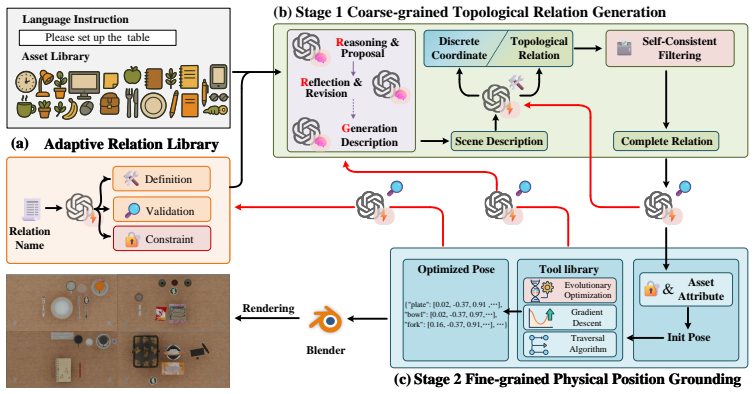
The load-bearing mechanism is the slow–fast collaboration with closed-loop validation. The slow system is the RRG pipeline (Reasoning–Reflection–Generation): it reasons about functional areas and object interactions, reflects to resolve conflicts and ensure every object is covered, then generates a structured scene description. The fast system converts that description into discrete grid coordinates and into typed topological relations (anchoring, relative, alignment) drawn from the Adaptive Relation Library (ARL)—an LLM-generated collection where each relation has a definition, a Python constraint function scoring the layout, and a validation function returning a boolean. A genetic algorithm (2,000 individuals, 100 generations) over a 600x300 pixel plane optimizes a fitness that sums physical feasibility (intersection-over-union of axis-aligned bounding boxes plus boundary and stacking containment) with semantic scores from ARL constraint functions. The closed loop is completed by three self-validation stages, the last of which feeds failed relations back to the LLM to adjust thresholds and repair code, then re-optimizes until all validation functions return true.
What would settle it
Take the layouts AutoLayout reports as optimal, set them in a rigid-body physics simulator with gravity and contact, let them settle, and measure interpenetration depth, unsupported objects, and objects that fall off the table. If a non-trivial fraction of layouts that score 100% collision-free contain gravitationally unstable or interpenetrating configurations—a bowl resting only on a cup's rim, or a stack that topples because its center of mass sits outside the support polygon—then the claim that near-perfect collision scores equal physical plausibility is falsified. A cheaper version is a manual audit of the 24 test-case layouts for any arrangement that is axis-aligned-bounding-box collision-free yet unrealizable under gravity.
Extended reading notes
Core claim
The paper's central claim is that layout synthesis should not be one model call. AutoLayout first has a 'slow system' run a Reasoning-Reflection-Generation pipeline to turn the instruction and object list into a complete scene description, then has a 'fast system' translate that description into a discrete coordinate set and a topological relation set, and finally grounds the result through a genetic algorithm whose fitness function combines physical checks (collision-free and in-boundary) with semantic constraints drawn from an Adaptive Relation Library. Because the ARL's relation definitions, constraint functions, and validation functions are generated and repaired by an LLM, the system is claimed to avoid the rigidity of fixed rules. Three self-validation stages form a closed loop: inconsistent relations are filtered, missing objects re-injected, and failed relation validations are fed back to the LLM to adjust thresholds and regenerate code until the layout passes. The paper's headline empirical assertion is that this yields near-perfect physical plausibility and functional completeness while improving semantic consistency over two-stage baselines.
Load-bearing premise
The load-bearing premise is that physical plausibility is fully captured by axis-aligned bounding-box non-overlap, boundary containment, and the stacking-containment check defined in the appendix—and that the genetic algorithm optimizes exactly those quantities. If real physical validity needs more, such as stable support for irregular shapes or center-of-mass balance, the near-perfect physics scores may not transfer beyond the simulated metric.
Editorial extensions
If this is right
- If the PSF numbers hold, AutoLayout tops every compared layout-generation baseline across all eight tabletop scenarios, with the largest gaps on dense or constrained tables.
- The ablation results imply that the gains are structural: removing the adaptive library, scene description, self-validation, or discrete initialization each degrades PSF by roughly 2 to 12 points and increases the average sampling rounds needed to reach a valid layout.
- 100% functional completeness means users get every requested object placed; the self-validation loop specifically re-injects omitted objects, a failure mode that drops 9.7% (LayoutGPT) to 36% (HOLODECK) of objects in baselines.
- Because the Adaptive Relation Library replaces fixed rules with LLM-generated code, the pipeline is claimed to generalize beyond the eight benchmarked scenarios to new instruction styles and relation types without manual prompt engineering.
Reading between the lines
- Because the genetic algorithm maximizes exactly the functions used to compute the reported physics scores, CF and IB largely measure optimizer convergence; the semantic scores (about 74% position, 73% alignment) are the comparatively honest ceiling and sit well below the near-perfect physics numbers.
- A testable extension would put a rigid-body simulator inside the validation loop instead of axis-aligned bounding-box checks; since the closed-loop repair mechanism already exists, adding a physics-based validation function should correct layouts that are AABB-clean but gravitationally unstable.
- The use of GPT-4o as the semantic judge means the reported semantic improvements are assessed by the same family of models that commits the spatial hallucinations under study; a stronger evaluation would score usability by a robot or by blinded human judges on functional criteria, of which the paper's own human study (0.95 dining, 0.875 office) is a partial instance.
- The complexity study's zero scores for all baselines suggest the comparison is less about absolute quality than about robustness to instruction difficulty; one implication is that layout methods should be benchmarked with a graded instruction set (the paper's easy-to-expert split) rather than a single average.
Editorial analysis
A structured set of objections, weighed in public.
Referee Report
Summary. The paper proposes AutoLayout, a closed-loop layout-synthesis system built on a slow-fast reasoning framework. A 'slow system' produces scene descriptions through a Reasoning-Reflection-Generation (RRG) pipeline, supported by an LLM-maintained Adaptive Relation Library (ARL). A 'fast system' turns these descriptions into discrete coordinates and topological relations, then refines them with a genetic algorithm, with three stages of self-validation. Experiments across 8 desktop scenarios compare AutoLayout with LayoutGPT, HOLODECK, and I-Design, reporting a PSF score of 91.7% versus 78.7% for the best baseline, near-perfect CF/IB/FC scores, ablations showing the contribution of each module, and a human evaluation in which all baselines score zero.
Significance. The system design is timely and, if the quantitative claims hold, would be a useful step toward reducing spatial hallucination in LLM-based layout generation. The paper's strengths include the explicit closed-loop validation mechanism, the ARL's ability to generate and repair constraint functions on the fly, and the unusually detailed prompt-level documentation in the appendix, which aids reproducibility. The ablation study in Table 4 also gives a clear picture of each component's role. However, the evaluation is weakened by circularity between the optimization objective and the reported metrics, a very small test set, and a human-evaluation table whose all-zero baseline scores are not adequately explained. These issues leave the magnitude of the claimed improvement not yet established.
major comments (5)
- [Abstract and Table 2] The abstract claims a 'significant 10.1% improvement over SOTA methods,' but Table 2's Average row reports AutoLayout PSF 91.7% versus best baseline LayoutGPT 78.7%, which is a 13.0-point absolute improvement and a 16.5% relative improvement. No calculation yielding 10.1% is shown anywhere in the manuscript. This is a material inconsistency because the headline number cannot be reproduced from the reported results; please either correct the abstract or state explicitly which aggregate and comparison the 10.1% refers to.
- [Section 4.1 and Appendix A.2] The CF, IB, and FC metrics are not independent evidence of quality. Algorithm 2 optimizes a fitness function that includes collision avoidance and containment, Section 3.4 uses a re-injection loop to force FC = 100%, and the PSF aggregate in Eq. (20) is a weighted combination of these same terms. In addition, the semantic Pos./Ali. scores are produced by GPT-4o, the same model family used to generate the scene descriptions and relations. Since the method is explicitly optimizing the reported metrics, the improvement over baselines partly reflects objective alignment rather than layout quality. Please provide evaluation that is not optimized by the method, such as held-out human judgment with a documented rubric, or physical-simulation validation.
- [Section 4.3.1 and Table 3] Table 3 reports exactly 0.0 for LayoutGPT, HOLODECK, and I-Design at every complexity level, including Easy cases with 1-3 objects, even though Table 2 shows these baselines achieving nonzero CF/IB in the same scenarios. The text explains this by citing 'cluttered centripetal placements and unnatural floating or partial overlapping,' but it provides no rubric, no number of raters, no inter-rater agreement, and no example prompts or scored responses. Because this human evaluation is the only evidence for aesthetic quality that goes beyond the already-optimized metrics, the protocol must be fully specified; without that, the all-zero baseline scores look like a scoring artifact rather than a meaningful comparison.
- [Section 4.1 and Table 2] The quantitative study consists of 8 scenarios with 3 object lists each, i.e., about 24 generation cases, and Table 2 reports averaged percentages without error bars, confidence intervals, or statistical tests. The per-scenario variation is large, for example AutoLayout Pos. ranges from 61.7 to 81.3 across scenarios. The claim that AutoLayout improves PSF by 13.0-22.6 points over baselines is therefore not statistically established. Please report per-case raw scores, distributions, and significance tests, or at least confidence intervals.
- [Appendix A.2.1 and A.2.2] Physical plausibility is defined exclusively through axis-aligned bounding-box IoU (with threshold tau=0.01) and containment checks. This cannot verify real stability for complex shapes or stacking relations; for example, an object resting on a narrow edge or tilted on another object can satisfy the AABB checks while being physically implausible. The claims in Section 4.2 about 'physical realism' and in Section 4.3 about 'realistic stacking' therefore go beyond what the metrics measure. Either adopt a stronger geometric or physics-based validation, or restrict the claims to the simulated AABB-level notion of physical plausibility.
minor comments (5)
- [Throughout] The term 'Dinning Table' appears in Table 2 and Figure 3; it should be 'Dining Table.'
- [Section 4.4] The sentence 'Finally, skipping the discrete initialization step (w/o C left the system unable to detect obvious geometric contradictions' is missing a closing parenthesis and a verb; please rephrase for clarity.
- [Appendix C.2] The text contains the typo 'pancils' instead of 'pencils,' and Table 5 lists 'GPT-o4-mini,' which is presumably 'GPT-4o-mini' or another intended model name.
- [Section 4.2] HOLODECK is referred to as 'the two-stage holographic deck'; please use the correct method name Holodeck.
- [Appendix A.2.3] The semantic evaluation uses GPT-4o as a judge, but no prompt template or scoring scale is provided for the Pos. and Ali. scores; please include the exact evaluation prompt so the numbers can be reproduced.
Circularity Check
FC=100% is enforced by re-injection, CF/IB are the GA's own fitness objective, and GPT-4o scores constraints that GPT-4o itself generated; the central PSF claim is substantially self-referential.
-
self definitional
[Algorithm 1 (lines 7-10); Section 4.2 'Functional Completeness'; Appendix A.2.4]
"k ← Select index where validity is False ▷ Functionally Incomplete ... C, R ←Update(C, R, Oi) [Algorithm 1]; 'The integrated self-validation loop explicitly checks for missing objects after each filtering or optimization pass, triggering re-injection and relocation until full coverage is achieved without manual intervention.' [Section 4.2]"
FC is defined in A.2.4 as the fraction of instruction-listed objects that appear in the layout. Algorithm 1 explicitly selects indices where validity is False (commented 'Functionally Incomplete') and calls Update until the layout is complete, and Section 4.2 states that the loop triggers 're-injection and relocation until full coverage is achieved.' Therefore AutoLayout's reported FC=100% is a termination condition of the algorithm, not an empirically measured outcome. Claiming 'places every requested object in every scenario' is equivalent to asserting that the re-injection loop runs to completion; the metric is satisfied by definition.
-
fitted input called prediction
[Section 3.3 (fine-grained grounding fitness); Section 4.2 'Physical Plausibility'; Appendix A.2.1-A.2.2]
"A genetic algorithm with 2,000 individuals and 100 generations is employed to search for the optimal solution. The fitness function comprises two components:Physical feasibility: ensuring collision-free placement and stability. Semantic consistency: evaluated by invoking constraint functions from the ARL for each relation."
CF and IB are computed from axis-aligned bounding-box overlap and table-containment violations. The Stage-2 optimizer's fitness explicitly includes 'Physical feasibility: ensuring collision-free placement and stability,' so the GA directly maximizes the same quantities later reported as CF and IB. The closed-loop validation further rejects or repairs layouts until validation functions return positive results. Reporting near-perfect CF/IB is therefore reporting the value of the objective being optimized, not an independent check of physical plausibility. The comparison to baselines that do not optimize this exact objective is meaningful but is a matched-filter comparison; the headline physical-plausibility gain is partly by construction.
1 more flagged steps
-
other
[Section 3.1 and 3.4 (ARL and self-validation); Section 4.1; Appendix A.2.3]
"'Semantic consistency uses GPT-4o as the evaluator to determine whether the generated 3D layouts align with the input language instructions' [Section 4.1]; 'When validation failure is detected, the current layout C and the failed relation r are fed back to the large model. The model then adjusts the parameters of the constraint function associated with r ... until all validation functions return positive results.' [Section 3.4]; 'Similar to AutoVLM,we employ GPT4o as an evaluator to score the generated layouts.' [A.2.3]"
The Pos./Ali. semantic scores are produced by GPT-4o, the same model family that generates the scene descriptions, the ARL relation definitions, the constraint functions, and the validation functions. The self-validation loop runs until all GPT-4o-generated validation functions return positive results, and then GPT-4o evaluates the rendered layout. Thus the reported semantic-consistency number measures whether GPT-4o's own generated constraints are satisfied and whether GPT-4o's evaluator approves the result. This is a self-evaluation loop rather than an external semantic ground truth; the 'semantic consistency' being reported is, by construction, GPT-4o's self-agreement.
full rationale
The central PSF score is substantially self-referential. The FC component is fully by construction: Algorithm 1 re-injects missing objects and Section 4.2 explicitly says the loop runs 'until full coverage is achieved,' so FC=100% restates the algorithm's termination condition. The CF/IB components are the genetic algorithm's own fitness objective ('ensuring collision-free placement and stability'), so near-perfect physical scores are the value of the optimized objective, not an independent physical-validation result. The semantic component is scored by GPT-4o, the same model that wrote the relation definitions, constraint functions, and validation functions, creating a self-evaluation loop. Independent content exists—human evaluation in Table 3, case studies, and ablations—so the score is not 8 or higher. Non-circular correctness risks are noted separately: the abstract's 10.1% improvement is not reproducible from Table 2's 13.0-point PSF gain, and Table 3's all-zero baseline scores lack rubric and rater-agreement details; these are validity concerns, not circularity, and do not affect the score.
Assumptions & free parameters
free parameters (7)
- PSF metric weights =
0.4 for physics, 0.3 for semantics, 0.3 for functional completeness
- IoU collision threshold tau =
0.01
- Genetic algorithm population size =
2000 individuals
- Genetic algorithm generations =
100 generations
- Mutation ratio =
0.3
- Max sampling rounds =
5
- Table pixel plane mapping =
600x300 pixels
assumptions (5)
- domain assumption AABB IoU is a valid measure of physical collisions and is sufficient for layout physical plausibility.
- domain assumption In-boundary and stacking containment checks capture physical stability.
- domain assumption LLM-generated constraint and validation functions are correct and comprehensive for the spatial relations that matter.
- domain assumption GPT-4o evaluation of rendered images is a valid proxy for semantic consistency and alignment.
- domain assumption The instruction and object list fully determine the intended layout, with no hidden user preferences.
Cite this review
Pith. "Pith review of AutoLayout: Closed-Loop Layout Synthesis via Slow-Fast Collaborative Reasoning." pith.science (2026). https://pith.science/paper/OPHSSHAO
@misc{pith2026250704293,
  author       = {Pith},
  title        = {Pith review of: AutoLayout: Closed-Loop Layout Synthesis via Slow-Fast Collaborative Reasoning},
  year         = {2026},
  howpublished = {\url{https://pith.science/paper/OPHSSHAO}},
  note         = {Machine review of arXiv:2507.04293}
}
read the original abstract
The automated generation of layouts is vital for embodied intelligence and autonomous systems, supporting applications from virtual environment construction to home robot deployment. Current approaches, however, suffer from spatial hallucination and struggle with balancing semantic fidelity and physical plausibility, often producing layouts with deficits such as floating or overlapping objects and misaligned stacking relation. In this paper, we propose AutoLayout, a fully automated method that integrates a closed-loop self-validation process within a dual-system framework. Specifically, a slow system harnesses detailed reasoning with a Reasoning-Reflection-Generation (RRG) pipeline to extract object attributes and spatial constraints. Then, a fast system generates discrete coordinate sets and a topological relation set that are jointly validated. To mitigate the limitations of handcrafted rules, we further introduce an LLM-based Adaptive Relation Library (ARL) for generating and evaluating layouts. Through the implementation of Slow-Fast Collaborative Reasoning, the AutoLayout efficiently generates layouts after thorough deliberation, effectively mitigating spatial hallucination. Its self-validation mechanism establishes a closed-loop process that iteratively corrects potential errors, achieving a balance between physical stability and semantic consistency. The effectiveness of AutoLayout was validated across 8 distinct scenarios, where it demonstrated a significant 10.1% improvement over SOTA methods in terms of physical plausibility, semantic consistency, and functional completeness.
Figures


Figures from the paper (1 more)

Reference graph
Works this paper leans on
-
[1]
Attribute-conditioned layout gan for automatic graphic design
Jianan Li, Jimei Yang, Jianming Zhang, Chang Liu, Christina Wang, and Tingfa Xu. Attribute-conditioned layout gan for automatic graphic design. IEEE Transactions on Visualization and Computer Graphics, 27 (10):4039–4048, 2020
work page 2020
-
[2]
Layouttransformer: Layout generation and completion with self-attention
Kamal Gupta, Justin Lazarow, Alessandro Achille, Larry S Davis, Vijay Mahadevan, and Abhinav Shrivastava. Layouttransformer: Layout generation and completion with self-attention. In Proceedings of the IEEE/CVF International Conference on Computer Vision, pages 1004–1014, 2021
work page 2021
-
[3]
Hierarchical planning for long-horizon manipulation with geometric and symbolic scene graphs
Yifeng Zhu, Jonathan Tremblay, Stan Birchfield, and Yuke Zhu. Hierarchical planning for long-horizon manipulation with geometric and symbolic scene graphs. In 2021 IEEE International Conference on Robotics and Automation (ICRA), pages 6541–6548. Ieee, 2021
work page 2021
-
[4]
Aligning cyber space with physical world: A comprehensive survey on embodied ai
Yang Liu, Weixing Chen, Yongjie Bai, Xiaodan Liang, Guanbin Li, Wen Gao, and Liang Lin. Aligning cyber space with physical world: A comprehensive survey on embodied ai. IEEE/ASME Transactions on Mechatronics, 2025
2025
-
[5]
Housekeep: Tidying virtual households using commonsense reasoning
Yash Kant, Arun Ramachandran, Sriram Yenamandra, Igor Gilitschenski, Dhruv Batra, Andrew Szot, and Harsh Agrawal. Housekeep: Tidying virtual households using commonsense reasoning. In European Conference on Computer Vision, pages 355–373. Springer, 2022
work page 2022
-
[6]
Yiqing Xu, Jiayuan Mao, Yilun Du, Tomas Lozáno-Pérez, Leslie Pack Kaebling, and David Hsu. "set it up!": Functional object arrangement with compositional generative models. In Robotics: Science and Systems, 2024
work page 2024
-
[7]
Towards long-horizon vision-language navigation: Platform, benchmark and method
Xinshuai Song, Weixing Chen, Yang Liu, Weikai Chen, Guanbin Li, and Liang Lin. Towards long-horizon vision-language navigation: Platform, benchmark and method. In Proceedings of the Computer Vision and Pattern Recognition Conference (CVPR), pages 12078–12088, June 2025
work page 2025
-
[8]
Dspnet: Dual-vision scene perception for robust 3d question answering
Jingzhou Luo, Yang Liu, Weixing Chen, Zhen Li, Yaowei Wang, Guanbin Li, and Liang Lin. Dspnet: Dual-vision scene perception for robust 3d question answering. In Proceedings of the Computer Vision and Pattern Recognition Conference (CVPR), pages 14169–14178, June 2025
work page 2025
Show all 29 references
-
[9]
Layoutvlm: Differentiable optimization of 3d layout via vision-language models
Fan-Yun Sun, Weiyu Liu, Siyi Gu, Dylan Lim, Goutam Bhat, Federico Tombari, Manling Li, Nick Haber, and Jiajun Wu. Layoutvlm: Differentiable optimization of 3d layout via vision-language models. Proceedings of the IEEE/CVF Conference on Computer Vision and Pattern Recognition, 2025
2025
-
[10]
Spatialrgpt: Grounded spatial reasoning in vision language models
An-Chieh Cheng, Hongxu Yin, Yang Fu, Qiushan Guo, Ruihan Yang, Jan Kautz, Xiaolong Wang, and Sifei Liu. Spatialrgpt: Grounded spatial reasoning in vision language models. arXiv preprint arXiv:2406.01584, 2024
2024 arXiv
-
[11]
Cross-modal causal relation alignment for video question grounding
Weixing Chen, Yang Liu, Binglin Chen, Jiandong Su, Yongsen Zheng, and Liang Lin. Cross-modal causal relation alignment for video question grounding. In Proceedings of the Computer Vision and Pattern Recognition Conference (CVPR), pages 24087–24096, June 2025
2025
-
[12]
Spatialcot: Advancing spatial reasoning through coordinate alignment and chain-of-thought for embodied task planning
Yuecheng Liu, Dafeng Chi, Shiguang Wu, Zhanguang Zhang, Yaochen Hu, Lingfeng Zhang, Yingxue Zhang, Shuang Wu, Tongtong Cao, Guowei Huang, et al. Spatialcot: Advancing spatial reasoning through coordinate alignment and chain-of-thought for embodied task planning. arXiv preprint...
2025 arXiv
-
[13]
Iterative visual reasoning beyond convolutions
Xinlei Chen, Li-Jia Li, Li Fei-Fei, and Abhinav Gupta. Iterative visual reasoning beyond convolutions. In Proceedings of the IEEE conference on computer vision and pattern recognition, pages 7239–7248, 2018
2018
-
[14]
Structured agents for physical construction
Victor Bapst, Alvaro Sanchez-Gonzalez, Carl Doersch, Kimberly Stachenfeld, Pushmeet Kohli, Peter Battaglia, and Jessica Hamrick. Structured agents for physical construction. In International conference on machine learning, pages 464–474. PMLR, 2019
2019
-
[15]
Physical primitive decomposition
Zhijian Liu, William T Freeman, Joshua B Tenenbaum, and Jiajun Wu. Physical primitive decomposition. In Proceedings of the European Conference on Computer Vision (ECCV), pages 3–19, 2018
2018
-
[16]
Holodeck: Language guided generation of 3d embodied ai environments
Yue Yang, Fan-Yun Sun, Luca Weihs, Eli VanderBilt, Alvaro Herrasti, Winson Han, Jiajun Wu, Nick Haber, Ranjay Krishna, Lingjie Liu, et al. Holodeck: Language guided generation of 3d embodied ai environments. In Proceedings of the IEEE/CVF Conference on Computer Vision and Patt...
2024
-
[17]
Layoutgpt: Compositional visual planning and generation with large language models
Weixi Feng, Wanrong Zhu, Tsu-jui Fu, Varun Jampani, Arjun Akula, Xuehai He, Sugato Basu, Xin Eric Wang, and William Yang Wang. Layoutgpt: Compositional visual planning and generation with large language models. Advances in Neural Information Processing Systems, 36:18225–18250,...
2023
-
[18]
Spatialvlm: Endowing vision-language models with spatial reasoning capabilities
Boyuan Chen, Zhuo Xu, Sean Kirmani, Brain Ichter, Dorsa Sadigh, Leonidas Guibas, and Fei Xia. Spatialvlm: Endowing vision-language models with spatial reasoning capabilities. In Proceedings of the IEEE/CVF Conference on Computer Vision and Pattern Recognition, pages 14455–14465, 2024
2024
-
[19]
Embodiedvsr: Dynamic scene graph-guided chain-of-thought reasoning for visual spatial tasks
Yi Zhang, Qiang Zhang, Xiaozhu Ju, Zhaoyang Liu, Jilei Mao, Jingkai Sun, Jintao Wu, Shixiong Gao, Shihan Cai, Zhiyuan Qin, et al. Embodiedvsr: Dynamic scene graph-guided chain-of-thought reasoning for visual spatial tasks. arXiv preprint arXiv:2503.11089, 2025
2025 arXiv
-
[20]
Mind’s eye of llms: Visualization-of-thought elicits spatial reasoning in large language models
Wenshan Wu, Shaoguang Mao, Yadong Zhang, Yan Xia, Li Dong, Lei Cui, and Furu Wei. Mind’s eye of llms: Visualization-of-thought elicits spatial reasoning in large language models. In The Thirty-eighth Annual Conference on Neural Information Processing Systems, 2024
2024
-
[21]
Cad-gpt: Synthesising cad construction sequence with spatial reasoning-enhanced multimodal llms
Siyu Wang, Cailian Chen, Xinyi Le, Qimin Xu, Lei Xu, Yanzhou Zhang, and Jie Yang. Cad-gpt: Synthesising cad construction sequence with spatial reasoning-enhanced multimodal llms. In Proceedings of the AAAI Conference on Artificial Intelligence, volume 39, pages 7880–7888, 2025
2025
-
[22]
Ruoyao Wang, Graham Todd, Ziang Xiao, Xingdi Yuan, Marc-Alexandre Côté, Peter Clark, and Peter Jansen. Can language models serve as text-based world simulators? In Proceedings of the 62nd Annual Meeting of the Association for Computational Linguistics (Volume 2: Short Papers),...
2024
-
[23]
Thinking in space: How multimodal large language models see, remember, and recall spaces.arXiv preprint arXiv:2412.14171, 2024
Jihan Yang, Shusheng Yang, Anjali W Gupta, Rilyn Han, Li Fei-Fei, and Saining Xie. Thinking in space: How multimodal large language models see, remember, and recall spaces.arXiv preprint arXiv:2412.14171, 2024
2024 arXiv
-
[24]
I-design: Personalized llm interior designer
Ata Çelen, Guo Han, Konrad Schindler, Luc Van Gool, Iro Armeni, Anton Obukhov, and Xi Wang. I-design: Personalized llm interior designer. arXiv preprint arXiv:2404.02838, 2024
2024
-
[25]
End-to-end optimization of scene layout
Andrew Luo, Zhoutong Zhang, Jiajun Wu, and Joshua B Tenenbaum. End-to-end optimization of scene layout. In Proceedings of the IEEE/CVF Conference on Computer Vision and Pattern Recognition, pages 3754–3763, 2020
2020
-
[26]
Scenehgn: Hierarchical graph networks for 3d indoor scene generation with fine-grained geometry
Lin Gao, Jia-Mu Sun, Kaichun Mo, Yu-Kun Lai, Leonidas J Guibas, and Jie Yang. Scenehgn: Hierarchical graph networks for 3d indoor scene generation with fine-grained geometry. IEEE Transactions on Pattern Analysis and Machine Intelligence, 45(7):8902–8919, 2023
2023
-
[27]
Planit: Planning and instantiating indoor scenes with relation graph and spatial prior networks
Kai Wang, Yu-An Lin, Ben Weissmann, Manolis Savva, Angel X Chang, and Daniel Ritchie. Planit: Planning and instantiating indoor scenes with relation graph and spatial prior networks. ACM Transactions on Graphics (TOG), 38(4):1–15, 2019
2019
-
[28]
Functional 3d scene synthesis through human-scene optimization
Yao Wei, Matteo Toso, Pietro Morerio, Michael Ying Yang, and Alessio Del Bue. Functional 3d scene synthesis through human-scene optimization. arXiv preprint arXiv:2502.06819, 2025
2025 arXiv
-
[29]
Llm-enhanced scene graph learning for household rearrangement
Wenhao Li, Zhiyuan Yu, Qijin She, Zhinan Yu, Yuqing Lan, Chenyang Zhu, Ruizhen Hu, and Kai Xu. Llm-enhanced scene graph learning for household rearrangement. In SIGGRAPH Asia 2024 Conference Papers, pages 1–11, 2024. 24
2024
Reviewed August 6, 2026 · model on record in the stance chip above.
Discussion (0). Continue with ORCID to comment.