Deep HI observations of cold gas inflow and outflow
Pith reviewed 2026-06-29 03:21 UTC · model grok-4.3
The pith
Deep HI observations with high resolution and low column density sensitivity are key missing ingredients for mapping gas flows in galaxy evolution.
A machine-rendered reading of the paper's core claim, the machinery that carries it, and where it could break.
Core claim
The central claim is that high-angular-resolution, high-sensitivity HI observations capable of reaching very low column densities remain essential but unavailable, and that targeted deep observations of individual nearby galaxies with SKA-Mid will supply the missing constraints on inflow and outflow processes.
What carries the argument
Deep HI mapping of inflow and outflow in individual nearby disk and dwarf galaxies, enabled by next-generation radio telescope sensitivity and resolution.
Load-bearing premise
That the processes controlling gas supply and removal in galaxies cannot be correctly interpreted without spatially resolved maps that reach much lower column densities than current observations provide.
What would settle it
A set of SKA-Mid AA4 maps of nearby galaxies that show no additional inflow or outflow structures below current column-density limits would indicate that the claimed observational gap is smaller than stated.
Figures


read the original abstract
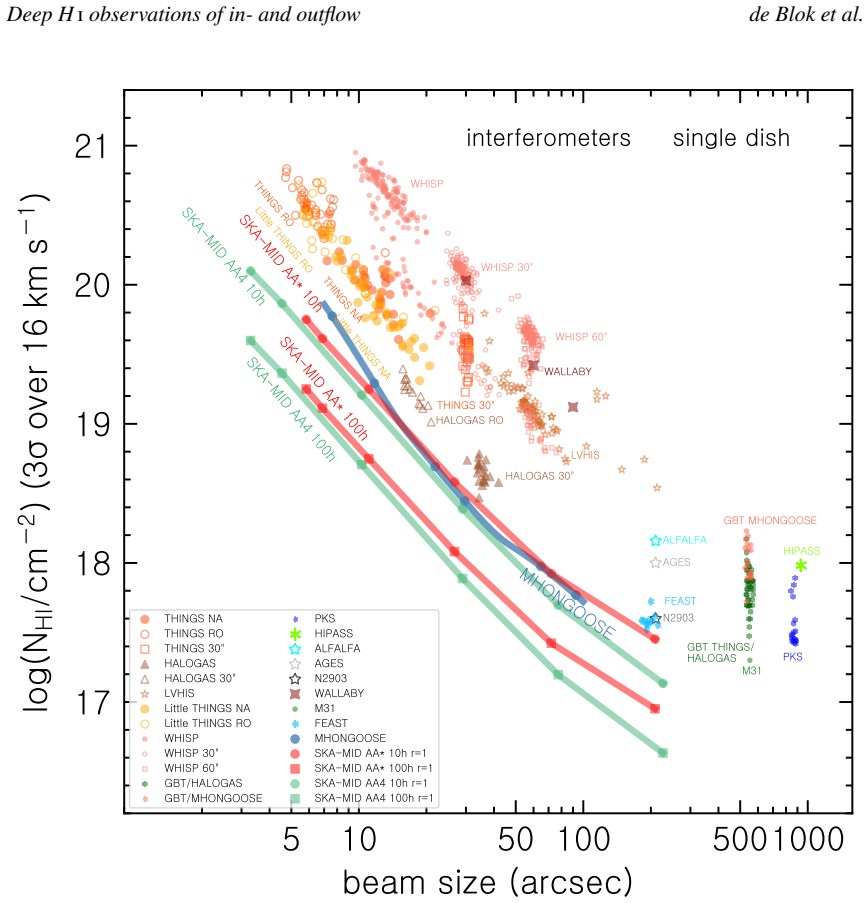
A major question in galaxy evolution is how galaxies acquire sufficient gas to sustain their star formation rates. HI observations with high angular resolution and sensitivity to very low column densities are some of the important observational ingredients that are currently still missing. Answers to these questions are necessary for a correct interpretation of observations of galaxy evolution in the high-redshift universe and will provide crucial input for the sub-grid physics in hydrodynamical simulations of galaxy evolutions. In this chapter we discuss the progress that has been made over the past years, describe the various processes that lead to inflow and outflow of gas, and discuss how SKA-Mid AA4 observations can contribute to further understanding these important aspects of galaxy evolution using deep observations of nearby individual disk and dwarf galaxies.
Editorial analysis
A structured set of objections, weighed in public.
Referee Report
Summary. The manuscript is a forward-looking discussion chapter on the observational requirements for studying cold gas inflow and outflow via HI in nearby galaxies. It states that high angular resolution and sensitivity to very low column densities remain missing ingredients, reviews progress and physical processes, and argues that SKA-Mid AA4 deep observations of individual disk and dwarf galaxies will be essential for interpreting high-redshift galaxy evolution and constraining sub-grid physics in simulations.
Significance. If the field-status assessment is accurate, the chapter usefully synthesizes current gaps and the prospective role of SKA-Mid AA4. Its contribution is primarily as a review of observational needs rather than new data, derivations, or predictions; no machine-checked proofs, reproducible code, or falsifiable quantitative forecasts are presented.
Simulated Author's Rebuttal
We thank the referee for their positive assessment of the manuscript as a forward-looking discussion chapter on HI observations of cold gas inflow and outflow, and for the recommendation to accept. No major comments were raised in the report.
Circularity Check
No derivation chain; forward-looking review with no quantitative claims
full rationale
The manuscript is a discussion chapter reviewing observational gaps in HI studies of inflows/outflows and the prospective role of SKA-Mid AA4. It advances no new empirical result, derivation, model, or quantitative prediction. The statement that high-resolution low-column-density observations are 'still missing' is a field-status assessment rather than a proposition resting on a specific, falsifiable assumption or internal logic that reduces to inputs. No equations, fits, or self-citation chains are present that could exhibit circularity. The text is self-contained as a review.
Axiom & Free-Parameter Ledger
Reference graph
Works this paper leans on
-
[1]
doi: 10.1093/mnras/stw1930. R. Auld, R. F. Minchin, J. I. Davies, et al.MNRAS, 371(4):1617,
-
[2]
doi: 10.1051/0004-6361/202038223. I. Bagetakos, E. Brinks, F. Walter, et al.AJ, 141:23,
-
[3]
doi: 10.1038/nature12351. R. Boomsma et al.A&A, 490(2):555–570, Nov
-
[4]
doi: 10.1051/0004-6361:200810120. J. N. Bregman.ApJ, 236:577,
-
[5]
doi: 10.1051/0004-6361:20040321. W. J. G. de Blok, J. Healy, F. M. Maccagni, et al.A&A, 688:A109,
-
[6]
doi: 10.1038/nature07648. N. M. Förster Schreiber and S. Wuyts.ARA&A, 58:661–725, Aug
work page internal anchor Pith review doi:10.1038/nature07648
-
[7]
doi: 10.1088/0004-637X/787/2/147. F. Fraternali. InIAU Symposium, volume 298,
-
[8]
F. Fraternali. In A. Fox and R. Davé, editors,Gas Accretion onto Galaxies, volume 430 of AstrophysicsandSpaceScienceLibrary,page323,Jan.2017.doi: 10.1007/978-3-319-52512-9_
-
[9]
doi: 10.1088/0004-637X/796/1/59. Y. Fukui et al.ApJ, 798(1):6, Jan
-
[10]
doi: 10.1088/0004-637X/798/1/6. Y. Fukui et al.PASJ, 69(3):L5, June
-
[11]
doi: 10.1093/pasj/psx032. Y. Fukui et al.PASJ, 73:S117–S128, Jan
-
[12]
doi: 10.1093/pasj/psy120. M. Girard et al.ApJ, 909(1):12, Mar
-
[13]
doi: 10.3847/1538-4357/abd5b9. T. Hayakawa and Y. Fukui.MNRAS, 529(1):1–31, Mar
-
[14]
doi: 10.1093/mnras/stae302. M. P. Haynes, R. Giovanelli, B. R. Kent, et al.ApJ, 861(1):49,
-
[15]
doi: 10.1088/0004-637X/762/ 1/12. D. A. Hunter, D. Ficut-Vicas, T. Ashley, et al.AJ, 144:134,
-
[16]
Ianjamasimanana et al.MNRAS, 513(2):2019–2038, June
R. Ianjamasimanana et al.MNRAS, 513(2):2019–2038, June
2019
-
[17]
doi: 10.1093/mnras/stac936. J. A. Irwin, G. L. Hoffman, K. Spekkens, et al.ApJ, 692:1447,
-
[18]
doi: 10.1088/0004-6256/144/5/152. I. D. Karachentsev, D. I. Makarov, and E. I. Kaisina.AJ, 145(4):101, Apr
-
[19]
C.-G.Kim, E.C.Ostriker,andR.Raileanu.ApJ,834:25,Jan.2017
doi: 10.1111/ j.1365-2966.2005.09451.x. C.-G.Kim, E.C.Ostriker,andR.Raileanu.ApJ,834:25,Jan.2017. doi: 10.3847/1538-4357/834/ 1/25. M.Kohnoetal.arXive-prints,art.arXiv:2510.18399,Oct.2025. doi: 10.48550/arXiv.2510.18399. B. S. Koribalski et al.MNRAS, 478(2):1611–1648, Aug
-
[20]
doi: 10.1093/mnras/sty479. B. S. Koribalski, J. Wang, P. Kamphuis, et al.MNRAS, 478(2):1611,
-
[21]
doi: 10.1146/annurev-astro-091918-104430. S. Kurapati et al.MNRAS, 538(2):1272–1287, Apr
-
[22]
doi: 10.1093/mnras/staf387. B. Lee et al.ApJSS, 262(1):31, Sept
-
[23]
doi: 10.3847/1538-4365/ac7eba. L. Lenkić et al.ApJ, 976(1):88, Nov
-
[24]
doi: 10.3847/1538-4357/ad758c. A. K. Leroy et al.ApJ, 814(2):83, Dec
-
[25]
doi: 10.1088/0004-637X/814/2/83. M.-M. Mac Low, R. McCray, and M. L. Norman.ApJ, 337:141, Feb
-
[26]
doi: 10.1086/167094. F. M. Maccagni and W. J. G. de Blok.arXiv preprint,
-
[27]
doi: 10.48550/arXiv.2407.03166. A. Marasco et al.A&A, 631:A50, Nov
-
[28]
doi: 10.1051/0004-6361/201936338. A. Marasco et al.A&A, 670:A92, Feb
-
[29]
doi: 10.1051/0004-6361/202244895. A. Marasco, W. J. G. de Blok, F. M. Maccagni, et al.A&A, 697:A86,
-
[30]
doi: 10.3847/1538-4357/aab08e. B. Mazzilli Ciraulo et al.arXiv e-prints, art. arXiv:2509.17560, Sept
-
[31]
Design Initiative for a 10 TeV pCM Wakefield Collider,
doi: 10.48550/arXiv. 2509.17560. K. B. W. McQuinn, L. van Zee, and E. D. Skillman.ApJ, 886(1):74, Nov
work page internal anchor Pith review doi:10.48550/arxiv
-
[32]
doi: 10.1093/pasj/32.4.581. S. Nakano and K. Tachihara.ApJL, 985(1):L5, May
-
[33]
S.Nakano,K.Tachihara,andM.Tamashiro.ApJSS,277(2):62,Apr.2025.doi: 10.3847/1538-4365/ adb8de
doi: 10.3847/2041-8213/adce0b. S.Nakano,K.Tachihara,andM.Tamashiro.ApJSS,277(2):62,Apr.2025.doi: 10.3847/1538-4365/ adb8de. D. Nelson et al.MNRAS, 490(3):3234–3261, Dec
-
[34]
doi: 10.1093/mnras/stz2306. C. A. Norman and S. Ikeuchi.ApJ, 345:372,
work page internal anchor Pith review doi:10.1093/mnras/stz2306
-
[35]
doi: 10.3847/1538-4357/aa6747. T. Oosterloo, F. Fraternali, and R. Sancisi.AJ, 134(3):1019, Sept. 2007a. doi: 10.1086/520332. T. Oosterloo, F. Fraternali, and R. Sancisi.AJ, 134(3):1019, Sept. 2007b. doi: 10.1086/520332. E. C. Ostriker and R. Shetty.ApJ, 731:41, Apr
-
[36]
doi: 10.1088/0004-637X/731/1/41. V. Pandya et al.MNRAS, 508(2):2979–3008, Dec
-
[37]
doi: 10.1093/mnras/stab2714. A. Pillepich et al.MNRAS, 473(3):4077–4106, Jan
-
[38]
doi: 10.1093/mnras/stx2656. N. M. Pingel, D. J. Pisano, G. Heald, et al.ApJ, 865(1):36,
work page internal anchor Pith review doi:10.1093/mnras/stx2656
-
[39]
doi: 10.1038/29466. M. E. Putman, J. E. G. Peek, and M. R. Joung.ARA&A, 50:491,
-
[40]
doi: 10.1093/mnras/stab900. B. Reichardt Chu et al.MNRAS, 536(2):1799–1821, Jan
-
[41]
doi: 10.1093/mnras/stae2705. P. Richter et al.A&A, 607:A48, Nov
-
[42]
doi: 10.1051/0004-6361/201630081. R. Sancisi, F. Fraternali, T. Oosterloo, and T. van der Hulst.A&A Review, 15:189,
-
[43]
doi: 10.1051/0004-6361/202037478. P. R. Shapiro and G. B. Field.ApJ, 205:762–765, May
-
[44]
doi: 10.1086/154332. P. R. Shapiro and G. B. Field.ApJ, 205:762,
-
[45]
doi: 10.3847/1538-4357/ac39a4. A. Sorgho, C. Carignan, D. J. Pisano, et al.MNRAS, 482(1):1248,
-
[46]
doi: 10.1093/pasj/psy020. T. A. Thompson and T. M. Heckman.ARA&A, 62(1):529–591, Sept
-
[47]
doi: 10.3847/1538-4357/aaf4fb. K. Tsuge et al.PASJ, 76(4):589–615, Aug
-
[48]
doi: 10.1093/pasj/psae035. J. Tumlinson, M. S. Peeples, and J. K. Werk.ARA&A, 55(1):389–432, Aug
-
[49]
J.vandeSandeetal.arXive-prints,art.arXiv:2306.00059,May2023
doi: 10.1146/ annurev-astro-091916-055240. J.vandeSandeetal.arXive-prints,art.arXiv:2306.00059,May2023. doi: 10.48550/arXiv.2306. 00059. J. M. vander Hulst, T. S. van Albada, and R. Sancisi. InASPConference Series, volume 240, page 451,
-
[50]
doi: 10.1146/ annurev.astro.43.072103.150610. S. Veilleux, R. Maiolino, A. D. Bolatto, and S. Aalto.A&ARv, 28(1):2, Apr
-
[51]
doi: 10.1007/1-4020-2579-3_2. F. Walter et al.AJ, 136(6):2563–2647, Dec
-
[52]
doi: 10.1088/0004-6256/136/6/2563. F. Walter, E. Brinks, W. J. G. de Blok, et al.AJ, 136:2563,
-
[53]
doi: 10.3847/1538-4357/ad3e61. E. J. Watkins et al.A&A, 676:A67, Aug
-
[54]
doi: 10.1051/0004-6361/202346075. S.D. M.White andM. J.Rees.MNRAS,183:341–358, May
-
[55]
doi: 10.1093/mnras/183.3.341. S. A. Wolfe, F. J. Lockman, and D. J. Pisano.ApJ, 816(2):81,
-
[56]
doi: 10.1093/mnras/stae1688. X. Xu et al.ApJ, 956(2):142, Oct
-
[57]
doi: 10.3847/1538-4357/acfa71. D. Yang et al.ApJ, 984(1):15, May
-
[58]
Y.Yuan,M.R.Krumholz,andC.L.Martin.MNRAS,518(3):4084–4105,Jan.2023
doi: 10.3847/1538-4357/adbbe8. Y.Yuan,M.R.Krumholz,andC.L.Martin.MNRAS,518(3):4084–4105,Jan.2023. doi: 10.1093/ mnras/stac3241. 21
discussion (0)
Sign in with ORCID, Apple, or X to comment. Anyone can read and Pith papers without signing in.